
Central Mediterranean coast
Tel Aviv
A city laid out on empty dunes in 1909 that now runs on four thousand white apartment blocks, fourteen kilometres of seafront and an economy built on software.
Founded
11 April 1909
plots drawn by lottery from 66 white and 66 grey seashells
The White City
about 4,000 buildings
International Style, World Heritage-listed in 2003
City population
about 468,000
end-2021 estimate; the metropolitan area is far larger
Seafront
about 14 km
13 municipal beaches strung along one promenade
Municipal area
52 sq km
roughly 12 sq km of it parks, groves and gardens
Things to do
11 sites, each with its own page
in Tel Aviv
Restaurants
12 picks
in Tel Aviv
Hotels
9 picks
in Tel Aviv
Getting there
7 routes
in Tel Aviv
When to go
Month by month
in Tel Aviv
תֵּל אָבִיב-יָפוֹ · Central Mediterranean coast, immediately north of Jaffa
Tel Aviv began with a few dozen families standing on empty sand north of Jaffa on 11 April 1909. They could not agree how to divide the ground, so Akiva Arieh Weiss collected sixty-six grey seashells and sixty-six white ones, wrote plot numbers on one set and family names on the other, and had the plots drawn pair by pair. The suburb they laid out was called Ahuzat Bayit; the following year it took the name Tel Aviv, borrowed from Nahum Sokolow's Hebrew translation of Theodor Herzl's novel Altneuland. In 1950, after the war of 1948, it merged with the ancient port beside it and became Tel Aviv-Yafo.
What grew on those dunes is now the working centre of Israel. The municipality counts 52 square kilometres of city and a metropolitan region of about 3.9 million people, 44 per cent of the country's population, on its own 2018 figures. The city itself is small enough to cross on foot in an afternoon and dense enough to hold four thousand-odd white modernist apartment blocks, listed by UNESCO in 2003 as the White City.
The shape of the place is simple. The sea runs down the western edge with a promenade along all of it and thirteen municipal beaches opening off it. Behind that sit the boulevards Patrick Geddes drew in the 1920s, then the markets, then the low-rise older quarters in the south, then Jaffa. The city is expensive, secular, young in its street life, and busiest after dark.
1909
A city drawn from two boxes of seashells
The ground was not entirely empty. Neve Tzedek, established in 1887 according to Israel's tourism ministry, was the first Jewish neighbourhood built outside the walls of Jaffa, and several others followed it before the Ahuzat Bayit society bought its twelve-odd acres of dunes. What made 1909 different was the intent: not another overflow quarter of Jaffa, but a planned suburb with wide streets, water pipes and building rules, drawn up in advance.
The name came in 1910, from Nahum Sokolow's translation of Herzl's Altneuland: tel aviv, an ancient mound and the spring, the past with the new thing on top of it. Growth was slow until the 1920s and then abrupt. Patrick Geddes was commissioned in 1925 and gave the city the grid it still uses: main streets for traffic, quiet residential streets between them, green pedestrian boulevards through the middle. On the municipality's account, refugees from Europe took the population from 42,000 to 130,000 between 1932 and 1936.
Jaffa and Tel Aviv were formally joined in April 1950, two years after the 1948 war, in which much of Jaffa's Arab population left or was displaced (how and why remains sharply contested between Israeli and Palestinian historians) and the combined municipality has been Tel Aviv-Yafo ever since. The two halves still read differently on the ground, and the seam between them (Neve Tzedek, Florentin, the flea market) is where a lot of the city's interest sits.

World Heritage
The White City: about 4,000 buildings in the International Style
The municipality puts it plainly: about 4,000 buildings went up in the International Style between the 1930s and Israel's establishment in 1948, and in 2003 UNESCO proclaimed the historic zone a World Cultural Heritage site. The municipality calls the area the world's largest grouping of buildings designed in that idiom, and unlike most modernist set-pieces it is not a campus or an estate but an entire working city centre that people still live in.
The architects had trained in Europe (many in Germany, several at the Bauhaus, which closed under Nazi pressure in 1933) and arrived with a vocabulary of flat roofs, asymmetry, strip windows, glass brick and no ornament. What they did with it here was local. Pale render reflects the sun; windows are small and set back rather than glazed wall to wall; balconies run long and narrow across the front of the block, deep enough to shade the room behind. Buildings are lifted on columns so air moves under them, and the roof is a place to sit in the evening rather than a lid.
The best of it is spread across the Geddes grid rather than gathered in one street: Rothschild, Ahad Ha'am, Bialik Street and the square behind it, and the ring of near-identical curved facades around Dizengoff Square. Liebling Haus at 29 Idelson Street, built for Tony and Max Liebling in 1936 to a design by Dov Karmi, has been restored as the White City Center, a joint Israeli-German conservation project running exhibitions, tours and an archive, and free to enter according to its own site.
- Long, narrow, recessed balconies: the local adaptation of the style
- Pilotis: the block lifted clear of the ground on columns
- Thermometer windows lighting a stairwell in a vertical strip
- Flat roofs used as terraces rather than left blank
- Rounded corners on street junctions, most visibly at Dizengoff Square

The sea
Thirteen beaches on one continuous promenade
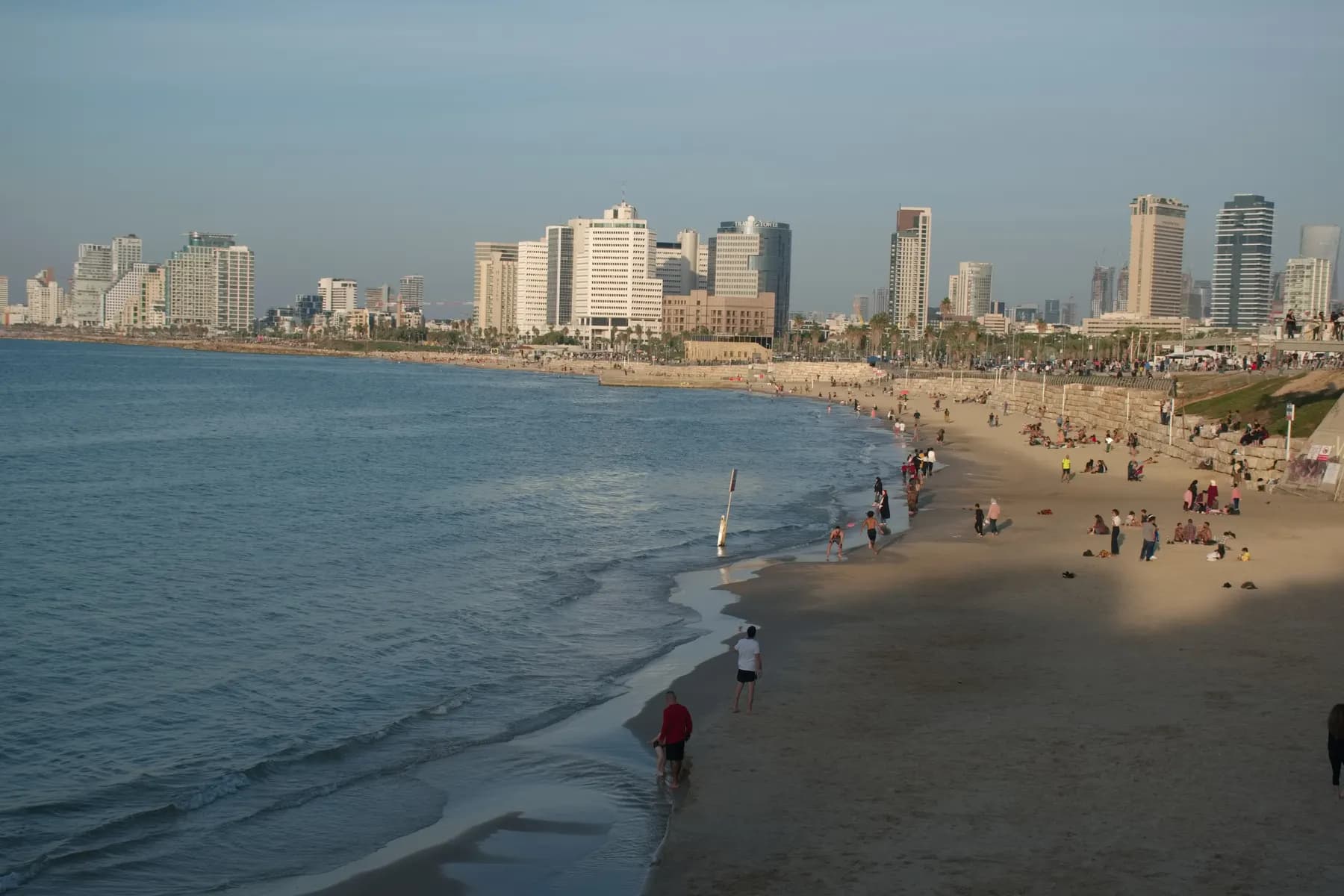
The municipality lists thirteen beaches along the city's shore, and the tourism ministry describes the promenade linking them as an 8.7-mile stretch (about 14 kilometres) running from the northern cliffs past the port, the hotel strip and Charles Clore Park to Jaffa. It is flat, unbroken and free, and it is the best introduction to the city: an hour's walk takes you past matkot players, outdoor gyms, surf schools and several thousand people doing nothing in particular.
The official bathing season runs from May to October, and the municipality posts lifeguard cover across a slightly wider window, from 16 April to 8 October. The duty hours it publishes begin at 7.15 in the morning and end at 4.45 in the afternoon, or 5.45 through June. The sensible rule is to swim only where a lifeguard is on duty and to take the flags seriously; the Mediterranean here can pull hard in a westerly.
The beaches have characters. Hilton, at the northern end, is the surf beach, the dog beach and, in the municipality's own words, Tel Aviv's official gay beach. The religious beach runs separate days for men and women: women on Sundays, Tuesdays and Thursdays, men on Mondays, Wednesdays and Fridays, and both on Saturday. Metzitzim sits beside the old port; Frishman, Bograshov, Gordon and Jerusalem beaches front the hotel strip; Givat Aliyah is down in Jaffa. Four (Tzuk, Northern Tzuk, Metzitzim and Hilton) are equipped for bathers with disabilities. The tourism ministry's figure for the whole stretch is about 8.5 million bathers a year, given undated on a page whose bathing-season detail dates from 2016.
- Bathing season May to October, with lifeguards on posted hours
- Hilton: surfers, the dog beach and the city's gay beach
- The religious beach: separate days for men and women
- Four beaches equipped for bathers with disabilities
- Promenade access, showers and changing rooms are free

Rothschild
The boulevard where the state was declared and the money now sits
Rothschild Boulevard was one of the first streets of Ahuzat Bayit and is still the axis of the centre: a green central walkway with kiosks and benches, modernist blocks down both sides and glass towers behind them. Number 16 is Independence Hall, built as the home of Meir Dizengoff, the city's first mayor, who gave it to the city after his wife Zina died in 1930. It housed the Tel Aviv Museum of Art from 1932 until 1971, and on 14 May 1948 David Ben-Gurion read the declaration of independence in its main hall, reconstructed in 1978. The building has been through a long conservation programme; check its status before you turn up.
The same boulevard is where Israel's largest social protest started. On 17 July 2011 tents pitched on the central walkway over the cost of renting a flat here turned into a national movement; by 3 September an estimated 400,000 people were out on streets across the country, which Al Jazeera recorded at the time as a record for the country.
The tech industry that pushed those rents up is still here, spread from Rothschild and the Lilienblum blocks through Sarona and out along the Ayalon towers. The best figures are national: the Israel Innovation Authority's 2025 report puts high tech at 57 per cent of all Israeli exports in the first half of 2025, its highest recorded share, with 403,000 people employed (about 11.5 per cent of the workforce) and output of some NIS 317 billion in 2024, roughly 17 per cent of GDP. Startup Genome's most recent Global Startup Ecosystem Report ranks Tel Aviv the fourth startup ecosystem in the world for the second year running, behind Silicon Valley, New York and London, at an ecosystem value of $250.3 billion on data gathered to the end of 2025.
The cost of living follows. In the Economist Intelligence Unit's 2021 survey Tel Aviv came first in the world for the first time, up five places, on a strong shekel and rising transport and grocery prices. The municipality's own 2018 figures count 425,000 people employed in the city, about 11 per cent of all Israeli employees, with professional, scientific and technical work the largest sector at 16 per cent.

South of centre
Neve Tzedek and Florentin, the low-rise south
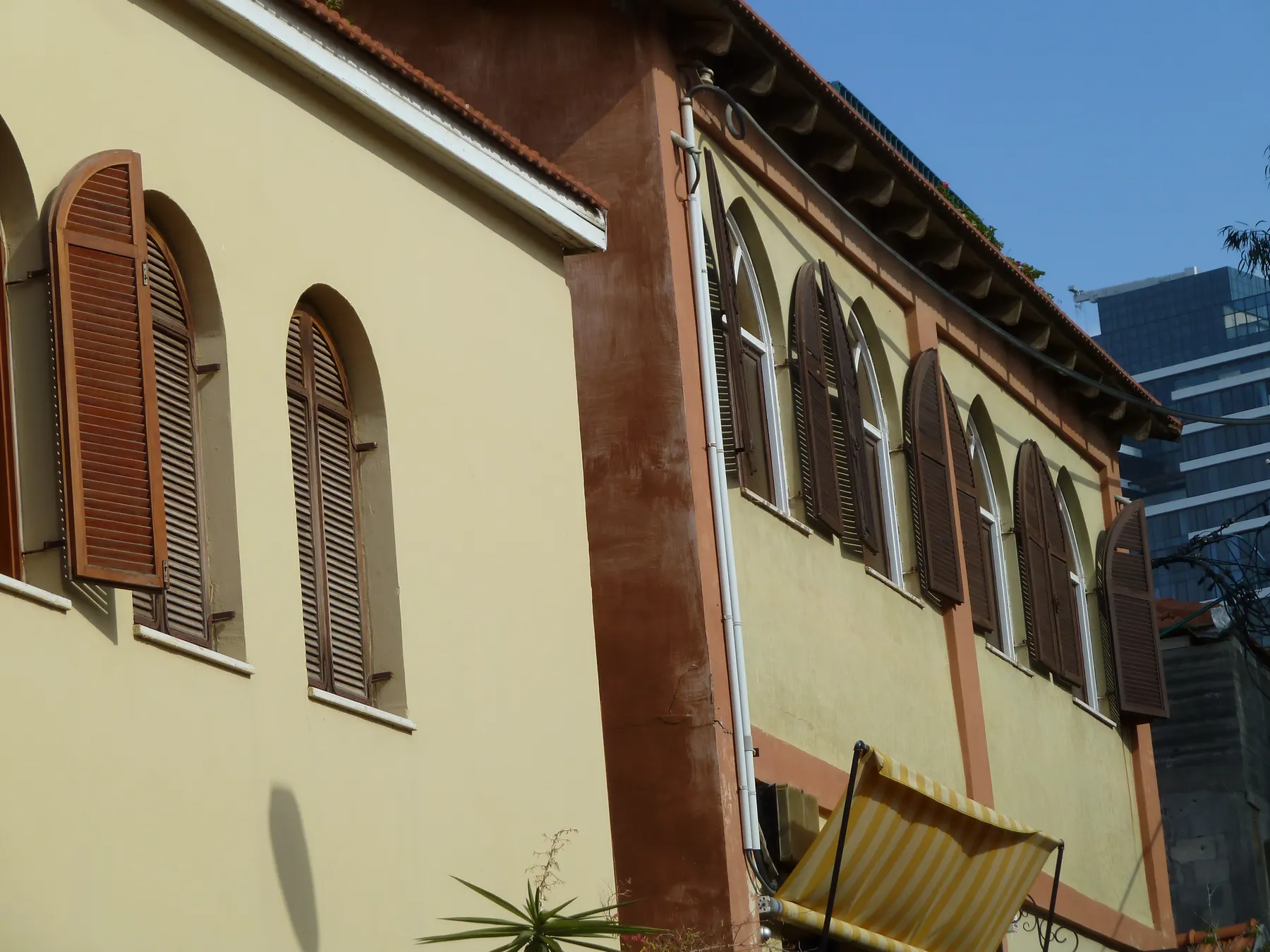
Neve Tzedek came first (1887, by the tourism ministry's dating, the first Jewish neighbourhood outside old Jaffa) and it still looks nothing like the rest of the city. The streets are narrow and bent, the houses low, with tiled roofs and shuttered windows; the ministry's own description is of restored architecture with boutiques and galleries lining the narrow side passages. Shabazi Street is the spine. The Suzanne Dellal Centre for Dance and Theatre occupies a converted school compound and runs performances and festivals through the year; the Nachum Gutman Museum of Art is minutes away, and HaTachana, the old Jaffa railway station, has reopened at the bottom of the neighbourhood as a compound of shops and cafes.
Florentin, a little further east and south, was laid out in 1927 among orchards beside the Jaffa–Jerusalem railway and named for David Florentin, a Greek-Jewish immigrant, Zionist and community leader who began building the area up. Its first residents were that small Greek group along with Jews from Bulgaria, North Africa and Bukhara, and it grew as a working district: a market formed organically beneath the new apartment blocks, with commercial space for produce and housewares on the ground floors and flats above.
That shape survived. Carpentry and upholstery workshops still open onto the street at seven in the morning; by nine at night the same street is bars. Residents moved out in the 1960s as industry moved in, and from the 1990s the municipality restored buildings and younger residents arrived; the neighbourhood is now, in the market's own description, trendy, artsy and full of students. A short walk south from either quarter brings you into Jaffa.

Markets
Carmel, Levinsky and the flea market
Shuk HaCarmel is the one at the centre of the city. It grew in the early 1920s out of the Yemenite quarter of Kerem HaTeimanim, where the original marketplace was known as HaKerem, and the municipality under Meir Dizengoff encouraged it, renaming market and street HaCarmel and allowing permanent structures where there had been stalls. It fed the city through the austerity years of the 1950s, survived municipal attempts to move it in the 1960s and 1970s, and has recently been reworked with covered walkways and shaded stalls. It runs from Allenby towards the sea, produce at the top end and prepared food increasingly in the middle.
Levinsky Market, on the edge of Florentin, is the other one worth an hour: spices, dried fruit, nuts, cheese, borekas and Balkan groceries, founded by the same immigration that built the neighbourhood around it. It is smaller, less crowded and better for taking things home.
In Jaffa, the Shuk HaPishpeshim flea market sells furniture, brass, records and a good deal of junk by day and turns into a bar quarter at night. The practical points hold for all three: busiest and best on Friday morning, emptying in a rush by early afternoon, shut on Saturday.
- Carmel Market: produce at the top end, cooked food in the middle
- Levinsky: spices, dried fruit and Balkan groceries near Florentin
- Jaffa flea market: bric-a-brac by day, bars after dark
- Friday morning is the peak; everything closes for Shabbat
After dark
The hours after midnight
Tel Aviv keeps late hours by any standard. Restaurants fill from nine, bars from eleven, clubs after one, and the beach at four in the morning is not empty. Density makes it work: the bar quarters (Florentin, the Allenby and Lilienblum blocks, Rothschild and its side streets, the Jaffa flea market, the old port) sit within a few kilometres of each other, and the walking between them is flat.
The city's calendar peak is Pride, held in June; the 2023 parade fell on 8 June. The municipality counted more than 150,000 people at it, and it ends on the beach; hotel rooms for that weekend go months in advance.
There is a quieter evening city too. Habima, founded as a Hebrew-language company in Bialystok in 1912, moved to Tel Aviv in 1931 and was designated Israel's national theatre in 1958; it stands on its own square at the top of Rothschild. The Tel Aviv Museum of Art, founded in 1932 in Dizengoff's house on Rothschild, moved in 1971 to its purpose-built main building on Shaul Hamelech Boulevard, where its modern and contemporary collections have been shown since.
One practical warning: Friday night is the biggest night out of the week precisely because nobody works on Saturday, but it is also when scheduled public transport stops. Plan the journey home before you start.

Light rail
The Red Line, the buses and the Shabbat problem
The Red Line opened on 18 August 2023, after years of delay and a torn-up city centre. It runs 24 kilometres from Petah Tikva to Bat Yam through the middle of Tel Aviv, with 34 stations, an underground section beneath the central city, trains every six to eight minutes and an end-to-end run of about 80 minutes. It is transformative in the tunnel (Globes reported that 60 per cent of journeys are made on the underground stretch, where the train runs fast) and slow on the surface at the southern end. Take-up has been below expectation: a year after opening, Globes reported it was carrying about 100,000 passengers a day against a forecast of 234,000.
It does not run on Shabbat. After a promise of weekend service was reversed (the route passes through the Haredi city of Bnei Brak) the line was launched with no Saturday operation beyond a 45-minute window on Saturday evening, and Mayor Ron Huldai skipped the opening ceremony over it. Two more light rail lines, the Purple and the Green, are under construction; the Green Line, close to 40 kilometres between Herzliya and Rishon LeZion, has already slipped past the end of 2028 according to NTA's own chief executive. The municipality expects the network to link Tel Aviv-Yafo with neighbouring cities including Ramat Gan, Givatayim, Herzliya, Petah Tikva, Bnei Brak, Bat Yam, Holon and Rishon LeZion by 2029, which is a target rather than a timetable.
In the meantime the city fills the Shabbat gap itself. Since November 2019 Tel Aviv has run free municipal buses on Friday nights and Saturdays (six routes at launch, roughly 300 kilometres and 500 stops, with the city covering $2.6 million of the $3.6 million first-year bill), routed to avoid religious neighbourhoods. The other two ways to move are the ones locals use: 137 kilometres of bicycle lanes, and walking.
On the ground
What to see at Tel Aviv
The things worth building a visit around, in the order most people reach them.
The White City on foot
Start at Bialik Square and work along Rothschild and Ahad Ha'am. Liebling Haus at 29 Idelson Street, the restored 1936 block that houses the White City Center, is free to enter and explains what you are looking at.
Independence Hall, 16 Rothschild
Meir Dizengoff's house, the first home of the Tel Aviv Museum of Art, and the room where Ben-Gurion declared the state on 14 May 1948. It has been through a long conservation programme, so check before you go.
The promenade at sunset
About 14 kilometres of flat, continuous seafront from the northern cliffs to Jaffa. Walk south in the last hour of light and finish with Old Jaffa on its headland ahead of you.
Carmel Market on a Friday morning
The shuk that grew out of the Yemenite quarter of Kerem HaTeimanim in the early 1920s. Produce at the Allenby end, cooked food in the middle, and total shutdown by mid-afternoon.
Neve Tzedek and Suzanne Dellal
The 1887 quarter that predates Tel Aviv itself: low houses, Shabazi Street, and the courtyard compound whose dance and theatre programme runs through the year.
Florentin after dark
Carpentry workshops by day, walls thick with graffiti, and a bar on almost every corner from eleven at night. Walk it rather than drive it.
Go deeper
Every site in Tel Aviv, in full
11 places here have a page of their own: what survives, what it costs, when it opens and how long to give it.
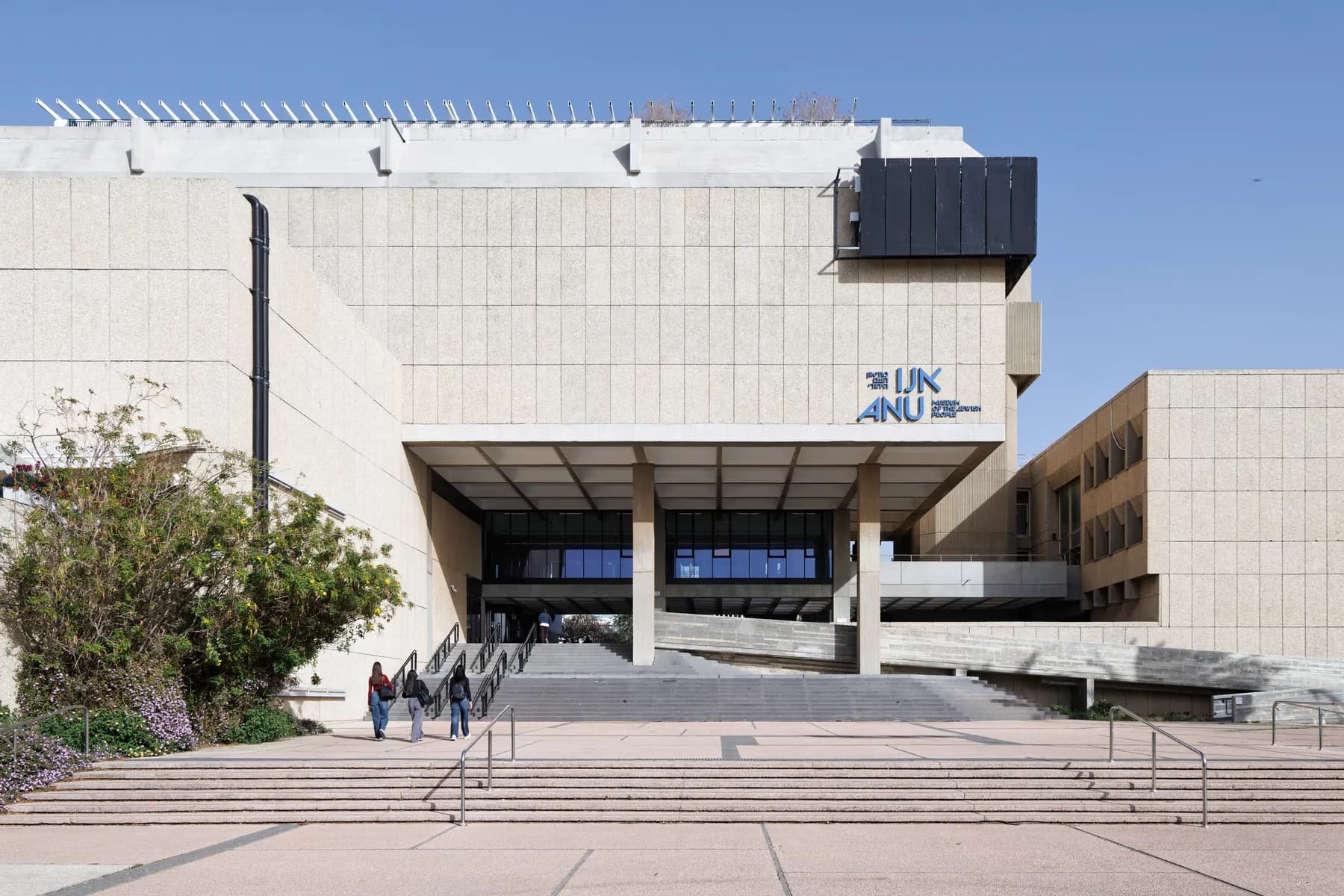
D. Benjamin Miller / CC0 · Wikimedia Commons
Museum
ANU, Museum of the Jewish People
The museum that opened in 1978 having deliberately decided not to collect objects reopened in 2021 with a 1,100-year-old Hebrew Bible as its centrepiece.
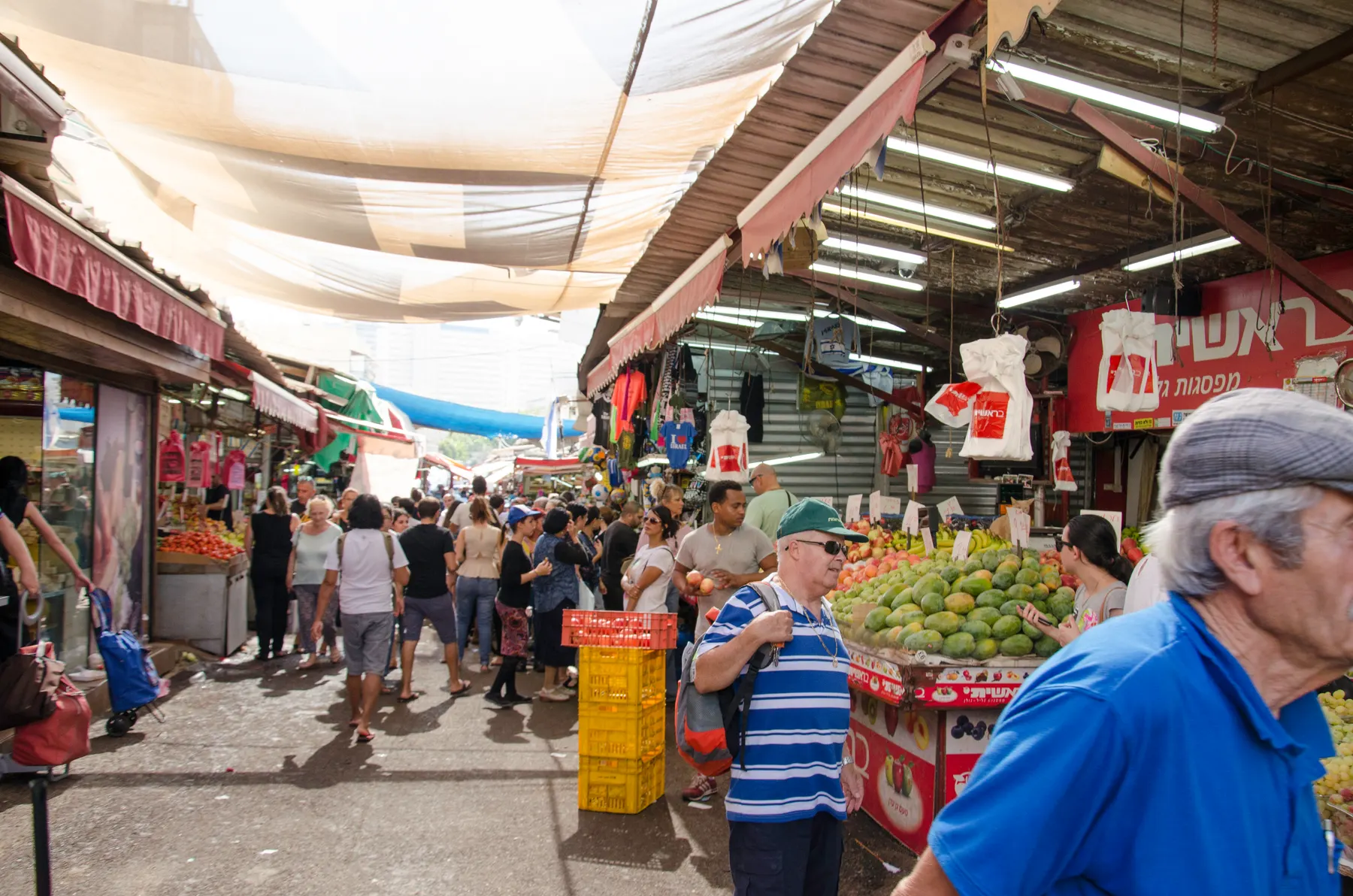
Rakoon / CC0 · Wikimedia Commons
Market
Carmel Market
The market opened in 1920 on plots bought in Russia seven years earlier as a speculation, by investors who fled the revolution and arrived in Tel Aviv with nothing else left.
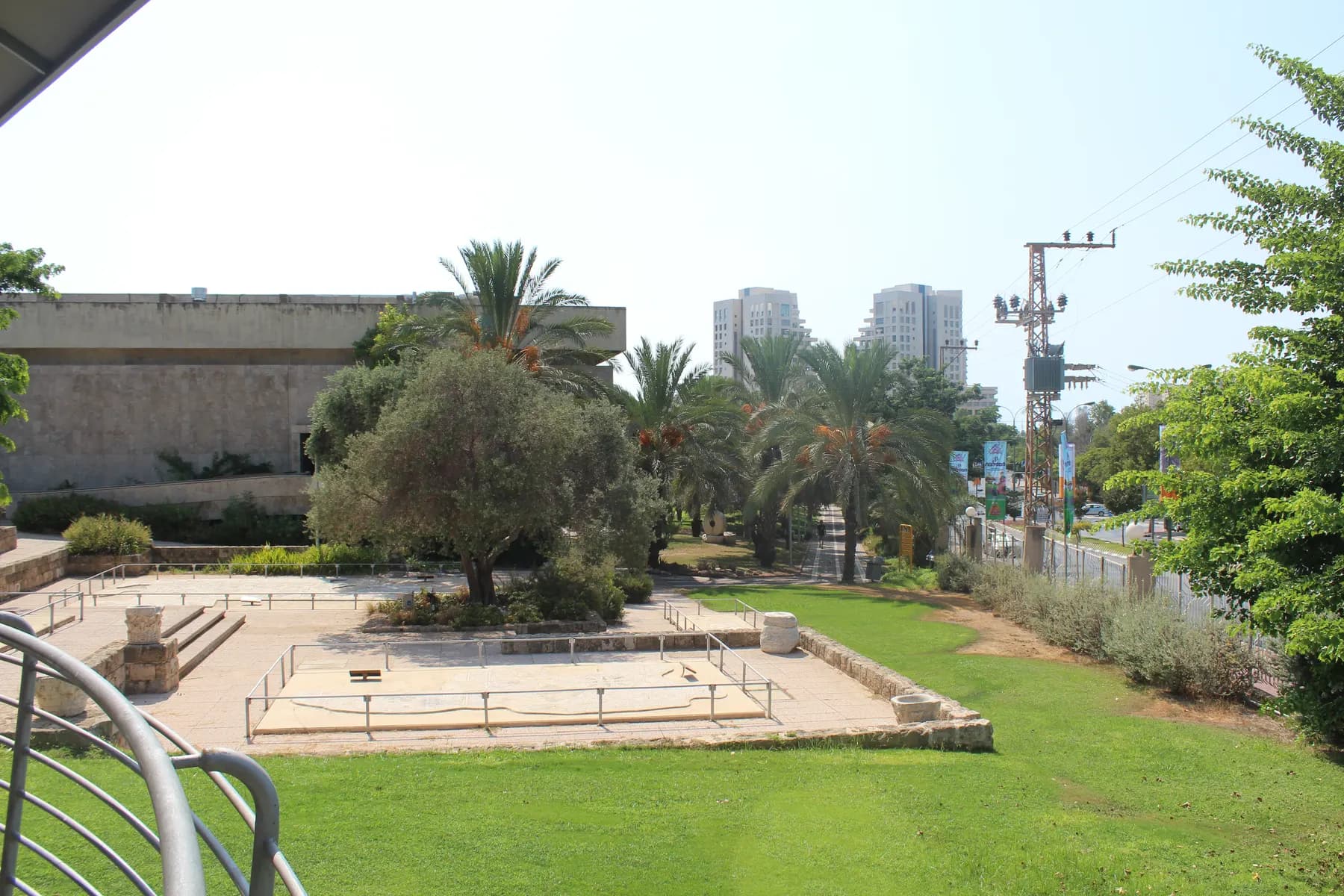
Deror_avi / CC BY-SA 4.0 · Wikimedia Commons
Museum
Eretz Israel Museum
The first excavation permit issued by the State of Israel, in 1948, was for the mound that still stands at the centre of this museum's grounds in Ramat Aviv.
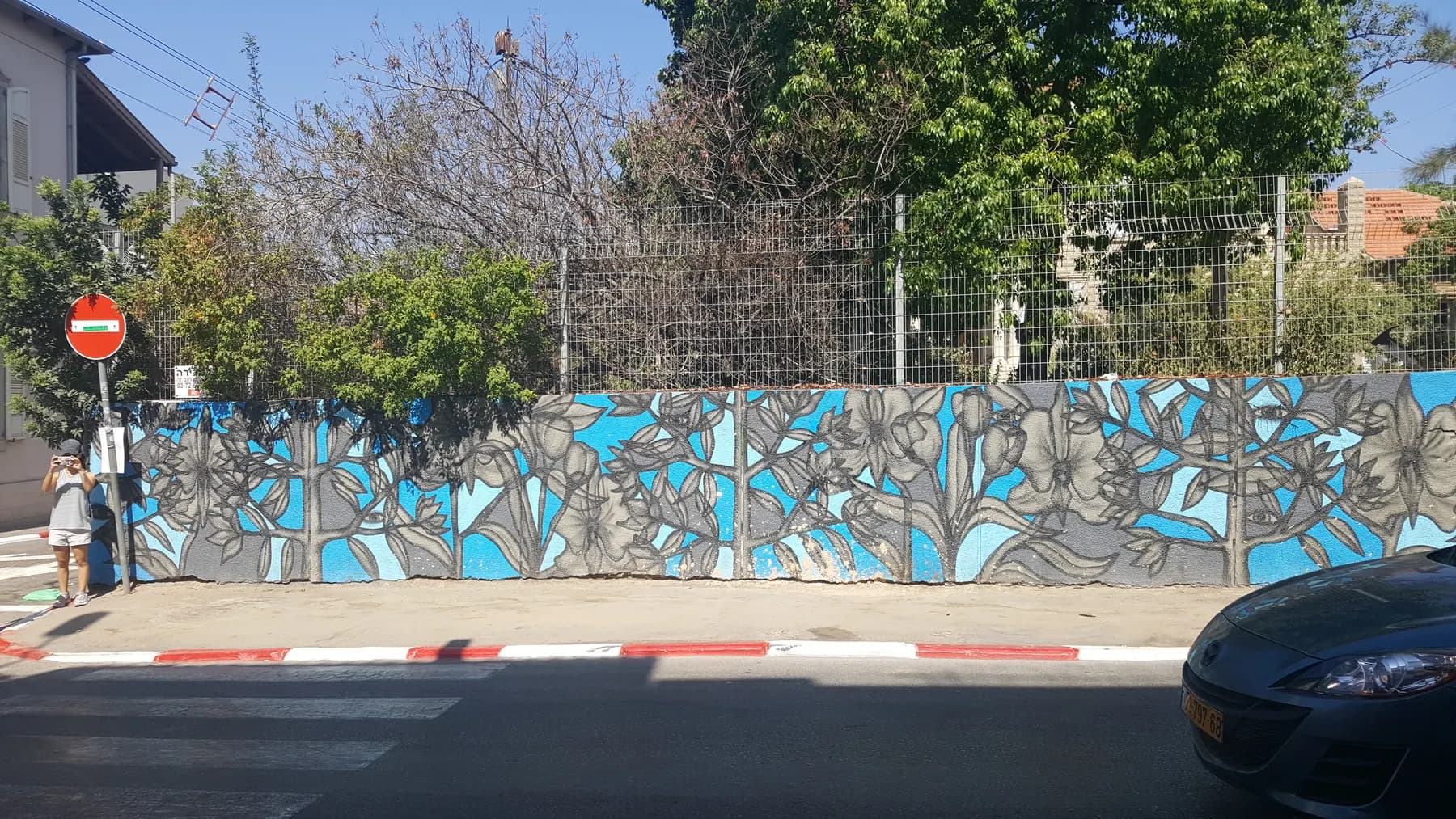
Ovedc / CC BY-SA 4.0 · Wikimedia Commons
Neighbourhood
Florentin
A 353-dunam grid laid out on an orchard in 1927 by Jews from Salonica, built with workshops on the ground floor and flats above, and still arranged that way.
הרווי ספיר / CC BY 2.5 · Wikimedia Commons
Nature reserve
HaYarkon Park
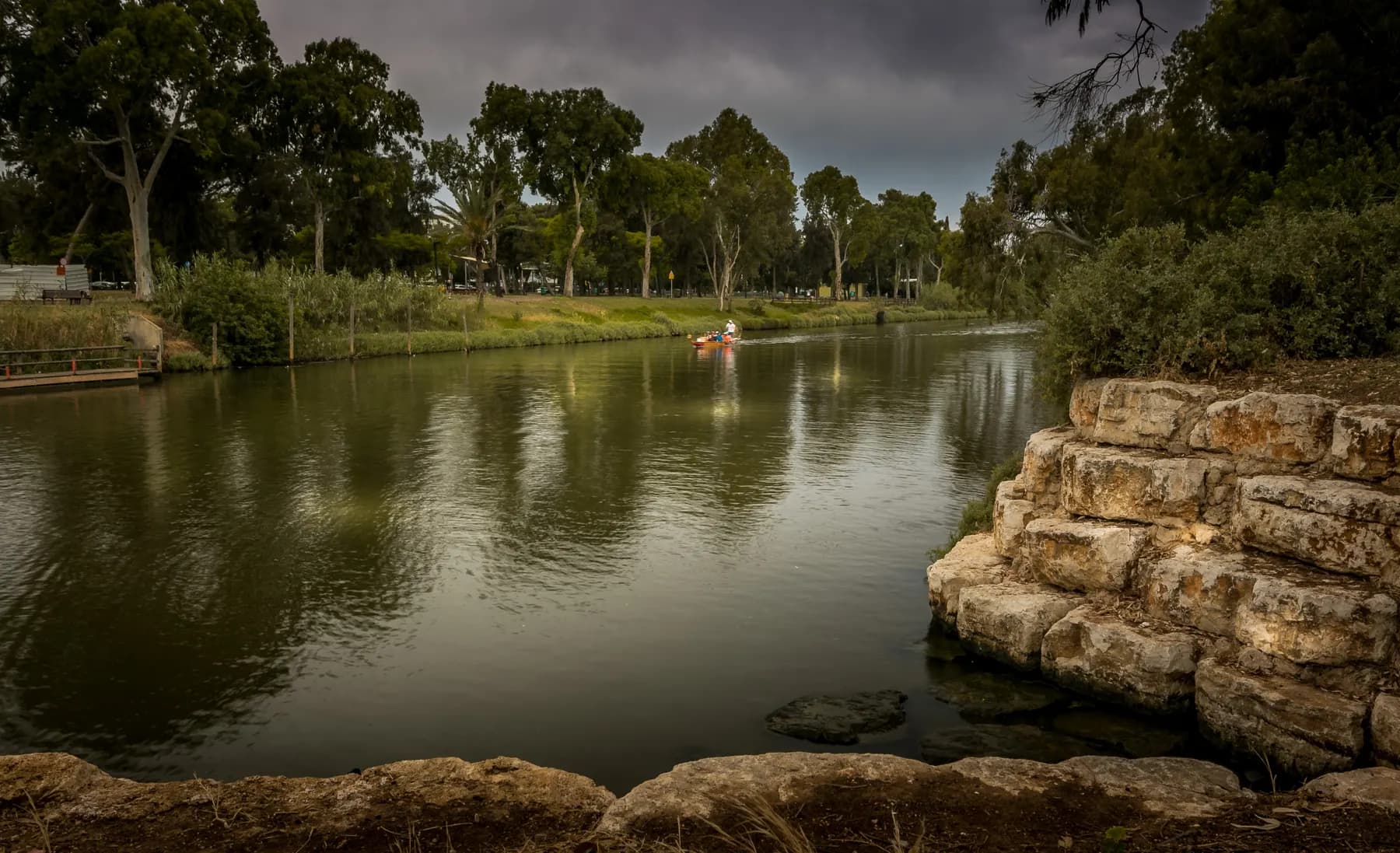
The park runs about 3,800 dunams from the Geha road to the sea, and the river it is named for now carries roughly 5 per cent of the water it did before the Yarkon-Negev pipeline took the springs.
Deror Avi / CC BY-SA 3.0 · Wikimedia Commons
Neighbourhood
Neve Tzedek
The quarter Jewish families built on the sand outside Jaffa in 1887, twenty two years before Tel Aviv existed, and the only one where the original houses were restored rather than cleared.
Doraharon / CC BY-SA 3.0 · Wikimedia Commons
Landmark
Sarona Colony and Sarona Market
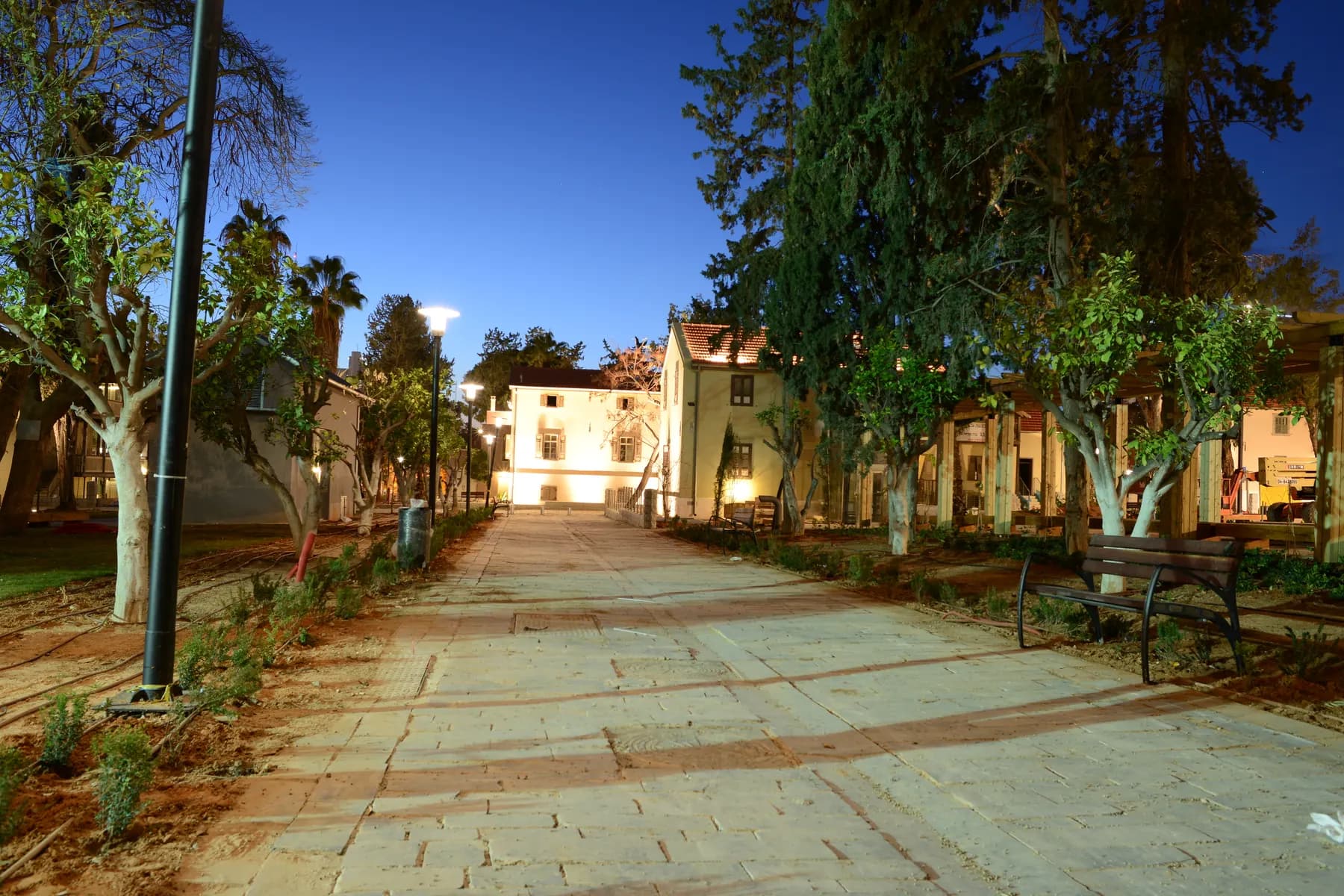
Five of Sarona's Templer houses no longer stand where they were built: in 2005 they were physically moved about thirty metres so that Kaplan Street could be widened.
ענת פרנק גורלי / CC BY 2.5 · Wikimedia Commons
Beach
Tel Aviv Beaches and the Tayelet
Thirteen municipal beaches on one continuous promenade, opened for the 2026 season on 25 March, with the lifeguard stations due to close for the year on 10 October.
Talmoryair / CC BY-SA 4.0 · Wikimedia Commons
Museum
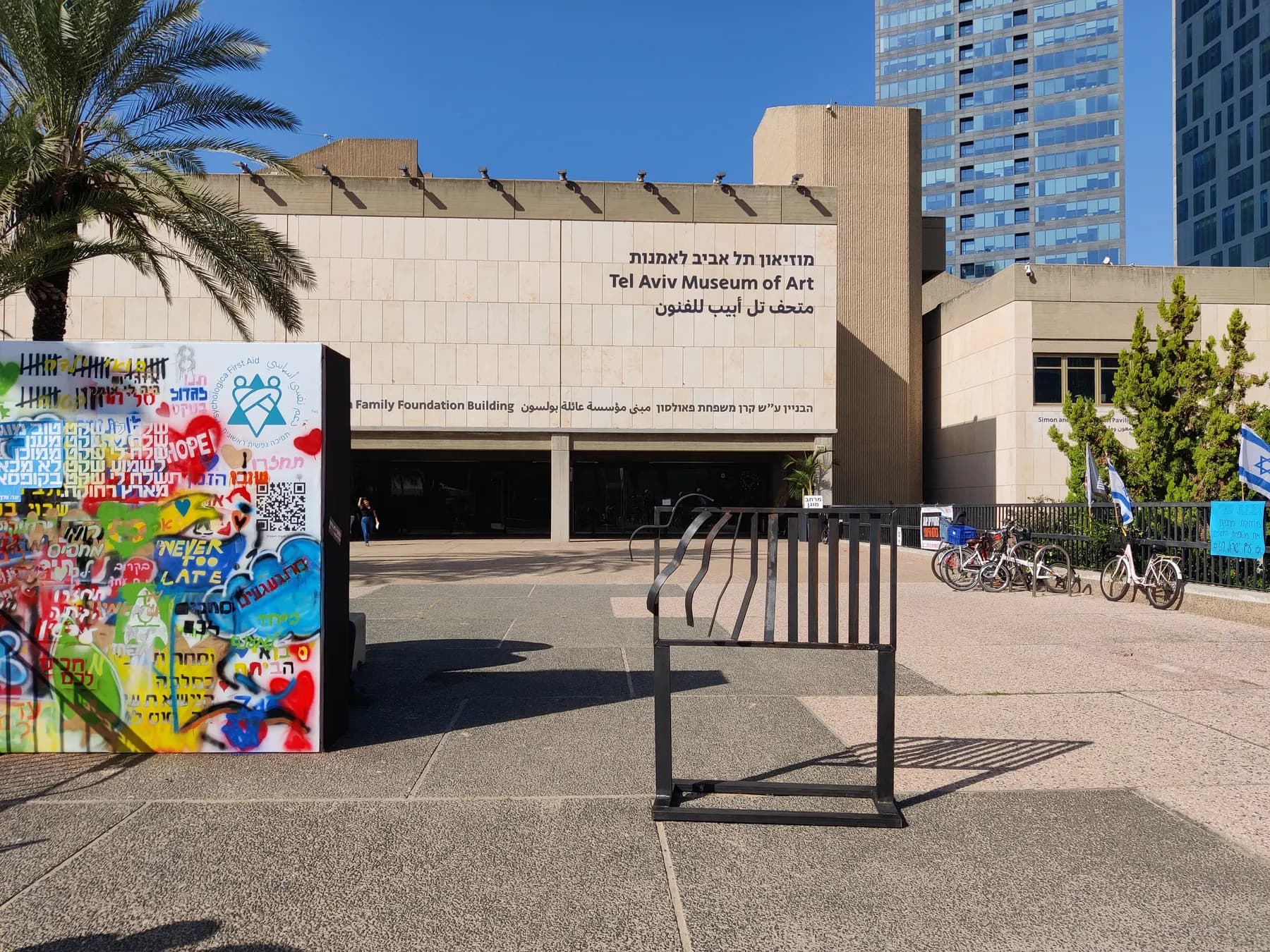
Tel Aviv Museum of Art
Israel's first art museum, opened in 1932 in the mayor's own house, now spread across three buildings on two addresses and built around a 26.5 metre concrete atrium called the Lightfall.
Romanhit / CC BY-SA 3.0 · Wikimedia Commons
Landmark
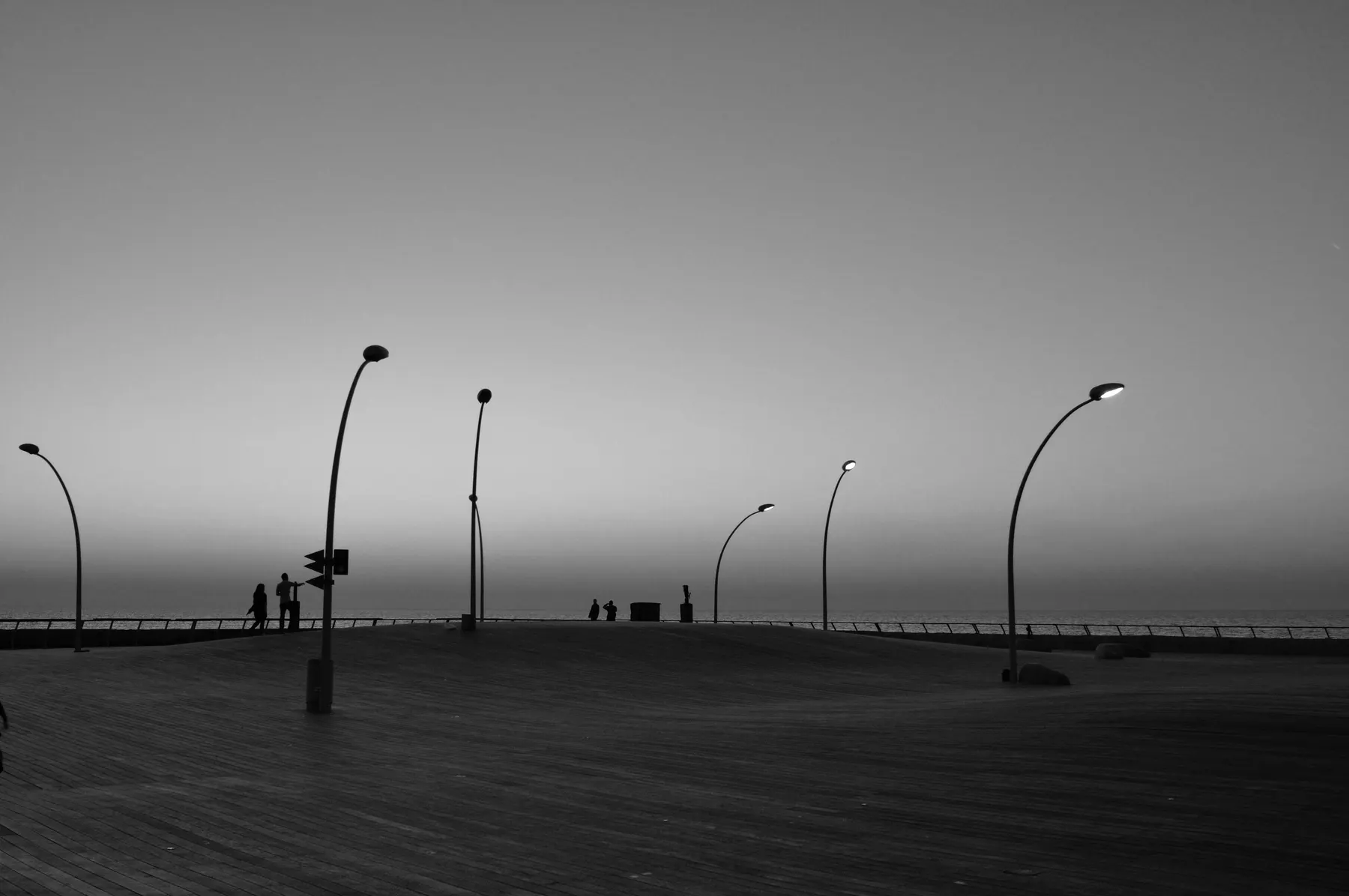
Tel Aviv Port
The first Jewish-run port on this coast landed its first cargo, a load of cement, on 19 May 1936, worked until 25 October 1965, and reopened as public space under a timber deck finished in 2008.
Marsupium / CC0 · Wikimedia Commons
Landmark
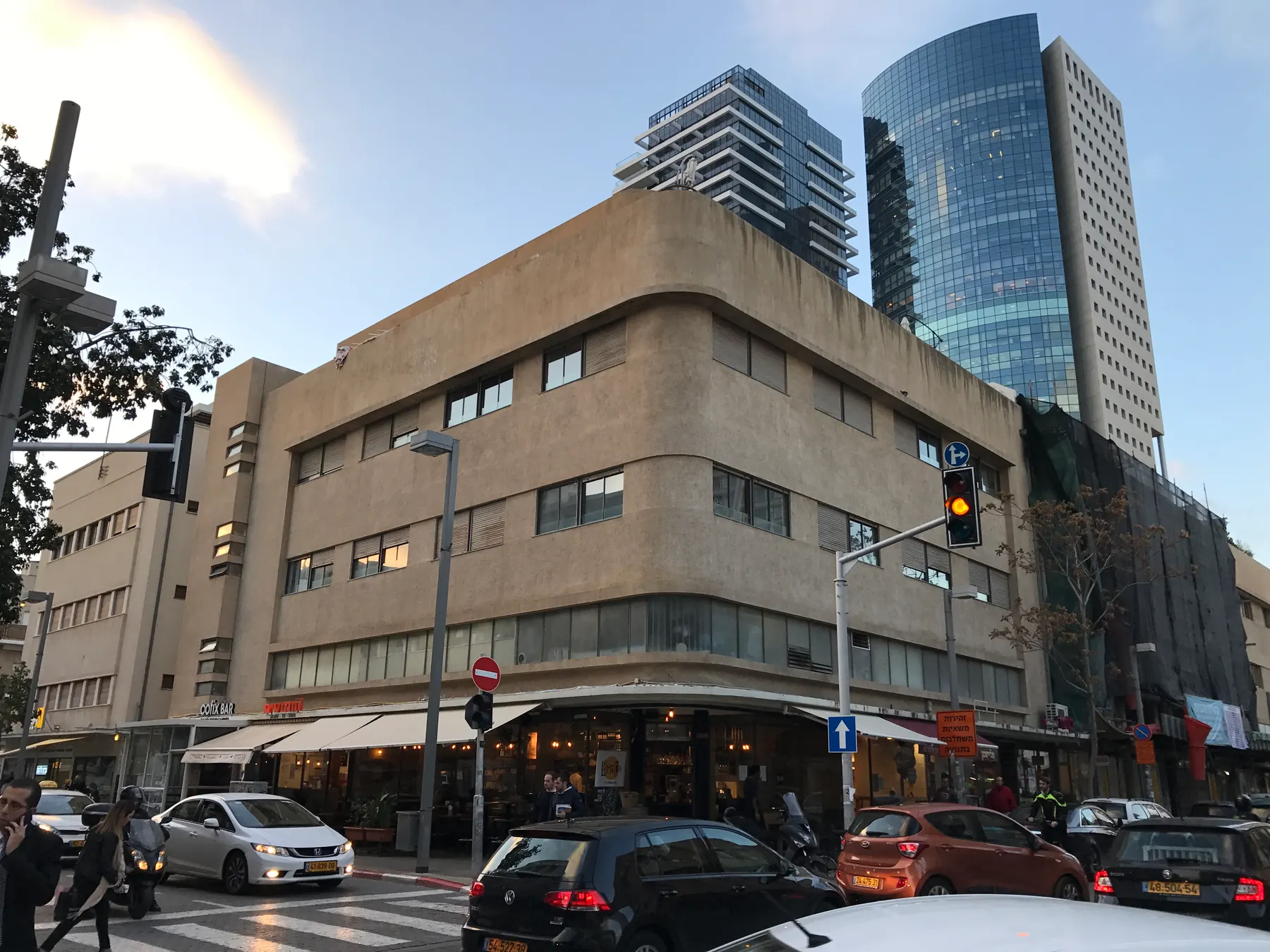
The White City and Bauhaus Tel Aviv
What UNESCO inscribed in 2003 is not one street but three separate zones covering 140.4 hectares, and roughly 90 per cent of the buildings inside them are privately owned flats.
The long view
Tel Aviv, in order
1887
Neve Tzedek is founded, the first Jewish neighbourhood built outside the walls of Jaffa
11 April 1909
The families of the Ahuzat Bayit society draw their plots on the dunes by a lottery of 66 white and 66 grey seashells
1910
The suburb is renamed Tel Aviv, after Nahum Sokolow's Hebrew translation of Herzl's Altneuland
1925
Patrick Geddes is commissioned and produces the plan of main streets, quiet residential streets and green boulevards that still governs the centre
1927
Florentin is laid out among orchards beside the Jaffa–Jerusalem railway
1932
The Tel Aviv Museum of Art opens in Meir Dizengoff's house at 16 Rothschild Boulevard
1932–1936
Refugees from Europe take the population from 42,000 to 130,000, the years in which much of the White City is built
14 May 1948
David Ben-Gurion declares the State of Israel in the hall at 16 Rothschild Boulevard
April 1950
Tel Aviv and Jaffa are formally merged into the single municipality of Tel Aviv-Yafo
2003
UNESCO proclaims the White City of Tel Aviv, about 4,000 International Style buildings, a World Cultural Heritage site
July–September 2011
Tents pitched on Rothschild Boulevard on 17 July over housing costs grow into Israel's largest social protest, peaking at an estimated 400,000 people on 3 September
18 August 2023
The Red Line light rail opens; the Purple and Green lines are still under construction
Getting there
- By air: Ben Gurion Airport is the country's main gateway and sits a short train ride east of the city, with trains running into the city's central stations. Israel Railways does not run on Shabbat, so a Friday-night or Saturday arrival means a taxi or a shared shuttle.
- By light rail: the Red Line has run since August 2023 from Petah Tikva to Bat Yam through central Tel Aviv, underground in the middle of the city. It does not operate on Saturdays beyond a short evening window.
- By bus: the national and metropolitan bus network converges on the city, and Tel Aviv additionally runs its own free municipal buses on Friday nights and Saturdays, a service it has operated since November 2019.
- On foot and by bike: the city is small and flat, with 137 kilometres of bicycle lanes on the municipality's count. Most visitors will walk more than they ride.
- Pay with a Rav-Kav card or its app equivalent; cash is not accepted on most services.
Access
The seafront promenade is level and continuous for its full length and is the easiest long walk in the city. The municipality equips four beaches (Tzuk, Northern Tzuk, Metzitzim and Hilton) for bathers with disabilities. Central Tel Aviv is flat, but pavements in Neve Tzedek, Florentin and the older parts of Jaffa are narrow, uneven and frequently blocked by scooters, and many White City blocks were built with steps at the entrance and no lift.
When to go
April to early June, and October to November. Summer is hot and heavily humid on the coast and the sea is warm enough to swim well into autumn; winter is mild and wet, with Britannica putting average annual precipitation at about 21 inches (roughly 530 mm), almost all of it falling between November and March. The official bathing season is May to October.
Hours and cost
The city runs on the Israeli week. Museums, markets and most shops wind down early on Friday afternoon and stay shut through Saturday, reopening Saturday evening; restaurants and bars are the exception and Friday night is the busiest of the week. The beaches and the promenade are open at all times, but lifeguards work only within the posted season (16 April to 8 October on the municipality's current schedule) and only during posted hours. The White City Center at Liebling Haus lists free admission on its own site, with hours of 8.00–17.00 Sunday to Thursday, 8.00–14.00 on Friday and 10.00–16.00 on Saturday as posted there when this page was checked in 2026; confirm before travelling.
Tel Aviv is expensive: it topped the Economist Intelligence Unit's Worldwide Cost of Living survey for 2021, its first time in first place, on a strong shekel and rising transport and grocery costs. The compensations are that the best of the city is free: the promenade, all thirteen beaches, the boulevards, the White City itself as an outdoor exhibit, and admission to the White City Center. Budget for food, drink and accommodation rather than tickets. The city had 78 hotels with nearly 8,500 rooms on the municipality's 2018 count, and demand is climbing again: nationally, tourist overnight stays rose from 1.5 million in January to September 2024 to 2.1 million in the same months of 2025, on Central Bureau of Statistics figures. Expect rates to spike around Pride in June and the autumn holidays.
Opening times and prices change. Both are given as published by the operator and should be checked against its own page before you travel.

Practical
What people wish they had known about Tel Aviv
- Do the White City on foot in the morning, before the light flattens the facades and the heat sets in.
- Work out Friday and Saturday before you arrive: shops and transport stop, restaurants do not, and the free municipal Shabbat buses cover only part of the network.
- Swim where a lifeguard is posted and take the flags seriously; the currents off this coast are stronger than the calm surface suggests.
- Carmel Market is at its best in the morning on a Friday, and effectively over by early afternoon.
- Book anything that involves a bed months ahead for the June Pride weekend, when the municipality counted more than 150,000 people in 2023.
- Give Jaffa a separate half-day rather than tacking it onto the end of a beach walk; it is a different city and deserves the time.
- Buy a Rav-Kav at the airport or a station; it works on buses and the light rail and saves the queue later.
The figures
Tel Aviv by the numbers
Each figure carries the year it belongs to and links the source it came from.
| Measure | Figure | As of | Source |
|---|---|---|---|
| City population | 467,875 | 2021 | citypopulation.de |
| Municipal area | 52 sq km | 2018 | tel-aviv.gov.il |
| Metropolitan population | about 3.9 million | 2018 | tel-aviv.gov.il |
| White City buildings in the International Style | about 4,000 | 2003 | tel-aviv.gov.il |
| Bathers on the city's beaches each year | about 8,500,000 | undated; the source page's own bathing-season detail is from 2016 | israel.travel |
| Red Line light rail passengers a day | about 100,000 | 2024 | en.globes.co.il |
| High tech as a share of Israeli exports | 57% | 2025 | innovationisrael.org.il |
| People employed in the city | 425,000 | 2018 | tel-aviv.gov.il |
Where this is
Tel Aviv in the length of the country
Israel runs about 420 km from its northern tip to Eilat. Here is where this one sits on that line.
Nearby
Where to go next

The southern quarter of Tel Aviv-…
Jaffa
A harbour worked for three and a half thousand years, now the southern quarter of Tel Aviv-Yafo: a tell of stacked ruins, an Ottoman old town, and a flea market still going.

Jerusalem
The Old City of Jerusalem
Less than a square kilometre behind Ottoman walls, holding the Western Wall, the Haram al-Sharif and the Church of the Holy Sepulchre, and about 35,000 people who live there.

Mediterranean coast
Caesarea
Herod poured a harbour into open water here, using volcanic ash shipped from the Bay of Naples. Most of it now lies more than five metres down.
Sources and further reading
Every link below was opened and checked when this page was written. Official statements are marked as such: they are the subject's own account, not an independent one.
- OfficialTel Aviv-Yafo Municipalitytel-aviv.gov.ilWhite City
UNESCO proclamation of the historic zone in 2003, about 4,000 International Style buildings built between the 1930s and 1948, the municipality's claim that this is the world's largest grouping of buildings in the style, and the White City Center at the Liebling House, built for Tony and Max Liebling in 1936 to a design by Dov Karmi
- OfficialTel Aviv-Yafo Municipalitytel-aviv.gov.ilHistory
Founding on 11 April 1909, Akiva Arieh Weiss and the 66 grey and 66 white seashells, the Patrick Geddes plan of 1925, growth from 42,000 to 130,000 between 1932 and 1936, and the merger with Jaffa in April 1950. Note that this page dates the UNESCO listing to 2004 while the municipality's own White City page says 2003; 2003 is used here
- OfficialTel Aviv-Yafo Municipalitytel-aviv.gov.ilBeaches
The list of thirteen beaches, the May–October bathing season, lifeguard cover from 16 April to 8 October on posted hours of 07:15 to 16:45 and to 17:45 in June, the four beaches equipped for people with disabilities, the religious beach's separate days, and Hilton as dog beach and the city's official gay beach
- OfficialTel Aviv-Yafo Municipalitytel-aviv.gov.ilLight Rail
The Red Line opened in August 2023, and the municipality's expectation that by 2029 the network will connect Tel Aviv-Yafo with nearby cities including Ramat Gan, Giv'atayim, Herzliya, Petah Tikva, Bnei Brak, Bat Yam, Holon and Rishon LeZion
- OfficialIsrael Ministry of Tourismisrael.travelTel Aviv by the Sea
The 8.7-mile promenade, thirteen beaches, and the figure of 8,500,000 bathers a year, which the page gives without a date; its bathing-season detail refers to 2016
- OfficialIsrael Ministry of Tourismisrael.travelNeve Tzedek
Neve Tzedek established in 1887 as the first Jewish neighbourhood outside old Jaffa, the restored architecture and the boutiques and galleries along its narrow side passages, the Suzanne Dellal Center's performances and festivals, the Nachum Gutman Museum of Art and HaTachana, the old Jaffa railway station
- OfficialWhite City Center, Tel Aviv-Yafowhitecitycenter.orgWhite City Center / Liebling Haus
Address at 29 Idelson Street, free entrance, opening hours of Sunday to Thursday 8:00–17:00, Friday 8:00–14:00 and Saturday 10:00–16:00 as posted in 2026, and the Israeli-German cooperation behind the centre
- OfficialCouncil for Conservation of Heritage Sites in Israelshimur.orgIndependence Hall
16 Rothschild Boulevard as Meir Dizengoff's house, his decision to donate it to the city after his wife Zina died in 1930, the art museum there from 1932 to 1971, the declaration of independence on 14 May 1948 and the 1978 reconstruction of the hall
- OfficialShuk HaCarmel (Carmel Market)en.shuktlv.co.ilHistory of the Carmel Market
Origins in the early 1920s in Kerem HaTeimanim, where the market was first called HaKerem, the municipality under Meir Dizengoff encouraging it and renaming market and street HaCarmel and permitting permanent buildings, the 1950s austerity years, failed relocation attempts in the 1960s and 1970s and the recent renovation with covered walkways and shaded stalls
- OfficialShuk HaCarmel (Carmel Market)en.shuktlv.co.ilFlorentin
Florentin established in 1927 among orchards beside the Jaffa–Jerusalem railway, David Florentin as a Greek immigrant, Zionist and community leader who began building the area up, the Greek, North African, Bukharan and Bulgarian communities, the market forming beneath the apartment blocks, residents leaving in the 1960s and the municipality's restoration from the 1990s
- OfficialIsrael Innovation Authorityinnovationisrael.org.ilThe State of High-Tech 2025
High tech at 57 per cent of Israeli exports in the first half of 2025, the highest share ever recorded, 403,000 employed and 11.5 per cent of the workforce, and output of about NIS 317 billion in 2024 or 17 per cent of GDP
- OfficialTel Aviv Museum of Arttamuseum.org.ilHistory of the Museum
Founded in 1932 at 16 Rothschild Boulevard in Meir Dizengoff's donated house, and the move to the purpose-built main building on Shaul Hamelech Boulevard, inaugurated in 1971
- ReportingThe Times of Israeltimesofisrael.comAfter innumerable delays, first Tel Aviv light rail line set to open August 18
The Red Line's 24 km route from Petah Tikva to Bat Yam, 34 stations, six-to-eight-minute headways, an end-to-end run of about 80 minutes, an underground section and a forecast of some 235,000 daily passengers
- ReportingJewish Telegraphic Agencyjta.orgTel Aviv's long-awaited light rail system is finally opening, but not on Shabbat
The reversal of the promised Shabbat service, the 45-minute Saturday-evening window, the Bnei Brak stops on the route and Mayor Ron Huldai's absence from the opening ceremony
- ReportingGlobesen.globes.co.ilPassengers shun Tel Aviv light rail
About 100,000 passengers a day one year after opening against a forecast of 234,000, 60 per cent of journeys made on the fast underground section, and slow surface running around Bat Yam at the southern end
- ReportingGlobesen.globes.co.ilNew NTA CEO: Green Line won't open in 2028
The Green Line's 39 km route from Herzliya through Tel Aviv to Rishon LeZion and its slippage past the already postponed date of the end of 2028
- ReportingThe Times of Israeltimesofisrael.comBreaking religious restrictions, buses to roll on Shabbat in Tel Aviv
The free municipal Shabbat bus service from November 2019: six routes, some 300 km and 500 stops, routes circumventing religious neighbourhoods, with the city paying $2.6m of $3.6m in first-year costs
- ReportingThe Times of Israeltimesofisrael.comOver 150,000 take part in Tel Aviv Pride Parade, says municipality
The municipality's count of more than 150,000 participants at the parade of 8 June 2023
- ReportingAl Jazeeraaljazeera.comTimeline: Israel protests
Tent camps set up on Rothschild Boulevard on 17 July 2011 over high rents, and an estimated 400,000 people on streets across Israel on 3 September 2011, a record for the country's social protests
- ReportingWorld Economic Forumweforum.orgTel Aviv is now the world's most expensive city to live in
Tel Aviv topping the EIU Worldwide Cost of Living index for 2021, up five places, on a strong shekel and rising transport and grocery costs
- ReportingYnetnewsynetnews.comTel Aviv ranked world's No. 4 startup hub
Tel Aviv fourth for the second consecutive year in Startup Genome's Global Startup Ecosystem Report, behind Silicon Valley, New York and London, with an ecosystem value of $250.3 billion on data collected to 31 December 2025
- ReportingThe Jerusalem Postjpost.comTourists return as Israelis head abroad, CBS data shows
Central Bureau of Statistics figures showing tourist overnight stays rising from 1.5 million in January to September 2024 to 2.1 million in the same months of 2025
- DataTel Aviv-Yafo Municipalitytel-aviv.gov.ilCity in Numbers
Municipal area of 52 sq km with about 12 sq km green, population 451,520 in 2018, a metropolitan population of 3.9 million or 44 per cent of Israel's people, 425,000 employed persons and 11 per cent of Israeli employees, professional and scientific work as the largest sector at 16 per cent, 137 km of bicycle lanes, and 78 hotels with nearly 8,500 rooms
- Datacitypopulation.de, citing the Central Bureau of Statisticscitypopulation.deTel Aviv-Yafo population
City population of 467,875 at 31 December 2021, sourced to the Central Bureau of Statistics of the State of Israel
- ReferenceEncyclopaedia Britannicabritannica.comTel Aviv-Yafo
Founding in 1909 as a Jewish garden suburb of Jaffa, the 1950 merger, about nine miles (15 km) of shoreline, mean annual precipitation of about 21 inches (530 mm) and the White City's roughly 4,000 buildings
- ReferenceEncyclopaedia Britannicabritannica.comHabima
Founded in Białystok in 1912, permanently established in Tel Aviv in 1931 and designated the National Theatre of Israel in 1958
- ReferenceJewish Virtual Libraryjewishvirtuallibrary.orgThe Founding of Tel Aviv
The Ahuzat Bayit company's purchase of some twelve acres of sand dunes north of Jaffa and the naming of the suburb in 1910 after Nahum Sokolow's translation of Herzl's Altneuland
- ReferenceWikipediaen.wikipedia.orgWhite City, Tel Aviv
Used only for orientation on the 2003 inscription and the flight of Bauhaus-trained architects from Germany after 1933; all figures on this page are carried from the municipality, the tourism ministry or Britannica
Tel Aviv: common questions
What exactly is the White City?+
It is the historic core of Tel Aviv, built largely between the 1930s and 1948 in the International Style. The municipality counts about 4,000 buildings in that idiom, and UNESCO proclaimed the zone a World Cultural Heritage site in 2003. It is not a museum quarter: the buildings are ordinary flats, and most are still lived in.
Is it really Bauhaus?+
Loosely. Some of the architects trained at the Bauhaus, which closed under Nazi pressure in 1933, and the city uses the term freely, but the style is better described as International Style adapted to a hot coastal climate, with recessed windows, long narrow shading balconies, pale render and buildings raised on columns.
When can you swim in Tel Aviv?+
The official bathing season runs from May to October, and the municipality posts lifeguard cover from 16 April to 8 October, on hours running from 7.15 in the morning to 4.45 in the afternoon, or 5.45 through June. The sea stays warm into autumn. Swim only where a lifeguard is on duty; the currents can be strong even when the surface looks calm.
How many beaches does the city have?+
Thirteen municipal beaches, strung along a promenade the tourism ministry describes as an 8.7-mile stretch, about 14 kilometres. Four are equipped for bathers with disabilities, one is a religious beach with separate days for men and women, and Hilton doubles as the dog beach and the city's official gay beach.
Does the light rail run on Saturday?+
Effectively no. The Red Line, open since 18 August 2023, was launched without Shabbat service beyond a 45-minute window on Saturday evening, after a promise of weekend operation was reversed. The route passes through the Haredi city of Bnei Brak, and Mayor Ron Huldai skipped the opening ceremony in protest.
How do you get around on Shabbat then?+
Tel Aviv has run its own free municipal buses on Friday nights and Saturdays since November 2019: six routes at launch, covering roughly 300 kilometres and 500 stops, deliberately routed away from religious neighbourhoods. Beyond that it is taxis, shared taxis, bicycles and walking.
Is Tel Aviv expensive?+
Yes. It ranked first in the world in the Economist Intelligence Unit's 2021 Worldwide Cost of Living survey, driven by a strong shekel and rising transport and grocery costs. Food, drink and hotels are where the money goes; the beaches, promenade and the White City itself cost nothing.
How long do you need?+
Three days covers the city comfortably: one for the White City and Rothschild, one for the beach, the promenade and the markets, and one for Neve Tzedek, Florentin and Jaffa. Add a fourth if you want museums or a day trip out along the coast.
What is the difference between Tel Aviv and Jaffa?+
Jaffa is the ancient port; Tel Aviv was founded beside it in 1909 as a Jewish garden suburb, in Britannica's description. They were formally merged in April 1950 into the single municipality of Tel Aviv-Yafo. They still feel entirely distinct, and the seafront promenade runs directly from one to the other.
When is Tel Aviv Pride?+
In June: the 2023 parade was held on 8 June. It is the largest event in the city's calendar, with the municipality counting more than 150,000 people that year, and it ends on the beach. Accommodation for that weekend sells out months ahead.
Hotels & Stays
See all hotels & stays →Ecce Homo Pilgrim House
Jerusalem
A guesthouse on the Via Dolorosa, over Roman pavement
Jerusalem Hotel
Jerusalem
A stone-vaulted hotel in East Jerusalem, by the Old City
Jungle Jaffa Hostel
Tel Aviv
A social hostel in old Jaffa, ten minutes' walk from the beach
Matmon Barava
Ein Yahav
Desert cabins and a visitor centre in Ein Yahav, deep in the Arava