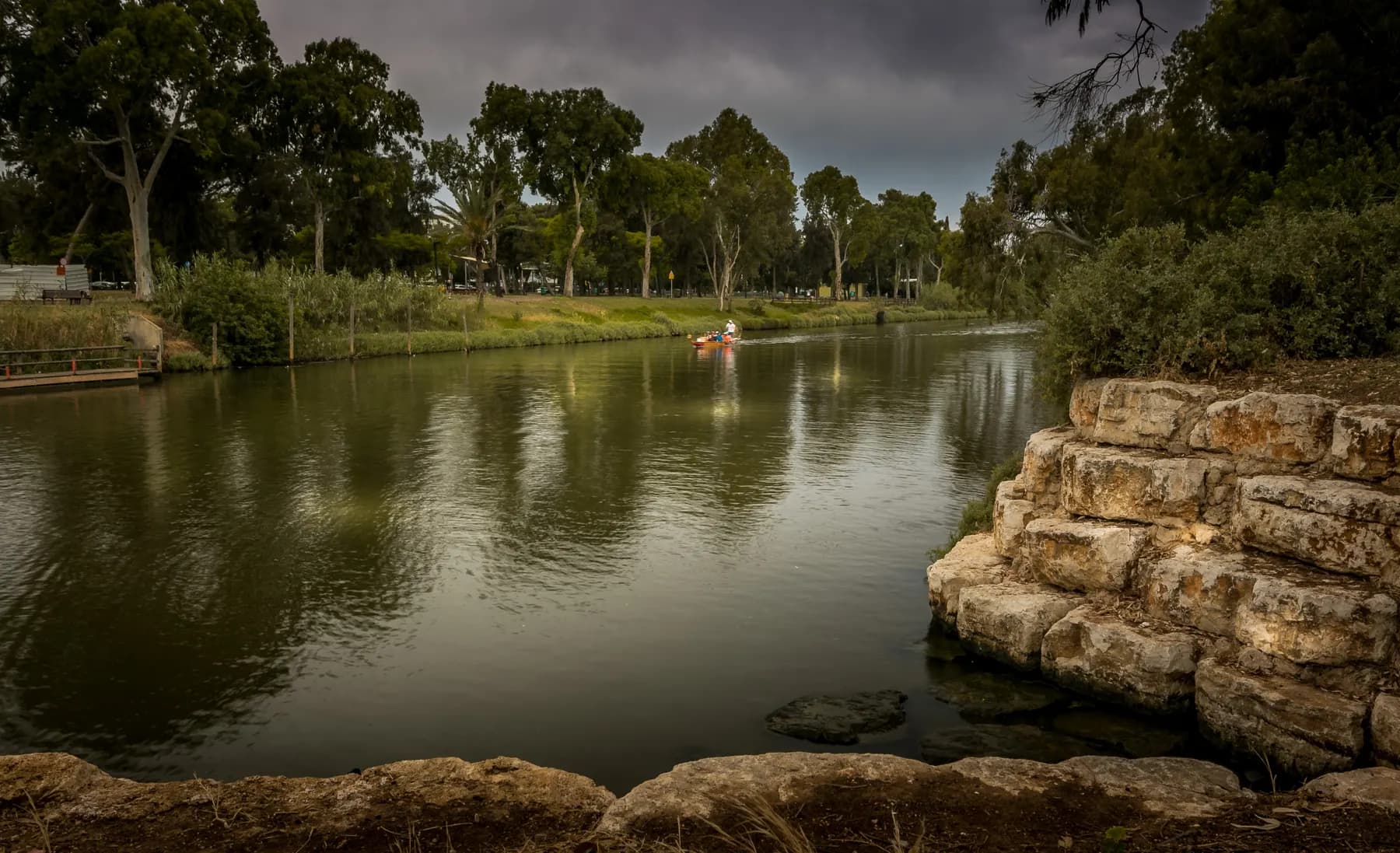
Nature reserve · Tel Aviv
HaYarkon Park
The park runs about 3,800 dunams from the Geha road to the sea, and the river it is named for now carries roughly 5 per cent of the water it did before the Yarkon-Negev pipeline took the springs.
הרווי ספיר / CC BY 2.5 · Wikimedia Commons
Area
about 3,800 dunams
the operator's own figure, of which 2,600 dunams are developed
Length of the river
27.5 km
the Yarkon River Authority's measurement, springs to sea
Flow left in the channel
about 5 per cent
of the Yarkon's historic natural discharge, on 2021 figures
Botanical gardens
four, all free
rock, cactus, tropical and clipped, each on its own hours
In short
- How long to give it
- About 90 minutes for one corner of it, and about half a day to take in the gardens, a mill site and the lake together
- The park itself
- No gate and no ticket office; the operator's regulations forbid staying overnight
- The park
- The operator publishes no entrance fee and the grounds are not gated
פארק הירקון
HaYarkon Park is the belt of parkland on both banks of the Yarkon River across the north of Tel Aviv, running from the Geha road in the east to the shoreline in the west. Its operator, the municipal company Ganei Yehoshua, gives the area as about 3,800 dunams, of which 2,600 are developed and 1,200 are groves, beds, flowers and shrubs. There is no perimeter fence and no ticket office, and everything the park itself runs, the four botanical gardens and the birding reserve included, is free.
It is not one attraction but a corridor of them: four botanical gardens on 40, 26, 20 and 15 dunams, each keeping its own opening hours; two Ottoman-period flour-mill sites and an archaeological tell; a lake dug in 1977 with boats for hire; a summer water park; a fee-charging sports complex; a wetland reserve run with KKL-JNF; and a concert ground that has held audiences above sixty thousand.
The river is the part with an argument in it. The Yarkon River Authority, the statutory body set up in 1990 to clean the stream up, states that until the mid-1950s about 200 million cubic metres of spring water a year ran down the channel, and that the Yarkon-Negev scheme captured almost all of it. What passes the picnic tables now is roughly a twentieth of that historic discharge, made up with treated effluent.
Orientation
Where the park starts, where it stops, and how to get into it
Ganei Yehoshua is a municipal company that also runs Menachem Begin Park in the south of the city and, since 2003, the nature gardens at Abu Kabir. Its account of the park's origins begins with David Ben-Gurion allocating the ground to the municipality at one lira per dunam, on the condition that no houses be built on either side of the Yarkon and that the land stay open as the centre of the city's green space. Planning began in 1969 and the company was set up in 1973.
There is nothing to buy at the edge because there is no edge to buy it at. Drivers use the car parks off Rokach Boulevard: the operator lists one at Rokach 94 and a second at Rokach 80, both open around the clock, plus a Sportek car park. Trains stop at the station the operator still calls University-Fairgrounds, and the bus lines it names are Metropoline 47 and 48 and Dan 22, 89 and 189.
The Yarkon is the spine and the reference point for everything else. The operator measures it at 28 km from the springs at Rosh Ha'ayin to the estuary; the river authority measures the channel at 27.5 km, with a straight-line distance of about 15 km; Britannica gives about 16 miles. The lowest 4 km is an estuary into which the Mediterranean pushes on the tide. Walking the north bank end to end became possible only in November 2011, after the municipality won a long case to clear a shack settlement known as the fishermen's village.
History
Forty years between the idea and a park worth walking in
The idea belongs to Meir Dizengoff's administration and dates from 1929. Nothing was done about it until 1950, and the tree-planting ceremony was held on 5 July 1951, near the point where the Ayalon joins the Yarkon. Planting was then handed to a private contractor that worked patch by patch without an overall scheme, and the Hebrew record concedes that by the early 1960s the result compared badly with the national park at Ramat Gan.
In 1962 a committee was appointed to enlarge it, with the architect Aba Elhanani among its members alongside Moshe Akron and Avraham Karavan. It resolved to extend the park to take in the Eretz Israel Museum and Tel Qasile, and to add a lake, a sports hall, a small train and a children's theatre. The scheme adopted was Elhanani's, worked up with the landscape architect Yosef Sagel, and building it fell to Akron, who became the park's first chief executive.
What most visitors walk through is the 1970s redesign, by the landscape architects Tzvi Dekel, Gideon Sarig and Yosef Sagel, who took the Rokach Prize for it. The lake was dug in 1977, Sportek and the rose garden opened in 1978, and Sarig has been the park's architect since the mid-1980s.
The two published accounts of the name do not agree. The operator says the company founded in 1973 was called Ganei Yehoshua after Yehoshua Rabinowitz, mayor from 1969 to 1974 and later finance minister. The Hebrew encyclopaedia entry dates the naming of the park to 1982, three years after Rabinowitz died. Neither addresses the other.
The gardens
Four botanical gardens, none of them ticketed
The rock garden covers 40 dunams in the middle of the park and is a geology collection as much as a planting: rock types were brought in from Mount Hermon in the north to Eilat in the south, and hundreds of Israeli plant species were set among them. The operator lists Mediterranean woodland trees including Palestine pistacia and Tabor oak, and geophytes including anemones, cyclamens and sea squills, so what is in flower changes sharply with the month.
The cactus and succulent garden runs to about 26 dunams and holds roughly 50,000 plants of about 3,500 kinds and species, among them euphorbias, cereus, aloes and prickly pears. The operator says some arrived as seed and were germinated in the garden's own nurseries, some came as plants from East Africa and the Kalahari in Namibia, and some were donated out of private Israeli collections.
The tropical garden was laid out in the 1970s over about 20 dunams and is the one to head for in August, because the whole point of it is humidity and shade: frequent irrigation, tall evergreens and shade structures keep the plants alive and, incidentally, keep the visitor cool. Palms, ferns, bamboos, cycads, aroids and water plants grow around pools stocked with fish. The clipped garden, about 15 dunams, is the opposite temperament: geometric beds, fountains and water channels in the classical and early Islamic manner, olive, bay and citrus for the Mediterranean half, and archaeological fragments and mosaics set into the layout.
All four are free, and none keeps the park's hours. The operator's Hebrew pages publish summer and winter timetables; its English pages publish one flat timetable of Sunday to Friday 09:00 to 16:00 and Saturday 10:00 to 16:00. Where they disagree, the Hebrew pages are the fuller and better maintained. Dogs are not admitted to any of the four.
- Rock garden and cactus garden, summer: Sunday to Thursday 09:00 to 18:00, Friday and Saturday 09:00 to 16:00.
- Tropical garden, summer: Sunday to Thursday 09:00 to 17:30, Friday and Saturday 09:00 to 16:00.
- Rock, cactus and tropical gardens, winter: Sunday to Thursday 09:00 to 16:00, Friday and Saturday 09:00 to 15:00.
- Clipped garden, winter: 09:00 to 16:00 every day it opens.
- Last admission to all four is half an hour before the closing time listed.
The Yarkon
What the pipeline took away, and what has been put back
The Yarkon drains a catchment of 1,800 square kilometres, taking in the Kana, Raba, Shilo and Ayalon streams, and it was the largest of the coastal rivers reaching the Mediterranean. The river authority states that until the middle of the 1950s about 200 million cubic metres of spring water a year came down it, an hourly discharge of some 25,000 cubic metres, clean enough for fishing and swimming. The Yarkon-Negev line then captured the springs, and the authority's own summary is blunt: the river effectively dried out, became a channel for sewage, industrial waste and fertiliser, and its aquatic ecosystem collapsed.
The two figures in circulation for that lost flow are not the same. The river authority gives about 200 million cubic metres a year; the park operator's history page gives about 100 million for the same period. Neither explains the gap, and the order of magnitude is the reliable part.
The Yarkon River Authority was created in 1990, under a founding order of 1988, with a remit of preventing pollution, restoring the stream and fitting it for recreation. It reports roughly 1,800 cubic metres an hour of spring water reaching the channel, about 5 per cent of the historic discharge, plus about 1,500 cubic metres an hour of treated effluent. Species held in refuge collections have been returned, among them the blue water lily and the Yarkon bream. Soft-shelled turtles are monitored, and a handful of jungle cat sightings over thirty years are treated as evidence of a working food web, because the animal is an apex predator.
What forced the pollution onto the national agenda happened on 14 July 1997, at the eastern end of the park. A temporary pedestrian bridge over the Yarkon, on the route into the Ramat Gan stadium for the opening of the Maccabiah Games, gave way under the Australian delegation. One athlete died in the fall; three more died afterwards of infections contracted in the water. An inquiry found the bridge had been built without the required permit, to a design well below the load standard, and five men were later convicted of causing death by negligence.
What survives
Two flour-mill sites and a tell, and how much of each is restoration
Seven Mills takes its name from the seven mills in the western part of a much larger milling complex that had worked here since Ottoman times. A dam held the Yarkon back, and the operator puts the annual flow then at 210 million cubic metres; the water ran down a purpose-cut race to turn the stones. More mills went up in the 19th century and the place worked as a rural centre, with a coffee house and a boat mooring for farmers waiting hours or days on their grain. Milling stopped when it could not compete with modern plant, in 1936 on the Hebrew account and in the 1930s on the operator's English one.
How much of it is original is worth stating plainly, because the published accounts do not match. The operator says the site went through extensive restoration between 1990 and 2008, that management passed to the Avshalom Institute, and that excavation led by Yehoshua Drey turned up Ottoman-period material. The Hebrew encyclopaedia entry says it was exposed and partly restored in 2000 and 2001. Either way, what stands is consolidated ruin with modern work in it, not a working mill.
Ten Mills, on the Ramat Gan side between the stadium and the shopping centre, is the biggest of the Yarkon mill sites, with structure standing up to three metres. It was uncovered in 1993 from under vegetation and drift sediment. Milling here goes back to the Roman period, when at least twenty pairs of stones worked; the name settled on ten because ten pairs were running during the fighting of the early 20th century. Its operators built an 80 metre flood wall and a system of dams and channels feeding twelve grinding stations, and the structure doubled as a river crossing, the stone bridge Jisr el-Hadar, which Judith Montefiore recorded passing in 1839. At its height 18 pairs of stones ran here, each grinding 30 to 40 kg of flour an hour, and the dig turned up a collapsed tunnel holding an arms cache of the Zionist underground.
Tel Napoleon, south of the Yarkon and east of the Ayalon, is the third old thing here: a saddle-shaped mound of about forty dunams rising 38 metres above sea level, whose principal find is a shaft of a Canaanite water system. It is not laid out as a visitor site, and the reward for climbing it is the view.
The concert ground
The lawn where sixty thousand people stand
Two venues here take crowds. The Wohl Amphitheatre is the built one, with a cafeteria beside it and a box office that opens two hours before a performance and sells only on the night. The other is not a venue at all in the architectural sense: an open slope called Givat HaMofa'im, the performance hill, where the audience stands on grass.
The attendances on record are the kind normally attached to stadiums. Michael Jackson played two nights in September 1993 to about 100,000 people in total; Madonna followed on 4 October 1993 before about 80,000. In one stretch of July 2017 the park took 57,204 for Britney Spears, 60,000 for Guns N' Roses and 48,011 for Radiohead. Bruno Mars played to 62,000 on 4 October 2023; his second night, booked for the evening of 7 October, was cancelled.
That trade has a cost inside the park. The petting zoo at Bavli closed permanently in May 2023, and the reasons given included concern about keeping animals in poor conditions and the noise of concerts nearby. The rocks from its enclosure were rearranged and left in place for people to sit on.
What to look for
Things not to walk past at HaYarkon Park
The details that repay knowing about before you are standing in front of them.
The rock garden
Forty dunams of rock brought from Mount Hermon to Eilat, planted with hundreds of Israeli species. Free, and open on its own timetable rather than the park's.
The cactus houses
About 50,000 plants of roughly 3,500 kinds over some 26 dunams, part grown from seed in the garden's own nurseries and part collected from East Africa and the Kalahari.
Ten Mills
The largest of the Yarkon mill sites, with walls up to three metres, uncovered in 1993. The same structure carried the stone bridge Judith Montefiore crossed in 1839.
Rosh Tzipor
A birding reserve of about 32 dunams built in 2017 on rebuilt wetland at the Ayalon confluence, with hides to watch from. Roughly 150 bird species have been recorded there.
The Senses Park
Fifteen dunams of play built for visitors with disabilities: musical installations, a texture wall, a scent bed reachable from a wheelchair, and accessible paths and seating.
The tropical garden in August
About 20 dunams kept deliberately humid and shaded since the 1970s, with pools for fish and waterfowl. It is the coolest ground in the park on a bad day.
The long view
HaYarkon Park, in order
1929
Meir Dizengoff's administration floats the idea of a park along the Yarkon. Nothing follows for twenty years.
5 July 1951
The tree-planting ceremony is held near the point where the Ayalon meets the Yarkon.
mid-1950s
The Yarkon-Negev line captures the springs for the national supply. The river's flow collapses and the channel takes sewage instead.
1962
A committee including the architect Aba Elhanani is appointed to enlarge the park. The scheme adopted is Elhanani's with the landscape architect Yosef Sagel; Moshe Akron builds it and becomes the first chief executive.
1969
Planning and development of the park begins, on the operator's own account.
1973
The Ganei Yehoshua company is founded to run the park.
1977
The artificial lake is dug.
1978
Sportek and the rose garden open.
1982
The park is named for Yehoshua Rabinowitz, on the Hebrew encyclopaedia's dating. The operator dates the name to the company's founding in 1973.
1984
The first pedal boats arrive from Belgium for the lake. Motor boats follow in 1986.
1990
The Yarkon River Authority begins work, under a founding order of 1988, with a remit of pollution prevention, restoration and recreation.
1993
The Ten Mills site is uncovered from under vegetation and silt.
14 July 1997
A temporary bridge over the Yarkon collapses under the Australian delegation entering the Maccabiah Games. Four die, one in the fall and three of infections from the water.
2000–2001
The Seven Mills site is exposed and partly restored, on the Hebrew encyclopaedia's account; the operator dates restoration work to 1990 through 2008.
November 2011
A new stretch of promenade makes the north bank continuously walkable for the first time.
2017
The Rosh Tzipor birding park opens on rebuilt wetland, a joint project of KKL-JNF, the municipality, Ganei Yehoshua and the Society for the Protection of Nature.
May 2023
The petting zoo at Bavli closes permanently, partly over the noise of concerts in the park.
Practical
Visiting HaYarkon Park
Where
HaYarkon Park (Ganei Yehoshua), Rokach Boulevard, Tel Aviv-Yafo
What ticket you need
This is not a site inside a larger ticketed park: it is the park, and it is free. What sits inside it is ticketed separately. The Meymadion water park, the Sportek complex, the boats, the hot-air balloon, the rope park and the escape rooms are run by their own operators, and no single ticket covers them, because there is no gate at which to sell one.
Opening hours
- The park itself
- No gate and no ticket office; the operator's regulations forbid staying overnightsource
- Rock garden and cactus garden, summer
- Sunday to Thursday 09:00 to 18:00, Friday and Saturday 09:00 to 16:00source
- Tropical garden, summer
- Sunday to Thursday 09:00 to 17:30, Friday and Saturday 09:00 to 16:00source
- Rock, cactus and tropical gardens, winter
- Sunday to Thursday 09:00 to 16:00, Friday and Saturday 09:00 to 15:00source
- Clipped garden, winter
- 09:00 to 16:00 on every day it openssource
- Last admission to the four gardens
- Half an hour before the closing time listedsource
- Rosh Tzipor birding park
- Daily in daylight: 07:00 to 19:00 in summer, 07:00 to 17:00 in wintersource
- Northern Sportek
- Sunday to Thursday 09:00 to 22:30, Friday 14:00 to 20:00, Saturday 10:00 to 21:00source
- Boat hire on the park lake
- 10:00 to 19:00source
- Meymadion water park
- Seasonal, June to October, Saturdays includedsource
- Wohl Amphitheatre box office
- Opens two hours before each show and sells on the night of the performance onlysource
Admission
- The park
- The operator publishes no entrance fee and the grounds are not gatedsource
- The four botanical gardens
- Freesource
- Rosh Tzipor birding park
- Freesource
- Northern Sportek
- Charged. The operator states there is a fee to enter the complex without publishing the figuresource
- Meymadion, the boats, the balloon and the rest
- Charged by their own operators, and covered by nothing the park sellssource
- Car parking
- The operator's English page lists ₪20 for a single entry, with a 75 per cent discount for city residents; the Hebrew page no longer publishes a tariffsource
- Commercial or professional photography in the gardens
- Charged, and must be arranged in advance by emailsource
Access
Better than most Israeli nature sites and not uniform. The ground either side of the river is flat, the paths are made up, and the north bank has been continuously walkable since November 2011. The operator lists disabled access at its car parks and states wheelchair access at the Rosh Tzipor birding park. The strongest provision is the Senses Park, 15 dunams in the middle of the park near the park offices, built for visitors with disabilities: accessible paths and seating, accessible water installations, musical and texture installations and a scent bed set at wheelchair height. Against that, the two mill sites are consolidated ruin on uneven ground and the operator's pages for them say nothing about access, and Tel Napoleon is an unmade climb of 38 metres with no adapted route.
On site
- Car parks off Rokach Boulevard, open around the clock
- Public cafeteria
- Barbecue and picnic complexes
- Playgrounds
- Cycle and walking paths on both banks
- Dog park
- Outdoor gym equipment
- Skate park and climbing wall
- Boat hire on the lake
- Park library
- Observation hides at the birding park
Booking
Guided tours of the nature gardens and of the birding park are booked separately, through the operator's tours and tickets line rather than the main office.
Hours and prices are given as the operator publishes them and change without much notice, particularly around Shabbat and the festivals. Check the operator's own page before you travel for this.
Official page at park.co.il →What people wish they had known
- The gardens keep their own hours and shut long before dusk, with last admission half an hour before the closing time. The park around them never closes, which is exactly why people turn up at 16:00 on a winter afternoon and find the rock garden already locked.
- The operator's English pages and its Hebrew pages give different garden hours. The English pages publish one flat timetable; the Hebrew pages publish summer and winter timetables. Work off the Hebrew ones and arrive early.
- Dogs are welcome in the park and there is a dog park, but no dogs are admitted to any of the four botanical gardens or to the birding reserve.
- Barbecues are legal only in the designated picnic complexes. Generators, gas canisters, inflatables and amplification are banned outright, vehicles may not be driven onto the park, and private events such as weddings are not permitted on park ground.
- Rosh Tzipor is not reached from the main park car parks. Vehicle access is from Rokach Street on the Ramat Gan side, opposite house 74, into the farm car park, and then on foot.
- The two mill sites are at opposite ends of a long walk and Ten Mills is across on the Ramat Gan bank, between the stadium and the shopping centre. Hire a bicycle if the plan is to see both in one visit.
The figures
HaYarkon Park by the numbers
Each figure carries the year it belongs to and links the source it came from.
| Measure | Figure | As of | Source |
|---|---|---|---|
| Area of the park | about 3,800 dunams, of which 2,600 are developed and 1,200 are groves, beds, flowers and shrubs | 2026 | park.co.il |
| Length of the Yarkon channel | 27.5 km from the source pool to the sea; the park operator gives 28 km and Britannica about 16 miles | 2026 | yarkon-river.org.il |
| Catchment drained by the Yarkon | 1,800 square kilometres | 2026 | yarkon-river.org.il |
| Flow before the Yarkon-Negev line | about 200 million cubic metres a year, roughly 25,000 cubic metres an hour | 2026 | yarkon-river.org.il |
| Flow in the channel now | about 1,800 cubic metres an hour of spring water, roughly 5 per cent of the historic discharge, plus about 1,500 cubic metres an hour of treated effluent | 2021 | yarkon-river.org.il |
| Bird species recorded at Rosh Tzipor | about 150, over about 32 dunams | 2026 | park.co.il |
| Plants in the cactus and succulent garden | about 50,000, of roughly 3,500 kinds and species, over about 26 dunams | 2026 | park.co.il |
While you are here
The rest of Tel Aviv
Everything else in this destination with a page of its own.
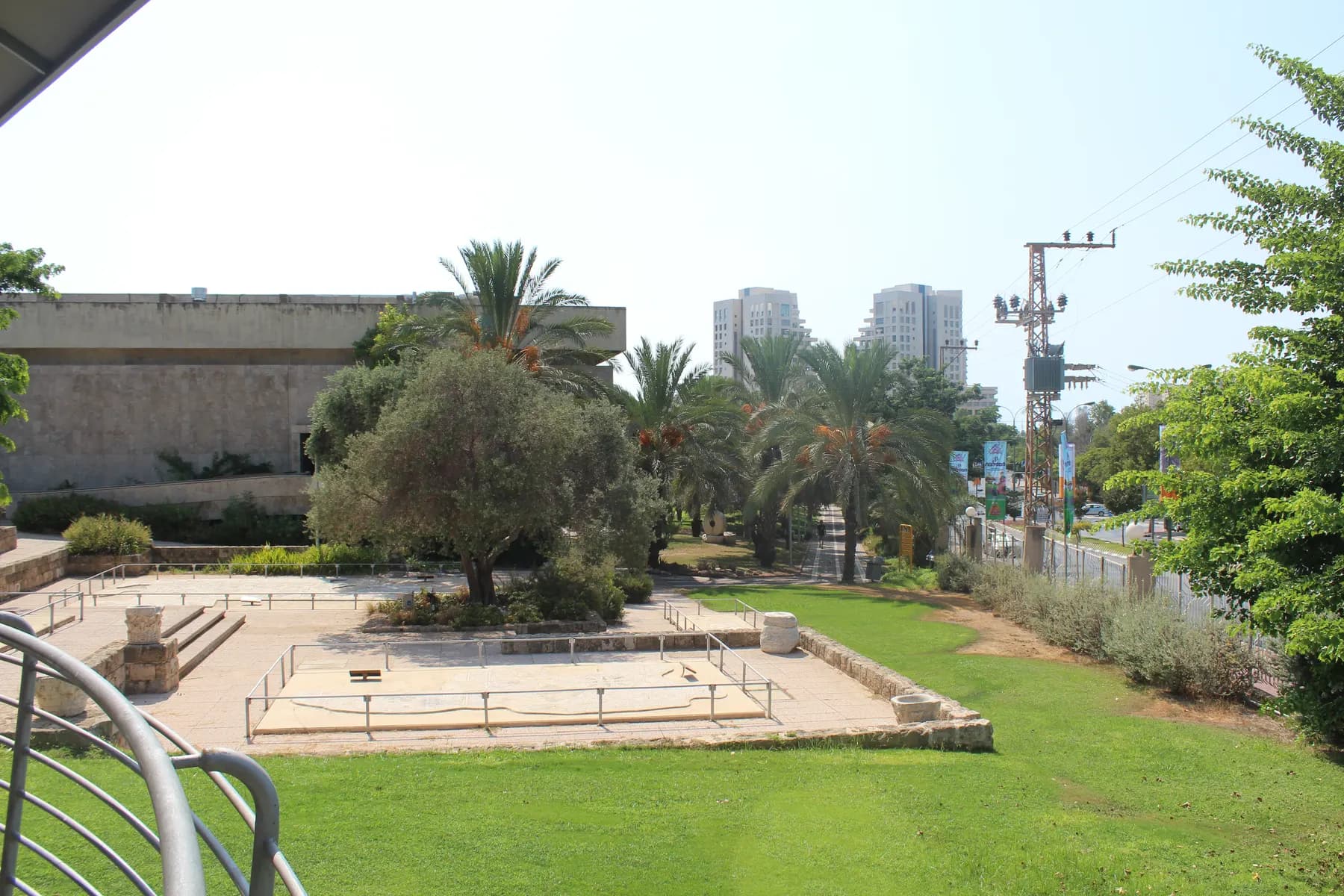
Deror_avi / CC BY-SA 4.0 · Wikimedia Commons
Museum
Eretz Israel Museum
The first excavation permit issued by the State of Israel, in 1948, was for the mound that still stands at the centre of this museum's grounds in Ramat Aviv.
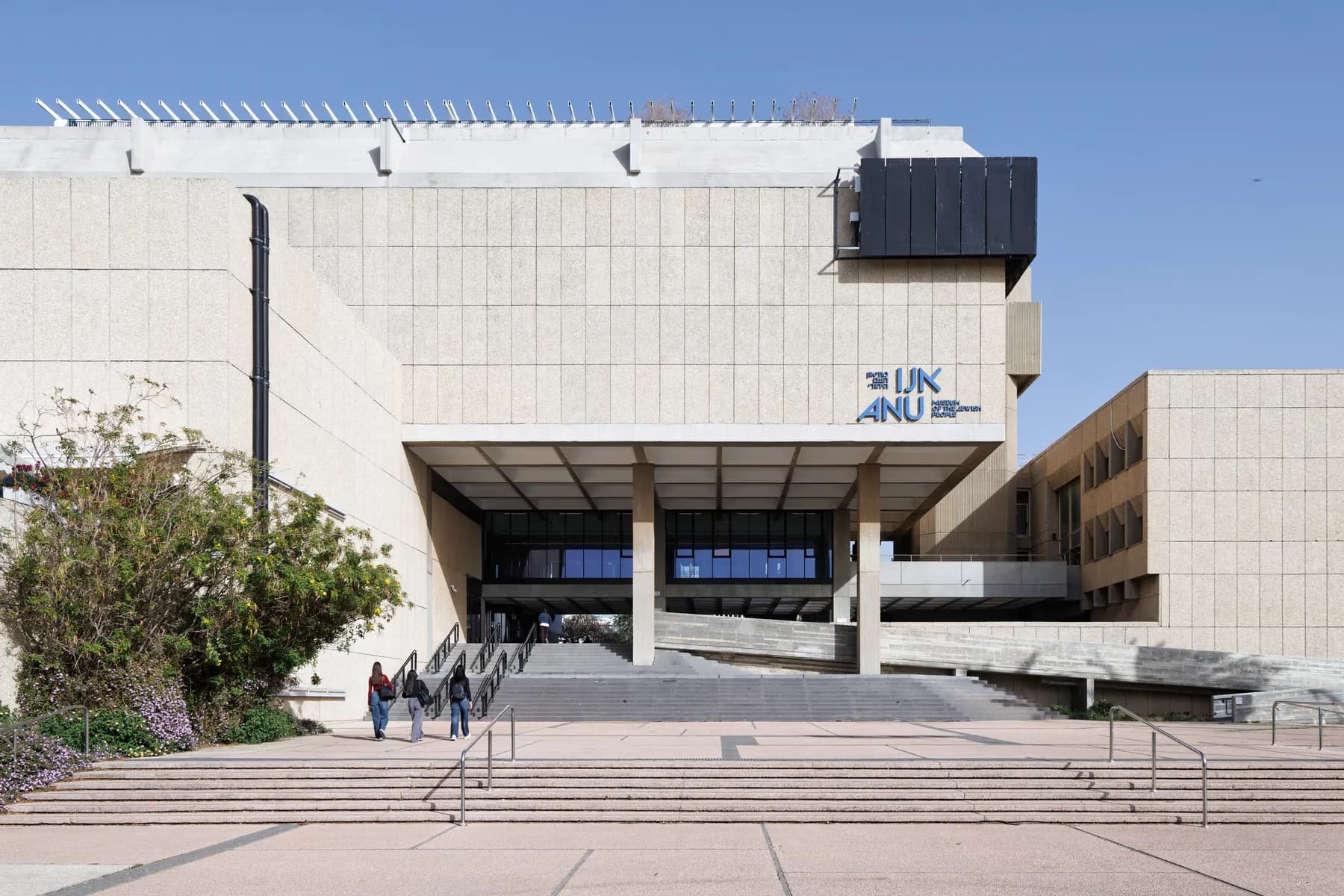
D. Benjamin Miller / CC0 · Wikimedia Commons
Museum
ANU, Museum of the Jewish People
The museum that opened in 1978 having deliberately decided not to collect objects reopened in 2021 with a 1,100-year-old Hebrew Bible as its centrepiece.
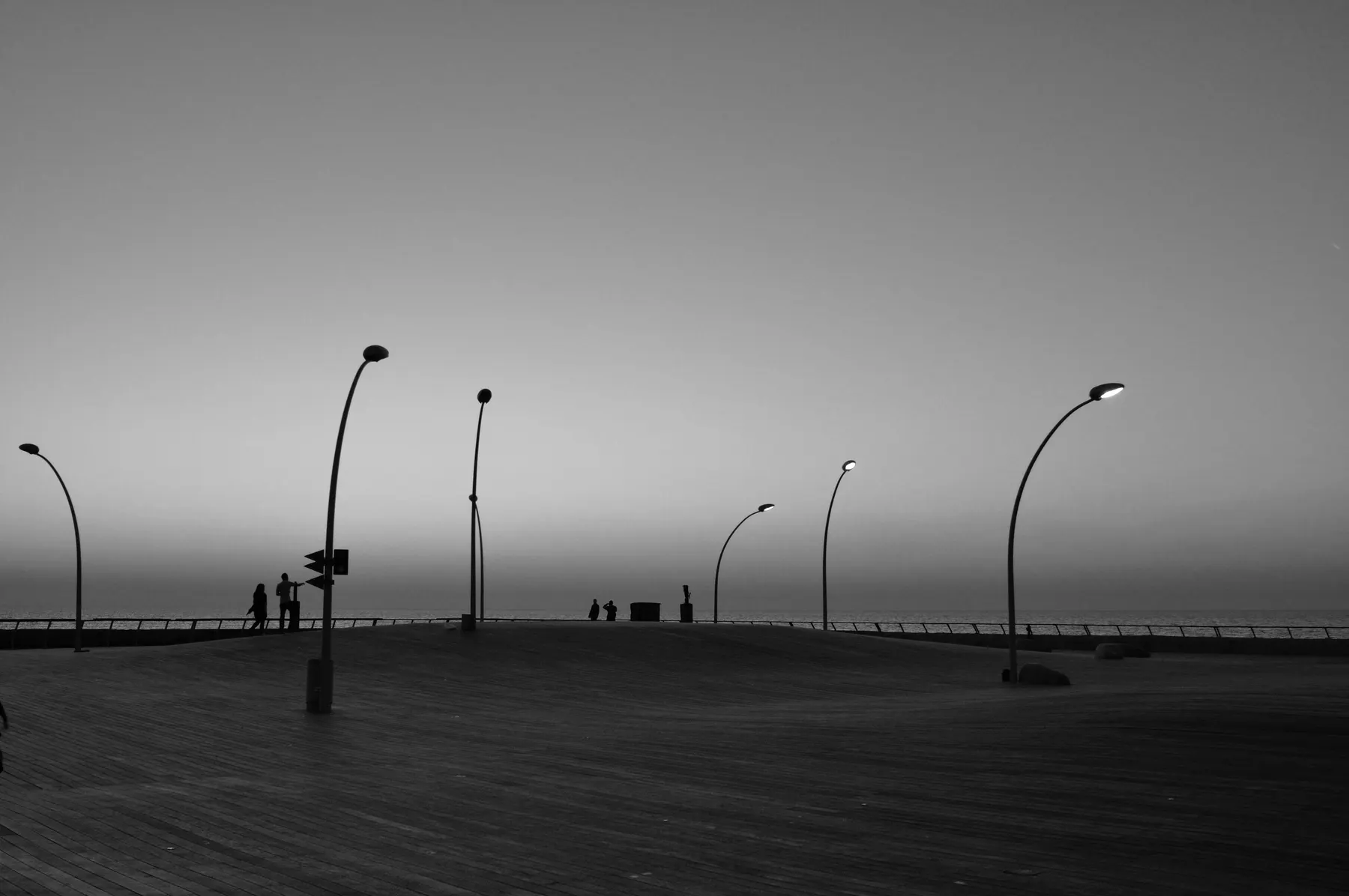
Romanhit / CC BY-SA 3.0 · Wikimedia Commons
Landmark
Tel Aviv Port
The first Jewish-run port on this coast landed its first cargo, a load of cement, on 19 May 1936, worked until 25 October 1965, and reopened as public space under a timber deck finished in 2008.
Sources and further reading
Every link below was opened and checked when this page was written. Official statements are marked as such: they are the subject's own account, not an independent one.
- OfficialGanei Yehoshua (Yarkon Park Company)park.co.ilGanne Yehoshua Park: information for visitors
Ben-Gurion's allocation of the land at one lira per dunam and the ban on building either side of the river, planning from 1969, the company founded in 1973 and named for Yehoshua Rabinowitz, the area of about 3,800 dunams with 2,600 developed and 1,200 in groves and beds, the Yarkon at 28 km, the pre-1954 flow of about 100 million cubic metres a year, the bus and train services, and the car parks with the ₪20 tariff and the residents' discount
- OfficialGanei Yehoshuapark.co.ilגן הסלעים (Rock Garden)
The rock garden at 40 dunams, rock types collected from Hermon to Eilat, the plant list from Palestine pistacia and Tabor oak to anemones and sea squills, free entry, no dogs, the charge for commercial photography, and the summer and winter timetables with last admission half an hour before closing
- OfficialGanei Yehoshuapark.co.ilגן הקקטוסים (Cactus and Succulent Garden)
About 26 dunams, roughly 50,000 plants of about 3,500 kinds and species, the euphorbias, cereus, aloes and prickly pears, the on-site greenhouses, and the material raised from seed or brought from East Africa, the Kalahari and private Israeli collections
- OfficialGanei Yehoshuapark.co.ilהגן הטרופי (Tropical Garden)
Laid out in the 1970s over about 20 dunams, the plant groups from palms and ferns to cycads and birds of paradise, the pools for fish and waterfowl, and the irrigation and shade regime that keeps the humidity up
- OfficialGanei Yehoshuapark.co.ilראש ציפור: מידע למבקר (Rosh Tzipor birding park, visitor information)
The reserve at about 32 dunams at the Ayalon confluence, founded in 2017 with KKL-JNF, the municipality and the Society for the Protection of Nature, about 150 bird species recorded, the rebuilt wet habitats and hamra soils, the ringing station, wheelchair access, free entry, and daylight hours of 07:00 to 19:00 in summer and 07:00 to 17:00 in winter
- OfficialGanei Yehoshuapark.co.il7 Mills: archaeological site
The name from seven mills in the western part of an Ottoman-period complex, the dam and the cut race, the annual flow of 210 million cubic metres, abandonment in the 1930s, restoration from 1990 to 2008, management by the Avshalom Institute and excavation led by Yehoshua Drey
- OfficialGanei Yehoshuapark.co.il10 Mills: archaeological site
The largest of the Yarkon mill sites with structure up to 3 m, uncovered in 1993, the 80 m flood wall and twelve grinding stations, the ten of twelve mills that give the name, the site's use as a river crossing, the 18 pairs of stones grinding 30 to 40 kg an hour, and the tunnel with the Zionist underground arms cache
- OfficialGanei Yehoshuapark.co.ilThe Park Lake
The man-made lake and its concession, the Yarkon boating company of 1938 to the late 1960s with 160 rowing boats and 18 larger craft, the collapse of boating in the 1980s under pollution, the pedal boats brought from Belgium in 1984 and motor boats in 1986, and opening hours of 10:00 to 19:00
- OfficialGanei Yehoshuapark.co.ilPark rules and regulations
Barbecues permitted in the designated picnic complexes only, the ban on generators, gas containers, inflatables and amplification, no vehicles on the park, no private events such as weddings, and no staying overnight
- OfficialYarkon River Authorityyarkon-river.org.ilאודות הנחל (About the river)
The catchment of 1,800 square kilometres and its tributaries, the pre-1950s flow of about 200 million cubic metres a year at some 25,000 cubic metres an hour, the channel at 27.5 km with a straight-line distance of about 15 km and a gradient of roughly 0.6 per thousand, the three river sections and the 4 km tidal estuary, and the seven local authorities the river crosses
- OfficialYarkon River Authorityyarkon-river.org.ilשיקום הנחל (Rehabilitating the river)
Clean water fit for fishing and swimming until the mid-1950s, the collapse of the aquatic ecosystem after the sources were sent to the Negev from 1955, the authority created in 1990 under a founding order of 1988, the present flow at about 5 per cent of the historic discharge with about 1,500 cubic metres an hour of treated effluent, and the reintroduction of the blue water lily and the Yarkon bream
- ReferenceEnglish Wikipediaen.wikipedia.orgMaccabiah bridge collapse
The collapse of the temporary pedestrian bridge over the Yarkon on 14 July 1997 as the Australian delegation walked into the Ramat Gan stadium, one death in the fall and three afterwards from infections contracted in the polluted water, the Dotan commission's findings on the missing permit and the substandard design and materials, the five convictions for causing death by negligence, and the clean-up effort the disaster prompted
- ReferenceEncyclopaedia Britannicabritannica.comYarqon River
The river as the principal perennial stream flowing almost entirely within Israel, its course of about 16 miles from the springs at Rosh Ha-Ayin to the Mediterranean in northern Tel Aviv, its role as the divide between the Plain of Sharon and the coastal lowlands, and the boating on it before the Yarkon-Negev project of the 1950s
- ReferenceHebrew Wikipediahe.wikipedia.orgפארק הירקון (Yarkon Park)
The 1929 idea under Dizengoff, the planting ceremony of 5 July 1951, the 1962 committee under Aba Elhanani, the adopted Elhanani and Yosef Sagel scheme, Moshe Akron as first chief executive, the 1970s redesign by Tzvi Dekel, Gideon Sarig and Yosef Sagel and its Rokach Prize, the lake of 1977, Sportek and the rose garden of 1978, the naming for Rabinowitz in 1982, the north bank promenade of November 2011, the Ten Mills history including Jisr el-Hadar and Judith Montefiore in 1839, Tel Napoleon at about forty dunams and 38 metres, the concert attendances, and the closure of the Bavli petting zoo in May 2023
HaYarkon Park: common questions
Is HaYarkon Park free?+
Yes. The operator publishes no entrance fee, and there is no perimeter fence or ticket office. The four botanical gardens and the Rosh Tzipor birding park state free entry on their own pages. What costs money is the commercial concessions inside the park: the Meymadion water park, the Sportek sports complex, boat hire on the lake, the hot-air balloon, the rope park, and the car parks.
How long do you need in HaYarkon Park?+
About 90 minutes is enough for one corner of it and about half a day covers the gardens, a mill site and the lake. The park runs about 3,800 dunams from the Geha road to the sea, so there is no version of a visit that sees all of it on foot. Pick the western end for the museums and the estuary, the middle for the gardens and the lake, and the eastern end for the mills and the birding reserve.
What are the opening hours of the gardens in HaYarkon Park?+
The operator's Hebrew pages give summer hours of Sunday to Thursday 09:00 to 18:00 and Friday and Saturday 09:00 to 16:00 for the rock and cactus gardens, with the tropical garden closing at 17:30 on weekdays, and winter hours of Sunday to Thursday 09:00 to 16:00 and Friday and Saturday 09:00 to 15:00. Last admission is half an hour before closing in every case. The operator's English pages publish a different and flatter timetable of Sunday to Friday 09:00 to 16:00 and Saturday 10:00 to 16:00, so the two sets of pages disagree.
How big is HaYarkon Park?+
The operator gives about 3,800 dunams, or 3.8 square kilometres, from the Geha road in the east to the seafront in the west, of which 2,600 dunams are developed. The Hebrew encyclopaedia entry gives about 3,750 dunams and rounds the area to 3.5 square kilometres, and calls it the second largest park in Israel after the Be'er Sheva River Park. Nobody has published a reconciliation of the two figures.
Can you swim in the Yarkon River?+
No, and nobody offers it. The river authority states that the water was clean enough for fishing and swimming until the middle of the 1950s and that the ecosystem then collapsed under sewage, industrial waste and fertiliser after the springs were diverted. What flows today is a mixture of spring water and treated effluent, and the river authority samples it for quality rather than presenting it as bathing water. Recreation on the Yarkon means boating, not immersion.
Can you rent boats on the Yarkon?+
Yes, on the artificial lake, from 10:00 to 19:00, with pedal boats and motor boats. The lake was dug in 1977 and the concession revives an older habit: a Yarkon boating company operated from 1938 to the late 1960s and at its peak ran 160 rowing boats and 18 larger river craft, before pollution ended the trade in the 1980s. The first pedal boats of the modern operation were brought from Belgium in 1984 and motor boats were added in 1986.
Is there shade in HaYarkon Park?+
In parts, and it is worth planning around. The operator counts 1,200 of the park's dunams as groves, beds, flowers and shrubs against 2,600 developed, so a good deal of the open lawn has no cover at all. The tropical garden is the reliable answer in high summer, because shade and humidity are the point of it, and the Bereshit forest is a eucalyptus grove. The riverside paths are shaded in stretches and open in others.
Is HaYarkon Park wheelchair accessible?+
Much of it is, and the exceptions are worth knowing. The ground beside the river is flat with made-up paths, the north bank has been continuously walkable since November 2011, the operator lists disabled access at its car parks and states wheelchair access at the birding park, and the Senses Park of 15 dunams was purpose-built for visitors with disabilities. The two mill sites are consolidated ruin on uneven ground with no published access information, and Tel Napoleon is an unmade 38 metre climb.
Is it worth it if you only have two days in Tel Aviv?+
Probably not ahead of the beach, the White City and Jaffa, unless something specific in the park is the draw. The honest case for going is narrow and real: the four free botanical gardens are unusual and well kept, the birding reserve is a serious piece of habitat restoration rather than a display, and the mill sites are the oldest built things in north Tel Aviv. If the trip includes children, or a hot afternoon with nothing booked, the calculation changes.
What is Rosh Tzipor?+
It is a birding reserve of about 32 dunams at the confluence of the Ayalon and the Yarkon, opened in 2017 as a joint project of KKL-JNF, the Tel Aviv-Yafo municipality, Ganei Yehoshua and the Society for the Protection of Nature. Wet habitats and hamra soils were rebuilt there deliberately, most of the ground is closed to visitors so the animals are left alone, and people watch from hides. About 150 bird species have been recorded, and the site runs a ringing station as part of an international migration research network.