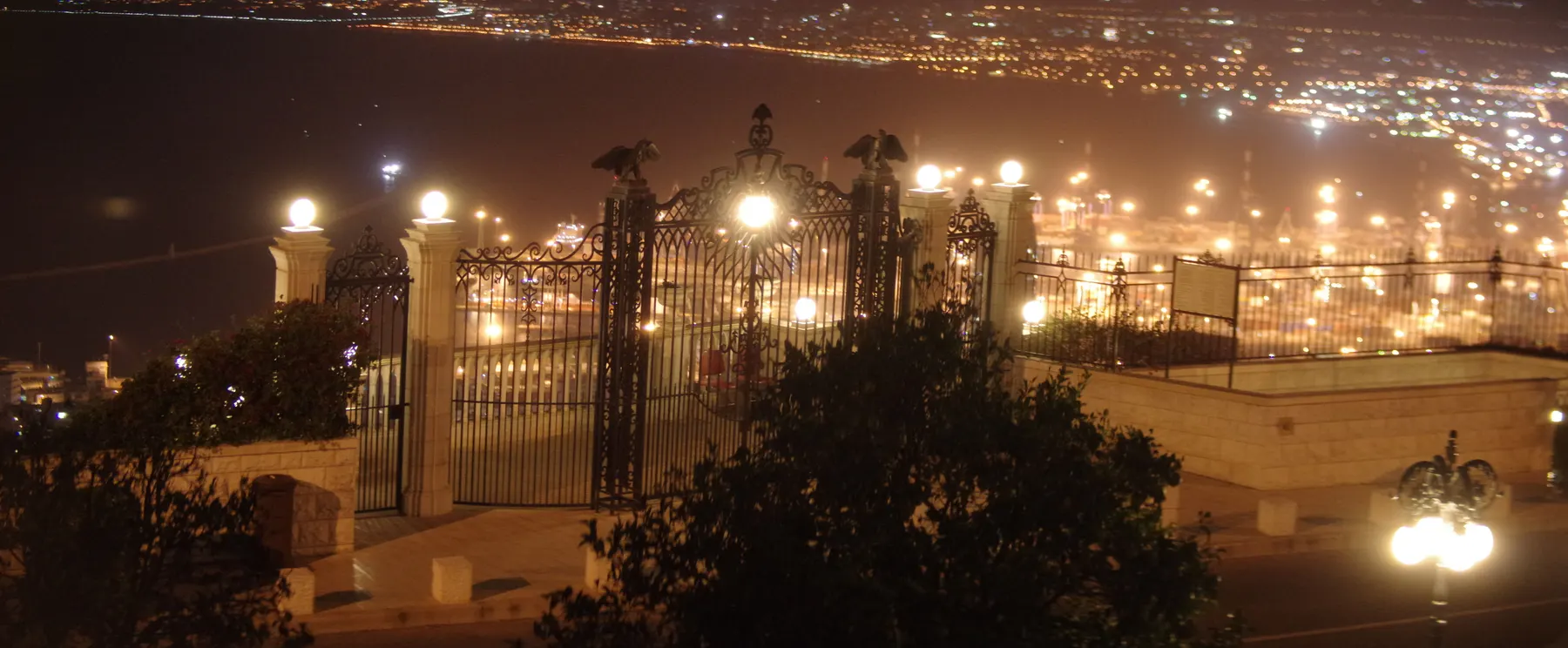
Viewpoint · Haifa
Louis Promenade
A 400-metre clifftop walk on Yefe Nof Street, given to Haifa in 1992 by Paul and May Goldschmidt in memory of their son Louis, and built by the man who was principal contractor of the Bahai gardens on the slope below it.
אהוד הלפרין / CC BY-SA 4.0 · Wikimedia Commons
Length
about 400 m
along the ridge line of Yefe Nof Street, Merkaz HaCarmel
Opened
1992
donated by Paul and May Goldschmidt of Haifa, formerly of South Africa
Admission
Free
listed by the Haifa tourism association among the city's free attractions, 2026
Kaiser's obelisk
25 October 1910
at the western end, marking Wilhelm II's visit of 1898
In short
- How long to give it
- about 45 minutes, or 90 with the Bahai balcony opposite
- Louis Promenade
- No published hours. The Haifa tourism association lists it as an attraction with no opening times: it is an ungated public walkway beside a city street.
- Louis Promenade
- Free. The Haifa tourism association carries it under the city's free attractions.
טיילת לואי
The Louis Promenade is a walkway about 400 metres long that runs along the top of the Carmel escarpment on Yefe Nof Street, in the Merkaz HaCarmel district of Haifa. It is the standard place to stand and look at the city: the ground drops away immediately to the north, the Bahai terraces descend the slope just to the east of it, and the whole of Haifa Bay opens out below. It was built in 1992, and it costs nothing.
The Haifa tourism association, which runs the visitor site for the city, describes what is visible from it as running from the bay and the Krayot suburbs to Acre, Nahariya and the Galilee hills, as far as Rosh Hanikra on the Lebanese border and, on its account, to Mount Hermon. How much of that list a visitor actually sees on a given morning is a question of haze rather than of geography, and Haifa's summers are humid.
It is not a wild clifftop path. The promenade takes in a 1950s public garden, a pool with a waterfall, lawns, benches, a large children's playground and a viewing terrace built out over the street, with hotels and their restaurants along the ridge behind. The name is a private one. Paul and May Goldschmidt, Haifa residents who had come from South Africa, paid for the promenade in memory of their son Louis, killed in a road accident on 15 May 1971. Paul Goldschmidt was the principal contractor of the Bahai gardens on the slope beneath.
The view
What is actually below the railing
The promenade sits on the northern edge of the Carmel ridge, which is the reason Haifa is described vertically. Below it, in order, are the Carmel slope, the mid-slope districts, the downtown and the port, and then the water. The bay curves away to the north-east towards Acre and Nahariya, and the Galilee headlands close it off at the far side. This is a working view rather than a scenic one: container stacks, tanks, breakwaters and cranes occupy the middle distance, and they are a fair account of what the city does for a living.
The Bahai terraces are the thing most people come to photograph, and the geometry is worth understanding before arriving. The 19 terraces and the golden-domed Shrine of the Bab climb the slope directly below Yefe Nof, and the axis they form continues down through the German Colony to the sea. From the promenade the terraces are to one side rather than dead ahead; the framed, head-on photograph of the whole staircase is taken from the Bahai gardens' own viewing balcony at 61 Yefe Nof, which is a separate site with its own gate and its own hours, immediately across the street.
The Haifa tourism association's page for the promenade lists the panorama as taking in Haifa Bay, the Krayot, Acre, Nahariya, the mountains of the Galilee and Rosh Hanikra, and it adds Mount Hermon, the northernmost point in the country. Hermon is a long way off across the Galilee, and it is not a sight to plan a trip around. The nearer half of that list, out to Rosh Hanikra, is the reliable part.
Founding
Paid for by the family whose son it commemorates
The promenade was donated, not municipally budgeted. Paul and May Goldschmidt were Haifa residents who had immigrated from South Africa, and they gave the walkway to the city in memory of their son Louis, who was killed in a traffic accident on 15 May 1971. The Hebrew accounts do not agree on his Hebrew name: the article on the promenade gives Louis (Uriel), the article on the surrounding neighbourhood gives Louis (Ariel).
Paul Goldschmidt's other work is on the same hillside. He was the principal contractor of the Bahai gardens, and when the promenade was laid out it was designed to double as an entrance to them from the ridge. That entrance is no longer in use, which is why a visitor arriving today has to walk to the separate balcony gate at number 61 rather than stepping from the promenade into the gardens.
The gift extended past the paving. Hebrew Wikipedia's account records that the parking and the public conveniences serving the promenade were funded by the family as well, and that the Goldschmidts later paid for a refurbishment of the Haifa educational zoo, further up the ridge, including electric carts that made the zoo usable by people with mobility problems. The zoo carries their son's name too.
The dates put the promenade slightly ahead of the thing it now overlooks. It opened in 1992; the 19 Bahai terraces below it, to Fariborz Sahba's design, were not opened to the public until June 2001. For nine years this was a viewpoint over a building site.
1898 to 1910
The Kaiser stood here first, and the Templers built him a terrace
The idea that this particular stretch of ridge is where you look at Haifa from is nearly a century older than the promenade, and it is German. Kaiser Wilhelm II arrived in Haifa on 25 October 1898 aboard the imperial yacht Hohenzollern, stepping ashore on a pier 65 metres long and 6 metres wide that the Templer engineer Gottlieb Schumacher had built for him beside the German Colony so that the Kaiser could first set foot on German-built ground. That same day the party went up to Carmelheim, the German settlement on the mountain, and on the way back stopped to look down on Haifa and the colony from the heights.
Friedrich Keller, one of the Templer leaders, decided to donate land on the Carmel in acknowledgement of the visit. About a year later the Templers presented a plan for a park running from the road up to the Carmel as far as the spot from which the Kaiser and his party had looked out. The far end of it was marked on the plan as Kaiserplatz, the Kaiser's terrace, and an obelisk to Wilhelm and his wife Auguste Victoria was to stand there.
The obelisk was inaugurated at the top of the Carmel on 25 October 1910, twelve years to the day after the landing. A German warship was to have anchored in Haifa with a party of sailors for the ceremony, but the plan was dropped amid German and Turkish tension following the murder of the Templer farmer Fritz Unger at Neuhardthof. Every October until the First World War the Templers held a Kaiserfest on the spot.
The war ended that. A gun position was dug in beside the obelisk, the British took the height when they captured Haifa, the park land was expropriated, and the monument was eventually destroyed. The Germans rebuilt it; then the Templers were deported during the Second World War, the site was neglected, and the obelisk disappeared under scrub.
Reconstruction
What at the western end is original, and what is not
Almost nothing. The obelisk standing in the small grove at the promenade's western end is a reconstruction, tidied up for the 1982 visit of Prince Louis Ferdinand of Prussia, the Kaiser's grandson, at the urging of Alex Carmel, the first scholar to work seriously on the Templers in this country. The rebuilt column faces south. The original faced north.
The lettering was reconstructed too, and the differences are recorded. The original cut WILHELM II, J.R., Auguste, Victorja, J.R. and 25 Okt. 1898, with full stops in places the new tablet does not use; the replacement reads AUGUSTA VICTORIA and spells the date out as 25 OCTOBER 1898. Explanatory panels in Hebrew and English were put up with it.
The naval gun beside the obelisk is a later arrival and belongs to nobody who was here. It is a Belgian muzzle-loader of French pattern, made at Liege in 1857, brought up from the memorial garden on Hasan Shukri Street and placed here, in the Hebrew account's phrase, as a counterweight to the German and Turkish side that lost the war.
The rest of the promenade is honest 1990s municipal landscaping laid over 1950s public gardens, which is not a criticism of it. What is genuinely old on this stretch is the sight line itself, and the fact that somebody thought it worth formalising in about 1899.
On the ground
Four hundred metres, and what stands on them
The promenade runs between the hotel at its eastern end, which has traded as the Nof and as the Bay View, and the Kaiser's obelisk at the west. Within that stretch it absorbs the Yefe Nof garden, laid out by the Haifa architect Shmuel Rozov as part of the city's public gardens programme in the 1950s, with a pool fed by a small waterfall. The bronze doe with her fawn at the water's edge is credited to the sculptor Aryeh Reznik, though the attribution is not airtight: the source the Hebrew account cites for it is a 1954 newspaper notice about a new sculpture in Gan Ha'em, the larger park a few streets away.
The rounded building standing on diagonal columns above the walk is the Rondo, the restaurant of the Dan Carmel hotel, also by Rozov, who designed the hotel; work on it began in 1961 and it opened in March 1963. The original drawings put a kiosk underneath the restaurant. It was never built, and the open apron under the Rondo became part of the promenade instead.
The observation terrace is built out above the street rather than set back behind it, which is what gives the drop its effect. The tourism association's own description of the walk lists flowering cultivated planting set into Mediterranean scrub, wide open lawns alongside smaller hidden corners, benches, and a large children's playground.
At the far end from the obelisk, between Beit Mainz and the Panorama towers, stands a memorial to the 73 soldiers killed when two Yasur transport helicopters collided over She'ar Yashuv on 4 February 1997. Five of the dead were Haifa residents. The Hebrew account of the neighbourhood places the memorial at the end of the promenade; the account of the disaster gives its address on Sderot HaNassi, the boulevard immediately behind.
- Yefe Nof garden and the pool with the doe and fawn, from the 1950s
- The Rondo, the Dan Carmel's round restaurant on diagonal columns
- The viewing terrace cantilevered over Yefe Nof Street
- A large children's playground and open lawns
- The memorial to the 73 killed in the 1997 helicopter collision
- The Kaiser's obelisk and the 1857 Belgian gun, at the western end
Across the street
The Bahai balcony is a separate site with a separate gate
The single most common mistake here is treating the promenade and the Bahai gardens' upper viewpoint as one place. They are two, on opposite sides of Yefe Nof Street, and only one of them has rules. The Bahai World Centre's own site gives the balcony's address as 61 Yefe Nof, open daily 09:00 to 17:00, closed on Bahai holy days and on Yom Kippur, with entrance free of charge and no reservation required. It describes three viewing platforms and a water fountain reached by two flights of stairs.
The dress and conduct rules apply inside that gate and not on the promenade: shoulders and knees covered with no tears in the fabric, no weapons, no animals, and nothing to eat or drink beyond a bottle of water, with chewing gum and smoking also excluded. The balcony is a viewpoint only, and the descent through the terraces from it is not part of a self-guided visit.
The Bahai site returns the favour and points visitors back across the road, noting that the Louis Promenade is directly opposite and gives pedestrian access to nearby shops and restaurants. It also publishes the practical details that the promenade's own operator does not: street parking on Yefe Nof, two marked accessible parking spaces 50 metres west of the balcony entrance, and a public toilet 100 metres east of it, the nearest accessible one on the street.
One current closure is worth checking before travelling. As published in August 2026, the Shrine of the Bab itself is closed to the public from 9 August to 5 September 2026, while the outer gardens stay open daily 09:00 to 17:00. The balcony on Yefe Nof is a viewpoint over the terraces rather than an entrance to the shrine, so this does not shut it, but the gardens' hours move for Bahai holy days and should be confirmed on the day.
What to look for
Things not to walk past at Louis Promenade
The details that repay knowing about before you are standing in front of them.
The cantilevered viewing terrace
The platform is built out over Yefe Nof Street rather than set back from it, so the ground falls away from directly under the railing. It is the reason the drop reads as a cliff rather than as a slope.
The Kaiser's obelisk
A reconstruction of the 1910 monument to Wilhelm II and Auguste Victoria, standing in a small grove at the western end. It was rebuilt for the 1982 visit of the Kaiser's grandson and now faces south, where the original faced north.
The 1857 Belgian gun
A muzzle-loading naval gun of French pattern, made at Liege, moved up here from the memorial garden on Hasan Shukri Street. The Hebrew account describes it as a counterweight to the German and Turkish side that lost the First World War.
The doe and fawn pool
A pool with a small waterfall in the 1950s Yefe Nof garden, with a bronze doe and her fawn at the edge, credited to Aryeh Reznik. The attribution rests on a 1954 notice about a sculpture in the neighbouring Gan Ha'em, so treat it as probable rather than settled.
The Rondo
The Dan Carmel's round restaurant, raised on diagonal columns above the walk, by the same architect who designed the hotel, Shmuel Rozov. A kiosk was drawn under it and never built, so the space beneath became promenade.
The 1997 helicopter memorial
At the eastern end, between Beit Mainz and the Panorama towers, for the 73 soldiers killed when two Yasur helicopters collided over She'ar Yashuv on 4 February 1997. Five of them were from Haifa.
The long view
Louis Promenade, in order
25 October 1898
Kaiser Wilhelm II lands at Haifa on a pier built for him by the Templer engineer Gottlieb Schumacher, and later that day looks down on the town and the German Colony from the Carmel.
About 1899
The Templers, on Friedrich Keller's initiative, present a plan for a park running up to the Kaiser's viewpoint, its far end marked Kaiserplatz.
25 October 1910
The obelisk to Wilhelm II and Auguste Victoria is inaugurated on the ridge. A German warship's ceremonial party is cancelled amid German and Turkish tension after the murder of the Templer farmer Fritz Unger.
1918
The British take the height and the gun position beside the obelisk when they capture Haifa, expropriate the park, and the monument is later destroyed.
1950s
Shmuel Rozov lays out the Yefe Nof garden with its pool and waterfall as part of the city's public gardens programme.
1961-1963
The Dan Carmel is built to Rozov's design, work starting in 1961 and the hotel opening in March 1963. Its round Rondo restaurant stands over what is now the promenade.
15 May 1971
Louis Goldschmidt is killed in a road accident.
1982
The obelisk site is restored for the visit of Prince Louis Ferdinand of Prussia, encouraged by the historian Alex Carmel. The rebuilt column faces south.
1992
The Louis Promenade opens, donated by Paul and May Goldschmidt, and designed to serve also as a ridge entrance to the Bahai gardens.
4 February 1997
Two Yasur helicopters collide over She'ar Yashuv, killing 73 soldiers. A memorial to them is later put up at the promenade's eastern end.
June 2001
The 19 Bahai terraces below the promenade open to the public, to Fariborz Sahba's design.
December 2021
Haifa municipality extends the Holiday of Holidays festival onto the promenade, with a four-day fair from 25 to 28 December.
Practical
Visiting Louis Promenade
Where
Yefe Nof Street, Merkaz HaCarmel, Haifa
Opening hours
- Louis Promenade
- No published hours. The Haifa tourism association lists it as an attraction with no opening times: it is an ungated public walkway beside a city street.source
- Bahai balcony, 61 Yefe Nof
- Daily 09:00 to 17:00. Closed on Bahai holy days and on Yom Kippur.source
- Shrine of the Bab, 2026 closure
- Closed to the public from 9 August to 5 September 2026. The outer gardens stay open daily 09:00 to 17:00.source
Admission
Access
The promenade itself is the easy part: 400 metres of paved walkway running level along the ridge, with benches, and the Haifa tourism association tags it among the city's accessible places. Getting to it is the hard part, because every approach from the lower city is a climb: the Carmelit funicular between the downtown and Merkaz HaCarmel covers 274 metres of height difference between its end stations. Take the funicular or a bus rather than walking up. Across the street, the Bahai balcony is much less accessible: its three viewing platforms are reached by two flights of stairs and the gardens' own site describes only a small area there as wheelchair accessible, with two marked accessible parking spaces 50 metres west of the entrance.
On site
- Benches
- Lawns
- Children's playground
- Viewing terrace
- Public toilet 100 m east of the Bahai balcony entrance
- Street parking on Yefe Nof
- Two accessible parking spaces
- Hotel restaurants on the ridge
Booking
Nothing to book. The Bahai gardens' guided tours from the main entrance do require reservation, but the balcony viewpoint opposite the promenade does not.
Hours and prices are given as the operator publishes them and change without much notice, particularly around Shabbat and the festivals. Check the operator's own page before you travel for this.
Official page at visit-haifa.org →What people wish they had known
- The head-on photograph of the Bahai terraces is not taken from the promenade. It is taken from the gardens' own balcony at 61 Yefe Nof, directly across the street, which closes at 17:00 and enforces a dress code the promenade does not.
- Most people walk a hundred metres from the hotels, take the photograph and turn back. The obelisk, the gun and the grove are at the far western end, and the whole promenade is only about 400 metres.
- Do not plan to walk up from the German Colony to reach it. The Carmelit funicular exists precisely to save that climb, covering 274 metres of height difference between the lower city and Merkaz HaCarmel in a single tunnel.
- The obelisk is a reconstruction, and it faces the wrong way. The 1910 original faced north; the column rebuilt for the 1982 royal visit faces south.
- There is one public toilet on this stretch, 100 metres east of the Bahai balcony entrance, and it is also the nearest accessible one. Parking is ordinary street parking on Yefe Nof.
- Check the Bahai gardens' site before building a day around the terraces. Their hours move for Bahai holy days and Yom Kippur, and in 2026 the Shrine of the Bab was closed to the public from 9 August to 5 September.
The figures
Louis Promenade by the numbers
Each figure carries the year it belongs to and links the source it came from.
| Measure | Figure | As of | Source |
|---|---|---|---|
| Length of the promenade | about 400 m | 2026 | visit-haifa.org |
| Year opened | 1992 | 2026 | visit-haifa.org |
| Bahai balcony hours, 61 Yefe Nof | daily 09:00 to 17:00 | 2026 | ganbahai.org.il |
| Marked accessible parking spaces at the balcony | 2, fifty metres west of the entrance | 2026 | ganbahai.org.il |
| Kaiser's obelisk inaugurated | 25 October 1910 | 1910 | he.wikipedia.org |
| Kaiser's landing pier at the German Colony | 65 m long, 6 m wide | 1898 | he.wikipedia.org |
| Death of Louis Goldschmidt | 15 May 1971 | 1971 | he.wikipedia.org |
| Dan Carmel hotel opened | March 1963 | 1963 | he.wikipedia.org |
While you are here
The rest of Haifa
Everything else in this destination with a page of its own.
Chris Yunker from St. Louis, United States / CC BY-SA 2.0 · Wikimedia Commons
Religious site
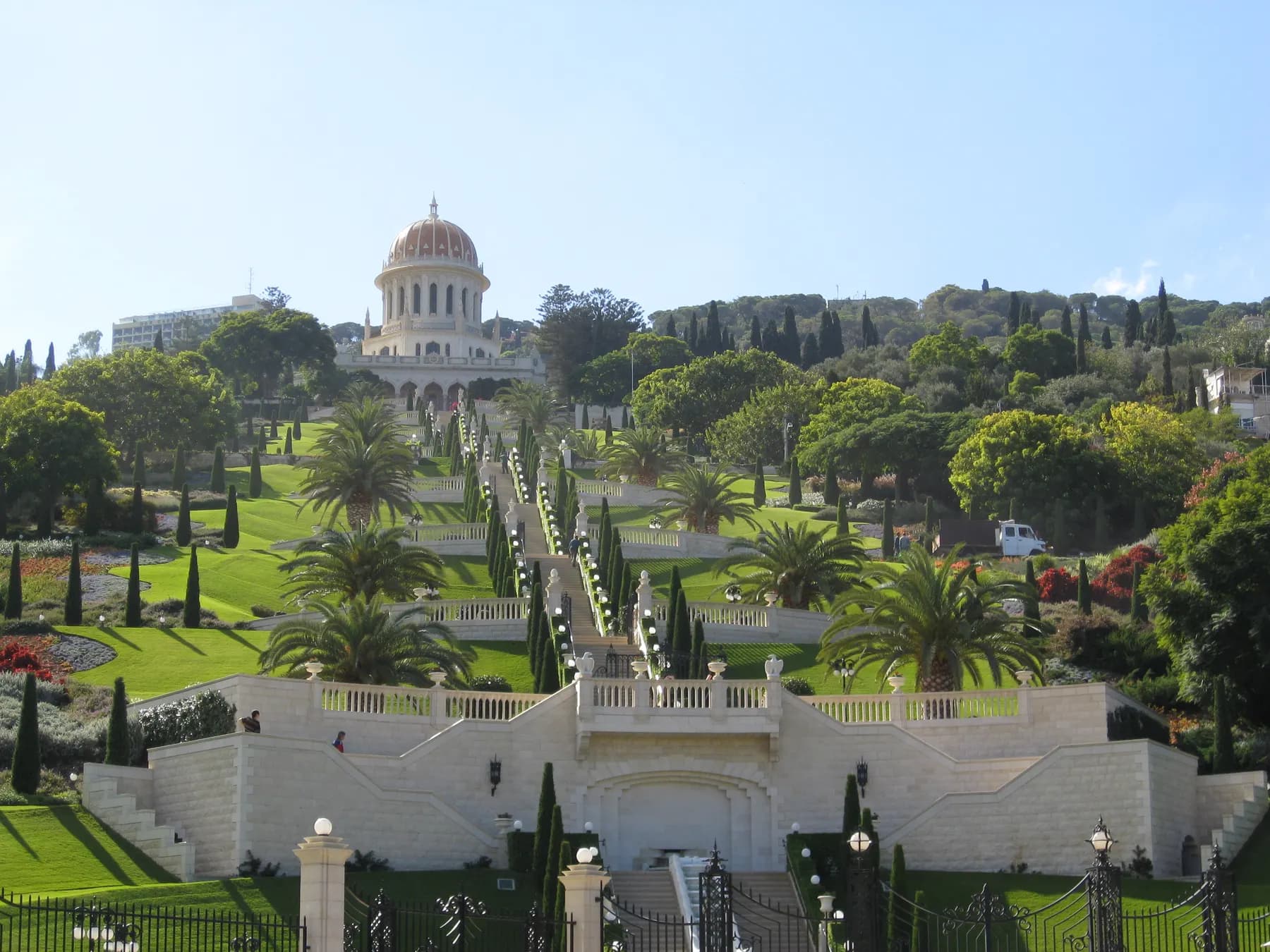
Bahai Gardens and the Shrine of the Bab
Nineteen terraces climb 225 vertical metres of Mount Carmel around a shrine whose stone core was built to receive a body that had been hidden for most of a century.
אושרי רייכר / CC BY 2.5 · Wikimedia Commons
Neighbourhood
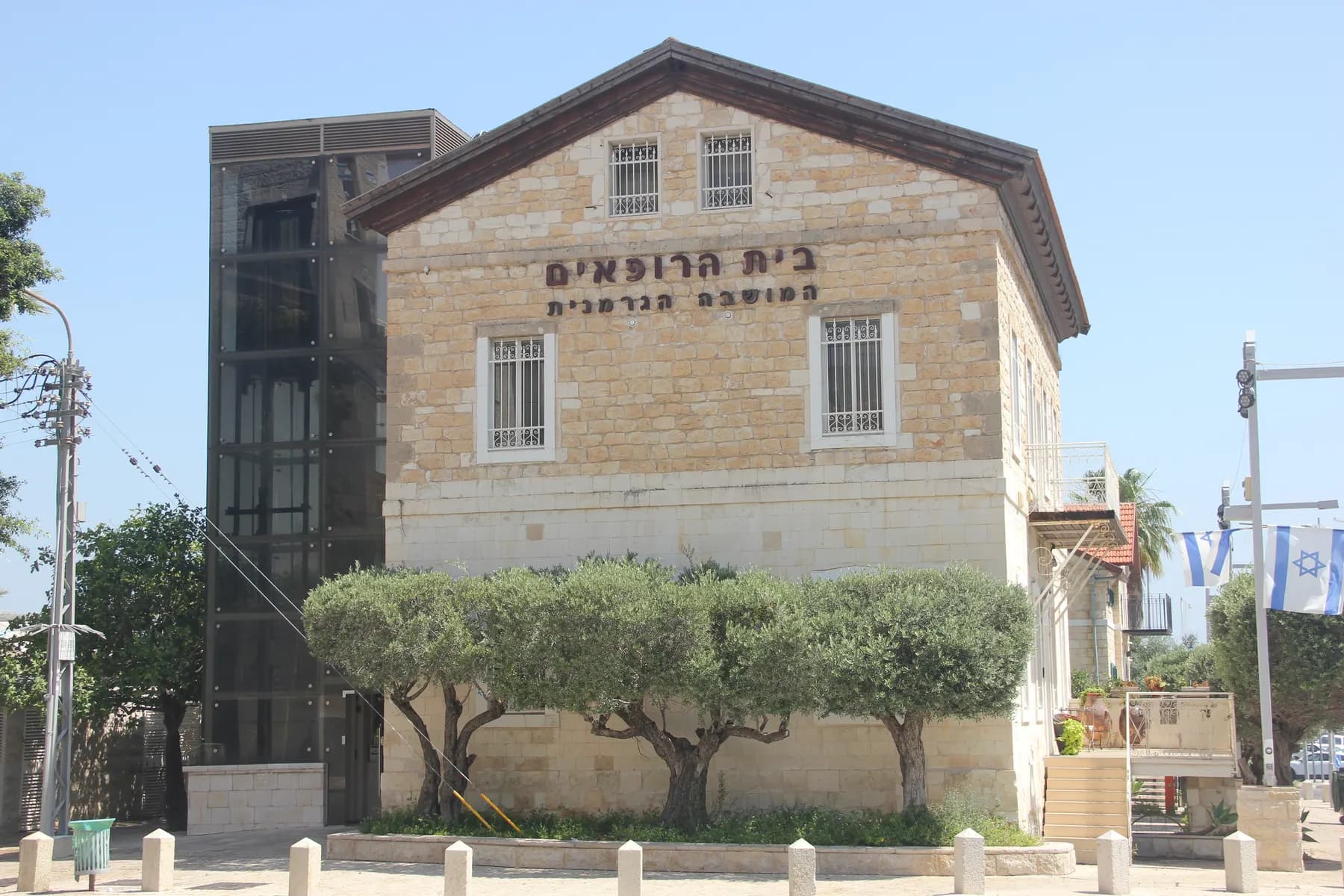
German Colony
A German Templer settlement of 1868 whose main street was laid out 30 metres wide, pointing from the anchorage straight up Mount Carmel at ground that was then the colony's vineyards and is now the Bahai terraces.
זאב שטיין / CC BY 2.5 · Wikimedia Commons
Religious site
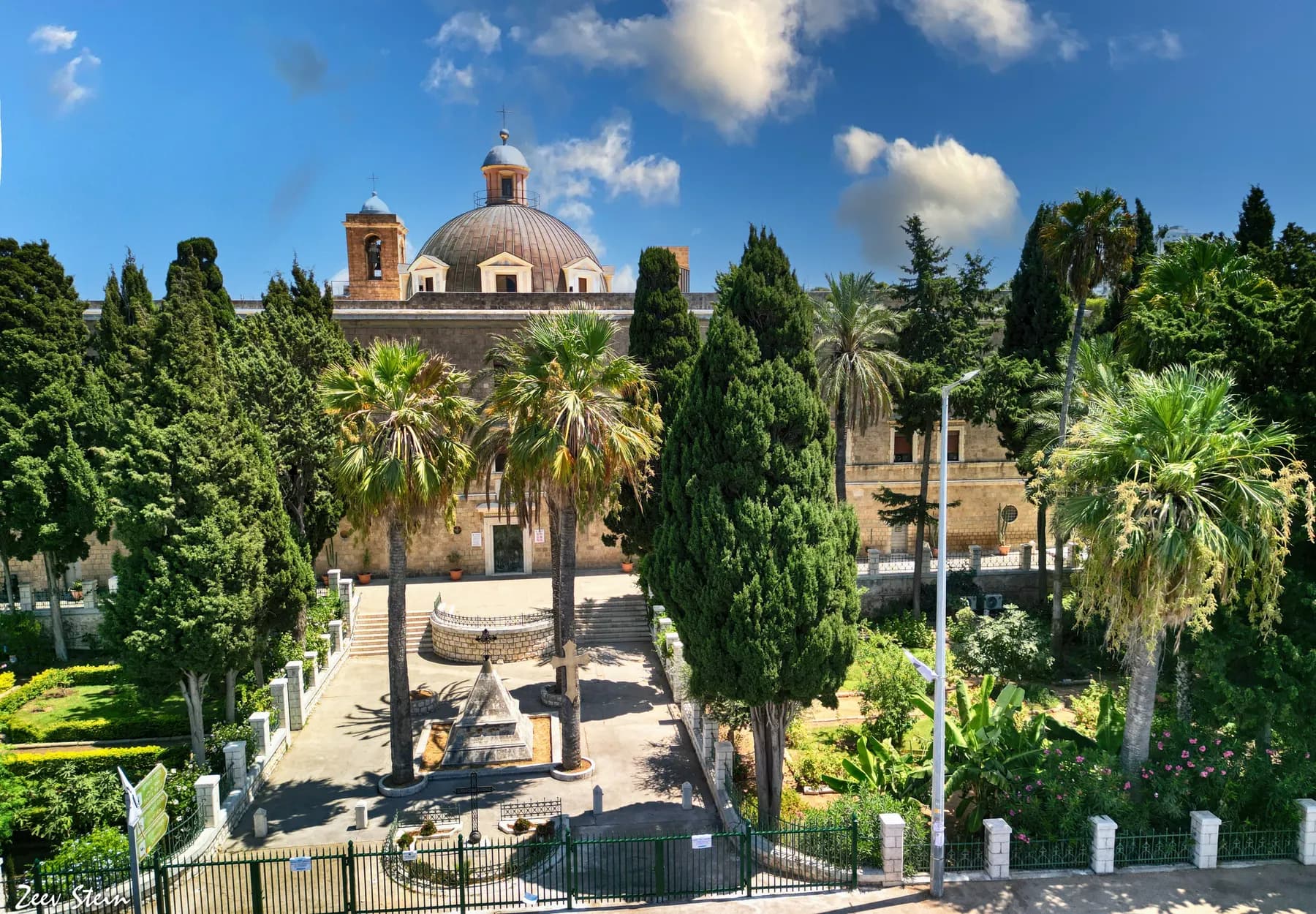
Stella Maris Carmelite Monastery
The mother house of the Discalced Carmelites stands on the seaward end of Mount Carmel over a grotto associated with Elijah, under a dome painted by the Maltese friar Luigi Poggi between 1924 and 1928.
Sources and further reading
Every link below was opened and checked when this page was written. Official statements are marked as such: they are the subject's own account, not an independent one.
- OfficialHaifa Tourism Associationvisit-haifa.orgLouis Promenade
The operator's own page: 1992, about 400 metres, the Goldschmidt donation, and the list of what is visible.
- OfficialHaifa Tourism Associationvisit-haifa.orgFree in Haifa
Where the promenade is listed as a free attraction, tagged for views, panoramic walking and accessible places.
- OfficialBahai Gardens, Bahai World Centreganbahai.org.ilVisit us in Haifa
Hours, free entry, dress and conduct rules, stairs, parking and toilets at the balcony at 61 Yefe Nof, and its note that the Louis Promenade is directly opposite.
- OfficialBahai Gardens, Bahai World Centreganbahai.org.ilEnvironmental considerations
Carries the same 2026 opening banner, including the closure of the Shrine of the Bab from 9 August to 5 September 2026.
- OfficialDan Hotelsdanhotels.comDan Carmel Haifa
The hotel whose round Rondo restaurant stands over the promenade.
- ReferenceHebrew Wikipediahe.wikipedia.orgטיילת לואי (Louis Promenade)
The fullest account: the donors, the 15 May 1971 accident, the disused garden entrance, the Rondo, the Yefe Nof garden and the doe, and the December 2021 fair.
- ReferenceHebrew Wikipediahe.wikipedia.orgאובליסק הקיסר בחיפה (The Kaiser's obelisk in Haifa)
The 1898 landing and pier, Keller's donation, the Kaiserplatz plan, the 1910 inauguration, the wartime destruction, the 1982 rebuild and the Belgian gun.
- ReferenceHebrew Wikipediahe.wikipedia.orgמרכז הכרמל (Merkaz HaCarmel)
Puts the promenade's ends at the Nof hotel and the obelisk, names the Yefe Nof garden and the doe pool, and places the helicopter memorial at its end.
- ReferenceWikipediaen.wikipedia.orgMerkaz HaCarmel
Independent English confirmation of the 1992 date, the 400-metre length and the Goldschmidt donation.
- ReferenceHebrew Wikipediahe.wikipedia.orgשמואל רוזוב (Shmuel Rozov)
The Haifa architect, born 1900, died 1975, who designed the Dan Carmel and the Yefe Nof garden.
- ReferenceHebrew Wikipediahe.wikipedia.orgמלונות דן (Dan Hotels)
Dates the Dan Carmel: designed by Rozov, built from 1961, opened March 1963.
- ReferenceHebrew Wikipediahe.wikipedia.orgכרמלית (The Carmelit)
Source for the climb up to the ridge: 274 metres of height difference between the Merkaz HaCarmel and lower city stations, 268 metres between the tunnel ends.
- ReferenceHebrew Wikipediahe.wikipedia.orgאסון המסוקים (The 1997 helicopter disaster)
The 4 February 1997 collision, the 73 dead, and the Haifa memorial between the Panorama towers and Beit Mainz.
Louis Promenade: common questions
Is the Louis Promenade free?+
Yes. The Haifa tourism association lists it among the city's free attractions, and there is no gate, no ticket and no booking. The Bahai gardens' viewing balcony across the street is also free of charge, but it does have opening hours and a dress code.
How long is the Louis Promenade and how long does it take to walk?+
It is about 400 metres, so twenty minutes at a stroll and back. Allow around 45 minutes to take in the Yefe Nof garden and the pool, the viewing terrace and the obelisk at the western end, and about 90 minutes if you cross to the Bahai balcony as well.
Is this the same place as the Bahai Gardens viewpoint?+
No, they are two separate sites facing each other across Yefe Nof Street. The promenade is a municipal walkway with no hours; the Bahai balcony at number 61 is run by the Bahai World Centre, opens daily 09:00 to 17:00, closes on Bahai holy days and Yom Kippur, and requires shoulders and knees to be covered. The promenade was originally designed to double as a ridge entrance to the gardens, but that entrance is no longer in use.
Can you see the Bahai terraces from the promenade itself?+
Partly. The terraces descend the slope just east of the promenade, so from the walkway they are seen at an angle, with the bay and the port filling most of the view. The straight-down-the-axis view of all 19 terraces and the golden dome comes from the balcony opposite.
Is the Louis Promenade wheelchair accessible?+
The promenade is paved, level and benched, and the Haifa tourism association includes it among the city's accessible places. The problem is the approach, since the ridge stands 274 metres above the lower city by the height difference the Carmelit funicular covers between its end stations. The Bahai balcony across the road is far less accessible: its viewing platforms are up two flights of stairs, and the gardens' own site describes only a small area there as wheelchair accessible, with two marked accessible bays 50 metres west of the entrance.
Is there shade on the promenade?+
Some, but not continuously. The tourism association describes flowering cultivated planting set into Mediterranean scrub, with wide open lawns alongside smaller enclosed corners, so there are trees along parts of the walk and none at all on the viewing terrace, which is the point of it. In July and August the ridge is cooler and breezier than the bay below, though it is still a Mediterranean summer.
What is the obelisk at the end of the promenade?+
It commemorates Kaiser Wilhelm II's visit to Haifa on 25 October 1898, and was inaugurated on the same date in 1910 by the German Templer community, whose plan called the spot Kaiserplatz. The original was damaged when the British took the height in the First World War and eventually destroyed; what stands there now is a reconstruction made for the 1982 visit of the Kaiser's grandson, Prince Louis Ferdinand of Prussia.
Why is it called the Louis Promenade?+
It is named for Louis Goldschmidt, a Haifa resident killed in a traffic accident on 15 May 1971. His parents, Paul and May Goldschmidt, who had immigrated from South Africa, paid for the promenade and gave it to the city in 1992. Paul Goldschmidt was the principal contractor of the Bahai gardens on the slope below, and the family later funded a refurbishment of the Haifa educational zoo, which also carries their son's name.
Can you get there without a car?+
Yes. The promenade is in Merkaz HaCarmel, the district at the top of the Carmelit funicular, which climbs 274 metres from the downtown in a single tunnel and takes the Rav-Kav card, and city buses serve the same ridge. Driving up means competing for street parking on Yefe Nof, which is tight.
Is it worth going out of the way for?+
If the weather is clear, yes, and it costs nothing. It is the standard vantage point on a city whose whole shape is vertical, and it takes under an hour. In heavy summer haze the far half of the panorama, the part that reaches Rosh Hanikra and beyond, simply is not there, and the German Colony below or the gardens themselves are a better use of the same morning.