Religious site · Haifa
Bahai Gardens and the Shrine of the Bab
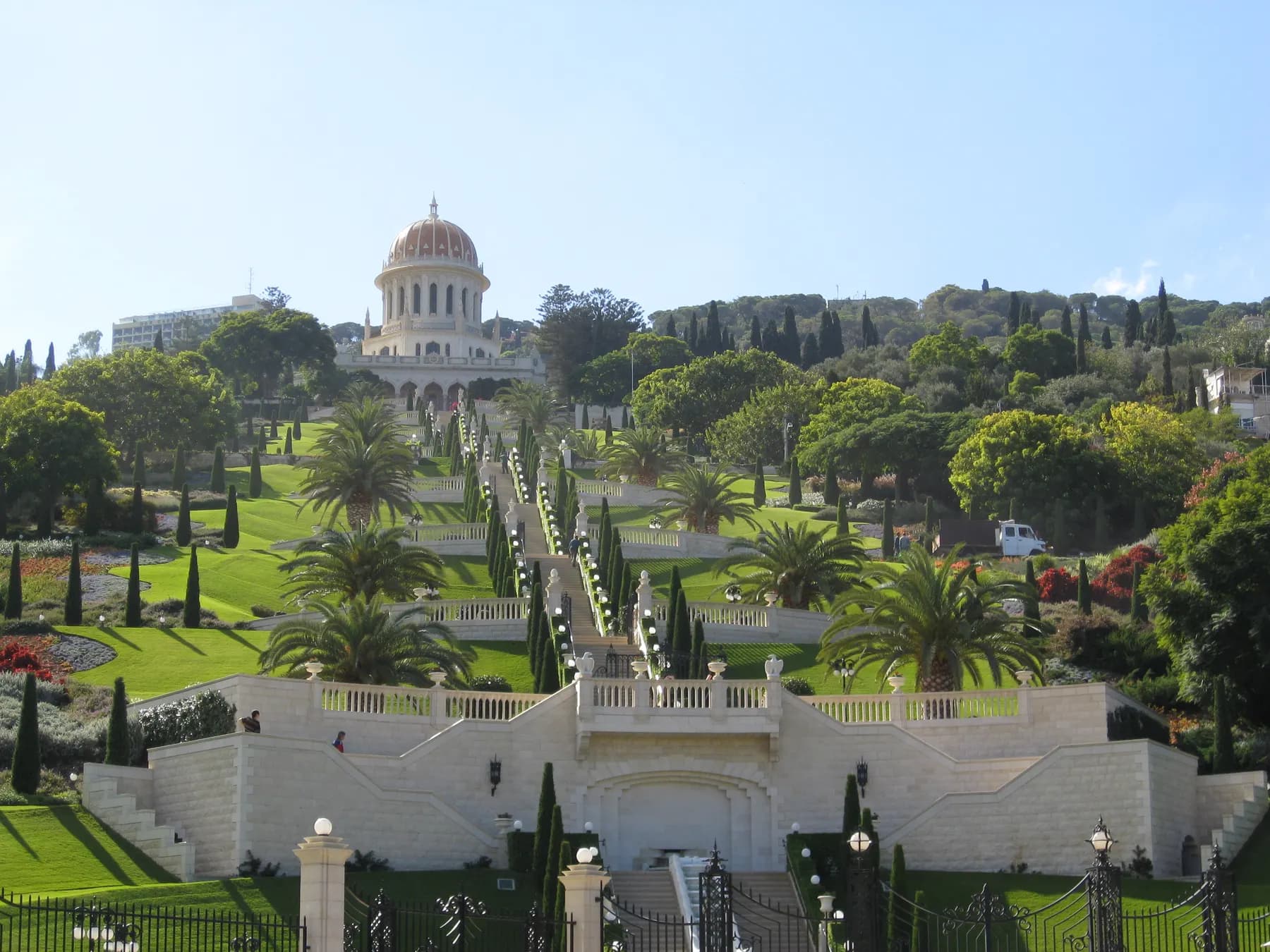
Nineteen terraces climb 225 vertical metres of Mount Carmel around a shrine whose stone core was built to receive a body that had been hidden for most of a century.
Chris Yunker from St. Louis, United States / CC BY-SA 2.0 · Wikimedia Commons
Terraces
19
eighteen for the Bab's first disciples, plus the shrine's own
Vertical climb
225 m
lowest terrace to highest, on the gardens' own figures
Admission
Free
at all three entrances, and the guided tour costs nothing either
Terraces inaugurated
22 May 2001
opened to the general public on 4 June that year
In short
- How long to give it
- about 30 minutes at any one viewpoint, about 90 minutes to take in the top and the bottom of the axis with the journey between them, and 50 minutes for the guided tour itself
- Outer gardens, all three entrances
- daily 09:00 to 17:00
- Everyone, at all three entrances
- free of charge
הגנים הבהאיים ומקדש הבאב
The Bahai Gardens in Haifa are nineteen garden terraces climbing a kilometre up the northern face of Mount Carmel, with the gold-domed Shrine of the Bab standing on the terrace at their centre. The shrine is the grave of Siyyid Ali Muhammad of Shiraz, called the Bab, who was shot in a public square in Tabriz on 9 July 1850, and it is the second holiest place in the Bahai Faith after the Shrine of Bahaullah at Bahji near Akko. Everything else on the mountain is arranged to point at that one building.
Entry costs nothing at any of the three gates, and the guided tour costs nothing either. That is the first thing most visitors do not expect. The second is what free entry actually buys: the gardens' own visitor page describes each of the three self-guided entrances as a viewpoint and nothing more. Walking down through the terraces means booking the Upper Terraces tour, which the operator puts at 50 minutes and 750 stairs.
The composition also looks older than it is. The stone core of the shrine was raised by Abdu'l-Baha and received the Bab's remains on 21 March 1909, the arcade, drum and gilded dome were finished in October 1953, and the terraces around them are a project of the 1990s. The Bahai holy places in Haifa and the western Galilee were added to the UNESCO World Heritage List in 2008, and the shrine's forecourt was rebuilt as recently as the second half of 2024.
The shrine
A six-room stone box, and the dome that arrived forty-four years later
The gardens' own history page sets out the life the building commemorates. The Bab was born in Shiraz in 1819, announced himself a messenger of God at twenty-four, forbade holy war, taught the equality of women and encouraged science and education, and was declared a heretic by the clergy. He was held in remote fortresses for three years and then executed in Tabriz on 9 July 1850, before what the operator describes as some ten thousand spectators. His remains were dumped outside the city under guard; his followers took them and moved them from hiding place to hiding place.
How long they stayed hidden is stated two ways by the same religious community. The Haifa gardens' history page says fifty years. The international Bahai site says six decades. The arithmetic between the execution and the burial gives fifty-eight years and eight months. What both accounts agree on is the sequence: in 1891 Bahaullah stood by a circle of cypresses on the bare north slope of Mount Carmel and pointed out to his son the spot for a mausoleum; Abdu'l-Baha bought the land and built a plain six-room structure of local stone; and the remains were laid in it on 21 March 1909.
Abdu'l-Baha was himself buried in the same building in November 1921, after a funeral the gardens describe as drawing ten thousand mourners, more than a quarter of the city's population, up the mountain from his house on Haparsim Street. Three further rooms were added in 1929. Britannica's entry on Haifa mentions only the tomb of Abd al-Baha, which is accurate but partial: two of the faith's central figures lie in one building, and the man the gold dome was built for is the other one.
The dome came half a century after the box. William Sutherland Maxwell, a Canadian Beaux-Arts architect and Shoghi Effendi's father-in-law, designed the superstructure in the early 1940s; the first threshold stone was laid in 1949 and the work was finished in October 1953. It is an octagon carrying an eighteen-windowed drum and a dome, with a colonnade of Rose Baveno granite and arches of Chiampo stone. Building materials were scarce in the region after the war, so most of the stone was carved in Italy and shipped, and the dome's structural engineering was done by Professor H. Neumann of the Technion, a few streets down the hill.
The terraces
Nineteen concave steps cut into the mountain rather than built out from it
Terraces around the shrine had been envisaged from early on and went up piecemeal. In 1987 the architect Fariborz Sahba was chosen to design the rest, construction ran through the 1990s, and the worldwide Bahai community paid for it out of voluntary contributions: the faith's news service put the figure at some US$250 million over the decade, writing in November 2000. Nobody in Israel was asked to contribute, because donations towards the gardens are accepted only from Bahais.
The dimensions are published by the operator and are worth having before the climb. The gardens run 1 kilometre up the northern slope and are 400 metres across at the widest point. The vertical distance between the bottom terrace and the top is 225 metres. There are approximately 1,700 steps from top to bottom, depending on the route. Nine terraces sit above the shrine and nine below it, which leaves the shrine on the tenth counting up from the German Colony.
Sahba counts eighteen rather than nineteen, and the distinction is the point of the design. The eighteen terraces stand for the Bab's first eighteen disciples, whom he named the Letters of the Living; in Arabic as in Hebrew the word for life, hai, has the numerical value eighteen. The nineteenth level belongs to the shrine alone. In the architect's words the terraces are rungs of a ladder leading to it.
The engineering answer to a slope this steep was to hollow into the mountain instead of building out from it, using concave terraces so that retaining structures and walls could be kept to a minimum. Only local stone quarried in the Galilee was used, though some of it was cut in Italy on computerised equipment that did not exist in Israel, which Sahba believed was the first time Israeli stone had been exported to Italy. The stone and metal ornament carries no religious meaning at all: the balustrades simply echo the ornamental windows in the drum below the dome.
- 1 km from the lowest terrace to the highest, 400 m across at the widest point
- 225 m of vertical climb
- About 1,700 steps top to bottom
- Nine terraces above the shrine, nine below, one for the shrine itself
Original and rebuilt
Almost nothing here is as old as it looks
By the standards of a country where the neighbouring sites are Roman and Crusader, this is a young place, and the oldest fabric in it is the part no visitor sees. The 1909 mausoleum is inside the 1953 casing. What stands in the open air is a Beaux-Arts exterior of the early 1950s wrapped around an Ottoman-era room.
The gold is newer still, and it is not gold in the way the postcards imply. The operator says the dome carries some 12,000 glazed ceramic tiles containing a very thin layer of gold leaf. Those tiles are not the originals: a restoration of the interior and exterior ran from 2008 to April 2011, with nearly 12,000 replacement tiles in more than 120 different shapes and sizes made in Portugal, fitted like a puzzle. The same project spent about 80,000 working hours on earthquake resistance, using concrete, steel and carbon fibre, and over 50,000 more on stonework, with volunteers from fifteen countries trained by conservators.
The most recent change is from the year before last. A construction project began in late July 2024, closing the shrine and the gardens around it, and they reopened on Sunday 1 December 2024. The approach paths from east and west were paved in Jerusalem Red Limestone and the plaza immediately in front of the shrine was enlarged and finished in Galil Gold Limestone, the stone already used for the floor of the colonnade and for the terraces above and below. The stated purpose was accessibility, and wheelchairs in particular.
So the honest description of what a visitor photographs is a 1953 exterior, a 2011 dome surface, gardens of the 1990s and a forecourt of 2024, arranged around a room from 1909 that is not open. That is not a criticism of the place. It is the reason the whole composition is in such unusually good condition.
Upkeep
Ninety gardeners, fifty volunteers and a computer reading the Technion's forecast
The finish of the hedges is the thing most visitors comment on, and it is bought with staff. The gardens say their team is roughly 90 local workers drawn from a variety of ethnic and religious communities, alongside 50 Bahai volunteers from more than a dozen countries. About 450 plant species grow here, most of them native to the region and chosen for colour, height, hardiness and the ability to survive on very little water.
The irrigation is the part that gets written up in the trade. A computer operates hundreds of valves through a network of polyethylene tubing so that each plant type gets what it needs when it needs it, and the scheduler works from a special weather forecast issued by the Technion to project the evapotranspiration rate. Most water goes to the roots at night through drippers and sprinklers; the occasional overhead watering needed to wash in fertiliser is done in the early morning, when evaporation is lowest. Much of the supply is brackish or polluted water pumped from licensed wells on the property and then treated.
The fountains and the streams beside the stairs look extravagant and are not. Each terrace unit circulates its own closed system, and the operator says the water added across the whole site each day to make up for evaporation is less than one person uses in a day. Large areas of lawn are sown with rye grass in winter and allowed to dry out over the summer, while the sloping ground has to stay planted year round, so ivy and other ground covers do the work of holding it in place.
There is a second Haifa underneath all this. Several Bahai World Centre buildings were dug into the side of the mountain rather than placed on top of it, to avoid disturbing the landscape and the geometry of the gardens. They are mostly offices and car parks, they include the bomb shelters Israeli law requires, and a passageway links them.
Not a park
A working religious centre that happens to own the best view in the city
The rules make more sense once the category is right. This is a pilgrimage site that admits the public, not a municipal garden that happens to contain a shrine. Nothing may be eaten or drunk inside except water from a bottle you carry, chewing gum and smoking are out, animals are not allowed, and pushchairs are kept off the tour because of the gradient. Photography is fine everywhere except inside the shrines. The gardens are not available for hire and no private events are held in them, although wedding photographs are welcome and common.
The white neoclassical buildings on the arc above the terraces are not part of the visit either. They are the administrative seat of the faith: the Seat of the Universal House of Justice, finished in 1982, the Centre for the Study of the Sacred Texts in 1999 and the Seat of the International Teaching Centre in 2000, with the International Archives building older than all three. A fifth building, an international library, has not been built.
One consequence surprises people who come away impressed. There is no Bahai community in Israel and no converts are accepted, which the gardens explain as following an instruction from Bahaullah to the believers who went into exile with him not to spread his teachings in the Holy Land. The Bahais on the mountain are volunteers serving fixed terms, on average about 650 people from around 75 countries at any one time, roughly a third of them replaced each year.
The gardens are, by a distance, the reason most visitors come to Haifa at all. Reporting in February 2012, the Times of Israel said they had drawn 900,000 visitors in 2011 and more than seven million in the decade since opening. They are also a site in a country that has air raid sirens: the operator publishes a page telling visitors caught in the open to lie on the ground, protect their heads and follow the staff.
What to look for
Things not to walk past at Bahai Gardens and the Shrine of the Bab
The details that repay knowing about before you are standing in front of them.
The axis from the German Colony plaza
The bottom gate at the junction of Ben Gurion Avenue and Hagefen Street puts the whole staircase in one frame, with the dome dead centre. A large fountain, cascading waterfalls and benches, up two flights of steps.
The balcony at 61 Yefe Nof
Three viewing levels and a water fountain at the top of the axis, looking straight down the terraces to the port, the bay and the Galilee hills. The Louis Promenade is directly across the road.
The dome, close up from the main entrance
The gate at 80 Hatzionut Avenue gives the nearest view of the shrine and the inner gardens. The dome carries some 12,000 glazed tiles with a thin layer of gold leaf, refitted between 2008 and 2011.
The succulent garden and the olive groves
The main entrance is the one part of the site that is not all clipped hedge: the operator lists olive groves, flowerbeds, a large succulent garden and a historic building on this approach.
The balustrades
Worth thirty seconds of attention on the tour. The stone and metal ornament has no religious meaning whatever: the balustrade pattern simply repeats the ornamental windows in the drum beneath the dome.
Terrace ten
The shrine stands on its own level with nine terraces above and nine below. The other eighteen stand for the Bab's first eighteen disciples, the Letters of the Living.
The long view
Bahai Gardens and the Shrine of the Bab, in order
9 July 1850
The Bab is executed in a public square in Tabriz. His followers recover the remains and move them between hiding places.
1891
Bahaullah points out to his son the spot on the north slope of Mount Carmel where a mausoleum should stand.
21 March 1909
Abdu'l-Baha places the remains in the six-room stone mausoleum he has built on the mountain.
November 1921
Abdu'l-Baha is buried in the same building after a funeral the gardens say drew ten thousand mourners. Three more rooms are added in 1929.
1949
The first threshold stone of Maxwell's superstructure is laid. Most of the stone is carved in Italy because materials are scarce after the war.
October 1953
The arcade, octagon, drum and gilded dome are completed over the original mausoleum.
1987
Fariborz Sahba is chosen to design the remaining terraces and gardens.
September 1998
The highest of the nineteen terraces opens, with the rest following over the next two years.
22 May 2001
The terraces are inaugurated before more than 3,000 Bahais from over 180 countries, some 650 dignitaries and about 100 journalists, in a temporary 4,000-seat amphitheatre at the foot of the mountain. Public opening follows on 4 June.
July 2008
The Bahai holy places in Haifa and the western Galilee are inscribed on the UNESCO World Heritage List.
2008 to April 2011
The shrine is restored inside and out, with nearly 12,000 new gilded tiles made in Portugal and about 80,000 working hours spent on earthquake resistance.
July to December 2024
Construction closes the shrine and its gardens from late July. They reopen on 1 December with repaved approaches and an enlarged plaza in front of the shrine.
Practical
Visiting Bahai Gardens and the Shrine of the Bab
Where
Main entrance 80 Hatzionut Avenue; balcony 61 Yefe Nof Street; German Colony plaza 21 Hagefen Street, Haifa
What ticket you need
Nothing here is ticketed, but the shrine and the gardens are two different openings on one free site: the terraces around the shrine run to 17:00 while the shrine itself is a morning visit, and the operator closes the shrine for weeks at a time for works. The site is also one component of a UNESCO World Heritage property that takes in Bahai places across Haifa and the western Galilee, including the Shrine of Bahaullah at Bahji outside Akko, which keeps its own separate hours.
Opening hours
- Outer gardens, all three entrances
- daily 09:00 to 17:00source
- Shrine of the Bab, 80 Hatzionut Avenue
- daily 09:00 to 12:00, as published by the operator when the shrine reopened on 1 December 2024source
- Shrine of the Bab, current closure
- closed to the public from 9 August to 5 September 2026, while the outer gardens stay opensource
- Upper Terraces guided tour, 45 Yefe Nof Street
- Tuesday to Sunday, by reservation, 50 minutessource
- Closed
- Bahai holy days and Yom Kippur, and the gardens may close temporarily in rainy weathersource
Admission
Access
Partial, and the operator is unusually straight about the limits. The Upper Terraces tour includes 750 stairs and is explicitly not suitable for anyone with walking difficulties, so a wheelchair cannot do the terraces. Of the three self-guided entrances, the German Colony plaza is described as suitable for visitors with limited mobility, with a wide paved area, benches and designated accessible parking on Ben Gurion Avenue; the main entrance at 80 Hatzionut has the largest area of paved surface but a moderately steep paved slope where wheelchair users may want assistance, with no designated accessible parking though loading at the kerb is possible; the balcony at 61 Yefe Nof has only a small accessible area, with two accessible parking spaces 50 m to the west. A separate accessible guided route starting and ending at 103 Hatzionut Avenue is recommended for wheelchair users, runs about 10 m of moderate slope and then about 50 m of flat paved path to a viewing terrace, is capped at 15 people, and must be arranged 10 business days in advance. Guides are trained to support lip-reading, written material is available, ornament may be explored by touch, and service animals are permitted.
On site
- Three free entrances
- Accessible toilets at the main entrance
- Public toilets near the balcony and on Ben Gurion Avenue
- Visitor Information Centre with an accessible auditorium
- Street parking on Yefe Nof Street and Hatzionut Avenue
- Two accessible parking spaces near the balcony
- Benches and shaded areas on the accessible route
- No cafe, kiosk or picnic area anywhere inside
Booking
The three viewpoints need no reservation. The Upper Terraces tour does: it runs Tuesday to Sunday for individuals and groups of up to 19, is booked online through the gardens' site, and starts at 45 Yefe Nof Street and finishes somewhere else, which matters if a car has been left at the start. Groups of 20 or more are handled by separate request. The operator asks people who cannot come to cancel by phone or email so the place can go to somebody else.
Hours and prices are given as the operator publishes them and change without much notice, particularly around Shabbat and the festivals. Check the operator's own page before you travel for this.
Official page at ganbahai.org.il →What people wish they had known
- Free entry does not mean free run of the terraces. All three self-guided entrances are viewpoints; the only way down through the gardens is the Upper Terraces tour, which has to be booked.
- The shrine keeps shorter hours than the gardens around it, 09:00 to 12:00 against 17:00, and it closes outright for maintenance: the operator currently publishes a closure from 9 August to 5 September 2026.
- The guided tour starts at 45 Yefe Nof Street and ends at a different place further down the mountain, so parking at the start and expecting to walk back to the car is a mistake.
- The dress rule includes the state of the fabric as well as its coverage: shoulders and knees covered, and no tears. Fashionably ripped jeans are the usual reason someone is turned away.
- Water in a bottle is the only thing that may be drunk inside. No coffee, no snacks, no chewing gum and no smoking anywhere in the gardens, and there is nowhere inside to buy any of it.
- The paths are pebbled and the paving is sometimes slippery, so the operator's advice about shoes with grip is practical rather than decorative. Bahai holy days move from year to year, and the gardens close on them and on Yom Kippur.
The figures
Bahai Gardens and the Shrine of the Bab by the numbers
Each figure carries the year it belongs to and links the source it came from.
| Measure | Figure | As of | Source |
|---|---|---|---|
| Length and width of the gardens | 1 km up the northern slope, 400 m across at the widest point | 2026 | ganbahai.org.il |
| Vertical distance, bottom terrace to top | 225 m | 2026 | ganbahai.org.il |
| Steps from top to bottom | approximately 1,700, depending on the route | 2026 | ganbahai.org.il |
| Stairs on the Upper Terraces guided tour | 750 | 2026 | ganbahai.org.il |
| Plant species in the gardens | about 450, most native to the region | 2026 | ganbahai.org.il |
| People who maintain the gardens | roughly 90 local workers and 50 Bahai volunteers from more than a dozen countries | 2026 | ganbahai.org.il |
| Tiles on the dome | some 12,000 glazed ceramic tiles carrying a very thin layer of gold leaf | 2026 | ganbahai.org.il |
| Cost of building the terraces | some US$250 million, from voluntary contributions by the worldwide Bahai community | 2000 | news.bahai.org |
While you are here
The rest of Haifa
Everything else in this destination with a page of its own.
אושרי רייכר / CC BY 2.5 · Wikimedia Commons
Neighbourhood
German Colony
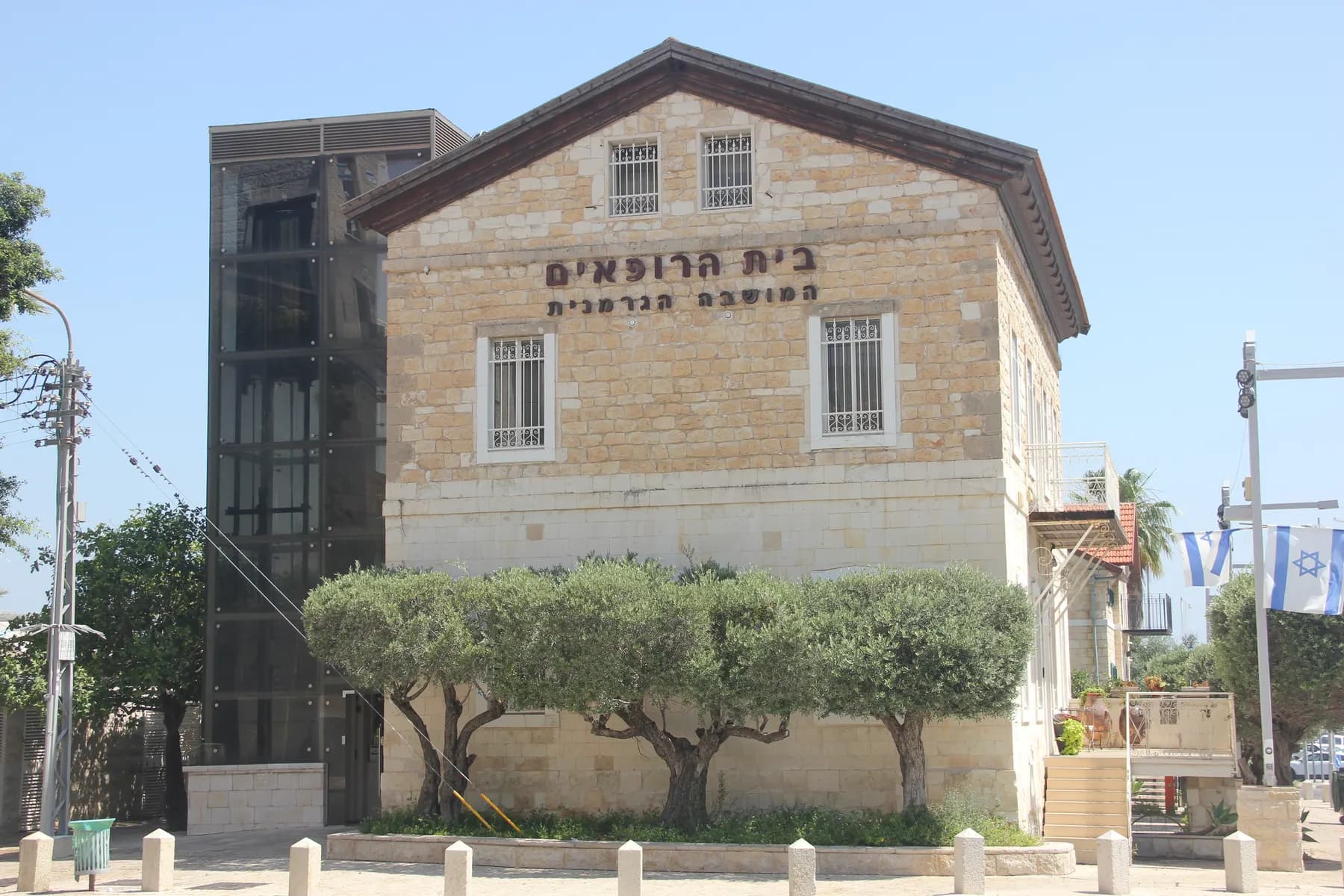
A German Templer settlement of 1868 whose main street was laid out 30 metres wide, pointing from the anchorage straight up Mount Carmel at ground that was then the colony's vineyards and is now the Bahai terraces.
אהוד הלפרין / CC BY-SA 4.0 · Wikimedia Commons
Viewpoint
Louis Promenade
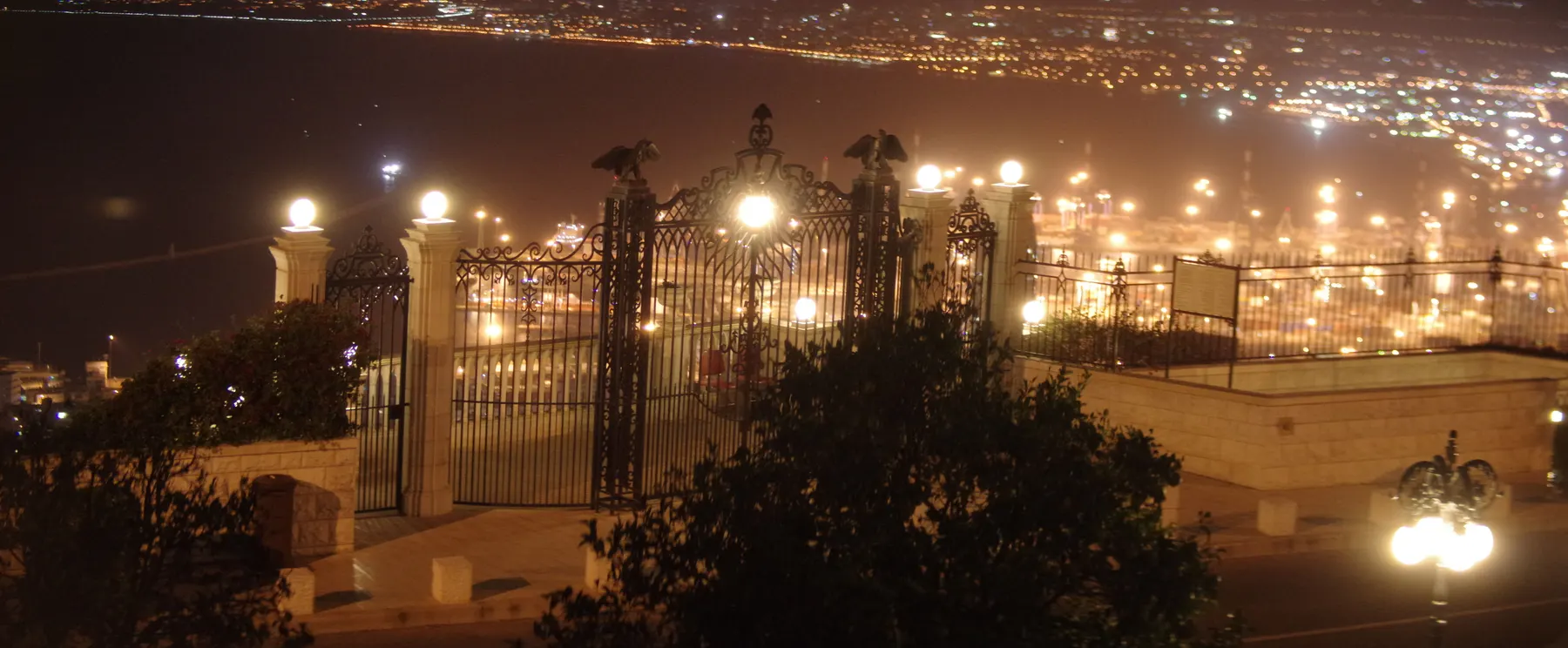
A 400-metre clifftop walk on Yefe Nof Street, given to Haifa in 1992 by Paul and May Goldschmidt in memory of their son Louis, and built by the man who was principal contractor of the Bahai gardens on the slope below it.
אושרי רייכר / CC BY 2.5 · Wikimedia Commons
Neighbourhood
Wadi Nisnas
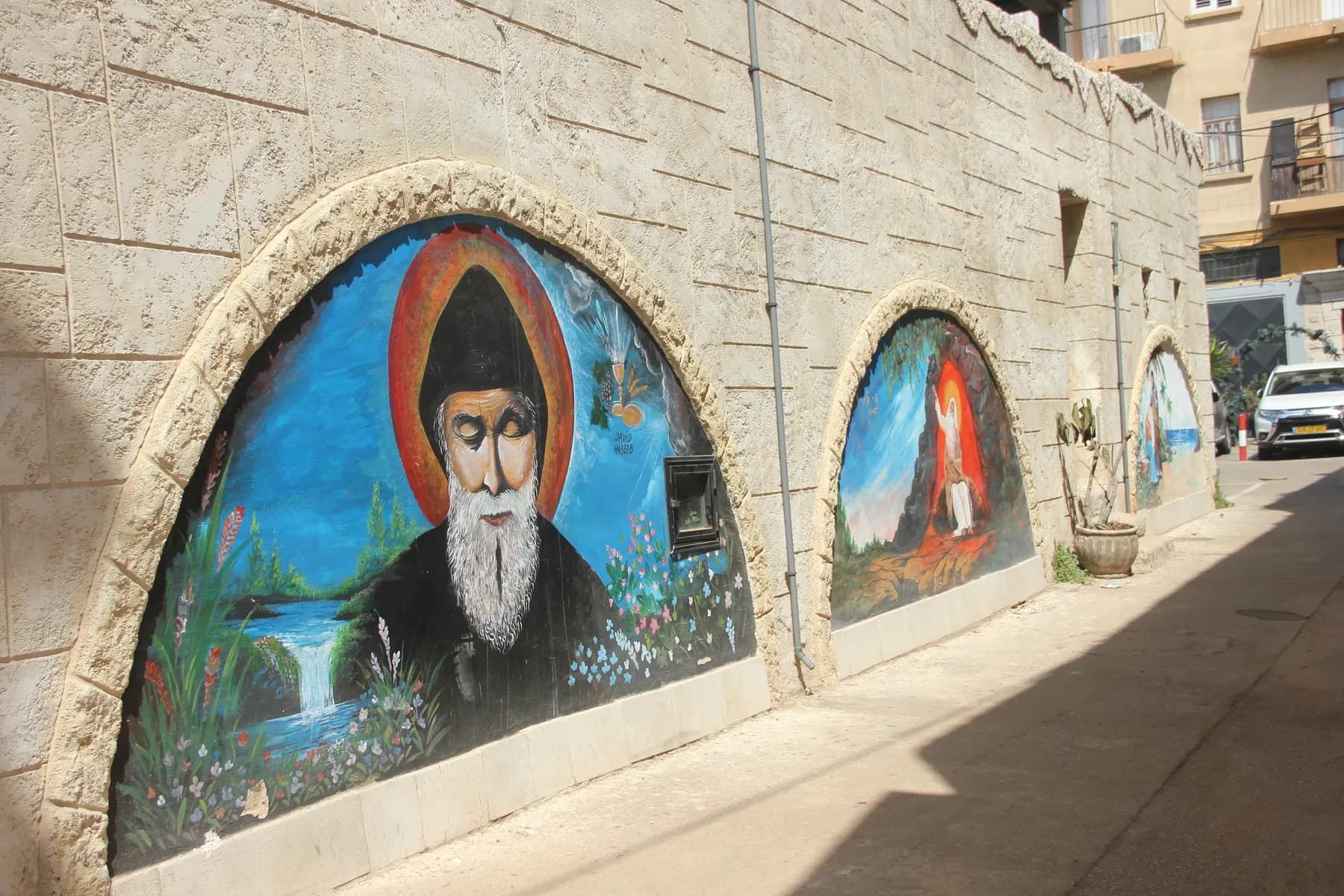
More than 50,000 Arabs lived in Haifa before the 1948 war and about 3,000 stayed; they were concentrated into this one valley, whose lanes have carried a permanent open-air art exhibition since the 1990s.
Sources and further reading
Every link below was opened and checked when this page was written. Official statements are marked as such: they are the subject's own account, not an independent one.
- OfficialBahá'í Gardens, Bahá'í World Centreganbahai.org.ilVisit us Haifa
The three self-guided entrances at 61 Yefe Nof, 80 Hatzionut and 21 Hagefen, all daily 09:00 to 17:00 and all free of charge and described as viewpoints only; the shrine closure from 9 August to 5 September 2026; closure on Bahai holy days and Yom Kippur; the dress rule; the bans on food, other beverages, gum, smoking, weapons and animals; and the Upper Terraces tour, 50 minutes, Tuesday to Sunday by reservation, up to 19 people, 750 stairs, starting at 45 Yefe Nof with a different finishing point
- OfficialBahá'í Gardens, Bahá'í World Centreganbahai.org.ilFrequently Asked Questions
The gardens 1 km long and 400 m wide with 225 m of vertical rise; approximately 1,700 steps; about 450 plant species; roughly 90 local workers and 50 Bahai volunteers from more than a dozen countries; the dome's some 12,000 glazed tiles with a very thin layer of gold leaf; the World Centre buildings, car parks and shelters dug into the mountain; donations accepted only from Bahais; no private events; about 650 volunteers from about 75 countries and no Israeli Bahai community
- OfficialBahá'í Gardens, Bahá'í World Centreganbahai.org.ilDesign Features of the Terraces, with an interview with the architect Fariborz Sahba
Sahba chosen in 1987; the eighteen terraces for the Letters of the Living and the numerical value of hai; the concave terraces hollowed into the mountain to cover 225 metres with minimal structure; local Galilee stone with some work executed in Italy on computerised equipment; and the statement that the stone and metal decoration has no religious meaning, the balustrades echoing the drum windows
- OfficialBahá'í Gardens, Bahá'í World Centreganbahai.org.ilEnvironmental Stewardship
The computerised irrigation running hundreds of valves; the Technion weather forecast used to project evapotranspiration; night watering at the roots and early-morning overhead irrigation; brackish and polluted water from licensed wells; rye grass dried out over summer and ground covers on the slopes against erosion; and the closed circulating system per terrace whose daily top-up is less than one person's consumption
- OfficialBahá'í Gardens, Bahá'í World Centreganbahai.org.ilA Brief History
The Bab born in Shiraz in 1819 and declaring himself at twenty-four; his teachings against holy war and for the equality of women; execution in a public square in Tabriz on 9 July 1850 before some ten thousand spectators; the remains hidden for fifty years before being brought to the Holy Land; and Bahaullah's exile to Akko and death on 29 May 1892
- OfficialBahá'í Gardens, Bahá'í World Centreganbahai.org.ilReopening of the Shrine of the Báb, Haifa
Press release: the construction project began in late July 2024 and the shrine and surrounding gardens reopened on Sunday 1 December 2024, with the shrine daily 09:00 to 12:00 and the gardens 09:00 to 17:00 at 80 Hatzionut; approach paths repaved in Jerusalem Red Limestone and the plaza enlarged in Galil Gold Limestone, for accessibility; and the 2008 UNESCO listing for outstanding universal value
- OfficialBahá'í Gardens, Bahá'í World Centreganbahai.org.ilAccessibility in the Holy Bahá'í Gardens
The recommended accessible guided route from 103 Hatzionut Avenue, about 10 m of moderate slope and 50 m of flat paved path to a viewing terrace, group size capped at 15 and 10 business days' notice; guides trained for lip-reading; ornament explorable by touch; service animals permitted; and the Visitor Information Centre's accessible auditorium and toilet
- OfficialBahá'í Gardens, Bahá'í World Centreganbahai.org.ilAbbas Effendi, 'Abdu'l-Bahá
Abdu'l-Baha born 1844, appointed successor in 1892, head of the community for 29 years, died in 1921; and the funeral in Haifa at which ten thousand mourners, described as more than a quarter of the city's population, escorted the coffin from Haparsim Street up Mount Carmel to the Shrine of the Bab
- OfficialBahá'í International Community (bahai.org)bahai.orgThe Shrine of the Báb
Bahaullah pointing out the spot by the cypresses in 1891; Abdu'l-Baha buying the land and raising a six-roomed mausoleum; the remains hidden for six decades before being laid to rest on 21 March 1909; Maxwell's superstructure designed in the early 1940s and completed in October 1953; and the decision to complete the nineteen terraces, built from 1990 and inaugurated in 2001
- OfficialBahá'í World News Servicenews.bahai.orgReshaping God's holy mountain to create a vision of peace and beauty for all humanity
Written in November 2000: Sahba as architect, some US$250 million contributed by the Bahai community over the decade, about 200,000 square metres of land, the gardens extending almost a kilometre up Mount Carmel, and the arrangement of nineteen terraces as nine above the shrine, nine below and one on its level
- OfficialBahá'í World News Servicenews.bahai.orgWith a dramatic flourish, Baha'is unveil majestic garden terraces on Mount Carmel
The inauguration of 22 May 2001: more than 3,000 Bahais from over 180 countries, more than 650 dignitaries from Israel and the diplomatic corps and at least 100 media representatives in a temporary 4,000-seat amphitheatre, and the terraces opening to the public on 4 June
- OfficialBahá'í World News Servicenews.bahai.orgBeauty of restored Shrine set to dazzle visitors and pilgrims
The restoration of the interior and exterior of the original 1909 structure, begun in 2008 and finished in April 2011; nearly 12,000 new gilded tiles in more than 120 shapes and sizes produced by a Portuguese firm; about 80,000 working hours on earthquake resistance using concrete, steel and carbon fibre; and over 50,000 hours of stonework by volunteers from 15 countries
- ReportingThe Times of Israeltimesofisrael.comBahai gardens most visited site in Israel
Reporting of 6 February 2012: 900,000 visitors in 2011 and more than seven million over the decade since the terraces opened, numbers roughly doubling between 2006 and 2011, the 2008 UNESCO inscription, and the Haifa mayor Yona Yahav on the daily tours
- ReferenceWikipediaen.wikipedia.orgShrine of the Báb
The six-room mausoleum of local stone and the burial on 21 March 1909; Abdu'l-Baha's interment in November 1921 and the three rooms added in 1929; Maxwell as architect with the dome engineered by Professor H. Neumann of the Technion; the first threshold stone in 1949; the octagon and eighteen-windowed drum; the Rose Baveno granite colonnade and Chiampo stone arches; and the 8 July 2008 World Heritage inscription
Bahai Gardens and the Shrine of the Bab: common questions
How much does it cost to visit the Bahai Gardens in Haifa?+
Nothing. The operator states that entrance is free of charge at all three Haifa entrances, and that the guided tours are offered without charge as well. Donations towards upkeep are accepted only from members of the Bahai community; the running costs of the Bahai World Centre come from voluntary contributions by Bahais worldwide. There is nothing to buy inside either, since no food or drink is sold.
Can you walk down the terraces from top to bottom?+
Only on the guided Upper Terraces tour, which has to be reserved. The three self-guided entrances, at 61 Yefe Nof, 80 Hatzionut and 21 Hagefen, are described by the operator as viewpoints. The tour runs Tuesday to Sunday, takes 50 minutes, is limited to 19 people, includes 750 stairs and begins at 45 Yefe Nof Street, ending at a different point downhill.
How long should I allow?+
About 30 minutes at any single viewpoint, and about 90 minutes to do the top and the bottom of the axis properly with the journey between them. The guided tour itself is 50 minutes, and the walk to the starting gate and the return from the finishing gate need to be added to that. Seeing the shrine as well means being at 80 Hatzionut Avenue in the morning.
Can I go inside the Shrine of the Bab?+
Yes, when it is open, and you do not need to be a Bahai. The operator's reopening notice of 1 December 2024 gives the shrine as daily 09:00 to 12:00 from the entrance at 80 Hatzionut Avenue, with the surrounding gardens open until 17:00. It closes for works from time to time, and the gardens' site currently states that it is shut to the public from 9 August to 5 September 2026. Photography is allowed everywhere in the gardens except inside the shrines.
Is the dome really gold?+
Not solid gold. The gardens say the dome is covered with some 12,000 glazed ceramic tiles that contain a very thin layer of gold leaf. The tiles now on it are not the originals from 1953: a restoration between 2008 and April 2011 replaced them with nearly 12,000 new gilded tiles in more than 120 shapes and sizes, made in Portugal by repeatedly fire-glazing porcelain and coating it in a gold solution.
Is it wheelchair accessible?+
The terraces are not, and the operator says so plainly: the tour has 750 stairs and is unsuitable for anyone with walking difficulties. The German Colony plaza at the foot is described as suitable for visitors with limited mobility, with a wide paved surface, benches and accessible parking on Ben Gurion Avenue. There is also a dedicated accessible guided route from 103 Hatzionut Avenue, about 60 metres of mostly flat paved path to a viewing terrace, capped at 15 people and arranged 10 business days in advance.
Is it worth it if I only have an hour?+
Yes, but pick one end rather than both. An hour is enough to stand at the German Colony plaza and look up the whole axis, or to stand at the Yefe Nof balcony and look down it, and either view is the one the gardens were designed to produce. What an hour will not buy is the tour, which needs a reservation, or the shrine, which shuts at noon.
How old is the site?+
Younger than it looks, and layered. The stone mausoleum at the core dates from before 1909, when the Bab's remains were interred in it. The arcade, drum and gold dome around it were finished in October 1953, the dome's tiles were replaced between 2008 and 2011, the nineteen terraces were built in the 1990s and inaugurated in May 2001, and the plaza in front of the shrine was rebuilt in the second half of 2024.
Is there shade, and can I bring a picnic?+
There is shade on parts of the route and benches at the plaza and on the accessible path, but the terraces are exposed and the operator suggests a hat and sunscreen in summer. A picnic is out of the question: eating, chewing gum, smoking and drinking anything other than water from your own bottle are all prohibited inside the gardens, which are treated as a religious site rather than a park.
Why is the Bahai world centre in Haifa at all?+
Because Bahaullah, the faith's founder, was exiled by the Ottoman authorities to Akko in 1868 and spent the last twenty-four years of his life there, and he directed that the Bab's remains be brought from Iran to Mount Carmel and that the administrative institutions of the faith be seated there. One consequence surprises visitors: there is no Bahai community in Israel and no converts are accepted, on Bahaullah's own instruction not to spread the teachings in the Holy Land. The Bahais on the mountain are volunteers on fixed terms.