Religious site · Haifa
Stella Maris Carmelite Monastery
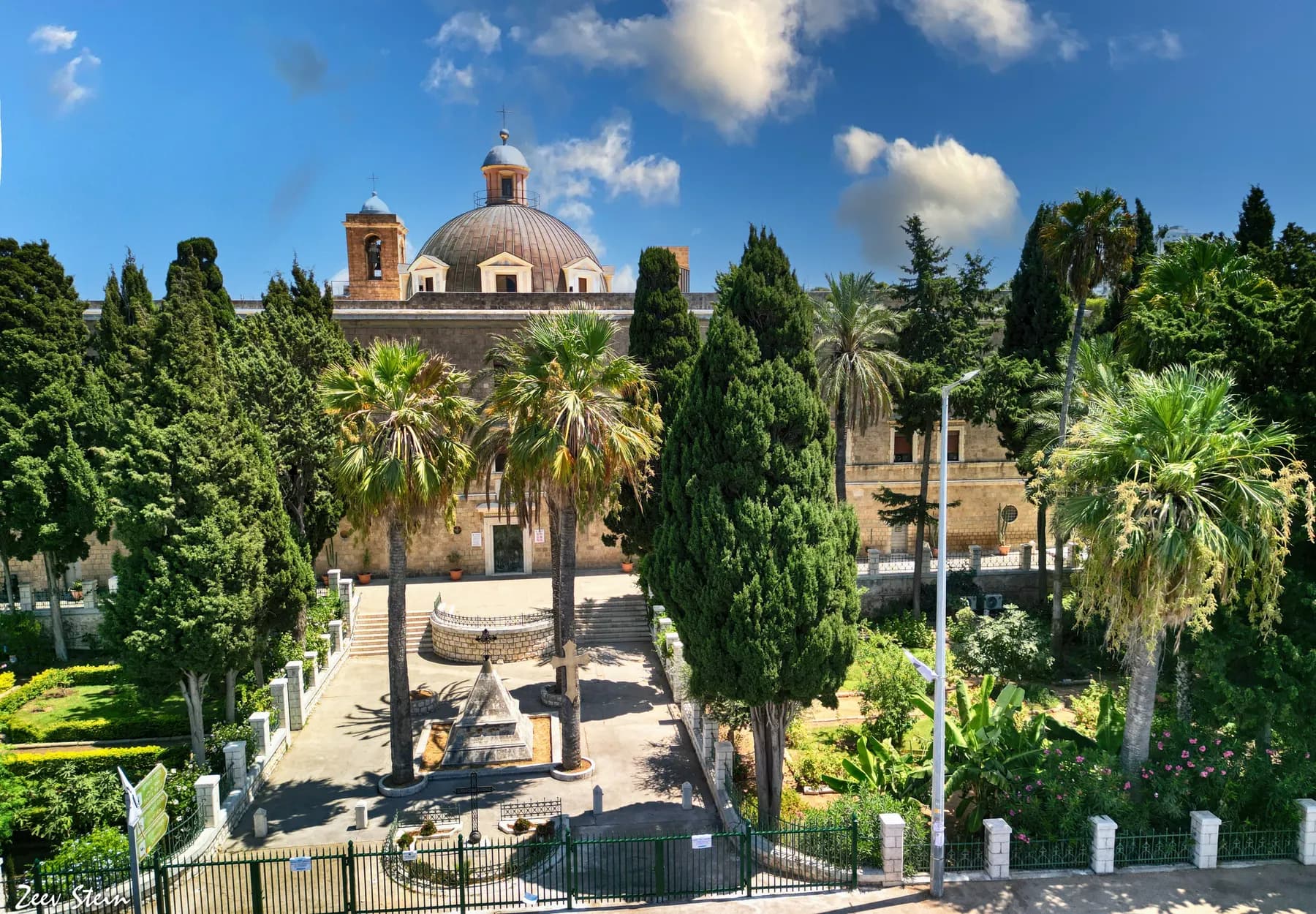
The mother house of the Discalced Carmelites stands on the seaward end of Mount Carmel over a grotto associated with Elijah, under a dome painted by the Maltese friar Luigi Poggi between 1924 and 1928.
זאב שטיין / CC BY 2.5 · Wikimedia Commons
Church dedicated
12 June 1836
before the building work was finished, on the fourth Carmelite site on this headland
Minor basilica
1839
the title granted by Pope Gregory XVI, three years after the dedication
Friars in residence
12
of about 15 in the order's Holy Land delegation, by its own count
Dome paintings
1924-1928
by the Maltese Carmelite Luigi Poggi
In short
- How long to give it
- about 45 minutes for the church and the grotto, or about 90 minutes taking in the pyramid, the terrace and the lighthouse forecourt across the road
- Church, every day
- 06:00 to 12:00 and 15:00 to 18:00
- Church and grotto
- The Discalced Carmelites publish opening hours and no admission charge, describing the church as open to the public every day
מנזר סטלה מאריס
Stella Maris is a working Discalced Carmelite monastery on the seaward end of Mount Carmel, and the mother house of the order worldwide. The church at its centre is built directly over a small grotto associated with Elijah, which is why the friars are here at all: the order began in the twelfth century as Latin hermits living in the caves of this mountain in imitation of him. Twelve friars live here, of about fifteen in the order's Holy Land delegation.
The building a visitor walks into is nineteenth century and is the fourth Carmelite establishment on this headland. The three before it were pulled down, blown up or quarried for stone, twice by Ottoman governors and once in the aftermath of a French campaign, and that sequence of demolitions is the real history of the place. What survives from earlier is fragmentary: the grotto, a room of Byzantine finds, and the ruins of the seventeenth-century convent near the lighthouse.
It is compact, and most people spend under an hour inside. The interior is faced in marble so bright that visitors assume it has been painted, the dome carries a cycle of biblical scenes finished in 1928, and a pyramid outside the door covers the bones of French soldiers left behind when Napoleon abandoned the siege of Acre in 1799. The church shuts for three hours in the middle of every day.
The site
A fortress block at the end of the ridge, and the order's spiritual centre
Mount Carmel stops abruptly at the Mediterranean, and Stella Maris sits on the last of it, on the headland above Bat Galim with the bay and the port cranes laid out to the east. The order describes the monastery as its mother house and the spiritual centre for the entire Order of Discalced Carmelites, which is a heavier claim than the building suggests: from the road it reads as a plain square block with a dome, the arms of the order over the door, and small barred windows low down.
That defensive look is deliberate and it is documented. The friars building the present church were assaulted by neighbours and had to defend the property and the people staying in it, so the ground floor went up with thick walls and few and small openings behind bars. The 1908 Catholic Encyclopedia called the result a large square block strong enough to afford protection against hostile attempts, with the church at its centre and no direct entrance from outside.
Stella Maris is Latin for Star of the Sea, a title of the Virgin Mary. The sequence here runs the other way round from most religious houses: the order was founded on this ridge and exported, not founded elsewhere and planted. For most of the twentieth century the complex was not the friars' to run, having been occupied by the army, first British and then Israeli. The lighthouse across the road, which the Carmelites themselves built, is still a military installation and not a visitor attraction. Below the monastery the Bat Galim cable car, opened in 1986 and 355 m long, climbs from the seafront promenade to the slope opposite.
History
Four monasteries in four hundred years, three of them demolished
In the twelfth century, under the Crusader Kingdom of Jerusalem, hermits settled in the caves of Mount Carmel in imitation of Elijah. Sometime between 1206 and 1214 their prior, known in the rule only by the initial of his first name, asked Albert Avogadro, the Latin Patriarch of Jerusalem, for a written rule of life, and got one. That request is the founding act of the Carmelite order. When Acre fell in 1291 the friars left, and stayed away for roughly two and a half centuries.
The return was negotiated rather than improvised. The Catholic Encyclopedia records a contract signed at Caiffa on 29 November 1631, after Prosper of the Holy Spirit had repeatedly visited the mountain on his journeys to and from India. Onuphrius of St James, a Belgian, and two companions reached Alexandretta on 5 November 1633 and took possession early the following year. For decades they lived in caverns cut in the rock, and were installed in a proper convent only on 14 December 1720, whereupon it was plundered within days and the fathers bound hand and foot. Prosper had died in his own grotto near the lighthouse in 1653, and that site is still Carmelite property.
In 1761 Daher al-Umar, by then the effective ruler of Galilee, ordered the friars off the promontory and had the convent demolished. They moved to the present position, directly above the grotto, clearing the ruins of a medieval Greek church known as the Abbey of St Margaret and of a chapel thought to be Byzantine. The French account dates that third monastery to 1767-1774.
It lasted a generation. The building was wrecked in the fallout from Napoleon's 1799 campaign, and in 1821 Abdullah Pasha of Acre had what remained destroyed outright, so his enemies could not fortify it while he moved on Jerusalem. Its masonry went into his summer palace and a lighthouse, both sold back to the Carmelites in 1846.
- c. 1206-1214: the hermits' rule from Albert Avogadro, and the order's beginning here
- 1631-1761: the convent on the promontory, demolished on Daher al-Umar's order
- 1767-1799: the third monastery above the grotto, wrecked after Napoleon's campaign
- 1827 or 1836 onwards: the fourth building, the one open today
1799
The field hospital, and the pyramid outside the door
Napoleon besieged Acre from 20 March to 21 May 1799 and failed to take it. During the campaign the monastery served as his field hospital, and when the army withdrew the sick and wounded who could not travel were left in it. They were killed and the friars driven out. How many were abandoned here is not settled: the French-language account puts it at about two thousand, a round figure that should be treated with suspicion.
What happened next is unusually well recorded for a small site. In 1804 Father Jules du Saint-Sauveur came back to take possession and found the floor strewn with bones. He gathered them into caves and walled up the entrances; the walls fell in and animals scattered them again. In the 1830s Brother Mathieu collected what was left and buried it under a pyramid at the church entrance.
The pyramid is still there, immediately in front of the church door, and most visitors walk straight past it. Its inscription is 2 Samuel 1:25, King David's lament over Saul and Jonathan: How are the mighty fallen in the midst of the battle.
On the far side of the road, in front of the lighthouse, a pillar carries a statue of the Immaculate Conception, erected by the people of Chile to honour the patroness of their nation.
The present church
Who built it, and the point at which the sources stop agreeing
The present church and monastery were the work of an Italian Discalced Carmelite lay brother whose name changes depending on which source you open. The order's own history page calls him Giovanni Battista Cassini and an expert architect; the 1908 Catholic Encyclopedia calls him John Baptist of the Blessed Sacrament, 1777 to 1849. He financed the work by collecting alms across Europe, and French royal backing mattered: an intervention by Charles X in 1825 obtained the sultan's permission to rebuild.
The dates do not line up, and it is worth knowing that before reading any guidebook on the subject. The Catholic Encyclopedia says the foundation stone was laid in 1827 and that, the work being on a larger scale than before, it was finished only by his successor, Brother Charles, in 1853. The French-language account has the rebuilding running 1827 to 1836, the church dedicated on 12 June 1836 while still unfinished, and community life beginning in 1846. The order's own page prints the 1846 return of the property and an 1836 start of works in consecutive sentences.
One date every source agrees on: three years after 1836, Pope Gregory XVI granted the church the title of minor basilica, and the sanctuary took the name Stella Maris. Treating 1836 as the year of the building and 1827 as the year of the stone is the safest way to hold it.
The property came back in pieces. In 1841 the Carmelites opened negotiations to buy back Abdullah Pasha's palace, built a few metres away out of their own quarried church, and after five years the sale went through. The palace became a hospice for pilgrims, a function the monastery still performs: part of the complex is now a Pilgrim Center with 47 rooms, taking groups of up to 95.
- Foundation stone 1827, completed 1853 by Brother Charles: Catholic Encyclopedia, 1908
- Rebuilt 1827-1836, dedicated 12 June 1836, community life from 1846: French Wikipedia
- Opened 1836: English Wikipedia
- Works started 1836, property returned 1846: the Discalced Carmelites' own history page
Inside
Marble that looks painted, and a dome finished in 1928
The church is built on a cross plan and its interior walls are faced in white marble panels. The order's own description makes the point that they are so bright and so well placed that visitors sometimes think the walls have been painted, which is fair warning: on a sunny morning the nave reads as a flat white surface until you are close enough to see the joints.
The dome is the thing people come inside for. It was decorated by the Maltese Carmelite Luigi Poggi between 1924 and 1928, and its scenes come from both testaments: Elijah carried up to heaven in the chariot of fire, the most legible of them, David with his harp, Isaiah, the Holy Family, and the four evangelists, with Latin verses running round the drum.
At the centre of the main altar stands a statue of the Virgin holding the child and the scapular, on a pedestal carved from a cedar of Lebanon, venerated locally as Our Lady of Mount Carmel. On the pilaster strips are four embossments for Carmelite saints: Teresa of Avila, John of the Cross, Edith Stein and Mariam Bouardy.
The room to the right of the entryway is easy to miss and worth two minutes: a permanent nativity scene and artefacts from the Byzantine church that once stood here. The Franciscan archaeologist Bellarmino Bagatti, who dug at Nazareth and Dominus Flevit, excavated at Stella Maris in 1960 and 1961. The souvenir shop is entered from outside, not through the church.
The grotto
The cave under the altar, and the other one down the hill
The altar stands on a raised platform, and a few steps down from the nave is the grotto the whole building exists to cover. It is small: an altar carved in the rock with a statue of Elijah above it, and candles burning for Carmelite communities in other countries. The tradition is that Elijah lived here for a time, and the grotto is also called the cave of the sons of the prophets.
It is not the Cave of Elijah, and confusing the two is the commonest mistake made about this site. That is a separate and larger grotto lower down the western slope, off Allenby Road, known in Arabic as el-Khader, venerated by Jews, Christians, Muslims and Druze, many Druze identifying Elijah with al-Khidr, the green prophet of water and life. It now functions as a synagogue, divided by a velvet curtain into a men's section and a women's section.
The separation has a history. When the Carmelites returned in the 1630s the lower cave was already in use by Mamluk ascetics venerating Elijah there, and after a series of incidents the friars moved to a different grotto nearby. Pilgrim testimony about a cave of Elijah on Carmel is older than either claim: Ioannes Phokas described one at the seaward end of the ridge in 1185, and Richard Pococke noted in 1738 that it was venerated by Christians, Jews and Muslims alike.
The monastery's great annual event dates from the First World War, when the statue of Our Lady of the Scapular was removed for safekeeping elsewhere in Haifa and carried back in a small procession in 1919. Every year since, on the first Sunday after Easter, the statue is walked between downtown Haifa and Stella Maris up the western slope, led by the Latin Patriarch. Wikipedia's account calls it the Holy Land's second largest Catholic procession after Palm Sunday in Jerusalem, a ranking nobody appears to have measured.
What to look for
Things not to walk past at Stella Maris Carmelite Monastery
The details that repay knowing about before you are standing in front of them.
The grotto beneath the main altar
A few steps down from the nave, a rock-cut altar with a statue of Elijah and candles burning for Carmelite houses around the world. It is the reason the church stands on this exact spot rather than fifty metres away.
Luigi Poggi's dome
Painted between 1924 and 1928 by a Maltese Carmelite, with Elijah's ascent in the chariot of fire as its clearest scene and Latin verses running round the drum. Stand under the crossing and look straight up.
The pyramid to Napoleon's dead
Directly in front of the church door, covering bones gathered from the floor of the earlier monastery after 1799 and reburied in the 1830s. The inscription is King David's lament from 2 Samuel 1:25.
The four Carmelite embossments
Reliefs on the pilaster strips for Teresa of Avila, John of the Cross, Edith Stein and Mariam Bouardy: the reform, its poet, a philosopher murdered at Auschwitz, and a Galilean mystic.
The Byzantine room by the entrance
To the right of the entryway, a permanent nativity scene and a display of finds from the Byzantine church that stood here. Bagatti excavated at Stella Maris in 1960 and 1961.
The Chilean column across the road
A pillar with a statue of the Immaculate Conception, in front of the lighthouse building, put up by the people of Chile to honour the patroness of their nation.
The long view
Stella Maris Carmelite Monastery, in order
c. 1206-1214
Albert Avogadro, Latin Patriarch of Jerusalem, gives the hermits of Mount Carmel a written rule of life. The Carmelite order begins here.
1291
Acre falls to the Mamluks and the Carmelites leave the Holy Land for about two and a half centuries.
29 November 1631
A contract signed at Caiffa lets the Discalced Carmelites recover Mount Carmel, after repeated visits by Prosper of the Holy Spirit.
1634
Onuphrius of St James and two companions take possession, living in caverns cut in the rock near the promontory.
14 December 1720
The friars are installed in a proper convent, which is plundered by Ottoman troops within days.
1761
Daher al-Umar orders the friars off the promontory and has their convent demolished.
1767-1774
A third monastery is built above the grotto, over the ruins of the medieval Abbey of St Margaret and a Byzantine-period chapel.
20 March - 21 May 1799
Napoleon besieges Acre and fails. The monastery serves as his field hospital; the wounded left behind are killed and the friars expelled.
1804
Father Jules du Saint-Sauveur returns, finds the floor strewn with bones, and walls them into caves.
1821
Abdullah Pasha of Acre has the ruined church destroyed and its stone built into his summer palace and a lighthouse.
1827
The foundation stone of the present church is laid, funded by alms collected across France, Italy and Europe.
12 June 1836
The church is dedicated, the building work still unfinished.
1839
Pope Gregory XVI grants the church the title of minor basilica and the sanctuary takes the name Stella Maris.
1846
Abdullah Pasha's palace and the lighthouse are sold back to the Carmelites; community life begins in the monastery.
1919
The statue of Our Lady of the Scapular returns from wartime safekeeping, beginning the annual procession up the Carmel.
1924-1928
The Maltese Carmelite Luigi Poggi paints the dome.
1960-1961
The Franciscan archaeologist Bellarmino Bagatti runs an excavation campaign at Stella Maris.
1986
The Bat Galim cable car opens, climbing 355 m of route from the seafront to the slope opposite the monastery.
Practical
Visiting Stella Maris Carmelite Monastery
Where
Stella Maris Road 100, Haifa
What ticket you need
The lighthouse across the road is a working military installation rather than part of the visit, and the ruins of the seventeenth-century convent beside it are Carmelite property that is not open on the same terms as the church.
Opening hours
Admission
Access
The church is entered at street level from the forecourt on Stella Maris Road and the nave itself is flat. The grotto is not: it sits under the main altar and is reached by a short flight of steps down from the nave, with no lift and no alternative route, so a wheelchair user can look into it from the nave but cannot go in. Arriving on foot from Bat Galim means a steep climb up the western slope; the cable car and the bus both exist to avoid it.
On site
- Souvenir shop, entered from outside
- Pilgrim guesthouse, 47 rooms
- Display of Byzantine finds
- Permanent nativity scene
- Daily mass and liturgy of the hours
- Organ recitals and church music concerts
Booking
Nothing is booked for the church itself. The Pilgrim Center inside the monastery takes groups of up to 95 people in 47 rooms, all with private bathroom, air conditioning, telephone and wifi, and is arranged directly with the friars by telephone or fax.
Hours and prices are given as the operator publishes them and change without much notice, particularly around Shabbat and the festivals. Check the operator's own page before you travel for this.
Official page at carmelholylanddco.org →What people wish they had known
- Time the visit around the midday shutdown. The church opens 06:00 to 12:00 and again 15:00 to 18:00, and a party that finishes the German Colony at half past twelve and drives up here finds a locked door.
- Do not come expecting the famous Cave of Elijah. That one is further down the mountain on Allenby Road and is a synagogue with separate men's and women's sections; the grotto here is a different, smaller cave under the altar.
- This is a monastery with twelve friars living in it, not a museum with a chapel attached. Cover shoulders and knees, keep quiet if an office or a mass is being sung, and stay out of the parts of the building that are the community's.
- The lighthouse opposite is a military installation, not a viewpoint. The forecourt in front of it, with the Chilean column, is the part to walk over to.
- Look at the pyramid on the way in rather than the way out. Most people notice it only when leaving, by which point they have not read the inscription or worked out that there are bones under it.
- Coming up from Bat Galim on foot is a long steep climb in full sun. The cable car from the promenade is tourist-oriented and does not run to a public transport timetable, so check it is operating before planning to arrive that way.
The figures
Stella Maris Carmelite Monastery by the numbers
Each figure carries the year it belongs to and links the source it came from.
| Measure | Figure | As of | Source |
|---|---|---|---|
| Friars living at Stella Maris | 12 | 2026 | carmelholylanddco.org |
| Members of the Holy Land delegation | about 15 | 2026 | carmelholylanddco.org |
| Rooms in the Pilgrim Center | 47 | 2026 | carmelholylanddco.org |
| Largest group the Pilgrim Center takes | 95 people | 2026 | carmelholylanddco.org |
| Years spent painting the dome | 1924 to 1928 | 1928 | carmelholylanddco.org |
| Bat Galim cable car route length | 355 m | 2024 | en.wikipedia.org |
| Focal height of the Stella Maris light | 179 m | 2026 | en.wikipedia.org |
| Siege the monastery served as a hospital for | 20 March to 21 May 1799 | 1799 | en.wikipedia.org |
While you are here
The rest of Haifa
Everything else in this destination with a page of its own.
מיכל פריימן / CC BY 2.5 · Wikimedia Commons
Religious site
Elijah's Cave
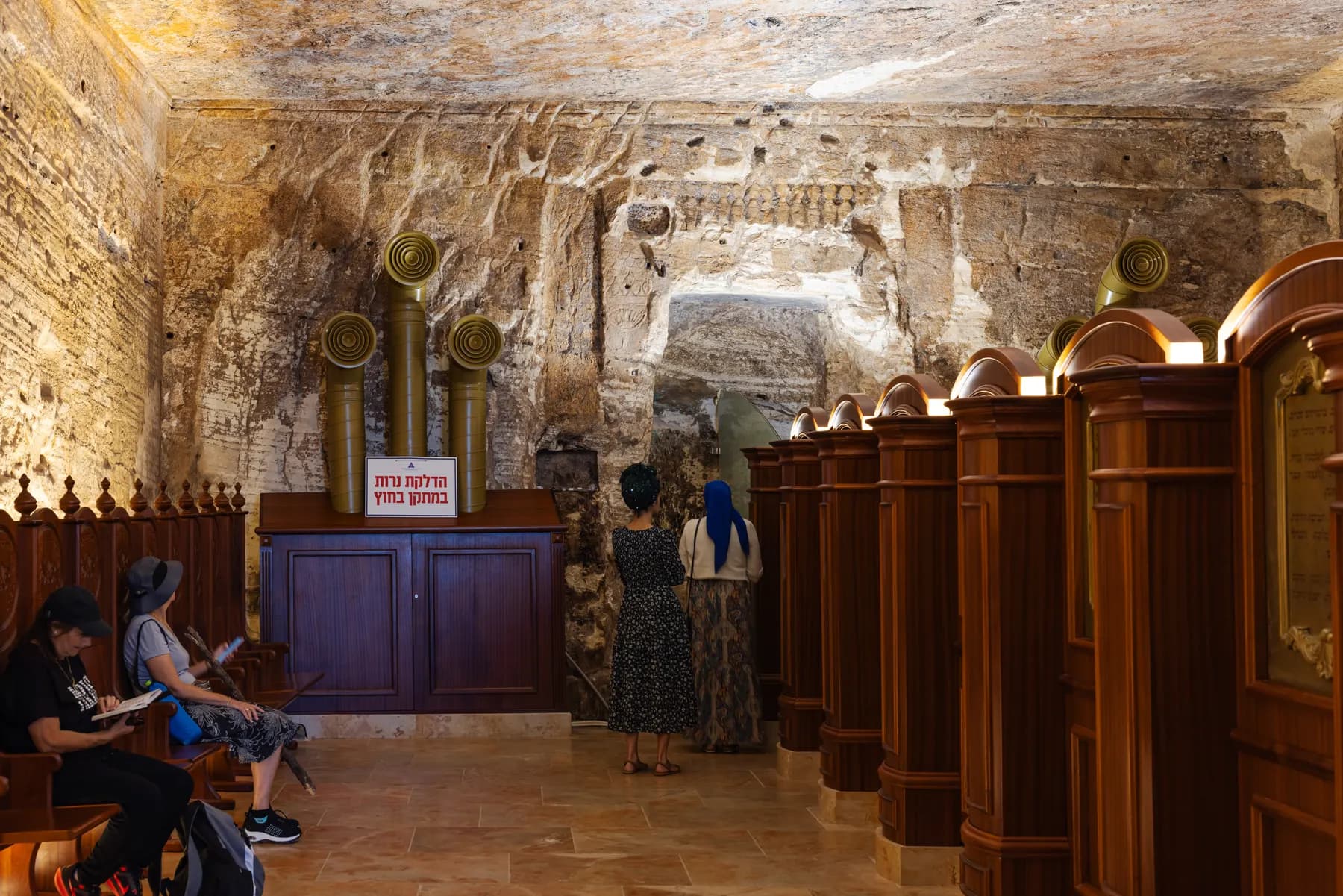
A rock chamber at road level under Cape Carmel, measured by the Israel Antiquities Authority at 13.5 by 8.7 metres, whose walls carry about 150 graffiti in Greek, Latin, Hebrew and Arabic left by pilgrims of four religions.
Orenshani7 / CC BY-SA 3.0 · Wikimedia Commons
Activity
Haifa Cable Car
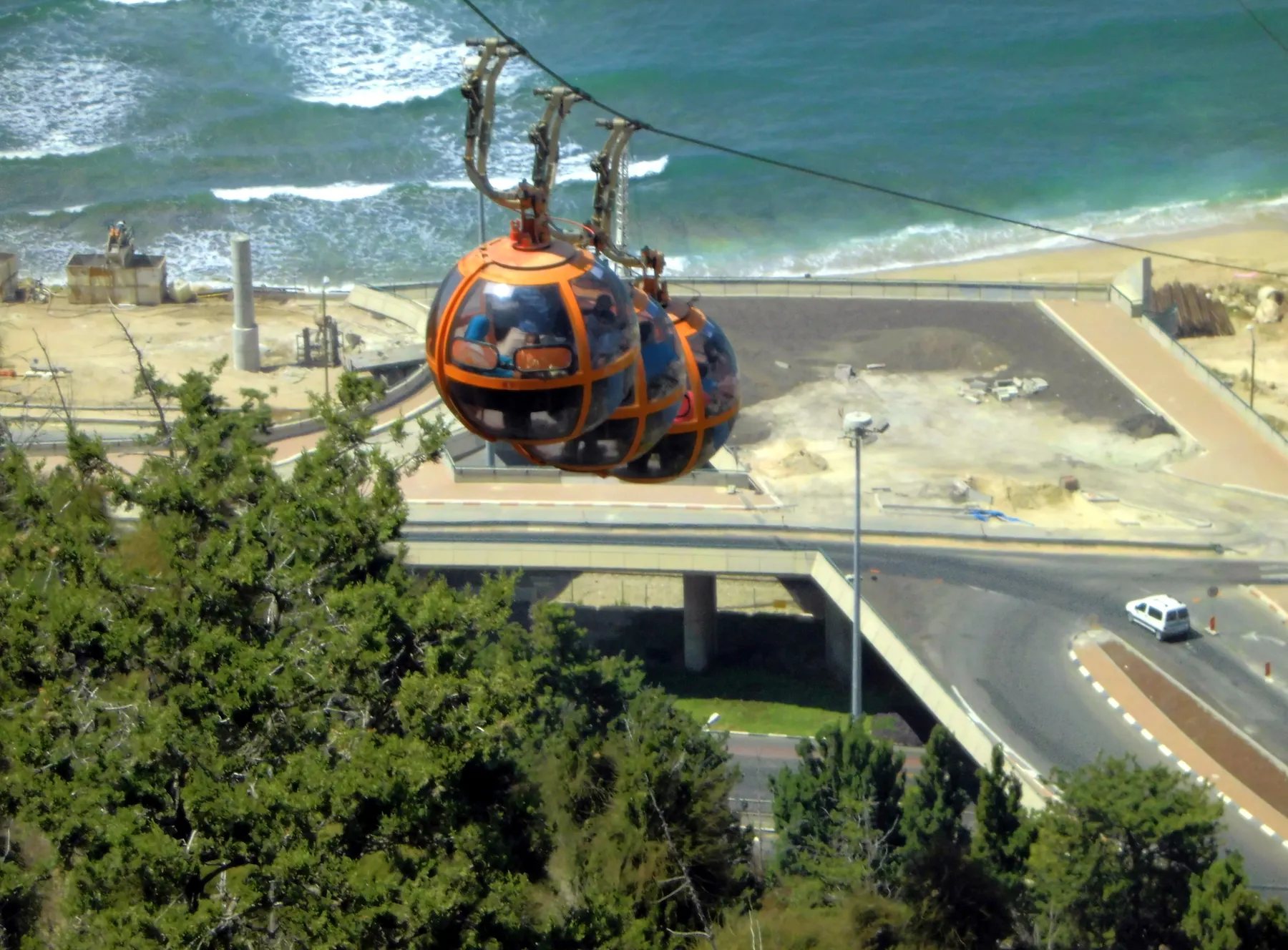
Six spherical cabins have been running the 355 metres from the Bat Galim promenade up to Stella Maris since 1986, three in each direction, and Haifa still calls them Gurel's eggs.
Museum
Clandestine Immigration and Naval Museum
A Ministry of Defence museum built around Af Al Pi Chen, a Royal Navy tank landing craft that sailed from Italy in September 1947 with 434 Holocaust survivors aboard and was boarded before she reached the coast.
Sources and further reading
Every link below was opened and checked when this page was written. Official statements are marked as such: they are the subject's own account, not an independent one.
- OfficialDiscalced Carmelite Order, Holy Land General Delegationcarmelholylanddco.orgStella Maris Church
Opening hours, the marble interior, the Poggi dome, the grotto under the altar, the four embossments, the pyramid and the Chilean column
- OfficialDiscalced Carmelite Order, Holy Land General Delegationcarmelholylanddco.orgThe history of the Carmelites
The order's own chronology from the twelfth-century hermits to the minor basilica title, including the 1761 demolition and the 1821 destruction
- OfficialDiscalced Carmelite Order, Holy Land General Delegationcarmelholylanddco.orgThe Discalced Carmelites in the Holy Land
Stella Maris as the mother house and spiritual centre, about 15 friars in the delegation and 12 resident here
- OfficialDiscalced Carmelite Order, Holy Land General Delegationcarmelholylanddco.orgPilgrim Center
47 rooms, groups of up to 95, and the facilities inside the guesthouse
- ReferenceWikipediaen.wikipedia.orgStella Maris Monastery
The building sequence, the defensive ground floor, the dome subjects and the annual procession from 1919
- ReferenceWikipedia (French)fr.wikipedia.orgMonastere Stella Maris
The 1767 building, the bones gathered after 1799 and buried under the pyramid, the 1827-1836 rebuilding, French royal backing and the twentieth-century army occupation
- ReferenceCatholic Encyclopedia, New Adventnewadvent.orgThe Carmelite Order
The 1631 contract at Caiffa, the 1720 convent, the 1827 foundation stone and completion by Brother Charles in 1853
- ReferenceWikipediaen.wikipedia.orgCave of Elijah
The larger cave on Allenby Road, its use as a synagogue, and its distinction from the grotto under the Stella Maris altar
- ReferenceWikipediaen.wikipedia.orgSiege of Acre (1799)
The dates of the siege the monastery served as a field hospital for
- ReferenceWikipediaen.wikipedia.orgStella Maris Light
The lighthouse across the road, its focal height and its rebuilding
- ReferenceWikipediaen.wikipedia.orgBat Galim cable car
The 1986 opening and the 355 m route between the promenade and the slope opposite the monastery
- ReferenceWikipediaen.wikipedia.orgBellarmino Bagatti
The Franciscan archaeologist's 1960-61 excavation campaign at Stella Maris on Mount Carmel
Stella Maris Carmelite Monastery: common questions
Is Stella Maris free to enter?+
The Discalced Carmelites publish opening hours for the church and no admission charge of any kind, stating on their own page only that the church is open to the public every day. There is a souvenir shop selling religious articles and scapulars, entered from outside, and a donation box inside, but nothing at the door. The Pilgrim Center guesthouse in the same complex is a separate arrangement and publishes no rates.
What are the opening hours?+
Every day from 06:00 to 12:00 and again from 15:00 to 18:00, per the order's own page. The three-hour closure in the middle of the day is the detail that trips people up. Times can shift around major feasts and around the annual procession on the first Sunday after Easter, so telephone ahead if the visit depends on it.
Is this the Cave of Elijah?+
No, and the distinction matters. The grotto here is a small cave under the main altar of the church, reached by a few steps down from the nave, with a rock-cut altar and a statue of the prophet. The Cave of Elijah proper is a larger grotto lower down the western slope off Allenby Road, known in Arabic as el-Khader, revered by Jews, Christians, Muslims and Druze, and now used as a synagogue. They are two separate sites with two separate entrances.
How long do you need there?+
About 45 minutes covers the church, the dome, the grotto and the room of Byzantine finds. Allow about 90 minutes to add the pyramid, the terrace and the lighthouse forecourt across the road with the Chilean column. It is a small building and no part of it takes long.
Can you get there by cable car?+
Yes, in principle: the Bat Galim cable car has run since 1986 from the seafront promenade up 355 m of route to the top of the slope opposite the monastery. It is a tourist operation rather than a scheduled public service, so it does not keep public transport hours and its running is worth checking on the day. Buses and taxis reach Stella Maris Road directly.
Is there a dress code?+
Treat it as a working Catholic church and cover shoulders and knees. The friars welcome pilgrims and visitors and do not police the door, which is exactly why turning up dressed for the beach at Bat Galim, twenty minutes below, reads badly here.
Is it wheelchair accessible?+
Partly. The church is entered at street level from the forecourt and the nave is flat, so the interior, the marble, the dome and the altar are reachable. The grotto is not: it lies under the altar and the only way in is a short flight of steps down from the nave, with no lift and no alternative route.
Is it worth visiting if you are not religious?+
It is worth about an hour on the history rather than the devotion. This is the founding house of an order that began on this mountain, and the site records four buildings, three demolitions, an Ottoman governor who quarried the church for his palace, and a French army that left its dead here in 1799. The dome and the marble are the aesthetic reward; the pyramid outside is the strangest thing on the site.
When was the current building put up?+
Sources disagree, which is unusual for a nineteenth-century building and worth stating plainly. The Catholic Encyclopedia gives a foundation stone in 1827 and completion by Brother Charles in 1853. French and English encyclopaedia accounts have it rebuilt from 1827 and dedicated on 12 June 1836. The order's own history page says the works started in 1836. All of them agree that Pope Gregory XVI made it a minor basilica three years after 1836.
Can you stay overnight at the monastery?+
Part of the monastery is a Pilgrim Center with 47 single, double and triple rooms, taking groups of up to 95 people. Every room has its own bathroom, air conditioning, telephone and wifi, and there is a dining room, a meeting room and a garden looking over the Mediterranean and the city. Rates are not published, and booking is arranged directly with the friars.