Neighbourhood · Haifa
German Colony
A German Templer settlement of 1868 whose main street was laid out 30 metres wide, pointing from the anchorage straight up Mount Carmel at ground that was then the colony's vineyards and is now the Bahai terraces.
אושרי רייכר / CC BY 2.5 · Wikimedia Commons
Founded
1868
the first Templer colony in the country, by settlers from Württemberg
Main street, as laid out
30 m wide
trees on both sides, running north to south down to the anchorage
Deported to Australia
661
on 31 July 1941, leaving 345 Germans in Palestine
Terraces above the axis
19
opened June 2001, UNESCO World Heritage from 8 July 2008
In short
- How long to give it
- About 90 minutes for the boulevard, its inscriptions and the two side lanes; half a day if the city museum and the gardens above are included
- The colony itself
- A public street with no gate and no closing time
- Walking the colony
- Free
המושבה הגרמנית
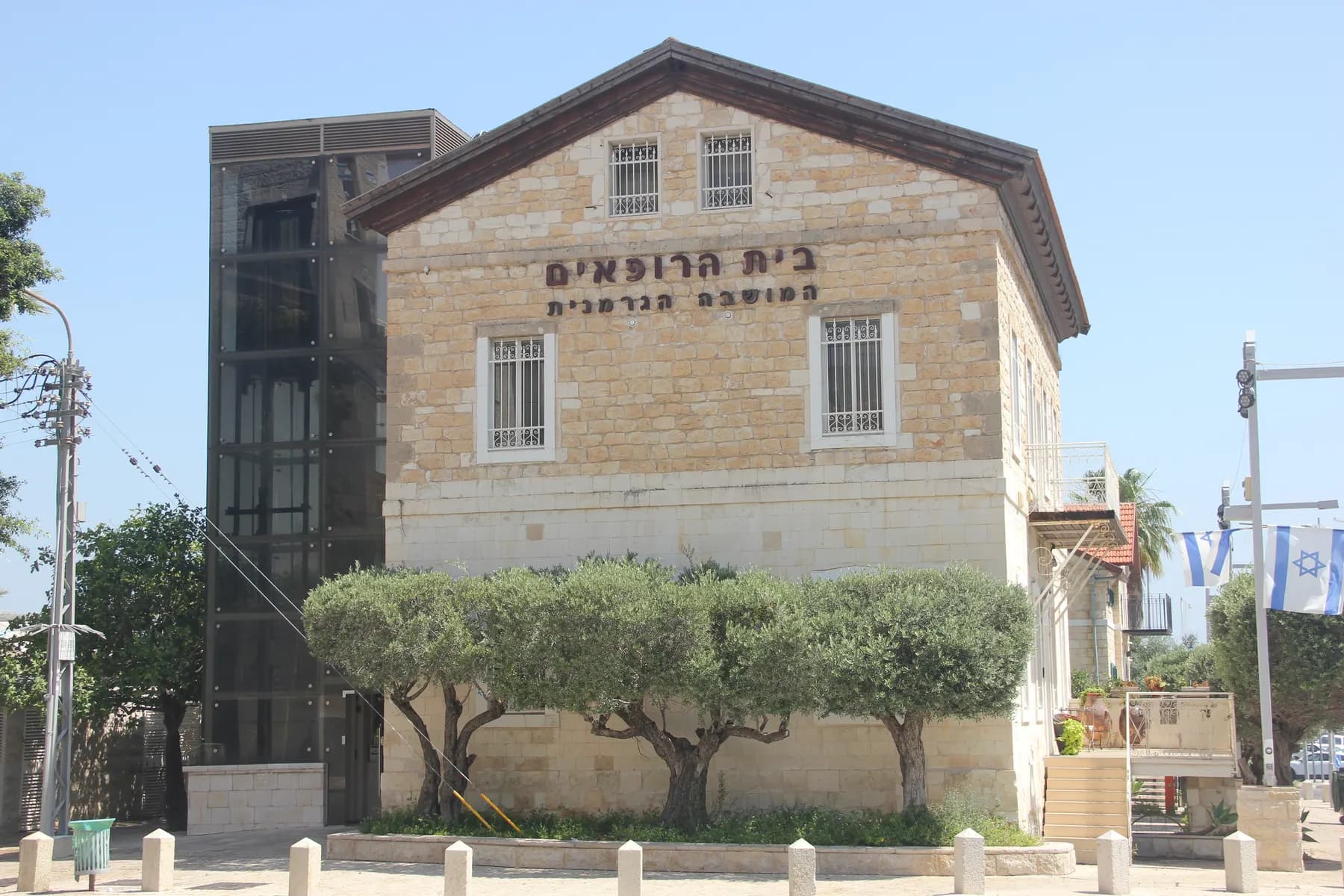
The German Colony is a nineteenth-century neighbourhood at the foot of Mount Carmel, built from 1868 by a German Protestant sect called the Templers and now the restaurant strip of central Haifa. Almost all of it is one street. Ben Gurion Boulevard runs from the sea up to HaGefen Street, and the two-storey houses of pale dressed stone that line it, with gabled ends, tiled roofs and family names cut over the doorways, are what people mean when they say German Colony.
The layout is what the Templers are remembered for. Their main street was set out at no less than 30 metres wide and planted with shade trees on both sides, with two narrow parallel lanes behind it. The Israel Ministry of Foreign Affairs account describes the first planned settlement of its kind in the country, built of stone under the architect Jacob Schumacher and roofed in red shingle. At the northern end was the anchorage the colonists shipped their building materials into; the Dagon grain silo stands there now.
What is not here is the community that built it. A large minority of the Templers joined the Nazi party, the British interned them in 1939 and deported hundreds to Australia in 1941, and the last German residents left Israel by the autumn of 1950. The houses stood as workshops and stores for four decades after that. What a visitor walks through today is the product of a municipal restoration begun in the 1990s and tied to the building of the Bahai gardens on the slope above.
Founding
A Württemberg sect lays out a street 30 metres wide
The Temple Society was founded in southern Germany in 1861 under the Protestant theologian Christoph Hoffmann, on the belief that settling in the Holy Land would hasten the second coming. In 1868 Hoffmann and Georg David Hardegg arrived from Württemberg with the first party. Hardegg stayed to build the Haifa colony while Hoffmann went on to found the second one at Jaffa. Haifa was then a walled town of roughly 4,000 people, and the Templers bought land outside it, on the flat ground between the mountain and the shore.
They built to a plan, which was the unusual part. The main street ran north to south from the anchorage towards the Carmel, with two narrow parallel streets behind it (today HaGanim and Meir Rotenberg) and cross streets running east to west, among them Jaffa Road and Allenby. Every house had a garden round it. At the southern end, on the lower slope of the mountain, were the colony's vineyards, which is where HaGefen Street, the street of the vine, gets its name.
Farming did not last. The colonists brought European methods, machinery and new crops including the potato, then moved into industry, tourism and transport. They ran the first scheduled carriage services between Haifa, Jaffa, Acre and Nazareth, which is also how regular post first moved between those towns, and they built hotels, workshops and an olive oil soap factory.
By the end of Ottoman rule the colony held about 750 people, with the only doctor in the district and the only building engineer. The housing figures do not agree: the English account gives 150 houses, the Hebrew one about 100 dwellings plus dozens of farm buildings. Jacob Schumacher held an American passport, as sixty of the colonists did, and served as United States consular agent for Haifa and northern Palestine.
Architecture
Gables, tiled roofs and a verse cut over the door
Templer houses are easy to identify once the grammar is clear: stone, European motifs mixed with eastern arches, a gable on almost every building, a balcony over the entrance, and an inscription cut above the front door. The inscription is usually a verse from the Old or New Testament chosen by the family, sometimes with the family name and the year of building beside it.
The clearest surviving example is on Beit Dyck at number 8, which reads EBEN EZER 1893: the stone of help, from the first book of Samuel, where Samuel sets up a stone and says that the Lord has helped us this far. The Dyck family sold agricultural equipment, and the large windows across the front were display windows for it.
The declared heritage buildings run in a short row, walkable in twenty minutes.
Number 16 was the Haifa home of Laurence Oliphant, the Scottish traveller, member of parliament, novelist and mystic, who settled in Palestine in 1882 and split his time between this house and another in the Druze village of Daliyat al-Karmel. His live-in secretary was Naftali Herz Imber, author of the poem that became Hatikvah.
The Templers did not build the whole street, and it is not a period piece. The Haifa Trail's inventory runs from the 1870s stone houses through an early twentieth-century Italian hospital to a Brutalist soldiers' centre and a shopping centre of 1999.
- No. 1: Beit Keller, house of the German vice-consul
- Nos. 2 to 4: Beit Struve, an olive oil and soap family
- No. 5: the Kraft Hotel, the first modern hotel in Haifa, later the British military governor's residence
- No. 8: Beit Dyck, agricultural machinery, with EBEN EZER 1893 over the door
- No. 11: Beit Ha'am and the Templer school, now the Haifa City Museum
- No. 12: Beit Schumacher
- No. 15: Beit Dr Schmidt, restored with a glass floor showing part of the cellar
- No. 16: Beit Oliphant
- No. 48: the tourism association's information office
Expulsion
How the colony emptied, between 1939 and 1950
The Templers backed Germany in the First World War and paid for it: in July and August 1918 the British sent 850 of them to an internment camp at Helwan near Cairo and deported 350 to Germany in April 1920. The colony recovered, and then the 1930s took it apart. In 1937, 34 per cent of German colonists in Palestine were Nazi party members, and on 12 May 1937, the day of George VI's coronation, every German colony in the country flew the swastika.
When war broke out in 1939 the British interned colonists holding German citizenship. The four German farming settlements became wired camps with watchtowers, while women and children from the town colonies at Haifa, Jaffa and Jerusalem were for a time left in their houses under police watch. On 31 July 1941, 661 German colonists were shipped to Australia by way of Egypt and held at Tatura in Victoria until 1946 or 1947, leaving 345 in Palestine. The British also brokered wartime exchanges of Templers for Jews under German control, on the order of 1,000 for 550 by one account.
The end was violent. On 12 March 1946 a Haganah team assassinated Gotthilf Wagner, the leader of the community, whom Jewish sources regarded as a committed Nazi and whom the Templers regarded as a victim; the Criminal Investigation Department read the killing in terms of land politics, because Wagner had told his people not to sell to Jews. Researchers still differ over the motive. More Templers were killed in 1948, the Haganah raided the internment camps in April, and the evacuated Germans reached Cyprus on 22 April. The rest left Israel for good between December 1948 and the autumn of 1950, and in 1962 Israel paid 54 million Deutschmarks for the nationalised property. The Templer cemetery survives on Jaffa Road, behind the British military cemetery, with an obelisk to the German dead of the First World War.
Restoration
What is original here, and what the 1990s put back
For four decades after the Germans left, the colony was a neglected fringe of the city centre, its houses used as workshops and stores, and attempts by the mayor Abba Hushi to rehabilitate it came to nothing. The turn came in the 1990s, when the neighbourhood was restored in step with the building of the Bahai gardens above it, and the design plan approved in 1996 set out to convert Ben Gurion Boulevard into a tourist and leisure axis.
The street itself was substantially rebuilt at the turn of the century, and this is the part visitors take for original when it is not. The traffic lanes were narrowed so that the pavements could be widened, a public transport lane was laid between them, and several street-facing gardens were expropriated to make the promenade.
The houses themselves are a mixture, and the Hebrew account is careful to say they were restored only in part. The plan to put the city museum into Beit Ha'am and the Templer school was drawn up in the same programme, initiated by the then director general of Haifa Museums, Nissim Tal, and designed by the architect Dagan Mushly; the two halls opened in 2000 and 2004. Their dates are disputed. The museum gives Beit Ha'am as 1869, the first Templer community building in the country, rebuilt in 1890 with a large hall and the bell tower that makes a Protestant meeting hall look like a church, and the school as 1902; Wikipedia's article on the neighbourhood describes an Evangelical community centre on the same ground, inaugurated on 2 July 1893, with a separate school of 1907.
So the honest reading is this. The street line, the width, the block pattern and the surviving house fronts are Templer work. The pavements, planting, lighting, bus lane and much of the stonework repair are from the last thirty years, the gardens that once surrounded each house are largely gone, and the shade trees are not the ones the colonists planted.
Alignment
A street that ended up pointing at something built 130 years later
What makes this neighbourhood photograph the way it does is an accident of sequence. The Templers laid their main street pointing up the mountain and put their vineyards at the top of it. That vineyard ground is where the Bahai World Centre now sits, and when the 19 garden terraces around the Shrine of the Bab opened in June 2001, to Fariborz Sahba's design, climbing close to a kilometre over some 200,000 square metres, they came down the hill along the line the Templers had already drawn.
The join is a roundabout at the corner of Ben Gurion Boulevard and HaGefen Street, named UNESCO Square for Tolerance and Peace: the gardens' main entrance plaza is on its southern side, the colony promenade starts on its northern side. The naming ceremony was held on 30 May 2011 in the presence of the UNESCO director general Irina Bokova, and the square was inaugurated on 9 December 2012, marking the World Heritage inscription of 8 July 2008.
The consequence for a visitor is worth planning around. Walking south, the terraces and the gold dome sit dead centre at the end of the street, framed by the houses; walking north the same view is behind you and the street ends in the Dagon grain silo. Tourists stand on the central island to take the photograph, which is a bad place to stand: it is thin, with moving traffic and a bus lane on both sides.
Today
A restaurant strip, mostly Arab-run, with a museum in the middle
The restored houses filled with businesses almost immediately: cafes, bars, restaurants and small hotels, the great majority Arab-owned. Hebrew Wikipedia's account calls Ben Gurion Boulevard the centre of leisure, social life and internal migration for young Arab Israelis more than anywhere else in Haifa, or in the country. It is the one part of the city busier after dark than during the day.
Institutional tenants arrived alongside the bars. The Haifa City Museum took the two Templer halls at number 11. In 2004 the WIZO design academy moved from Hadar into a building the municipality vacated here, the first Hebrew-language academic institution in the lower city, and the students who followed pushed the port campus built nearby that decade. The tourism association keeps its information office at number 48 and runs a guided walk on Saturday mornings.
The colony is also one of the two neighbourhoods that host the Holiday of Holidays each December, the festival the municipality runs with the Beit Hagefen Jewish-Arab centre and the Wadi Nisnas residents' committee. Wadi Nisnas, immediately east across HaGefen Street, is where the market is; the colony is where the sitting down is done.
One recent scar is worth knowing about. On 17 November 2024 the Schumacher building, which houses the University of Haifa's Schumacher Institute and its collections, was hit by a missile fired from Lebanon.
What to look for
Things not to walk past at German Colony
The details that repay knowing about before you are standing in front of them.
EBEN EZER 1893, on Beit Dyck
The clearest Templer inscription left on the street, cut over the door of number 8. It is the stone of help from the first book of Samuel, and the wide windows below it were showcases for the family's agricultural machinery.
Beit Ha'am and the Templer school
The pair of halls at number 11, now the Haifa City Museum. The bell tower on the front was added in an 1890 rebuild, which is why a Protestant sect's meeting hall looks like a church.
Beit Oliphant, at number 16
The Haifa house of Laurence Oliphant, who settled here in 1882. His live-in secretary was Naftali Herz Imber, who wrote the poem that became Hatikvah.
The glass floor at number 15
Dr Schmidt's house, home of the colony's doctor and British vice-consul, was restored with a glass panel set into the entrance so that part of its deep cellar is visible from the doorway.
UNESCO Square
The roundabout where the boulevard meets HaGefen Street, with the Bahai gardens' entrance plaza on one side and the colony promenade on the other. Inaugurated on 9 December 2012 for the 2008 World Heritage inscription.
The Templer cemetery on Jaffa Road
Behind the British military cemetery, holding the people who ran the colony, with an obelisk at its centre to the German dead of the First World War. Templer dead from four other colonies were reinterred here after 1952.
The long view
German Colony, in order
1861
The Temple Society is founded in southern Germany under the Protestant theologian Christoph Hoffmann.
1868
Hoffmann and Georg David Hardegg arrive from Württemberg. Hardegg stays to build the Haifa colony, Hoffmann goes on to found the Jaffa one. The main street is laid out 30 metres wide, running from the anchorage towards the Carmel.
1869
The Templer cemetery opens. By the museum's own account, Beit Ha'am, the community hall, is put up in the same year.
1874-1893
The Temple Society splits and Evangelical envoys convert about a third of the colonists. A community centre with a prayer hall and two schoolrooms is inaugurated on 2 July 1893, and EBEN EZER 1893 is cut over the door of Beit Dyck at number 8.
1898
For the visit of Kaiser Wilhelm II, the community builds a pier at the colony's bathing beach to a design by Gottlieb Schumacher, and the Kaiser's boat ties up at it.
1918-1920
The British intern 850 Templers at Helwan in Egypt and deport 350 of them to Germany in April 1920. Enemy property passes to a public custodian.
12 May 1937
Every German colony in Palestine flies the swastika for the coronation of George VI. In the same year 34 per cent of German colonists in the country are Nazi party members.
1939
War breaks out and the British intern colonists holding German citizenship, turning the four German farming settlements into wired camps.
31 July 1941
661 German colonists are deported to Australia by way of Egypt and held at Tatura in Victoria until 1946 or 1947, leaving 345 in Palestine.
12 March 1946
A Haganah team assassinates Gotthilf Wagner, the leader of the German community. The motive is still argued over.
1948-1950
The Haganah raids the internment camps in April 1948 and the evacuated Germans reach Cyprus on 22 April. Between December 1948 and the autumn of 1950 the last Germans leave Israel, most for Australia.
1962
Israel pays 54 million Deutschmarks in compensation for the nationalised German property.
1996-2004
A design plan approved in 1996 converts Ben Gurion Boulevard into a tourist and leisure axis: lanes narrowed, pavements widened, a bus lane inserted and street-facing gardens expropriated. The city museum opens in Beit Ha'am in 2000 and in the school in 2004.
June 2001
The 19 Bahai terraces open on the slope above, along the line the Templer street had already drawn.
8 July 2008
The Bahai holy places, including the terraces at the head of the boulevard, are inscribed on the UNESCO World Heritage List.
9 December 2012
UNESCO Square for Tolerance and Peace is inaugurated at the junction of Ben Gurion Boulevard and HaGefen Street.
Practical
Visiting German Colony
Where
Ben Gurion Boulevard, between HaGefen Street and Derech HaAtzmaut, Haifa
What ticket you need
The colony is not inside a ticketed park and needs no ticket of its own. What sits at the top of its axis does have a gate: the Bahai gardens begin across UNESCO Square, entry is free, and they run to their own opening times and their own rules on dress, food and photography. Check those before planning to walk straight from the boulevard into the terraces.
Opening hours
- The colony itself
- A public street with no gate and no closing time
- Haifa City Museum, Sunday, Tuesday, Wednesday and Saturday
- 10:00–16:00source
- Haifa City Museum, Thursday
- 10:00–18:00source
- Haifa City Museum, Friday
- 10:00–14:00source
- Haifa City Museum, Monday
- Closedsource
- Haifa Museums in July and August
- Daily 10:00–18:00, Friday 10:00–14:00source
- Haifa City Museum, current status
- Closed for the installation of a new exhibition, as posted by Haifa Museums in August 2026source
- Guided walk of the colony, Saturdays
- 11:00–13:00source
Admission
- Walking the colony
- Free
- Guided walk with the Haifa tourism association
- ₪15 per personsource
- Haifa City Museum, adult
- ₪30source
- Child aged 5 to 18, soldier, police officer, student, visitor with a disability, Haifa resident
- ₪30source
- Senior citizen
- ₪15source
- Family ticket
- ₪100, and ₪17 for each additional childsource
- Combined ticket to all the Haifa Museums
- ₪80 adult, ₪40 senior, ₪170 familysource
- New immigrant, within one year of arrival
- Free at the Haifa Museums, on production of valid identificationsource
Access
The boulevard is the accessible part and the buildings mostly are not. Ben Gurion Boulevard is a wide, paved promenade on a gentle continuous gradient, rebuilt at the turn of the century with the traffic lanes narrowed to widen the pavements, and it can be done in a wheelchair or with a pushchair from end to end. The Haifa City Museum is a different matter: the museum states that its building is a conservation building with no lift, so only the ground floor is accessible. The central traffic island, where most people stand to photograph the terraces, is narrow and has moving traffic and a bus lane on either side of it.
On site
- Restaurants, cafes and bars along the boulevard
- Boutique hotels in converted Templer buildings
- Tourist information office at 48 Ben Gurion Boulevard
- Haifa City Museum at number 11
- Interpretive signs on individual buildings for a self-guided walk
Booking
The Saturday walk is booked through the Haifa tourism association on a space-available basis, with the meeting point sent out the day before; the association's number is 04-8535606. Groups wanting a guided tour of the city museum, including in languages other than Hebrew, book on 04-6030800.
Hours and prices are given as the operator publishes them and change without much notice, particularly around Shabbat and the festivals. Check the operator's own page before you travel for this.
Official page at visit-haifa.org →What people wish they had known
- Walk the boulevard uphill, from the port end towards HaGefen Street. The whole composition of terraces and gold dome is at the southern end of the street, so anyone who starts at UNESCO Square and walks north spends the visit with the view behind them.
- Do not stand on the central island for the photograph. It is a thin strip with moving traffic and a public transport lane on both sides, and the same shot is available from the wide pavements.
- Check the museum before setting out rather than on arrival. It closes on Mondays, it shuts at 14:00 on Fridays, and in August 2026 Haifa Museums was posting that the city museum was closed altogether for the installation of a new exhibition.
- Look up at the doorways rather than at the menus. The inscriptions, family names and dates cut into the lintels are the surviving Templer material, and the one at number 8 reading EBEN EZER 1893 is the clearest of them.
- Do not expect anything German to eat. Almost all the restaurants and bars on the boulevard are Arab-owned, and the food is Arab, Israeli and Mediterranean; the German element here is the masonry.
- Treat the street surface as modern, not historic. The pavements, planting, lighting and bus lane date from a rebuild approved in 1996, and several of the front gardens the Templers laid out were expropriated to make the promenade.
The figures
German Colony by the numbers
Each figure carries the year it belongs to and links the source it came from.
| Measure | Figure | As of | Source |
|---|---|---|---|
| Colony founded | 1868, the first Templer colony in the country | 2026 | en.wikipedia.org |
| Width of the main street as laid out | 30 m, with trees on both sides | 2026 | jewishvirtuallibrary.org |
| Population and housing at the end of Ottoman rule | about 750 people; 150 houses by the English account, about 100 dwellings plus dozens of farm buildings by the Hebrew one | 2026 | en.wikipedia.org |
| Nazi party membership among German colonists in Palestine | 34 per cent | 1937 | en.wikipedia.org |
| Deported to Australia on 31 July 1941 | 661, leaving 345 in Palestine | 2026 | en.wikipedia.org |
| Israeli compensation for nationalised German property | 54 million Deutschmarks | 1962 | en.wikipedia.org |
| Neighbourhood area and population, from a Haifa municipality area profile | 0.39 sq km and 3,810 residents | 2007 | he.wikipedia.org |
| Adult admission to the Haifa City Museum | ₪30, or ₪80 for the combined Haifa Museums ticket | 2026 | hcm.org.il |
While you are here
The rest of Haifa
Everything else in this destination with a page of its own.
Chris Yunker from St. Louis, United States / CC BY-SA 2.0 · Wikimedia Commons
Religious site
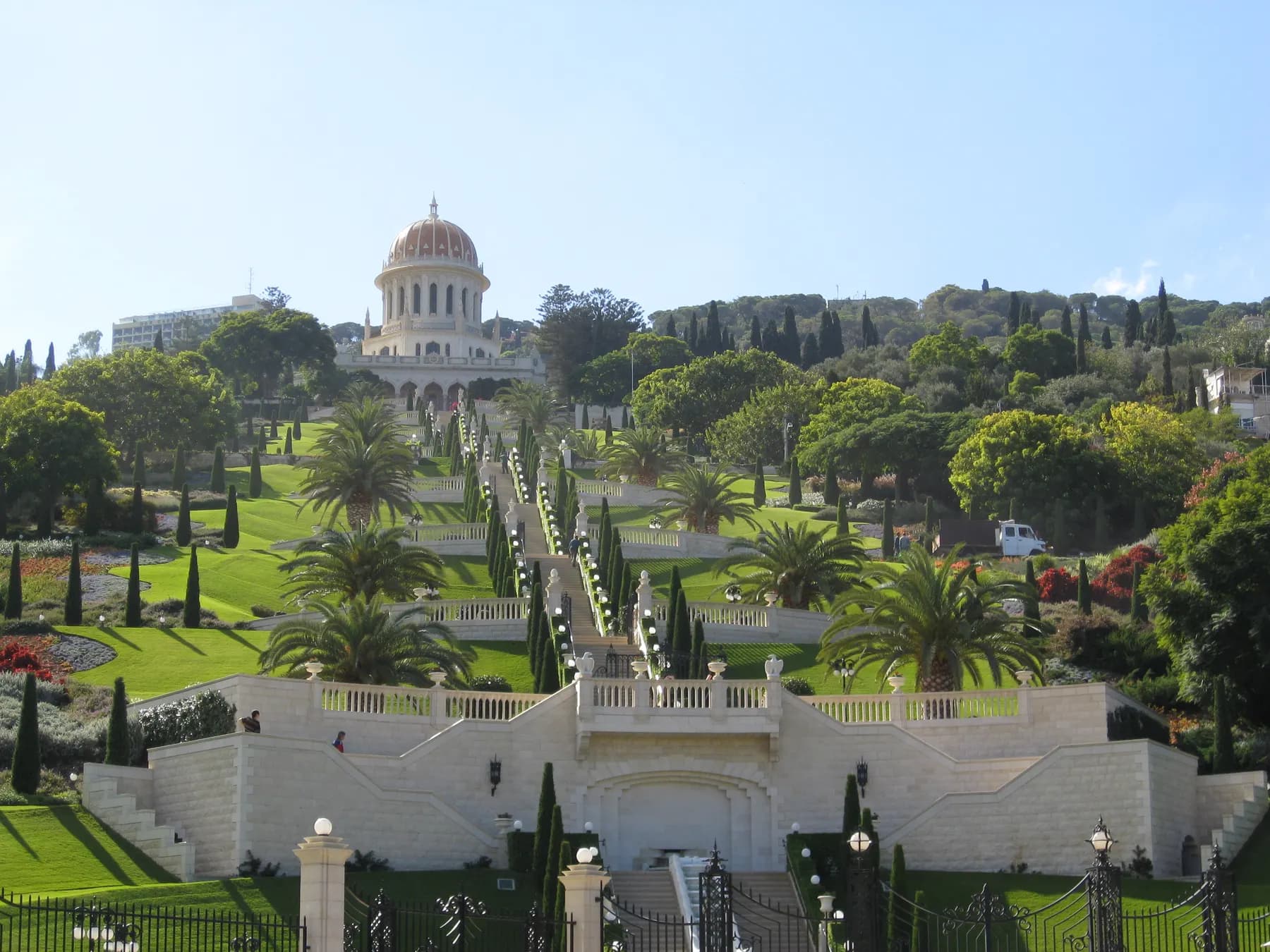
Bahai Gardens and the Shrine of the Bab
Nineteen terraces climb 225 vertical metres of Mount Carmel around a shrine whose stone core was built to receive a body that had been hidden for most of a century.
אושרי רייכר / CC BY 2.5 · Wikimedia Commons
Neighbourhood
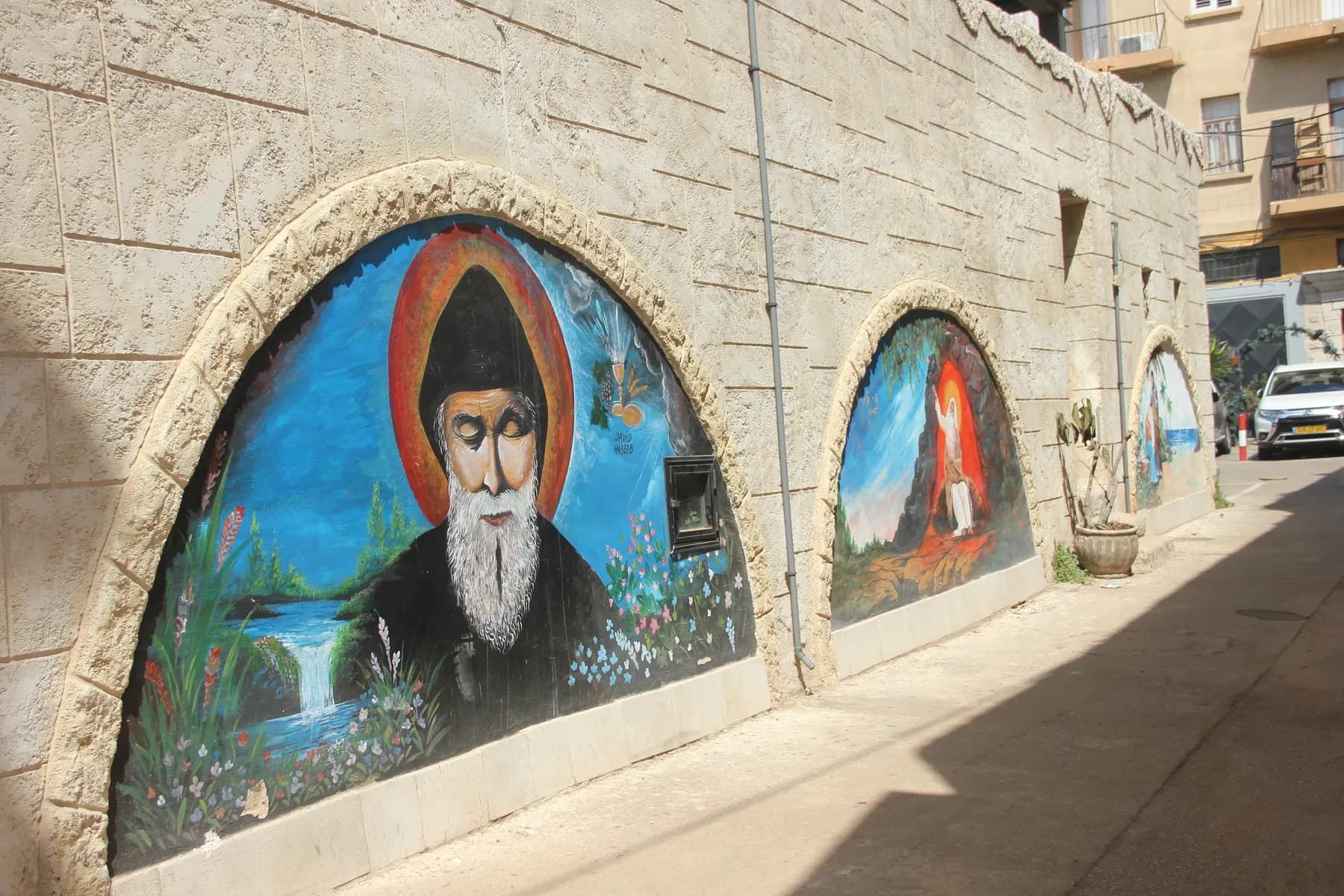
Wadi Nisnas
More than 50,000 Arabs lived in Haifa before the 1948 war and about 3,000 stayed; they were concentrated into this one valley, whose lanes have carried a permanent open-air art exhibition since the 1990s.
אהוד הלפרין / CC BY-SA 4.0 · Wikimedia Commons
Viewpoint
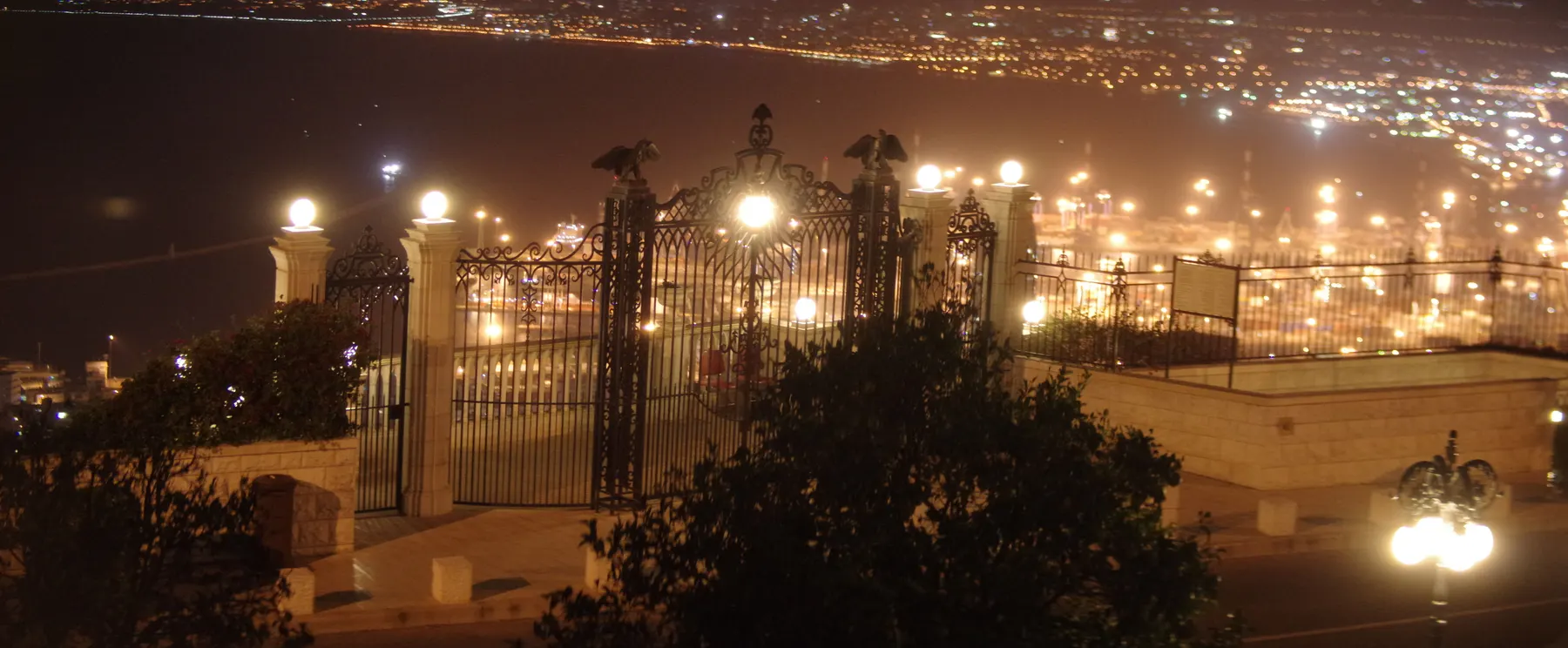
Louis Promenade
A 400-metre clifftop walk on Yefe Nof Street, given to Haifa in 1992 by Paul and May Goldschmidt in memory of their son Louis, and built by the man who was principal contractor of the Bahai gardens on the slope below it.
Sources and further reading
Every link below was opened and checked when this page was written. Official statements are marked as such: they are the subject's own account, not an independent one.
- OfficialAmuta LeTayarut VeNofesh Haifavisit-haifa.orgHaifa Tourism Association
The city tourism body's own site, giving its office and information centre at 48 Ben Gurion Boulevard, its telephone number 04-8535606, and its listings of attractions, tours and hotels in the German Colony
- OfficialHaifa Tourism Associationvisit-haifa.orgSaturday tours: the German Colony, Hadar and Carmel Centre, at 11:00
The weekly guided walk of the German Colony: Saturdays 11:00 to 13:00, ₪15 per person, registration on a space-available basis with the meeting point sent the day before
- OfficialHaifa Museumshcm.org.ilHaifa City Museum: visitor information, the buildings and prices
Beit Ha'am established 1869 as the first Templer community building, rebuilt in 1890 with a large hall and a bell tower, the Templer school of 1902, the 1990s restoration plan initiated by Nissim Tal and designed by Dagan Mushly, the museum opening in 2000 and 2004, the full price list, the address at 11 Ben Gurion Avenue and the statement that only the ground floor is accessible
- OfficialHaifa Museumshms.org.ilMuseum opening hours
The current weekly hours table for the Haifa City Museum, the July and August daily hours of 10:00 to 18:00 with Fridays to 14:00, and the notice that the city museum is closed for the installation of a new exhibition
- OfficialTempelgesellschaft in Deutschlandtempelgesellschaft.deHistorical cemeteries
The Templers' own body on the Haifa cemetery: its position off Jaffa Road behind the British soldiers' cemetery, the graves register, and the reinterment there after 1952 of the dead from Sarona, Waldheim, Bethlehem of Galilee and Wilhelma
- ReferenceJewish Virtual Library, reproducing the Israel Ministry of Foreign Affairs accountjewishvirtuallibrary.orgHaifa: The German (Templar) Colony
Hoffmann and Hardegg arriving from Württemberg in 1868, Hardegg staying in Haifa while Hoffmann founded Jaffa, Haifa's population of about 4,000, the 30 metre street with trees on both sides, stone houses with red shingle roofs under the architect Jacob Schumacher, Beit Am at 11 Ben Gurion Boulevard, and the informational signs for a self-guided walk
- ReferenceWikipediaen.wikipedia.orgGerman Colony, Haifa
The 1868 founding, the 1874 schism and the Evangelical congregation, the community centre inaugurated 2 July 1893 and the school of 1907, 750 inhabitants and 150 houses at the end of Ottoman rule, the cemetery from 1869, 34 per cent Nazi party membership in 1937 and the swastika on 12 May 1937, the 1939 internment, the deportation of 661 on 31 July 1941, and the Schumacher building hit by a missile on 17 November 2024
- ReferenceHebrew Wikipediahe.wikipedia.orgהמושבה הגרמנית (חיפה) (The German Colony, Haifa)
The neighbourhood boundaries and the 2007 municipal figures of 0.39 sq km and 3,810 residents, the street planned at no less than 30 metres with HaGanim and Meir Rotenberg behind it, the vineyards that gave HaGefen Street its name, about 100 dwellings at the end of Turkish rule, the listed houses at numbers 1, 2 to 4, 5, 8, 12, 15 and 16 with their families, the failed Abba Hushi initiatives, the 1990s restoration alongside the Bahai gardens project, the narrowing of the traffic lanes for a bus lane and wider pavements, the Arab ownership of most of the businesses, the WIZO move in 2004, the cemetery obelisk, and the Kaiser's pier of 1898
- ReferenceHebrew Wikipediahe.wikipedia.orgאדריכלות טמפלרית (Templer architecture)
The gable on almost every Templer building, the balcony over the entrance, European motifs combined with eastern arches, the practice of cutting a scriptural verse, family name and building year above the front door, and the EBEN EZER 1893 inscription on Beit Dyck traced to 1 Samuel 7:12
- ReferenceWikipediaen.wikipedia.orgGerman Templer colonies in Palestine
The 850 Templers interned at Helwan in 1918 and 350 deported in 1920, the wired camps of September 1939 with women and children left in the town colonies, the 661 deported to Australia and held at Tatura until 1946 or 1947, the wartime exchange of about 1,000 Templers for 550 Jews, the assassination of Gotthilf Wagner on 12 March 1946 and the dispute over its motive, the arrival in Cyprus on 22 April 1948, the final departures from December 1948 to autumn 1950, and the DM 54 million paid by Israel in 1962
- ReferenceWikipediaen.wikipedia.orgTerraces (Baháʼí)
Nineteen terraces designed by Fariborz Sahba and opened to the public in June 2001, extending almost a kilometre up Mount Carmel over some 200,000 square metres, and the UNESCO World Heritage inscription of July 2008
- ReferenceWikipediaen.wikipedia.orgUNESCO Square
The roundabout at Ben Gurion Boulevard and HaGeffen Street, with the Bahai gardens' entrance plaza to the south and the German Colony promenade to the north, the naming ceremony of 30 May 2011 attended by Irina Bokova, and the inauguration on 9 December 2012 marking the World Heritage inscription of 8 July 2008
- ReferenceWikipediaen.wikipedia.orgLaurence Oliphant
Oliphant settling in Palestine in 1882 and dividing his time between a house in the German Colony in Haifa and one in Daliyat al-Karmel, his secretary Naftali Herz Imber living with them, and his book Haifa, or Life in Modern Palestine illustrated by Alice Oliphant
- ReferenceHaifa Trailhaifatrail.comHaifa Trail, section 21: German Colony towards Jaffa Road
The building-by-building list along Ben Gurion Boulevard: the tourism association at 48, the Colony Hotel, the Neri Bloomfield design school, the early twentieth-century Italian hospital, a Brutalist soldiers' centre, the city museum at 11 in the Templer community building, Gottlieb Schumacher's house at 12 and Oliphant's at 16, plus the German hospice on Jaffa Road and the Dagon granary at the foot of the street
German Colony: common questions
What is the German Colony in Haifa?+
It is a neighbourhood at the foot of Mount Carmel built from 1868 by the Templers, a German Protestant sect from Württemberg, as the first of their colonies in the country. Its centre is Ben Gurion Boulevard, laid out 30 metres wide from the old anchorage up towards the mountain and lined with two-storey stone houses with gabled ends and tiled roofs. The German community was interned and deported between 1939 and 1950, and the neighbourhood was restored from the 1990s as Haifa's main eating and drinking street.
Do you need a ticket for the German Colony?+
No. It is a public street with no gate, no closing time and no admission charge. The only things inside it that are ticketed are the Haifa City Museum at number 11, where an adult ticket is ₪30 and the combined Haifa Museums ticket is ₪80, and the Haifa tourism association's Saturday guided walk, which is ₪15 per person.
How long does it take?+
About 90 minutes covers the boulevard end to end, the inscriptions on the listed houses and the two narrow parallel lanes behind it. Add an hour or so for the city museum, and most of a day if the Bahai terraces above are on the same itinerary. It is roughly a kilometre of street, so the time goes on stopping rather than on walking.
Are the buildings original or reconstructed?+
Both, and the split is worth knowing. The street line, its 30 metre width, the block pattern and the surviving house fronts with their gables and lintel inscriptions are Templer work of the 1870s onwards, and a row of the houses is listed by the Council for Conservation of Heritage Sites in Israel. The Hebrew account says the buildings were restored only in part. The pavements, planting, lighting and the bus lane come from a rebuild approved in 1996 that narrowed the traffic lanes and expropriated several street-facing gardens.
What happened to the Germans who lived here?+
They were interned and then removed. In 1937, 34 per cent of German colonists in Palestine belonged to the Nazi party; the British interned German citizens when war broke out in 1939, and on 31 July 1941 deported 661 of them to Australia by way of Egypt, leaving 345 behind. The community's leader, Gotthilf Wagner, was assassinated by the Haganah on 12 March 1946, the evacuated Germans reached Cyprus in April 1948, and the last of them left Israel between December 1948 and the autumn of 1950.
Can you walk from the German Colony up to the Bahai gardens?+
Yes, and the two are laid out to be walked as one line. The boulevard ends at UNESCO Square, the roundabout at HaGefen Street, with the Bahai gardens' main entrance plaza directly across it. Entry to the gardens is free, but they open only at set hours and enforce their own rules on dress, food and photography, so check them rather than assuming the gate will be open.
Is the Haifa City Museum worth going into?+
It is worth it for the buildings as much as the exhibitions. The museum occupies Beit Ha'am, which its own account dates to 1869 as the first Templer community building in the country, rebuilt in 1890 with a bell tower that gives it a church-like front, and the Templer school of 1902 beside it. The displays are about Haifa rather than the Templers, running from Daher al-Umar's rebuilding of the town in the eighteenth century through the port and the Mandate. Note that only the ground floor is accessible, because the building has no lift.
Is it accessible for a wheelchair or a pushchair?+
The street is, the buildings largely are not. Ben Gurion Boulevard is a wide paved promenade on a gentle, continuous gradient and can be done from end to end on wheels. The Haifa City Museum states that it is a conservation building without a lift and that only its ground floor is accessible. Kerbs on the side lanes are less predictable than on the boulevard itself.
When is the best time to come?+
Late afternoon into the evening. The boulevard is a working restaurant strip that is busier after dark than during the day, the terraces above it are lit at night, and the low sun puts the light on the stone fronts on the western side of the street. Mornings are better for the museum and for reading the inscriptions without crowds in front of them, and December weekends bring the Holiday of Holidays festival into the colony and neighbouring Wadi Nisnas.
Is there anything German about the German Colony now?+
Only the fabric. There has been no German community here since 1950, the businesses on the boulevard are overwhelmingly Arab-owned, and the food is Arab, Israeli and Mediterranean rather than German. What remains German is the plan of the streets, the stone houses with their gables and balconies over the entrances, the biblical verses and family names cut over the doors, and the Templer cemetery on Jaffa Road.