
Museum · The Negev
Ben-Gurion's Desert Home and Tomb
David and Paula Ben-Gurion moved into a Swedish prefabricated hut at Kibbutz Sde Boker on 14 December 1953, and his will asked that it be left exactly as he died in it twenty years later.
Adult ticket
₪25
₪15 for a child aged 5 to 18, as published by the Ben-Gurion Heritage Institute
Books in the study
about 5,000
catalogued from January 2022; the hut was built with shelving for a thousand
Left as it stood
1 December 1973
opened as a museum a year later, as the will asked
The graves
3 km south
a separate free site at Midreshet Ben-Gurion, run by the parks authority
In short
- How long to give it
- About 90 minutes at the hut, plus half an hour at the graves and ten minutes of driving between them
- The hut, Sunday to Thursday
- 08:30-16:00
- Adult
- ₪25
צריף בן-גוריון
Ben-Gurion's Desert Home is a wooden hut at Kibbutz Sde Boker, off Route 40 in the central Negev, in which Israel's first prime minister and his wife Paula lived from December 1953 until his death twenty years later. It is kept as close as possible to the state it was in when he died, and it is small: two separate bedrooms, a guest room, a kitchen and one large study lined with books. The Ben-Gurion Heritage Institute runs it as a museum, with further exhibitions built around it.
The second half of the visit is three kilometres south, and most people do not realise it is a different place with a different operator. Ben-Gurion asked to be buried not on Mount Herzl but on a ridge above Nahal Zin beside Paula, who had died in 1968. The graves sit at the end of a 300-metre path through a planted garden, in a plaza looking out over the Zin canyon. The Israel Nature and Parks Authority looks after that half, it opens in daylight hours, and it charges nothing.
The two halves argue with each other. The hut is an unremarkable prefab of a kind erected across the country in the early 1950s to relieve a housing shortage, chosen by a man who could have had anything. The grave garden won a national design competition. Modesty in one, ceremony in the other, ten minutes of driving between them.
The move
A prime minister asks a year-old kibbutz whether he can join
The Hebrew Wikipedia account, footnoted throughout to the Israeli press of the day, puts the beginning in May 1953. Driving back from the opening of Ma'ale Ha'atzmaut on the road to Eilat, Ben-Gurion saw a hut and a few people at the roadside, stopped the car and got out. They were young people who had fought in the Negev in the War of Independence and had concluded that fighting for it was not enough, that it had to be settled. He was struck as much by the fact that they belonged to no settlement movement and to no party.
A few days later he wrote to them. 'In my 47 years in this country I have seen a number of pioneering enterprises,' the letter runs, and then: 'forgive me if I say that I have never in my life seen a pioneering enterprise like Sde Boker.' He had never envied any man or group, he added, but on that visit he had found it hard to suppress something like envy at not having taken part. At the end of September 1953 he gave the kibbutz 1,200 lira to buy camels, and asked what the terms of joining were. There was one condition: not to engage in politics.
He was 67. The minutes of the admissions committee survive. One member asked whether refusal was even possible. Another said he had to be accepted although it would be a burden. A third objected outright, on the grounds of the difficulties his arrival would create. He was accepted by a majority.
The rest ran fast and in public. Newspapers reported from 16 October 1953 that a Swedish hut was going up for him; on 22 October a partial denial appeared saying the site had not even been surveyed; on 10 November Paula visited the huts, by then standing, and chose the colour they would be painted. In early November he announced he would resign, and on 14 December the couple moved in. He had assumed Paula would stay in Tel Aviv. She did not, and by most accounts settled into the place more readily than he did.
- Kibbutz Sde Boker founded on 15 May 1952 by former soldiers
- Ben-Gurion's letter to its members, May 1953
- 1,200 lira donated for camels, late September 1953
- One condition of membership: no politics
- Moved in on 14 December 1953, a week after resigning
The building
A prefab with running water and shelving for a thousand books
The Jewish Agency paid for three huts, identical to the Scandinavian prefabricated units then being put up across the country to relieve the housing shortage. One was fitted out for the couple: two separate bedrooms, a guest room and a large study with a library built to hold a thousand books. It was the only hut on the site with running water and sewage, a water heater, a refrigerator and gas. The other two housed his aides, his guards and his visitors, and guard posts, a fence and generators arrived with him.
The shelving was badly under-specified. The Heritage Institute now describes a library of more than 5,000 volumes in nine languages, covering Judaism and the Bible, philosophy, history, geography and the army, and says most of his books never came south: over 22,000 remain at the Tel Aviv house. Cataloguing began in January 2022 under Yad Ben-Zvi's Eretz Hefetz project. The hut's director, Gil Schnaider, told Ynet at the time that the team was registering about twenty books a day.
What that cataloguing turned up is the most human thing in the building. There are books in Japanese, Italian and Amharic. There is a Spanish Don Quixote he insisted on reading in the original, learned with Yitzhak Navon as his teacher, carrying his own marginal notes: transliterations into Hebrew, question marks, glosses. There is a Machiavelli in Italian, which he could probably follow because he had Latin.
The rest of the interior is the material culture of Israel in its first two decades, undisturbed: the furniture, the crockery, the pictures on the walls. In the guest room are a map of the country, the flag, a copy of the declaration of independence given to him by Golda Meir, and family photographs. His slippers and the pile of books beside his bed are where he left them.
- Three prefabricated huts, paid for by the Jewish Agency in 1953
- Two bedrooms, a guest room and a study with shelving for 1,000 books
- The only hut on site with running water, sewage, a water heater, a refrigerator and gas
- About 5,000 books in the study today, in nine languages
- Cataloguing began January 2022, at roughly twenty books a day
The will
What survives, what is statutory, and what was rebuilt in 2025
The instruction is in the will, and the museum publishes its own English rendering of it: 'I ask that the home in Sde Boker, which was my home until the day I passed away, shall be kept in its current state, including all furniture, books and magazines that are in it.' The same document asked that the house, its library and its contents be open to the public. In November 1974, a year after he died, the hut was inaugurated as a museum in the presence of the president and the prime minister.
In 1976 the David Ben-Gurion Law made the arrangement statutory. It set up the Ben-Gurion Heritage Institute and specified that the institute shall be at Sde Boker and shall contain the hut and 'his library in the place where it was at the time of his death'. The museum around it was designed by Uri De Bar, work for which he received the Ben-Gurion Prize.
So the hut and its contents are original, and one other building is: the Gypsum House, which the operator calls the first permanent house built on the kibbutz and which now holds an exhibition on the founders and on Ben-Gurion's first days here. Almost everything else a visitor walks through is recent. The animation 'Ben-Gurion Hosts', the interactive tables of 'Ben-Gurion in the Test of Time', the film 'Who is a Leader?' and the outdoor Pioneering Park were all added to turn a small house into a site that holds a school group for two hours.
The hut and its exhibition were refurbished in 2010 under a Prime Minister's Office heritage programme, and conservation of the building began in January 2022. Then, in October 2025, the neighbourhood around it was reconstructed: Srugim reported a project led by the Heritage Institute with KKL-JNF and the Council for Conservation of Heritage Sites, worked up from 1950s aerial photographs and residents' testimony. The morning paths Ben-Gurion walked were re-laid, roses of the kind Paula grew were planted at the entrance, and the water installation that gave the couple their running water was restored. It is a careful reconstruction, and it is a reconstruction: the sensation of standing in a 1950s kibbutz lane is a year old.
- Opened as a museum in November 1974, a year after his death
- David Ben-Gurion Law, 1976: the hut and library are protected by statute
- Original buildings: the hut and the Gypsum House
- Added later: four exhibitions, a sand table and the Pioneering Park
- The surrounding 1950s neighbourhood was rebuilt and completed in October 2025
Above the Zin
The graves, and the competition that decided how to approach them
Paula Ben-Gurion died on 29 January 1968 and was buried the following day on a plot south of the library building at Midreshet Sde Boker. Choosing it meant giving up the couple's entitlement to the plot of national leaders on Mount Herzl. Who chose the spot is not settled: Hebrew Wikipedia, following David Ohana and Michael Feige, gives one version in which his friend Avraham Zvion proposed it and Ben-Gurion approved, and another in which the idea was his own. He died on 1 December 1973 and was buried beside her two days later. The will asked that no eulogies be spoken at the funeral or at the graveside and that no honour volleys be fired.
Preparing the ground raised the plaza by several metres, so that although the two headstones stand side by side, Ben-Gurion's grave is in fact some metres higher than his wife's. The stones were designed by the sculptor Ezra Orion: plain rectangular blocks with diagonal plaques set into wide recesses along the top, carrying each name, the years of birth and death, and the year that person came to the country.
The setting was chosen by open competition. In May 1974 the National Parks Authority invited designs for the plaza and its surroundings, asking for a park that would let visitors come as pilgrims and that would be modest but full of dignity. Its chairman, Yaakov Yannai, argued that the library building below the plaza should be pulled down to open up space, but entrants were told to leave it standing and work it in; it later became the home of the Heritage Institute. A jury of thirteen, including Yigael Yadin, Teddy Kollek and the architects Al Mansfeld, Yaakov Rechter and Arieh Sharon, considered 54 submissions and chose the landscape architects Lipa Yahalom and Dan Zur, later Israel Prize laureates.
What they built covers about 90 dunams and is mostly planting. A path of roughly 300 metres winds from the car park, stepped stone slabs and rocks laid along both sides among carob and olive trees so that it reads as the channel of a desert wadi, and delivers a walker into a large open plaza. The graves lie at its centre under pepper trees inside a black chain on posts. Stepped rock ledges double as seating, and beyond the low southern wall the ground falls into Nahal Zin. The state memorial ceremony is held here each year around the sixth of Kislev.
The grave has been attacked twice: with swastikas in February 1989, by a Haredi group calling itself KaSHeT, and with the word 'Hitler' in March 2005, reported the same day by both Ynet and Haaretz.
- Paula buried 30 January 1968; David buried 3 December 1973
- Mount Herzl declined in favour of the ridge above Nahal Zin
- Headstones by the sculptor Ezra Orion, carrying the year each of them came to the country
- 1974 competition: 54 entries, judged by a jury of thirteen
- Won by landscape architects Lipa Yahalom and Dan Zur
- About 90 dunams of garden; a path of roughly 300 m to the plaza
Practicalities
Two sites, two operators, and only one of them sells a ticket
The hut compound is run by the Ben-Gurion Heritage Institute and charges admission. The graves are run by the Israel Nature and Parks Authority, which publishes no entrance fee for them and gives them no line in its 2025 national price list; its page says only that the site is open in daylight hours and needs no booking. Hebrew Wikipedia notes that the grave garden is formally part of Ein Avdat National Park rather than a national park in its own right, which is why it has no gate of its own.
One of the activities the museum advertises is not at the museum. 'Trial of the People', in which visitors vote as a jury on five episodes in Israeli history, is at the Ben-Gurion campus at Midreshet Ben-Gurion and carries its own charge. The Pioneering Park is on the hut site but is an outdoor challenge course for booked groups, priced separately, which the operator states plainly is not accessible to people with physical disabilities and is classed as an extreme activity.
Accessibility at the hut is otherwise good and unusually specific: level paths throughout, a wheelchair to borrow at the desk, an accessible bay and two accessible toilets, an induction loop, subtitles on the films and audio description on the animation. The operator also says, without softening it, that the interactive tables of 'Ben-Gurion in the Test of Time' are not adapted for visitors with sight or hearing impairments.
A visit to both is a morning: about 90 minutes at the hut, ten minutes of driving, half an hour at the graves. Ein Avdat National Park is a few minutes further along the same road, which is how these three usually get combined.
What to look for
Things not to walk past at Ben-Gurion's Desert Home and Tomb
The details that repay knowing about before you are standing in front of them.
The study
One room, walls of shelving and a desk he wrote his memoirs at. The books are the exhibit: nine languages, a Spanish Don Quixote annotated in his own hand, Machiavelli in Italian, volumes in Japanese and Amharic.
The two bedrooms
David and Paula slept in separate rooms, and both are open. The slippers and the stack of books beside his bed have not been moved since 1973.
The Gypsum House
The first permanent building on the kibbutz, and the only structure on the site other than the hut that is original. Its exhibition covers the founders, the settlement then and now, and Ben-Gurion's first days here.
The walk to the graves
Roughly 300 metres of stepped stone and planting designed to read as a wadi channel, opening without warning onto the plaza and the drop into Nahal Zin. The reveal is the whole point of the design.
The inscriptions
Each headstone carries the name, the years of birth and death, and the year that person came to the Land of Israel. On a national monument that third line is an unusual thing to record.
'Ben-Gurion Hosts'
A short animation shown before the museum proper, built from photographs of his life with every word of the script taken from his own writing and speech. The operator includes it at no extra charge.
The long view
Ben-Gurion's Desert Home and Tomb, in order
15 May 1952
Kibbutz Sde Boker is founded by a group of former soldiers.
May 1953
Ben-Gurion stops at the roadside on the way back from Eilat, talks to the settlers, and writes them a letter saying he has never seen a pioneering enterprise like it.
16 October 1953
The press reports that a Swedish prefabricated hut is being erected for him at Sde Boker.
10 November 1953
Paula Ben-Gurion visits the finished huts and chooses the colour they are painted.
7 December 1953
Ben-Gurion resigns as prime minister.
14 December 1953
David and Paula move into the hut.
1955 to 1963
Back in office as defence minister and then prime minister, he keeps the hut but spends most of his time at the Tel Aviv house.
1963
He leaves government and moves to the kibbutz permanently.
29 January 1968
Paula dies; she is buried the next day on the ridge above Nahal Zin, forgoing the plot on Mount Herzl.
1 December 1973
Ben-Gurion dies. He is buried beside her two days later, with no eulogies and no honour volleys, as his will asked.
May 1974
The National Parks Authority opens a public competition for the design of the grave plaza; 54 entries are submitted.
November 1974
The hut opens as a museum in the presence of the president and the prime minister.
1976
The David Ben-Gurion Law establishes the Heritage Institute and fixes the hut and library in place by statute.
February 1989
The grave is defaced with swastikas by a group calling itself KaSHeT.
March 2005
The word 'Hitler' is sprayed on the grave, reported the same day by Ynet and Haaretz.
2010
The hut and its exhibition are refurbished under a Prime Minister's Office heritage programme.
January 2022
Conservation of the hut begins and the library is catalogued book by book under Yad Ben-Zvi's Eretz Hefetz project.
October 2025
The reconstructed 1950s neighbourhood around the hut is completed, worked up from aerial photographs and residents' testimony.
Practical
Visiting Ben-Gurion's Desert Home and Tomb
Where
Ben-Gurion's Desert Home, Kibbutz Sde Boker, off Route 40. The graves are 3 km south, at Midreshet Ben-Gurion.
What ticket you need
The graves are a separate site with a separate operator and no ticket. Hebrew Wikipedia notes that the grave garden is administered as part of Ein Avdat National Park rather than as a national park of its own, but nothing is collected at the gate and the museum ticket buys nothing there.
Opening hours
- The hut, Sunday to Thursday
- 08:30-16:00source
- The hut, Friday and holiday eves
- 08:30-14:00source
- The hut, Saturday and holidays
- 10:00-16:00source
- Last useful arrival
- The operator asks visitors to come about an hour before closingsource
- Guided tour, in Hebrew
- 11:00, Sunday to Friday, family-adaptedsource
- The graves
- Daylight hours only; no advance booking neededsource
Admission
- Adult
- ₪25source
- Senior, student, serving member of the security forces
- ₪20source
- Child aged 5 to 18, visitor with a disability
- ₪15source
- Guided tour, adult
- ₪40, by prior reservation and subject to availability, on the English price listsource
- Guided tour, concession
- ₪30, on the English price listsource
- Group guiding, on top of entry
- ₪350 for up to 40 adults, ₪225 for up to 35 childrensource
- Pioneering Park, outdoor activity
- ₪40 adult, ₪30 concession, booked groupssource
- The graves
- No entrance fee published, and no line for the site in the parks authority's 2025 price listsource
Access
The hut compound is level and, on the operator's own account, wheelchair accessible throughout: all paths are made accessible, a wheelchair can be borrowed at the ticket desk, there is an accessible parking bay and two accessible toilets, and the desk has an induction loop and a plain-language sheet with a visual map. Films carry subtitles and the animation has recorded audio description. The operator states that the interactive tables of 'Ben-Gurion in the Test of Time' are not adapted for visitors with sight or hearing impairments, and that the outdoor Pioneering Park is not accessible to people with physical disabilities and is classed as an extreme activity. At the graves the parks authority lists parking, the service centre, the toilets, the paths and the grave plaza as accessible; the approach is a level walk of about 300 metres rather than a climb, so a wheelchair can make it, but there is no shortcut and no shade for most of it.
On site
- Ticket desk
- Free introductory animation
- Toilets
- Accessible toilets
- Picnic tables
- Paula Café
- Second-hand shop
- Car park
- Petrol station on site
- Service centre and shaded picnic tables at the graves
Booking
Independent visits need no booking: turn up in opening hours and buy at the desk. Groups must be arranged in advance by email or telephone, and guided tours in English depend on a guide being free, so ask before travelling if that matters. The 11:00 daily tour is in Hebrew.
Hours and prices are given as the operator publishes them and change without much notice, particularly around Shabbat and the festivals. Check the operator's own page before you travel for this.
Official page at ben-gurion.co.il →What people wish they had known
- Do not expect the graves to be at the hut. They are 3 km south at Midreshet Ben-Gurion, on a different access road, run by a different body, and a visitor who leaves after the museum has seen half the thing.
- The 11:00 daily tour is in Hebrew. English guiding exists but is bookable in advance and depends on a guide being free, so an English speaker who wants a guided visit should ask before setting out rather than at the desk.
- Friday and holiday eves close at 14:00, not 16:00, and the operator asks for arrivals about an hour before closing. A Friday afternoon plan built around this site does not work.
- The introductory animation is included in the ticket and is shown before the museum. People who skip it to save time then walk into the hut without the context the rooms are arranged to reward.
- The grave plaza is stone and mostly unshaded, and the path to it is a level 300 metres in the open. In summer it is a job for early morning or the last hour of light, not midday.
- Ein Avdat National Park is a few minutes further down the same road and charges its own admission. Nothing at the hut or the graves covers it.
The figures
Ben-Gurion's Desert Home and Tomb by the numbers
Each figure carries the year it belongs to and links the source it came from.
| Measure | Figure | As of | Source |
|---|---|---|---|
| Adult admission to the hut | ₪25 | 2026 | ben-gurion.co.il |
| Books in the study | about 5,000 | 2022 | ynet.co.il |
| Shelving the hut was built with | room for 1,000 books | 1953 | he.wikipedia.org |
| Visitors a year to the hut compound | about 100,000 | 2025 | srugim.co.il |
| Area of the grave garden | about 90 dunams | 2026 | he.wikipedia.org |
| Path from the car park to the grave plaza | about 300 m | 2026 | parks.org.il |
| Entries in the 1974 design competition | 54 | 1974 | he.wikipedia.org |
| Distance from the hut to the graves | 3 km | 2026 | parks.org.il |
While you are here
The rest of The Negev
Everything else in this destination with a page of its own.
רחל וייסלר / CC BY 2.5 · Wikimedia Commons
Nature reserve
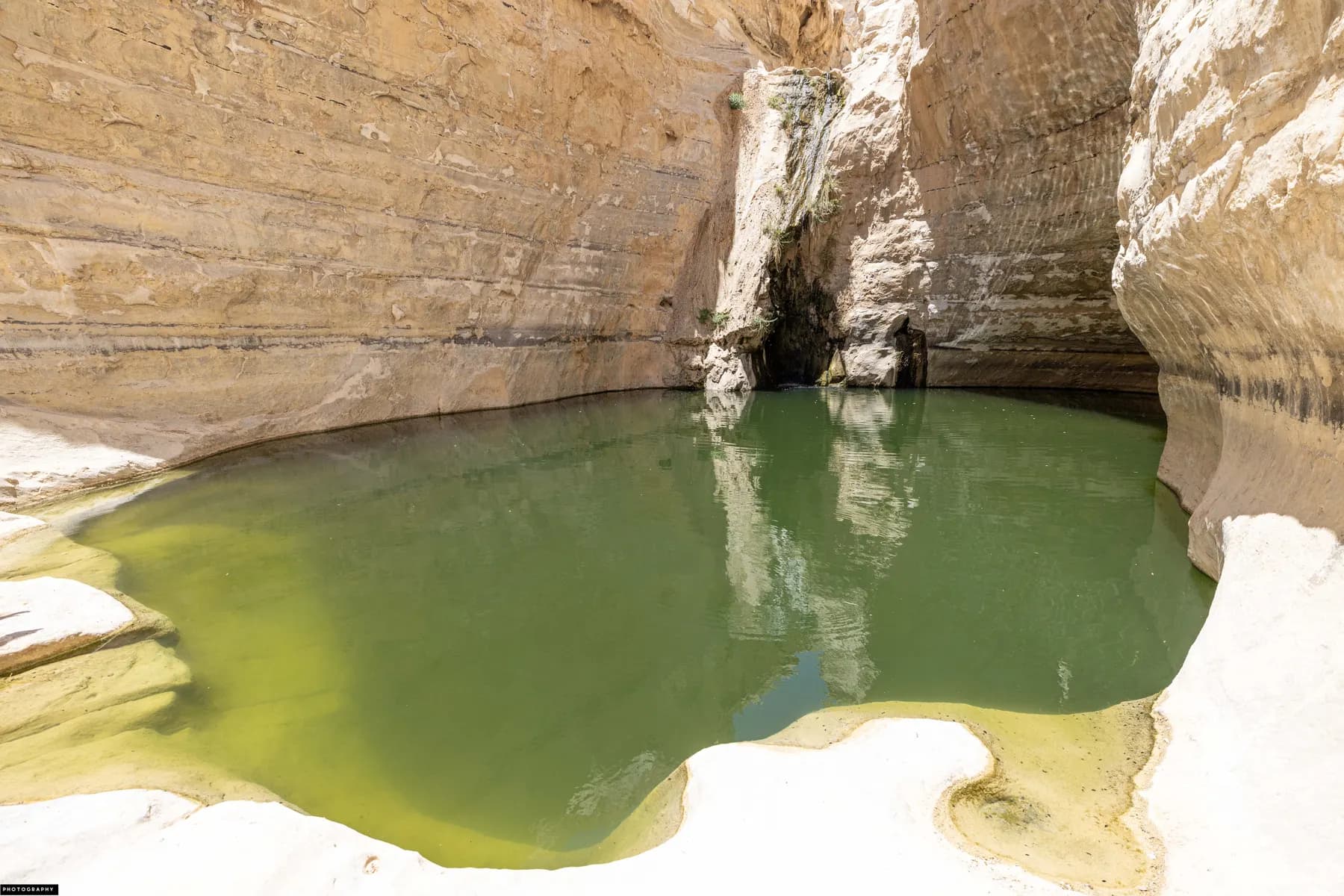
Ein Avdat National Park
Three springs keep water running all year at the bottom of a white chalk canyon that was cleared, laid out and opened to the public in 1961 as a seventy-fifth birthday present for David Ben-Gurion.
ישראל פרקר / CC BY 2.5 · Wikimedia Commons
Archaeological site
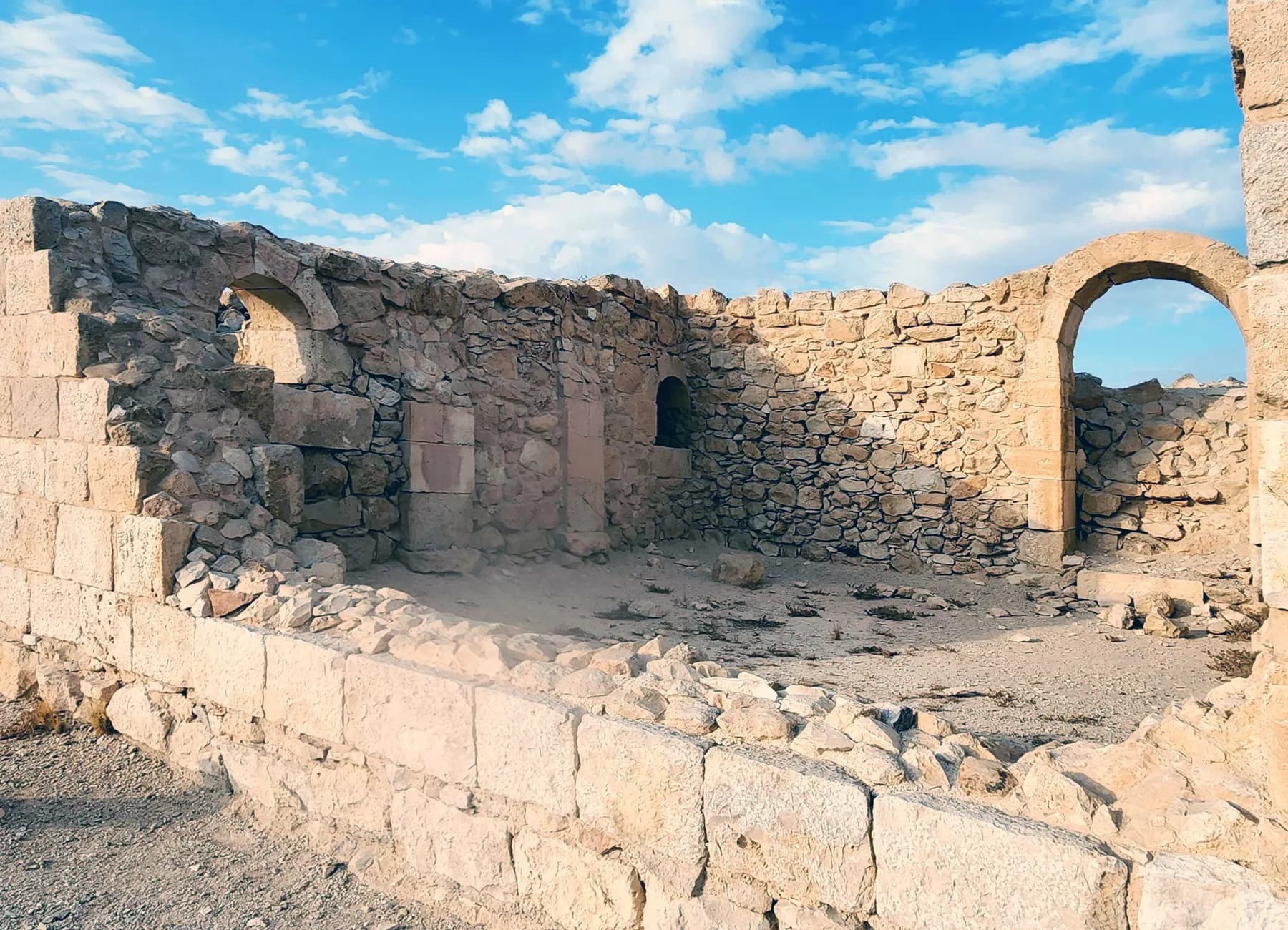
Avdat National Park
Avdat was station number 62 on the Incense Route, and the caravan road that brought frankincense from Arabia towards the port of Gaza can still be picked out climbing to it from the southeast.
Orhat / CC BY-SA 4.0 · Wikimedia Commons
Nature reserve
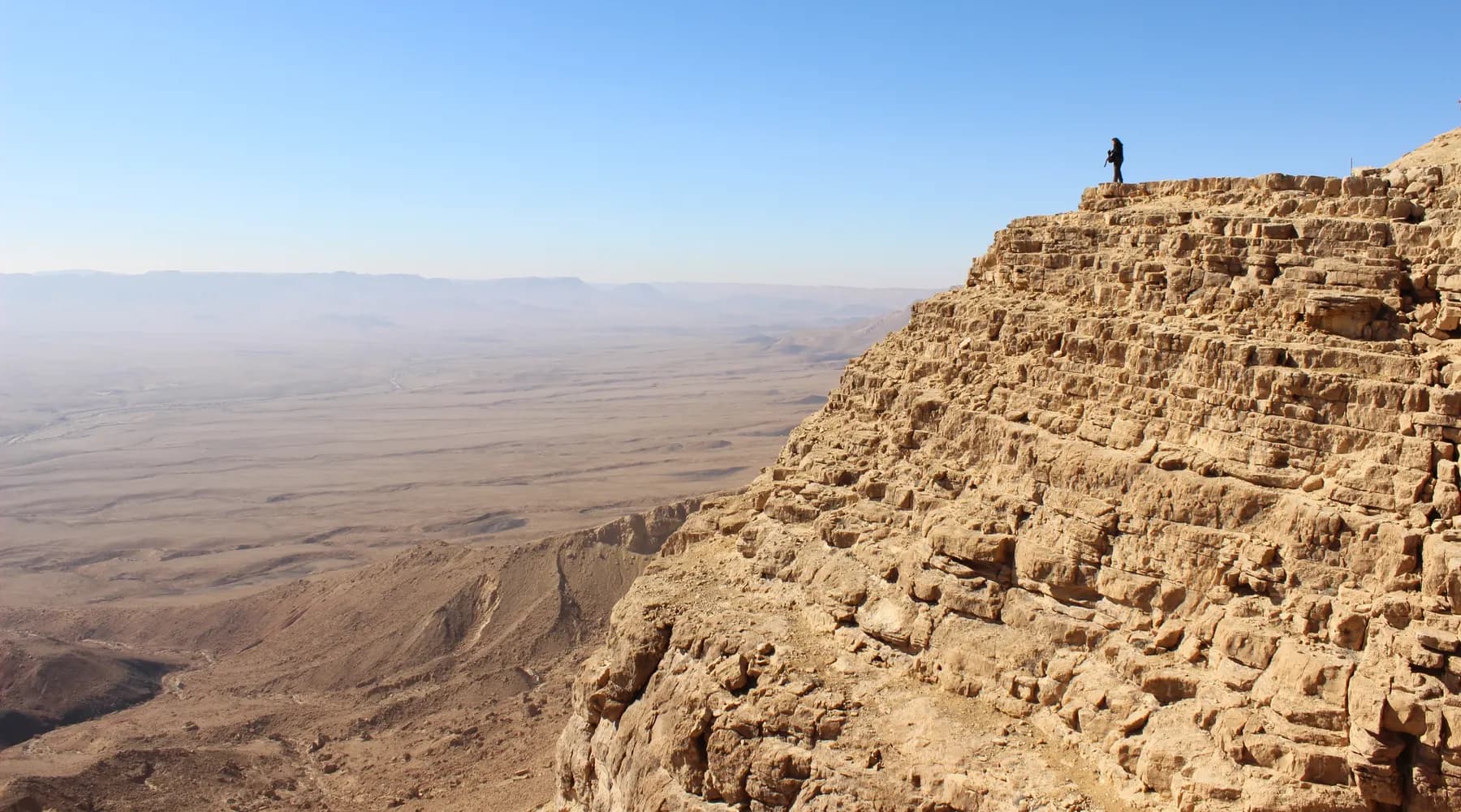
Makhtesh Ramon (Ramon Crater)
The floor of the makhtesh was quarried for clay and quartz before it was protected, and the parks authority's scenic road across the eastern half runs over ground it had to rehabilitate.
Sources and further reading
Every link below was opened and checked when this page was written. Official statements are marked as such: they are the subject's own account, not an independent one.
- OfficialBen-Gurion's Desert Home, Ben-Gurion Heritage Instituteben-gurion.co.ilמידע למבקרים עצמאים (Information for independent visitors)
current opening hours, the three-tier admission prices, the 11:00 tour and the accessibility arrangements
- OfficialBen-Gurion's Desert Homeben-gurion.co.ilVisitor Info
the English price table, including guided-tour, group and out-of-hours rates
- OfficialBen-Gurion's Desert Homeben-gurion.co.ilBen-Gurion Desert Home
what is on the site, the free introductory animation, the three supporting exhibitions and the 1976 law
- OfficialBen-Gurion's Desert Homeben-gurion.co.ilAbout Ben-Gurion's Desert Home
the museum's English rendering of the will, the library in nine languages and the objects in the guest room
- OfficialBen-Gurion's Desert Homeben-gurion.co.ilהצהרת נגישות (Accessibility statement)
what is and is not adapted, including the interactive tables and the Pioneering Park
- OfficialIsrael Nature and Parks Authorityparks.org.ilגן לאומי קבר בן גוריון (Ben-Gurion's Tomb National Park)
the garden's design, the 300 m path, daylight-hours opening, the 3 km from the kibbutz and the access provision
- OfficialIsrael Nature and Parks Authorityen.parks.org.ilBen-Gurion's Tomb National Park
the English page for the grave site, its outlook over the Zin canyon and its facilities
- ReportingYnetynet.co.ilלהציץ בספרים של בן גוריון עם הערות בכתב ידו
January 2022: the library catalogued at about twenty books a day, and the Spanish, Italian, Japanese and Amharic finds
- ReportingSrugimsrugim.co.ilמסע בזמן: שכונתו של בן גוריון מתעוררת לחיים אחרי 50 שנה
October 2025: the reconstruction of the neighbourhood, its partners and the figure of about 100,000 visitors a year
- DataIsrael Nature and Parks Authorityparks.org.ilמחירון 2025: דמי כניסה לשמורות טבע וגנים לאומיים
the national fee schedule, which carries no line for the grave site and gives the neighbouring parks' prices
- ReferenceHebrew Wikipediahe.wikipedia.orgצריף בן-גוריון
footnoted to the 1953 press: the roadside meeting, the letter, the admissions committee, the hut's specification, the will and the 1976 law
- ReferenceHebrew Wikipediahe.wikipedia.orgגן לאומי קבר בן-גוריון
the 1974 competition and its jury, the raised plaza, Ezra Orion's headstones, the 90 dunams and the two desecrations
- ReferenceEncyclopaedia Britannicabritannica.comDavid Ben-Gurion
birth as David Gruen in 1886, the terms of office, the 1963 resignation, leaving the Knesset in 1970 and the death on 1 December 1973
- ReferenceEnglish Wikipediaen.wikipedia.orgSde Boker
the kibbutz founded on 15 May 1952 by former soldiers, and the study of about 5,000 books
Ben-Gurion's Desert Home and Tomb: common questions
How much does it cost to visit Ben-Gurion's Desert Home?+
The Heritage Institute publishes ₪25 for an adult, ₪20 for a senior, a student or a serving member of the security forces, and ₪15 for a child aged 5 to 18 or a visitor with a disability. Its English price list also carries guided-tour rates of ₪40 for an adult and ₪30 for a concession, bookable in advance and subject to a guide being available. Group guiding is charged on top of entry, at ₪350 for up to 40 adults or ₪225 for up to 35 children. The graves have no admission fee at all.
Is Ben-Gurion actually buried at the hut?+
No. He and Paula are buried 3 km south, at Midreshet Ben-Gurion, in a garden run by the Israel Nature and Parks Authority. He chose the ridge there over the plot for national leaders on Mount Herzl in Jerusalem, and Paula was buried at the spot in January 1968, nearly six years before him. It is a ten-minute drive from the museum and is free to enter.
Do I need to book in advance?+
Not for an independent visit: the museum says to come during opening hours and buy at the desk. Groups do have to be arranged in advance by email or phone, and so does anything beyond the standard entry, such as a guided tour, the Pioneering Park or a sign-language interpreted visit, which the operator asks for at least three weeks ahead.
How long does it take?+
About 90 minutes at the hut compound if the films are watched and the exhibitions are read, and about half an hour at the graves. Add ten minutes of driving between the two. A school group or a family working through the interactive tables and the sand table will spend longer at the museum.
Is everything in the hut original?+
The hut and its contents are, and so is the Gypsum House next to it, which was the first permanent building on the kibbutz. Everything else is later. The four exhibitions, the sand table and the outdoor Pioneering Park were added over the years, the hut and its display were refurbished in 2010, conservation of the building began in January 2022, and the 1950s neighbourhood the hut now stands in was reconstructed from aerial photographs and completed in October 2025.
Is it wheelchair accessible?+
The hut compound is, on the operator's own account: level accessible paths throughout, a wheelchair available at the ticket desk, an accessible parking bay, two accessible toilets and an induction loop at the desk. The graves are reached by a level path of about 300 metres and the parks authority lists the parking, the toilets, the paths and the grave plaza as accessible. The two exceptions the operator names are the interactive tables of 'Ben-Gurion in the Test of Time', which are not adapted for visitors with sight or hearing impairments, and the Pioneering Park, which is not accessible to people with physical disabilities.
Is it worth it if I am not Israeli?+
It depends on what you want from a museum. There is nothing spectacular here: one small prefabricated house with the furniture of a 1950s kibbutz in it. What it offers is the specific, checkable fact of a head of government who moved to a hut in the desert at 67, took a kibbutz's one condition of membership that he stay out of politics, and then went back on it. The library is the thing that surprises most visitors, and it needs no national background to read.
Is there shade, and what is there to eat?+
The museum compound has picnic tables, a café called Paula Café, a second-hand shop and a petrol station on the site, and the walk between the buildings is short. The grave garden has a service centre with shaded picnic tables and toilets near the car park, but the plaza itself and most of the path to it are open to the sun. In summer both places are better done early.
Can I combine it with Ein Avdat?+
Yes, and most people do. Ein Avdat National Park lies a few minutes further along the same stretch of Route 40, and the grave garden sits between the two. Ein Avdat charges its own admission and neither the museum ticket nor the free grave site covers it, so budget for that separately, and check the park's own closing time, which is earlier than the museum's.
Where does the 'Trial of the People' activity happen?+
Not at the hut. The museum's English pages place it at the Ben-Gurion campus at Midreshet Ben-Gurion, south of the museum and near the graves, and it carries its own ticket. It is an interactive film in which visitors vote as a jury on five episodes from Israeli history, taking its cue from a line Ben-Gurion wrote in 1948 regretting that Israel had no jury system.