Museum · The Negev
Israeli Air Force Museum, Hatzerim
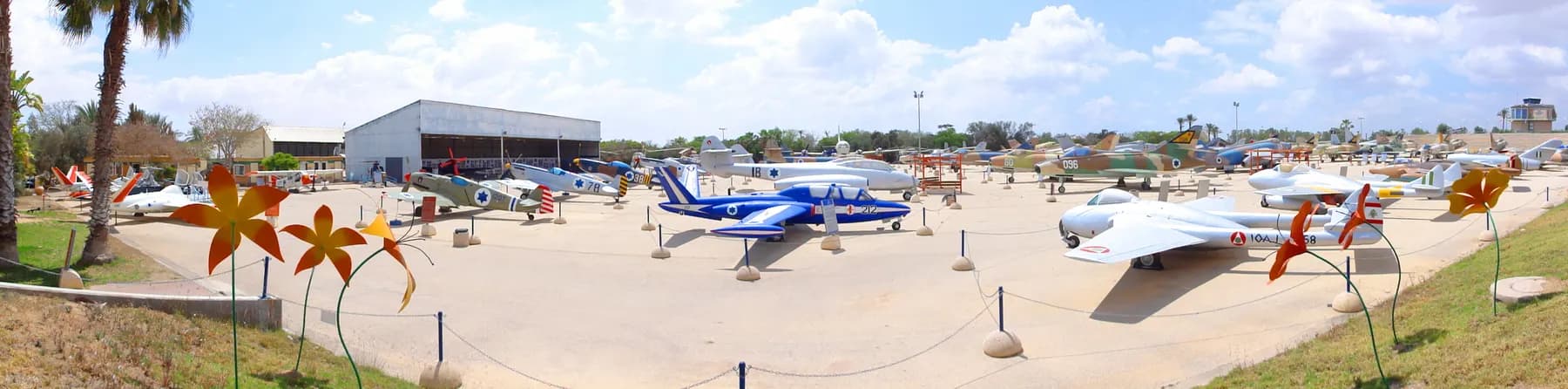
The air force parks its retired and captured aircraft on an open concrete apron beside its own flight school west of Beersheba, from a Czech-built Messerschmitt copy of 1948 to the F-16 that struck the Osirak reactor in 1981.
DYKT Mohigan / CC BY 2.0 · Wikimedia Commons
Aircraft on show
more than 140
the Jewish Virtual Library's count; visitor guides usually say about 150
Opened to the public
20 June 1991
cornerstone laid on 16 July 1985, on Hebrew Wikipedia's account
Sent for scrap
20 aircraft
decided February 2022, the Entebbe Boeing 707 among them, per Ynet
Reopened
22 April 2026
after three years shut through the war, per Walla
In short
- How long to give it
- about 90 minutes on the apron, or two to three hours with a guided tour and the indoor exhibitions
- Sunday to Thursday, and Chol HaMoed
- 08:00-17:00
- Adult
- ₪30 on the last figure an independent visitor guide publishes; the guide carries no date and the figure predates the three-year closure
מוזיאון חיל האוויר
The Israeli Air Force Museum is an open-air aircraft park on the edge of Hatzerim airbase, about six kilometres west of Beersheba, where the air force keeps the machines it has retired and the ones it has captured. There is almost no building to it. The aircraft stand in rows on concrete under the desert sky, a painted walking route runs between them, and serving air force soldiers staff the place. The flight school is on the same base, so trainers pass overhead while visitors walk the lines.
The collection is the reason to come and the reason for the argument that surrounds it. It holds the F-16 that bombed the Osirak reactor and later carried six and a half kill markings, the MiG-21 an Iraqi pilot defected with in 1966, a Mirage with thirteen kills that Israel bought back from Argentina, and the prototype of the Lavi fighter that was cancelled before it entered service. It also holds a decade of critical Israeli reporting about rust, peeling paint and aircraft rotting in a yard behind the display fence.
Two things to know before setting out. In February 2022 the air force decided to scrap twenty of the museum's aircraft, including the Boeing 707 that had served as the flying command post over Entebbe and afterwards as the hall where heritage films were screened. The museum then spent three years closed through the war, reopening only on 22 April 2026. What is on the apron today is not what the guidebooks describe.
The site
An aircraft park on the edge of a working airbase
Hatzerim was the first Israeli Air Force base built from the ground up rather than inherited from the Royal Air Force, and it was declared operational on 3 October 1966. It sits six kilometres west of Beersheba and carries the flight academy, the aerobatic team and two fighter squadrons. The museum is adjacent to all of it, which is the single fact that shapes a visit: this is a military installation with a public apron attached, not a civilian museum with an airfield theme.
The layout as it stands dates from a refurbishment carried out over the winter of 2021 and 2022. Ynet's Udi Etzion, who walked it on the reopening day in May 2022, described the aircraft rearranged into a new order with a walking route painted between them to resemble a runway, part of it roofed so that visitors had shade on the route for the first time. That refurbishment cost several million shekels and was the first significant work on the site since it opened to the public in 1991.
The same report set out what the refurbishment took away. The Boeing Stratocruiser, whose doors had been open to visitors, was locked on safety grounds and repainted white in a scheme it had never worn in service, which Etzion called an inaccuracy not acceptable in museums of this kind. The Fouga Magister trainer near the entrance, where children could sit in the cockpit and be photographed, was locked too. On reopening day the longest queue of children was for the airfield fire engine, because its cab was the only one they were allowed to climb into, and it stood beside a borrowed F-35.
Everything else is outdoors. The Jewish Virtual Library describes an outdoor exhibition of more than 140 aircraft and helicopters, and the museum has been promised a building since 2016 without getting one.
- Hatzerim declared operational on 3 October 1966, the first IAF base built from scratch
- Six kilometres west of Beersheba, on the northern edge of the Negev
- Home to the air force flight academy and the aerobatic team
- Refurbished over the winter of 2021 and 2022 at a cost of several million shekels
- Part of the walking route roofed for shade for the first time in 2022
The founder
A Phantom pilot who spent thirty years collecting aircraft
Yaakov Turner enlisted in the air force in 1953, commanded an air combat squadron in the Six-Day War and the War of Attrition, flew the F-4 Phantom in the Yom Kippur War, and retired as a brigadier general in 1985. That same year he founded the museum at Hatzerim. Hebrew Wikipedia dates the cornerstone to 16 July 1985 and credits the effort mainly to him; the museum opened to the public on 20 June 1991.
The founding date is not agreed. English Wikipedia's infobox says the museum was established in 1977 and opened in 1991; Ynet wrote in 2022 that it was founded in 1991 by Turner; the Jewish Virtual Library says it has been open to the public since 1997. The air force's own account would settle it, and its website refuses connections from outside Israel, so this page cannot.
What is not in doubt is that the collection exists because one man kept pushing. Ynet found him in 2016 in the yard behind the display fence, standing among Phantoms he had saved from the scrapyard with donated money, explaining which aircraft were reserves that had never been meant for display and which were waiting on a decision about their future. Turner went on to be commissioner of the Israel Police from 1990 to 1993 and mayor of Beersheba from 1998 to 2008. He died on 27 October 2024, aged 89.
The counter-argument was in the same report. Danny Shalom, an aviation historian who ran the aviation and space museum at Rishon LeZion, told Ynet that the air force did not treat the museum seriously, that heritage preservation received minimal funding while resources went to operational needs, and that Turner's insistence on running the place himself left volunteers who offered help unanswered.
Condition
Twenty aircraft to the scrapyard, and a Boeing sawn in half
On 13 February 2022 Ynet reported that the air force had decided to send twenty of the museum's aircraft for scrap. Weather and inadequate maintenance had done the work: paint had peeled, rust had eaten into metal, birds had nested in engine intakes, and some airframes were judged at risk of collapse. The museum had closed without notice at the end of December for the refurbishment, and the list included Ouragan, Mystere and Phantom fighters that had flown in Israel's wars, along with helicopters and a Nord transport. The value of what went was put at tens of millions of shekels, and the decision was taken without consulting the public or air force veterans, and without testing whether donations or purchase offers might have saved any of it. The IDF spokesperson said the only items scrapped were spare parts and metal beyond use, or aircraft that repeated checks had shown could not be restored.
The aircraft of greatest historical value on that list was the Boeing 707 carrying air force number 008, which had flown as the airborne command post on the Entebbe raid of 3 and 4 July 1976 and had spent its museum years as the hall in which heritage films were shown to visitors. Anyone travelling to Hatzerim to see it should know what survives. When Ynet walked the site three months later, the forward section of the 707 was parked beyond the display fence, sawn off from the rest of the fuselage, and was said to be intended one day for a separate display commemorating the operation alongside the Hercules that flew it.
Two other headline aircraft were missing from the apron on that visit, both awaiting paint in the same closed yard. One was the Avia S-199, the Czech-built Messerschmitt derivative that was the first fighter the air force owned, that attacked the Egyptian column near what is now Ashdod, and that scored the force's first aerial kills. The other was the Catalina flying boat that Boeing donated to the museum in 2008 at the initiative of 69 Squadron veterans.
The complaint about paint is older than the scrapping. Hebrew Wikipedia records that many Israeli aviation enthusiasts object to a museum policy they see as favouring crowd appeal over historical accuracy, under which aircraft are painted in schemes they never wore, and criticise the neglect of exhibits. The museum's own curator, Avi Moshe-Segal, put the constraint plainly to Ynet in 2016: restoring an aircraft to its original condition is possible, and it takes resources the museum does not have.
- 20 aircraft condemned in February 2022, including Ouragans, Mysteres and Phantoms
- Boeing 707 number 008, the Entebbe command post, among them
- Its nose section survives behind the fence, cut from the fuselage
- Avia S-199 and the 2008 Catalina were off display in May 2022, awaiting paint
- The Stratocruiser was repainted white in a scheme it never wore in service
The collection
The MiG that defected and the F-16 that bombed a reactor
The single most travelled aircraft here is a Soviet fighter. Operation Diamond was a Mossad effort begun in mid-1963 to obtain a MiG-21, then the most advanced Soviet fighter in service, and it ended on 16 August 1966 when an Iraqi Air Force MiG-21 flown by the defecting pilot Munir Redfa landed in Israel. The aircraft was renumbered 007 for the manner of its arrival and was flying again within weeks with the test pilot Danny Shapira. Note a small ambiguity for anyone standing in front of it: English Wikipedia's list of the museum's aircraft describes the MiG-21 numbered 007 as liveried as the Operation Diamond aircraft, while its article on the operation captions the museum's aircraft as Redfa's own.
The F-16A parked here has a documented record no other example of the type can match. Netz 107 was the first F-16 to touch Israeli soil, landing at Ramat David on 2 July 1980. On 7 June 1981, flown by Amos Yadlin, it was the second F-16 to put bombs into the Osirak reactor in Iraq. It went on to shoot down seven Syrian aircraft in the war of 1982, one of them shared, which is where the half in its six and a half kill markings comes from. It was retired in 2015 and put on display at Hatzerim.
The rest of the front rank is similarly specific. A Dassault Mirage III numbered 159 carries thirteen kills and was re-acquired from Argentina, which had bought Israel's surplus Mirages. There is a prototype of the IAI Lavi, the Israeli fighter cancelled in 1987. Among the foreign types are a Syrian MiG-23 whose pilot defected in 1989 and a Hawker Hunter bought from Chile and painted in Royal Jordanian colours. Partial remains are displayed as remains: the tail of an Egyptian Su-7 shot down in the Yom Kippur War and pieces of a Bristol Beaufighter shot down in 1948 and recovered in 1994.
One thing not to expect on an ordinary day. The museum's three airworthy aircraft, the Black Spitfire once flown by Ezer Weizman, the yellow Harvard and a Stearman rebuilt from the parts of two after one burned through negligence in 2015, were moved into the operational area of the base as a lesson from that fire. Ynet reported in 2022 that they would be brought across only for special events and the holidays that draw crowds.
- MiG-21 number 007, from the defection of 16 August 1966
- Netz 107, first F-16 in Israel, Osirak on 7 June 1981, 6.5 kill markings
- Mirage III number 159 with thirteen kills, bought back from Argentina
- The prototype of the cancelled IAI Lavi
- Captured Syrian MiG-23 and Gazelle, and a Hunter in Jordanian colours
What next
A building promised since 2016, and a reopening in 2026
On 6 November 2016 the engineering and construction directorate of the Ministry of Defence and the air force announced an open architecture competition for a new museum at Hatzerim, described as a heritage centre for the air force and a showcase for Israeli aviation. The Haifa practice Schwartz Besnosoff won it. In 2018 the ministry published a second tender, for the content design, and set out what the building was meant to be: most of the exhibits brought inside five display halls alongside seven experiential spaces covering different eras of Israeli aviation, the whole conceived as a national heritage centre, a science centre in aviation and space for young people, and a shop window for the Israeli defence industry.
It has not been built. Ynet's 2022 report explained part of why: the museum operates as a military unit under the host base rather than as an independent institution, which makes it hard for the air force to accept the larger donations that the plan, approved in 2017, would need. Each base was instead made responsible for maintaining the museum aircraft that had served with it.
Then came the war. Walla's military correspondent Amir Bohbot reported on 21 April 2026 that the museum had been closed for the previous three years because of the fighting and regional tension, and would reopen to the public the following day to mark Independence Day, with an F-16I Sufa that had flown in the recent strikes inside Iran at the centre of the display. The reopening was framed as taking place under strict security restrictions and without harming operational readiness; the other air force bases stayed shut and there was no Independence Day flypast that year.
Whether that reopening has settled into ordinary daily opening is the one thing this page cannot answer, because the only body that publishes it is the air force, on a website that returns an access denied page to anyone connecting from outside Israel. Telephone before driving out.
- Architecture competition announced 6 November 2016, won by Schwartz Besnosoff of Haifa
- 2018 tender: five display halls and seven experiential spaces on the present site
- Plan approved in 2017, still unbuilt as of the most recent reporting
- Closed roughly three years through the war; reopened 22 April 2026
What to look for
Things not to walk past at Israeli Air Force Museum, Hatzerim
The details that repay knowing about before you are standing in front of them.
Netz 107
The F-16A that landed in Israel first, bombed the Osirak reactor on 7 June 1981 with Amos Yadlin at the controls, and finished with six and a half kill markings. Retired in 2015 and parked here since.
MiG-21 number 007
The Soviet fighter Israel spent three years trying to obtain and got on 16 August 1966, when the Iraqi pilot Munir Redfa flew it out. The number is a joke about how it arrived.
Mirage III Shahak 159
Thirteen kill markings, and a second life: Israel sold its surplus Mirages to Argentina and later bought this one back to display it.
The Lavi prototype
The fighter Israel Aerospace Industries built and the government cancelled in 1987. Ynet noted in 2022 that external wear showed on it more than on most of the collection.
The captured line
A Syrian MiG-23 flown out by a defector in 1989, a Syrian Gazelle helicopter taken in 1982, and a Hunter bought from Chile and painted as a Jordanian aircraft. The last of those is a reconstruction of a livery, not a captured machine.
The remains, displayed as remains
The tail of an Egyptian Su-7 shot down in the Yom Kippur War, the tail of a MiG-19 from 1967, and fragments of a Bristol Beaufighter lost in 1948 and retrieved in 1994.
The long view
Israeli Air Force Museum, Hatzerim, in order
16 August 1966
Munir Redfa lands an Iraqi MiG-21 in Israel; the aircraft is renumbered 007 and eventually reaches the museum
3 October 1966
Hatzerim airbase declared operational, the first Israeli Air Force base built from the ground up
16 July 1985
Cornerstone laid, largely through the efforts of Brigadier General (res.) Yaakov Turner, who retired from the air force that year
20 June 1991
The museum opens to the public
February 2015
The silver Boeing Stearman, kept airworthy and flown at displays, is destroyed by fire attributed to poor maintenance
2015
Netz 107 is retired from air force service and put on display
16 October 2016
Ynet publishes photographs from the yard behind the display fence and reports on aircraft corroding while awaiting restoration
6 November 2016
The Ministry of Defence and the air force announce an architecture competition for a new museum; Schwartz Besnosoff of Haifa win it
2018
A second tender is published, for the content design of five display halls and seven experiential spaces
End of December 2021
The museum closes without notice for its first major refurbishment since 1991
13 February 2022
Ynet reveals that 20 aircraft are to be scrapped, among them the Entebbe Boeing 707
5 May 2022
The museum reopens with a painted walking route and partial shade; the S-199, the Catalina and the 707's nose sit behind the fence
2023 to 2026
Closed for about three years through the war
22 April 2026
Reopens for Independence Day with an F-16I Sufa flown in strikes on Iran as the centrepiece
Practical
Visiting Israeli Air Force Museum, Hatzerim
Where
Hatzerim airbase, about 6 km west of Beersheba. The museum is on the base perimeter and is reached by road from the city; there is parking, which filled within an hour of opening on the busiest day Ynet reported.
What ticket you need
The museum is not inside a ticketed park; it is inside the perimeter of an active air force base. Ynet reported in 2022 that it operates as a military unit under the responsibility of the host base rather than as an independent institution, which is why its opening follows the operational situation, and why it stayed shut for about three years of war.
Opening hours
- Sunday to Thursday, and Chol HaMoed
- 08:00-17:00source
- Friday and festival eves
- 08:00-15:00 on the Jewish Virtual Library's listing; an independent visitor guide publishes 08:00-13:00 insteadsource
- Saturday and Jewish holidays
- Closedsource
- Why these are not the operator's own figures
- The air force publishes the museum's hours at iaf.org.il, which returns an access denied page to connections from outside Israel. Both listings above predate the closure, and the museum reopened only on 22 April 2026. Telephone before travelling.source
Admission
- Adult
- ₪30 on the last figure an independent visitor guide publishes; the guide carries no date and the figure predates the three-year closuresource
- Child
- ₪20 on the same guidesource
- Groups and Independence Day
- Special rates for parties of more than 30, and on Yom Ha'atzmaut, on the same guidesource
- Confirm before you go
- No price on this page comes from the air force itself, for the reason set out under hours. Treat these as the order of magnitude and ring to check.source
Access
Easier than almost any other site in the Negev, and for one reason: it is flat. The aircraft stand on concrete and asphalt, there is no climb and no rough ground, and an independent guide reports that nearly all of the museum is wheelchair accessible apart from the aircraft interiors, which are entered by steps. The real obstacle is the sun. This is an open apron in the northern Negev with no shade except the roofed section of the walking route added in the 2022 refurbishment, so a summer visit means going at opening time and carrying water; drinking fountains and taps are provided around the site. Climbing into cockpits should not be assumed: several that were open to the public before 2022, including the Fouga Magister and the doors of the Boeing Stratocruiser, were locked on safety grounds during the refurbishment.
On site
- Open-air apron
- Partly roofed walking route
- Indoor exhibition rooms
- Gift shop
- Café
- Toilets
- Drinking water points
- Guided tours by arrangement
- Car park
Booking
Guided tours are arranged in advance. Because the museum is staffed by serving soldiers and sits on an operational base, group visits and anything on a holiday are worth confirming by telephone rather than assuming.
Hours and prices are given as the operator publishes them and change without much notice, particularly around Shabbat and the festivals. Check the operator's own page before you travel for this.
Official page at iaf.org.il →What people wish they had known
- Do not travel here for the Entebbe Boeing 707. It was condemned in February 2022, and Ynet found only its nose section three months later, cut from the fuselage and parked in an area closed to the public, awaiting a future display that has not yet been built.
- Do not count on seeing the Black Spitfire. The three airworthy aircraft were moved into the operational part of the base after the 2015 fire and, on Ynet's reporting, come across to the museum only for special events and holidays.
- Check that it is open at all before driving out. This is a military unit, not a civilian museum: it closed without notice at the end of 2021 and again for about three years of war, and it reopened only in April 2026.
- Go at opening time in summer. The apron is open desert, and the only shade is the roofed part of the walking route added in 2022.
- Children who expect to sit in a fighter cockpit will be disappointed by most of the line. Several aircraft that were open before 2022, including the Fouga trainer by the entrance, are now locked.
- It is not in Beersheba. Hatzerim is about six kilometres west of the city, on a base with no pedestrian approach, so plan the transport rather than assuming a short walk or a quick taxi back.
The figures
Israeli Air Force Museum, Hatzerim by the numbers
Each figure carries the year it belongs to and links the source it came from.
| Measure | Figure | As of | Source |
|---|---|---|---|
| Aircraft and helicopters on display | more than 140 | 2017 | jewishvirtuallibrary.org |
| Aircraft condemned for scrap | 20 | 2022 | ynet.co.il |
| Air force serial of the Entebbe Boeing 707 | 008 | 1976 | ynet.co.il |
| Kill markings on Netz 107 | 6.5, a world record for the F-16 on Wikipedia's account | 2015 | en.wikipedia.org |
| Kills credited to Mirage III number 159 | 13 | 2026 | en.wikipedia.org |
| Cornerstone laid | 16 July 1985 | 1985 | he.wikipedia.org |
| Opened to the public | 20 June 1991 | 1991 | en.wikipedia.org |
| Years closed through the war | about three | 2026 | news.walla.co.il |
While you are here
The rest of The Negev
Everything else in this destination with a page of its own.
Abrahams Well / CC BY-SA 3.0 · Wikimedia Commons
Museum
Abraham's Well International Visitor Centre
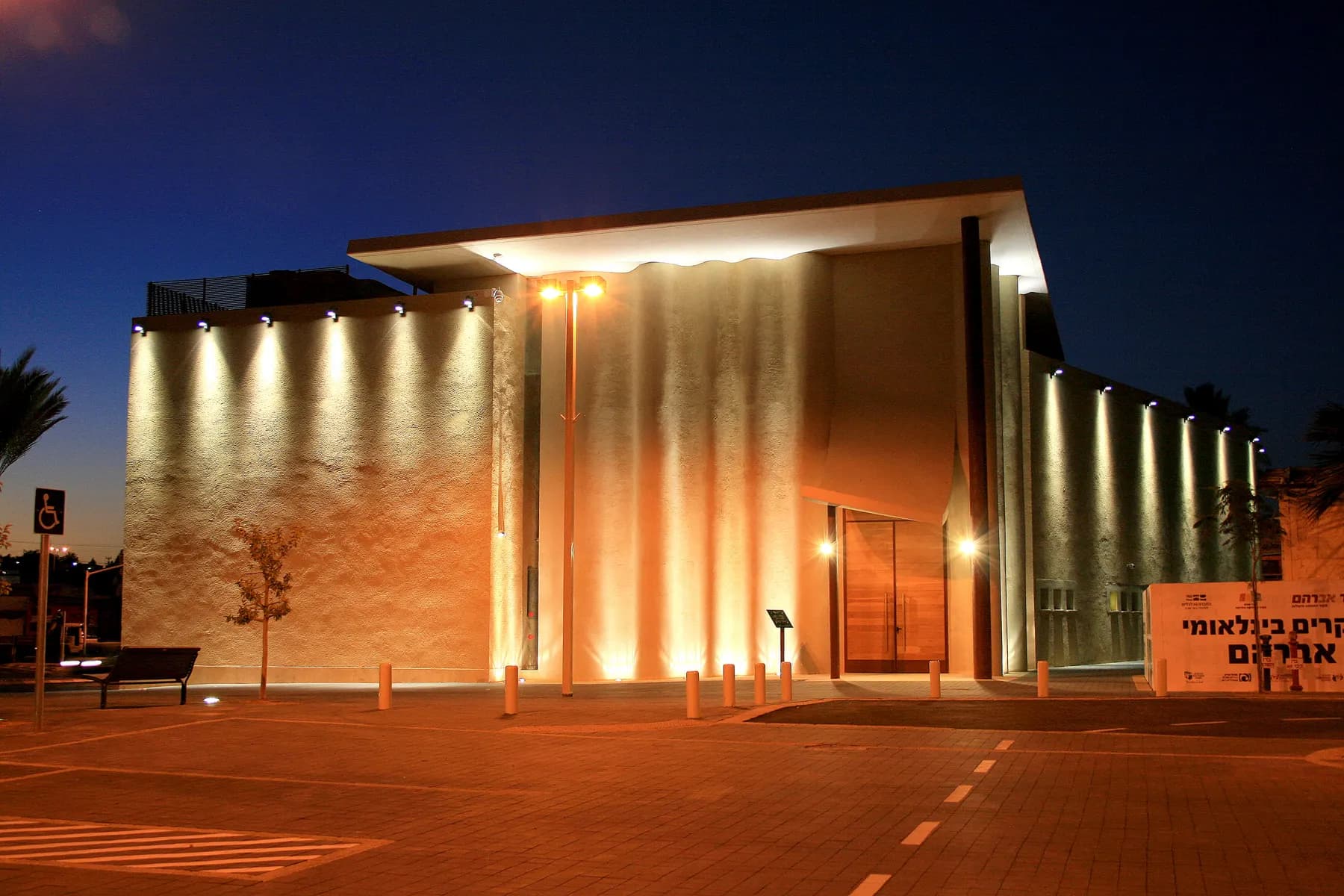
The shaft is 13.5 metres deep, and the inscribed stone Claude Conder found fifteen courses down inside it is dated 505 AH, which is the twelfth century CE.
זאב שטיין / CC BY 2.5 · Wikimedia Commons
Archaeological site
Tel Be'er Sheva National Park
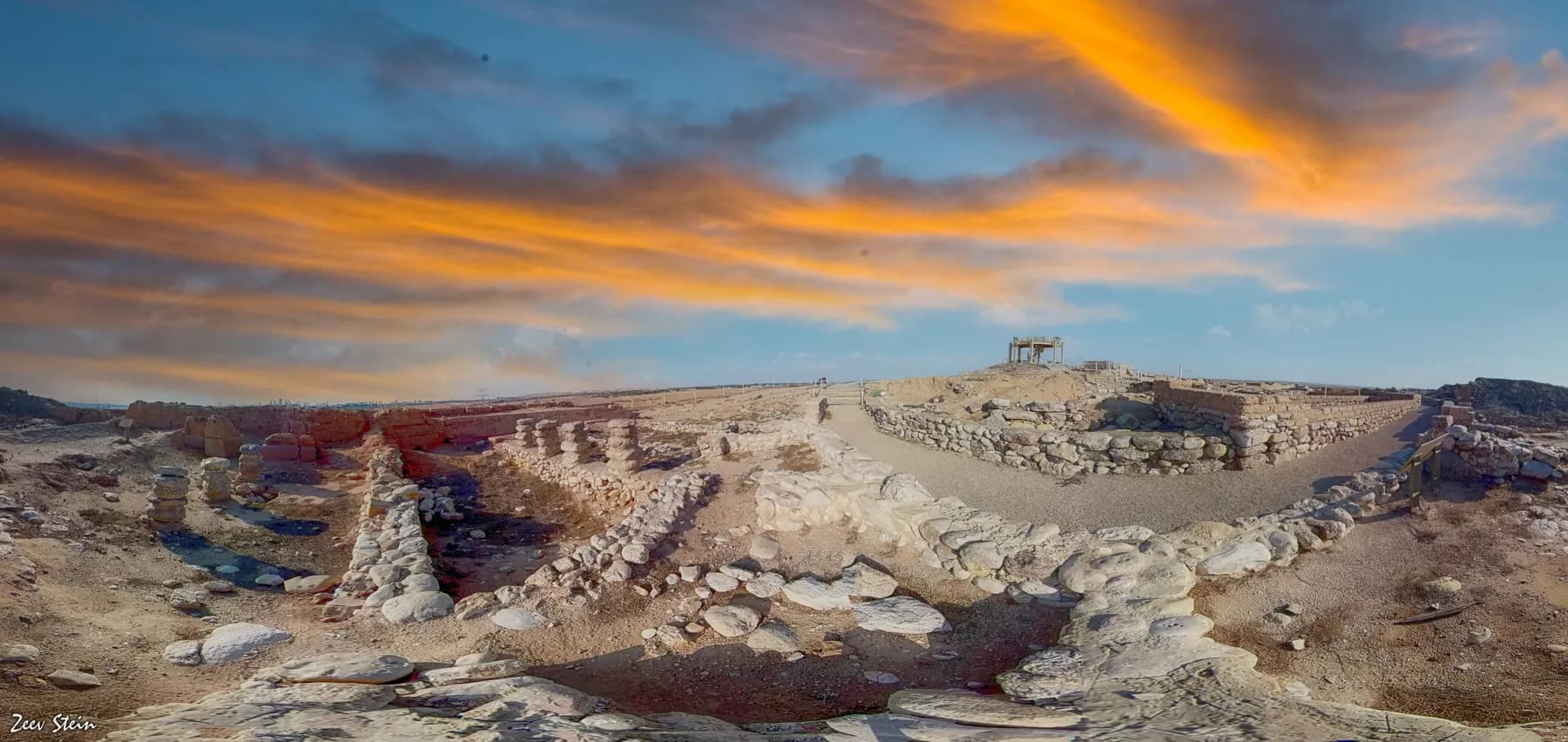
The stones of a four-horned altar were found here buried inside a storehouse wall, and the well beside the town gate goes down 69 metres to the water table.
Museum
Ben-Gurion's Desert Home and Tomb
David and Paula Ben-Gurion moved into a Swedish prefabricated hut at Kibbutz Sde Boker on 14 December 1953, and his will asked that it be left exactly as he died in it twenty years later.
Sources and further reading
Every link below was opened and checked when this page was written. Official statements are marked as such: they are the subject's own account, not an independent one.
- OfficialIsrael Ministry of Defencemod.gov.ilהטובים לתוכן: מכרז לעיצוב תוכן מוזיאון חיל האוויר
the ministry's own tender for the content design of the renewed museum: built on the present site, most exhibits into five display halls beside seven experiential spaces, conceived as a national air force heritage centre
- ReportingYnetynet.co.ilכנפיים שבורות: חיל האוויר נפרד מעשרות מטוסים ומסוקים ישנים
Udi Etzion, 13 February 2022: the decision to scrap 20 aircraft, the Entebbe Boeing 707 number 008 among them, the closure for refurbishment, the airworthy aircraft moved onto the base, and the IDF spokesperson's response
- ReportingYnetynet.co.ilללא מטוס הקרב הראשון: מוזיאון חיל האוויר נפתח מחדש
Udi Etzion, 6 May 2022: the reopened apron, the painted and partly roofed walking route, the locked Fouga and Stratocruiser, the repainting in a scheme never worn, and the 707's nose section behind the fence
- ReportingYnetynet.co.ilירוקת, לכלוך, הזנחה וחוסר השקעה: כך משמרים את היסטוריית התעופה הישראלית
Ilana Curiel and Itay Blumenthal, 16 October 2016: the yard behind the display fence, Yaakov Turner on the Phantoms saved by donation, curator Avi Moshe-Segal on the cost of restoration, and Danny Shalom on irreversible damage
- ReportingWallanews.walla.co.ilאחרי שלוש שנים: מוזיאון חיל האוויר נפתח עם מטוס הקרב שתקף באיראן
Amir Bohbot, 21 April 2026: three years closed through the war, the reopening on 22 April 2026 under security restrictions, and the F-16I Sufa from the strikes on Iran placed at the centre of the display
- ReferenceWikipediaen.wikipedia.orgIsraeli Air Force Museum
the itemised list of aircraft on display, the 1985 cornerstone and 1991 opening, the exhibits on the 669 rescue unit, and the Passover and Independence Day displays of active aircraft
- ReferenceHebrew Wikipediahe.wikipedia.orgמוזיאון חיל האוויר
the cornerstone of 16 July 1985, the criticism from Israeli aviation enthusiasts of paint schemes the aircraft never wore and of neglected exhibits, the 2015 Stearman fire, and the 2016 architecture competition won by Schwartz Besnosoff
- ReferenceWikipediaen.wikipedia.orgYaakov Turner
born 27 February 1935, enlisted 1953, squadron commander and Phantom pilot, retired as brigadier general in 1985 and founded the museum, police commissioner 1990 to 1993, mayor of Beersheba 1998 to 2008, died 27 October 2024
- ReferenceWikipediaen.wikipedia.orgNetz 107
the first F-16 to land in Israel on 2 July 1980, Amos Yadlin's strike on Osirak on 7 June 1981, the seven Syrian aircraft downed in 1982 including one shared, and the 2015 retirement to the museum
- ReferenceWikipediaen.wikipedia.orgOperation Diamond
the Mossad operation from mid-1963, Munir Redfa's landing on 16 August 1966, the renumbering to 007, and Danny Shapira's test flights against Israeli fighters
- ReferenceWikipediaen.wikipedia.orgEntebbe raid
the raid of 3 July 1976, and the two Boeing 707s that followed the Hercules transports, one fitted as a hospital and the other circling Entebbe with the operation's commander aboard
- ReferenceWikipediaen.wikipedia.orgHatzerim Airbase
declared operational on 3 October 1966, the first Israeli Air Force base built from the ground up, six kilometres west of Beersheba, home to the flight academy and the aerobatic team with the museum adjacent
- ReferenceJewish Virtual Libraryjewishvirtuallibrary.orgThe Israel Air Force Museum
an outdoor exhibition of more than 140 aircraft and helicopters, and a set of published opening hours; note that its founding date of 1997 disagrees with every other account
- Reference101Israel101israel.comIsraeli Air Force Museum
an independent visitor guide, not the operator and carrying no date: the layout, the gift shop, café, water points and wheelchair access, the film shown inside a gutted Boeing, and the ticket prices quoted on this page
Israeli Air Force Museum, Hatzerim: common questions
Where is the Israeli Air Force Museum?+
It is at Hatzerim airbase, about six kilometres west of Beersheba on the northern edge of the Negev. The base was declared operational on 3 October 1966 and houses the air force flight academy and aerobatic team; the museum sits next to it. Most visitors come by car from Beersheba.
Is the Boeing 707 from the Entebbe raid still there?+
No, not as an aircraft. Ynet reported in February 2022 that the 707 carrying air force number 008, which flew as the airborne command post over Entebbe on 3 and 4 July 1976 and later served as the museum's film hall, was among twenty aircraft condemned for scrap because its condition risked collapse on visitors. Returning in May 2022, the same reporter found the nose section behind the display fence, sawn from the fuselage, said to be intended one day for a separate Entebbe display alongside a Hercules.
How long does a visit take?+
About 90 minutes is enough to walk the apron and read the signs. Allow two to three hours if a guided tour is arranged or if the indoor exhibitions and the film are open. Aviation enthusiasts routinely spend longer, because the interest here is in individual airframes rather than in a curated narrative.
Is it open on Saturday?+
No. Every listing that publishes hours for the museum has it closed on Saturdays and on Jewish holidays, with Friday a short day. The Jewish Virtual Library gives Sunday to Thursday 08:00 to 17:00 and Friday and festival eves 08:00 to 15:00, while an independent visitor guide gives Friday 08:00 to 13:00. Neither figure comes from the air force, whose site blocks connections from outside Israel.
How much does it cost?+
The last published figures we could open are ₪30 for an adult and ₪20 for a child, from an independent visitor guide that carries no date, with special rates for groups of more than thirty and on Independence Day. Those predate a three-year closure, so treat them as an order of magnitude and telephone to confirm.
Can you get there without a car?+
It is difficult. The museum is six kilometres out of Beersheba on the perimeter of a working airbase, and there is no walkable approach. Bus services to the gate exist but we could not verify a current timetable from outside Israel, so a car or a taxi arranged in both directions is the safe assumption.
Can you climb into the aircraft?+
Into a few, and fewer than there used to be. The 2022 refurbishment locked several cockpits and doors on safety grounds, including the Fouga Magister that stood by the entrance and the Boeing Stratocruiser. On the reopening day the only cab children could climb into was the airfield fire engine, which is why the longest queue formed there rather than at the F-35 parked nearby.
Is it worth it if you are not an aviation enthusiast?+
Honestly, less so than a specialist would tell you, and more so than the setting suggests. There is no climate-controlled hall, no immersive staging and, on the reporting of the past decade, visible wear on some of the exhibits. What there is instead is a specific object attached to almost every story in Israeli air force history: the defector's MiG, the aircraft that struck the Osirak reactor, the fighter Israel designed and then cancelled, the tail of an Egyptian jet shot down in 1973.
Do the aircraft here still fly?+
Three of them can, and they are usually not on the apron. The Black Spitfire once flown by Ezer Weizman, a yellow Harvard and a Stearman rebuilt from the parts of two aircraft are kept airworthy, and after a Stearman was destroyed by fire in 2015 all three were moved to permanent parking inside the operational area of the base. Ynet reported they would appear at the museum only for special events and busy holidays.
Why does the museum look neglected in some photographs?+
Because it has been, and the reporting on it is Israeli rather than foreign. Ynet photographed corroding aircraft in the yard behind the display fence in 2016, quoted the curator saying that restoring an aircraft to its original state took resources the museum did not have, and revealed the scrapping of twenty airframes in 2022. A new museum building with five display halls has been in design since a 2016 architecture competition and has not been built.