Religious site · Haifa
Elijah's Cave
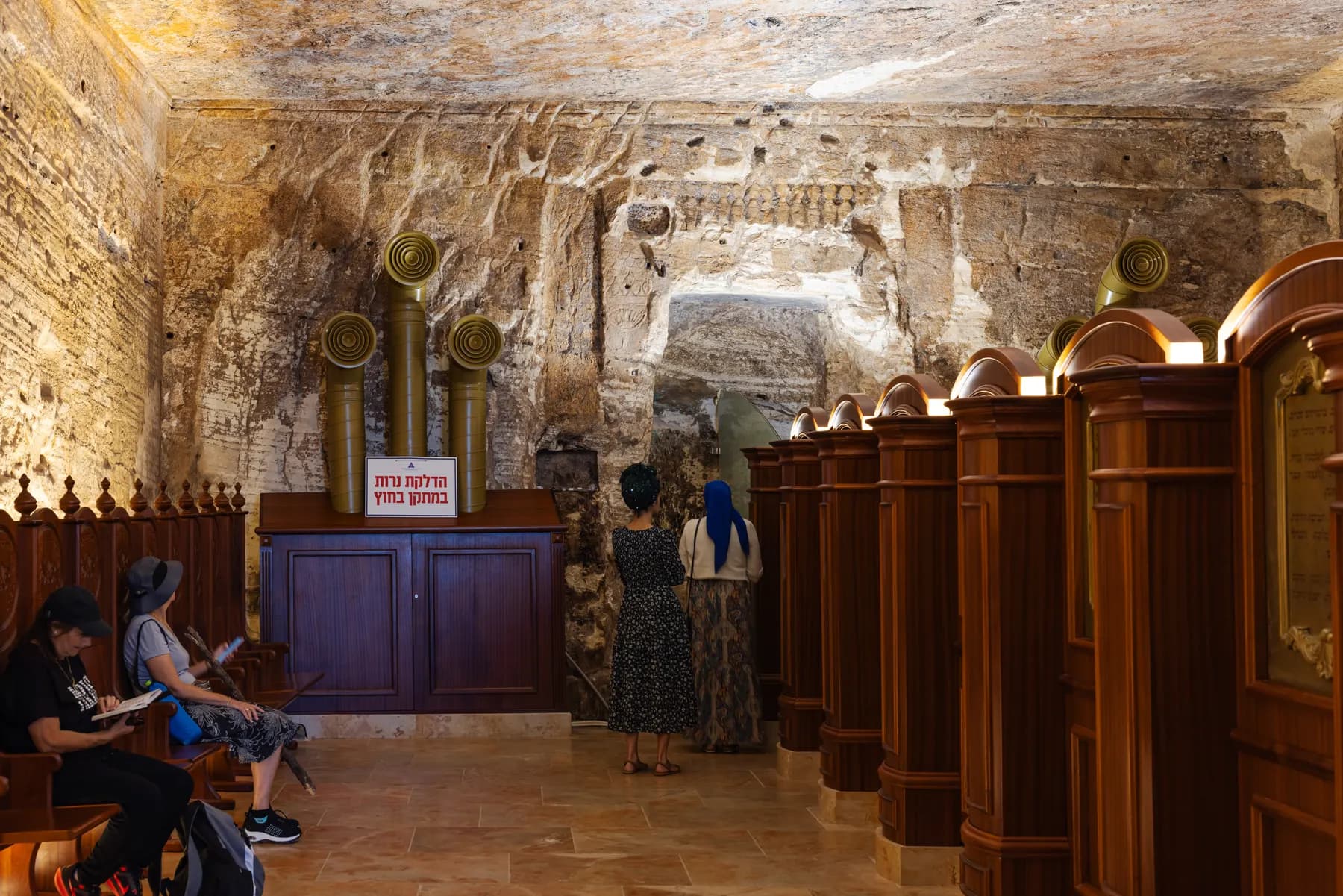
A rock chamber at road level under Cape Carmel, measured by the Israel Antiquities Authority at 13.5 by 8.7 metres, whose walls carry about 150 graffiti in Greek, Latin, Hebrew and Arabic left by pilgrims of four religions.
מיכל פריימן / CC BY 2.5 · Wikimedia Commons
Main chamber
13.5 by 8.7 m
4.3 m high, as measured by the Israel Antiquities Authority in its 2021 survey
Inscriptions on the walls
about 150
Greek, Latin, Hebrew and Arabic, first catalogued by Asher Ovadiah in 1969
Found in the 2021 conservation
15 more
inscriptions nobody had seen, plus 33 corrected readings, published June 2024
Admission
Free
listed under free attractions by the Haifa tourism association, 2026
In short
- How long to give it
- About 30 to 45 minutes for the cave itself, or half a day taken together with Stella Maris, the cable car and the Bat Galim seafront
- Sunday to Thursday
- 08:00-21:45
- Entry
- Free. The operator publishes no price, and the Haifa tourism association files the cave under free attractions in the city.
מערת אליהו · الخضر
Elijah's Cave is a hewn chamber in the foot of Mount Carmel, at 231 Allenby Road in Haifa, kept as a prayer hall and open without charge. It sits about 40 metres above sea level on the northern slope of the ridge, south-west of the Bat Galim neighbourhood and directly below the Stella Maris monastery, and it is the place where Jewish tradition puts Elijah's hiding from Ahab. Jews, Christians, Muslims and Druze have all venerated it, which is a claim made about a good many sites in the country and is unusually well documented at this one.
What a visitor walks into is one rectangular room with a smaller square room off it, both floored in stone slabs, both lit, both air-conditioned, and the main room divided by a partition into a men's side and a women's side. The interest is on the walls. Pilgrims have been scratching and inking their names into this rock since the first or second century of the common era, on the evidence of the letter forms, and the resulting mass of graffiti has been catalogued three times over, most recently in the Corpus Inscriptionum Iudaeae/Palaestinae.
The cave is also routinely confused with a second grotto of the same name, the one under the high altar of the Carmelite church up the hill. They are different caves, a few hundred metres and a steep climb apart, and the confusion is old enough that the Carmelites once held both. This page is about the lower one, the one on the road.
The chamber
One hewn room, a side room, and a floor from the 1980s
The cave faces north. The Israel Antiquities Authority's 2021 survey gives the main chamber as roughly rectangular, 8.7 by 13.5 metres and 4.3 metres high, with an opening near the entrance leading east into a square side chamber of 3.2 by 3.3 metres and 2.3 metres high, reached up three steps. Popular accounts, including the Hebrew Wikipedia article, give the room as 14.40 metres long, 8 metres wide and 5 metres high and put the side room in the western wall rather than the eastern one. The figures are close enough to be the same room measured twice and far enough apart that the page gives both.
Almost nothing you stand on or sit on is ancient. The stone paving in both rooms was laid long after the cave's use in antiquity, and it rests on a concrete floor carried on concrete pillars that the Antiquities Authority puts at probably the 1980s, with a gap of about 0.4 metres between that slab and the rock walls east and west. Two stone benches run along the southern wall, and when part of the western one was taken down in 2021 to run services, a large stone basin turned up inside it in secondary use, and the original wall behind it was found to have been coated in greyish plaster.
The rock itself is the exhibit. Conservation in 2021 sprayed the soot off the walls and the lichen off the cave front, removed encrustation by hand, pinned loose rock with basalt pins and filled cracks with a lime mortar tinted to match. The team's conclusion was that the cave now has to be held at a constant 20 degrees and 60 per cent humidity, with the air conditioning running without interruption, and that no one may drill into these walls again.
- Main chamber: 8.7 by 13.5 m, 4.3 m high (Israel Antiquities Authority, 2021)
- Square side chamber: 3.2 by 3.3 m, 2.3 m high, up three steps
- Two stone benches along the southern wall, partly dismantled during the 2021 works
- Hewn niche in the centre of the southern wall, and a second, raised niche in the side chamber
- Stone paving over a concrete floor on pillars, probably 1980s
Graffiti
About 150 signatures, and fifteen nobody had seen
Y. Olami surveyed the cave in 1985. Asher Ovadiah then documented roughly 150 inscriptions on its walls, in Greek, Latin, Hebrew and Arabic, publishing them from 1969 and again in 2015 with Rosario Pierri. Tal Ilan and O. Pinkpank went back over them in 2012, and in 2023 Walter Ameling republished the set as numbers 6435 to 6614 of the fifth volume of the Corpus Inscriptionum Iudaeae/Palaestinae. Dating rests on the letter forms rather than on any stratigraphy, and on that basis the cultic inscriptions begin in the first or second century of the common era.
The 2021 cleaning made the walls legible again and Avner Ecker and Noam Bar-David re-read the lot using 3D scans and reflectance transformation imaging. That produced 33 new readings and 15 inscriptions that had never been recorded at all. The best of them is on the western wall of the main chamber, inside a carved tabula ansata frame that the 2015 catalogue had listed as empty: multispectral imaging brought up an inscription written in ink, beginning in Greek with a formula that translates as 'With good fortune, in remembrance of Heliophon'. The name Heliophon is not otherwise known in this country, and the Lexicon of Greek Personal Names has it mostly around Greece, the Greek islands and western Asia Minor.
The rest of the new material is small: thin scratched or inked graffiti, plus little crosses cut over older inscriptions. Whether those crosses are Byzantine or later depends on how they relate to the Greek texts underneath, and the excavators say plainly that this has not been settled. Among the older recorded marks are engravings of the seven-branched menorah and a Hebrew inscription reading 'Yitzhak ben Kuma'.
Four faiths
El-Khader, Mar Elias, and the School of the Prophets
The Antiquities Authority describes the cave flatly as sacred to followers of the four religions in the country: Muslims, Christians, Jews and Druze. Each has its own name for it and its own reason. Muslim Arabs call it el-Khader, the Green, after al-Khidr, and credit the place with the power to bring rain. Arab Christians call it Mar Elias. European Christians called it the School of the Prophets, on the assumption that Elijah taught his disciples in the large room. Druze veneration of Elijah is central rather than incidental, and is part of why the Druze settled the Carmel at all.
Custody has moved. Hebrew Wikipedia records that until 1948 the cave was a Muslim Sufi endowment whose holders let members of other religions pray there, and the Antiquities Authority's reading of the small arched niche cut inside the larger one in the southern wall is that it served as a mihrab in the period when the cave was a mosque. Hooks and cuttings in that same niche were in use until recently to hang a cloth over holy books kept inside it. Today the room is run as a Jewish prayer hall, with a curtain, a partition between the men's and women's halves, and notes pushed into the rock.
The sharing has not always been smooth. The Carmelite order says a Mass in the cave once a year on 14 June, the feast of Elisha. In 1954, after an ark was installed in the cave, the monks arrived to find they could not hold it, and it took about three weeks to arrange a solution; the following year officials of the Ministry of Religions had to intervene to get the Mass said again. It is worth knowing what the room is before walking into it: it is a functioning place of prayer for people who are not tourists, and it is quiet.
Before Elijah
Snakes over the niche, and a cult older than the tradition
In the centre of the southern wall of the main chamber is a hewn niche, and the carvings around it belong to several different periods. Ovadiah recorded scale motifs on both sides of it and a lotus on its left. The 2021 documentation added something nobody had published before: a carved relief of uraei, rearing serpents, above the niche. The design is Egyptian in origin, the excavators date the carving to the Roman period, and their reading is that these reliefs flanked an object of pagan worship standing in the niche.
That fits what else is under the floor. Probes cut through the concrete down to bedrock in 2021 confirmed Hellenistic pottery in the south-western corner, and the first excavation in the cave, by A. Zemer, had already produced finds from the Hellenistic, Byzantine and Ottoman periods and the British Mandate. A trial excavation in December 2019, about 20 metres north-west of the entrance and dug ahead of a new access path, found the foundations of a mid-nineteenth-century building along with Hellenistic, Byzantine, Mamluk and Ottoman pottery, sixteen clay tobacco pipe fragments, and imported coffee cups from Kutahya and from China.
None of this proves what the cult was. Mount Carmel had a well-attested pagan sanctuary: Michael Avi-Yonah published a Greek inscription from the mountain reading 'To Heliopolitan Zeus of Carmel', and Suetonius has Vespasian consulting an oracle there while Tacitus describes an altar with no image and no temple around it. The Haifa tourism association repeats the suggestion that the cave housed the oracle of the god of Carmel. What the excavation report will say is narrower and more useful: the reliefs above the niche probably indicate worship at the spot as early as the Roman period.
Two caves
Which Elijah's Cave you are standing in
Two grottoes on the Carmel are called Elijah's Cave, and visitors regularly end up at the wrong one. The lower one is this shrine on Allenby Road. The upper one is a small grotto beneath the high altar of the church at the Stella Maris monastery, reached down a few steps from the nave, with a stone altar and a statue of the prophet in it. The Discalced Carmelite friars who have custody of that monastery call their one Elijah's grotto.
For a while the same order held both. The Sacred Congregation in Rome approved the Carmelites' return to the Carmel on 30 January 1627 and sent Father Prosper of the Holy Spirit, prior of the Carmelite house in Aleppo. On 29 November that year he signed an agreement with Ahmad Turabay, the emir who ruled the mountain, handing the order Elijah's Cave and the summit for a monastery and gardens, and he said Mass in the cave. Between 1631 and 1635 he converted it into a church.
It did not hold. The Muslim dervishes who had held the cave before him protested, and the protest reached Istanbul. In 1635 Prosper gave up the cave and built instead on the slope between the Greek church and the cave, cutting most of the building into the hillside at what is still called Prosper's Cave. He died there in 1653 and the place was destroyed under Daher al-Umar. The monastery moved to its present site above the upper grotto, was wrecked in Napoleon's campaign of 1799, was demolished on the orders of Abdullah Pasha in 1821, and reopened in its current form in 1836.
Pilgrimage
The day after Shabbat Nachamu, and the cures people came for
The busiest day of the year is the day after Shabbat Nachamu, the first of the seven sabbaths of consolation following Tisha b'Av, when people come up from Haifa, Tiberias and Safed to pray. The national holy places centre gives the site's annual hillula as 12 Av. Richard Pococke, writing in 1738, already recorded that visiting on the Saturday after the Sabbath of Consolation had become a custom, and that Christians, Jews and Muslims all venerated the place. A nineteenth-century report describes a hillula here at Lag Ba'omer as well; the operator says that practice has thinned out in recent years.
The cave has a long reputation as a healing site, and specifically as a place for mental illness. People thought to be mentally ill were brought here from a distance and left in the cave for several days in the hope that they would be cured through Elijah. The Hebrew sources call the visit 'the ziyara of Haifa'. Alongside that, the cave draws the same prayers as other shrines in the country: for the health of the sick, for a marriage partner, and for children.
The physical traces of all this are what you see on arrival. Curtains hang on the southern wall, where the niche sits roughly where an ark would. Notes go into the rock. Candles are lit outside, at the stand the operator provides, rather than in the chamber, which is now climate-controlled to protect the inscriptions. Pilgrims once added their own names to those walls, which is how the corpus of 150 inscriptions came about, and is emphatically no longer permitted.
What to look for
Things not to walk past at Elijah's Cave
The details that repay knowing about before you are standing in front of them.
The niche in the southern wall
The one carved feature that repays looking at properly. Scale motifs down both sides, a lotus on the left, and above them a relief of rearing serpents in the Egyptian manner that the Antiquities Authority dates to the Roman period and first published in 2024.
The arch inside the niche
A smaller arched niche cut inside the larger one, generally read as the mihrab from the period when the cave served as a mosque. The hooks around it held a cloth over holy books until recently.
The tabula ansata on the western wall
A carved dovetailed frame on the western wall of the main chamber, listed as blank in the 2015 catalogue. Multispectral imaging in 2021 found an ink inscription in it, opening 'With good fortune, in remembrance of Heliophon'.
The menorah engravings
Seven-branched candelabra scratched into the rock among the Greek graffiti, along with a Hebrew inscription reading 'Yitzhak ben Kuma'. They are small and thin, not monumental, and easy to walk past.
The square side chamber
Three steps up from the main hall, 3.2 by 3.3 metres and low enough at 2.3 metres to feel like a different building. Its southern wall carries a second niche, hewn and built, raised above floor level.
The grotto under the Stella Maris altar
The other Elijah's Cave, a short and steep distance above this one, under the high altar of the Carmelite church. Worth pairing with this visit precisely so the difference between the two is clear.
The long view
Elijah's Cave, in order
First or second century CE
The earliest cultic graffiti on the cave walls, dated by the letter forms rather than by any excavated layer.
Roman period
Reliefs of uraei, scales and a lotus are cut around the niche in the southern wall, probably flanking an object of pagan worship standing in it.
1175
Benjamin of Tudela visits Haifa and the Carmel and records Elijah's cave on the mountain, with a structure raised over it by the Crusaders.
1185
The pilgrim Ioannes Phokas writes of 'the cave of the Prophet Elijah' at the end of the Carmel ridge facing the sea.
1270-1291
A Jewish pilgrim describes a cave on the slopes of the Carmel with a synagogue dedicated to Elijah, and Elisha's cave above it on the summit.
30 January 1627
Rome approves the Discalced Carmelites' return to Mount Carmel and sends Father Prosper of the Holy Spirit, prior of the order's house in Aleppo.
29 November 1627
Prosper signs an agreement with the emir Ahmad Turabay handing the Carmelites Elijah's Cave and the summit, and says Mass in the cave.
1631-1635
Prosper turns the cave into a church. The Muslim dervishes who held it protest as far as Istanbul, and in 1635 he abandons the cave and builds on the slope above instead.
1738
Richard Pococke records the cave venerated by Christians, Jews and Muslims, and the custom of visiting on the Saturday after the Sabbath of Consolation.
1864-1867
Charles Wilson documents buildings put up outside the cave, and from about 1867 the family of Elhaj Ibrahim adds more. One of them was excavated in 2019.
1948
The cave ceases to be the Muslim Sufi endowment it had been, whose holders had allowed members of other religions to pray in it.
1954-1955
An ark is installed in the cave and the Carmelites arrive for their annual Mass to find it blocked. A solution takes about three weeks, and the year after, Ministry of Religions officials have to intervene again.
1969
Asher Ovadiah publishes the inscriptions in Qadmoniot, having documented about 150 of them on the walls.
1980s
A concrete floor on concrete pillars is laid over the bedrock and covered with stone paving, which is the floor visitors walk on now.
December 2019
A trial excavation 20 metres north-west of the entrance, ahead of a new access path, uncovers a mid-nineteenth-century building and pottery from the Hellenistic period onwards.
March to September 2021
The Israel Antiquities Authority documents, surveys and conserves the cave for the Western Wall and Holy Sites Heritage Foundation, funded by the Ministry of Religious Services.
2023
Walter Ameling republishes the cave's inscriptions as numbers 6435 to 6614 in volume V.1 of the Corpus Inscriptionum Iudaeae/Palaestinae.
18 June 2024
The preliminary report appears: 33 new readings, 15 previously unrecorded inscriptions, and the ink text naming Heliophon.
Practical
Visiting Elijah's Cave
Where
231 Allenby Road (Derech Allenby), Haifa
What ticket you need
The cave is not inside a ticketed park and needs no ticket of its own. Two things nearby do have gates and hours: the Stella Maris monastery above it, which keeps its own opening times and a dress code, and the Haifa cable car from Bat Galim, which is a paid ride. Neither is required to see the cave.
Opening hours
- Sunday to Thursday
- 08:00-21:45source
- Friday, as published by the national holy places centre
- 08:00-14:45source
- Friday, as published by the Haifa tourism association
- 08:00-13:45source
- Saturday
- Neither the operator nor the Haifa tourism association publishes a Saturday time. Assume the site keeps Shabbat and plan around it.source
Admission
- Entry
- Free. The operator publishes no price, and the Haifa tourism association files the cave under free attractions in the city.source
Access
Better than most cave shrines and not perfect. The operator lists the site as accessible to people with disabilities, with private vehicle access, organised parking, seating, lighting and toilets, and the cave sits at road level on Allenby Road rather than up the mountain. The approach path from the road includes steps, and the way in from Sderot HaHagana likewise. The floors inside are level paving. Anyone arriving in a wheelchair should ring the site on 04-8361403 first rather than assume the route from a particular direction is step-free.
On site
- Parking
- Toilets
- Drinking water
- Seating
- Candle-lighting stand
- Prayer books
- Lighting
- Public transport nearby
Booking
Nothing to book and no ticket office. The site is run by the National Centre for the Development of Holy Places, which lists a telephone number of 04-8361403 for the cave itself. Groups and anyone with an access question should use it, because opening times at holy sites move for festivals and for Shabbat.
Hours and prices are given as the operator publishes them and change without much notice, particularly around Shabbat and the festivals. Check the operator's own page before you travel for this.
Official page at holy.org.il →What people wish they had known
- Go to the right cave. The one on Allenby Road and the grotto under the altar at Stella Maris are both called Elijah's Cave, and people who set out for one arrive at the other. The Allenby cave is at street level with its own car park; the Stella Maris grotto is inside a working monastery church up the hill.
- Treat the two published Friday closing times as a real disagreement. The National Centre for the Development of Holy Places gives Friday 08:00 to 14:45 and the Haifa tourism association gives 08:00 to 13:45. Work to the earlier one, or ring 04-8361403.
- Dress and behave for a prayer hall, not a monument. The main chamber is divided into men's and women's sides with a partition and a curtain, people are praying in it, and the room is small enough that a raised voice carries.
- Look at the walls, not the floor. Everything underfoot is a stone-paved concrete slab from around the 1980s. The inscriptions are the old material, and most of them are thin scratches or faint ink rather than carved lettering, so give your eyes a minute in the low light.
- Do not touch, mark or lean on the rock. Conservation in 2021 cleaned the inscriptions by hand and concluded that no drilling may ever be done in these walls again. Pilgrims writing their names is exactly how the corpus came about, and it is what the conservation was undoing.
- Light candles outside. There is a candle stand provided, and the chamber is now held at a fixed temperature and humidity to protect the inscriptions, which is why the soot on the walls was a conservation problem in the first place.
The figures
Elijah's Cave by the numbers
Each figure carries the year it belongs to and links the source it came from.
| Measure | Figure | As of | Source |
|---|---|---|---|
| Main chamber | 8.7 by 13.5 m, 4.3 m high | 2024 | hadashot.iaa.org.il |
| Square side chamber | 3.2 by 3.3 m, 2.3 m high, up three steps from the main hall | 2024 | hadashot.iaa.org.il |
| Height above sea level | 40 m, on the northern slope of the Carmel ridge | 2024 | hadashot.iaa.org.il |
| Inscriptions documented on the walls | about 150, in Greek, Latin, Hebrew and Arabic | 2024 | hadashot.iaa.org.il |
| Result of the 2021 re-reading | 33 new readings and 15 inscriptions never previously detected | 2024 | hadashot.iaa.org.il |
| Catalogue numbers in the Corpus Inscriptionum Iudaeae/Palaestinae, volume V.1 | 6435-6614 | 2023 | hadashot.iaa.org.il |
| Clay tobacco pipe fragments from the 2019 trial excavation outside the cave | 16 | 2022 | hadashot.iaa.org.il |
| Published opening hours | Sunday to Thursday 08:00 to 21:45; Friday from 08:00 | 2026 | holy.org.il |
While you are here
The rest of Haifa
Everything else in this destination with a page of its own.
זאב שטיין / CC BY 2.5 · Wikimedia Commons
Religious site
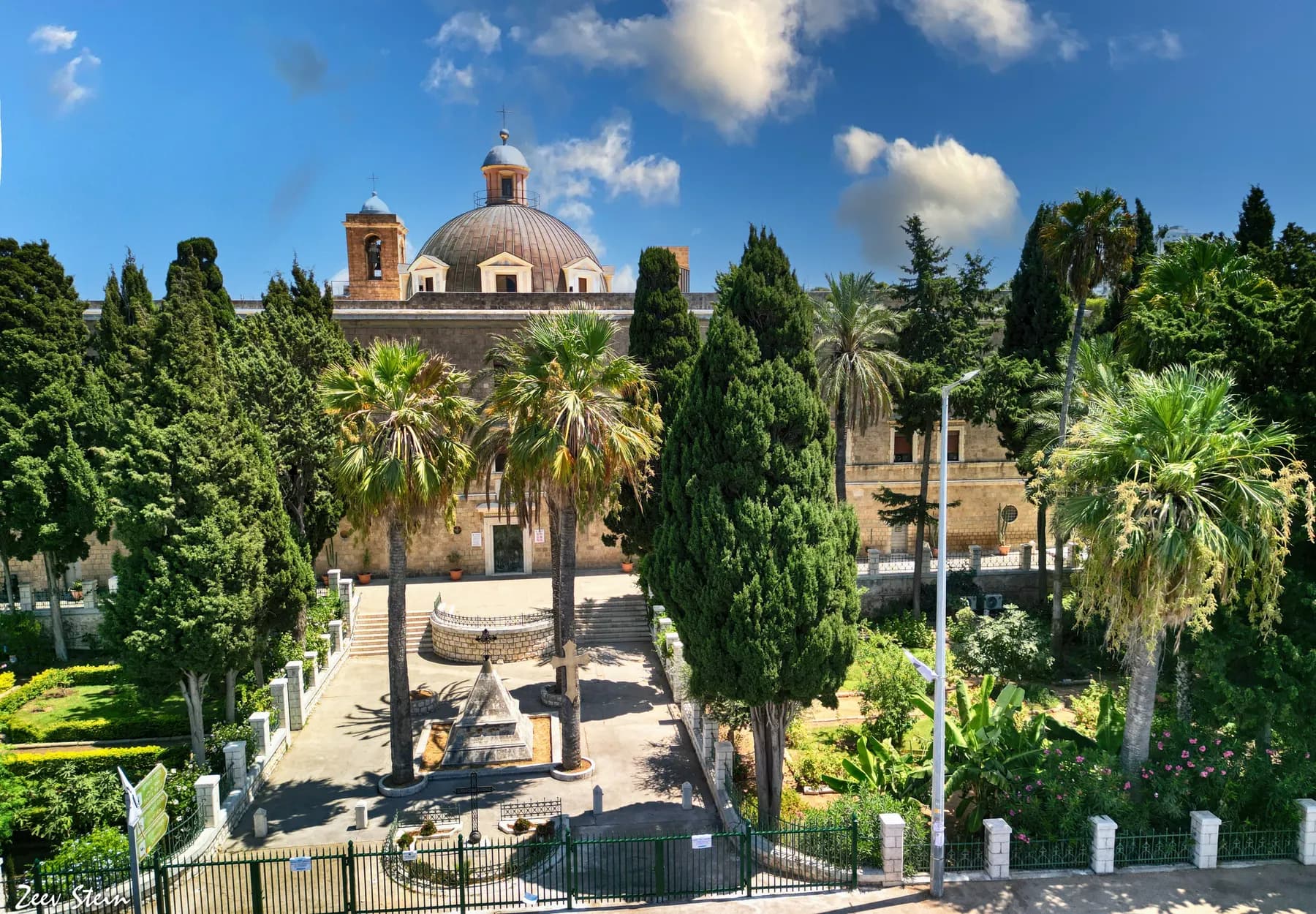
Stella Maris Carmelite Monastery
The mother house of the Discalced Carmelites stands on the seaward end of Mount Carmel over a grotto associated with Elijah, under a dome painted by the Maltese friar Luigi Poggi between 1924 and 1928.
Orenshani7 / CC BY-SA 3.0 · Wikimedia Commons
Activity
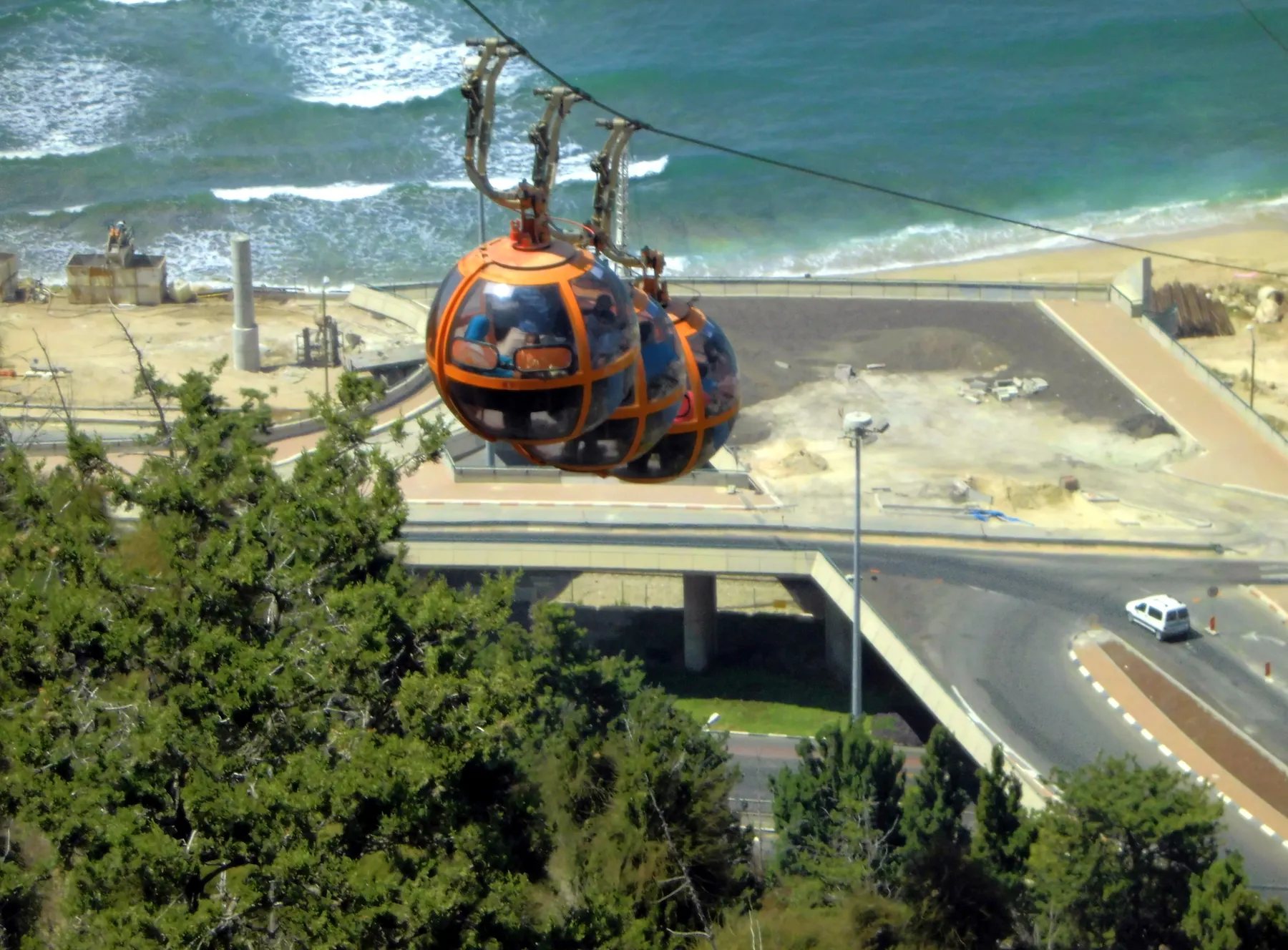
Haifa Cable Car
Six spherical cabins have been running the 355 metres from the Bat Galim promenade up to Stella Maris since 1986, three in each direction, and Haifa still calls them Gurel's eggs.
Museum
Clandestine Immigration and Naval Museum
A Ministry of Defence museum built around Af Al Pi Chen, a Royal Navy tank landing craft that sailed from Italy in September 1947 with 434 Holocaust survivors aboard and was boarded before she reached the coast.
Sources and further reading
Every link below was opened and checked when this page was written. Official statements are marked as such: they are the subject's own account, not an independent one.
- OfficialNational Centre for the Development of Holy Placesholy.org.ilמערת אליהו הנביא (Elijah's Cave)
The operator's own page: the address at 231 Allenby Road, opening hours of Sunday to Thursday 08:00 to 21:45 and Friday 08:00 to 14:45, the telephone number 04-8361403, the annual hillula on 12 Av, the custom of praying here the day after Shabbat Nachamu, the thinning of the Lag Ba'omer practice, the description of a large central chamber with a smaller hewn room beside it, the hanging curtains and the notes, and the on-site facilities including parking, toilets, water, seating, a candle stand, prayer books, lighting and an accessibility statement
- OfficialHaifa Tourism Association (visit-haifa.org)visit-haifa.orgמערת אליהו הנביא, attraction listing
The city tourism body's listing: the cave above Bat Galim and below the Stella Maris viewpoint, its importance to Jews, Christians, Muslims and Druze, the Muslim name el-Khader, the walls covered with pilgrim inscriptions including one by a Roman soldier named Germanus, the suggestion that the cave housed an oracle of the god of Carmel, the address at 231 Allenby Road, and opening hours of Sunday to Thursday 08:00 to 21:45 and Friday 08:00 to 13:45
- OfficialHaifa Tourism Associationvisit-haifa.orgFree attractions in Haifa
The tourism association's index of things in the city that cost nothing to enter, which includes Elijah's Cave; the basis for describing admission as free
- ReferenceHadashot Arkheologiyot 136 (2024), Israel Antiquities Authorityhadashot.iaa.org.ilHaifa, Elijah's Cave: preliminary report
Tepper, Ecker, Bar-David, Tirosh Hacohen and Avrahami on the March to September 2021 documentation, survey and conservation: the location 40 m above sea level, the main chamber at 8.7 by 13.5 m and 4.3 m high, the square side chamber at 3.2 by 3.3 m up three steps, the stone benches and the reused stone basin, the concrete floor of probably the 1980s, the uraei relief above the southern niche dated to the Roman period, the inner arched niche read as a mihrab, about 150 inscriptions catalogued by Ovadiah, CIIP V.1 nos 6435-6614, 33 new readings and 15 previously undetected inscriptions, the ink inscription naming Heliophon, and the conservation requirement of 20 degrees and 60 per cent humidity with no drilling
- ReferenceHadashot Arkheologiyot 134 (2022), Israel Antiquities Authorityhadashot.iaa.org.ilElijah's Cave: final report on the 2019 trial excavation
Cyrill Segal on the December 2019 excavation 20 m north-west of the cave entrance, dug ahead of a new access path and funded by the Ministry of Religious Services: the mid-nineteenth-century building attributed to the family of Elhaj Ibrahim in or shortly before 1867, Charles Wilson's documentation of buildings outside the cave in 1864-1866, Hellenistic, Byzantine, Mamluk and Ottoman pottery, 16 clay tobacco pipe fragments, and imported coffee cups from Kutahya and China as evidence of pilgrimage
- ReferenceHebrew Wikipediahe.wikipedia.orgמערת אליהו (Elijah's Cave)
The alternative measurements of 14.40 m long, 8 m wide and 5 m high with a side room in the western wall, the position between Bat Galim and Stella Maris with approaches from Sderot HaHagana and Allenby Road on a path that includes steps, the cave as a Muslim Sufi endowment until 1948 that allowed others to pray, the names el-Khader and Mar Elias and the School of the Prophets, the Carmelite Mass on 14 June and the disputes of 1954 and 1955, Benjamin of Tudela in 1175, the visitor accounts of 1742 and 1835, the nineteenth-century Lag Ba'omer hillula, the menorah engravings and the Hebrew inscription of Yitzhak ben Kuma, Ovadiah's 150 inscriptions and the Antiquities Authority conservation project that found fifteen new Greek texts
- ReferenceWikipediaen.wikipedia.orgCave of Elijah
The two grottoes on Mount Carmel that share the name, the main shrine on Allenby Road at about 40 m above sea level and its division into men's and women's prayer sections behind a velvet curtain, the Arabic name el-Khader and the Druze identification of Elijah with al-Khidr, the reputation for curing the sick, and the pilgrim testimonies of Ioannes Phokas in 1185, an unnamed Jewish pilgrim between 1270 and 1291, and Richard Pococke in 1738
- ReferenceHebrew Wikipediahe.wikipedia.orgהאב פרוספר (Father Prosper of the Holy Spirit)
The Roman approval of 30 January 1627, the agreement of 29 November 1627 with the emir Ahmad Turabay handing the Carmelites Elijah's Cave and the summit, the Mass said in the cave, the conversion of the cave into a church between 1631 and 1635, the protest of the Muslim dervishes reaching Istanbul, the retreat in 1635 to the slope at what became Prosper's Cave, his death there in 1653 and the destruction of that monastery in 1767
- ReferenceWikipediaen.wikipedia.orgStella Maris Monastery
The upper grotto beneath the high altar of the monastery church, reached down a few steps from the nave and holding a stone altar with a statue of Elijah, the Discalced Carmelites' custody of it, Prosper's return in 1631, the eviction by Daher al-Umar, the damage in Napoleon's 1799 campaign, the demolition ordered by Abdullah Pasha in 1821 and the opening of the present church in 1836
- ReferenceWikipediaen.wikipedia.orgMount Carmel
The pagan sanctuary on the mountain: Michael Avi-Yonah's 1952 publication of the Greek inscription reading 'To Heliopolitan Zeus of Carmel', Suetonius on Vespasian consulting an oracle there, Tacitus on an altar with no image and no temple, the Arabic name Jabal Mar Elyas, and the centrality of Elijah to the Druze and its bearing on Druze settlement of the Carmel
Elijah's Cave: common questions
What is Elijah's Cave in Haifa?+
It is a rock-hewn chamber at the foot of Mount Carmel, at 231 Allenby Road, held in Jewish tradition to be where the prophet Elijah hid from King Ahab. The Israel Antiquities Authority describes it as sacred to followers of four religions in the country: Muslims, Christians, Jews and Druze. It is run today as a Jewish prayer hall by the National Centre for the Development of Holy Places, and its walls carry about 150 pilgrim inscriptions.
Is there an entrance fee?+
No. The operator publishes opening hours but no price, and the Haifa tourism association lists the cave among the free attractions in the city. There is no ticket office and nothing to book.
What are the opening hours?+
The National Centre for the Development of Holy Places publishes Sunday to Thursday 08:00 to 21:45 and Friday 08:00 to 14:45. The Haifa tourism association gives the same weekday hours but a Friday close of 13:45. Neither publishes a Saturday time. Ring 04-8361403 if the visit depends on it.
Is this the same cave as the one at Stella Maris Monastery?+
No, they are two different grottoes on the same mountain, both called Elijah's Cave. This one is the large shrine on Allenby Road at about 40 metres above sea level. The other is a small grotto beneath the high altar of the Carmelite church at Stella Maris, reached down a few steps from the nave. The Discalced Carmelites held this lower cave briefly in the 1630s before moving up the hill.
Is it wheelchair accessible?+
Partly, and better than the setting suggests. The operator lists the site as accessible to people with disabilities and provides parking, seating, lighting and toilets, and the cave is at road level rather than up the mountain, with level stone paving inside. The approach paths from Allenby Road and from Sderot HaHagana include steps, so telephone 04-8361403 before relying on a step-free route.
How long do you need there?+
About 30 to 45 minutes is enough for the cave itself, and most of that is spent looking at the walls. It works better as part of a half day on this side of the headland, combined with Stella Maris above it, the cable car down at Bat Galim, and the seafront.
Can non-Jews and non-religious visitors go in?+
Yes. The cave has been a shared pilgrimage site for centuries and the sharing is documented: Richard Pococke found Christians, Jews and Muslims all venerating it in 1738, Carmelite monks say a Mass in it once a year on 14 June, and it was a Muslim Sufi endowment until 1948 whose holders let others pray there. It is a functioning prayer hall, so dress and behave accordingly.
Is there actually anything to see, or is it an empty room?+
It is a large empty room with remarkable walls, and how much you get out of it depends on whether you look at them. The carved niche in the southern wall carries scale and lotus motifs and a relief of rearing serpents in the Egyptian manner that was only published in 2024; around them are roughly 150 inscriptions in four languages, menorah engravings, and small crosses cut over older texts. Anyone expecting architecture will be disappointed.
How old is the site?+
Older than the tradition attached to it, but by how much is unresolved. The earliest cultic graffiti are dated to the first or second century of the common era on the shape of the letters, and the serpent reliefs above the niche are read as Roman-period decoration for a pagan cult object. Probes under the floor in 2021 confirmed Hellenistic pottery. Nothing excavated in the cave connects it to the biblical Elijah, and the archaeologists do not claim it does.
When is it busiest?+
The day after Shabbat Nachamu, the first sabbath of consolation after Tisha b'Av, which usually falls in August. Pilgrims come from Haifa, Tiberias and Safed, and the custom is old enough that Pococke noted it in 1738. The operator gives the site's annual hillula as 12 Av. Any ordinary weekday morning is quiet by comparison.