
Museum · Haifa
Clandestine Immigration and Naval Museum
A Ministry of Defence museum built around Af Al Pi Chen, a Royal Navy tank landing craft that sailed from Italy in September 1947 with 434 Holocaust survivors aboard and was boarded before she reached the coast.
Opened to the public
1969
named for David HaCohen and run by the Ministry of Defence museums unit
Aboard Af Al Pi Chen
434
Holocaust survivors, on the voyage intercepted in September 1947
Adult admission
₪20
as the Ministry of Defence publishes it in 2026, with ₪15 concessions and ₪10 for the registered disabled
Blockade-running ships
141
the museum's own count, of which Af Al Pi Chen was the only survivor
In short
- How long to give it
- about 90 minutes, or close to two hours if you go inside both the submarine and the missile boat
- Sunday to Thursday
- 09:00-16:00
- Adult
- ₪20
מוזיאון ההעפלה וחיל הים
The Clandestine Immigration and Naval Museum is a Ministry of Defence museum at 204 Allenby Road, under the Stella Maris headland at the southern entrance to Haifa, and the object it is built around is a warship standing on dry land. Af Al Pi Chen is a Mark 2 tank landing craft launched for the Royal Navy on Tees-side in 1941, bought second-hand by the Haganah's Mossad LeAliyah Bet in 1946, and intercepted in September 1947 while carrying 434 Holocaust survivors towards Mandatory Palestine. Her name means, roughly, nonetheless.
The collection runs in two wings that the museum insists are a single subject. The immigration wing covers the Haapala years: the ships, the routes, the boardings, and the British internment camps on Cyprus where most of the passengers ended up. The naval wing picks the story up at independence and follows the Israeli Navy through its wars, which is why a submarine, a missile boat and a yard of captured craft and naval guns stand outside.
It is a defence establishment museum rather than a civic one, and it reads that way. There is a memorial corner for the navy's dead, a memorial wall in the yard for the immigrant ships that never arrived, and the first thing at the site is not a display case but the bridge of INS Dakar, the submarine that vanished with 69 men aboard in January 1968 and was found on the sea floor thirty-one years later. The steps down from Allenby Road to the entrance are named after her.
Orientation
Down the Dakar steps, and not the museum next door
The museum sits below the road, and the Ministry of Defence's own page is blunt about how to reach it: from 204 Allenby Road you go down the flight of steps called Ma'ale HaDakar to get to the entrance. The compound has a second frontage on HaHagana Avenue at number 65, which is where the yard gates are. There is no visitor car park inside, so arriving drivers park on Allenby Road, and anyone who needs a vehicle brought in has to ring ahead and have the gates opened.
The commonest mistake here is the one made a few doors away. The National Maritime Museum is a different institution at 198 Allenby Road with a far broader subject, and the ministry's own page confirms as much by listing it among the neighbouring attractions, alongside Elijah's Cave, the cable car, the Bat Galim promenade and the Stella Maris lookout and church.
Published opening hours do not agree, which is worth knowing before a long walk down the steps. The Ministry of Defence gives Sunday to Thursday, 09:00 to 16:00, closed on Fridays and the eves of festivals. Haifa municipality and the Council for Conservation of Heritage Sites both publish 10:00 to 16:00 for the same days, and the municipality adds that Friday is available only to booked groups of thirty or more and that Saturday is closed. Guiding is in Hebrew and English, and group tours are by prior arrangement in every version.
Prices, at least, come from one place. The ministry publishes ₪20 for an adult, ₪15 for youth aged 5 to 18, students, senior citizens and army pensioners, ₪10 for holders of National Insurance and hostile-action disability certificates, and free entry for bereaved families.
The ship
From a Tees-side landing craft to the last blockade runner left afloat
She began as LCT 147, a Mark 2 tank landing craft built by Stockton Construction at Thornaby-on-Tees, launched on 23 September 1941 and commissioned that December. She took part in the North Africa campaign, and between March and May 1943 was rebuilt at Portsmouth Dockyard as a landing craft rocket, LCT(2)(R) 147. She was paid off from British service in May 1945. The museum's own account of this stretch does not line up with the reference record: it puts her transfer to the Mediterranean in June 1943 and has her at Operation Torch, which was fought in November 1942. Nobody has reconciled the two, so take the sequence and not the months.
The Italian branch of the Mossad LeAliyah Bet bought her in March 1946. To keep the British from looking closely she was registered to a Swedish couple named Kronstro, and inside the organisation she carried the code name The Invader. Over the summer of 1947 a local yard fitted bunks into a hull designed to put tanks onto a beach, and stowed tinned food and enough water for the estimated length of the passage. She loaded from an open shore on the Gulf of Gaeta north of Naples, a spot English-language accounts give as Formia.
She sailed on 17 September 1947 with 434 Holocaust survivors aboard. She was caught on the way in, her passengers were sent to the camps on Cyprus, and the ship herself was tied up against the breakwater in Haifa harbour and left there. The name was the point. She put to sea a few weeks after the British seized the Exodus and turned its roughly 4,500 passengers back towards Europe, an event after which the British expected the sailings to stop. Af Al Pi Chen means nonetheless.
The last part of her working life is the part nobody expects. When the navy was formed during the war of 1948 it took whatever floated, and she went on carrying the same name as a training ship in the landing craft unit, then as base ship for Flotilla 11, until she left service in 1958.
What survives
Cut into four pieces, craned across a harbour and welded together again
The decision to build a museum inside one of the old immigrant ships was taken at the end of the 1950s. Af Al Pi Chen was chosen for an unsentimental reason: by the museum's own count she was the only one left of the 141 ships that had run the blockade. Moving her from a distant mooring was not simple. She was cut into four pieces, lifted to the site by large cranes and joined back together there. So the hull on Allenby Road is genuinely the 1941 hull, and it is also a hull that was sawn apart and rewelded in order to be here at all.
She then stood as a very large piece of scrap for several years. From 1966 a naval officer and Palyam veteran, Lieutenant Colonel Yosef Almog, took the project in hand, had her restored and adapted for visitors, and ran the place for its first twenty-six years after it opened in 1969. English Wikipedia credits the founding to a Colonel Yoske Coral instead. The two accounts have not been reconciled anywhere public, and the museum does not settle it.
The plan is older still, and it originally involved a more famous ship. Haifa municipality resolved in 1951 to found a museum of clandestine immigration and to preserve the Exodus as its centrepiece. That came to nothing, and the ship that took the role was a far less celebrated one.
Inside, the split between relic and reconstruction is easy to see once you look for it. The bunks the immigrants slept in are still below her deck, and the audiovisual presentation on the Haapala runs down there. A section of hull plating from the Patria is a real object with a hard story attached: the French liner was requisitioned by the British in 1940 to deport about 1,900 refugees from Haifa to Mauritius, the Haganah planted a two-kilogram charge meant only to stop her sailing, and she went over and sank in Haifa harbour in under sixteen minutes on 25 November 1940, killing 267 people. The organisation's part in it stayed secret until one of its operatives published an account in 1957. The Cyprus camp interiors, by contrast, are sets, and the map of the smuggling routes is a computer.
- Original: the 1941 hull, cut into four and rejoined on site
- Original: the immigrants' bunks in the hold
- Original: a section of the Patria's hull plating
- Reconstruction: the Cyprus detention camp interiors
- Altered for visitors: entrances cut into the submarine's port side
The navy
The Dakar bridge, a submarine to walk through, and a smuggler's container
INS Dakar was the Royal Navy T-class submarine HMS Totem, bought by Israel with two sisters in 1965, rebuilt, and commissioned under her Israeli name at Portsmouth on 10 November 1967. She sailed for Haifa on 9 January 1968 with 69 men aboard, more than her normal complement of sixty, made her last position report east of Crete on the morning of 24 January, and was never heard from again. The wreck was found on 28 May 1999, thirty-one years later, between Crete and Cyprus at some 9,800 feet, close to 3,000 metres. The evidence points to a sudden dive past her maximum depth and a catastrophic hull failure, but the cause has never been established. On 11 October 2000 her bridge and the forward section of her sail were raised and set up as the memorial that now stands here.
Two warships in the yard can be gone aboard, and the ministry says so plainly. INS Mivtach, which it describes as the navy's first missile boat, is one. The other is the submarine INS Gal, and she is the more rewarding of the two: lead boat of a class of three based on the German Type 206 but built by Vickers at Barrow-in-Furness rather than in Germany, for the political reasons of the day, launched in December 1975 and commissioned in June 1976. She was decommissioned in 2000 and shipped back to Haifa in October 2007, with entrances cut into her port side so that visitors could get inside a hull that was never meant to admit anyone who was not crew.
The rest of the yard is harder-edged: naval guns, captured enemy vessels, attackers' boats, and a weapons container from the Karine A, the freighter seized during the second intifada. Set among them is a memorial wall for the immigrant ships that sank on their way to the coast, and close by stands a monument to the crew of the destroyer INS Eilat. Inside the building there is a memorial corner for the navy's dead, with the casualty files consultable in the library or through a computer terminal, and an archive holding documents, photographs and handmade objects left by immigrants and sailors.
One exhibit is worth flagging as unconfirmed. English Wikipedia says the museum also holds remnants of an Israeli motor torpedo boat and a lifeboat from USS Liberty, the American intelligence ship attacked by Israeli aircraft and torpedo boats in June 1967. The museum's own pages say nothing about it either way, and what is actually on show from that episode is not something this page can confirm.
Context
The numbers behind the blockade, and why they do not agree
Haapala, the word in the museum's Hebrew name, covers the clandestine movement of Jews to Palestine against British immigration limits between 1920 and 1948. The United States Holocaust Memorial Museum puts the total at well over 100,000 people, more than 70,000 of them Holocaust survivors, and says that after the Second World War over ninety per cent of the ships were intercepted by the Royal Navy before they reached the shore. By 1948 the British were holding more than 50,000 Jewish refugees in internment camps on Cyprus.
The ship counts are worth reading sceptically wherever they appear on a panel. The museum works from 141 ships. The English-language survey of Aliyah Bet gives 142 voyages by 120 ships, and adds that over 1,600 people drowned at sea. The definitions behind those totals differ, since a sailing is not a ship and an attempt is not an arrival, and nobody has reconciled them.
The argument the building is making is that the two wings are one continuous institution: that the Palyam, the maritime arm of the Palmach, and the Mossad LeAliyah Bet crews who ran the blockade became the Israeli Navy in 1948, so the landing craft and the missile boat belong in the same yard. The case is a reasonable one and it is also a commemorative one, made by the ministry that owns the navy. The museum does not pretend to be neutral about it, and a visitor is free to weigh it.
What to look for
Things not to walk past at Clandestine Immigration and Naval Museum
The details that repay knowing about before you are standing in front of them.
The Dakar bridge
The bridge and forward sail of a submarine lost with 69 men, raised from close to 3,000 metres on 11 October 2000 and set up as a memorial. The steps down to the museum carry her name.
Below the deck of Af Al Pi Chen
The immigrants' bunks are still in the hold, and the audiovisual programme on the clandestine immigration runs down there. Circling the ship in the yard and leaving is the standard mistake.
The plating from the Patria
A section of the hull of the deportation ship that sank in Haifa harbour on 25 November 1940 with 267 dead, after a Haganah charge intended only to prevent her sailing for Mauritius.
Inside INS Gal
A Vickers-built submarine of the Type 206 family, paid off in 2000 and shipped home in 2007, entered through openings cut into her port side. Extremely tight, and not for the claustrophobic.
The memorial wall in the yard
Built for the immigrant ships that sank on their way to the coast. A monument to the crew lost with the destroyer INS Eilat stands close by, and there is a memorial corner for the navy's dead indoors.
The Karine A container
A weapons container off the freighter intercepted during the second intifada, displayed in the yard among the captured enemy craft and the naval guns.
The long view
Clandestine Immigration and Naval Museum, in order
25 November 1940
The deportation ship Patria sinks in Haifa harbour after a Haganah charge, killing 267 people. A piece of her hull is now in the immigration wing.
23 September 1941
LCT 147, a Mark 2 tank landing craft, is launched at Thornaby-on-Tees for the Royal Navy.
March 1946
The Italian branch of the Mossad LeAliyah Bet buys her, registering her to a Swedish couple to keep British attention away.
17 September 1947
Af Al Pi Chen sails from the Gulf of Gaeta with 434 Holocaust survivors, is intercepted, and her passengers are interned on Cyprus.
1948
Taken into the new Israeli Navy as a training ship, and later used as base ship for Flotilla 11.
1951
Haifa municipality resolves to found a museum of clandestine immigration, intending to preserve the Exodus as its centrepiece.
1958
Af Al Pi Chen leaves service.
Late 1950s to 1966
The ship is cut into four, craned to the present site and rejoined, then stands as scrap until Lieutenant Colonel Yosef Almog begins her restoration.
25 January 1968
INS Dakar is lost on passage from Portsmouth to Haifa with 69 crew aboard.
1969
The Clandestine Immigration and Naval Museum opens to the public. Almog directs it for its first twenty-six years.
28 May 1999
The Dakar wreck is located between Crete and Cyprus at close to 3,000 metres.
11 October 2000
Her bridge and forward sail section are raised and brought to the museum as a memorial to her crew.
October 2007
The submarine INS Gal, decommissioned in 2000, is shipped back to Haifa and opened as an exhibit with access cut into her hull.
Practical
Visiting Clandestine Immigration and Naval Museum
Where
204 Allenby Road, Haifa. The entrance is down the Ma'ale HaDakar steps; the yard gates are at 65 HaHagana Avenue
Opening hours
- Sunday to Thursday
- 09:00-16:00source
- Friday and festival eves
- Closed, per the Ministry of Defence; Haifa municipality says Friday is open only to booked groups of 30 or moresource
- Saturday
- Closedsource
- A conflict worth checking
- Haifa municipality and the Council for Conservation both publish 10:00-16:00, an hour later than the ministry's own pagesource
- Group tours
- By prior arrangement, in Hebrew or Englishsource
Admission
Access
Better than most warship museums, and the ministry publishes the detail rather than leaving it to be guessed. The main entrance and the museum building are wheelchair accessible, and the ship Af Al Pi Chen and the quay are reached by a dedicated platform lift. The missile boat and the submarine are not accessible and cannot be made so: they are entered through naval hatchways and, in the submarine's case, through openings cut in the hull. There is one accessible toilet cubicle, a lowered counter at the ticket desk, an induction loop, wheelchairs and hearing devices to borrow, and a workstation with magnification for visually impaired visitors. The auditorium is accessible and its films carry Hebrew and English subtitles and sign language. There is no visitor car park in the compound, and a disabled driver has to telephone in advance to have the yard gates on HaHagana Avenue opened. Note also that the pedestrian route down from Allenby Road is a flight of steps.
On site
- Auditorium with subtitled and signed films
- Library and archive
- Guided tours by arrangement
- Accessible toilet
- Platform lift to the ship and quay
- No visitor car park
Booking
Individuals do not need to book Sunday to Thursday. Group tours, and Friday visits where they are offered at all, have to be arranged in advance by telephone or email.
Hours and prices are given as the operator publishes them and change without much notice, particularly around Shabbat and the festivals. Check the operator's own page before you travel for this.
Official page at mod.gov.il →What people wish they had known
- Do not confuse this with the National Maritime Museum a few doors along at 198 Allenby Road. They are separate institutions with separate tickets, and the ministry's own page lists the maritime museum as a neighbour rather than as part of this one.
- Check the hour before you go. The Ministry of Defence's own page opens at 09:00 and the municipality's listing at 10:00, which is a real conflict rather than a slip, and the two also publish different telephone numbers for the same museum.
- Go below the deck of Af Al Pi Chen. The bunks and the audiovisual presentation are down in the hold, and a visitor who walks round the outside of the landing craft has seen the ship and none of what it was used for.
- Ask about guiding when you arrange the visit. Tours run in Hebrew and English but are set up in advance rather than to a fixed timetable, so a group that turns up hoping for one will usually be walking round on its own.
- Budget more time for the yard than for the galleries. The submarine, the missile boat, the guns and the captured craft are all outdoors, there is very little shade, and the interiors mean hatchways, steep ladders and low headroom.
- Approach on foot from Allenby Road and you will be going down steps. A driver bringing someone who cannot manage them has to ring ahead so the yard gates on HaHagana Avenue can be opened, because there is no car park inside the compound.
The figures
Clandestine Immigration and Naval Museum by the numbers
Each figure carries the year it belongs to and links the source it came from.
| Measure | Figure | As of | Source |
|---|---|---|---|
| Adult admission | ₪20 | 2026 | mod.gov.il |
| Passengers aboard Af Al Pi Chen | 434 | 1947 | en.wikipedia.org |
| Blockade-running ships, on the museum's count | 141 | 2026 | museums.mod.gov.il |
| Voyages and ships, on the reference count | 142 voyages by 120 ships | 1948 | en.wikipedia.org |
| Clandestine immigrants to Palestine | well over 100,000, more than 70,000 of them Holocaust survivors | 1948 | encyclopedia.ushmm.org |
| Share of post-war ships intercepted | over 90 per cent | 1948 | encyclopedia.ushmm.org |
| Crew lost with INS Dakar | 69 | 1968 | navyhistory.au |
| Depth of the Dakar wreck | some 9,800 feet, close to 3,000 m | 1999 | navyhistory.au |
While you are here
The rest of Haifa
Everything else in this destination with a page of its own.
מיכל פריימן / CC BY 2.5 · Wikimedia Commons
Religious site
Elijah's Cave
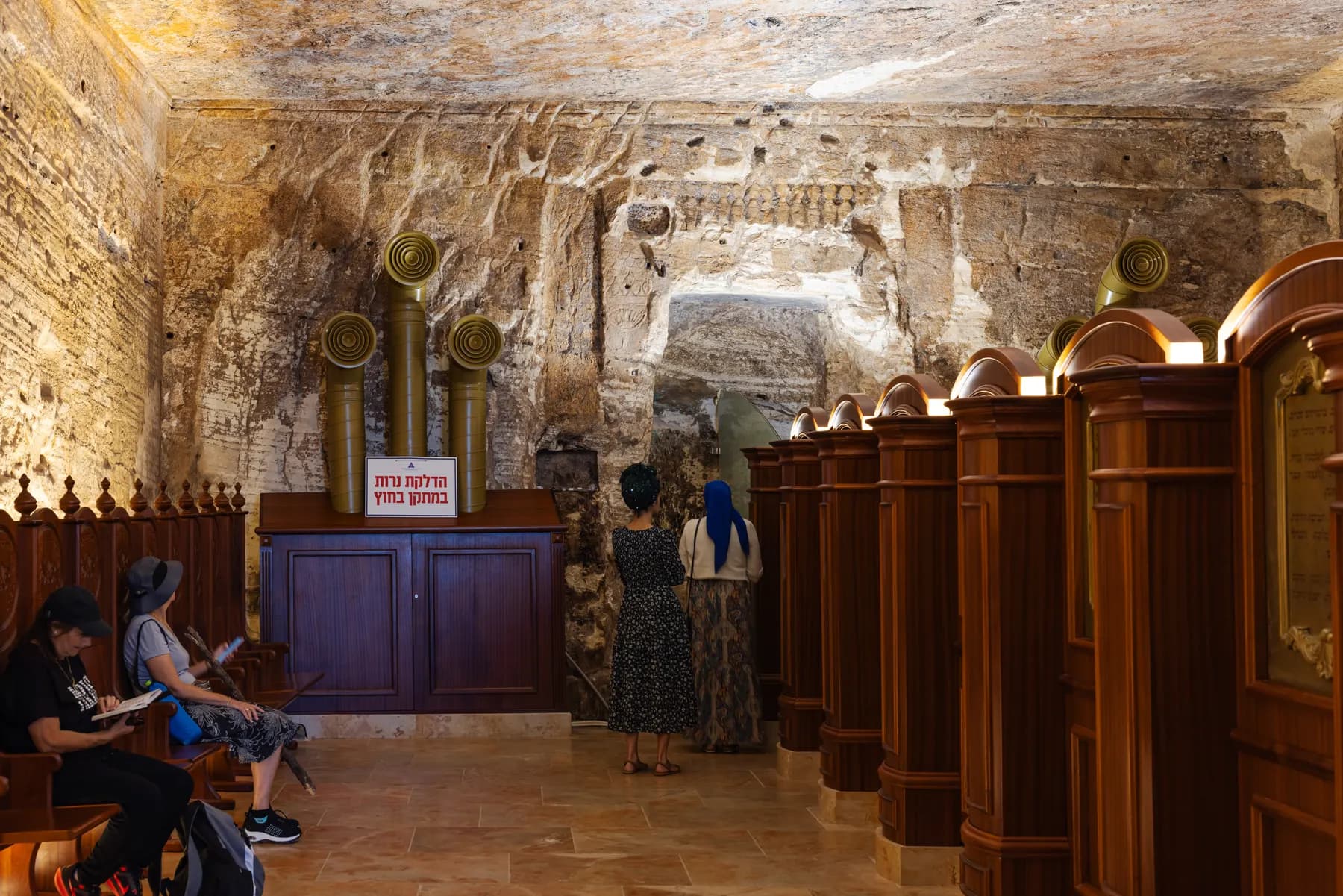
A rock chamber at road level under Cape Carmel, measured by the Israel Antiquities Authority at 13.5 by 8.7 metres, whose walls carry about 150 graffiti in Greek, Latin, Hebrew and Arabic left by pilgrims of four religions.
זאב שטיין / CC BY 2.5 · Wikimedia Commons
Religious site
Stella Maris Carmelite Monastery
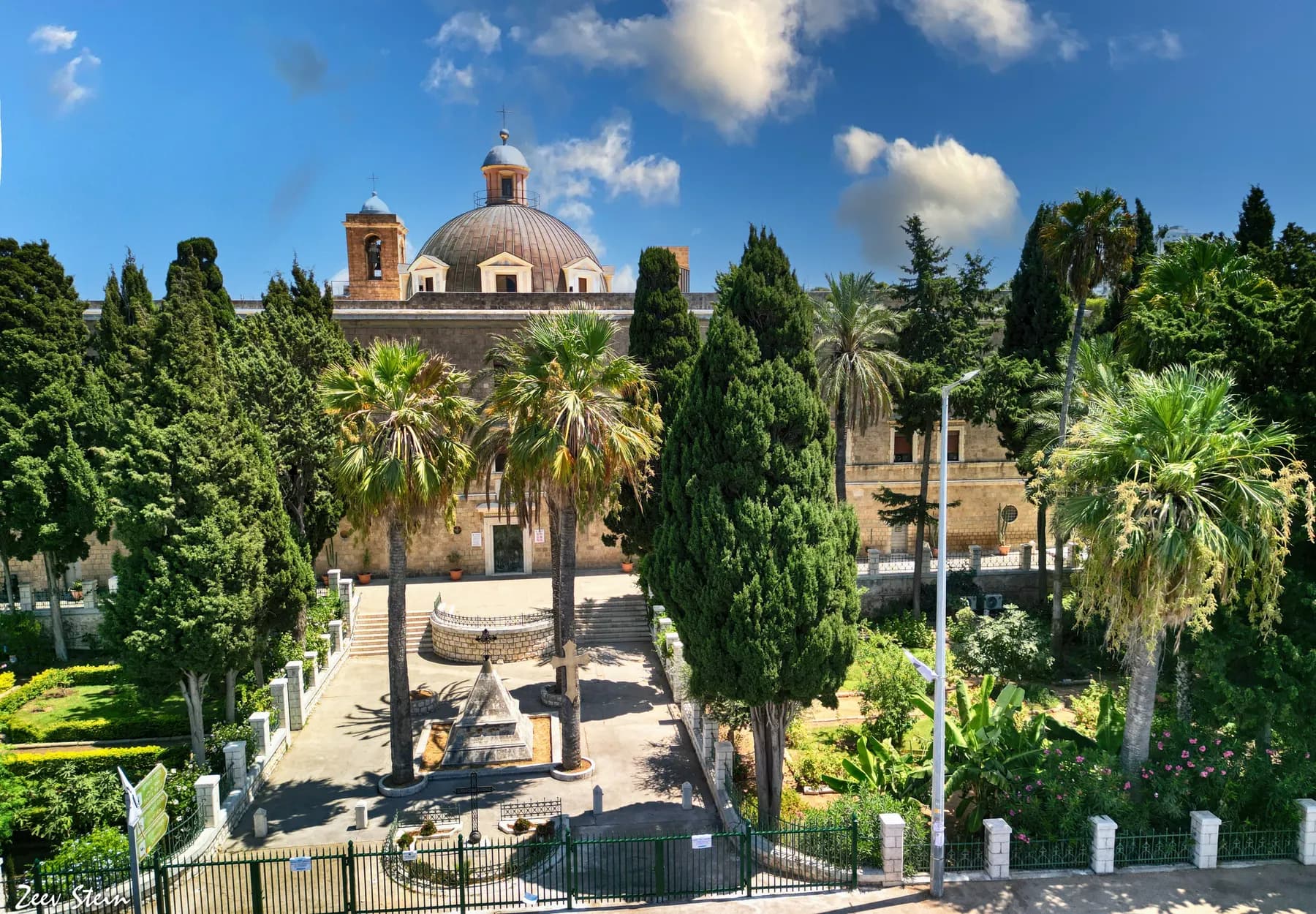
The mother house of the Discalced Carmelites stands on the seaward end of Mount Carmel over a grotto associated with Elijah, under a dome painted by the Maltese friar Luigi Poggi between 1924 and 1928.
Orenshani7 / CC BY-SA 3.0 · Wikimedia Commons
Activity
Haifa Cable Car
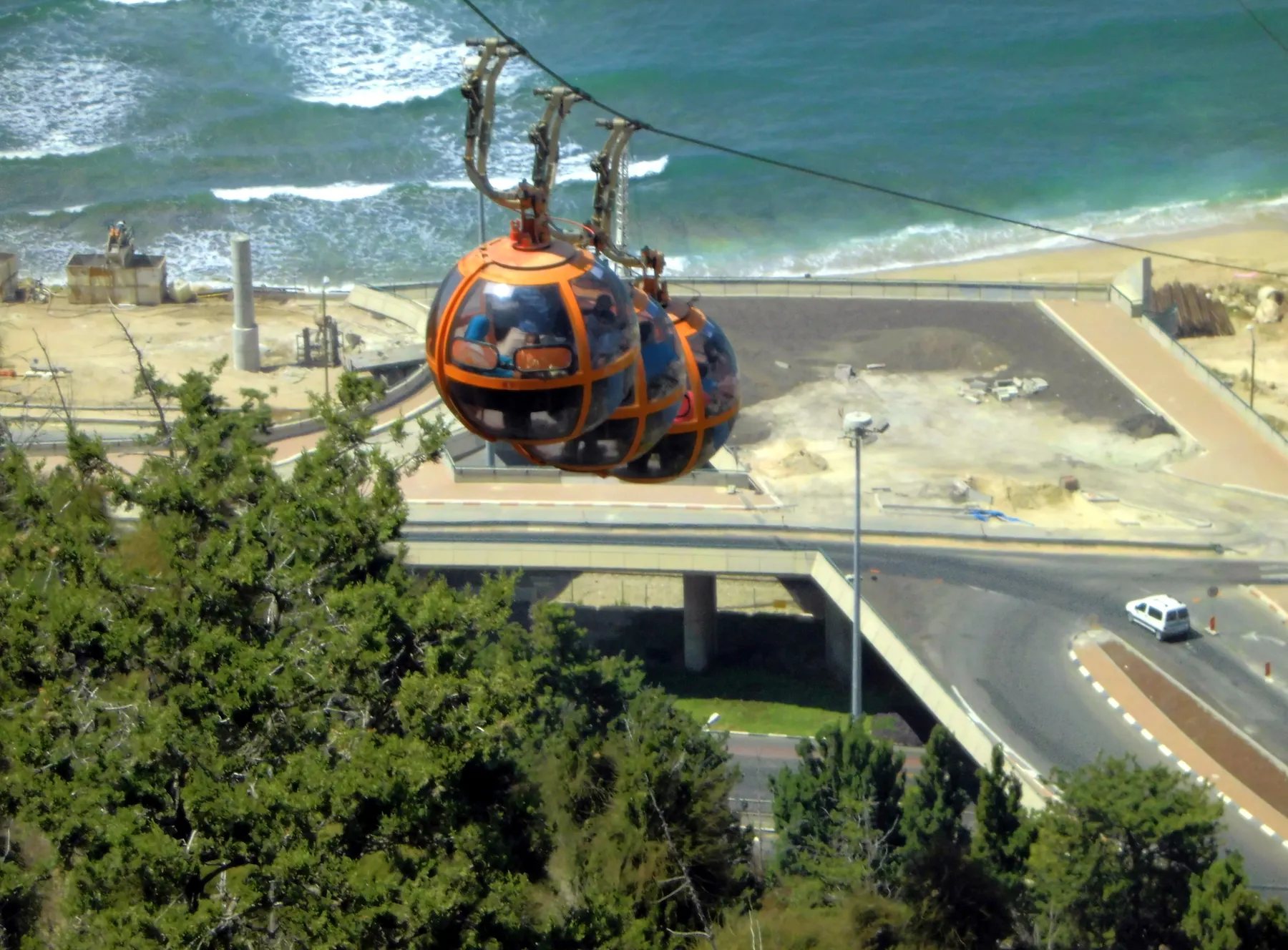
Six spherical cabins have been running the 355 metres from the Bat Galim promenade up to Stella Maris since 1986, three in each direction, and Haifa still calls them Gurel's eggs.
Sources and further reading
Every link below was opened and checked when this page was written. Official statements are marked as such: they are the subject's own account, not an independent one.
- OfficialIsrael Ministry of Defencemod.gov.ilמוזיאון ההעפלה וחיל הים בחיפה
the operator's own page: opening hours, the four admission tiers in shekels, the address and the instruction to come down the Ma'ale HaDakar steps
- OfficialIsrael Ministry of Defence museums unitmuseums.mod.gov.ilנגישות: מוזיאון ההעפלה וחיל הים
the published accessibility statement: the platform lift to the ship and quay, the inaccessible submarine and missile boat, the induction loop, and the parking arrangement at HaHagana 65
- OfficialIsrael Ministry of Defence museums unitmuseums.mod.gov.ilאוניית המעפילים אף על פי כן
the museum's own account of the ship: 141 blockade runners with this the only survivor, the cutting into four sections, Yosef Almog's restoration from 1966, the Kronstro registration, the sailing from the Gaeta coast and the Flotilla 11 service
- OfficialIsrael Ministry of Defence museums unitmuseums.mod.gov.ilאודות מוזיאון ההעפלה וחיל הים
the vessels visitors may enter, the library and archive, the memorial wall for the ships that sank, the INS Eilat monument, and the National Maritime Museum listed as a neighbouring site
- OfficialHaifa Municipalityhaifa.muni.ilמוזיאון ההעפלה חיל הים
the municipality's competing hours: 10:00 to 16:00 Sunday to Thursday, Friday for booked groups of thirty or more, Saturday closed, and a different telephone number
- ReferenceCouncil for Conservation of Heritage Sites in Israelshimur.orgClandestine Immigration and Naval Museum in Haifa
a third set of published hours, the guiding languages, and the statement that the museum belongs to the Ministry of Defence museums unit
- ReferenceWikipediaen.wikipedia.orgHMS LCT 147
the build at Thornaby-on-Tees, the launch of 23 September 1941, the 1943 conversion to a landing craft rocket, and the 434 passengers who sailed from Formia on 17 September 1947
- ReferenceHebrew Wikipediahe.wikipedia.orgמוזיאון ההעפלה וחיל הים
the 1951 municipal decision to build the museum around the Exodus, the bunks and audiovisual show, the Patria hull section, the reconstructed Cyprus camp interiors, the computerised route map and the Karine A container
- ReferenceWikipediaen.wikipedia.orgClandestine Immigration and Naval Museum
the 1969 opening, the dedication to David HaCohen, the competing attribution of the founding to a Colonel Yoske Coral, and the unconfirmed claim that USS Liberty material is held here
- ReferenceWikipediaen.wikipedia.orgPatria disaster
the planned deportation to Mauritius, the two-kilogram Haganah charge of 25 November 1940, the sinking in under sixteen minutes, the 267 dead and the 1957 disclosure
- ReferenceNaval Historical Society of Australianavyhistory.auIsraeli Naval Submarine Dakar
HMS Totem's sale to Israel in 1965, the commissioning of 10 November 1967, the departure from Portsmouth on 9 January 1968 with 69 aboard, the discovery of the wreck on 28 May 1999 at some 9,800 feet, and the raising of the bridge on 11 October 2000
- ReferenceWikipediaen.wikipedia.orgGal-class submarine
the Type 206 derivation, the build by Vickers at Barrow-in-Furness for political reasons, INS Gal's launch in December 1975 and commissioning in June 1976, her decommissioning in 2000 and the entrances cut into her port side for the 2007 museum conversion
- ReferenceUnited States Holocaust Memorial Museumencyclopedia.ushmm.orgAliyah Bet
the totals for clandestine immigration, the post-war interception rate, the scale of internment on Cyprus and the Exodus 1947 affair
- ReferenceWikipediaen.wikipedia.orgAliyah Bet
the competing count of 142 voyages by 120 ships, the role of the Palyam as the maritime arm of the Palmach, and the figure for those drowned at sea
Clandestine Immigration and Naval Museum: common questions
What is the ship at the Clandestine Immigration and Naval Museum?+
Af Al Pi Chen, a Mark 2 tank landing craft launched for the Royal Navy at Thornaby-on-Tees in September 1941 as LCT 147. The Italian branch of the Mossad LeAliyah Bet bought her in March 1946, and she was intercepted in September 1947 carrying 434 Holocaust survivors. She later served in the Israeli Navy and left service in 1958.
How much does it cost to get in?+
The Ministry of Defence publishes ₪20 for an adult and ₪15 for youth aged 5 to 18, students, senior citizens and army pensioners. Holders of a National Insurance or hostile-action disability certificate pay ₪10, and bereaved families enter free. Those are the ministry's own figures for 2026.
When is it open?+
Sunday to Thursday, with the Ministry of Defence giving 09:00 to 16:00 and Haifa municipality giving 10:00 to 16:00 for the same days. Fridays and the eves of festivals are closed on the ministry's page, and the municipality says Friday is open only to booked groups of thirty or more. Saturday is closed. Ring before travelling, because the published hours genuinely disagree.
Is the ship real or a reconstruction?+
It is the original 1941 hull, but it was cut into four pieces, craned to the site and welded back together in order to be there, which is the museum's own account. Nothing on the site is a replica vessel. Several have been altered to let people inside, most obviously the submarine, which had entrances cut into her port side.
Can you go inside the submarine and the missile boat?+
Yes, the ministry lists both as open to visitors. INS Gal, a Type 206 boat built by Vickers at Barrow-in-Furness, was shipped back to Haifa in 2007 with entrances cut into her hull, and inside she is very tight indeed. INS Mivtach, which the ministry calls the navy's first missile boat, stands alongside her in the yard.
How long does a visit take?+
About 90 minutes covers the two indoor wings and a walk round the yard. Allow closer to two hours if you go inside both the submarine and the missile boat and sit through the audiovisual programme in the ship's hold. It is not a full morning.
Is it wheelchair accessible?+
Partly, and the ministry is unusually specific about which parts. The main entrance, the museum building, the ship and the quay are accessible, the last two by a dedicated platform lift. The submarine and the missile boat are not, and cannot be. There is an accessible toilet, a lowered ticket counter, an induction loop and wheelchairs to borrow, but no car park, so vehicle access has to be arranged by telephone in advance.
Is it suitable for children?+
The hardware holds most children easily, since a submarine, a missile boat, naval guns and captured craft can all be climbed around. The immigration wing is a different proposition, dealing with Holocaust survivors, deportation and internment, and the reconstructed Cyprus camp interiors are bleak by design. The vessel interiors also involve ladders and low headroom.
Is it the same as the National Maritime Museum?+
No. The National Maritime Museum is a different institution at 198 Allenby Road with a much broader subject, and the Ministry of Defence's own page for this museum lists it among the neighbouring attractions rather than as part of the site. This one opened in 1969, belongs to the ministry, and covers clandestine immigration and the Israeli Navy only.
Why is it called Af Al Pi Chen?+
The phrase means nonetheless, or in spite of everything. The ship sailed a few weeks after the British seized the Exodus in July 1947 and turned its roughly 4,500 passengers back towards Europe, an event after which the British expected the clandestine sailings to stop. The name is a direct answer to that.