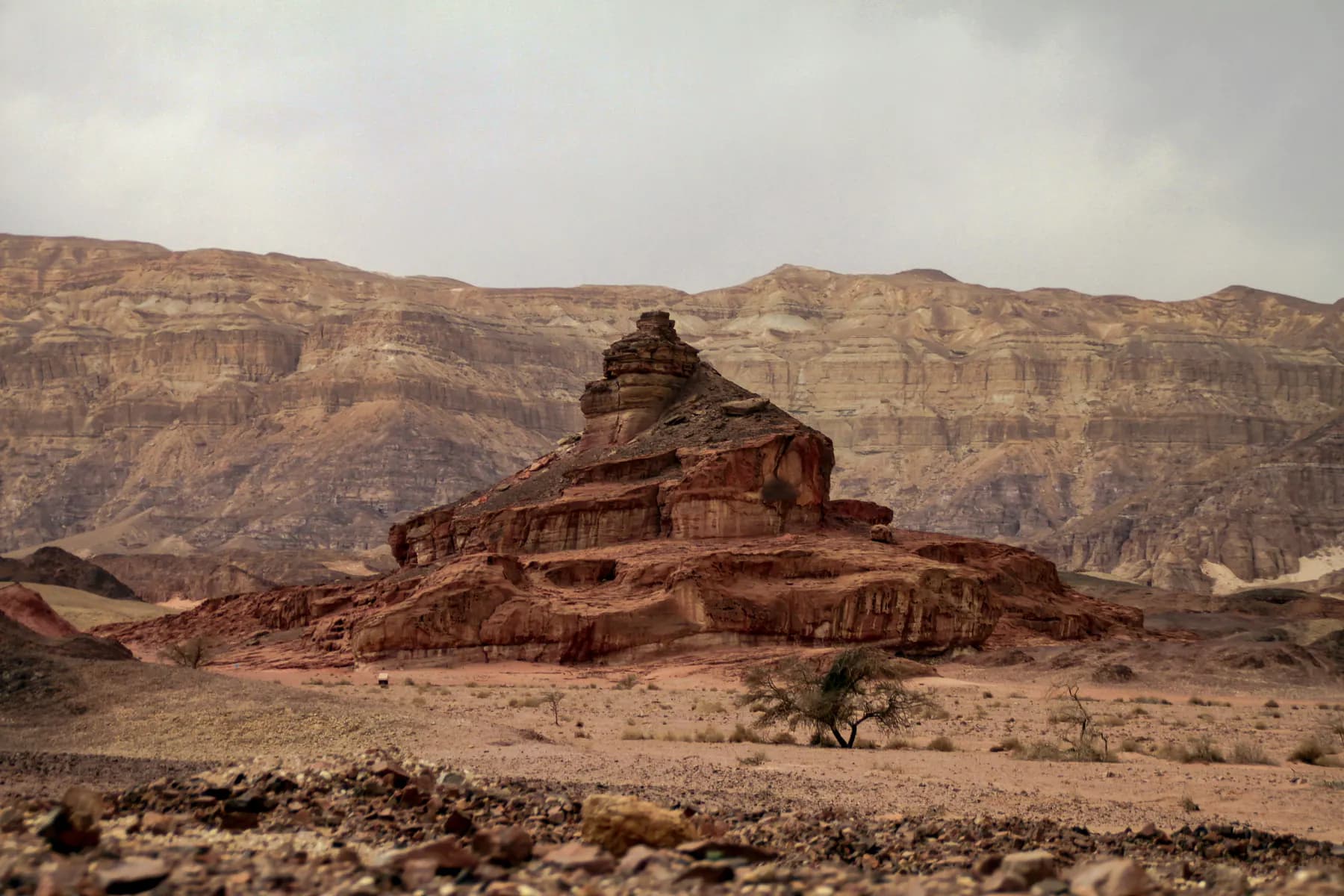
Archaeological site · The Negev
Timna Park
Beno Rothenberg's Arabah Expedition dug an Egyptian temple to the goddess Hathor out of the sand at the foot of Solomon's Pillars in 1969, and the mines around it have been redated twice since.
טלי אראל / CC BY-SA 4.0 · Wikimedia Commons
Copper worked here since
the 5th millennium BCE
the Chalcolithic, per Cavanagh, Ben-Yosef and Langgut in Scientific Reports, 2022
Park area
about 70,000 dunams
the park's own figure, larger than the built area of Tel Aviv
Hathor temple
Site 200, dug in 1969
by the Arabah Expedition under Beno Rothenberg
Entry
₪49
per person from age 3, valid seven consecutive days, as published by Timna Park
In short
- How long to give it
- about 3 to 4 hours for the main sites by car, or a full day with one of the canyon trails
- Sunday to Saturday
- 08:00–16:00; visitors already inside may stay until sunset
- Entry, adult or child
- ₪49 per person, payable from age 3
פארק תמנע
Timna Park is a ticketed desert valley of red and purple sandstone about 20 kilometres north of Eilat, holding the remains of one of the oldest copper industries anywhere and a small Egyptian temple to the goddess Hathor at the foot of the rock formation called Solomon's Pillars. The park puts its own area at roughly 70,000 dunams. That scale is the first practical fact about it: the sites are kilometres apart, joined by a road loop, and the park tells visitors plainly that it is best seen with a private vehicle.
Underneath the scenery is an industrial landscape. Copper ore was taken out of these cliffs from the Chalcolithic onwards, and the valley's peak came in a roughly half-millennium window in the Late Bronze and Iron Ages. What is left of it is thousands of blocked mine shafts, mounds of slag, smelting camps, and rock engravings of chariots and hunts cut in the 14th to 12th centuries BCE. Alongside all that sit sandstone shapes that owe nothing to human beings at all: arches, a mushroom, a sphinx, and the pillars themselves, which are wind and water working along cracks in the rock rather than anything anyone built.
The valley has also been reinterpreted twice in living memory. Nelson Glueck surveyed it in the 1930s and called the workings King Solomon's Mines. Rothenberg found the Hathor temple and replaced Solomon with Egypt. Since 2012 Erez Ben-Yosef's Central Timna Valley Project at Tel Aviv University has redated the main smelting camps to the early Iron Age, after the Egyptians left. Which of those readings a visitor is standing in front of at any given sign is worth knowing before setting out.
Orientation
A park you drive around, not walk across
The entrance is on Route 90 near Kibbutz Elifaz, and the park's own instruction after buying a ticket is to stop at the visitor centre for a barcode, a map and an orientation. That is not a formality: the centre is where the 360-degree film and the exhibits are, and it is where a ranger will tell which of the trails are open. From there a made road runs to each of the main sites, each with its own car park.
Almost every site is a short walk from a car park rather than a hike. The park gives Solomon's Pillars as a circular route of 500 metres at easy difficulty, the Hathor temple as 200 metres there and back, the Mushroom as 200 to 300 metres, the Chariots engravings as 200 to 300 metres, and the Waffle Wall as about 100 metres from the Mushroom car park. The long walking is optional and clearly signposted: three canyon trails of 4.7 kilometres, 6 kilometres and 10 kilometres, the last of which the park rates challenging and puts at about three and a half hours, and a family circuit of 3 kilometres past fossil trees.
Water is the constraint the park is most insistent about. Its hiker guidance asks for a minimum of three litres per person and states that a hydration station is available only at the Lake Complex. Hiking at night is prohibited outright, and drones need authorisation. Gates close at 16:00, but visitors already inside may stay until sunset.
- Solomon's Pillars: 500 m circular, easy
- Temple of Hathor: 200 m there and back, easy
- The Arches, red trail: about an hour, ladders and stakes
- Canyon trails: 4.7 km, 6 km and 10 km loops
- Fossil Trees: 3 km circular, family-friendly
- Carry at least 3 litres per person; water only at the lake
Site 200
The temple at the foot of the pillars
The single most consequential thing found in this valley is small, low and easy to walk past. At the base of Solomon's Pillars stands a shrine to Hathor, the Egyptian goddess associated with mining and with foreign lands, known in the excavation records as Site 200 and on the park's signs as the Miners' Temple. The Central Timna Valley Project's account credits its excavation to Rothenberg's Arabah Expedition in 1969. The park dates the structure to Egypt's 19th and 20th Dynasties and says it went through several phases of destruction and rebuilding, with material from both the Egyptian and the Midianite periods in it.
The wider Egyptian window is tighter than the temple alone suggests. Cavanagh, Ben-Yosef and Langgut, writing in Scientific Reports in 2022, put the New Kingdom presence at roughly 1300 to 1140 BCE, from Seti I to Ramesses V, and note that the valley was originally attributed solely to those dynasties precisely because of the rich Egyptian finds from this one small temple. Egypt then withdrew from the southern Aravah at the end of the Late Bronze Age, weakened by internal struggles and by the wider collapse across the eastern Mediterranean.
What a visitor sees is foundation courses and re-erected stone rather than a standing building, which is normal for a shrine of this size and age and is worth expecting. The compensation is above it. The park points to a smoothed surface on the cliff ceiling just north of the temple carrying an Egyptian rock engraving of Ramesses III, reached by the staircase that climbs from the temple. It is a short climb and it is the reason to do the Solomon's Pillars loop in the order the park suggests: up the stairs to the carving, then down to the temple.
The argument
Solomon, the pharaohs, or Edom
Glueck's reading in the 1930s was that these were the mines of King Solomon, and the name stuck to the pillars permanently even though the pillars are a landform. The obituary of Rothenberg published in the Israel Exploration Journal in 2012 describes what happened next: with strict adherence to the facts on the ground, and in a period soaked in biblical literalism, Rothenberg replaced Glueck's Solomon at Timna with an interpretation of Egyptian-controlled mines after he found the Hathor temple. That became the standard account for nearly half a century.
It is no longer standard. The Central Timna Valley Project states flatly that the previously accepted Egyptian paradigm, under which the main sites belonged to the Late Bronze Age, is no longer valid: Site 30 is now dated to the early Iron Age, the 11th to 9th centuries BCE, and the date of the other main smelting camps and of the thousands of mine shafts is consequently insecure. Ben-Yosef, Liss, Yagel, Tirosh, Najjar and Levy, publishing in PLOS ONE in September 2019, radiocarbon dated 154 slag samples from controlled contexts and found continuous copper production from about 1300 to 800 BCE, peaking after Egypt's departure rather than during it.
Who ran that peak is where researchers still differ, and the difference is not a technicality. The 2019 paper reads the industry as the emergence of the Edomite kingdom, and identifies a sharp technological leap in the second half of the 10th century BCE, with the copper left behind in the slag falling by 55.5 per cent as smelting got better. It links that leap to the campaign of the pharaoh Shoshenq I, commonly dated to around 925 BCE. Timna Park's own account of the same evidence takes the 10th-century date as reassigning the mines to Solomon and the United Monarchy. Both readings sit on the same radiocarbon dates; the disagreement is about which polity to attach them to, and it is unresolved.
Underground
Shafts, galleries and the ladders into them
Rothenberg's expedition sorted the workings into three technologies, and the project that succeeded him kept the scheme. Type A is open-pit mining, shallow pits dug into the gravel below the sandstone cliffs to pick out copper ore nodules that had already eroded out of the rock. Type B is shaft-and-gallery work cut with stone tools. Type C is the same idea cut with metal chisels, and thousands of shafts across the valley belong to it, most of them dug to prospect for a vein rather than to follow one.
Dating a hole in the ground is hard, because mines leave almost no pottery or organic material. The Central Timna Valley Project applied optically stimulated luminescence to the sediment that refilled two mining areas near the chariot engravings, measuring how long the quartz grains had been in the dark. The results put open-pit mining at Merkavot 1 in the Chalcolithic, with further work there at the end of the second millennium BCE, and put an excavated shaft at Merkavot 2 in the Chalcolithic as well. That is a very long industry: the same valley, worked with hammer stones and then with chisels, across three and a half millennia.
For a visitor the mines are reached at the Arches. The park's red trail there takes about an hour and involves ladder climbs, stakes and squeezing through narrow passages, and it runs past ancient mining works with interpretive signs. The black trail is a 30-minute variant off it, climbing ladders into a cave and back out to a viewpoint. Anyone unhappy on ladders or in confined spaces should take the green trail instead, which the park gives as 15 to 20 minutes to the Small Arch.
Collapse
The industry that burned through its own desert
Smelting copper takes a furnace at around 1,100 degrees, and in a hyper-arid valley the scarce commodity is not ore but firewood. Mark Cavanagh, Erez Ben-Yosef and Dafna Langgut set out to find what the smelters actually burned, analysing hundreds of charcoal samples from two well-stratified accumulations of industrial waste. Their paper appeared in Scientific Reports on 21 September 2022.
The answer was two local species: Retama raetam, white broom, and acacia, both high in calorific value and both well suited to a furnace. The telling detail is what turned up later in the sequence. Species unsuited to the prevailing regional conditions begin to appear in the charcoal, which the authors read as the search for fuel widening as the nearby stands were used up. Their conclusion is that the lucrative copper industry ended because it ran out of fuel, having hastened desertification and degraded the local ecosystem itself.
It is an unusually direct thing to be able to see from an archaeological site, and it changes how the slag mounds read. The heaps beside the trails are not just waste. They are a record of how many acacia trees the valley no longer has.
Rebuilt
What is ancient here, and what is not
Three of the park's best-known features are modern, and the park says so. The Tabernacle is a full-scale reconstruction of the biblical Mishkan, built with the altar, the copper laver, the table of showbread, the menorah, the Ark and the priestly garments, and presented as a model rather than as a find. It is seen on a guided tour that has to be booked in advance and costs ₪20 per person on top of entry, running hourly on Sunday to Thursday mornings and afternoons, earlier on Friday, and not at all on Saturday.
Timna Lake is artificial. It was made to give wildlife a permanent water source and visitors somewhere to sit, it covers 16 dunams and holds roughly 20,000 cubic metres of water that is not drinkable, and swimming in it is not allowed. Pedal boats are. The lake complex is where the café, the shop, the sand bottle filling station and the accommodation are, and it is the only place in the park with a hydration station.
The sandstone formations, by contrast, are entirely natural and are frequently taken for the opposite. The park is explicit that the arches, though they mimic built structures, are the work of wind on sandstone over millennia. So is the Mushroom, where a hard cap sits on a slender stem because the softer rock beneath eroded faster, and so is the Sphinx, and so are Solomon's Pillars, which are erosion working down the cracks in red sandstone and have no connection to Solomon beyond Glueck's naming.
What to look for
Things not to walk past at Timna Park
The details that repay knowing about before you are standing in front of them.
The temple of Hathor, Site 200
The Egyptian mining shrine at the foot of Solomon's Pillars, excavated in 1969, whose finds pinned the valley to Egypt's 19th and 20th Dynasties for half a century. Low walls rather than a standing building, and 200 metres there and back from the car park.
The Ramesses III rock engraving
Cut into a smoothed cliff surface just north of the temple and reached by the staircase above it. The park describes it as a chance to come face to face with the likeness of a pharaoh, and it is a two-minute climb from the temple.
Solomon's Pillars
The red sandstone columns the park is known for, formed by erosion along cracks in the rock rather than by any builder. The 500-metre loop climbs the cliff above them and ends at an ancient copper smelting site.
The Arches, red trail
About an hour of ladders, stakes and narrow passages leading to the Great Arch and past ancient mine workings with explanatory signs. The green trail, 15 to 20 minutes to the Small Arch, is the shorter alternative.
The Chariots petroglyphs
Two clusters of rock engravings from the 14th to 12th centuries BCE: chariots with two wheels and two figures apiece, and a hunting scene with ibex, vultures, oryx and ostriches. A sheltered hut at the start holds replicas and signage.
The Mushroom and the Waffle Wall
A capped sandstone pillar left behind by uneven erosion, with a copper smelting site beside it in the same valley. The Waffle Wall is 100 metres away, a banded rock face of mineral layers laid down over half a billion years.
The long view
Timna Park, in order
5th millennium BCE
Copper is being taken from the valley in the Chalcolithic. Luminescence dating puts both an open pit at Merkavot 1 and a shaft at Merkavot 2 in this period.
c. 1300–1140 BCE
Egypt's 19th and 20th Dynasties, from Seti I to Ramesses V, work the valley. The Hathor temple at Site 200 and the chariot engravings belong here.
c. 1140 BCE
Egypt withdraws from the southern Aravah at the end of the Late Bronze Age, and the industry passes to the local desert society.
11th–9th centuries BCE
The industrial peak. Site 30 and Site 34, Slaves' Hill, date to this window, and researchers link the production to biblical Edom.
late 11th to early 10th century BCE
The date returned directly by radiocarbon on a purple-dyed wool fibre from Slaves' Hill.
second half of the 10th century BCE
Smelting efficiency jumps sharply; the copper left in the slag falls by 55.5 per cent.
c. 925 BCE
The campaign of Shoshenq I, which Ben-Yosef and colleagues propose as the trigger for that technological leap.
c. 800 BCE
Copper production in the valley ends. A 2022 charcoal study argues the cause was fuel exhaustion.
1930s
Nelson Glueck surveys the valley and names the workings King Solomon's Mines.
1969
Rothenberg's Arabah Expedition excavates the temple to Hathor, and Egyptian control replaces Solomon as the standard reading.
2012
Rothenberg dies at 98. The Central Timna Valley Project begins at Tel Aviv University under Erez Ben-Yosef.
2013
The project's first field seasons concentrate on Site 34, Slaves' Hill, one of the largest smelting camps in the valley.
2021
Purple wool dyed with murex sea snail is published from Slaves' Hill, the oldest so far known in the southern Levant.
2022
Charcoal analysis identifies white broom and acacia as the industry's fuel, and its exhaustion as the likely end of the industry.
Practical
Visiting Timna Park
Where
Route 90, about 20 km north of Eilat, near Kibbutz Elifaz
What ticket you need
Everything in this page sits inside one ticketed park, and one ₪49 ticket covers the lot: the Hathor temple, Solomon's Pillars, the Arches, the Chariots, the Mushroom and the lake all need no separate payment. The two things that cost extra are the Tabernacle tour at ₪20 per person and hire of bicycles or pedal boats at the lake.
Opening hours
- Sunday to Saturday
- 08:00–16:00; visitors already inside may stay until sunsetsource
- August
- the park stays open into the night, with last entry at 21:30source
- Café Timna
- 08:00–15:30; the souvenir shop until 16:00source
- Bicycle and pedal boat hire
- 08:00–15:30, from the lake area onlysource
- Tabernacle tours
- Sunday to Thursday 09:30, 10:30, 11:30, 12:30, 14:30 and 15:30; Friday to 13:30; closed Saturdaysource
Admission
Access
Partly. The park states in its own words that the walking trails are not accessible, so the canyon routes, the Arches ladders and the climb to the Ramesses III engraving are out of reach for wheelchair users. What is accessible is substantial: the visitor centre with its exhibits and 360-degree film, accessible parking within 150 metres of the marked sites, accessible chemical toilets at Solomon's Pillars and at the Arches, and accessible toilets, showers and changing facilities at the lower level of the lake complex. Café Timna and the shop are accessible and carry audio induction loops, and the park offers a portable induction loop and a ranger with a kit on request through its accessibility coordinator.
On site
- Visitor centre and 360-degree film
- Café Timna
- Souvenir shop
- Drinking water at the lake complex only
- Accessible toilets at the lake, Solomon's Pillars and the Arches
- Car park at each site
- Bicycle hire at the lake
- Pedal boats
- Sand bottle filling station
- Camping, caravans and glamping
Booking
Tickets are sold online through the park's own booking engine, and the park notes a discount for booking online. Whether bought online or at the gate, the ticket has to be exchanged at the visitor centre for a barcode and an orientation before going any further. The Tabernacle tour is separate and has to be arranged in advance by telephone.
Hours and prices are given as the operator publishes them and change without much notice, particularly around Shabbat and the festivals. Check the operator's own page before you travel for this.
Official page at parktimna.co.il →What people wish they had known
- Go to the visitor centre before driving on. The park requires the ticket to be exchanged there for a barcode and a briefing, and it is where the map and the trail closures are. People who drive straight to Solomon's Pillars end up doubling back.
- Treat it as a driving park with short walks, not a hiking park. The sites are spread across roughly 70,000 dunams and the park itself recommends a private vehicle; the buses from Eilat and from the centre of the country stop at the junction, not inside.
- Carry the water the park asks for. Its hiker guidance sets a minimum of three litres per person and says the only hydration station is at the Lake Complex, which is at the far end of the loop from several of the sites.
- Check the ladders before committing. The red trail at the Arches involves ladder climbs, stakes and narrow passages for about an hour; the green trail to the Small Arch is 15 to 20 minutes and the softer option.
- Book the Tabernacle before the day if it matters. It runs on fixed tour times, needs advance booking, costs ₪20 a head on top of entry and does not run on Saturday.
- Do not expect a standing temple at Site 200. What survives of the Hathor shrine is low, and the striking thing above it is the Ramesses III engraving up the staircase, which many visitors miss because they stop at the walls.
The figures
Timna Park by the numbers
Each figure carries the year it belongs to and links the source it came from.
| Measure | Figure | As of | Source |
|---|---|---|---|
| Entry per person | ₪49 | 2026 | parktimna.co.il |
| Tabernacle tour, on top of entry | ₪20 per person | 2026 | parktimna.co.il |
| Park area | about 70,000 dunams | 2026 | parktimna.co.il |
| Distance north of Eilat | about 20 km, on Route 90 | 2026 | parktimna.co.il |
| Water the park asks hikers to carry | at least 3 litres per person | 2026 | parktimna.co.il |
| Slag samples radiocarbon dated | 154, giving production from about 1300 to 800 BCE | 2019 | journals.plos.org |
| Fall in copper left in the slag | 55.5 per cent, in the second half of the 10th century BCE | 2019 | journals.plos.org |
| Timna Lake | 16 dunams, about 20,000 cubic metres, not drinkable | 2026 | parktimna.co.il |
While you are here
The rest of The Negev
Everything else in this destination with a page of its own.
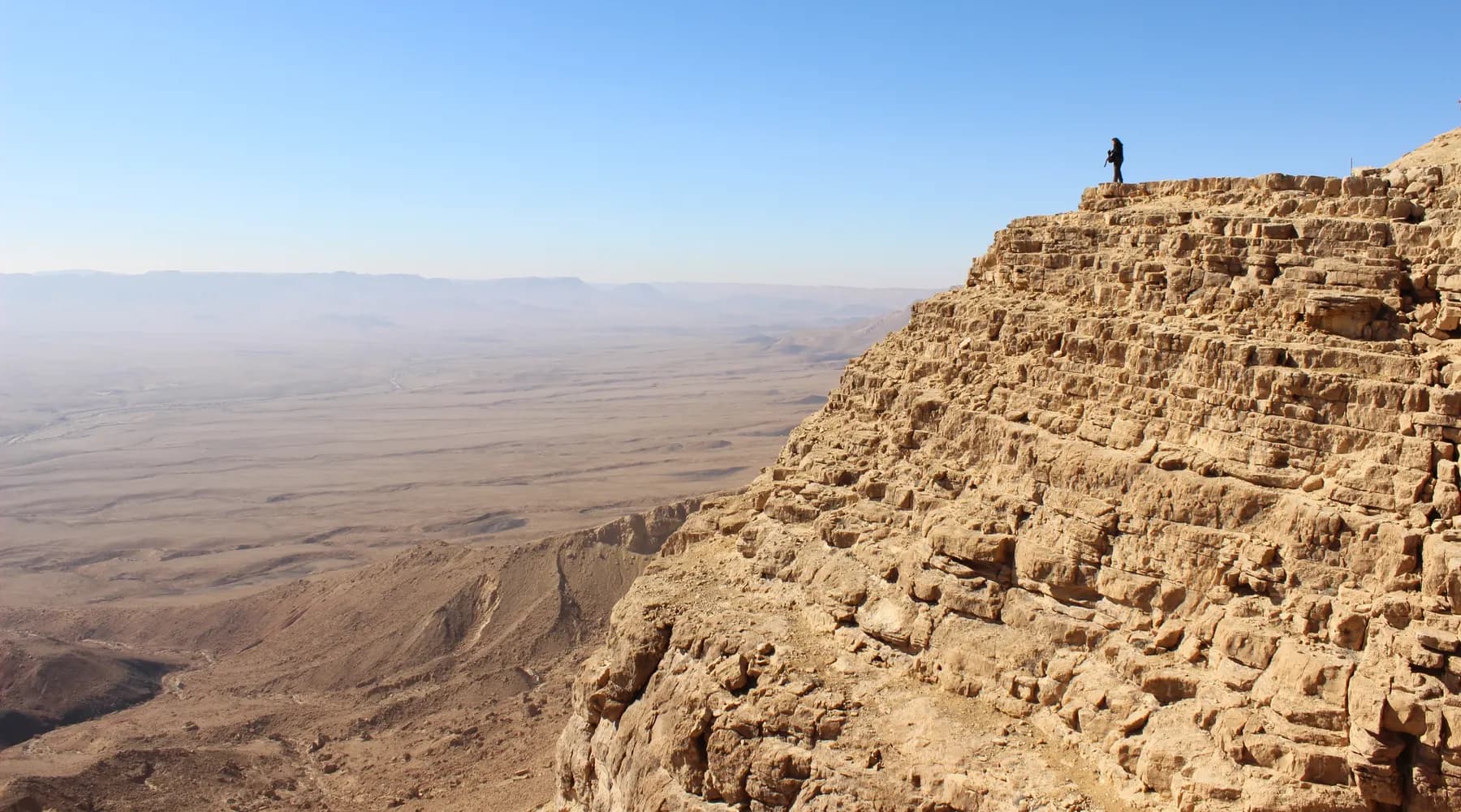
Orhat / CC BY-SA 4.0 · Wikimedia Commons
Nature reserve
Makhtesh Ramon (Ramon Crater)
The floor of the makhtesh was quarried for clay and quartz before it was protected, and the parks authority's scenic road across the eastern half runs over ground it had to rehabilitate.
Activity
Stargazing in the Ramon Crater
The Israel Nature and Parks Authority won the International Dark Sky Park title for the Ramon Crater in September 2017 after three years of assessment, and the research observatory five kilometres west of the town logs about 170 nights a year with no cloud at all.
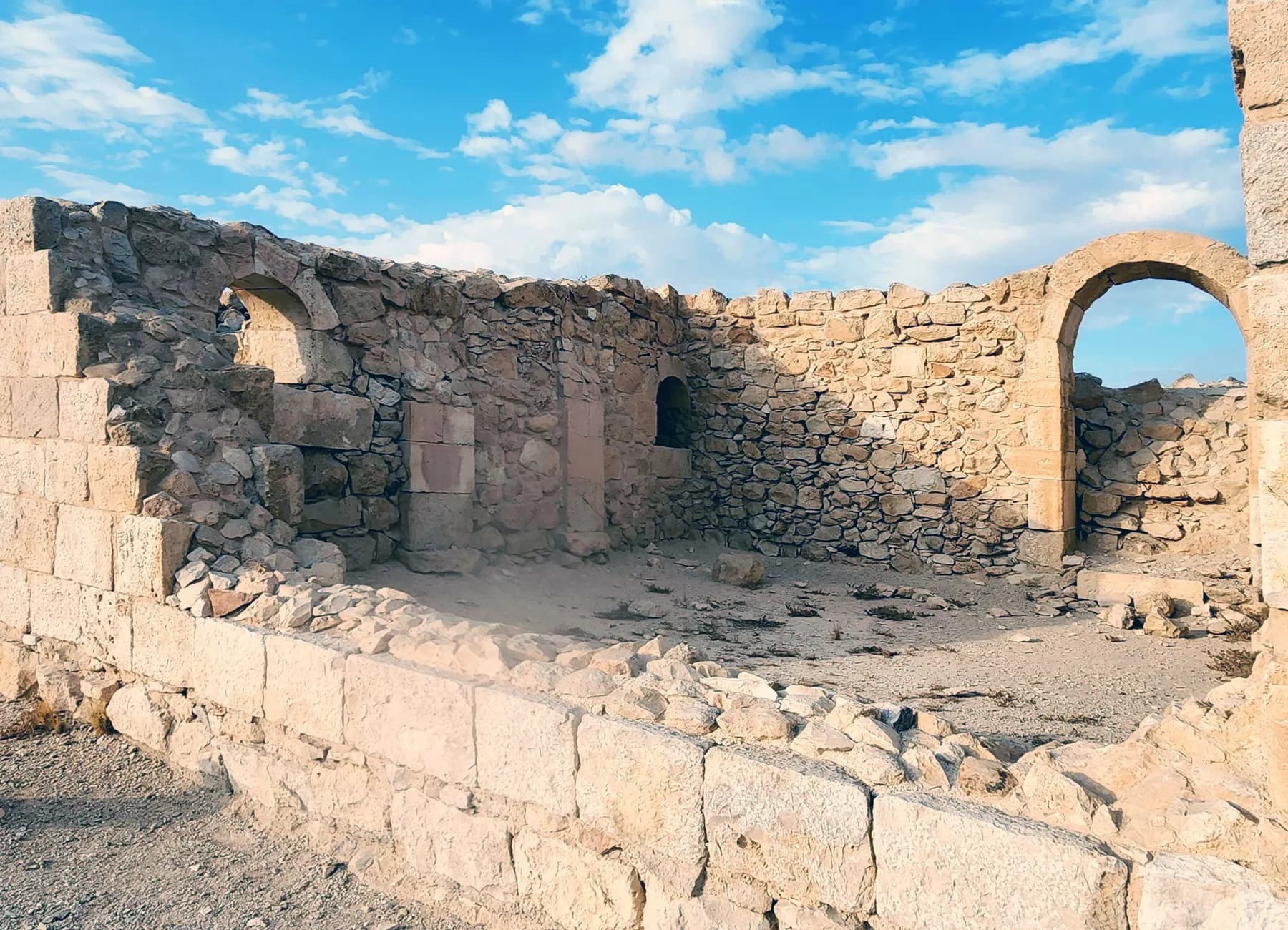
ישראל פרקר / CC BY 2.5 · Wikimedia Commons
Archaeological site
Avdat National Park
Avdat was station number 62 on the Incense Route, and the caravan road that brought frankincense from Arabia towards the port of Gaza can still be picked out climbing to it from the southeast.
Sources and further reading
Every link below was opened and checked when this page was written. Official statements are marked as such: they are the subject's own account, not an independent one.
- OfficialTimna Parkparktimna.co.ilKnow before your visit
opening hours, staying until sunset, the visitor centre barcode, and the park's own area figure
- OfficialTimna Parkparktimna.co.ilTickets
the ₪49 entry price on the park's booking engine, seven-day validity, August night opening and café hours
- OfficialTimna Parkparktimna.co.ilPark Sites
trail lengths and difficulty, hiker safety rules, the Hathor temple, the Arches, the Chariots and Timna Lake
- OfficialTimna Parkparktimna.co.ilThe Tabernacle
the reconstruction, its tour times and the ₪20 supplement
- OfficialTimna Parkparktimna.co.ilTimna Story
the park's own account of the history, including its reading of Ben-Yosef's work as reassigning the mines to Solomon
- OfficialTimna Parkparktimna.co.ilNavigating Timna Park
location on Route 90 near Kibbutz Elifaz, distance from Eilat and the bus lines that stop at the junction
- OfficialTimna Parkparktimna.co.ilAccessibility Commitment
accessible parking distances, toilets at Solomon's Pillars and the Arches, and the induction loop provision
- ReferenceSonia and Marco Nadler Institute of Archaeology, Tel Aviv Universitytau.ac.ilThe Central Timna Valley Project
the project's scope from 2012, the redating of Site 30 to the early Iron Age and the abandonment of the Egyptian paradigm
- ReferenceCentral Timna Valley Project, Tel Aviv Universitytau.ac.ilCTV: Mining Technology
the three mining types, the 1969 excavation of the Hathor temple as Site 200, and the luminescence dates from Merkavot
- ReferenceIsrael Exploration Journal 62(1), reprinted by the Central Timna Valley Projecttau.ac.ilIn Memoriam: Professor Beno Rothenberg
Rothenberg's life, his work with Glueck, and his replacement of Solomon with Egyptian control after finding the temple
- ReferencePLOS ONE (Ben-Yosef, Liss, Yagel, Tirosh, Najjar and Levy), 18 September 2019journals.plos.orgAncient technology and punctuated change: Detecting the emergence of the Edomite Kingdom in the Southern Levant
154 radiocarbon-dated slag samples, production from about 1300 to 800 BCE, the 10th-century efficiency leap and Shoshenq I
- ReferencePLOS ONE (Sukenik, Iluz, Amar, Varvak, Shamir and Ben-Yosef), 28 January 2021journals.plos.orgEarly evidence of royal purple dyed textile from Timna Valley (Israel)
murex-dyed purple fibres from Slaves' Hill, Site 34, one directly dated to the late 11th or early 10th century BCE
- ReferenceScientific Reports 12:15434 (Cavanagh, Ben-Yosef and Langgut), 21 September 2022nature.comFuel exploitation and environmental degradation at the Iron Age copper industry of the Timna Valley, southern Israel
white broom and acacia as the industry's fuel, the Egyptian window of about 1300 to 1140 BCE, and fuel exhaustion as the likely end
Timna Park: common questions
Is Timna Park worth visiting?+
It is, if the appeal is that the geology and the archaeology are in the same frame. The draw is not one monument but a valley: an Egyptian shrine to Hathor at the foot of eroded sandstone pillars, thousands of ancient mine shafts, rock engravings of chariots, and arches you climb ladders to reach. Visitors expecting a compact ruin like Avdat or Masada will find something looser and more spread out, and people who dislike driving between stops will get less from it.
How much does it cost to enter Timna Park?+
Timna Park publishes entry at ₪49 per person, adult or child, payable from age three. The ticket is valid for seven consecutive days and includes a bottle to fill with coloured sand. The park notes a discount for booking online through its own engine. A guided tour of the Tabernacle costs an extra ₪20 per person and has to be booked in advance.
What are the opening hours?+
The park publishes 08:00 to 16:00, Sunday to Saturday, and says visitors already inside may stay until sunset. During August it stays open into the night, with last entry at 21:30. Café Timna closes at 15:30 and the souvenir shop at 16:00; bicycle and pedal boat hire also stop at 15:30.
How long do you need at Timna Park?+
About three to four hours covers the main sites if you drive between them and take the short marked walks: Solomon's Pillars, the Hathor temple, the Chariots, the Mushroom and the lake. Add the Arches red trail, which the park puts at roughly an hour, and it becomes half a day. One of the canyon loops, at 4.7, 6 or 10 kilometres, turns it into a full day.
Are these really King Solomon's mines?+
The name comes from Nelson Glueck, who surveyed the valley in the 1930s, and it is not settled. Rothenberg's discovery of the Hathor temple in 1969 shifted the standard reading to Egyptian control, and since 2012 Tel Aviv University's Central Timna Valley Project has redated the main smelting camps to the early Iron Age, after the Egyptians left. The 2019 PLOS ONE study by Ben-Yosef and colleagues reads that peak as the emergence of the Edomite kingdom; the park's own account reads the same dates as evidence for Solomon and the United Monarchy. Researchers still differ over which polity to attach the copper to.
Can you go inside the ancient copper mines?+
Partly, and only at the Arches. The park's red and black trails there run past ancient mine workings and involve ladder climbs, stakes and, on the black trail, climbing into a cave and out to a viewpoint. Most of the valley's thousands of shafts are blocked and are visible only as pale plates on the surface, which is what the guides are pointing at when they say there are mines everywhere.
Can you get to Timna Park without a car?+
Not easily. The park lists line 991 from Eilat and lines 390, 394 and 397 from the centre of the country, and states that these stop at the junction rather than inside the park. Since the sites are spread across roughly 70,000 dunams and are joined by an internal road, arriving without a vehicle means either a long walk from the gate or arranging a lift. The park recommends a private vehicle.
Is Timna Park wheelchair accessible?+
The main sites are reachable and the walking trails are not. The park states outright that its walking trails are not accessible, which rules out the canyon routes, the Arches ladders and the staircase to the Ramesses III engraving. It does provide accessible parking within 150 metres of marked sites, accessible chemical toilets at Solomon's Pillars and the Arches, an accessible visitor centre with a 360-degree film, and accessible toilets, showers and changing facilities at the lake complex.
Is there shade, and how hot does it get?+
Shade is scarce away from the lake complex, which is where the café, the seating areas and the only hydration station are. This is a hyper-arid valley in the southern Aravah and the park's own hiking rules assume it: a hat, proper shoes and at least three litres of water per person. In the hot months the sensible pattern is to start at opening and do the exposed walks first.
Can you stay overnight in the park?+
Yes. The park runs its own accommodation at the lake complex, including guest rooms, caravans, glamping tents, a camping area and a desert khan, plus caravan docking for visitors bringing their own. Staying in means being in the valley after the day visitors leave, though the park prohibits hiking at night.