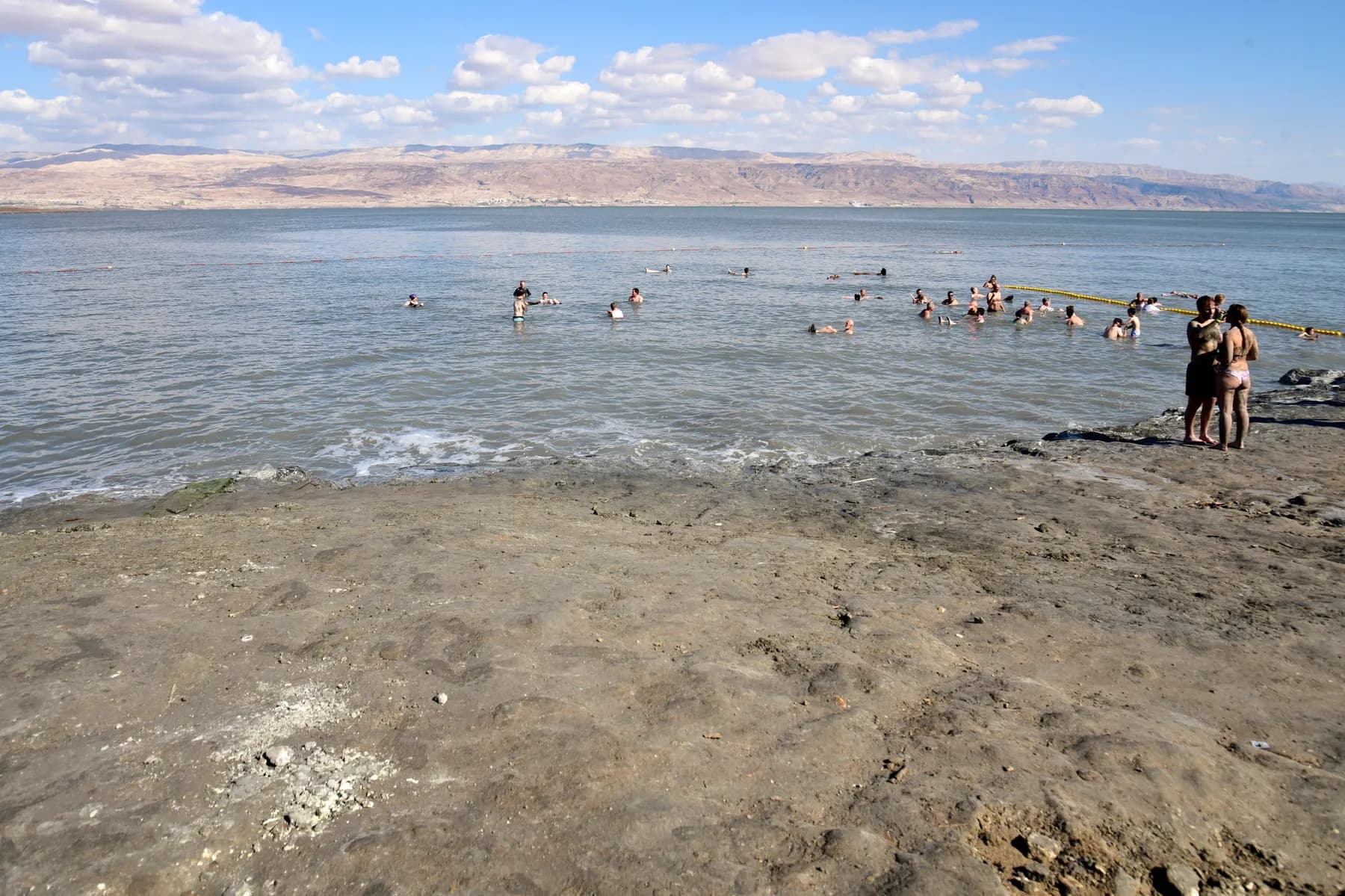
Beach · The Dead Sea
Kalia Beach
The northernmost managed beach on the Dead Sea, run by Kibbutz Kalia on the site of the potash works the Arab Legion destroyed in May 1948, with a paid gate and two quite different tickets.
Bahnfrend / CC BY-SA 4.0 · Wikimedia Commons
Adult admission
₪45
the all-inclusive ticket, covering parking, a chair, an umbrella and unlimited shuttles, as the operator posts it
Opening hours
08:00 to 18:00
summer, seven days a week; 08:00 to 17:00 in winter, weekends and holidays included
Entry-only ticket
₪20
over-13s, sold at the gate; parking, chair, umbrella and shuttle are then charged separately
Street artists on the ruins
36
recruited for the -430 Gallery, which the kibbutz launched in March 2018
In short
- How long to give it
- about two hours, or half a day with lunch and the gallery
- Summer, every day
- 08:00 to 18:00, weekends and festivals included
- Adult, all-inclusive (13 and over)
- ₪45, covering parking, chairs, umbrella and unlimited shuttles
חוף קליה
Kalia Beach is a privately run, gated bathing beach at the northern tip of the Dead Sea, operated by Kibbutz Kalia about 25 minutes from Jerusalem by the operator's own reckoning. It is the first beach a driver reaches coming down Route 90 from the north, and the kibbutz describes it as the northernmost beach on the sea. Admission is charged, the black mud is not, and a shuttle runs between the entrance terrace on the upper level and the strip of sand at the water.
The gate matters more here than it does further south, where the council-run beaches at Ein Bokek and Hamei Zohar are free. On this shore there is very little left to choose from: Mineral Beach and the public beach at Ein Gedi have closed, and the bathing access at Einot Tzukim went in 2000, all of it to the sinkholes that open as the lake retreats. Kalia is one of the few places on the northern basin where a lifeguard is on duty and the ground under the car park has been checked.
The name is older than the beach. Kalia was the workers' settlement of the Palestine Potash Company's northern plant, built from 1934 under the Siberian mining engineer Moshe Novomeysky, evacuated by boat in May 1948 and destroyed by the Arab Legion days later. Nothing of that plant is standing here now. What a visitor sees is entirely the work of the kibbutz re-established after 1967, down to the abandoned buildings on the shore that 36 street artists have since painted.
The gate
Two tickets, two levels and a bell for the shuttle
The site works on two levels. The gate, the car park, the shops and the terrace restaurant sit on the upper level; the bathing strip, the lower bar and the lifeguard's hut are below, and a minibus runs between a stop by the entrance and a stop beside the hut. There is no timetable. The operator's instruction is to press the bell at the stop and wait.
The kibbutz sells two quite different tickets and the difference is easy to miss. The all-inclusive ticket is ₪45 for anyone aged 13 and over and ₪35 for a child aged 3 to 12, a senior, a student, a disabled visitor or a soldier in regular service, and it covers parking, beach chairs, an umbrella and unlimited shuttle rides. The second route is entry only, at ₪20 for anyone over 13, which buys the toilets and the showers and nothing else.
Taken on its own, ₪20 looks like the cheap option. It is not, for anyone who arrives by car. Parking is charged separately at ₪0.70 a minute for the first thirty minutes and ₪0.50 a minute after that, to a daily maximum of ₪90, with the first fifteen minutes free on the English page. A deckchair is ₪8, an umbrella ₪8 and the shuttle ₪10 per person each way. A driver who wants a chair and a lift down to the water passes ₪45 quickly.
Tickets are sold at the gate and nowhere else. The kibbutz states plainly that there is no way to book a day visit in advance and no need to, because the beach is wide. Opening hours are the same every day of the week including Saturdays and festivals: 08:00 to 18:00 in summer and 08:00 to 17:00 in winter.
- All-inclusive: ₪45 adult, ₪35 child aged 3 to 12, senior, student, disabled visitor or serving soldier
- Entry only: ₪20 for over-13s, covering toilets and showers
- Parking: ₪0.70 a minute for 30 minutes, ₪0.50 a minute after, ₪90 a day maximum
- Shuttle ₪10 one way, deckchair ₪8, umbrella ₪8
- Towel hire ₪16, or ₪31 to buy one
History
The potash works that gave the beach its name
Moshe Novomeysky, born in Barguzin in Siberia in 1873, first saw the Dead Sea in 1911 and spent the next sixteen years trying to obtain the right to work it. High Commissioner Herbert Plumer accepted his application in 1927 and a seventy-five year concession followed in August 1929. Palestine Potash Limited was incorporated in England that same year, registered as a foreign company in Palestine in 1930, and on 1 January 1930 was formally granted the concession for the extraction of salts and minerals in the Dead Sea.
The company worked from two sites: the northern plant here, and a second at Sodom at the far southern end. Potash was made by solar evaporation of the brine, the workforce was both Arab and Jewish, and a settlement for the workers named Kalia grew up beside the plant from 1934. From 1936 the business was profitable, which it managed against a German potash cartel selling below cost to break it.
It ended in a fortnight. Novomeysky negotiated a neutral-zone agreement with Transjordan on 13 May 1948 and was then injured in an accident that stopped him following it up. On 19 and 20 May, on Ben-Gurion's order, hundreds of workers, kibbutz members and the Palmach detachment left, going out by boat. The Arab Legion entered on 22 May and destroyed the potash installations and both kibbutzim. The northern shore stayed empty apart from a Jordanian army camp.
The company itself survived the loss of its northern half: it was nationalised by the Israeli government in 1951 and renamed the Dead Sea Works in 1953. The industry never came back to this end of the lake. What came back was farming, and later a beach.
On the ground
Nothing original stands, and the ruins have been painted
There is no archaeology to look at here. Everything a visitor walks past is post-1967 and most of it is far newer than that. Kalya was re-established as a Nahal paramilitary settlement in 1968, the first in the area; civilians moved into the former Jordanian camp in 1972 and the finished houses were occupied in 1974. The kibbutz dates its own founding to 1974 and to a Nahal group, so its account and the encyclopaedic one differ by six years depending on whether the outpost or the houses is treated as the start.
The kibbutz says it has around 450 members, farms some of the largest date plantations in the country, runs a dairy and a chicken house, and generates its own electricity from the sun. Alongside the beach it operates a holiday village of about 64 rooms, the -420 glamping site and the Qumran site up the road. The published population figures differ from the membership figure the kibbutz gives: 585 people in 2024, on the encyclopaedic count.
The one thing on the shore that is genuinely old is derelict. Buildings left behind as the water withdrew now carry the -430 Gallery, a street-art project the kibbutz launched in March 2018 and has since filled with work by 36 artists, on three set themes: the drying of the sea, the geography and wildlife of the basin, and the relationship between the people who live around it, in Jericho and in the Dead Sea settlements. The kibbutz says the project runs on donations, takes no government money, and is open to the public around the clock.
The eating arrangements are the part that catches people out. The terrace restaurant is an events venue for up to 150 people and is not open continuously; the Salty pop-up at the entrance opens at weekends; the lower bar, which the kibbutz and reference sources alike call the lowest bar in the world at 417 metres below sea level, opens Thursday to Saturday and on festivals and is shut from Sunday to Wednesday. On a Monday, the juice bar is the whole menu.
The water
Why the shuttle exists and the neighbouring beaches do not
The Dead Sea's surface is the lowest natural land or water surface on Earth, and it is still going down. Israel's State Comptroller reported in 2025 that the northern basin, the one this beach stands on, is expected to keep falling by about 115 centimetres a year. The strait that once joined it to the southern basin is dry. A beach on this shore is therefore a moving target, and the walk from the terrace to the water is longer than the plans of any given decade assumed, which is what the shuttle is for.
The retreat also leaves buried salt behind, fresh groundwater dissolves it, and the ground drops without warning. The Geological Survey of Israel counted a little over a hundred sinkholes in 1990; by the time the Times of Israel reported on them there were more than 6,000, with new ones appearing daily. The casualties on this coast are a matter of record: Mineral Beach and the public beach at Ein Gedi have gone, along with the jobs they held, and Einot Tzukim closed its bathing access in 2000.
That is the honest reason Kalia is busy. It is not that the northern shore has been improved. It is that almost everything else on it has been shut, and a lifeguarded beach with a checked car park is now a scarce thing here. The same 2025 comptroller report found that eleven of twelve projects meant to shore up the northern basin were incomplete, and named the Megilot Dead Sea Regional Council among the bodies whose tourism development had not been carried through.
For a visitor the practical consequence is short and inflexible: bathe where the lifeguard is, use the marked paths and the marked parking, and do not wander along the shore to find a quieter spot. Unfenced ground away from the managed strip is exactly the ground that has been collapsing.
Location
Off Route 90, and on which side of the line
The turning is on Route 90 just south of the Lido junction. Coming from the north, the kibbutz directs drivers to turn left immediately after the junction and left again at the first turning; coming from the south, to pass Kibbutz Kalia, take the first proper right and then the next left. The operator advertises the drive from Jerusalem as 25 minutes, which is a fair-weather figure for a road that drops about a kilometre in altitude on the way down.
Without a car it is harder than the distance suggests. The kibbutz says Egged buses serve the site, but they stop on Route 90 itself, leaving a walk of roughly 1.5 kilometres and ten to fifteen minutes from the bus stop to the beach gate. There is no shade on that stretch, and this is a desert shore: the national high on 17 July 2019, 49.9°C, was recorded at the southern end of this same lake.
The beach lies within the Megilot Regional Council, which was established in 1981, is the smallest regional council in Israel and takes its name from the scrolls found at Qumran inside its territory. Its six communities are Israeli settlements in the Judea and Samaria area, that is, in the West Bank rather than in Israel proper. Israel and most other states take opposite views on the legality of civilian settlement there, and this page does not attempt to settle that. Practically, the drive is on an Israeli-run road to an Israeli-run gate, and visitors should check what their own travel insurance says about the territory before relying on it.
What to look for
Things not to walk past at Kalia Beach
The details that repay knowing about before you are standing in front of them.
The black mud, at no charge
The mud is dug from the shore and the kibbutz makes no charge for it, unlike the packaged product in the cosmetics shop at the top. Smear, wait for it to dry stiff, then rinse it off under the hot showers.
The lower bar
A wooden shack close to the waterline that the kibbutz and reference works alike call the lowest bar in the world, at 417 metres below sea level. It opens Thursday to Saturday and on festivals only, from 10:00, and is closed Sunday to Wednesday.
The -430 Gallery
Thirty-six street artists have painted the abandoned buildings on the shore since March 2018, on themes of the drying lake and the people who live around it. The kibbutz says it is donation-funded, takes no state money and is open around the clock.
The terrace above the beach
The upper level looks straight across the northern basin to the mountains of Moab in Jordan. It is also where the shuttle starts, so it is the one part of the site that everyone passes through twice.
The barbecue compounds
Two fixed grill areas with shade and water, free to use with a ticket. Charcoal and grilling grids are not provided and can be bought at the shop; barbecues brought from home are not allowed in.
The long view
Kalia Beach, in order
1911
Novomeysky's first visit. Moshe Novomeysky, a mining engineer from Barguzin in Siberia, sees the Dead Sea and begins pursuing the right to extract its minerals.
1927
The application is accepted. High Commissioner Herbert Plumer accepts Novomeysky's application for a Dead Sea concession.
1929
A seventy-five year concession. The concession is granted in August; Palestine Potash Limited is incorporated in England the same year.
1930
The concession is formalised. The company is registered in Palestine, and on 1 January the concession for extracting salts and minerals in the Dead Sea is granted to Palestine Potash Limited.
1934
Kalia is built. A workers' settlement named Kalia is established beside the northern potash plant.
1936
The works turn a profit. The company is profitable from this year, despite the German potash cartel selling below cost against it.
1948
Evacuation and destruction. A neutral-zone agreement is negotiated with Transjordan on 13 May; workers, kibbutz members and the Palmach detachment leave by boat on 19 and 20 May; the Arab Legion enters on 22 May and destroys the plant and both kibbutzim.
1951
Nationalisation. The Israeli government nationalises Palestine Potash; it is renamed the Dead Sea Works in 1953, and never returns to the northern shore.
1968
Kalya is re-established. A Nahal paramilitary settlement is founded, the first in the area, on ground that had held a Jordanian army camp.
1974
The houses are occupied. Civilians had moved into the former Jordanian camp in 1972; the completed homes are populated in 1974, the year the kibbutz gives as its founding.
1981
The Megilot Regional Council. The council that administers Kalya and five other communities on this shore is established.
2000
Einot Tzukim loses its beach. Bathing access at the oasis closes because of sinkholes and mudflats, part of a wave of closures that also takes Mineral Beach and the public beach at Ein Gedi.
2018
The -430 Gallery opens. The kibbutz launches a street-art project on the abandoned buildings of the shore in March, eventually involving 36 artists.
2025
The comptroller reports. Israel's State Comptroller finds the northern basin still falling about 1.15 metres a year and eleven of twelve remedial projects incomplete.
Practical
Visiting Kalia Beach
Where
Kalia Beach, off Route 90 south of the Lido junction, northern Dead Sea
What ticket you need
The beach is one part of the kibbutz's tourism operation, which also runs the Kalia Holiday Village of about 64 rooms, the -420 glamping site and the Qumran site up the road. A beach ticket does not cover any of them, and there is no camping on the beach itself.
Opening hours
- Summer, every day
- 08:00 to 18:00, weekends and festivals includedsource
- Winter, every day
- 08:00 to 17:00, weekends and festivals includedsource
- The lower bar
- Thursday to Saturday and festivals from 10:00, closed Sunday to Wednesday. The operator's own page gives the closing time as 17:00 in one answer and 17:30 in another.source
- Salty restaurant
- Weekends only, at the entrance to the beachsource
Admission
- Adult, all-inclusive (13 and over)
- ₪45, covering parking, chairs, umbrella and unlimited shuttlessource
- Child 3 to 12, senior, student, disabled visitor, serving soldier
- ₪35, all-inclusivesource
- Entry only (over 13)
- ₪20, covering toilets and showers, sold at the ticket office onlysource
- Parking, if not on an all-inclusive ticket
- ₪0.70 a minute for the first 30 minutes, ₪0.50 a minute after that, ₪90 for the daysource
- Extras
- Shuttle ₪10 one way, deckchair ₪8, umbrella ₪8, towel hire ₪16 or ₪31 to buysource
Access
The operator publishes an accessibility statement for its website, last updated on 7 May 2025, but nothing about physical access to the beach. The site is on two levels and the shuttle between the entrance and the waterline is the only transport between them: it is included in the all-inclusive ticket and ₪10 a leg otherwise, and it is summoned by pressing a bell at either stop. The last stretch to the water is unpaved beach. Anyone who needs certainty about wheelchair access should telephone the beach on 076-5752116 before setting out.
On site
- Lifeguards
- Free black mud
- Hot showers
- Changing rooms
- Toilets
- Paid lockers
- Towel hire
- Shuttle to the waterline
- Deckchairs and umbrellas
- Lower bar and juice bar
- Dead Sea cosmetics shop
- Treatment rooms, booked ahead
- Two barbecue compounds
- Power sockets
- Wi-Fi at the bar
- Camel rides
- Dogs allowed on a lead
Booking
Day tickets cannot be bought in advance and are sold at the gate only; the kibbutz says there is no need to reserve. Treatments are by prior telephone booking and subject to availability, and events are arranged by email with the beach office.
Hours and prices are given as the operator publishes them and change without much notice, particularly around Shabbat and the festivals. Check the operator's own page before you travel for this.
Official page at kaliadeadsea.com →What people wish they had known
- Work out the ticket before joining the queue. The ₪20 entry-only fare looks cheaper until parking, a chair, an umbrella and two shuttle rides are added to it, at which point most drivers have paid more than the ₪45 all-inclusive.
- Do not plan the day around the bar. It opens Thursday to Saturday and on festivals only, so a Sunday to Wednesday visit means the juice bar, and the terrace restaurant is an events venue that does not open continuously.
- Bring charcoal and a grilling grid if the barbecue compound is the point of the trip. The grills are fixed and free to use, barbecues from home are not allowed in, and the shop sells the rest at shop prices.
- Ride the shuttle rather than walking down and along. It is included in the all-inclusive ticket, it is summoned by pressing a bell at either stop, and the ground either side of the managed strip is the ground that collapses.
- Coming by bus, allow for the last 1.5 kilometres on foot from the Route 90 stop, with no shade on it and midday temperatures on this lake that reached 49.9°C at its southern end in July 2019.
- Leave the speaker at home. The kibbutz runs this as a quiet beach and does not allow amplified music; dogs are welcome but must stay on a lead.
The figures
Kalia Beach by the numbers
Each figure carries the year it belongs to and links the source it came from.
| Measure | Figure | As of | Source |
|---|---|---|---|
| Adult admission, all-inclusive | ₪45 | 2026 | kaliadeadsea.com |
| Child, senior, student, disabled or serving soldier | ₪35 | 2026 | kaliadeadsea.com |
| Entry-only ticket | ₪20 | 2026 | kaliadeadsea.com |
| Daily parking maximum | ₪90 | 2026 | kaliadeadsea.com |
| Walk from the Route 90 bus stop | about 1.5 km, 10 to 15 minutes | 2026 | kaliadeadsea.com |
| Artists in the -430 Gallery | 36, since March 2018 | 2026 | kaliadeadsea.com |
| Population of Kibbutz Kalya | 585 | 2024 | en.wikipedia.org |
| Fall of the northern basin | about 1.15 m a year | 2025 | ynetnews.com |
While you are here
The rest of The Dead Sea
Everything else in this destination with a page of its own.
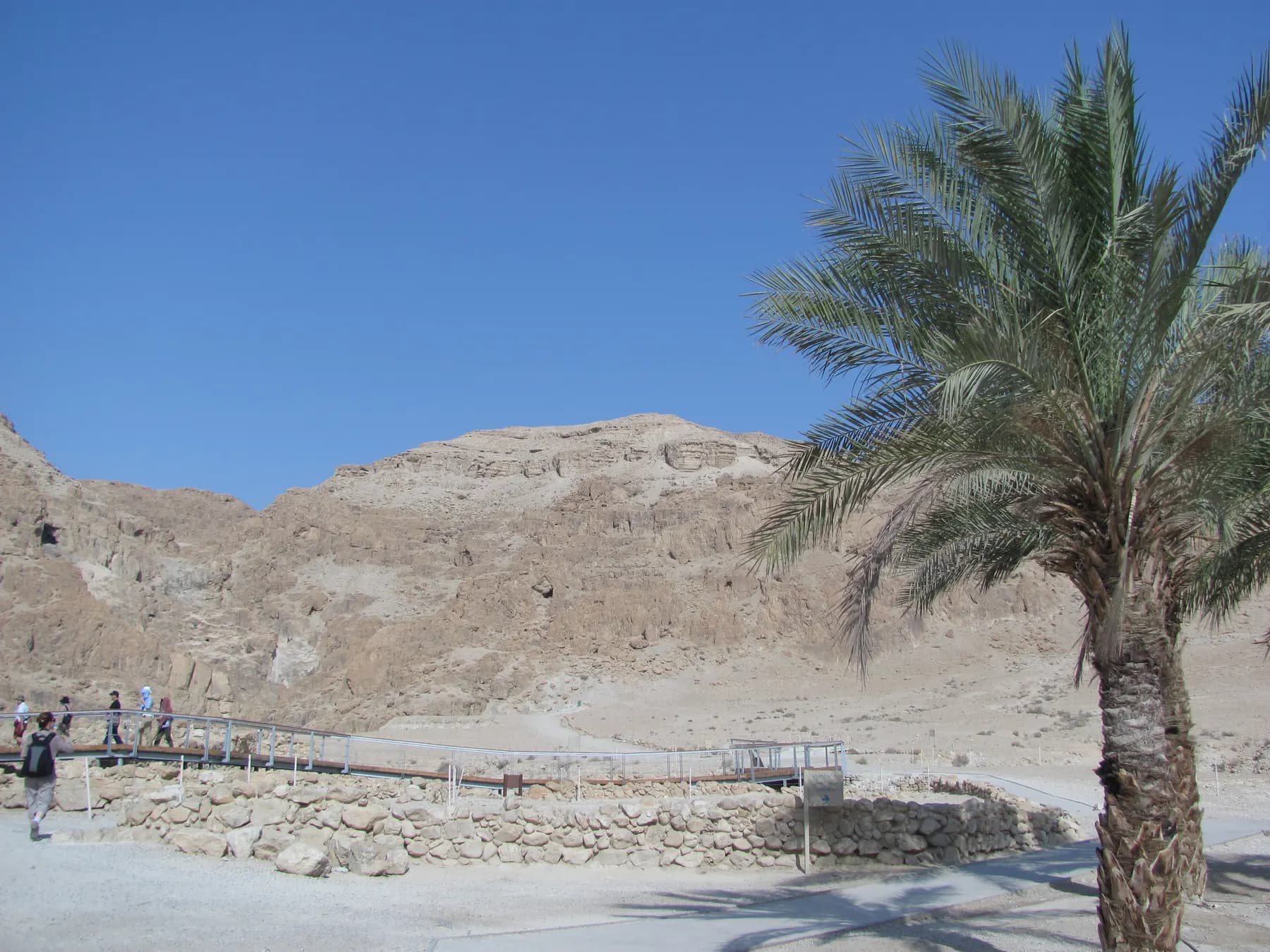
MotherForker / CC BY-SA 3.0 · Wikimedia Commons
Archaeological site
Qumran National Park
Eleven caves here gave up the Dead Sea Scrolls between 1947 and 1956, five of them found by Bedouin and six by archaeologists, and what the settlement beside them actually was is still argued over.
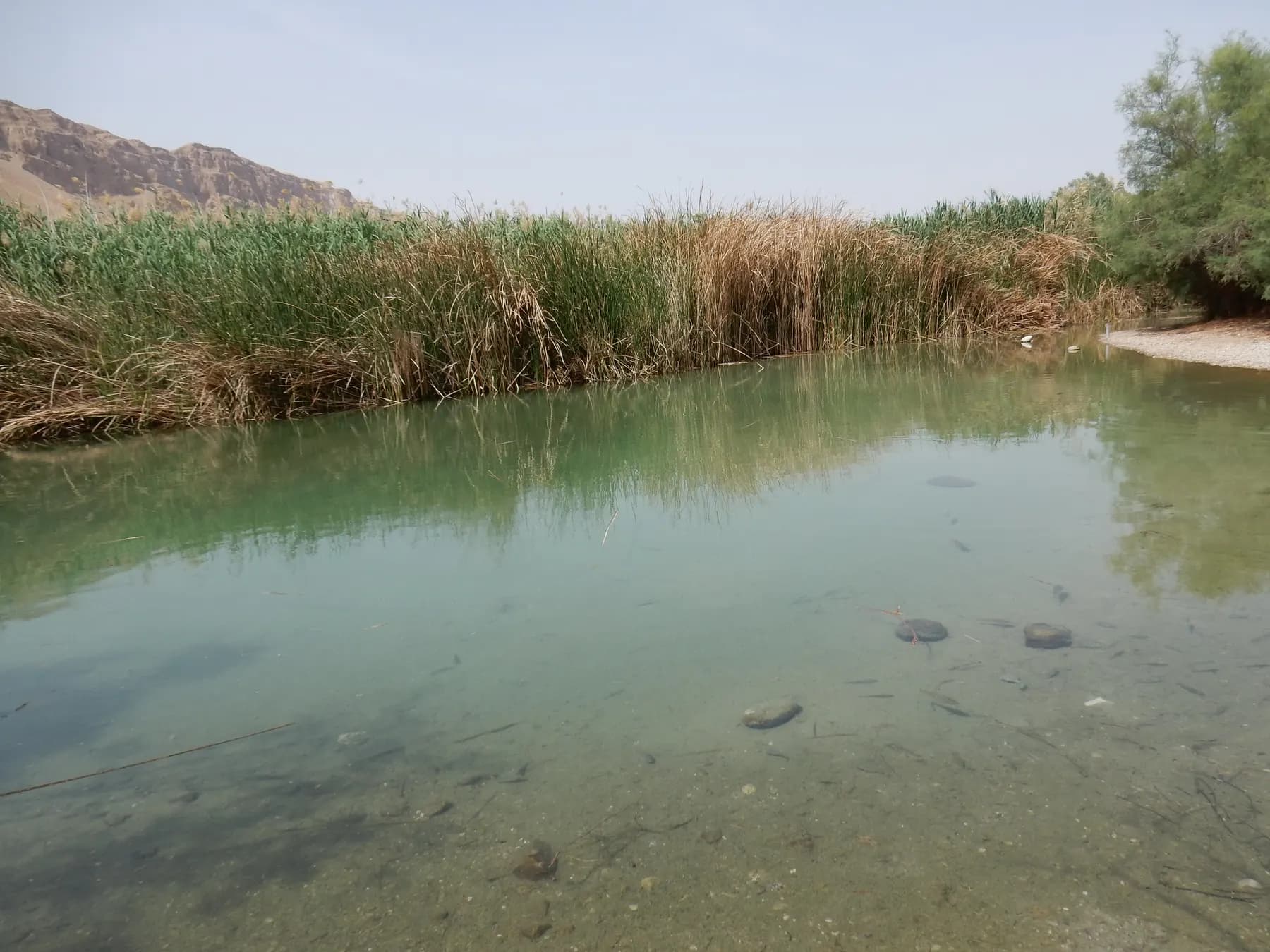
DinaKuzia / CC BY-SA 4.0 · Wikimedia Commons
Nature reserve
Einot Tzukim (Ein Feshkha) Nature Reserve
Brackish springs surface at the foot of the escarpment here and run into pools you can get into, and the Israel Nature and Parks Authority puts the point where they emerge at 390 metres below sea level.
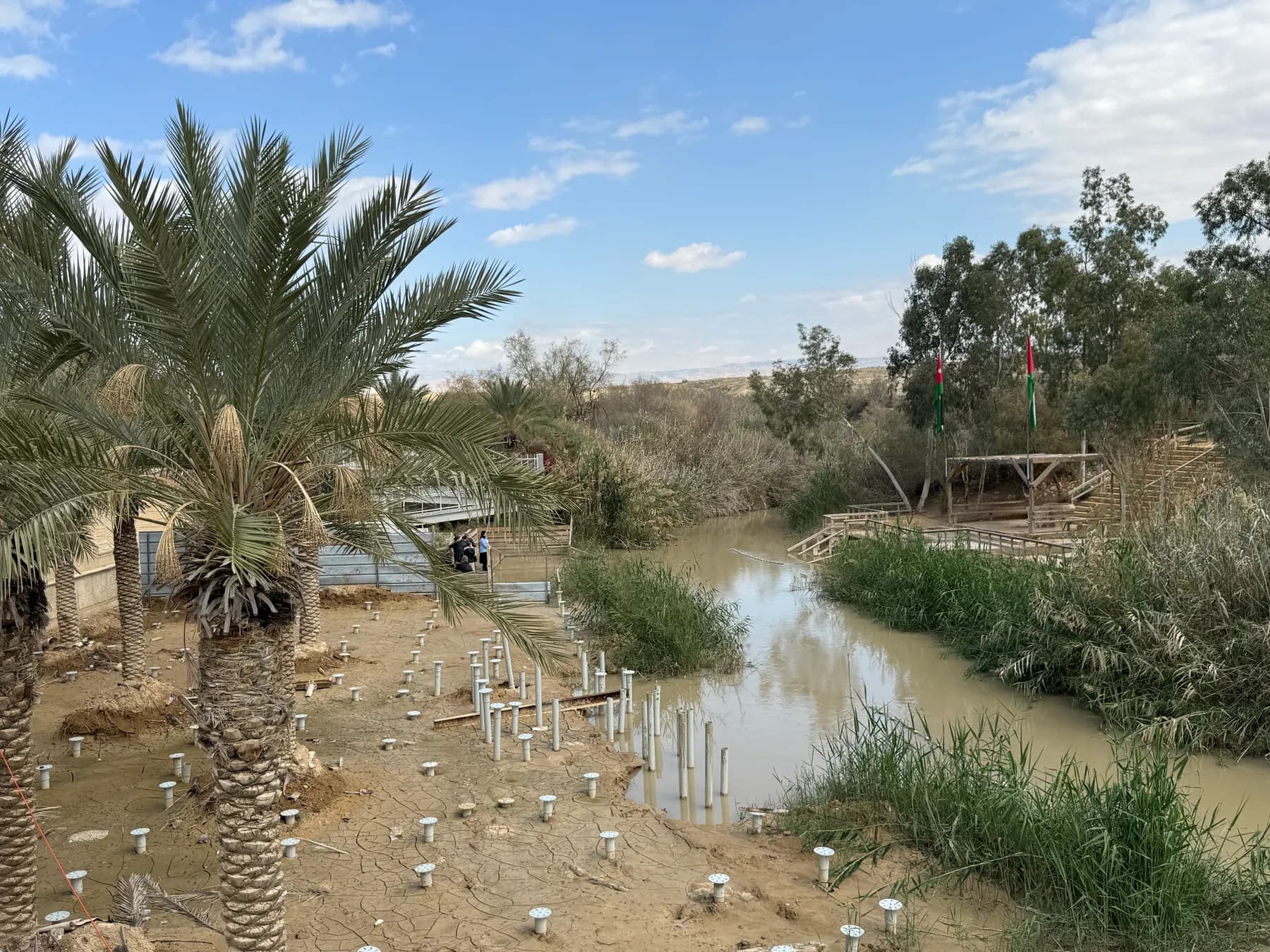
שלמה רודד / CC BY 2.5 · Wikimedia Commons
Religious site
Qasr al-Yahud Baptismal Site
The traditional site of Jesus's baptism stands inside a closed military zone: more than 6,500 landmines were lifted from the monasteries around it between 2018 and 2020, and the riverbank itself reopened in February 2026 after NIS 25 million of building work.
Sources and further reading
Every link below was opened and checked when this page was written. Official statements are marked as such: they are the subject's own account, not an independent one.
- OfficialKalia Tourism, Kibbutz Kaliakaliadeadsea.comKalia Beach
The operator's English page: hours of 08:00 to 18:00 in summer and 08:00 to 17:00 in winter, admission of ₪45 adult, ₪35 child and concession, ₪20 entry only, parking at ₪0.70 and ₪0.50 a minute to a ₪90 daily maximum, shuttle ₪10, chair and umbrella ₪8 each, the facilities list and the free black mud.
- OfficialKalia Tourism, Kibbutz Kaliakaliadeadsea.comחוף קליה (Kalia Beach, Hebrew)
The Hebrew page and its questions: the two ticket routes set out explicitly, the bar's Thursday to Saturday hours, the Egged stop on Route 90 and the 1.5 km walk, the bell-summoned shuttle, separate bathing after hours, the rule against speakers, dogs on a lead, towel hire at ₪16, and no advance booking.
- OfficialKalia Tourism, Kibbutz Kaliakaliadeadsea.comAbout Us
The kibbutz's own account: founded in 1974 by a Nahal group, around 450 members, date plantations, dairy and solar generation, the holiday village of about 64 rooms, the -420 glamping site, and its operation of the Qumran site.
- OfficialKalia Tourism, Kibbutz Kaliakaliadeadsea.comThe -430 Gallery
Launched in March 2018 with 36 leading street artists, painted on abandoned buildings on the northern beaches, open to the public 24/7, funded by donation with no government support, on three set themes.
- OfficialKalia Tourism, Kibbutz Kaliakaliadeadsea.comAccessibility Statement
Covers the website only, at WCAG 2.2 level AA, last updated 7 May 2025. The operator publishes no equivalent statement for physical access to the beach, which is why this page does not claim one.
- OfficialDead Sea Land (Tamar Regional Council tourism)deadsea.co.ilThe Hotel Beaches
The council-run beaches at Ein Bokek and Hamei Zohar, with chairs, umbrellas and shade free to the public, lifeguards, showers, toilets, changing rooms and wheelchair access, cited here for the contrast with a paid gate.
- ReportingYnetnewsynetnews.comDead Sea level keeps falling, but Israel still has no rescue plan
Israel's State Comptroller in 2025: the northern basin expected to keep falling about 1.15 m a year, eleven of twelve projects incomplete, and the Megilot Dead Sea Regional Council named among the bodies whose northern-basin tourism development has not been completed.
- ReportingThe Times of Israeltimesofisrael.comAs the Dead Sea dries, its collapsing shores force a return to nature
More than 6,000 sinkholes with new ones appearing daily against a little over 100 in 1990 on the Geological Survey of Israel's count, the loss of Mineral Beach and the public beach at Ein Gedi with the jobs they provided, and Einot Tzukim's beach access closed in 2000.
- ReportingThe Times of Israeltimesofisrael.comIsrael bakes as temperature climbs to near-record 49.9°C
The 49.9°C reading recorded on the Dead Sea shore on 17 July 2019, cited here for what the walk from the highway bus stop means in summer.
- DataU.S. Geological Survey (EROS)eros.usgs.govEarthshots: Dead Sea, Israel, Jordan, West Bank
The lake surface as the lowest natural land or water surface on Earth at more than 400 m below sea level, and the strait between the northern and southern basins now dry.
- ReferenceWikipediaen.wikipedia.orgKalya
The 1929 potash tender, the flight by boat on 20 May 1948, re-establishment as a Nahal settlement in 1968 as the first in the area, the completed homes populated in 1974, a population of 585 in 2024, the kibbutz at 360 m below sea level, and the lowest bar in the world at 417 m below sea level.
- ReferenceWikipediaen.wikipedia.orgMoshe Novomeysky
Born 25 November 1873 in Barguzin and died 27 March 1961; first visit to the Dead Sea in 1911; the application accepted by High Commissioner Herbert Plumer in 1927 and a seventy-five year concession granted in August 1929; the workers' settlement of Kalia from 1934; the neutral-zone agreement of 13 May 1948, the evacuation of 19 and 20 May and the Arab Legion's destruction of the site on 22 May.
- ReferenceWikipediaen.wikipedia.orgDead Sea Works (formerly Palestine Potash Limited)
Incorporated in England in 1929 and registered in Palestine in 1930; the concession for the extraction of salts and minerals granted on 1 January 1930; plants at Kalya in the north and Sodom in the south; profitable from 1936 against German cartel dumping; the northern half destroyed in 1948; nationalised in 1951 and renamed the Dead Sea Works in 1953.
- ReferenceWikipediaen.wikipedia.orgMegilot Regional Council
Established in 1981, the smallest regional council in Israel, six communities including Kalya, named for the scrolls found at Qumran, and situated in the Judea and Samaria area.
Kalia Beach: common questions
How much does it cost to get into Kalia Beach?+
The all-inclusive ticket is ₪45 for anyone 13 and over and ₪35 for a child aged 3 to 12, a senior, a student, a disabled visitor or a soldier in regular service, and it covers parking, beach chairs, an umbrella and unlimited shuttles. There is also an entry-only ticket at ₪20 for over-13s that covers the toilets and showers and nothing else. On that second route parking is ₪0.70 a minute for the first half hour and ₪0.50 a minute after, capped at ₪90 for the day, with a chair or umbrella ₪8 each and the shuttle ₪10 per person each way. All figures are the operator's own, posted on its Kalia Beach page.
What are the opening hours?+
Every day from 08:00 to 18:00 in summer and 08:00 to 17:00 in winter, with the same hours at weekends and on festivals. The lower bar keeps its own hours, opening Thursday to Saturday and on festivals from 10:00 and closing on Sunday to Wednesday. The operator's page gives the bar's closing time as 17:00 in one answer and 17:30 in another, so it is worth telephoning if the drink is the reason for the trip.
Is Kalia Beach open on Shabbat?+
Yes. The kibbutz publishes identical hours for Sunday to Thursday and for weekends and festivals, so Saturday is a normal operating day. That also makes it one of the busier days, since it is one of very few managed beaches left on the northern shore.
Do I need to book in advance?+
No, and the operator says it is not possible. Day tickets are sold at the ticket office at the gate only, and the kibbutz's stated reason is that the beach is large enough to absorb whoever turns up. Treatments in the beauty centre are the exception and need a telephone booking beforehand, subject to availability.
Is the mud free?+
Yes. Black mud is available on the beach at no extra charge on top of admission, which is the main practical difference between this and buying a tub in the cosmetics shop at the top of the site. Spread it on, let it dry, and rinse it off at the showers rather than in the sea.
How do I get there from Jerusalem without a car?+
By Egged bus down Route 90, but the buses stop on the highway rather than at the beach, leaving a walk of about 1.5 kilometres and ten to fifteen minutes to the gate. There is no shade on that stretch and no water on it, so in July or August it is a poor plan without a lift arranged at the far end.
Is there separate bathing for men and women?+
Not during normal opening hours, when bathing is mixed. The kibbutz says separate bathing sessions are held on certain dates after the beach has closed to the public, and gives a telephone number for the organisation that runs them rather than handling bookings itself.
Can I bring a dog, a barbecue or a speaker?+
A dog is fine on a lead and under supervision throughout. A barbecue from home is not: there are two fixed grill compounds with shade and water, and visitors bring their own charcoal and grilling grids or buy them at the shop. Speakers are not allowed at all, because the kibbutz runs this as a quiet beach.
Is Kalia better than the beaches at Ein Bokek?+
They are different propositions rather than better and worse. Ein Bokek is free and run by the Tamar Regional Council, which provides chairs, umbrellas, shade, lifeguards and wheelchair access at no charge, and it sits in the southern basin in front of the hotel strip; Kalia charges at the gate, sits on the open northern basin about 25 minutes from Jerusalem by the operator's reckoning, and is far quieter. If the trip is a day out from Jerusalem, Kalia is the obvious one; if it is a spa holiday, the hotels are all in the south.
How long should I allow?+
About two hours covers a float, the mud, a shower and a drink, and that is as long as most people last in the heat. Half a day is reasonable if lunch at the bar, the -430 Gallery and a barbecue are part of the plan. Twenty minutes at a time in the water is plenty, and the salt makes longer immersion uncomfortable rather than adventurous.