Nature reserve · The Dead Sea
Einot Tzukim (Ein Feshkha) Nature Reserve
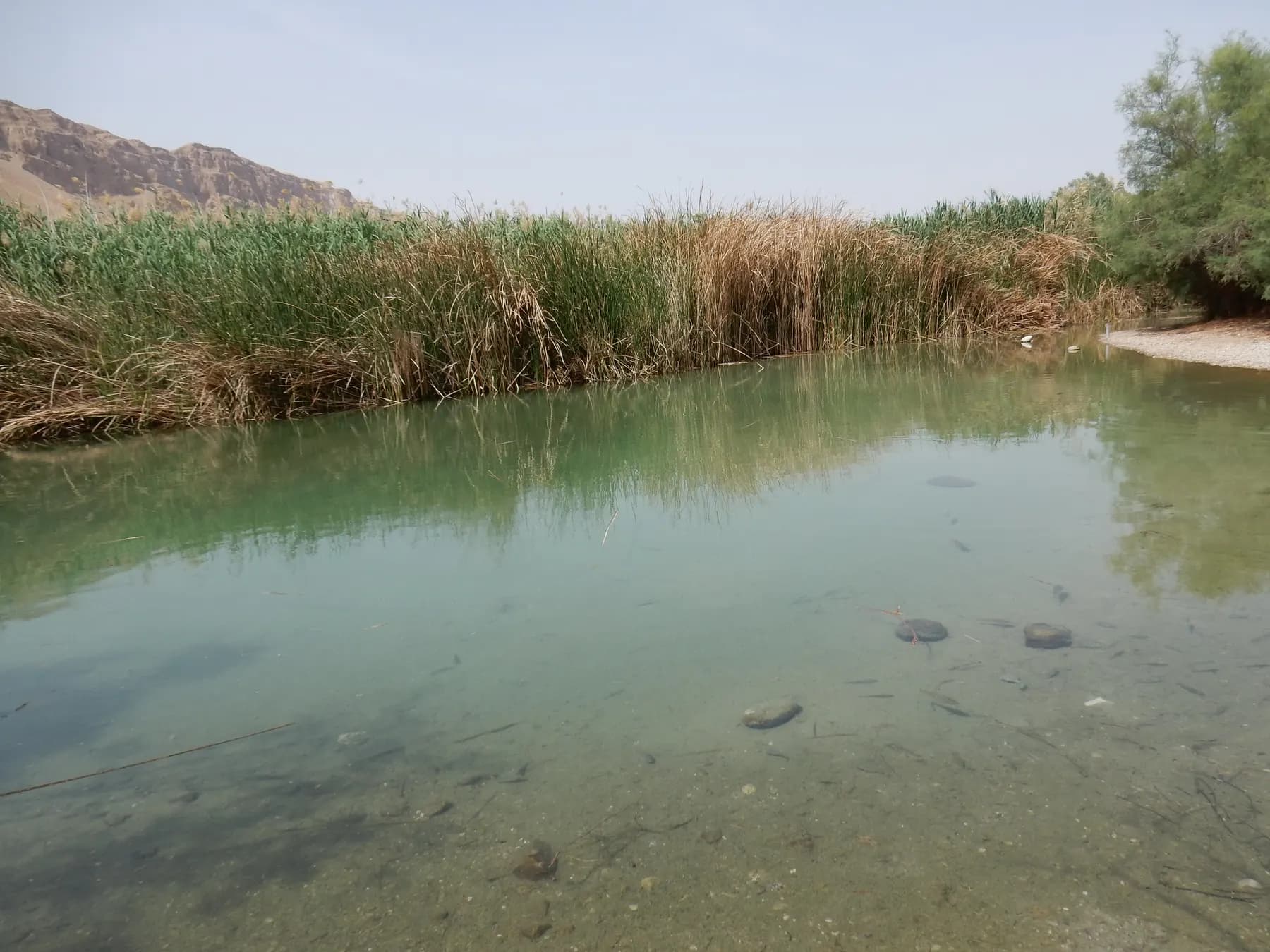
Brackish springs surface at the foot of the escarpment here and run into pools you can get into, and the Israel Nature and Parks Authority puts the point where they emerge at 390 metres below sea level.
DinaKuzia / CC BY-SA 4.0 · Wikimedia Commons
Where the springs emerge
390 m below sea level
the parks authority's own figure; it puts the lake beside them at about 430 m below
Spring discharge
up to 70 million m³ a year
which the reserve's brochure calls Israel's largest natural water source not used by people
Length of the reserve
6.5 km
along the foot of the escarpment, per the parks authority's 2025 brochure
Adult admission
₪40
Israel Nature and Parks Authority price table, read in 2026
In short
- How long to give it
- about two hours: half an hour to an hour and a half on the marked circuit, plus about half an hour in the visitor centre, and longer again if the deep pool is open or you take the Hidden Reserve tour
- Summer, Sunday to Thursday and Saturday
- 08:00 to 17:00
- Adult
- ₪40
שמורת טבע עינות צוקים · عين فشخة
Einot Tzukim, called Ein Feshkha on most maps and in Arabic, is a nature reserve on the north-western shore of the Dead Sea where springs surface at the foot of the escarpment and are held in pools that visitors are allowed to get into. The Israel Nature and Parks Authority runs it, describes it as the lowest nature reserve in the world, and gives its length along the shore as 6.5 kilometres. It is signposted off Route 90, three kilometres south of the Kalia junction and the same distance below Qumran.
The water is the point. Rain falling on the Judaean hills sinks into a limestone and dolomite aquifer, crosses the fault system at the rift's edge and comes out of the gravel layers filling the valley floor. The parks authority puts the emergence at 390 metres below sea level and the discharge at up to 70 million cubic metres a year, and calls it the largest natural water source in Israel that people do not use. It is not fresh: the springs are brackish, and the Times of Israel reported the pools holding steady at 24 degrees Celsius the year round.
One thing the reserve does not offer is the Dead Sea. The shoreline has pulled back more than a kilometre, the ground it left is unstable, and the first rule in the parks authority's brochure is that access to the sea is prohibited. Here instead are pools, a circuit through four bands of salt-tolerant vegetation, an unreconstructed Roman-period farm that scholars cannot agree about, a closed southern section visited only with a guide, and a visitor centre that opened in 2024.
Orientation
Three reserves in one, and only the middle one is open
What a ticket buys is the central visitors' section: a car park, a service centre, the visitor centre, picnic areas shaded by date palms and tamarisks, several wading pools full all year, and one deeper pool. A marked circuit links the pools and the archaeological site, with interpretation boards along the way. The parks authority's Hebrew brochure gives it as half an hour to an hour and a half, and says it can be broken up with a swim.
North of that is the closed reserve, which the public never sees. An older parks authority page, cited by Wikipedia, put it at about 2,700 dunams against the visitors' section's 500, with entry by special invitation for scientists. The part of the oasis with the most to lose is the part with nobody in it.
South is the Hidden Reserve, and it is the reason to come on a Friday or a Saturday. The parks authority describes a walking route between clear pools and heavy vegetation, and its 2025 brochure lists guided visits at 10:00 and 14:00 on Fridays, at 10:00, 12:00 and 14:00 on Saturdays, and hourly on festivals from 10:00 to 15:00, with Arabic-language tours on Fridays at 11:00. Those weekend tours are free and are for individual visitors. Groups, and individuals who want the Hidden Reserve midweek, must bring a guide from the reserve's approved list.
The fourth part of the reserve is a view rather than a place. A lookout faces the retreating shore, and the parks authority is blunt about why it is only a lookout: the coast has gone back more than a kilometre, and the exposed bed is unstable and sinkhole-prone.
- Closed reserve, north: about 2,700 dunams, scientists by invitation only
- Visitors' reserve, centre: about 500 dunams, pools, trail, archaeological site, visitor centre
- Hidden Reserve, south: guided only; free tours at weekends and festivals, an approved guide midweek
- The Dead Sea itself: off limits, and the reserve's rules say so in the first line
Water
Where the water comes from, and why it keeps moving south
The parks authority explains the name from the setting: Ein Feshkha, it says, means split or cloven, for the rift the oasis sits in and the springs that break out of it. The Palestine Exploration Fund's name lists, compiled by Edward Henry Palmer in 1881, instead record Feshkhah as either a personal name or a word with no meaning at all.
Why the water is salty has two candidate explanations and the parks authority prints both: fresh water mixing with ancient brines held in deep rock, and fresh water mixing with Dead Sea water left trapped in the sediment as the lake withdrew. The degree of mixing varies from spring to spring, which is why salinity runs across a wide range here rather than sitting at one value. William Lynch, in 1847, recorded 84 degrees Fahrenheit and a strong smell of sulphur.
The springs are also moving. Burg, Yechieli and Galili published a study of this complex in the Journal of Hydrology in 2016, describing the springs shifting slightly eastward as the shore retreats and the whole system extending southward without much change in total discharge, with the new seepages varying widely in salinity. The parks authority puts the same thing in plainer terms: the northern springs dry up and new ones break out to the south on ground the lake has vacated, so the balance looks preserved while the habitat is in fact being replaced.
That replacement is the problem. As the lake falls it exposes soft clay laid down on its own bed, and the springs cut down into it, producing what the reserve calls micro-canyons: narrow channels where plants grow only beside the running water, because the salty mud above will not hold them. Standing pools disappear, and the fish that depend on them go with the pools. The parks authority has answered by deepening old pools and digging new ones where water surfaces naturally, and the Times of Israel reported staff moving fish into newly emerging springs.
Life
Four bands of vegetation, and an ant at the edge of its range
The vegetation sorts itself into four bands parallel to the shore, keyed to how much water is in the ground and how salty it is. The parks authority lists them west to east: saltbush and sea-blite fed only by runoff off the cliff; tamarisk closer to the springs; common reed and tall sugar cane standing in the flowing water; and rush and glasswort in the saline belt at the eastern edge. The tamarisks explain their own dominance: they push salt out through their leaves, the night dew washes it down, and the ground beneath ends up too salty for competitors.
The fish are the reason parts of the reserve are shut. Tilapia and tooth-carps reached Ein Feshkha through the Jordan and its tributaries and have diverged from their relatives upstream; the dispar tooth-carp, four to six centimetres long, lives in the saline flowing springs and exists only around the Dead Sea. Wikipedia records these saline wetlands as the only known place where blue killifish and Dead Sea killifish live alongside one another, and the pool-digging programme is aimed at keeping them going.
The insects are stranger than the fish. The reserve's own brochure calls Einot Tzukim the northernmost place in the world where the weaver ant Polyrhachis simplex occurs. In winter the workers climb the tamarisks and weave shelters for the cicadas and aphids whose honeydew they live on, using their own larvae as tools: a worker carries a larva and presses it until silk comes out of its upper lip.
Larger animals are a matter of luck. The reserve sits on the migration route between Europe and Africa, and BirdLife International has recognised it as an Important Bird Area for its griffon vultures, Dead Sea sparrows and cinereous buntings. The films in the visitor centre show what the cameras catch and visitors generally do not: wolves, striped hyenas, bats, owls, snakes and the rare swamp cat. The donkeys are not wild; the parks authority brought them in to graze the reeds back.
Archaeology
A Roman-period farm, and a long argument about what it made
There is a dig on the flat ground inside the visitors' section, worked twice. Roland de Vaux of the Ecole Biblique, who excavated Qumran three kilometres north, dug here in 1956 and 1958; the parks authority's brochure mentions only 1958. Yizhar Hirschfeld excavated again in 2001 for the Hebrew University. What they uncovered is a farm: a main building of about 24 by 18 metres around a central courtyard, a staircase showing an upper storey, an enclosed yard read as stabling, and an industrial installation with two plastered basins.
The dating has moved. De Vaux placed the traces between 100 and 31 BCE and read the farm as part of the same community that occupied Qumran. Both Jodi Magness and Hirschfeld concluded that the complex is Herodian, meaning after 37 BCE. The end is firmer: the parks authority has the site destroyed in the revolt against Rome of 66 to 70 CE, resettled, then abandoned for good in the Bar Kokhba revolt of 132 to 135 CE. Hirschfeld also found, on the cliff about 50 metres above the spring, a square limestone watchtower with potsherds of the seventh and sixth centuries BCE.
Nobody agrees on what the installation was for. De Vaux suggested a tannery or fish-raising; later readings have offered indigo manufacture, date wine and date honey. Hirschfeld's answer, the one the parks authority's brochure leads with, is balsam perfume: the large round stones crushed the branches, the open pool soaked out the essence, a built cell stored it, the workers used the ritual bath before starting, and the product went out through the port of Gaza. Since the final boiling stage needs ovens and there are none here, Hirschfeld put that step at Qumran, where ovens were found.
The counter-case is printed on the same brochure page: other researchers read the crushing stones and soaking pools as equipment for date wine or date honey, on the grounds that dates were grown here and were a staple. Ehud Netzer went further, publishing a paper in the Israel Exploration Journal in 2005 titled "Did Any Perfume Industry Exist at 'Ein Fashkhah?". A farm stood here and processed something in quantity; what it processed is unresolved.
One more site sits in the reserve, off the visitor circuit. Khirbet Mazin, in Hebrew Metzad Kidron, stands at the southern end on the old shoreline: a fortress tower combined with a dry dock and a boat dock. A 2001 survey nearby turned up a hoard of bronze coins of Alexander Jannaeus, and Hirschfeld read it as a royal dock on a lake that was then a working route between Judaea and Moab.
Fabric
What is ancient here, what was dug last decade, and what opened in 2024
The archaeology has not been put back up. What is on the ground is a floor plan in low stone: the walls of the villa, the enclosed yard, the two water channels, the reservoir, the plastered basins and the round crushing stones. It sits on the accessible path, so it is one of the easier Roman-period sites in the country to reach, and one of the least dressed up.
The pools are a different case, and it is worth knowing before arriving. Several hold water all year, but this is not simply a set of springs with a fence around it. The parks authority states plainly that over the past decade it has been deepening existing pools and cutting new ones where water emerges naturally, to hold the fish together as the springs migrate south. The deep pool, Tamar, is 1.5 metres deep and opens only when a lifeguard is on duty. What a visitor swims in is a managed habitat, rebuilt about as fast as the lake takes it away.
The newest thing here is the visitor centre. The Times of Israel reported it opening informally at Passover in April 2024 and formally on 21 May 2024, with Environmental Protection Minister Idit Silman at the ribbon-cutting, at a cost of about 35 million shekels. Built to blend into the cliffs behind it, it runs from a hall of oversized models of the reserve's plants and animals, through an auditorium where a geologist, a microbiologist and an ecologist set out the lake's past, present and future, to a room about the reserve after dark. The paper put pre-war visitor numbers at around 170,000 a year.
Two administrative facts are worth carrying. Einot Tzukim lies in the West Bank, and the parks authority files it under its Judea and Samaria district; the status of that territory is disputed, with Israel and most other states taking opposite views. And since 1 January 2026 the operator states on both its Hebrew and English pages that entry is by advance registration only, through its website.
- Ancient and in place: the villa walls, the enclosed yard, the water channels, the reservoir, the plastered basins and the crushing stones
- Not reconstructed: nothing of the farm has been rebuilt above its footings
- Dug by the parks authority in the past decade: deepened pools and new pools cut where springs surface, to hold the fish
- Built in 2024: the visitor centre, at about 35 million shekels, opened formally on 21 May
- Not reachable at all: the Dead Sea shoreline, more than a kilometre away across unstable ground
What to look for
Things not to walk past at Einot Tzukim (Ein Feshkha) Nature Reserve
The details that repay knowing about before you are standing in front of them.
Tamar Pool
The one deep pool, 1.5 metres, fitted with a lift for visitors with mobility impairments and open only when a lifeguard is on duty. It runs through the bathing season and daily in July and August except Wednesdays, so check before travelling for it.
The Hidden Reserve tour
The closed southern section, walked with a reserve guide past flowing streams, natural pools, micro-canyons cut into the clay and the vegetation band at the water's edge. Free tours run at weekends and on festivals; midweek entry needs a guide from the approved list.
The balsam farm
An unreconstructed Roman-period villa and industrial complex with two plastered basins, a reservoir and the round stones that crushed something valuable. Whether that something was balsam, dates or indigo has been argued over since de Vaux dug here.
The micro-canyons
Where the springs cut down into the soft clay the lake left behind, plants survive only inside the channel beside the running water, because the salty mud on top will not hold them. It is the clearest thing to look at if you want to see the lake's retreat doing something.
The visitor centre films
Two films, one in which a geologist, a microbiologist and an ecologist describe what lives in and under the lake, and one of camera-trap footage of wolves, hyenas, bats, owls and swamp cat. The parks authority allows about half an hour for the whole run.
The retreating-shore lookout
A viewpoint over ground the Dead Sea has abandoned, which in this reserve amounts to more than a kilometre. It is a lookout rather than a path because the exposed bed is unstable and full of sinkholes.
The long view
Einot Tzukim (Ein Feshkha) Nature Reserve, in order
about 5 million years ago
The Dead Sea rift begins to open. Streams that had run west to the Mediterranean start draining into it instead, filling it with sediment.
7th-6th century BCE
A square limestone watchtower stands on the cliff about 50 metres above the spring, with a view over both Feshkha and Qumran. Hirschfeld found it and dated it by potsherds in 2001.
1st century BCE to 1st century CE
A farm operates on the terrace: a villa around a central courtyard, an enclosed yard for animals, and an industrial complex fed by a channel from a spring that no longer exists at that point.
66-70 CE
The farm is destroyed during the Jewish revolt against Rome, and afterwards resettled.
132-135 CE
The site is abandoned for the last time during the Bar Kokhba revolt.
1838
Edward Robinson records the spring at 80 degrees Fahrenheit and notes the foundations of a small square tower beside it.
1847
William Lynch describes a shallow clear stream at 84 degrees, soft yet brackish, with a strong smell of sulphur, and disproves for himself the claim that nothing lives on these shores.
1883
The Palestine Exploration Fund's Survey of Western Palestine records 'Ain Feshkhah and the smaller 'Ain et Tannur as the two important springs of the Dead Sea district.
October 1900
R. A. Stewart Macalister has a stonemason from Jericho cut a reference line and the initials PEF into a rock near the reeds, 14 feet above the water, to measure the lake by. It was used until 1913 and rediscovered after 1967.
1956 and 1958
Roland de Vaux of the Ecole Biblique excavates the farm. The parks authority's brochure records only the 1958 season.
1969
The nature reserve is established. The Applied Research Institute in Jerusalem records 97 dunams taken from the land of the Palestinian village of al-Ubeidiya for it.
2001
Yizhar Hirschfeld excavates for the Hebrew University, dates the complex to the Herodian period and argues it produced balsam perfume. A survey on the shore near Khirbet Mazin yields a large hoard of Alexander Jannaeus coins.
2005
Ehud Netzer publishes a paper in the Israel Exploration Journal asking whether any perfume industry existed at Ein Feshkha at all.
2016
Burg, Yechieli and Galili publish a study of the spring complex in the Journal of Hydrology, describing the springs migrating south and east as the lake falls while total discharge holds up.
April and May 2024
The new visitor complex opens to the public over Passover and is formally inaugurated on 21 May, at a reported cost of about 35 million shekels.
1 January 2026
The parks authority states that entry to the reserve is by advance registration only.
Practical
Visiting Einot Tzukim (Ein Feshkha) Nature Reserve
Where
Einot Tzukim (Ein Feshkha) Nature Reserve, Route 90, 3 km south of the Kalia junction, northern Dead Sea
What ticket you need
Einot Tzukim is a self-contained reserve with its own gate and its own ticket. No Dead Sea beach, hotel or spa entry covers it, and it is not part of a larger park. An Israel Nature and Parks Authority subscription or an Israel Pass does cover it. Worth repeating, because it is the commonest wrong assumption about this site: there is no way from inside the reserve down to the Dead Sea, and bathing here means the spring pools, not the lake.
Opening hours
- Summer, Sunday to Thursday and Saturday
- 08:00 to 17:00source
- Winter, Sunday to Thursday and Saturday
- 08:00 to 16:00source
- Friday and holiday eves
- the website lists the same hours as the rest of the week, 08:00 to 17:00 in summer and 08:00 to 16:00 in winter; the printed brochure says the reserve closes one hour earlier on Fridays and holiday eves. Plan on the earlier time.source
- Rosh Hashanah eve, Passover eve and Yom Kippur eve
- 08:00 to 13:00source
- Last entry
- one hour before the closing time listedsource
- Tamar Pool, the deep pool
- bathing season from the first day of Passover to the end of October, open at weekends, festivals and chol hamoed from 10:00 until an hour before closing; in July and August open on weekdays too, closed Wednesdays. Only when a lifeguard is present.source
- Tamar Pool, as published in English
- March to November, Friday 10:00 to 15:00 and Saturday 10:00 to 16:00 under summer time, Friday 10:00 to 14:00 and Saturday 10:00 to 15:00 under winter time, and all week except Wednesday in the summer months. The English and Hebrew pages do not match.source
- Visitor centre screenings
- Sunday to Thursday at 10:30, 12:30 and 14:30; Friday, Saturday and festivals hourly on the hour from 09:00 to 15:00source
- Hidden Reserve guided tours
- Friday at 10:00 and 14:00; Saturday at 10:00, 12:00 and 14:00; festivals every hour on the hour from 10:00 to 15:00; in Arabic on Fridays at 11:00source
Admission
- Adult
- ₪40source
- Child
- ₪25source
- Student
- ₪34source
- Adult in a group above 30 people
- ₪34source
- Child in a group above 30 people
- ₪21source
- Israeli senior citizen
- ₪23 on the English price table, ₪20 on the Hebrew onesource
- Reserve-duty soldier
- ₪30, listed on the Hebrew price table onlysource
- Pupil
- ₪10, listed on the Hebrew price table onlysource
- Hidden Reserve tour
- no charge on top of admission at weekends and on festivals, for individual visitorssource
Access
Unusually good, and there is no climbing involved anywhere in the open section. The parks authority describes a wheelchair-accessible path running from the western disabled car park to the archaeological site, to Tamar Pool and to the Kaneh wading pool, with shaded accessible picnic corners and accessible toilets; Tamar Pool has a lift into the water, though it only runs in the bathing season, so telephone before making a journey for it. Two disabled parking bays sit beside the spring pool with accessible toilets and showers reached over compacted ground. The remaining paths, including those in the Hidden Reserve, are compacted local earth and mostly level. The operator's English page says the Hidden Reserve is not fully accessible but is possible for people with considerable mobility impairments visiting with a companion, by prior arrangement on 02-994-2355.
On site
- Car park, with disabled bays
- Accessible toilets and showers
- Visitor centre with two films
- Wading pools, open all year
- Tamar deep pool, lifeguarded, in season only
- Shaded picnic areas
- Drinking fountain
- Service centre: ice cream, cold and hot drinks, snacks, souvenirs, books, sunscreen, hats, camping goods, ice, water gear
- Barbecues allowed in the public area, in a proper grill, no open fires
- Guided tours of the Hidden Reserve
- No dogs or other pets
- No access to the Dead Sea
Booking
The parks authority states on both its Hebrew and English pages that from 1 January 2026 entry is by advance registration only, through its website. Organised groups book separately, and both groups and midweek individual visitors who want the Hidden Reserve must come with a guide from the reserve's approved list; the Hebrew page points bookings at the authority's Judea guiding centre on 02-6541255. Reserve numbers are 02-9942355 for the reserve itself and *3639 for the national information line.
Hours and prices are given as the operator publishes them and change without much notice, particularly around Shabbat and the festivals. Check the operator's own page before you travel for this.
Official page at en.parks.org.il →What people wish they had known
- Do not come here to float. The Dead Sea cannot be reached from inside the reserve: the shore has retreated more than a kilometre and the ground between is unstable. The nearest place to get into the lake is Kalia Beach, a few minutes north on Route 90.
- Check whether the deep pool is running before you drive out for it. Tamar opens only in the bathing season, only when a lifeguard is on duty, and not on Wednesdays, and the English and Hebrew pages give different seasons for it. The shallow wading pools are full all year.
- The Hidden Reserve is the best part and it is not walk-in. Free guided tours run at weekends and on festivals at fixed times; midweek you need a guide from the reserve's approved list, arranged in advance.
- Book before travelling. The operator says entry has been by advance registration only since 1 January 2026, and the booking is made through the parks authority website rather than at the gate.
- Time the visitor centre. Screenings run at set hours, three a day midweek and hourly at weekends, so a visitor who wanders the trail first can arrive at the auditorium between shows.
- Entry closes an hour before the posted closing time, and the printed brochure says the reserve shuts an hour early on Fridays and holiday eves even though the website does not. Treat the earlier time as the real one.
The figures
Einot Tzukim (Ein Feshkha) Nature Reserve by the numbers
Each figure carries the year it belongs to and links the source it came from.
| Measure | Figure | As of | Source |
|---|---|---|---|
| Adult admission | ₪40 (child ₪25, student ₪34, group ₪34 adult and ₪21 child) | 2026 | en.parks.org.il |
| Elevation at which the springs emerge | 390 metres below sea level, with the lake beside them given as about 430 metres below | 2025 | static.parks.org.il |
| Spring discharge | up to 70 million cubic metres a year | 2025 | static.parks.org.il |
| Length of the reserve | 6.5 kilometres along the foot of the escarpment | 2025 | static.parks.org.il |
| Pool water temperature | a steady 24 degrees Celsius the year round | 2024 | timesofisrael.com |
| Visitors a year before the Gaza war | about 170,000 | 2024 | timesofisrael.com |
| Cost of the new visitor complex | about 35 million shekels | 2024 | timesofisrael.com |
| Size of the closed northern section | about 2,700 dunams, against about 500 dunams in the visitors' section | 2026 | en.wikipedia.org |
While you are here
The rest of The Dead Sea
Everything else in this destination with a page of its own.
MotherForker / CC BY-SA 3.0 · Wikimedia Commons
Archaeological site
Qumran National Park
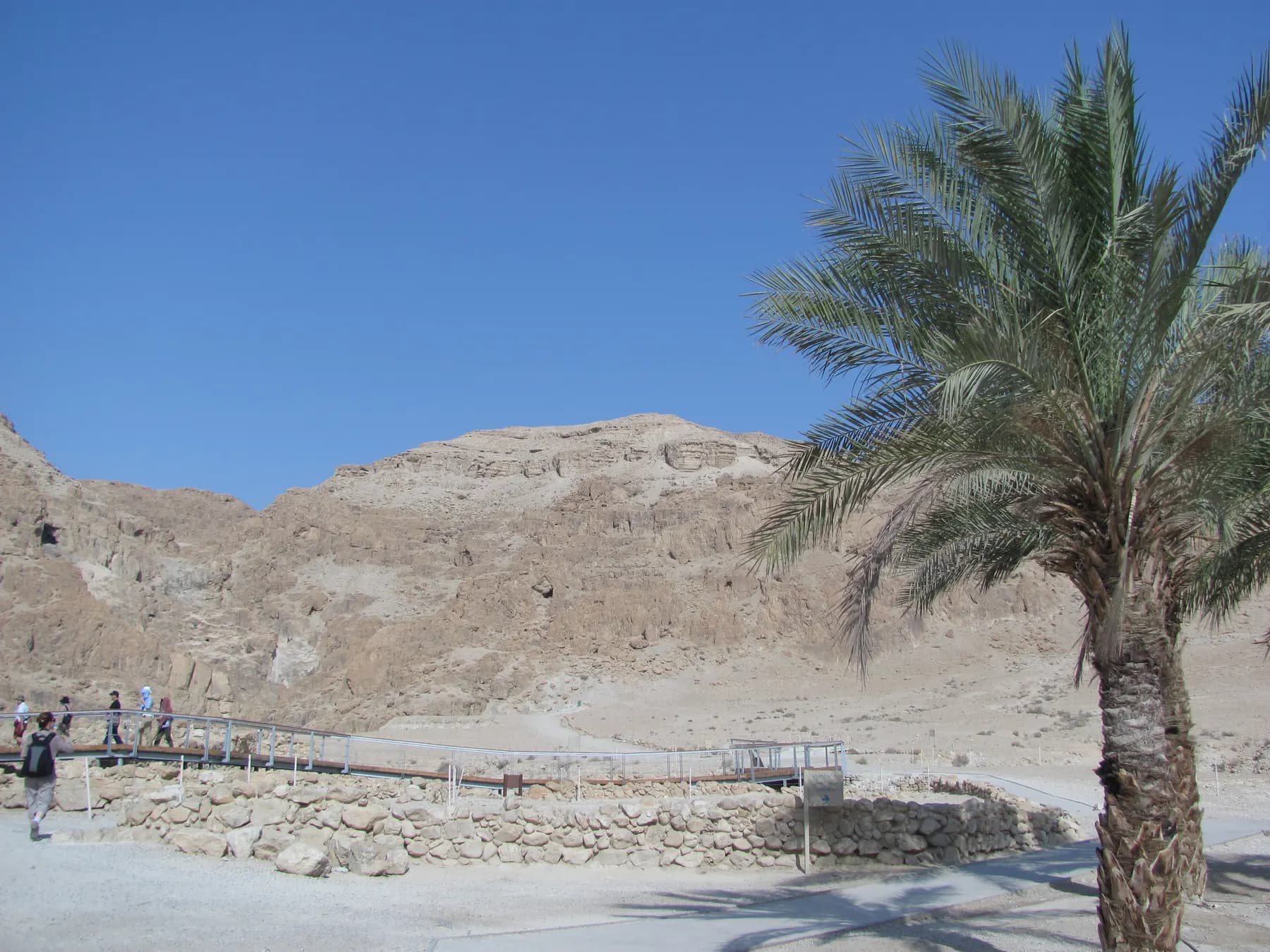
Eleven caves here gave up the Dead Sea Scrolls between 1947 and 1956, five of them found by Bedouin and six by archaeologists, and what the settlement beside them actually was is still argued over.
שלמה רודד / CC BY 2.5 · Wikimedia Commons
Religious site
Qasr al-Yahud Baptismal Site
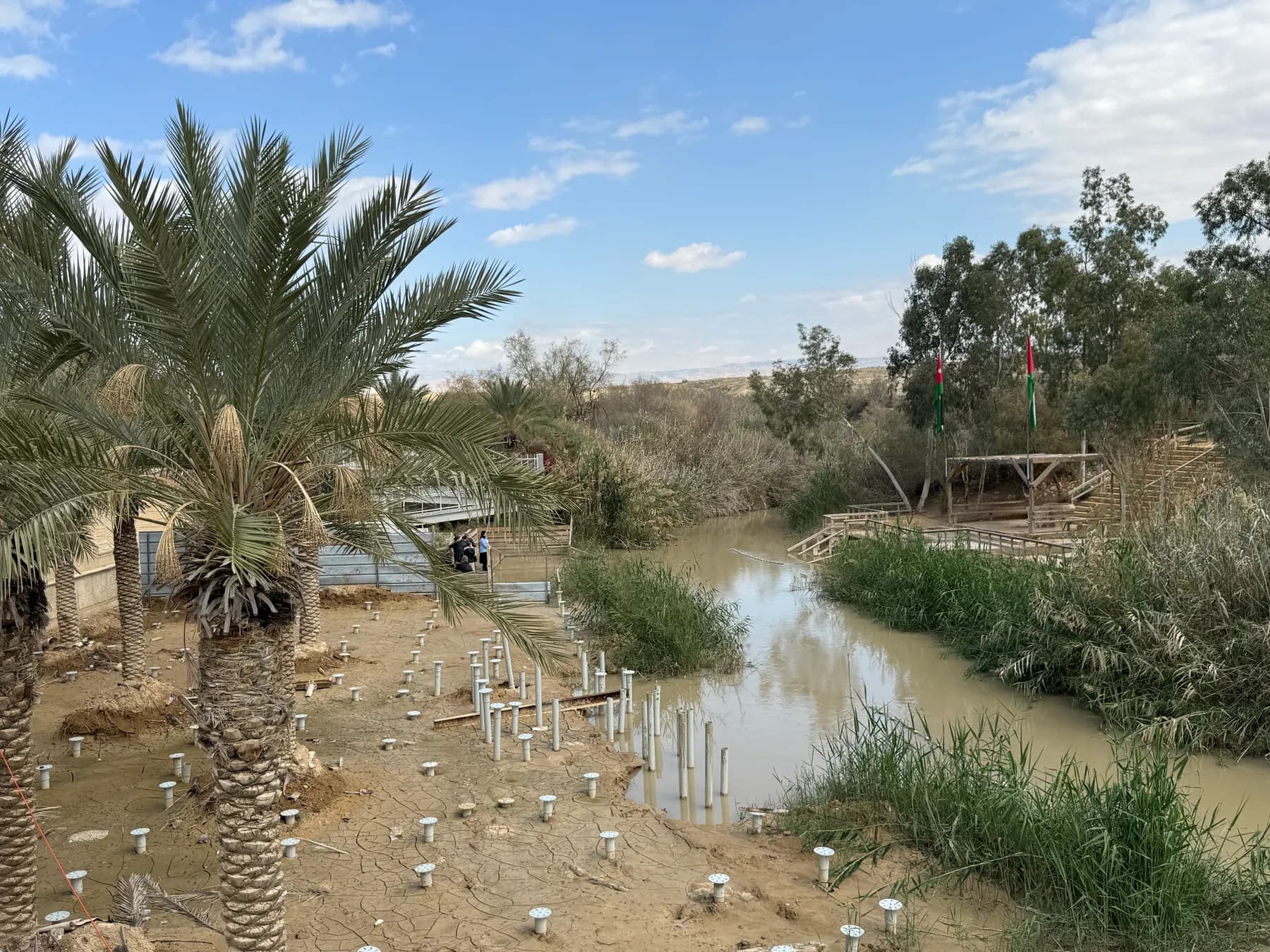
The traditional site of Jesus's baptism stands inside a closed military zone: more than 6,500 landmines were lifted from the monasteries around it between 2018 and 2020, and the riverbank itself reopened in February 2026 after NIS 25 million of building work.
Bahnfrend / CC BY-SA 4.0 · Wikimedia Commons
Beach
Kalia Beach
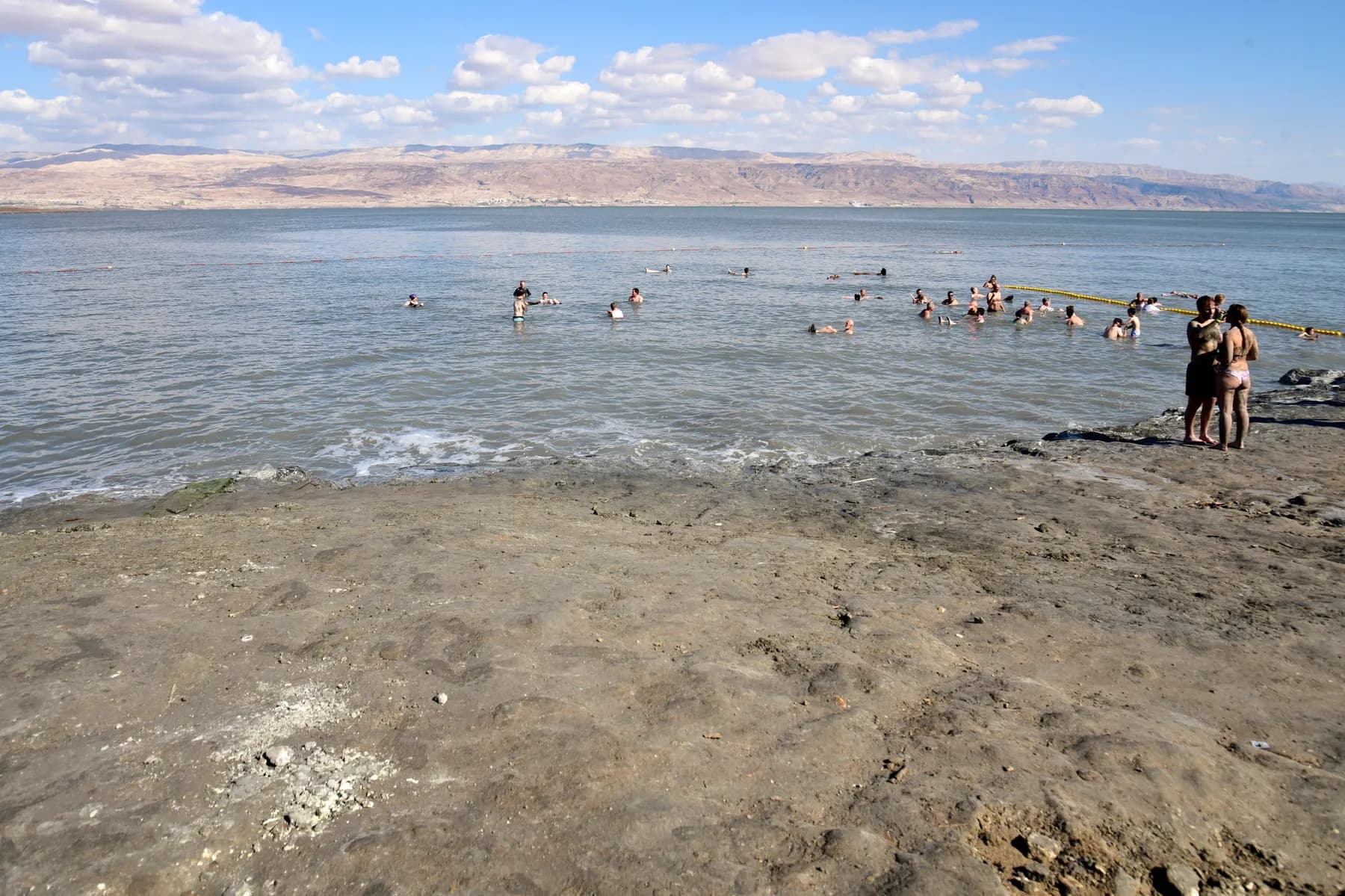
The northernmost managed beach on the Dead Sea, run by Kibbutz Kalia on the site of the potash works the Arab Legion destroyed in May 1948, with a paid gate and two quite different tickets.
Sources and further reading
Every link below was opened and checked when this page was written. Official statements are marked as such: they are the subject's own account, not an independent one.
- OfficialIsrael Nature and Parks Authorityen.parks.org.ilEnot Tsukim Nature Reserve
Summer and winter opening hours, the one-hour entry cutoff, the holiday-eve hours, the full fee table (adult ₪40, child ₪25, student ₪34, group ₪34 and ₪21, Israeli senior ₪23), the English version of the Tamar Pool timetable, the accessibility list, the no-dogs rule, the statement that there is no access to the Dead Sea, and the directions off Route 90 three kilometres south of Kibbutz Kalia
- OfficialIsrael Nature and Parks Authority, Hebrew siteparks.org.ilשמורת טבע עיינות צוקים (עין פשחה)
The advance-registration requirement from 1 January 2026, the Hebrew Tamar Pool season and weekday rules, the visitor centre screening times and its three rooms, the description of the Hidden Reserve and the guide requirement, the retreating-shore lookout and why the sea cannot be reached, the accessible path and the pool lift, the service centre stock, and the two extra fee rows plus the ₪20 senior rate
- OfficialIsrael Nature and Parks Authoritystatic.parks.org.ilשמורת טבע עיינות צוקים, visitor brochure (2025)
The reserve's 6.5 km length, the springs at 390 metres below sea level and discharge up to 70 million cubic metres a year, the claim to be the lowest nature reserve in the world and the largest unused natural water source in Israel, the two explanations for the salinity, the micro-canyons, the account of spring migration and the pool-digging programme, the four vegetation belts, the Hidden Reserve tour times including the Arabic tour, the site rules, and the drive times to Qumran, Qasr al-Yahud and Ein Gedi
- OfficialIsrael Nature and Parks Authoritystatic-en.parks.org.ilEnot Tsukim Nature Reserve, visitor brochure (English)
The English text of the same brochure: the geology of the rift and Lisan Lake, the aquifer and the springs, the archaeological site as a first-century farm with a balsam installation excavated in 1958 by de Vaux and in 2001 by Hirschfeld, Pliny on balsam, the date-wine and date-honey counter-reading, the weaver ant as the northernmost population in the world, the fish and bird lists, the introduced donkeys, and the rule that the reserve closes an hour earlier on Fridays and holiday eves
- OfficialDead Sea Land, the regional tourism sitedeadsea.co.ilEinot Tzukim Nature Reserve (Ein Feshkha)
An independent operator's summary of the same site: the Hidden Reserve as guided-only with large pools, small streams and an old watchtower, the Tamar Pool season, the Second Temple period farm and its perfume, and the Kedron Fortress with its tower, shipyard, cisterns and boat dock
- ReportingThe Times of Israeltimesofisrael.comDead Sea oasis's new visitor complex showcases efforts to save unique ecosystem
The Passover 2024 soft opening and the 21 May 2024 ribbon-cutting with Environmental Protection Minister Idit Silman, the cost of about 35 million shekels, pre-war visitor numbers of about 170,000 a year, the pools at a steady 24 degrees Celsius, the two films and the Alice in Wonderland entrance hall, staff moving fish to newly emerging springs, and the Hidden Reserve's trees
- ReportingThe Jerusalem Postjpost.comThe 35-minute miracle: inside Jerusalem's best-kept Dead Sea escape
A 2026 visit: the 35-minute drive from central Jerusalem, reserve manager Eldad Hazan Ganan and his description of the place as a Dead Sea jungle, and the Hidden Reserve as a space entered only with a guide holding a key
- ReportingAll Israel Newsallisraelnews.comForgotten Dead Sea archaeological site possibly used by John the Baptist and Herod Antipas
Measurements and description of Khirbet Mazin, also called Metzad Kidron: an 18 by 9 metre tower with cisterns and store rooms, a 30 by 11 metre shipyard with a maintenance ramp and a 15 metre stone pier, Pesach Bar-Adon's identification with Midin, and the Jannaeus coin hoard studied by Donald Tzvi Ariel
- ReferenceWikipediaen.wikipedia.orgEin Feshkha
The three-way division of the reserve and the dunam figures for the closed and visitors' sections, the 1969 establishment and the ARIJ record of 97 dunams taken from al-Ubeidiya, the nineteenth-century spring temperatures from Robinson, Lynch and Tristram, Palmer's 1881 note that Feshkhah may be a personal name or meaningless, the PEF rock cut in October 1900, the killifish living side by side, the BirdLife Important Bird Area designation, de Vaux's 1956 and 1958 seasons, the 24 by 18 metre main building, the Magness and Hirschfeld redating to the Herodian period, the Iron Age watchtower, and the full list of proposed uses for the installation including Netzer's 2005 paper
- ReferenceYizhar Hirschfeld, Israel Exploration Journal 54 (2004), pp. 37-74jstor.orgExcavations at 'Ein Feshkha, 2001: Final Report
The published final report of the 2001 excavation, on which the Herodian dating, the Iron Age watchtower above the spring and the balsam reading all rest. The journal record is public; the full text sits behind JSTOR's paywall
- ReferenceA. Burg, Y. Yechieli and A. Galili, Journal of Hydrology 536 (2016), pp. 222-235sciencedirect.comResponse of a coastal hydrogeological system to a rapid decline in sea level: the case of Zuqim springs
The study of this spring complex as the lake falls: springs shifting slightly eastward with the retreating shore, the system extending southward without significant change in total discharge, new seepages varying widely in salinity, and continuous freshening as old trapped brines are flushed. The publisher page carries the abstract; the full text is paywalled
- ReferenceWikipediaen.wikipedia.orgKhirbet Mazin
That Khirbet Mazin lies in the southern part of the Ein Feshkha nature reserve, its Iron Age pottery of the eighth and seventh centuries BCE, the bronze coins of Alexander Jannaeus from the 2001 survey, and the dry dock and anchorage
Einot Tzukim (Ein Feshkha) Nature Reserve: common questions
Can you swim at Einot Tzukim?+
Yes, in the spring-fed pools, which is the main reason most people come. Several shallow wading pools hold water all year, and one deeper pool, Tamar, at 1.5 metres, opens in the bathing season when a lifeguard is on duty and is closed on Wednesdays. The water is brackish rather than fresh, and the Times of Israel reported it holding at 24 degrees Celsius the year round.
Can you get into the Dead Sea from the reserve?+
No. Access to the Dead Sea is prohibited and it is the first rule in the parks authority's own brochure. The shoreline has retreated more than a kilometre from the springs, the exposed bed is unstable and pitted with sinkholes, and the reserve offers a lookout toward it rather than a path to it. For floating, use a supervised beach such as Kalia, a few minutes north.
How much does Einot Tzukim cost?+
Adult admission is ₪40 and a child ₪25 on the parks authority's price table, with a student at ₪34 and groups above 30 people at ₪34 an adult and ₪21 a child. The Hebrew table carries two rows the English one omits, reserve-duty soldiers at ₪30 and pupils at ₪10, and the two pages disagree on the Israeli senior rate, ₪23 in English against ₪20 in Hebrew. An Israel Nature and Parks Authority subscription or an Israel Pass covers entry.
What is the Hidden Reserve and how do you get into it?+
It is the closed southern third of the reserve, where the springs surface and a walking route has been laid out between clear pools and heavy vegetation. Entry is only with a guide. The parks authority runs free tours for individual visitors at weekends and on festivals, listed in its 2025 brochure as 10:00 and 14:00 on Fridays, 10:00, 12:00 and 14:00 on Saturdays and hourly from 10:00 to 15:00 on festivals, with an Arabic-language tour on Fridays at 11:00. Groups, and individuals midweek, must bring a guide from the approved list.
How long do you need at Einot Tzukim?+
About two hours is a comfortable visit. The parks authority gives the self-guided circuit as half an hour to an hour and a half and the visitor centre as about half an hour. Add an hour or more if the deep pool is open and you intend to use it, and roughly another hour for the Hidden Reserve tour.
Is it worth visiting if you have already seen Ein Gedi?+
They are not the same kind of place, so probably yes if water and quiet interest you. Ein Gedi is a canyon walk to a waterfall with ibex on the path; Einot Tzukim is flat, shaded, and built around getting into the water and looking closely at a wetland. It is also far less strenuous: nothing here involves a climb.
Is Einot Tzukim wheelchair accessible?+
Largely yes, and it is one of the more accessible sites on this coast. A wheelchair-accessible path runs from the western disabled car park to the archaeological site, Tamar Pool and the Kaneh wading pool, with shaded accessible picnic corners and accessible toilets and showers, and Tamar Pool has a lift into the water that operates in the bathing season. Remaining paths are compacted earth and mostly level. The Hidden Reserve is described by the operator as not fully accessible but possible with a companion by prior arrangement.
Is there shade at Einot Tzukim?+
More than almost anywhere else on the Dead Sea shore, which is the practical argument for coming here in summer. The picnic areas sit under date palms and tamarisks, and the vegetation belts along the water are dense enough to walk in. The open sections of the circuit are still full desert sun, so the usual rules apply and the service centre sells hats and sunscreen.
Can Einot Tzukim be combined with Qumran in one day?+
Easily, and the parks authority prints the drive times on its own brochure: Qumran is about five minutes away, the baptismal site at Qasr al-Yahud about fifteen, and Ein Gedi about twenty-five. A common order is Qumran in the early morning, Einot Tzukim through the middle of the day when the shade and the water matter most, and a supervised beach afterwards.
Are the pools natural?+
Partly. The water is genuinely spring water, but the pools themselves are managed. The parks authority states that over the past decade it has deepened existing pools and dug new ones wherever water surfaces naturally, because the springs are migrating south as the Dead Sea falls and the natural pools that the reserve's endemic fish depend on are disappearing into incised channels. What visitors bathe in is a habitat being rebuilt about as fast as the lake removes it.