Archaeological site · The Dead Sea
Ein Gedi Ancient Synagogue
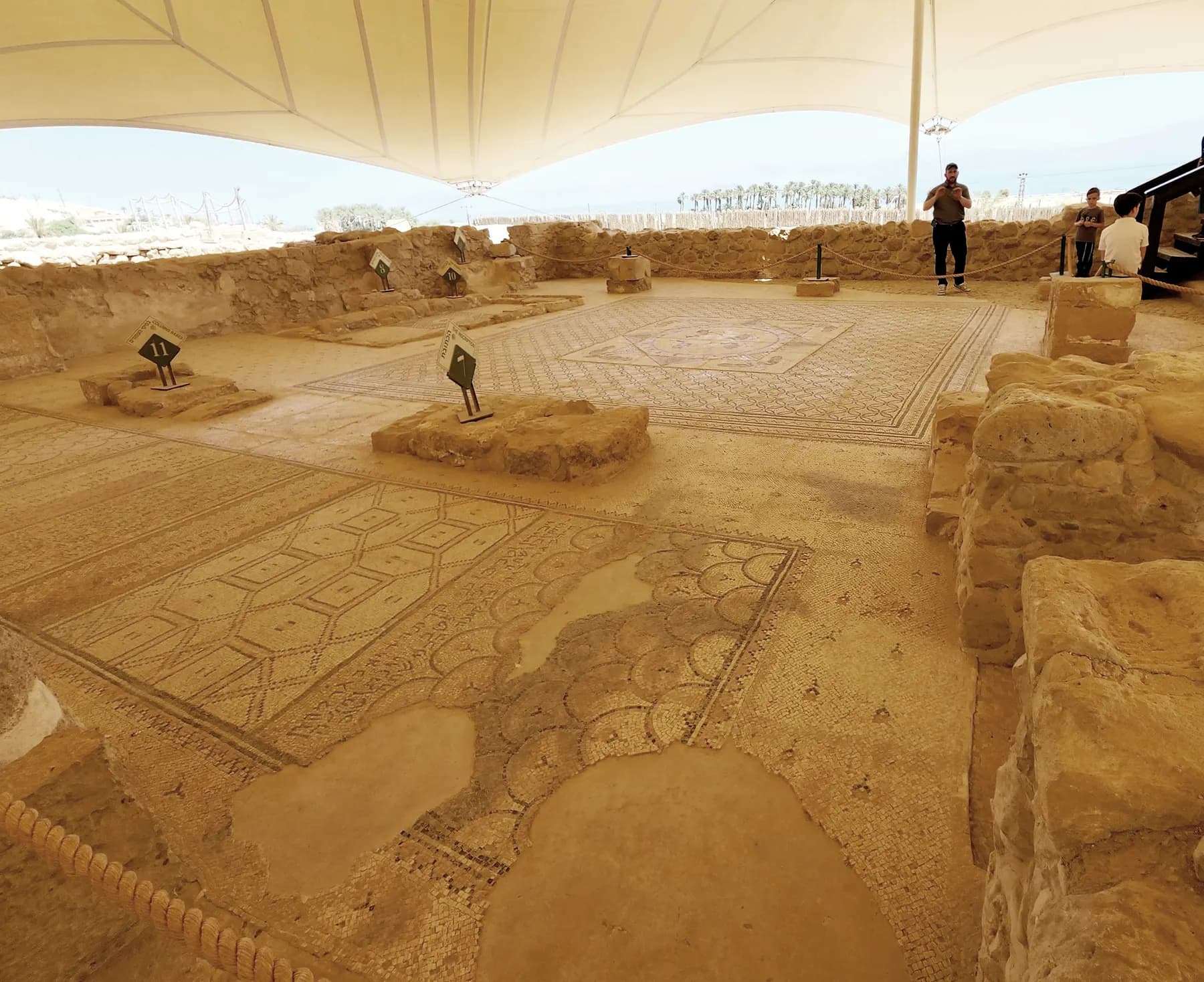
The mosaic floor of this village synagogue carries a Judeo-Aramaic curse on anyone who reveals the secret of the town, and the parks authority's own brochure suggests the secret was how to grow and process balsam.
ישראל פרקר Israel Preker / CC BY 2.5 · Wikimedia Commons
The building on show
sixth century CE
the Israel Nature and Parks Authority's own dating; the first synagogue on the spot went up early in the third century
Adult admission
₪16
the line the parks authority prints as "Synagogue" on its En Gedi fee table, read in 2026
Scroll lifted from the ark
5 May 1970
excavated by Yosef Porath, unreadable for 45 years, scanned and virtually unwrapped in 2015
Radiocarbon date of that scroll
210 to 390 CE
at 89 per cent probability, from the Weizmann Institute measurement published in 2016
In short
- How long to give it
- about an hour, and an hour and a half to two hours longer if the parks authority's escape game is added
- Summer, Sunday to Thursday and Saturday
- 08:00 to 17:00
- Adult
- ₪16
בית הכנסת העתיק בעין גדי
Ein Gedi Ancient Synagogue is the conserved floor of a Jewish village synagogue on the western shore of the Dead Sea, run by the Israel Nature and Parks Authority as the En Gedi Antiquities site with its own gate, its own car park and its own cheaper ticket. The parks authority's Hebrew page describes it as an ancient synagogue of the sixth century CE with a mosaic floor, among the most impressive in the Land of Israel. Practically, it is the flat visit at Ein Gedi: concrete paths, a short circuit, and the excavated village of low stone walls standing around the building.
Two things set it apart from the other ancient synagogues of the country. The first is the writing. A long Hebrew and Judeo-Aramaic inscription ran in the mosaic of the western aisle, listing ancestors from Adam to Japheth, the months and the signs of the zodiac, and the donors who paid for the building, before turning to threats and cursing whoever should reveal "the secret of the town" to outsiders. The parks authority's visitor brochure suggests the secret was the cultivation and processing of balsam, the perfume that made this oasis rich.
The second is what came out of the Torah ark. In 1970 the excavators lifted charred lumps from the burnt ark that could not be opened without destroying them, and they sat in Israel Antiquities Authority storage for more than four decades. In 2015 a team led by Brent Seales at the University of Kentucky scanned one and unwrapped it in software, revealing the opening of Leviticus: the earliest copy of a book of the Pentateuch ever found in a Torah ark. Neither that scroll nor the inscription panel is at Ein Gedi today.
Orientation
A separate gate, a short walk, and a village of knee-high walls
The antiquities have their own entrance off Route 90, between the Nahal David and Nahal Arugot gates of En Gedi Nature Reserve, and the parks authority treats them as a separate transaction. Its English page says no reservation is necessary to visit the En Gedi Antiquities site, and that a visitor coming only for the antiquities should buy a ticket at that entrance for that area alone. The site keeps its own telephone line, 08-9170586, apart from the two canyon offices.
What waits inside the fence is compact. The parks authority lists an entrance plaza, a visitor service station, toilets, shaded picnic corners, directional and explanatory signage, observation points over the ancient village, and a concrete path that runs from the entrance all the way to the ancient synagogue and into the building itself. Parking sits beside the gate, outside the fence.
What survives is a ruin held in place rather than a rebuilt structure. The walls of the prayer hall stand low; the floor is the reason people come; imprints of burnt roof beams are still visible on it. Almost everything a visitor walks on or reads is modern: the concrete path, the compacted-aggregate paths through the village, the handrails fitted to its steps, the signage, and a scale model of the ancient village that the authority provides as an alternative for people who cannot get round the ruins.
The village around the synagogue is not the synagogue dig. Gideon Hadas ran a series of salvage excavations for the Israel Antiquities Authority from the 1980s and prepared the Roman and Byzantine village for public presentation between 1993 and 1995, exposing three strata: a Roman one probably destroyed at the end of the Bar Kokhba revolt, a Byzantine one destroyed in the sixth century, and a Mamluk one taken apart when the ground was cleared for modern farming.
The floor
Birds, peacocks and three menorahs
The building grew in stages. It began as a simple hall with a geometric mosaic floor and was rebuilt over time into a basilica plan with a bema and an ark, colour in the mosaic, and the aisles that carried the inscriptions. The parks authority's brochure puts it plainly: a synagogue was erected in the middle of the village in the third century CE and with the passage of years it was modified, enlarged and renovated, until in its last period it was a large and handsome building that reflected how well the villagers were doing.
The decoration belongs to the later phases. The Jewish Virtual Library's account gives a mid-fifth-century renovation with a new coloured mosaic: a pattern of four-petalled flowers, four birds at the centre, pairs of peacocks at the corners, and three seven-branched menorahs near the bema. The birds have been identified as crowned cranes alongside francolins or partridges, which is a reading rather than a caption written by the people who laid the floor.
One object from the building has never been matched elsewhere. A seven-branched menorah was found here, of a type unique for its period. Accounts differ on what it was made of: the Jewish Virtual Library describes a candelabrum about 30 centimetres high in bronze, while the archaeological summary of the site calls it metal and probably silver. The excavators also recorded graffiti of ships scratched into plastered walls and pillars, which may have been decorative or votive, and nobody has settled which.
- First hall: simple, with a geometric mosaic floor
- Later phases: basilica plan with a bema and a Torah ark
- Mid-fifth-century floor: four-petalled flowers, four birds, pairs of peacocks
- Three seven-branched menorahs in the mosaic near the bema
- A seven-branched menorah found here, about 30 cm high, of a type unique for its time
The inscription
Whoever reveals the secret of the town
The western aisle of the prayer hall carried a mosaic inscription that is among the longest found in any ancient synagogue. It works through several registers: a genealogy running from Adam to Japheth, a list of the months with the signs of the zodiac, and dedications naming the donors. Among the names are Halfi and his three sons, Yosi, Ezrin and Hezkin, a Rabbi Yosi, and Yonathan the cantor.
Then it turns. The parks authority's brochure describes the passage as one that threatens and curses anyone who would cause controversy or libel, or reveal "the secrets of the city" to strangers. The Jewish Virtual Library renders the sanction itself as "The one whose eyes roam over the entire earth and sees what is concealed will uproot this person and his seed from under the sun". A curse against informing, set in the floor of a village prayer hall, is not something the rest of the corpus prepares a reader for.
What the secret was is genuinely open. The parks authority's brochure offers the answer most researchers give: the cultivation and processing of balsam, the source of the region's wealth, a trade so valuable that Marc Antony took the Jericho and Ein Gedi groves for Cleopatra and Herod then leased them back from her. Jodi Magness reads the clause differently, setting it against a similar phrase in the Damascus Document from nearby Qumran and in the Cairo Geniza, and arguing that what is being punished is betraying one's own Jewish community to gentiles rather than leaking a recipe.
The panel is not on site. The mosaic inscription is displayed at the National Campus for the Archaeology of Israel in Jerusalem, on the roof plaza that opened to the public while the building below it was still being finished. The operator's page does not state which parts of the floor at Ein Gedi are the original tesserae and which are made good, so a visitor should not assume either way.
1970
A lump of charcoal that turned out to be Leviticus
The excavation of 1970 was headed by Dan Barag and Ehud Netzer of the Institute of Archaeology at the Hebrew University of Jerusalem with Yosef Porath, and it opened the synagogue's Torah ark. Inside were multiple charred lumps of what looked like parchment. Porath lifted the scroll on 5 May 1970. Its structure had been burned and crushed into chunks of charcoal that disintegrated further every time they were touched, and with no viable conservation protocol the Israel Antiquities Authority simply shelved it.
The ark held more than the scroll. Alongside it were silver pendants, oil lamps, coins, fragments of glass, and 132 animal bones from kosher species, mostly goat and sheep but also chicken and fish. The bones carry butchery marks and may be the remains of religious meals; why they were inside the ark has never been explained, though storage as a genizah, because they were treated as holy, is one suggestion.
The reading came four and a half decades later and from computer science rather than conservation. Seales and his colleagues scanned the object with x-ray micro-computed tomography at a spatial resolution of 18 micrometres per voxel, then segmented, textured and flattened the layers in software to produce a single flat image of a surface that will almost certainly never be physically opened. Their paper appeared in Science Advances in 2016. Ink showed up because it absorbs x-rays more strongly than the skin around it, which implies it contains a metal such as iron or lead, though nobody can sample it to find out.
What emerged is the start of a scroll: a large blank margin, then two columns of the book of Leviticus. One sheet of 35 lines was recovered, 18 of them preserved and 17 reconstructed, at 33 to 34 letters and spaces per line. The consonantal text is identical to the medieval Masoretic Text, which it precedes by centuries, and it is the earliest copy of a book of the Pentateuch ever found in a Torah ark. The dating is argued: radiocarbon at the Weizmann Institute gave an age of 1754 years plus or minus 40, calibrating to 210 to 390 CE at 89 per cent probability, while Ada Yardeni proposed a date in the late first or early second century on the shape of the letters, and Drew Longacre defended the radiocarbon reading against her.
The end
Burnt once, and dated four different ways
Everyone agrees the village and its synagogue burned. Nobody agrees when, or who did it. The archaeologists who dug the synagogue attributed the destruction to Byzantine persecution of Jews under Justinian; the parks authority's brochure puts the fire around the middle of the sixth century CE; the Jewish Virtual Library places it in the second half of the sixth century, still in Justinian's reign; others argue for a Bedouin raid before the Persian invasion, late in the sixth century or early in the seventh; and the team that read the scroll works with a fire of about 600 CE. Anyone quoting a single confident date for the end of Ein Gedi is quoting one camp.
What followed is less disputed. Balsam cultivation around the Dead Sea stopped when the village emptied, and the knowledge of how to grow and process the plant left with the refugees and was never recovered. If the inscription really was protecting a trade secret, the curse outlived the secret.
The floor came back to notice by accident. The parks authority's brochure says remnants of the synagogue's mosaic were found in 1965 while a field was being ploughed; the archaeological summary of the site gives the first discovery as 1966. Systematic excavation of the synagogue and the buildings beside it ran from 1970 to 1972 under Dan Barag of the Hebrew University and Yosef Porath, then of the Israel Department of Antiquities.
The most recent damage is not ancient. In May 2025 a flash flood dropped about 35 millimetres of rain on the reserve in a very short period, which the parks authority called an extreme event unlike anything seen there for many years. Trails were washed out and the ancient synagogue was flooded and will need preservation and restoration work. The antiquities site has since been listed by the operator as open as usual while much of the rest of the reserve stays shut.
What to look for
Things not to walk past at Ein Gedi Ancient Synagogue
The details that repay knowing about before you are standing in front of them.
The western aisle
The strip of floor where the long inscription ran, from the genealogy of Adam to Japheth through the zodiac to the curse. The panel itself is in Jerusalem now, so the aisle is where the story happened rather than where the object is.
The bema and the ark position
The raised platform and the spot where the Torah ark stood, which is where the charred Leviticus scroll, the silver pendants, the lamps, the coins and the 132 animal bones were found in 1970.
Burnt beam imprints in the floor
The fire that ended the village left the shapes of its roof beams on the floor of the building. It is the most direct physical evidence on site for the destruction that the dating argument is about.
The birds and peacocks
The coloured mosaic of the later phase used four-petalled flowers, four birds at the centre and pairs of peacocks at the corners, with three seven-branched menorahs near the bema.
The model of the ancient village
A scale model at the accessible end of the site, provided by the parks authority for visitors who cannot walk the compacted paths through the ruins. It is also the quickest way to understand the layout before walking it.
The balsam escape game
The parks authority runs one of its outdoor escape games at the En Gedi Antiquities site, built around the balsam perfume. The kit is paid for on top of admission and the visit has to be coordinated in advance.
The long view
Ein Gedi Ancient Synagogue, in order
Early 3rd century CE
A synagogue is built in the middle of the resettled village, on the parks authority's account, and is enlarged and renovated repeatedly thereafter.
Mid 5th century CE
A renovation lays the coloured mosaic floor with four-petalled flowers, birds, peacocks and three menorahs.
6th century CE
The phase of the building that the parks authority puts on show, with the long Hebrew and Judeo-Aramaic inscription in the western aisle.
Mid 6th to early 7th century CE
The village and its synagogue burn. The excavators blame Justinian's persecution of Jews; others argue for a Bedouin raid; the scroll team works with a fire of about 600 CE.
1965
Remnants of the mosaic floor turn up while a field is being ploughed, per the parks authority's brochure. The archaeological summary of the site dates the first discovery to 1966.
5 May 1970
Yosef Porath lifts the charred scroll from the burnt Torah ark during the excavation headed by Dan Barag and Ehud Netzer.
1970 to 1972
Barag and Porath excavate the synagogue and the buildings around it.
1993 to 1995
Gideon Hadas prepares the Roman and Byzantine village around the synagogue for public presentation for the Israel Antiquities Authority.
2015
Brent Seales's team at the University of Kentucky virtually unwraps the scroll from micro-CT data and reads Leviticus; the method is published in Science Advances in 2016.
May 2025
A flash flood of about 35 mm of rain in a very short period damages the reserve and floods the ancient synagogue, which will need conservation work.
Practical
Visiting Ein Gedi Ancient Synagogue
Where
En Gedi Antiquities gate, off Route 90, between the Nahal David and Nahal Arugot entrances to En Gedi Nature Reserve, about 1 km north of Kibbutz Ein Gedi
What ticket you need
The synagogue sits inside En Gedi Nature Reserve and is sold as its own area at its own price: ₪16 for an adult here against ₪31 for the reserve. The operator's English page says both that the entry ticket to each of the three areas is good for same-day entry to the others, and that a visitor coming only for the antiquities should buy a ticket for that area alone. Those two sentences sit awkwardly beside two different prices, so anyone intending to walk a canyon on the same day should ask at the gate which ticket covers what before paying twice.
Opening hours
- Summer, Sunday to Thursday and Saturday
- 08:00 to 17:00source
- Summer, Friday and holiday eves
- 08:00 to 16:00source
- Winter, Sunday to Thursday and Saturday
- 08:00 to 16:00source
- Winter, Friday and holiday eves
- 08:00 to 15:00source
- Rosh Hashanah eve, Passover eve and Yom Kippur eve
- 08:00 to 13:00source
- Last entry
- one hour before the closing time listed, and visitors must be out of the gate by closingsource
Admission
- Adult
- ₪16source
- Child
- ₪7source
- Student
- ₪14source
- Adult in a group
- ₪14source
- Child in a group
- ₪6source
- Israeli senior citizen
- ₪8source
- Israeli pupil, and reserve duty
- ₪6 for a pupil, ₪12 on reserve duty, on the Hebrew fee tablesource
- Serving soldier or national service volunteer
- free, against a valid card, on the Hebrew fee tablesource
Access
The most accessible thing at Ein Gedi, and unusually so for an archaeological site. Parking is beside the gate outside the fence, and the parks authority has made the entrance plaza, the visitor service centre, the toilets and the shaded picnic corners accessible, with a concrete path running from the entrance to the ancient synagogue and into the building itself, plus observation points over the ancient village and explanatory signage. There is no climb and no streambed. The limit is the ruins themselves: the paths through the ancient village are compacted aggregate with handrails fitted to the steps, and the parks authority states that walking in the ancient village is not suitable for people using a wheelchair. A scale model of the village is provided as the alternative. The scenic promenade linking the Nahal David gate to the synagogue is a gentle gradient, and the section beyond the synagogue towards Nahal Arugot is steeper. Service animals are not permitted anywhere in the reserve; the authority offers a cage at the entrance for the duration of a visit, which will not suit everyone.
On site
- Ticket office at the antiquities gate
- Car park beside the gate
- Visitor service station
- Accessible toilets
- Shaded picnic corners
- Explanatory signage and a scale model of the ancient village
- Outdoor escape game, kit sold separately
- No dogs, and no service animals
Booking
No reservation is needed here. The parks authority requires separate advance booking for Wadi David and Wadi Arugot but states that no reservation is necessary for the En Gedi Antiquities site, and that a visitor coming only for the antiquities should buy at that entrance. The escape game is the exception: it needs the visit coordinated in advance and the kit is paid for on top of admission. The antiquities ticket office is on 08-9170586 and the parks authority information centre is *3639.
Hours and prices are given as the operator publishes them and change without much notice, particularly around Shabbat and the festivals. Check the operator's own page before you travel for this.
Official page at en.parks.org.il →What people wish they had known
- Drive to the right gate. The antiquities have their own entrance, ticket office and car park off Route 90, separate from the Nahal David and Nahal Arugot gates, and asking for the synagogue at a canyon gate means getting back in the car.
- Do not come here expecting to see the famous inscription. The mosaic panel with the curse is displayed at the National Campus for the Archaeology of Israel in Jerusalem, not at Ein Gedi.
- The charred Leviticus scroll is not on site either. It is held by the Israel Antiquities Authority and was read from a scan, not by unrolling, so there is nothing to look at in a case here.
- Sort the ticket order out before paying. A visitor walking a canyon on the same day should ask at the gate what a ₪31 reserve ticket and a ₪16 antiquities ticket each cover, because the operator's own page describes the arrangement two different ways.
- This is the flat part of Ein Gedi. Anyone who has written the whole reserve off as a scramble over boulders has misread it: the route from the gate to the synagogue is concrete and level, and it goes inside the building.
- Ask about the escape game before arriving rather than at the gate. It has to be coordinated in advance, the kit costs extra, and it runs only during the site's normal opening hours.
The figures
Ein Gedi Ancient Synagogue by the numbers
Each figure carries the year it belongs to and links the source it came from.
| Measure | Figure | As of | Source |
|---|---|---|---|
| Adult admission to the synagogue site | ₪16 (child ₪7, student ₪14, Israeli senior ₪8) | 2026 | en.parks.org.il |
| Radiocarbon age of the En-Gedi scroll | 1754 years plus or minus 40, calibrating to 210 to 390 CE at 89 per cent probability | 2016 | pmc.ncbi.nlm.nih.gov |
| Text recovered from the scroll | one sheet of 35 lines, 18 preserved and 17 reconstructed, at 33 to 34 letters and spaces per line | 2016 | pmc.ncbi.nlm.nih.gov |
| Scan resolution used to read it | 18 micrometres per voxel, giving an image of roughly 1,410 pixels per inch | 2016 | pmc.ncbi.nlm.nih.gov |
| Animal bones found inside the Torah ark | 132, all from kosher species, mainly goat and sheep | 2026 | en.wikipedia.org |
| Height of the seven-branched menorah found here | about 30 cm | 2026 | jewishvirtuallibrary.org |
| Escape game kit, on top of admission | ₪20 to ₪25, for an average of an hour and a half to two hours | 2026 | parks.org.il |
| Rain in the flash flood that flooded the synagogue | about 35 mm in a very short period | 2025 | ynetnews.com |
While you are here
The rest of The Dead Sea
Everything else in this destination with a page of its own.
In-bar / CC BY-SA 4.0 · Wikimedia Commons
Nature reserve
Ein Gedi Nature Reserve
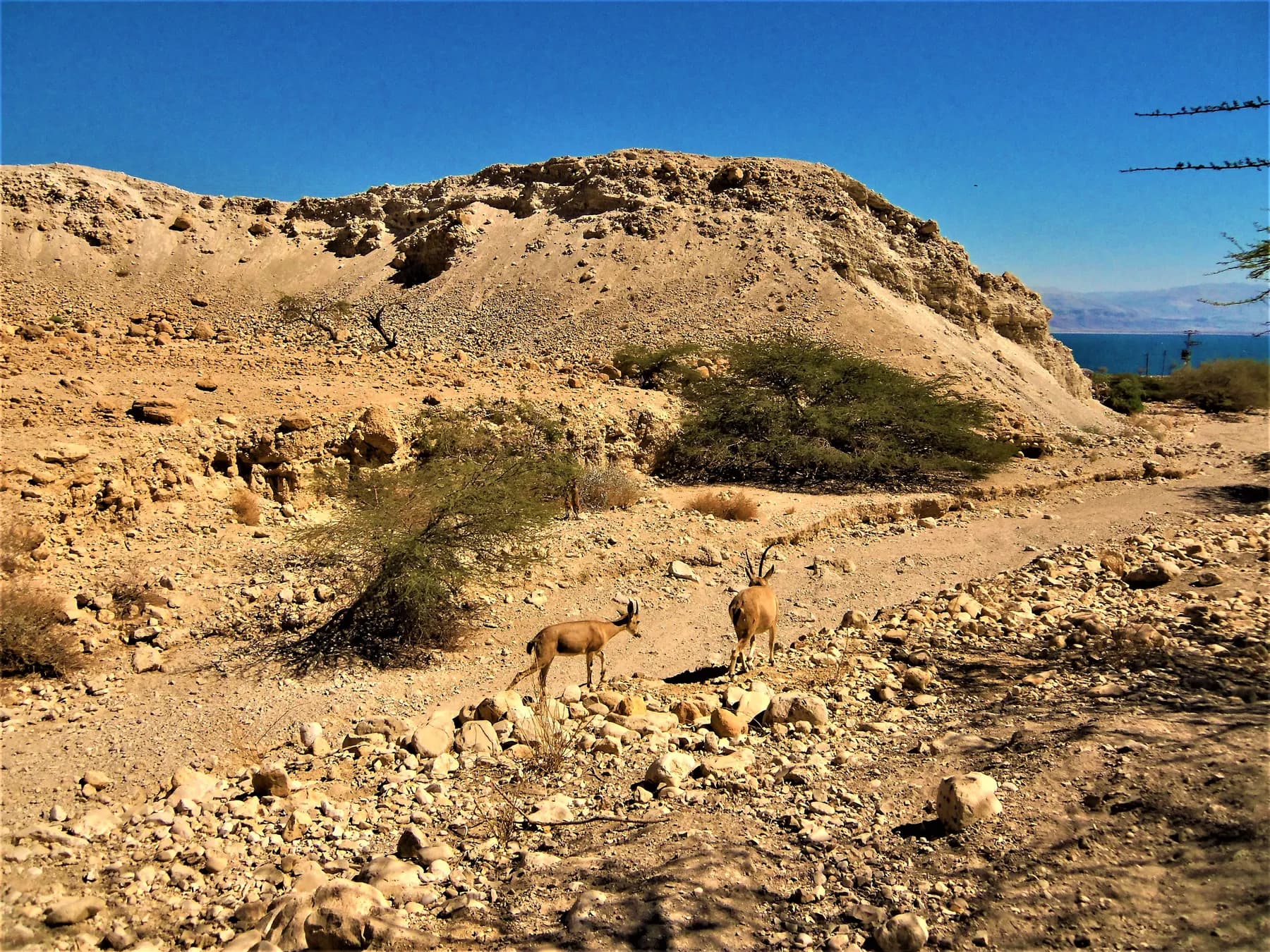
Four springs push about three million cubic metres of fresh water a year through two desert canyons here, and the parks authority has been rebuilding the trails between them since a flood tore through the reserve in May 2025.
ישראל פרקר Israel Preker / CC BY 2.5 · Wikimedia Commons
Nature reserve
Ein Gedi Botanical Garden
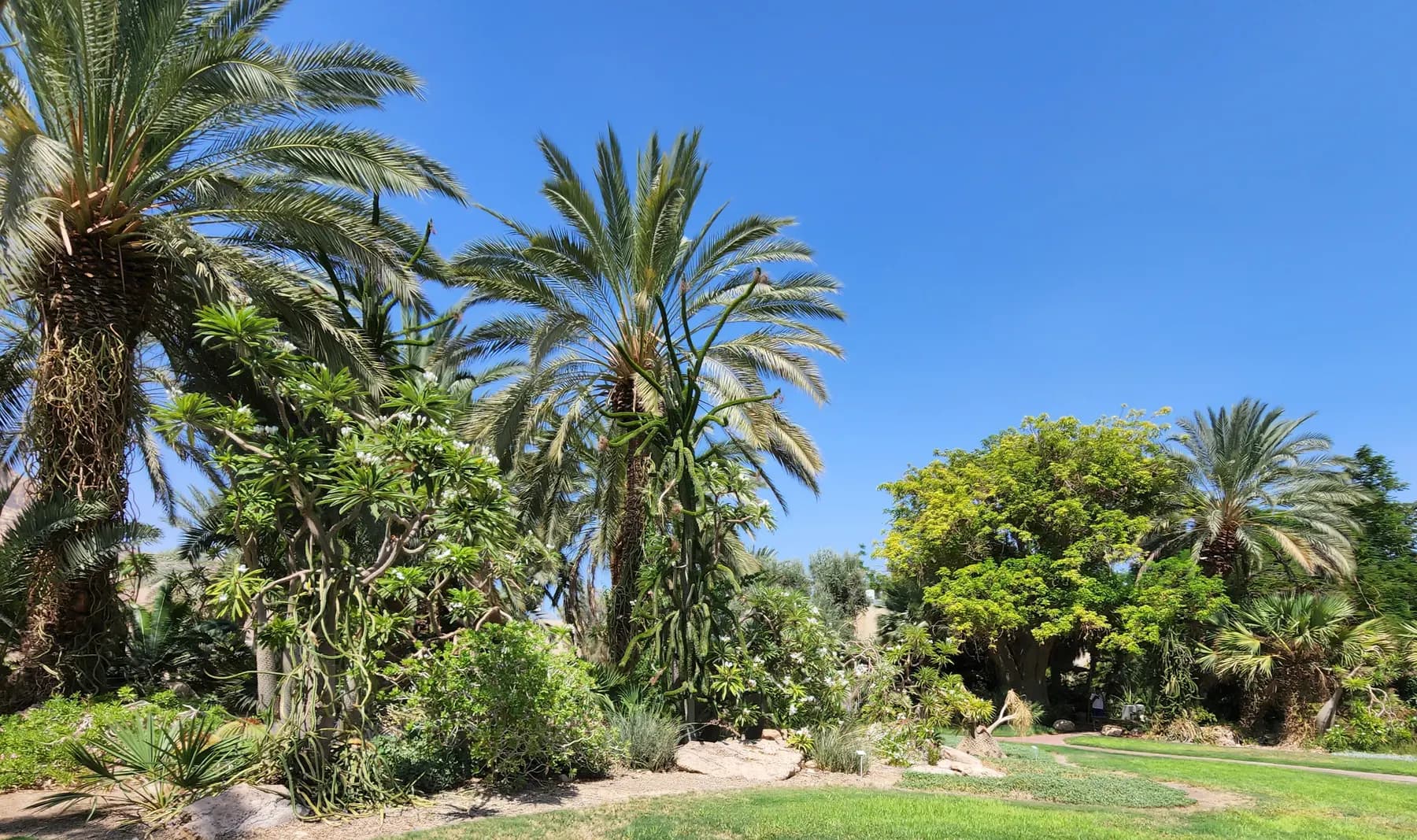
About 80 date palms went into a bare plateau south of Nahal Arugot in April 1959, and the collection that grew out of them was catalogued in the 1980s at more than 900 species, with a kibbutz of some 700 people living inside it.
MotherForker / CC BY-SA 3.0 · Wikimedia Commons
Archaeological site
Qumran National Park
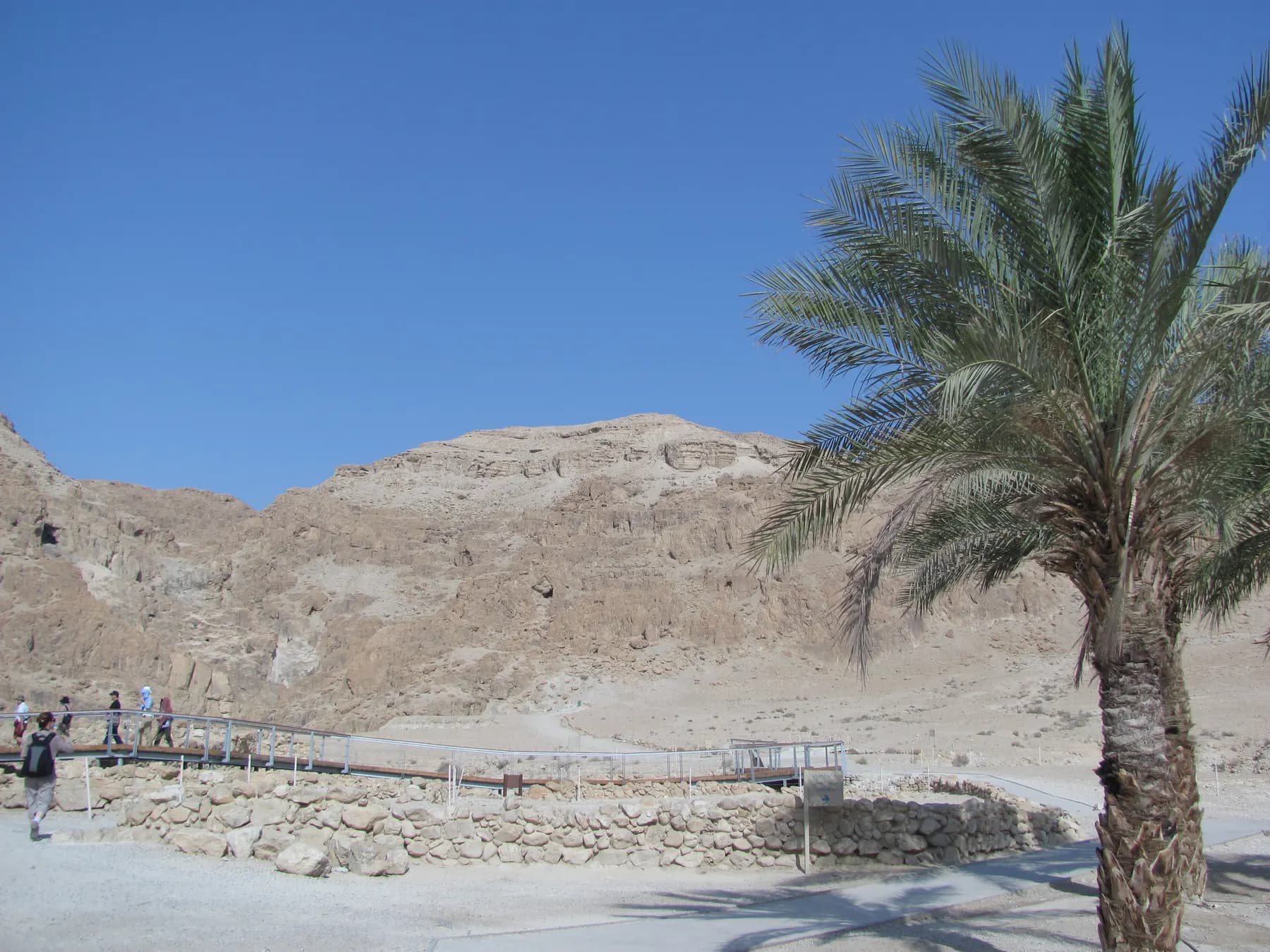
Eleven caves here gave up the Dead Sea Scrolls between 1947 and 1956, five of them found by Bedouin and six by archaeologists, and what the settlement beside them actually was is still argued over.
Sources and further reading
Every link below was opened and checked when this page was written. Official statements are marked as such: they are the subject's own account, not an independent one.
- OfficialIsrael Nature and Parks Authorityen.parks.org.ilEn Gedi Nature Reserve
Summer and winter opening hours and the one-hour entry cutoff; the fee table whose "Synagogue" lines give ₪16 adult, ₪7 child, ₪14 student, ₪14 adult in group, ₪6 child in group and ₪8 Israeli senior; the statement that no reservation is necessary for the En Gedi Antiquities site and that a visitor coming only for it should buy at that entrance; the accessibility list for the synagogue including parking at the gate, well-paved paths and a shaded accessible route; the antiquities telephone line 08-9170586; and the standing notice that the antiquities are open as usual while other areas stay closed
- OfficialIsrael Nature and Parks Authorityparks.org.ilשמורת טבע עין גדי (En Gedi Nature Reserve, Hebrew site)
The description of the antiquities as an ancient synagogue of the sixth century CE with a mosaic floor among the most impressive in the Land of Israel; the concrete path from the entrance to and into the ancient synagogue, the observation points over the ancient village and the scale model offered as an alternative accessibility adaptation; the statement that walking in the ancient village is unsuitable for wheelchair users; the gentle gradient between Nahal David and the synagogue and the steeper section beyond; holiday eve hours; and the fuller fee table with ₪6 for a pupil, ₪12 on reserve duty and free entry for serving soldiers
- OfficialIsrael Nature and Parks Authoritystatic.parks.org.ilEn Gedi Nature Reserve visitor brochure (PDF)
The synagogue as the focus of Jewish settlement in the third to sixth centuries CE with a mosaic floor decorated with animals and inscriptions; the erection of the synagogue in the middle of the village in the third century and its later enlargement; the discovery of the mosaic in 1965 while a field was being ploughed; the inscriptions listing the genealogy from Adam to Japheth, the months and the signs of the zodiac and the donors; the inscription threatening and cursing anyone who causes controversy or libel or reveals the secrets of the city to strangers, with balsam suggested as the secret; destruction by fire around the middle of the sixth century CE; and the Marc Antony, Cleopatra and Herod episode over the balsam groves
- OfficialIsrael Nature and Parks Authorityparks.org.ilמשחקי בריחה וחידות בטבע (Escape games and puzzles in nature)
En Gedi Antiquities National Park listed among the sites running the authority's outdoor escape games; a kit price of ₪20 to ₪25 on top of site admission; an average playing time of an hour and a half to two hours; a recommended minimum age of seven; and the requirement to coordinate the visit in advance, with games running only during the site's normal opening hours
- ReportingYnetnews, 8 May 2025ynetnews.comSevere damage to Ein Gedi Nature Reserve, which will remain closed following flash flood
About 35 mm of rain in a very short period, described by the parks authority as an extreme event unlike anything seen in the area for many years; the statement that the ancient synagogue was flooded and will require preservation, restoration and rehabilitation; and the reserve's visitor figures of about 318,000 in 2024 against roughly 700,000 in 2019
- ReferenceSeales et al., Science Advances, 2016pmc.ncbi.nlm.nih.govFrom damage to discovery via virtual unwrapping: Reading the scroll from En-Gedi
The 1970 discovery of charred parchment lumps in the synagogue's Holy Ark and the forty years of shelving that followed; Yosef Porath's excavation of the scroll on 5 May 1970; the micro-CT scan at 18 micrometres per voxel and the segmentation, texturing and flattening pipeline; the sheet of 35 lines with 18 preserved and 17 reconstructed at 33 to 34 letters per line; the identification as the earliest copy of a Pentateuchal book found in a Holy Ark and its identity with the consonantal Masoretic Text; the radiocarbon date of the third or fourth century CE against Yardeni's palaeographic first or second century; and the destruction of the site by fire circa 600 CE
- ReferenceWikipediaen.wikipedia.orgEn-Gedi Scroll
The radiocarbon result of 1754 years plus or minus 40 from the Weizmann Institute, calibrating to 235 to 340 CE at 68 per cent and 210 to 390 CE at 89 per cent probability; Ada Yardeni's palaeographic challenge and Drew Longacre's rebuttal; the large blank margin showing Leviticus was the first book on the scroll; and the excavation under Dan Barag and Ehud Netzer of the Hebrew University with Yosef Porath
- ReferenceWikipediaen.wikipedia.orgEin Gedi (archaeological site)
The synagogue first noticed in 1966 and excavated from 1970 to 1972 by Dan Barag of the Hebrew University and Yosef Porath of the Israel Department of Antiquities; the three building phases from a simple hall with geometric mosaic to a basilica plan with bema and ark; the western aisle inscription described as among the longest in any ancient synagogue, with the names Halfi and his sons Yosi, Ezrin and Hezkin, Rabbi Yosi and Yonathan the cantor; the 132 kosher animal bones, silver pendants, lamps, coins and glass in the ark; the ship graffiti; the seven-branched menorah described as metal and probably silver; the burnt roof beam imprints on the floor; Jodi Magness's alternative reading of the curse; the competing destruction dates; and Gideon Hadas's salvage excavations preparing the village for presentation between 1993 and 1995
- ReferenceJewish Virtual Libraryjewishvirtuallibrary.orgEin Gedi
The synagogue built at the beginning of the third century and renovated in the fourth and mid-fifth centuries; the mid-fifth-century coloured mosaic with four-petalled flowers, four birds at the centre and pairs of peacocks at the corners; the three seven-branched menorahs near the bema; the bronze seven-branched candelabrum about 30 cm high; the wording of the curse against those revealing the secrets of the town; and destruction by fire probably under Justinian in the second half of the sixth century
- ReferenceWikipediaen.wikipedia.orgNational Campus for the Archaeology of Israel
The sixth-century Byzantine mosaic floor from the Ein Gedi synagogue on permanent display on the campus roof plaza in Jerusalem, with its Judeo-Aramaic curse on anyone who neglects his family, provokes conflict, steals property, slanders his friends or reveals the secret of the town
Ein Gedi Ancient Synagogue: common questions
What is the Ein Gedi ancient synagogue?+
It is the excavated and conserved floor of a village synagogue on the western shore of the Dead Sea, dated by the Israel Nature and Parks Authority to the sixth century CE in the phase now on show. A synagogue first went up on the spot early in the third century and was enlarged and rebuilt repeatedly. It stands in the middle of an excavated Roman and Byzantine village, and it is run as the En Gedi Antiquities site with its own gate.
What is the curse in the mosaic?+
A passage in the long mosaic inscription that threatens anyone who causes controversy, slanders a neighbour, steals, or reveals "the secret of the town" to outsiders. The Jewish Virtual Library renders the sanction as "The one whose eyes roam over the entire earth and sees what is concealed will uproot this person and his seed from under the sun". The parks authority's brochure, following most researchers, suggests the secret was how balsam was grown and processed. Jodi Magness reads the clause instead as being about betraying the Jewish community to gentiles, and the question is not settled.
How much does it cost?+
The parks authority lists the synagogue site at ₪16 for an adult, ₪7 for a child, ₪14 for a student, ₪14 for an adult in a group, ₪6 for a child in a group and ₪8 for an Israeli senior citizen. Its Hebrew fee table adds ₪6 for a pupil, ₪12 on reserve duty and free entry for a serving soldier or national service volunteer against a valid card. Those were the published figures when this page was written.
Is it included in the Ein Gedi Nature Reserve ticket?+
The operator's English page says the entry ticket to each of the three areas of the reserve is good for same-day entry to the others, which would include this one. It also says that a visitor coming only for the antiquities should buy a ticket at that entrance for that area alone, at the lower price. The safe move is to ask at whichever gate is reached first, before buying twice.
Can I see the Leviticus scroll or the inscription there?+
No. The mosaic inscription panel is on display at the National Campus for the Archaeology of Israel in Jerusalem, and the charred scroll is held by the Israel Antiquities Authority and has never been physically opened. What is at Ein Gedi is the building, its floor, the position of the ark, and the village around it.
Is it wheelchair accessible?+
The synagogue itself is, and unusually so. The parks authority provides parking beside the gate, an accessible entrance plaza, visitor service centre, toilets and shaded picnic corners, and a concrete path that runs from the entrance to the ancient synagogue and into the building. The ruins of the village around it are not: those paths are compacted aggregate and the authority states plainly that walking in the ancient village is not suitable for people using a wheelchair, offering a scale model as the alternative.
How long does it take?+
About an hour is enough for the synagogue and a circuit of the village. Add an hour and a half to two hours if the parks authority's balsam escape game is being played, which is its own average figure for that activity. It is a short visit by design and pairs naturally with a canyon walk earlier the same day.
Do I need to book?+
No. The parks authority requires separate advance booking for the Wadi David and Wadi Arugot trails but states that no reservation is necessary for the En Gedi Antiquities site. The escape game is the exception and needs its visit coordinated in advance. Telephone *3639, or the antiquities office on 08-9170586, for current conditions.
Is it worth it if I have already walked Wadi David?+
For anyone interested in what the oasis actually was, yes, because the walks show the water and this shows the people who lived on it. It is also the only part of the reserve that gives a flat, shaded, sitting-down visit at the end of a hot morning. Someone who came to the Dead Sea to swim and hike will find it a small, quiet ruin with the most interesting thing about it displayed in Jerusalem.
Was it damaged in the 2025 flood?+
Yes. A flash flood in May 2025 put about 35 millimetres of rain on the reserve in a very short period, and the ancient synagogue was flooded and reported as needing preservation, restoration and rehabilitation work. The parks authority has since listed the antiquities site as open as usual while much of the rest of the reserve, including the Ein Gedi Spring and Dodim Cave, remains closed.