Nature reserve · The Dead Sea
Ein Gedi Botanical Garden
About 80 date palms went into a bare plateau south of Nahal Arugot in April 1959, and the collection that grew out of them was catalogued in the 1980s at more than 900 species, with a kibbutz of some 700 people living inside it.
ישראל פרקר Israel Preker / CC BY 2.5 · Wikimedia Commons
Plant species
more than 900
catalogued from 1985 with the botanical garden of the Hebrew University of Jerusalem
Area
110 dunams
11 hectares, in the 2022 academic history; the kibbutz's own figure is 100 dunams
People living inside it
718
the population of Kibbutz Ein Gedi in 2024
Ground level
about 300 m below sea level
three elevation models queried at the garden in 2026 give 295 to 310 m
In short
- How long to give it
- About 90 minutes, or half a day with the museum, the cafe and a guided tour
- Sunday to Thursday, and Saturday
- 08:30 to 16:00
- Adult, 13 to 65
- ₪20
הגן הבוטני בקיבוץ עין גדי
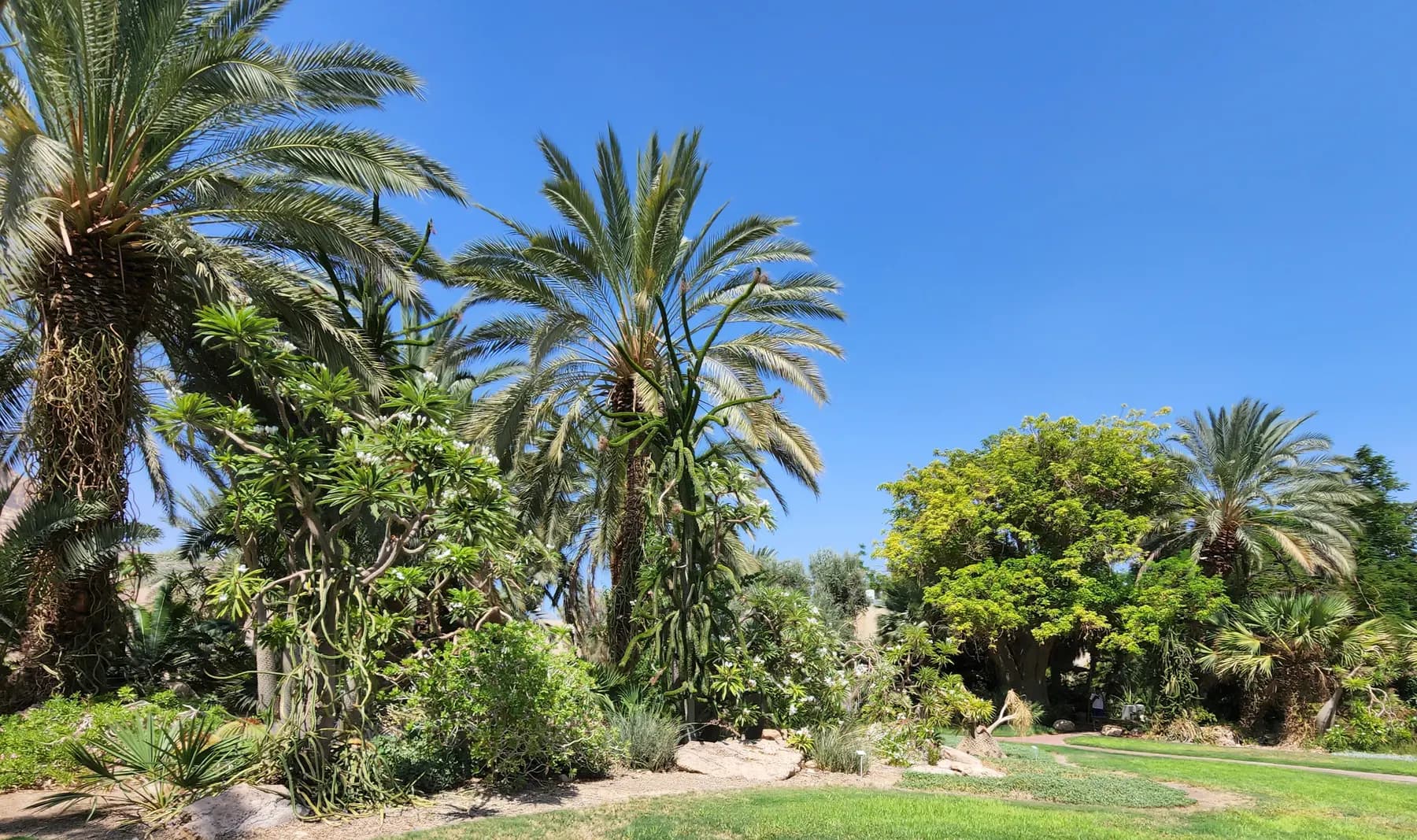
The Ein Gedi Botanical Garden is the grounds of a working kibbutz that were planted over seventy years and then catalogued as a botanical collection. It is not a park with a settlement beside it. The lawns, beds and specimen trees run between the houses, the dining hall, the hotel, the swimming pool and the cemetery of Kibbutz Ein Gedi, and the people who live there live inside the collection. That is the one genuinely unusual thing about it, and the academic history of the kibbutz puts it plainly: the garden is unique insofar as it encompasses a residential area.
It is also a ticketed attraction. An adult pays ₪20 at the entrance, a child, a soldier or a senior pays ₪15, and guests of the kibbutz hotel walk in without paying, all as the operator publishes on its own page. What the ticket buys is a walk of an hour or two through African baobabs, cacti and succulents from several deserts, tropical rainforest plants growing in the shade of the big trees, a group of palms, and a bed of perfume and incense species that nods at what Ein Gedi was farming two thousand years ago.
The garden has also become more important to the kibbutz than it was meant to be. Ein Gedi built its tourism on the Dead Sea: a campsite, a beach, a petrol station and a spa at the hot springs. The sinkholes and the retreating shoreline took most of that away, and the spa closed in the spring of 2020. In 2021 the manager of the kibbutz hotel told Haaretz that the sea was far less meaningful in what Ein Gedi now offers, and that people do not come to Ein Gedi for the Dead Sea. The garden is a large part of what replaced it.
The place
A collection with front doors in it
Kibbutz Ein Gedi stands on a plateau that slants from the hills in the west down towards the Dead Sea, just south of Nahal Arugot and above the oasis. The garden is the whole of that plateau: paths and kibbutz roads running between residential blocks, with planting on both sides. Visitors pay at the entrance and then walk the same routes the residents use to get to the dining hall.
This produces a visit that does not feel like other botanical gardens. There are no glasshouses and no walled compartments. Sections are defined by what happens to grow in a given aspect and how much water reaches it: heavy shade under old ficus and other broad canopies, dry beds of cactus and succulents in the open, palms along the roads, and the strip with a view where the ground drops away east towards the lake. The operator sets out an aroma garden of medicinal and fragrance plants drawn from the Bible, a rock display, a bird feeding area and the Ein Gedi Museum, which tells the kibbutz's own story and opens daily from 08:30 to 16:00.
Because it is inhabited, the garden is also maintained to a standard set by people who have to look at it every day rather than by a curatorial department. The Hebrew account of the garden lists the working problems bluntly: a shortage of water in the summer months, sun damage in the hottest hours, and the job of keeping a garden looking like a garden inside an active community.
The practical consequence is that the walking is easy by the standards of this coast. Nothing here resembles the boulder steps of Wadi David next door, and the shade under the oldest trees is the only reliable shade in Ein Gedi outside a building.
Origins
Eighty date palms into bare ground, April 1959
Nothing about this garden is old. Kibbutz Ein Gedi began as a NAHAL military outpost in 1953, down in the oasis near the ancient remains, and became a civilian kibbutz in 1956. In July 1959 it moved a few kilometres south to the plateau it occupies now, and that site was completely barren. Some 80 date palms were planted there in April 1959, a few months before the members relocated. That is the start of the garden.
The early planting was ordinary kibbutz landscaping, and it was ordinary in its aims: fast shade and soft lawn to set against the desert. The Hebrew record credits the first plan to Dov Bnayahu, whose son Dan Bnayahu was one of the founders of the kibbutz. Early choices included Delonix, which flowers red for half the year, date palms, native desert species and rose beds. The Delonix turned out to be a mistake: the trees grew too large, their roots threatened the foundations of buildings, and hard pruning ruined their shape, so their numbers were reduced over time.
What made the difference was that Ein Gedi's climate was of national scientific interest. In December 1960 the kibbutz received a consignment of desert trees from the Institute for the Study of the Negev, and other institutions in Israel began supplying samples from Australia, India, Madagascar, Africa, the Caribbean and the Americas to find out whether they would take. There was room for them because the shade thrown by the taller trees had killed off the grass in places. Many of the introductions failed against the heat or the strict water regime. Some did not.
The formal turn came in 1985, when the kibbutz gardeners established a working relationship with Dr Michael Avishai of the botanical garden of the Hebrew University of Jerusalem. Avishai and other Jerusalem specialists ran a long process of cataloguing more than 900 plant species across the kibbutz, and it was that catalogue that turned a kibbutz garden into a botanical garden. In the early 1990s, as visitors began arriving specifically to see it, the kibbutz decided to charge a small fee at the entrance. In 1994 the garden was entered on the register of Botanic Gardens Conservation International.
Collections
Baobabs, thirty palms and a rainforest floor in the shade
The headline plants are the baobabs. The Hebrew description groups them as giant trees of the Bombacaceae, the African baobab among them, and the operator places them where the ground opens towards the Dead Sea, near the cafe named after them. A baobab in fruit, in a desert, above a lake that is 300 metres lower than sea level, is the image most people take away from this garden.
The rest of the collection sorts itself by water and light rather than by continent. In the open ground there are cacti and other succulents from desert regions; the garden's entry in the Botanic Gardens Conservation International database claims an adjacent cactus park with over 1,000 cacti and desert plants, and about 30 varieties of palm across the site. In the permanent shade under the heavy canopies there is rainforest floor planting: pothos, monstera, colocasia, philodendron and others, which survive there only because they are watered and because the big trees have made a microclimate that does not exist anywhere else at this latitude on this shore.
Two groups are deliberate arguments rather than displays. The first is the Israeli planting: olive, pomegranate and fig, growing beside tropical species from Madagascar, Australian trees and African palms, which is the operator's own way of describing the garden. The second is the bed of perfume and incense plants, which the Hebrew account describes as a memorial to the local agricultural culture of two thousand years ago. Ein Gedi's ancient wealth came from balsam and aromatic crops, and the garden's tour of that bed is built around the biblical perfume plant.
A visitor should not expect labelling on the scale of a university garden. Self-guided maps are handed out at the hotel reception in Hebrew, English and Russian, guided tours run in Hebrew and English, and the garden sells its own dates, organic silan and a cosmetics line, which is a reminder that this is a working agricultural community rather than a research institution.
- African baobabs and other giant trees of the Bombacaceae family
- Cacti and succulents from several deserts, with a separate cactus park alongside
- About 30 varieties of palm, alongside the date palms the kibbutz farms
- Tropical rainforest floor plants growing in the shade of the oldest canopies
- Perfume and incense species, referring to Ein Gedi's ancient balsam trade
- Olive, pomegranate and fig, the local planting, set among the imports
Checking
Which of the claims about this garden hold up
Almost nothing in this garden is native and none of it is old, which inverts the usual question at a Dead Sea site. The test here is not what survives and what was rebuilt, but which claims about the garden trace back to somebody who counted.
The uniqueness claim holds, with a caveat about who is making it. The 2022 microhistory of the kibbutz, published in the Journal of Israeli History by Nir Arielli of the University of Leeds, states that the garden is unique insofar as it encompasses a residential area. The garden's own entry in the Botanic Gardens Conservation International database says the same in stronger terms, and so does the English Wikipedia article on the kibbutz. The database entry is supplied by the institution it describes, so the independent weight here rests on Arielli.
The species count is consistent and the round number is not. More than 900 is what Arielli reports from the 1985 cataloguing, what Botanic Gardens Conservation International records, and what both the Hebrew and English encyclopaedia entries give. The operator's own pages say only hundreds of species. Figures of about 1,000 appear on travel listings without a count behind them. The area is given as 110 dunams by Arielli and as 100 dunams by the English encyclopaedia entry, and the two have not been reconciled.
Two claims should be treated with more caution. Tourism listings state that the National Geographical Society recognises the garden as the eleventh wonder of the world; no publication by the National Geographic Society carrying that designation could be found, the kibbutz's own pages do not make the claim, and the society's name is misspelled in the listings that do. And the garden is often described as sitting 400 metres below sea level, which is roughly the level of the lake rather than of the kibbutz: three public elevation models queried at the garden's coordinates in 2026 returned 295, 307 and 310 metres below sea level. The plateau is high ground by Dead Sea standards, which is why it has a view.
Context
Why a garden became the reason to stop at Ein Gedi
The garden was made for the residents. It ended up carrying the kibbutz. Ein Gedi spent the 1970s and 1980s building an economy on the lake below: a petrol station, a campsite, a tavern, a bathing beach and, from 1984, a new spa building at the hot springs, marketed in Denmark, West Germany and Switzerland. By 1974 the kibbutz was already earning more than 65 per cent of its income from things that were not agriculture.
The lake then withdrew from all of it. By 2017 spa visitors who wanted to bathe had to be driven more than 1.3 kilometres to reach the water, over ground thought to be at risk from new sinkholes. The spa closed in the spring of 2020. The Israeli account of the kibbutz records a road diverted, a newly built bridge abandoned on safety grounds and the campsite shut, all for the same reason. What is left within walking distance of a visitor's car is the nature reserve, the antiquities and the garden.
Tom Geva, who manages the kibbutz hotel that grew out of the guesthouse of the 1960s, put the position to Haaretz in 2021: the sea is far less meaningful in the package Ein Gedi now offers, there is no access to the sea in the area because of the sinkholes and the retreating shoreline, and his job is to build a programme for an audience that will not find the sea. Read that way, the ₪20 ticket is not a garden entry fee so much as the current shape of a settlement economy.
The garden's own supply is not guaranteed either. It is watered from the springs of the oasis, and the kibbutz's use of that water has been contested. In 2001 the Haaretz journalist Neri Livneh contrasted the flourishing kibbutz with drying springs and a nature reserve in trouble, quoting the wildlife expert Uzi Paz against drawing water straight from the Ma'ayan Ein Gedi spring rather than downstream. In 2006 the Society for the Protection of Nature campaigned against the kibbutz's mineral water plant taking more from those springs. Both disputes concern the flow that keeps the lawns green.
What to look for
Things not to walk past at Ein Gedi Botanical Garden
The details that repay knowing about before you are standing in front of them.
The baobabs above the lake
African baobabs and their relatives in the Bombacaceae are the garden's signature planting, set where the plateau opens east towards the Dead Sea. The cafe beside them is named for them.
The rainforest floor under the old canopies
Pothos, monstera, colocasia and philodendron growing outdoors in one of the driest places in Israel, in permanent shade thrown by trees planted in the 1960s. They exist because the shade killed the lawn and the gardeners filled the gap.
The perfume and incense bed
Aromatic and medicinal species planted as a reference to the balsam trade that made ancient Ein Gedi rich. The garden runs a tour of it built around the biblical perfume plant.
The cactus and succulent ground
Dry beds of cacti and other succulents from several deserts, with a cactus park alongside that the garden's database entry credits with over 1,000 cacti and desert plants.
The Ein Gedi Museum
A small museum inside the garden on how the kibbutz was built and lived in, from the isolated years to the present, open daily from 08:30 to 16:00.
The tractor tour
A trailer behind a tractor, ₪35 for an adult and ₪25 for a child aged 3 to 12, booked in advance at the garden office. It is the only way to cover the whole plateau without walking it.
The long view
Ein Gedi Botanical Garden, in order
1953
A NAHAL outpost is established at Ein Gedi, in the oasis beside the ancient remains, a few kilometres from the Jordanian border.
1956
The outpost becomes a civilian kibbutz. In the same year the assembly votes against opening a guesthouse, on the grounds that tourism would distort the kibbutz's character.
April 1959
Some 80 date palms are planted on the barren plateau south of Nahal Arugot, a few months before anyone moves there. This is the beginning of the garden.
July 1959
The kibbutz relocates from the oasis to the plateau. Shade trees and lawns follow in the early 1960s, as at any other kibbutz of the period.
December 1960
The kibbutz receives a consignment of desert trees from the Institute for the Study of the Negev. Israeli institutions begin using Ein Gedi to test whether species from Australia, India, Madagascar, Africa, the Caribbean and the Americas will grow here.
1985
The kibbutz gardeners formalise a relationship with Dr Michael Avishai of the botanical garden of the Hebrew University of Jerusalem. He and other specialists catalogue more than 900 species across the kibbutz.
Early 1990s
Visitors start coming for the garden itself, and the kibbutz begins charging an entrance fee and offering guided tours.
1994
The garden is entered on the register of Botanic Gardens Conservation International.
1997
The kibbutz opens a plant to bottle water from the Ein Gedi spring, which becomes a long-running controversy about a public resource and about the oasis the garden is watered from.
Spring 2020
The Ein Gedi spa at the hot springs closes. By 2017 bathers had already needed a vehicle to cover the 1.3 kilometres to the water.
April 2022
AHAVA opens a factory and visitor centre at Ein Gedi with 100 employees, adding another non-agricultural leg to the kibbutz economy.
Practical
Visiting Ein Gedi Botanical Garden
Where
Kibbutz Ein Gedi, off Route 90 on the western shore of the Dead Sea, about two kilometres south of the Ein Gedi Nature Reserve entrance
What ticket you need
The garden is the kibbutz, so the ticket is effectively admission to an inhabited settlement: the paths pass front doors, washing lines and parked bicycles, and residents are going about a normal day. The Ein Gedi Nature Reserve and the En Gedi antiquities, including the ancient synagogue, are separate sites run by the Israel Nature and Parks Authority a couple of kilometres north, with their own gates and their own tickets. Neither ticket covers the other, and a great many visitors arrive expecting one and buy the other.
Opening hours
Admission
- Adult, 13 to 65
- ₪20source
- Child 3 to 12, senior, soldier, disabled visitor, Matmon card holder, security service employee, guest of the Ein Gedi hostel or field school
- ₪15source
- Guests of the Ein Gedi hotel
- No charge, and guided tours of the garden and the nature reserve are includedsource
- Tractor tour
- ₪35 adult, ₪25 child aged 3 to 12, prior registration required, availability limitedsource
- Groups
- Priced on application to the garden officesource
Access
Easier than anything else at Ein Gedi, but not step-free by design. The garden is laid out along the kibbutz's own paved roads and paths, so there is no scrambling and no boulder staircase of the kind the nature reserve is built on. It is not flat: the kibbutz sits on a plateau that slants from the hills in the west down towards the lake, so a circuit means going down and coming back up, and the ground between the beds is lawn, gravel and packed earth rather than path. The operator publishes no wheelchair route, no gradient information and no accessible-toilet list for the garden, and its accessibility statement covers the hotel rather than the grounds. A pushchair is fine on the roads. A manual wheelchair would want a strong pusher and the freedom to turn back. The tractor tour means climbing up into a trailer.
On site
- Ticket desk at the garden entrance
- Ein Gedi Museum
- Cafe by the baobabs, plus the hotel restaurants
- Shop selling dates, organic silan and the garden's cosmetics line
- Self-guided maps in Hebrew, English and Russian at hotel reception
- Guided tours in Hebrew and English
- Swimming pool and spa at the hotel
- Deep shade under the older trees
- Parking on the kibbutz
Booking
Nothing needs booking for a walk round: pay at the entrance and pick up a self-guided map at the hotel reception. The tractor tour must be registered in advance on +972 8 659 4726 and the operator describes availability as limited. Guided tours, the perfume garden tour, the shibori dyeing workshop and the Pilates class held under a large ficus are arranged through the garden office on 052 531 8968 or by email. Hotel guests get guided tours of both the garden and the nature reserve at no extra cost, usually at weekends, with private tours arranged midweek.
Hours and prices are given as the operator publishes them and change without much notice, particularly around Shabbat and the festivals. Check the operator's own page before you travel for this.
Official page at ngedi.co.il →What people wish they had known
- Do not confuse this with the Ein Gedi Nature Reserve. The reserve is a couple of kilometres north with its own gate and its own ticket from the Israel Nature and Parks Authority, and the garden ticket buys nothing there. People routinely arrive at the kibbutz meaning to walk to a waterfall.
- Check the hours before setting off, because the operator publishes two versions. Its English page gives 08:30 to 16:00 with an early Friday close; its Hebrew page, updated more recently, gives 08:00 to 17:00 in summer and 08:00 to 16:00 in winter. Telephone the garden if the difference matters to the plan.
- Go early or late. This is a hot desert climate with about 50 millimetres of rain a year, and the middle of a summer day on an open plateau is not the way to see a garden. The old trees are the only serious shade.
- Say at the desk if the kibbutz hotel is where the night is booked. Hotel guests tour the garden at no charge and get guided tours of the nature reserve as well, so paying at the entrance is money thrown away.
- Book the tractor tour before arriving, not on the day. It runs by prior registration on +972 8 659 4726 and the operator describes availability as limited.
- Treat it as a place people live. The route passes private homes and gardens, and quiet behaviour and closed gates matter more here than at a ticketed park with no residents.
The figures
Ein Gedi Botanical Garden by the numbers
Each figure carries the year it belongs to and links the source it came from.
| Measure | Figure | As of | Source |
|---|---|---|---|
| Plant species catalogued across the kibbutz | more than 900 | 1985 | eprints.whiterose.ac.uk |
| Area of the garden | 110 dunams, in the academic history of the kibbutz | 2022 | eprints.whiterose.ac.uk |
| Area of the garden, the other published figure | 100 dunams (10 hectares, 24.7 acres) | 2026 | en.wikipedia.org |
| Date palms planted on the bare plateau | about 80, in April 1959 | 1959 | eprints.whiterose.ac.uk |
| Population of Kibbutz Ein Gedi | 718 | 2024 | en.wikipedia.org |
| Palm varieties in the collection | about 30, per the garden's own database entry | 2026 | tools.bgci.org |
| Adult admission | ₪20, with ₪15 for children, seniors and soldiers | 2026 | ngedi.co.il |
| Ground elevation at the garden | 307 m below sea level on SRTM and 310 m on ASTER | 2026 | api.opentopodata.org |
While you are here
The rest of The Dead Sea
Everything else in this destination with a page of its own.
In-bar / CC BY-SA 4.0 · Wikimedia Commons
Nature reserve
Ein Gedi Nature Reserve
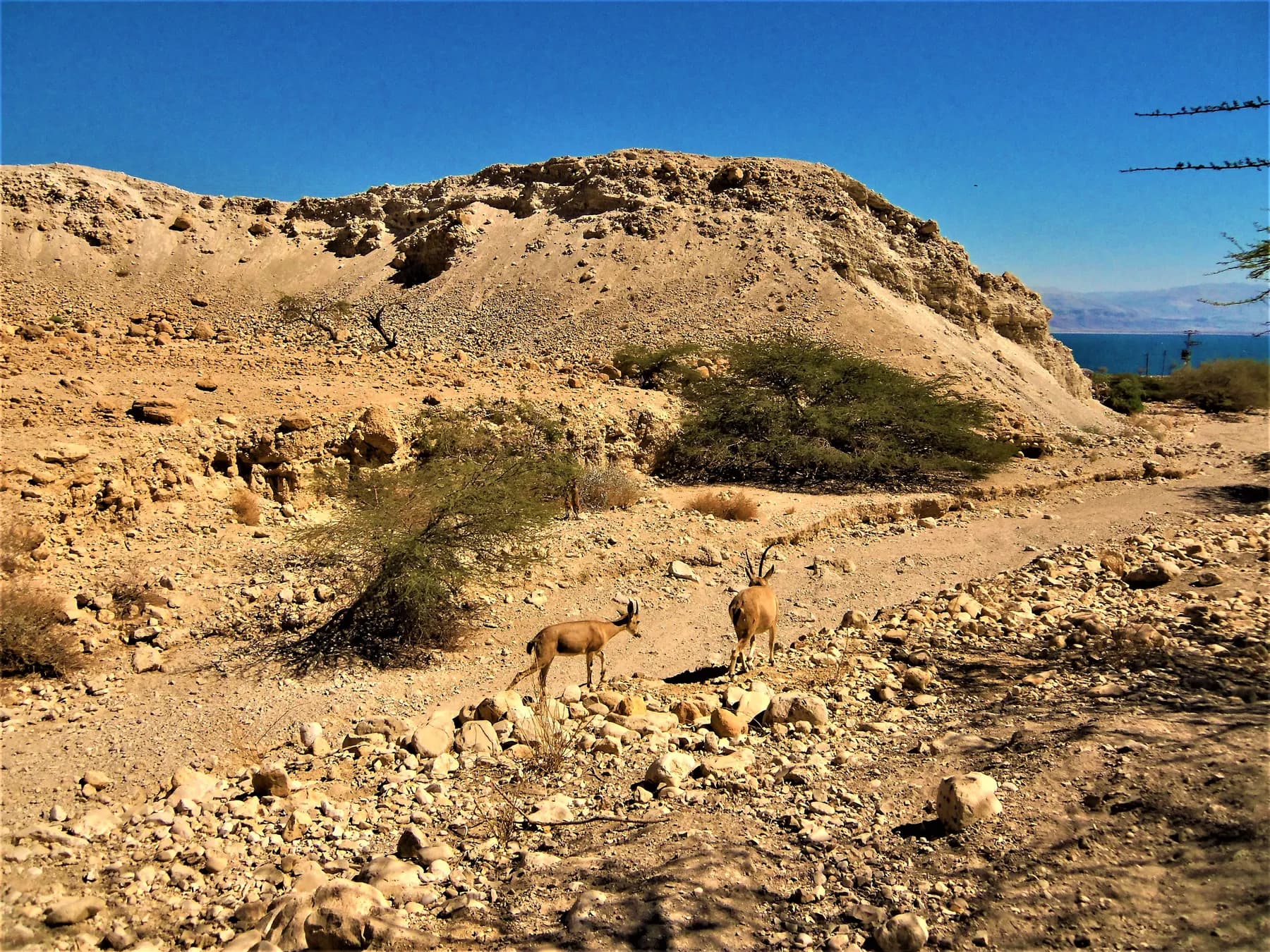
Four springs push about three million cubic metres of fresh water a year through two desert canyons here, and the parks authority has been rebuilding the trails between them since a flood tore through the reserve in May 2025.
ישראל פרקר Israel Preker / CC BY 2.5 · Wikimedia Commons
Archaeological site
Ein Gedi Ancient Synagogue
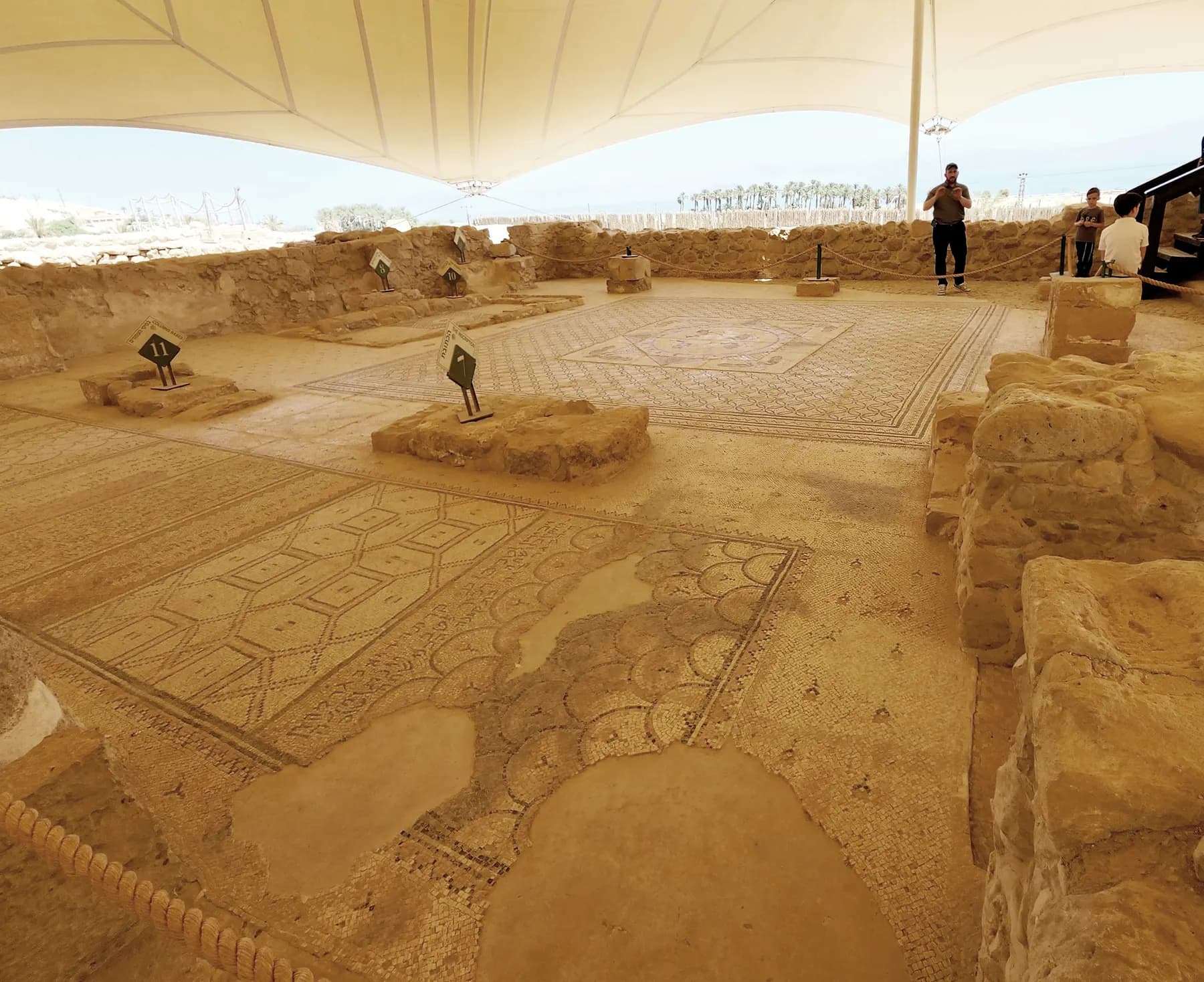
The mosaic floor of this village synagogue carries a Judeo-Aramaic curse on anyone who reveals the secret of the town, and the parks authority's own brochure suggests the secret was how to grow and process balsam.
DinaKuzia / CC BY-SA 4.0 · Wikimedia Commons
Nature reserve
Einot Tzukim (Ein Feshkha) Nature Reserve
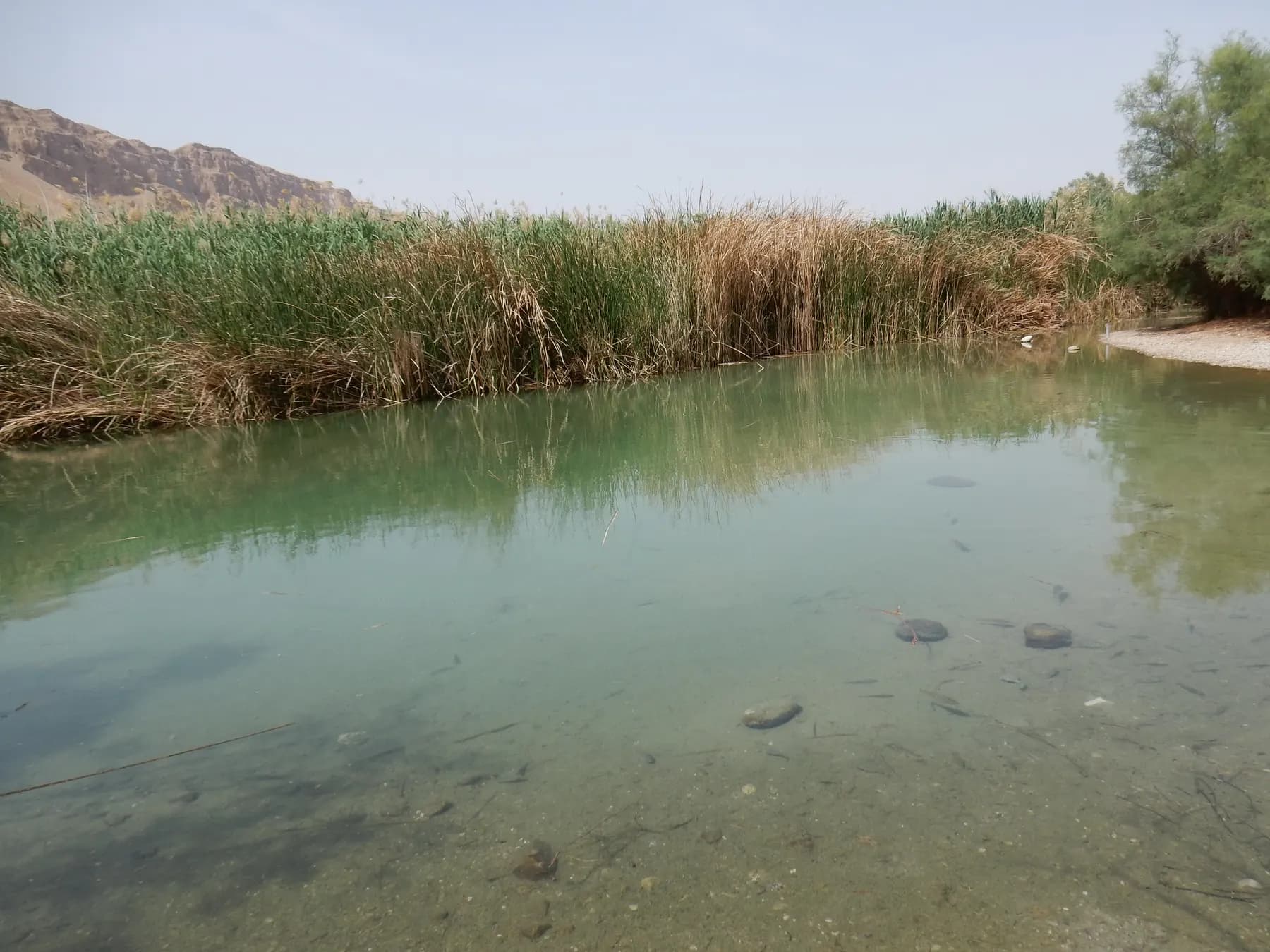
Brackish springs surface at the foot of the escarpment here and run into pools you can get into, and the Israel Nature and Parks Authority puts the point where they emerge at 390 metres below sea level.
Sources and further reading
Every link below was opened and checked when this page was written. Official statements are marked as such: they are the subject's own account, not an independent one.
- OfficialKibbutz Ein Gedi Hotelngedi.co.ilThe Ein Gedi Botanical Garden
The operator's English page: admission of ₪20 and ₪15, free entry for hotel guests, the tractor tour at ₪35 and ₪25 with prior registration, opening hours of 08:30 to 16:00 with an early Friday close, and the description of the planting.
- OfficialKibbutz Ein Gedi Hotelngedi.co.ilגן בוטני עין גדי (Ein Gedi botanical garden, general information)
The Hebrew page, last updated in March 2026, which gives every day 08:00 to 17:00 in summer and 08:00 to 16:00 in winter, the garden office telephone number, and free guided tours for hotel guests.
- OfficialKibbutz Ein Gedi Hotelngedi.co.ilמה בגן הבוטני (What is in the botanical garden)
The garden's sections: the aroma garden of biblical medicinal and fragrance plants, the rock display, the bird feeding area, the baobabs and the cafe named for them, and the Ein Gedi Museum with its daily 08:30 to 16:00 hours.
- OfficialKibbutz Ein Gedi Hotelngedi.co.ilסיפורו של גן (The story of a garden)
The kibbutz's own account of how the garden was made: the aim of shade and lawn, the saline rocky ground, the Delonix that had to be reduced, the shift to drought-tolerant species, the tropical understorey planting, the self-seeded papayas and the division of the garden into maintenance zones.
- OfficialKibbutz Ein Gedi Hotelngedi.co.ilסיורים וסדנאות (Tours and workshops)
Self-guided maps in Hebrew, English and Russian at reception, guided tours in Hebrew and English, the perfume garden tour built around the biblical perfume plant, the shibori dyeing workshop and the Pilates class under the large ficus.
- ReportingDead Sea Land, Tamar Regional Councildeadsealand.org.ilBotany is blooming in Kibbutz Ein Gedi
The regional tourism body's account of the garden, including the claim that it is the only botanical garden of its kind that is inhabited. Its dates for the founding of the kibbutz do not match the scholarly record and are not used here.
- ReportingKibbutzVisitkibbutzvisit.comKibbutz Ein Gedi listing
Cited only as an example of the eleventh wonder of the world claim, which it attributes to the National Geographical Society without a reference and which the kibbutz's own pages do not make.
- DataBotanic Gardens Conservation Internationaltools.bgci.orgDead Sea Ein Gedi Botanic Garden, GardenSearch entry 2258
The garden's register entry, supplied by the institution: year of establishment given as 1994, more than 900 species, about 30 palm varieties, an adjacent cactus park with over 1,000 cacti and desert plants, and the claim that residents live within the grounds.
- DataOpen Topo Dataapi.opentopodata.orgElevation query at 31.4517, 35.3853 (SRTM 30 m)
Returns 307 metres below sea level at the garden. The ASTER 30 m dataset at the same point returns 310 metres below sea level.
- DataOpen-Meteoapi.open-meteo.comElevation API query at 31.4517, 35.3853 (Copernicus DEM)
Returns 295 metres below sea level at the garden, the third of the three models used to check the widely repeated claim that the garden sits 400 metres below sea level.
- ReferenceNir Arielli, Journal of Israeli Historyeprints.whiterose.ac.ukLand, water and the changing Dead Sea environment: a microhistory of Kibbutz Ein Gedi
The scholarly account: the NAHAL outpost of 1953, the July 1959 move to the barren plateau, the 80 date palms of April 1959, the desert trees from the Institute for the Study of the Negev in December 1960, the 1985 cataloguing with Dr Michael Avishai of the Hebrew University, the figure of 110 dunams, the entrance fee introduced in the early 1990s, the spa's closure in spring 2020 and the 2021 Haaretz interview with the hotel manager Tom Geva.
- ReferenceWikipediaen.wikipedia.orgEin Gedi (kibbutz)
The kibbutz founded in 1953, a population of 718 in 2024, the 100 dunam garden with over 900 species registered with Botanic Gardens Conservation International in 1994, the sinkhole damage that closed the campsite and the spa, the 1997 bottling plant, the AHAVA factory of April 2022 and the hot desert climate with about 50 millimetres of rain a year.
- ReferenceHebrew Wikipediahe.wikipedia.orgהגן הבוטני בעין גדי (The botanical garden at Ein Gedi)
About 900 species suited to the hot dry climate, the first plan credited to Dov Bnayahu whose son Dan Bnayahu was a founder of the kibbutz, the working problems of summer water shortage and sun damage, and the collections: cacti and succulents, rainforest floor planting, giant Bombacaceae including the African baobab, and perfume and incense plants recalling the local agriculture of two thousand years ago.
Ein Gedi Botanical Garden: common questions
Is the Ein Gedi Botanical Garden the same as the Ein Gedi Nature Reserve?+
No, they are different sites with different owners and separate tickets. The botanical garden is the grounds of Kibbutz Ein Gedi and is run by the kibbutz. The nature reserve, with Wadi David, Wadi Arugot and the En Gedi antiquities, is a couple of kilometres north and is run by the Israel Nature and Parks Authority. Neither ticket is valid at the other.
How much does the Ein Gedi Botanical Garden cost?+
The operator publishes ₪20 for an adult aged 13 to 65 and ₪15 for a child aged 3 to 12, a senior, a soldier, a disabled visitor, a Matmon card holder, a security service employee or a guest of the Ein Gedi hostel or field school. Guests of the kibbutz hotel pay nothing. Groups are quoted on application. The tractor tour is charged separately at ₪35 for an adult and ₪25 for a child.
What are the opening hours?+
The operator's English page gives 08:30 to 16:00 on Sunday to Thursday and Saturday, and 08:30 to 14:00 on Friday. Its Hebrew page, which carries a more recent update, gives every day of the week at 08:00 to 17:00 in summer and 08:00 to 16:00 in winter. The two have not been reconciled, so the safe assumption is the shorter English window, or a telephone call to the garden office.
Is it really the only botanical garden with people living in it?+
That is the claim, and the strongest support for it is independent. The academic microhistory of the kibbutz, published in the Journal of Israeli History in 2022, says the garden is unique insofar as it encompasses a residential area. The entry in the Botanic Gardens Conservation International database says the same, but that entry is supplied by the garden itself, so it is not a second opinion. Roughly 718 people were living inside the boundary in 2024.
How many plants are there, 900 or 1,000?+
More than 900 is the figure that traces to an actual count. It comes from the cataloguing carried out from 1985 by Dr Michael Avishai of the botanical garden of the Hebrew University of Jerusalem and other specialists, and it is what the reference works and the international database repeat. Figures of about 1,000 circulate on travel listings without a source. The operator's own pages say only that hundreds of species are grown.
Can you visit if you are not staying at the kibbutz hotel?+
Yes. The garden sells tickets at the entrance to anyone. Staying at the hotel simply removes the charge and adds free guided tours of the garden and of the nature reserve, usually at weekends, with private tours arranged midweek.
How long do you need, and is it worth it?+
About 90 minutes covers the garden at a walking pace, and half a day is realistic with the museum, the cafe and a guided tour. Whether it is worth it depends on what is expected: this is not a manicured research garden with labelled beds and glasshouses, it is seventy years of kibbutz planting that turned out to be a collection. The reason to go is the combination, which does not exist elsewhere, of baobabs and rainforest understorey growing on a desert plateau above the Dead Sea, in a place where people are living their ordinary lives among them.
Is there shade, and when is the best time of day?+
There is real shade, and it is the point of the older parts of the garden: the canopies planted in the 1960s throw enough shade to have killed the lawn beneath them and to support tropical understorey planting. It is still a hot desert site with roughly 50 millimetres of rain a year, so early morning or the last hours before closing are far better than the middle of the day, especially in summer.
Can you get into the Dead Sea from the kibbutz?+
Not any more. The Ein Gedi spa at the hot springs closed in the spring of 2020, and by 2017 bathers there already had to be driven more than 1.3 kilometres to reach the water across ground considered at risk from sinkholes. The kibbutz campsite and its beach have gone the same way. For floating, the supervised beaches are at Ein Bokek, well to the south.
Is it suitable for a wheelchair or a pushchair?+
A pushchair is fine on the kibbutz roads, which are paved. A wheelchair is harder than it looks: the plateau slopes down towards the lake, so a circuit involves a climb back, and the ground between the beds is lawn, gravel and packed earth. The operator does not publish a wheelchair route, gradients or an accessible-toilet list for the garden, so anyone who needs certainty should telephone the garden office before travelling.