Archaeological site · The Sea of Galilee
Kursi
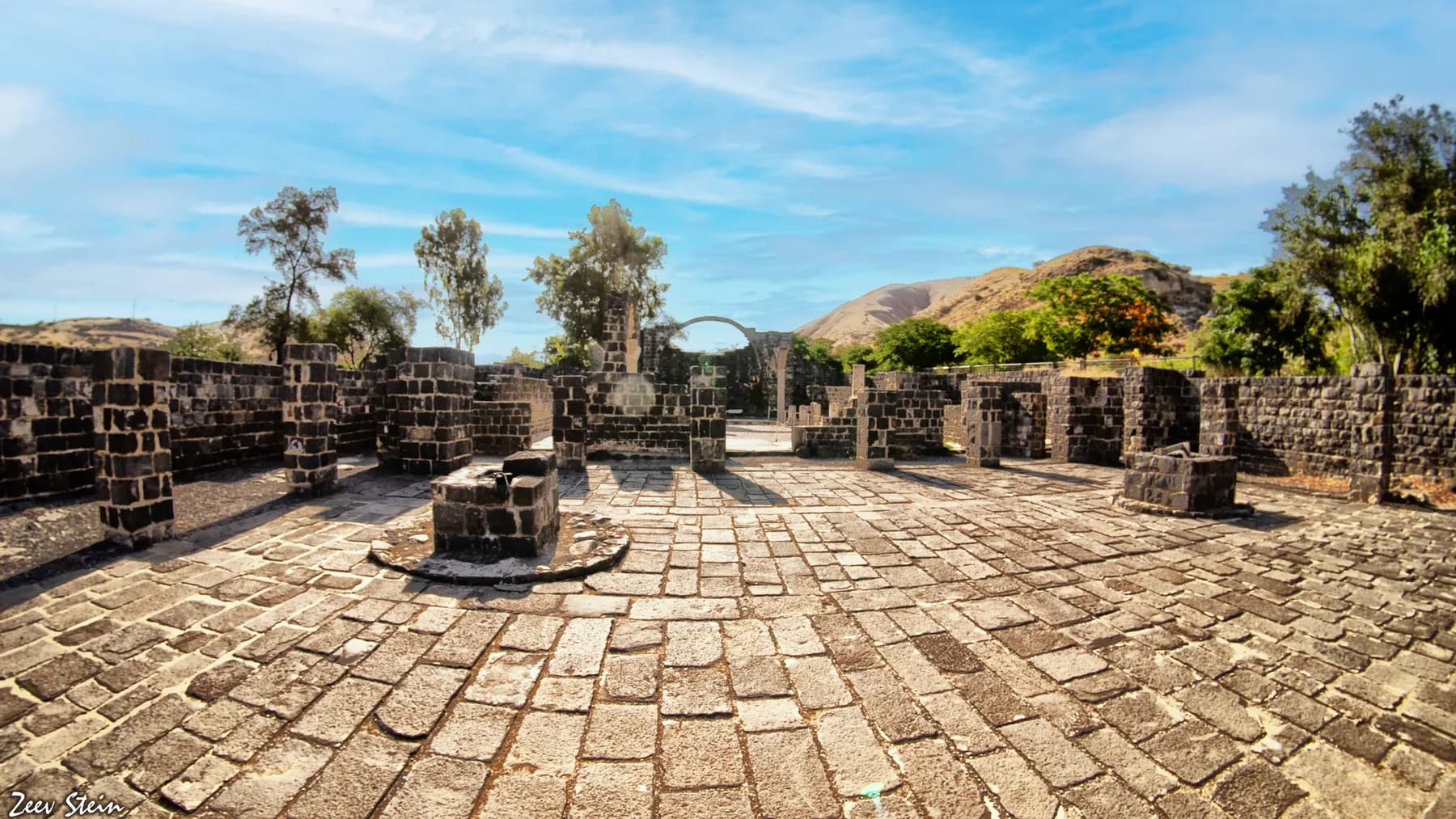
A bulldozer cutting a new road to the Golan hit its wall in 1970, and what came out was a walled Byzantine monastery of 145 by 123 metres that the parks authority calls the largest known in the Holy Land.
זאב שטיין / CC BY 2.5 · Wikimedia Commons
Walled enclosure
145 by 123 m
the Israel Nature and Parks Authority's brochure calls it the largest known Byzantine monastery in the Holy Land
The church
23 by 45 m
a basilica with two rows of six columns, per the parks authority; Wikipedia gives 24 by 45 m
Baptistery mosaic laid
585
the inscription on the room's threshold dates it to the reign of the emperor Maurice
Adult admission
16 ILS
the parks authority's published fee, read on 13 August 2026
In short
- How long to give it
- about 60 minutes for the compound, or 90 with the climb to the hillside chapel and a stop at the service centre
- Summer, Sunday to Thursday and Saturday
- 08:00 to 17:00
- Adult
- 16 ILS
כורסי
Kursi National Park preserves the walled remains of a Byzantine monastery on the eastern shore of the Sea of Galilee, where Nahal Samakh comes down out of the Golan. The Israel Nature and Parks Authority's own brochure describes it as the largest known Byzantine monastery in the Holy Land: an enclosure of 145 by 123 metres with a basilica at the centre, a bathhouse, an oil press, lodgings for pilgrims, and a watchtower over the gate that faced the water. Christian tradition puts the miracle of the swine here.
Nobody was looking for it. In 1970 a road crew cutting a new route towards the Golan turned up Byzantine pottery, and the excavation that followed, by Dan Urman and Vassilios Tzaferis of the Department of Antiquities and Museums, ran from 1971 to 1974. The site opened to the public in September 1982, having been shut to Christian pilgrimage since the ninth century.
What a visitor sees is a deliberate mixture, and the operator says so. The mosaic floors, the column bases, the oil press and the burial crypt are excavated original. The church walls standing to head height are not: the parks authority cleared the rubble and rebuilt them, so that the shape and the volume of a basilica can be read from inside it. Knowing which is which is most of the pleasure of the place.
Discovery
The road crew that found a monastery
Kursi had been out of the record for something over a thousand years. Arab settlers used the ruined church as houses and storerooms in the ninth century, according to the parks authority's brochure, and after that the place stopped functioning as a Christian pilgrimage site altogether. The pilgrim reference site See the Holy Land describes the rediscovery in 1970 as a matter of Byzantine pottery noticed in the trail of a bulldozer building a new road to the Golan Heights.
The dig that followed ran from 1971 to 1974 and was led by Dan Urman together with Vassilios Tzaferis, working for the state antiquities body. Tzaferis was born on Samos in 1936, renounced his Greek citizenship in 1964 to stay in Israel, and went on to be deputy director and then director of the Israel Antiquities Authority's Division for Surveys and Excavations before retiring in 2001. He died on 1 January 2015. Kursi is one of the excavations his obituaries list alongside Beth She'an, Tel Dan and Capernaum.
Work has continued in bursts since. A separate excavation in 1980 dug around a prominent boulder on the slope east of the church and found a small chapel beside it. Between 2011 and 2013 a bathhouse came out of the ground north of the church. The most consequential recent find is not inside the park at all, and is dealt with at the end of this page.
The ruins
What is original, and what was put back
The monastery sat inside a rectangular stone wall of 145 by 123 metres. The gate faced the lake and had a watchtower beside it; a paved road ran down from the shore to the gate, and from the gate a paved street led to the church. A pilgrim arriving by boat therefore walked uphill through a controlled sequence, with the bathhouse on the northern side of the entrance before the church at the centre.
The church is a basilica of about 23 by 45 metres, divided by two rows of six columns each into a nave and two aisles. The stone columns carried Corinthian marble capitals cut with crosses. Beneath the position of the altar the excavators found a small stone box for relics. There is a single apse with rooms on either side of it; a room on the northern side holds an oil press, which the parks authority reconstructed along with the lower church.
The southern room off the apse was the baptistery, used for baptising infants, and its threshold carries the mosaic inscription that dates the floor to the year 585, in the reign of the emperor Maurice. The parks authority's brochure puts the construction of the baptistery at the end of the sixth century, which fits. A staircase from the southern end of the narthex, closed to visitors, drops to a burial crypt: the parks authority reports the remains of 30 men there, probably the monastery's own priests.
Smaller things are worth finding. The atrium is largely built over a large cistern and the two well heads give it away. Along the northern stretch of the enclosure wall the excavators exposed dwellings, courtyards and drainage channels, the domestic half of a complex that housed not only monks but, on the parks authority's reading of the evidence, a Christian community that kept itself apart from the Jewish settlement on the shore nearby.
- Original: the mosaic floors, the column bases and capitals, the oil press, the crypt, the cistern and the wall footings
- Reconstructed: the lower church and its oil press, and the enclosure walls, cleared of rubble and rebuilt
- Closed to visitors: the stair down to the burial crypt, and the ladder into the cistern under the atrium
- Outside the fence: the harbour breakwater and the possible synagogue at Kursi Beach
Mosaics
The floor where the animals were scratched out
The nave floor is geometric. The interest is in the aisles, where the mosaic ran to medallions of local plants and animals, and where somebody later went along the floor removing the living creatures. Cockerels, geese, doves, cormorants and several kinds of fish are listed among the original subjects. Some survive well enough to be identified. Many do not, because the figures were deliberately picked out.
The plants came off better, and that asymmetry is the point: citrons, figs, pomegranates, dates and bunches of grapes are still legible where the birds beside them are not. One panel shows a basket set between a pair of doves. The parks authority notes the dove's Christian associations, the Holy Spirit and the purity of Mary among them.
Who defaced the floor, and when, is not settled. The parks authority's brochure attributes it to the ninth-century Arab settlers who were living in the ruins, and calls them probably responsible. See the Holy Land instead places the obliteration at the abandonment of the monastery in the early eighth century. The evidence on the floor shows only the selectivity, not the hand.
One absence is conspicuous. Nothing in the mosaics depicts the miracle of the swine, and the parks authority's Hebrew page says there is not even a hint of one, while allowing that such a panel may have existed and been destroyed, or may simply not have been found yet. A site built to commemorate an event did not, so far as anyone can now see, put the event on its floor.
The hillside
The boulder, the tower and the cave above the church
Christian tradition does not localise the miracle in the church. It localises it on the slope above, at a large boulder east of the compound, and that is where the 1980 excavation went. It found a small chapel wedged between the hillside and the rock, its apse built into a cave, along with remains of what may have been a tower raised around the boulder itself.
Three distinct layers of mosaic floor were excavated under the chapel, which means the spot was refloored twice and mattered for a long time. See the Holy Land reports crosses in the earliest of those floors and takes them as evidence that it was laid before 427, when crosses on church pavements were prohibited. That would make the rock older as a venerated place than the monastery below it.
The parks authority calls it simply the Holy Rock, and links the cave to the place where the possessed man is said to have come out to meet Jesus. The chapel is on rough ground above the excavated compound and is a short climb from the level part of the site.
The Gospel
Gerasenes, Gadarenes or Gergesenes
The episode Kursi commemorates is told three times, in Mark 5, Matthew 8 and Luke 8, and the three accounts do not agree with each other. The country is that of the Gerasenes in Mark, the Gadarenes in Matthew and the Gergesenes in Luke, with further variation between ancient manuscripts of the same gospel. Mark and Luke have one possessed man; Matthew has two.
The parks authority's brochure identifies the site with Gergessa or Gerasa, quoting the phrase about the country of the Gadarenes which is over against Galilee, and adds that archaeologists identify the place as the ancient Kursi named in the Talmud as a centre of idol worship. The modern name of the site is therefore the Talmudic one, not the Gospel one.
None of this settles where the event was believed to happen in the first century, only where it was being commemorated by the fifth. A Byzantine monastery of this size on this shore is strong evidence for a well established local tradition. It is not evidence for a location.
Outside the park
The marble slab of 2015, and a lake that fell further than it does now
In November and December 2015 an excavation at Kursi Beach, about a kilometre north-west of the national park, opened the south-western corner of a public building on the lake shore that its excavators thought might be a synagogue. It had a raised platform of roughly two square metres, aligned east to west, built with limestone slabs reused from an arch. The dig was directed by Haim Cohen with Michal Artzy and reported in the Israel Antiquities Authority's excavation journal under permit G-88/2015.
Inside the building lay a marble slab, broken but largely recoverable, measuring 1.25 metres by 0.7 and 8 centimetres thick, carrying eight lines of Hebrew and Aramaic. The text opens with a phrase meaning to be remembered in good memory and closes with amen. The excavators recorded it as the first of its kind found in Israel. Haggai Misgav of the Hebrew University, quoted by the Times of Israel, read it as a standard dedicatory synagogue inscription and compared the letter forms to the Trumpeting Place inscription from the Temple Mount.
Pottery and coins from the building run from the Byzantine period into the early Abbasid, in the seventh and eighth centuries, and the excavators concluded that Kursi was part of a Jewish settlement through the Byzantine, Umayyad and early Abbasid periods. A Christian pilgrimage monastery and a Jewish village were sharing this stretch of shore. In Area A the same project recorded a harbour breakwater standing about 2.5 metres high, its large basalt blocks laid diagonally on the seaward face and vertically on the inner one.
An earlier survey off the same beach is worth knowing about for a different reason. In the autumn of 2000 Ehud Galili and colleagues found the foundations of a small building, 2.5 metres square, lying at 213.5 to 214.1 metres below sea level. Radiocarbon on wood and grain in its mortar gave a calibrated date of 530 to 660, and the plaster showed it had been built on dry land, which means the lake had at some point fallen to 215 metres below sea level or lower. None of these three sites is inside the ticketed park, and there is nothing built for visitors at any of them.
What to look for
Things not to walk past at Kursi
The details that repay knowing about before you are standing in front of them.
The inscription that dates the floor
On the threshold of the baptistery, a mosaic inscription records that the floor was laid in the year 585, in the reign of the emperor Maurice. It is the one hard date the building supplies about itself.
The defaced aisle mosaics
Birds and fish picked out of the pavement while the citrons, figs, pomegranates and grape bunches beside them were left alone. The selectivity is visible from standing height and is the most eloquent thing on the site.
The Holy Rock and its chapel
A boulder on the slope east of the compound, with a small chapel squeezed between it and the hillside and its apse built into a cave. Three layers of mosaic floor were found beneath it.
The oil press and the crypt stair
A working oil press in a room off the northern aisle, reconstructed by the parks authority, and the sealed staircase from the narthex down to the crypt where the remains of 30 men were found.
The sand box that prints the story
A large rotating drum set in a sand box that visitors turn to press the New Testament account of the swine miracle into the sand in several languages. It is aimed at children and works on adults.
The bench
A wooden bench that the parks authority lists among the park's points of interest on the strength of a reputation for a calming effect on the people who sit on it. Make of that what you like; it is a good place to sit.
The long view
Kursi, in order
5th century
The monastery and its basilica are built on the eastern shore, inside a stone wall of 145 by 123 metres, with a watchtower at the lakeward gate and a paved road down to the water.
Before 427 (proposed)
The earliest of the three mosaic floors in the hillside chapel is laid, dated by See the Holy Land from the crosses in it, which were prohibited on church pavements after that year.
585
The mosaic floor of the baptistery is laid, according to the inscription on its threshold, in the reign of the emperor Maurice. The parks authority puts the room's construction at the end of the sixth century.
614
The Sasanian invasion damages the church and destroys many of the other buildings; the settled area shrinks. The church is later rebuilt.
Early 8th century
The church is destroyed. The parks authority's brochure says it was razed by fire at the beginning of the eighth century; Wikipedia attributes the final destruction to the earthquake of 749. The two accounts have not been reconciled here.
9th century
Arab settlers live in the ruins and use them for storage. Kursi ceases to function as a place of Christian pilgrimage, and the mosaic figures are defaced at some point around this time.
1970
A bulldozer cutting a new road towards the Golan turns up Byzantine pottery and the buried monastery with it.
1971 to 1974
Dan Urman and Vassilios Tzaferis excavate the complex for the state antiquities body, uncovering what the parks authority calls the largest known Byzantine monastery in the Holy Land.
1980
A separate excavation around the boulder on the hillside east of the church finds a small chapel with its apse built into a cave, and three layers of mosaic beneath it.
September 1982
Kursi opens to the public, with the lower church, its oil press and the enclosure walls reconstructed by the Israel Nature and Parks Authority.
September to November 2000
An underwater survey off Kursi Beach records the foundations of a small building at 213.5 to 214.1 metres below sea level, radiocarbon dated to 530 to 660 and built on what was then dry land.
2011 to 2013
Excavation north of the church exposes a bathhouse. The parks authority's own page lists it under the late Roman period in one place and dates it to the Byzantine period in another.
November to December 2015
At Kursi Beach, about a kilometre north-west of the park, Haim Cohen and Michal Artzy uncover a public building, possibly a synagogue, with a marble slab bearing eight lines of Hebrew and Aramaic.
Practical
Visiting Kursi
Where
Kursi (Gerassa) National Park, eastern shore of the Sea of Galilee. From Kursi junction on Route 92, 5 km north of Ein Gev, turn east and continue about 50 metres to the signposted turnoff.
What ticket you need
Kursi is a national park in its own right with its own gate and its own ticket, not a free-to-enter site inside a bigger park, and a parks authority subscription or an Israel Pass is what makes entry free rather than a Sea of Galilee ticket of any kind. The reverse trap matters more: the harbour breakwater and the possible synagogue with the 2015 marble inscription are at Kursi Beach, roughly a kilometre north-west, outside the fence, and your ticket does not cover them because there is nothing ticketed there to cover.
Opening hours
- Summer, Sunday to Thursday and Saturday
- 08:00 to 17:00source
- Summer, Friday and holiday eves
- 08:00 to 16:00source
- Winter, Sunday to Thursday and Saturday
- 08:00 to 16:00source
- Winter, Friday and holiday eves
- 08:00 to 15:00source
- Rosh Hashanah eve, Passover eve and Yom Kippur eve
- 08:00 to 13:00source
- Last entry
- One hour before the closing time listed, on every day of the weeksource
- Telephone
- 04-6731983, or the parks authority information centre on *3639source
Admission
- Adult
- 16 ILSsource
- Child
- 7 ILSsource
- Student
- 14 ILSsource
- Israeli senior citizen
- 8 ILSsource
- Adult in a group
- 14 ILSsource
- Child in a group
- 6 ILSsource
- Parks authority subscription and the Israel Pass
- Kursi is one of the sites the parks authority's own subscription covers for unlimited free entry, as its Kursi brochure states, and the park page carries the Israel Pass badge. Check what your pass includes before relying on itsource
Access
Better than most excavated sites, up to a point that the parks authority states precisely. From the accessible parking there is a concrete path to the entrance of the national park. The authority lists as accessible the entrance foyer, the toilets, the concrete path that runs as far as the entrance to the antiquities, a concrete gathering and prayer plaza outside the antiquities, benches, a drinking fountain and directional signage. Note where that list stops: the made path reaches the entrance to the excavated area rather than running through it, so the church floor, the aisles and the crypt stair are on ancient paving with thresholds and low walls. The chapel by the boulder is higher up the slope on rough ground and is not on the accessible route. The authority publishes a coordination form for visitors with disabilities, which is the way to ask a specific question before travelling.
On site
- Service centre selling hot and cold drinks, ice cream, fast food and snacks
- Souvenir shop with books, sun cream, hats and water gear
- Toilets, listed as accessible
- Candle-lighting area
- Concrete gathering and prayer plaza outside the antiquities
- Benches and a drinking fountain
- Accessible parking with a concrete path to the gate
- Sand box with a rotating drum that prints the swine miracle story in several languages
- No dogs; no fires or barbecues
Booking
The parks authority runs a visit coordination system for Kursi and asks visitors to register a time slot in advance. Its Hebrew page is explicit about why: if you have registered, arrive and find the site full, you will be asked to show the coordination confirmation at the gate in order to get in. Groups and anyone wanting a ceremony in the prayer plaza should book through the same system.
Hours and prices are given as the operator publishes them and change without much notice, particularly around Shabbat and the festivals. Check the operator's own page before you travel for this.
Official page at en.parks.org.il →What people wish they had known
- Work backwards from the last entry, not the closing time. The gate to the site shuts an hour before the park closes, and the park closes an hour earlier in winter than in summer, so a 15:15 arrival in January is a wasted drive.
- Register a visit slot before you go. The parks authority runs a coordination system for Kursi and says outright that a visitor who arrives to a full site will be asked to show the confirmation at the gate.
- Do not go looking for the swine miracle in the mosaics. There is no panel of it anywhere in the church, which surprises most first-time visitors more than anything else on the site.
- The walls are the reconstruction and the floors are the original. Spend the time low down, on the aisle mosaics and the baptistery threshold, rather than photographing the rebuilt masonry.
- Allow for the climb if you want the chapel. The compound is flat and largely made up, but the Holy Rock and its chapel are up the slope to the east on rough ground, and that part is not on the accessible route.
- The 2015 synagogue and the ancient harbour are not here. They are at Kursi Beach about a kilometre north-west, outside the park, and there is nothing laid out for visitors at either.
The figures
Kursi by the numbers
Each figure carries the year it belongs to and links the source it came from.
| Measure | Figure | As of | Source |
|---|---|---|---|
| Walled monastery enclosure | 145 by 123 m | 2026 | static.parks.org.il |
| The basilica | 23 by 45 m, with two rows of six columns | 2026 | parks.org.il |
| Burials in the crypt | the remains of 30 men, probably the monastery's priests | 2026 | static.parks.org.il |
| Adult admission | 16 ILS, with a child at 7 ILS and an Israeli senior at 8 ILS | 2026 | en.parks.org.il |
| Marble slab from the building at Kursi Beach | 1.25 by 0.7 m, 8 cm thick, eight lines of Hebrew and Aramaic | 2017 | hadashot.iaa.org.il |
| Harbour breakwater at Kursi Beach | about 2.5 m high, of large basalt blocks | 2017 | hadashot.iaa.org.il |
| Submerged building foundations off Kursi Beach | 2.5 by 2.5 m, at 213.5 to 214.1 m below sea level, radiocarbon dated to 530 to 660 | 2007 | hadashot.iaa.org.il |
| Distance from Ein Gev to the Kursi junction turnoff | 5 km north on Route 92 | 2026 | en.parks.org.il |
While you are here
The rest of The Sea of Galilee
Everything else in this destination with a page of its own.
Tracy Hunter from Spokane, USA / CC BY 2.0 · Wikimedia Commons
Archaeological site
Capernaum
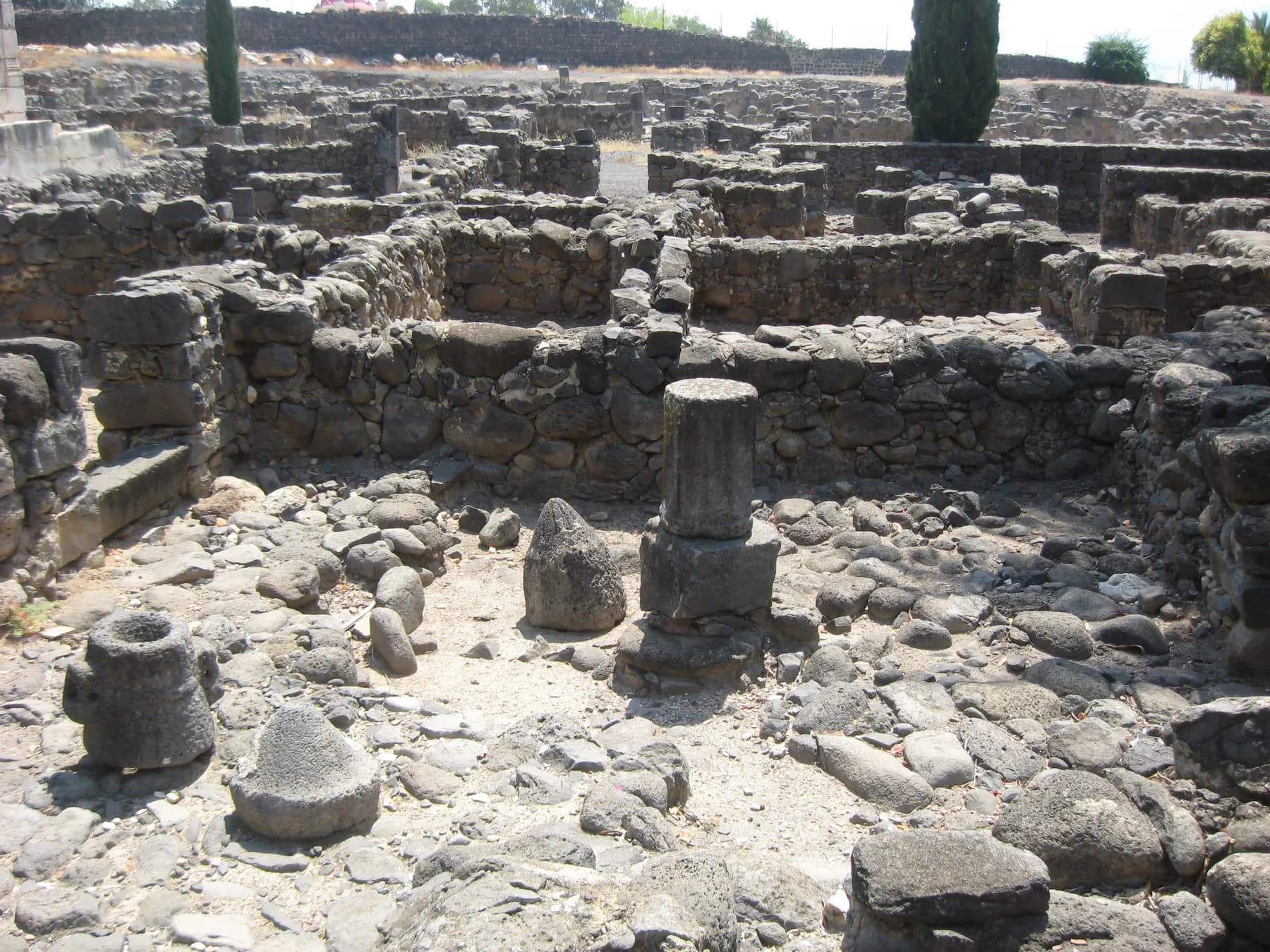
Two thirds of the ruined village belongs to the Franciscans, who finally got the title deeds on 19 September 1894 after eight years of Ottoman paperwork and have dug it in twenty-three seasons since 1968.
Commander, U.S. Naval Forces Europe-Africa/U.S. 6th Fleet / Public domain · Wikimedia Commons
Religious site
Mount of Beatitudes
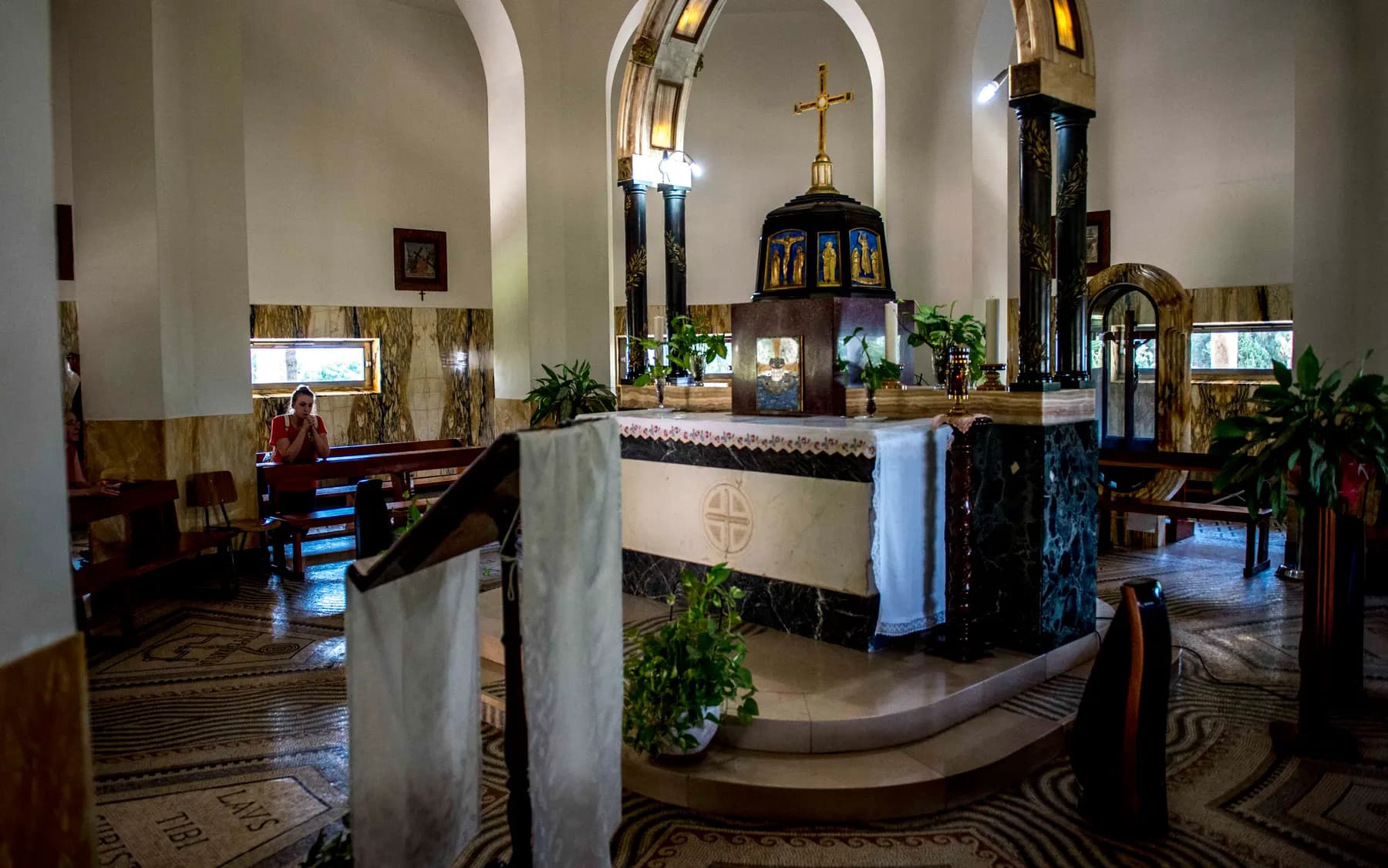
Antonio Barluzzi gave the church eight sides for the eight beatitudes and set it on a hill about 25 metres below sea level, which makes the summit one of the lowest in the world.
זאב שטיין / CC BY 2.5 · Wikimedia Commons
Archaeological site
Korazim
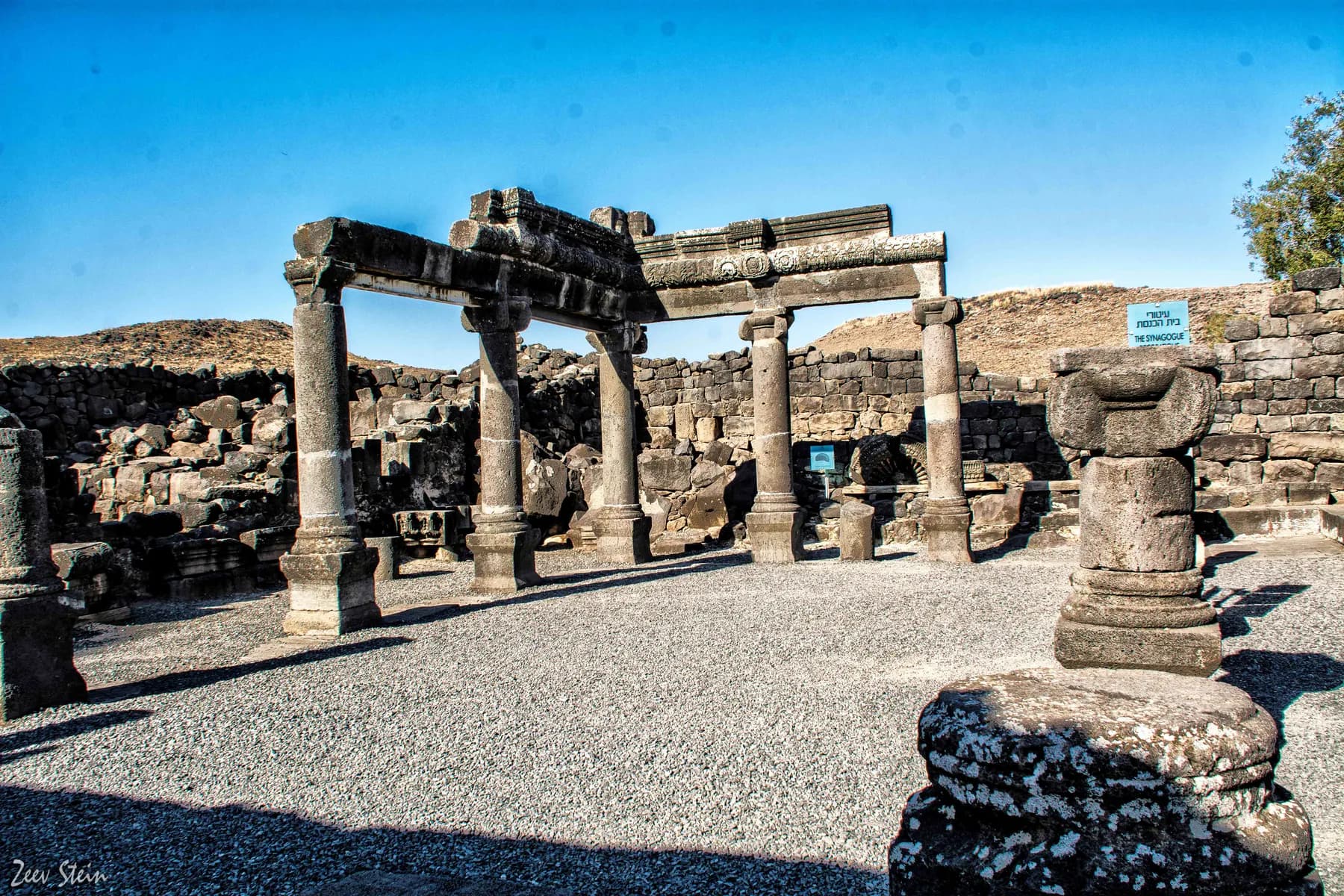
A Talmudic-era town built entirely out of the black basalt it stands on, remembered in the Babylonian Talmud for its wheat and in the Gospels for refusing to listen.
Sources and further reading
Every link below was opened and checked when this page was written. Official statements are marked as such: they are the subject's own account, not an independent one.
- OfficialIsrael Nature and Parks Authorityen.parks.org.ilKursi (Gerassa) National Park
The operator's English page, read on 13 August 2026: summer hours of 08:00 to 17:00 Sunday to Thursday and Saturday and 08:00 to 16:00 on Fridays and holiday eves, winter hours of 08:00 to 16:00 and 08:00 to 15:00, entry closing one hour before, 13:00 closes on Yom Kippur eve and other festival eves, the fee table (adult 16 ILS, child 7 ILS, adult in group 14 ILS, child in group 6 ILS, student 14 ILS, Israeli senior citizen 8 ILS), the telephone number 04-6731983, the cafeteria, souvenir shop and candle-lighting area, and the directions from Kursi junction on Route 92, 5 km north of Ein Gev
- OfficialIsrael Nature and Parks Authorityparks.org.ilKursi National Park (Hebrew)
The fuller Hebrew page, which carries material the English one omits: the enclosure of 145 by 123 metres described as one of the largest in Israel, the paved road from the lake to the monumental gate with its watchtower, the church of 23 by 45 metres as a basilica with two rows of six columns, Corinthian marble capitals cut with crosses, the relic box beneath the altar, the baptistery for infants with the threshold inscription dating the mosaic to 585 in the reign of Maurice, the burial cave with the remains of 30 men, the mosaic subjects (cockerels, geese, doves, cormorants, fish, citrons, figs, pomegranates and grapes) and the note that no depiction of the swine miracle exists or has yet been found, the 1980 discovery of the chapel by the Holy Rock with its apse in a cave, the bathhouse excavated 2011 to 2013 north of the church, the sand box with its rotating drum and the bench, the accessibility statement, the service centre stock list, the ban on dogs and fires, the festival eve closing times, and the visit coordination rule
- OfficialIsrael Nature and Parks Authoritystatic.parks.org.ilKursi National Park brochure
The park's own English leaflet, downloaded and read for this page. Source of the 1970 accidental discovery during road construction, the excavation by Dan Urman and Vassilios Tzaferis of the Department of Antiquities and Museums, the claim that this is the largest known Byzantine monastery in the Holy Land at 123 by 145 metres, the chapel on the nearby hill with three separate layers of mosaic, the fifth-century construction and the baptistery built at the end of the sixth, the 614 Persian invasion, the razing by fire at the beginning of the eighth century, the ninth-century Arab settlers blamed for destroying the mosaic figures, the parks authority's reconstruction of the lower church and its oil press, the 30 skeletons in the nearby chapel, the opening to the public in September 1982, and the subscription offering unlimited free entry
- ReportingThe Times of Israeltimesofisrael.comAncient inscription points to Jewish past for early Christian site
Independent reporting on the December 2015 find, published 21 December 2015: the dig led by Haim Cohen of the University of Haifa with the Israel Antiquities Authority and the parks authority and funded by the Avery-Tsui Foundation, the imported Greek marble, the words marmaria, amen, the holy king and the merciful, and Haggai Misgav of the Hebrew University reading it as a standard dedicatory synagogue text whose script resembles the Trumpeting Place inscription from the Temple Mount, along with the large inner harbour and the village that preceded the slab
- ReferenceIsrael Antiquities Authorityhadashot.iaa.org.ilKursi Beach, 2015 (Hadashot Arkheologiyot 129)
The excavation report by Haim Cohen and Michal Artzy under permit G-88/2015, covering the dig of November to December 2015 about 1 km north-west of the national park: the south-western part of a public building that may be a synagogue, its bema of roughly two square metres aligned east to west and built of limestone slabs reused from an arch, the marble slab of 1.25 by 0.7 metres and 8 centimetres thick with eight lines of Hebrew and Aramaic opening with a formula of good memory and closing with amen, described as the first of its kind found in Israel, the breakwater in Area A standing about 2.5 metres of large basalt stones laid diagonally outside and vertically inside, and the conclusion from the pottery and coins that Kursi was part of a Jewish settlement through the Byzantine, Umayyad and early Abbasid periods
- ReferenceIsrael Antiquities Authorityhadashot.iaa.org.ilKursi Beach (Hadashot Arkheologiyot 119)
The underwater survey of September to November 2000 by Ehud Galili, Baruch Rosen, Elisabetta Boaretto and Alexander Tsetskin: foundations 0.4 to 0.5 metres wide of a building 2.5 by 2.5 metres lying at 213.5 to 214.1 metres below sea level, a calibrated radiocarbon date of 530 to 660 from carbonised wood and grain in the mortar, the suggestion that it was the base of an observation or guard tower, and the inference from the plaster that it was built on dry land and therefore that the lake had fallen to 215 metres below sea level or lower
- ReferenceWikipediaen.wikipedia.orgKursi, Sea of Galilee
Used for the setting on Nahal Samakh, the description of the church interior (the geometric nave floor against the figured aisles, the baptistery with its small font on the southern side of the apse, the narthex stair to the crypt, the oil press room and the atrium built over a cistern with two well heads), the hillside chapel wedged between the slope and the boulder with a possible tower around it, the destruction of the church attributed to the earthquake of 749 rather than to fire, the church measured at 24 by 45 metres against the parks authority's 23 by 45, the description of the 1971 to 1974 dig as the largest Byzantine monastic complex found in Israel, and the note that Christian finds from Kursi are held at the Golan Archaeological Museum
- ReferenceSee the Holy Landseetheholyland.netKursi
A pilgrim reference site, used here for the account of the 1970 rediscovery from Byzantine pottery in a bulldozer's trail, the complex given as 1.8 hectares, the oil press in a room off the left-hand aisle and the crypt of 30 monks beneath a chapel in the right-hand aisle, the fishing harbour with a breakwater and a pool for keeping live fish, the dating of the earliest hillside chapel mosaic to before 427 from the crosses in it, and the alternative account that the mosaic figures were obliterated when the monastery was abandoned in the early eighth century
- ReferenceWikipediaen.wikipedia.orgVassilios Tzaferis
Biography of the excavator: born on Samos on 1 April 1936, renounced Greek citizenship in 1964 to remain in Israel, deputy director of the antiquities body's Division for Surveys and Excavations from 1971 and director from 1999, retired in 2001, died 1 January 2015, with Kursi listed among his excavations alongside Beth She'an, Tel Dan and Capernaum
Kursi: common questions
What is Kursi National Park?+
It is the excavated and partly reconstructed remains of a Byzantine monastery on the eastern shore of the Sea of Galilee, run as a national park by the Israel Nature and Parks Authority. The walled compound measures 145 by 123 metres and contains a basilica, a bathhouse, an oil press, a burial crypt and pilgrim buildings. The authority's brochure calls it the largest known Byzantine monastery in the Holy Land. Its Hebrew page hedges to one of the largest in Israel.
Is Kursi where the miracle of the swine happened?+
It is where the miracle was being commemorated by the fifth century, which is a different claim. The Gospels place the episode in the country of the Gerasenes, the Gadarenes or the Gergesenes depending on which of Mark, Matthew and Luke you read and which manuscript, and the parks authority identifies the site with Gergessa or Gerasa. A monastery of this size on this shore is evidence of a well established tradition, not of a location.
How much does it cost to get in?+
The parks authority publishes 16 ILS for an adult and 7 ILS for a child, with a student at 14 ILS and an Israeli senior citizen at 8 ILS. Groups pay 14 ILS an adult and 6 ILS a child. A parks authority subscription covers entry, and the park page carries the Israel Pass badge. Prices move, so check the authority's page before travelling.
What are the opening hours?+
In summer the park opens at 08:00 and closes at 17:00 from Sunday to Thursday and on Saturday, and at 16:00 on Fridays and holiday eves. In winter those become 16:00 and 15:00. On the eves of Rosh Hashanah, Passover and Yom Kippur it closes at 13:00. Entry to the site closes one hour before the stated closing time in every case.
How long do you need at Kursi?+
About an hour covers the compound at a comfortable pace, and about ninety minutes if you climb to the hillside chapel and stop at the service centre. It is a small, legible site with one main building and a short circuit, which makes it a good second stop rather than a day out. Most visitors pair it with the northern shore.
Is Kursi wheelchair accessible?+
Partly, and the parks authority is unusually specific about where the accessible route stops. A concrete path runs from the accessible parking to the park entrance, and the foyer, toilets, a concrete gathering and prayer plaza, benches, a drinking fountain and the signage are all listed as accessible. The concrete path reaches the entrance to the antiquities rather than running through them, so the church interior is on ancient paving with thresholds. The hillside chapel is up rough ground and is not accessible.
What is original here and what was rebuilt?+
The mosaic floors, column bases and capitals, the oil press, the crypt, the cistern and the wall footings are excavated original. The parks authority reconstructed the lower church and its oil press, and cleared and rebuilt the enclosure walls, which is why the basilica reads as a three-dimensional building rather than a plan on the ground. The brochure states this plainly, so the distinction is easy to make on site.
Why are the animals in the mosaics damaged?+
They were deliberately picked out of the floor, while the plants beside them were largely left alone. Who did it is unresolved: the parks authority's brochure attributes the damage to the Arab settlers who lived in the ruins in the ninth century, while the reference site See the Holy Land places it at the abandonment of the monastery in the early eighth. The pattern of the damage is clear even where its author is not.
Can you visit the synagogue and harbour found in 2015?+
No, not as a laid-out site. The public building that may be a synagogue, its marble inscription and the basalt breakwater are at Kursi Beach about a kilometre north-west of the park, outside the fence, and nothing there is set up for visitors. The excavation report is published in the Israel Antiquities Authority's journal, and the finds themselves are not on display at Kursi.
Is there anywhere to buy food and drink?+
Yes. The park has a service centre selling hot and cold drinks, ice cream, fast food and snacks, and a shop with books, souvenirs, sun cream, hats and water gear. There are toilets, benches and a drinking fountain. Dogs are not allowed in and fires and barbecues are prohibited.