Religious site · The Sea of Galilee
Mount of Beatitudes
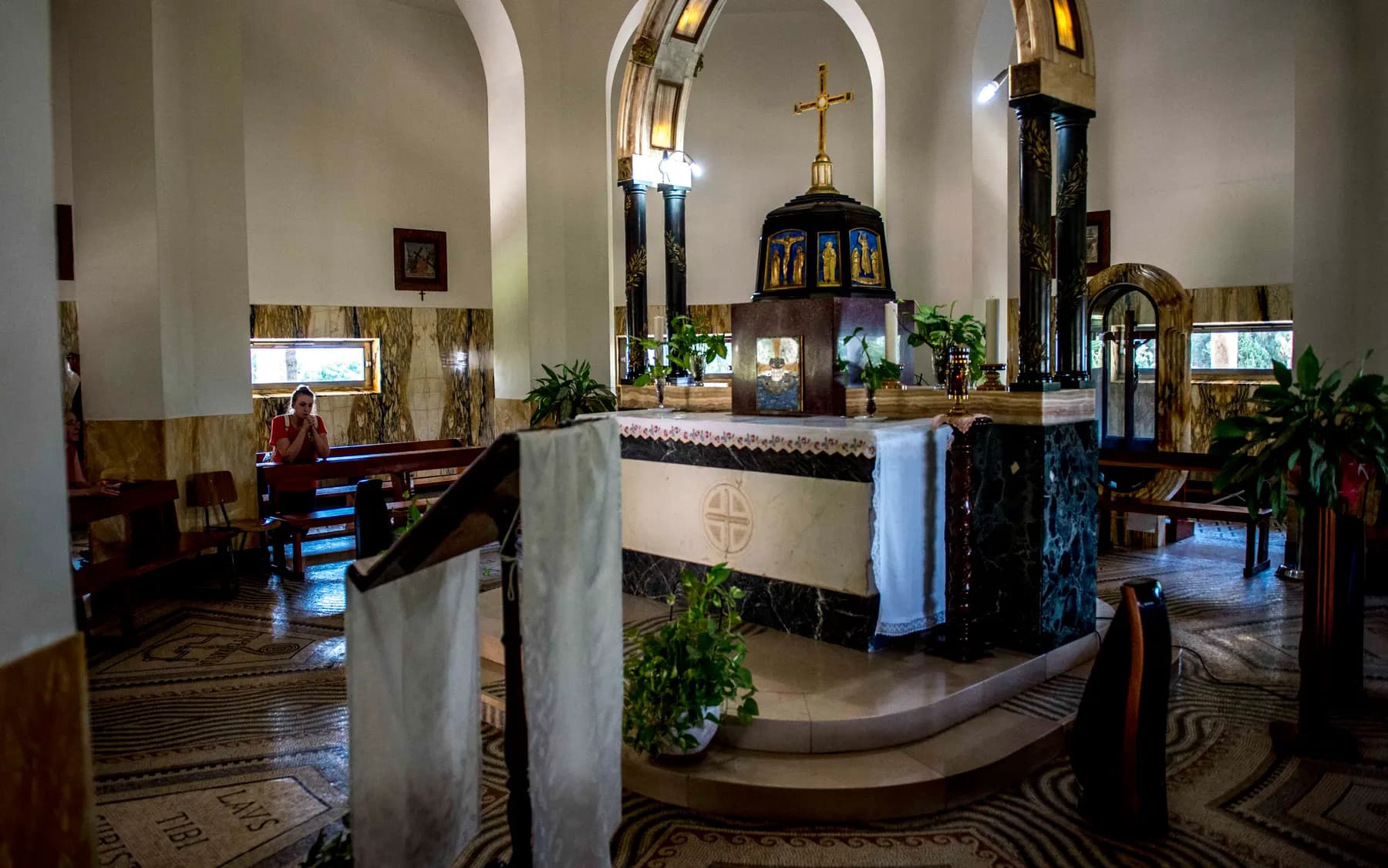
Antonio Barluzzi gave the church eight sides for the eight beatitudes and set it on a hill about 25 metres below sea level, which makes the summit one of the lowest in the world.
Commander, U.S. Naval Forces Europe-Africa/U.S. 6th Fleet / Public domain · Wikimedia Commons
Church completed
1938
designed by Antonio Barluzzi, built from 1936
Sides
8
one for each beatitude of Matthew 5:3-10
Altitude
about 25 m below sea level
nearly 200 m above the lake, on Survey of Israel figures
Byzantine chapel below
late 4th century
further down the slope, in use until the 7th century
In short
- How long to give it
- about 45 minutes to an hour for the church, the arcade and the garden
- Daily, morning
- 08:00 to 11:30
- Church and garden
- no admission charge is listed
הר האושר
The Mount of Beatitudes is a hillside above the north-western shore of the Sea of Galilee where Christian tradition places the Sermon on the Mount, and where an octagonal church finished in 1938 stands inside a terraced garden. It is not a summit in any dramatic sense. Wikipedia's article on the hill, citing the Survey of Israel's 1:50,000 sheet, puts it at roughly 25 metres below sea level and nearly 200 metres above the lake, which it calls one of the lowest summits in the world.
The church was designed by Antonio Barluzzi, the Italian architect behind most of the twentieth-century Catholic shrines in the Holy Land, and built for the Italian Mission Society. Raymond Cohen's history of the Holy Sepulchre, published by Oxford University Press, records Benito Mussolini as the funder. The building is owned and overseen by ANSMI, the National Association for Assistance to Italian Missionaries, and run day to day by the Franciscan Missionary Sisters of the Immaculate Heart of Mary, who also keep two guesthouses on the property.
What a visitor actually gets here is a short walk, a garden and a view, not an excavation. The Byzantine remains that gave the hill its claim lie further down the slope and are not the thing anyone photographs. The gate shuts for two and a half hours in the middle of the day, and the charge at the entrance is levied on the vehicle rather than the person. Those two facts catch out more arrivals than anything else on the hill.
Orientation
The drive up, and the gate that shuts at half past eleven
The site sits above the northern shore between Tabgha and Capernaum, on the southern slopes of the Korazim Plateau, reached by a private drive that climbs off the lake road. Vehicles park at the top, beside the church, so there is no walk up from the highway. What is inside the wall is a single compound: the octagonal church at the centre, a colonnaded walk running round it, terraced gardens falling away towards the water, and the sisters' guesthouses behind.
The hours are the thing to plan around. The Christian Information Centre in Jerusalem, which publishes the opening times of the Holy Land shrines and updated its table on 7 August 2026, lists the Mount of Beatitudes as open 08:00 to 11:30 and again 14:00 to 16:30, with the site closed at Easter, at Christmas and on the Feast of the Beatitudes. Other timetables in circulation give 08:00 to 12:00 and 14:30 to 17:00, and Hebrew listings give different figures again. Work from the Centre's page, which is the operator's own.
The same table prices the vehicles rather than the people: 30 shekels for a car, 60 for a van and 100 for a bus. No admission charge for the church itself appears on it. Several travel guides report a small per-person charge collected from visitors arriving on foot, and the operator's list does not carry one, so anyone walking in should have change and should not be surprised either way.
Coaches make up most of the traffic, and they arrive in convoy. The compound absorbs them better than the neighbouring shrines do, because the garden is large and the paths loop, but the church interior is small and fills quickly. Early morning, in the first hour after the gate opens, is the quiet part of the day.
The tradition
Which mountain, and how confident anyone is about it
The gospels do not name a hill. Britannica describes the Sermon on the Mount as the collection of teaching in Matthew, chapters 5 to 7, where Jesus goes up a mountain and sits down. Luke's parallel sermon is delivered on a level place. BiblePlaces, the biblical geography reference run by Todd Bolen, treats the two as easily reconciled, on the grounds that the Galilean hillsides are full of level places, but neither text fixes a location, and no early source claims to.
The oldest link to this stretch of shore is a cave rather than a hilltop. The pilgrim Egeria, writing about 381, is quoted describing, near the Seven Springs at Tabgha, the cave to which the Saviour climbed and spoke the Beatitudes. Her passage survives only at second hand, through the twelfth-century compilation of Peter the Deacon, who had access to a copy of her text now lost. The archaeologist Bargil Pixner identified the terrace above the cave called Mughara Ayub, at Tabgha, as the traditional place of the sermon: a spot below and west of the modern church, not the church itself.
For centuries the tradition pointed somewhere else entirely. The Catholic Encyclopedia of 1907 identifies the Mount of Beatitudes as Karn Hattin, the twin-peaked Horns of Hattin west of the lake, and is unusually blunt about the evidence for it: the tradition apparently does not go back beyond the crusaders, Jerome, the best informed man of his day on such questions, knew of no such tradition, and Edward Robinson observed that a number of hills west of the lake would serve equally well. Mount Arbel has also been proposed.
Jerome Murphy-O'Connor, in the Oxford Archaeological Guide to the Holy Land, gives the flattest account of how the modern site came to be the modern site. It was perhaps inevitable, he writes, that this well-watered area with its shade trees on the shore of the Sea of Galilee, where Byzantine pilgrims ate their picnics, should have been identified as the location of two episodes involving the consumption of food, meaning the multiplication of the loaves and fishes at Tabgha and the breakfast at which Peter was given charge. Once those were fixed, siting the sermon on the small hill above them became convenient. He is not dismissive of the result: from here, he adds, one can see virtually all the places in which Jesus lived and worked.
What survives
The fourth-century chapel is downhill, and hardly anyone sees it
A Byzantine church stood lower down the slope from the present building, put up in the late fourth century and in use until the seventh. A rock-cut cistern lies beneath it, and the remains of a small monastery to its south-east. Part of its mosaic floor was lifted and is now displayed at Capernaum, a couple of kilometres east along the shore, which means the oldest thing associated with this site is not on this site.
The remains were dug by Bellarmino Bagatti, the Franciscan archaeologist who later directed the Studium Biblicum Franciscanum and excavated at Ein Karem, Emmaus, Bethlehem, Dominus Flevit, Nazareth and Mount Carmel. The date of the Beatitudes dig is given as 1936 in the list of his excavations and as 1935 in several secondary accounts. The discrepancy is small and nobody has published a reconciliation, but it is worth knowing that the two dates in circulation refer to the same season of work.
The practical consequence for a visitor is simple and often missed. Nothing inside the walled compound at the top of the hill is ancient. The church, the arcade, the garden terraces and the guesthouses all date from 1936 or later, and the fourth-century material is on the slope below, unenclosed and unsignposted from the church gate.
- Ancient: the Byzantine chapel's remains further down the slope, the rock-cut cistern beneath them and traces of a small monastery to the south-east
- Moved: part of the Byzantine mosaic floor, lifted and now displayed at Capernaum
- Modern: the octagonal church, the arcade, the garden terraces and the guesthouses, none of them earlier than 1936
- Elsewhere: the cave Egeria's account points to, which lies on the slope above Tabgha rather than at the church
The building
Barluzzi's octagon, and who paid for it
Antonio Barluzzi, 1884 to 1960, built most of the Catholic shrines a modern pilgrim in this country walks into: the Church of All Nations at Gethsemane between 1919 and 1924, the Transfiguration on Mount Tabor from 1921 to 1924, the Flagellation on the Via Dolorosa from 1927 to 1929, St Lazarus at Bethany in 1952 and 1953, the Visitation at Ein Karem finished in 1955. He worked mainly on commission from the Franciscan Custody of the Holy Land. The Beatitudes church was the exception, commissioned instead by the Italian Mission Society. Published construction dates differ slightly: the sisters' own site gives 1936 to 1938, and Barluzzi's biography gives 1937 to 1938.
The plan is an octagon, one side for each of the eight beatitudes, with the texts set in Latin in the upper windows. The style is neo-Byzantine. Marble veneer casts the lower interior walls and the dome carries gold mosaic. Around the altar, symbols laid into the pavement stand for seven virtues: justice, prudence, fortitude, temperance, faith, hope and charity. The altar itself is of alabaster and onyx. Outside, a colonnaded walk rings the building and opens onto the lake.
The money came from Fascist Italy. Cohen's account, published by Oxford University Press, names Benito Mussolini as the funder of a church begun in the years of Italy's Ethiopian war and completed under the British Mandate. The building has been in Italian Catholic hands ever since: ANSMI, the National Association for Assistance to Italian Missionaries, holds and oversees it, and the Franciscan Missionary Sisters of the Immaculate Heart of Mary, known as the Sisters of Egypt, live on the site and run it.
The garden is part of the design rather than a lawn around it. Paths drop away in terraces towards the water, and three further altars stand in the open for groups, which is where most pilgrim services here are actually held. The church interior seats very few people, and a coach party will not fit inside it.
Since 1938
Two popes, a millennium Mass and a building on the peak
On 24 March 2000 John Paul II celebrated a Mass for Youth here during his Jubilee pilgrimage to the Holy Land. The Vatican files the homily under Korazim, Mount of the Beatitudes, and in it he called the gathering a rehearsal for World Youth Day and greeted young people from Israel, the Palestinian Territories, Jordan and Cyprus alongside pilgrims from four continents. It was the largest Christian gathering the hill has held.
Paul VI's visit is repeated everywhere and is harder to pin down. Wikipedia's article on the church states that both Paul VI and John Paul II celebrated Mass here, and Italian accounts of the January 1964 pilgrimage put Nazareth, Tabgha, Capernaum, the Mount of Beatitudes and Mount Tabor in the same day. The Vatican's own published index of that journey lists Jerusalem, Nazareth and Bethlehem and does not name the mountain. Both things can be true, since the index catalogues speeches rather than stops, but a reader who wants a documented papal Mass on this hill has one, in 2000, not two.
The peak above the church is occupied by a separate institution. Domus Galilaeae, run by the Neocatechumenal Way, had its first stone laid in January 1999 and opened in 2000, and John Paul II inaugurated it on the same pilgrimage, saying he hoped it would become a place for interreligious dialogue. It is a study and conference centre with its own gate and its own arrangements, and it is not part of a visit to the church.
The hill is also a waypoint on a walking route. The Jesus Trail, 65 kilometres from Nazareth to Capernaum on its own operator's description, runs through Zippori, Cana, the Horns of Hattin, Arbel, Migdal, Ginosar and Tabgha before crossing the Mount of Beatitudes on its final approach. Walkers arriving that way come up the slope on foot rather than up the drive, which is the one common exception to the vehicle charge.
What to look for
Things not to walk past at Mount of Beatitudes
The details that repay knowing about before you are standing in front of them.
The octagon and its eight windows
The plan has one side for each of the beatitudes of Matthew 5:3-10, and the texts are set in Latin in the upper windows. Counting them round is the quickest way to read Barluzzi's intention.
The seven virtues in the pavement
Mosaic symbols laid into the floor around the altar stand for justice, prudence, fortitude, temperance, faith, hope and charity. They are easy to walk over without noticing.
The dome
Gold mosaic above marble veneer on the lower walls, in a neo-Byzantine interior small enough that a full coach party cannot get inside it at once.
The colonnaded walk and the view north
The arcade rings the church and opens onto the basin. Jerome Murphy-O'Connor's guide makes the case for the site on exactly this ground: from here one can see virtually all the places in which Jesus lived and worked.
The garden altars
Three altars stand in the open among the terraces. Almost every pilgrim service on this hill happens at one of them rather than inside the church.
The Byzantine chapel below the compound
Remains of a late fourth-century church with a rock-cut cistern beneath it and a small monastery to its south-east, further down the slope. Part of its mosaic floor is now on display at Capernaum.
The long view
Mount of Beatitudes, in order
Late 4th century
A small church is built lower down the slope, with a rock-cut cistern beneath it and a monastery to its south-east. It stays in use until the 7th century.
c. 381
The pilgrim Egeria records a cave near the Seven Springs at Tabgha to which the Saviour climbed and spoke the Beatitudes. Her passage survives only through Peter the Deacon's twelfth-century compilation.
12th century onwards
The tradition attaches instead to Karn Hattin, the Horns of Hattin west of the lake. The Catholic Encyclopedia still identifies the Mount of Beatitudes with that hill in 1907, while noting that Jerome knew of no such tradition.
1936
Bellarmino Bagatti excavates the Byzantine remains on the slope. Some accounts date the season to 1935.
1936–1938
Antonio Barluzzi's octagonal church is built for the Italian Mission Society, funded by Benito Mussolini.
January 1964
Paul VI makes the first papal pilgrimage to the Holy Land. Reference accounts place him on this hill; the Vatican's published index of the journey does not name it.
January 1999
The first stone of Domus Galilaeae is laid on the peak above the church, for the Neocatechumenal Way.
24 March 2000
John Paul II celebrates a Mass for Youth at the Mount of the Beatitudes during his Jubilee pilgrimage, and inaugurates Domus Galilaeae on the same visit.
Practical
Visiting Mount of Beatitudes
Where
Mount of Beatitudes, off Route 90 between Tabgha and Capernaum, northern Sea of Galilee
What ticket you need
The Mount of Beatitudes is not inside a national park and carries no park ticket. Domus Galilaeae, the Neocatechumenal Way's study centre on the peak above the church, is a separate institution with its own entrance and its own arrangements, and is not covered by a visit here.
Opening hours
Access
Better than most Galilee shrines, and undocumented by the site itself. Vehicles park at the top of the hill, so there is no climb from the road. Access Israel, the accessibility organisation, lists the site as having convenient parking, an accessible route and accessible toilets, and includes it in a suggested accessible day beside the Kinneret. The garden is terraced and its paths slope, and the operator publishes no accessibility statement of its own, so a group with specific needs should telephone the sisters before travelling.
On site
- Car and coach parking at the top of the drive
- Toilets
- Terraced gardens with three outdoor altars
- Two guesthouses
- Mass and prayer bookings by telephone or fax
Booking
Prayer, preaching and Mass have to be arranged in advance with the Franciscan Missionary Sisters of the Immaculate Heart of Mary, by telephone on 04 671 1223 or by fax on 04 671 1225, according to the church's own site. The same site takes group bookings for the two guesthouses, which together hold up to 150 pilgrims, and says individual visitors are charged more than groups.
Hours and prices are given as the operator publishes them and change without much notice, particularly around Shabbat and the festivals. Check the operator's own page before you travel for this.
Official page at cicts.org →What people wish they had known
- The midday closure is the commonest mistake. The Christian Information Centre's table gives 08:00 to 11:30 and 14:00 to 16:30, so an itinerary that puts the Mount of Beatitudes after a late morning at Capernaum arrives at a locked gate.
- The charge at the entrance is on the vehicle, not the head. A car pays 30 shekels whether it carries one person or four, which makes this one of the cheapest stops on the northern shore for a family and one of the dearer ones for a solo driver.
- The Byzantine remains are not under the church. They are further down the slope, and part of their mosaic floor was lifted and put on display at Capernaum, so anyone hoping to stand on fourth-century flooring should plan the two sites together.
- A group cannot simply hold a service on arrival. Prayer, preaching and Mass are booked in advance with the sisters by telephone or fax, and in practice they happen at one of the three outdoor altars in the garden rather than inside the church.
- The closures follow the Christian calendar, not the Israeli one. The operator lists Easter, Christmas and the Feast of the Beatitudes, and does not list Yom Kippur, which does close neighbouring Capernaum and the Primacy of St Peter at Tabgha.
- This is a working monastery with two guesthouses attached rather than a museum. The sisters live on the site, the church is in use, and the compound closes at 16:30 whatever the light is doing outside.
The figures
Mount of Beatitudes by the numbers
Each figure carries the year it belongs to and links the source it came from.
| Measure | Figure | As of | Source |
|---|---|---|---|
| Opening hours | 08:00 to 11:30 and 14:00 to 16:30 | 2026 | cicts.org |
| Parking charge | ₪30 car, ₪60 van, ₪100 bus | 2026 | cicts.org |
| Church built | 1936 to 1938, on the site of fourth-century Byzantine ruins | 1938 | beatitudes.church |
| Sides of the church | 8, one for each beatitude | 1938 | en.wikipedia.org |
| Altitude of the hill | about 25 m below sea level, nearly 200 m above the lake | 2026 | en.wikipedia.org |
| Byzantine church on the slope | built in the 4th century, in use until the 7th | 2026 | en.wikipedia.org |
| Guesthouse capacity | up to 150 pilgrims across two guesthouses | 2026 | beatitudes.church |
| Jesus Trail | 65 km, Nazareth to Capernaum, passing this hill | 2026 | jesustrail.com |
While you are here
The rest of The Sea of Galilee
Everything else in this destination with a page of its own.
יוסי רון / CC BY 2.5 · Wikimedia Commons
Religious site
Tabgha
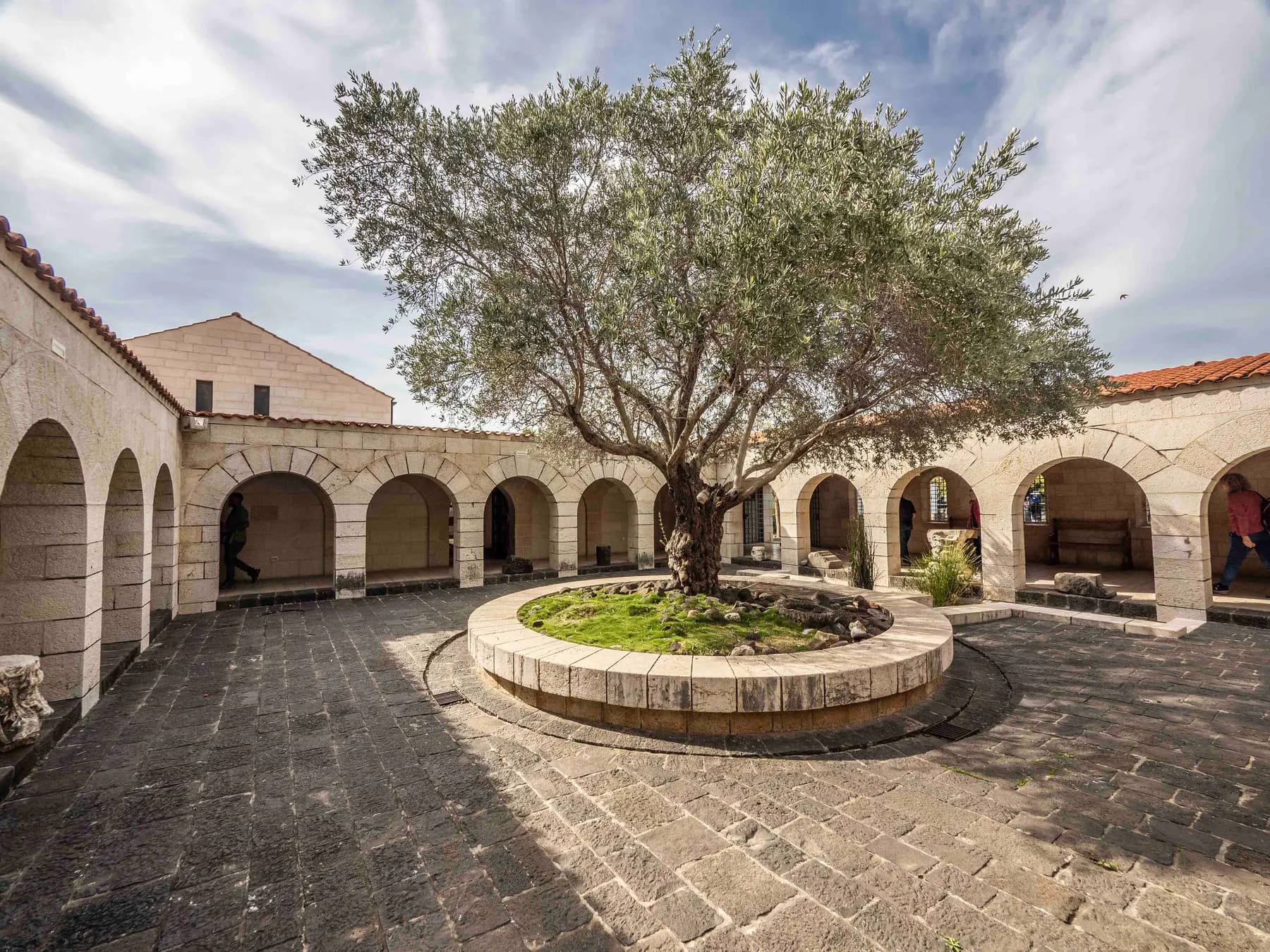
The mosaic in front of the altar shows a basket of four loaves, not the five of the Gospel account, and the usual reading is that the fifth is the one consecrated on the altar above it.
Tracy Hunter from Spokane, USA / CC BY 2.0 · Wikimedia Commons
Archaeological site
Capernaum
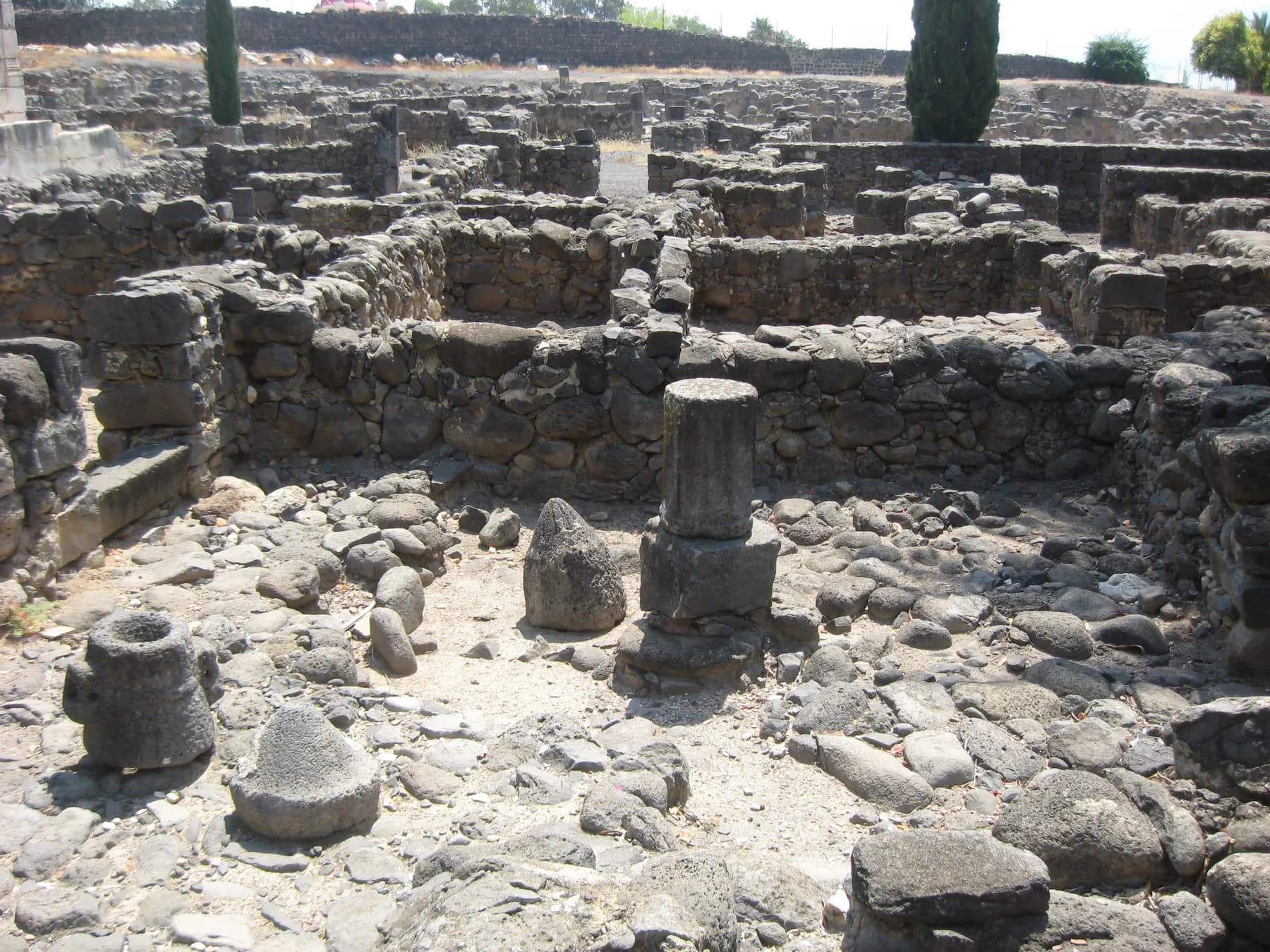
Two thirds of the ruined village belongs to the Franciscans, who finally got the title deeds on 19 September 1894 after eight years of Ottoman paperwork and have dug it in twenty-three seasons since 1968.
זאב שטיין / CC BY 2.5 · Wikimedia Commons
Archaeological site
Korazim
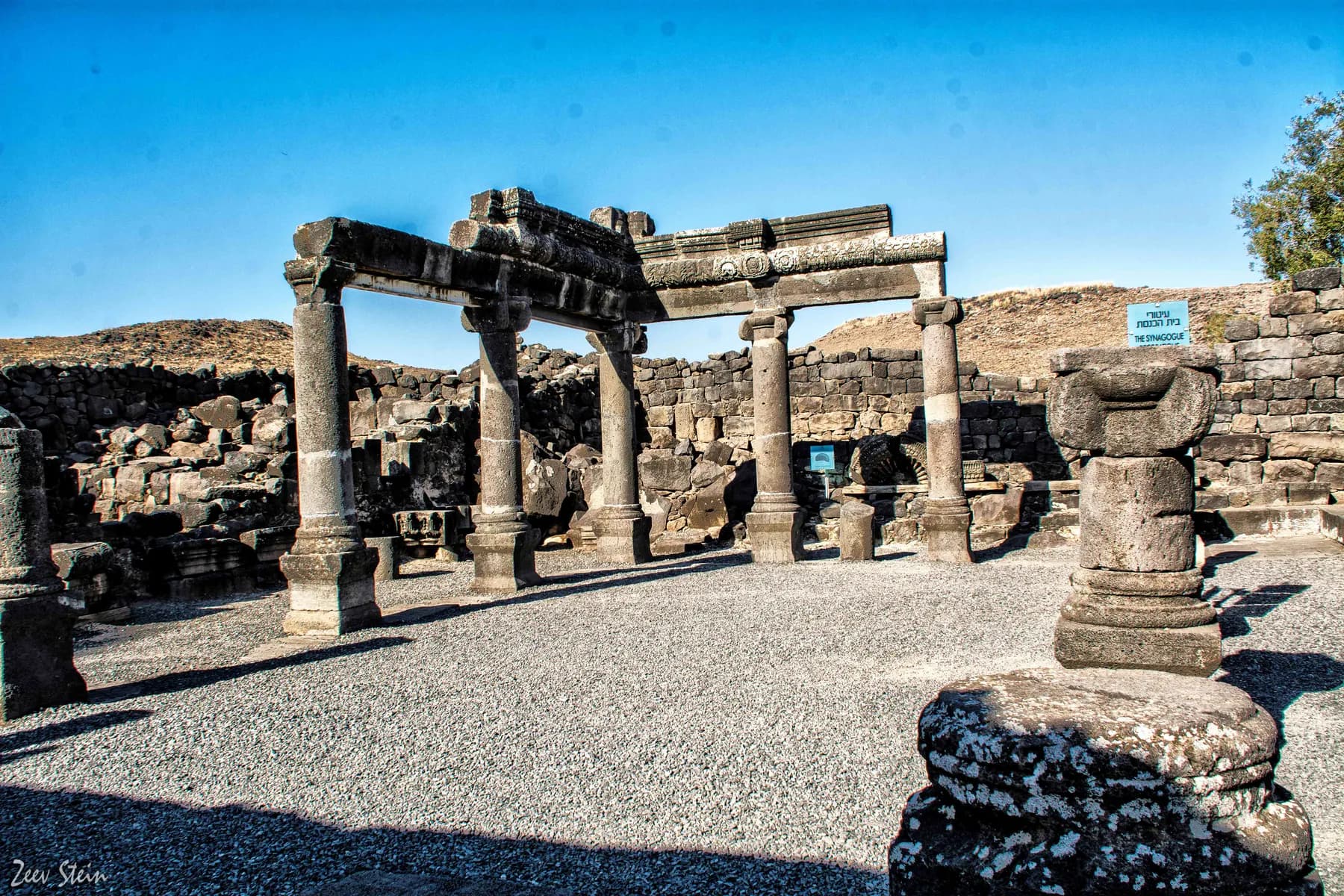
A Talmudic-era town built entirely out of the black basalt it stands on, remembered in the Babylonian Talmud for its wheat and in the Gospels for refusing to listen.
Sources and further reading
Every link below was opened and checked when this page was written. Official statements are marked as such: they are the subject's own account, not an independent one.
- OfficialChristian Information Centre, Jerusalemcicts.orgUpdated Opening Hours: Holy Places and Tourist Sites in the Holy Land
The operator's published table, updated 7 August 2026: Mount of Beatitudes open 08:00 to 11:30 and 14:00 to 16:30, parking at 100 ILS for a bus, 60 for a van and 30 for a car, closed at Easter, Christmas and the Feast of the Beatitudes, run by the Franciscan Missionary Sisters (FMCIM) on 04 671 1200. Also the comparison hours and the Yom Kippur closures for Capernaum and the Primacy of St Peter at Tabgha
- OfficialFranciscan Sisters Monastery, Mount of the Beatitudesbeatitudes.churchAbout and Contact Us
The church's own account of itself: designed by Antonio Barluzzi, built between 1936 and 1938 on the site of fourth-century Byzantine ruins, octagonal for the eight beatitudes, maintained and overseen by ANSMI, with the Franciscan Sisters running it and the phone and fax numbers for Mass reservations
- OfficialFranciscan Sisters Monastery, Mount of the Beatitudesbeatitudes.churchPlan Your Visit
Two guesthouses accommodating up to 150 pilgrims, group booking by email, individual visitors charged more than groups, and the contact route for arranging a place for prayer, preaching or Mass
- OfficialHoly See (John Paul II, Jubilee Pilgrimage to the Holy Land)vatican.vaMass for Youth at the Mount of the Beatitudes, Korazim, 24 March 2000
The primary record of the papal Mass on this hill: date, place, the framing of the gathering as a rehearsal for World Youth Day, and the roll call of nationalities present, within the pilgrimage of 20 to 26 March 2000
- OfficialHoly See (Paul VI)vatican.vaPilgrimage to the Holy Land, 1964
The Vatican's own index of Paul VI's January 1964 journey. It lists Jerusalem, the Basilica of the Annunciation at Nazareth, the meeting with Athenagoras and Bethlehem, and does not name the Mount of Beatitudes, which is why this page treats the 1964 Mass here as reported rather than documented
- OfficialJesus Trailjesustrail.comAbout the Jesus Trail
The 65-kilometre waymarked route from Nazareth to Capernaum and its list of stages, which places the Mount of Beatitudes between Tabgha and Capernaum on the final approach
- ReferenceThe Catholic Encyclopedia, via New Adventnewadvent.orgMount of Beatitudes (1907)
The pre-modern identification of the Mount of Beatitudes with Karn Hattin, the observation that the tradition apparently does not go back beyond the crusaders, that Jerome knew of no such tradition, and Robinson's point that a number of hills west of the lake would serve equally well
- ReferenceWikipediaen.wikipedia.orgChurch of the Beatitudes
Construction between 1936 and 1938, the octagonal plan for the eight beatitudes, neo-Byzantine style with marble veneer on the lower walls and gold mosaic in the dome, the pavement symbols of justice, prudence, fortitude, temperance, faith, hope and charity, ANSMI and the Franciscan Missionary Sisters, the Mussolini funding cited to Raymond Cohen's Saving the Holy Sepulchre (Oxford University Press, 2008), and the quotations from Jerome Murphy-O'Connor's Oxford Archaeological Guide on how the site came to be identified
- ReferenceWikipediaen.wikipedia.orgMount of Beatitudes
Altitude of around 25 metres below sea level and nearly 200 metres above the lake, cited to the Survey of Israel 1:50,000 series, the position on the southern slopes of the Korazim Plateau between Capernaum and Tel Kinrot, the Byzantine church built lower down the slope in the 4th century and used until the 7th, and the rival identifications of Mount Arbel and the Horns of Hattin
- ReferenceSee The Holy Landseetheholyland.netMount of Beatitudes
Egeria's report of the cave near the Seven Springs, Bargil Pixner's identification of the terrace above Mughara Ayub as the traditional place of the sermon, the eight beatitudes set in Latin in the upper windows, the alabaster and onyx altar, the seven virtues in the pavement, the three additional altars in the garden, and the Domus Galilaeae on the peak
- ReferenceBiblePlaces (Todd Bolen)bibleplaces.comMount of Beatitudes
The hill formerly known as Mount Eremos, above the Cove of the Sower between Capernaum and Tabgha; the Byzantine church at the base of the hill; and the reconciliation of Matthew's mountain with Luke's level place on the grounds that the Galilean hillsides are full of level places
- ReferenceWikipediaen.wikipedia.orgAntonio Barluzzi
Barluzzi's dates, 1884 to 1960, and the dated list of his Holy Land churches: All Nations at Gethsemane 1919 to 1924, the Transfiguration on Mount Tabor 1921 to 1924, the Flagellation 1927 to 1929, the Beatitudes 1937 to 1938, St Lazarus at Bethany 1952 to 1953 and the Visitation at Ein Karem completed in 1955, mostly commissioned by the Franciscan Custody
- ReferenceWikipediaen.wikipedia.orgBellarmino Bagatti
The dated list of Bagatti's excavations, giving 1936 for the Church of the Beatitudes alongside Mount Nebo, Ein Karem, Emmaus, Bethlehem, Dominus Flevit, Nazareth and Stella Maris, and his professorship from 1935 and directorship of the Studium Biblicum Franciscanum from 1968 to 1978
- ReferenceEncyclopaedia Britannicabritannica.comSermon on the Mount
The Sermon on the Mount as the collection of teaching in Matthew chapters 5 to 7, addressed to disciples and a large crowd, containing the Beatitudes and the Lord's Prayer
Mount of Beatitudes: common questions
How long do you need at the Mount of Beatitudes?+
About 45 minutes to an hour covers the church, the colonnaded walk and the garden without hurrying. There is no excavation to work through and little interpretation on the ground, so the time goes on the interior, the pavement mosaics and the descent through the terraces towards the view. Groups that have booked a service at one of the garden altars should allow longer.
Is there an entrance fee at the Mount of Beatitudes?+
The Christian Information Centre's table lists no admission charge for the church and prices vehicles instead: 30 shekels for a car, 60 for a van, 100 for a bus. Several travel guides report a small per-person charge for visitors arriving on foot, which does not appear on the operator's own list. Bring change either way.
What are the opening hours?+
08:00 to 11:30 and 14:00 to 16:30, according to the Christian Information Centre's table, which was updated on 7 August 2026. The site is closed at Easter, at Christmas and on the Feast of the Beatitudes. Other timetables in circulation give 08:00 to 12:00 and 14:30 to 17:00, so it is worth checking the Centre's page rather than a tour operator's before setting out.
Is this really where the Sermon on the Mount was preached?+
Nobody knows, and the sources have never agreed. Matthew has the sermon delivered on a mountain and Luke's parallel version on a level place, and neither names a hill. The oldest local tradition, reported through Egeria about 381, points to a cave near the Seven Springs at Tabgha rather than to a summit, and from the crusades until well into the twentieth century the Mount of Beatitudes was commonly identified with Karn Hattin, several kilometres west.
How old is the church on the Mount of Beatitudes?+
It was finished in 1938. Antonio Barluzzi designed it for the Italian Mission Society and construction ran from 1936, or from 1937 on Barluzzi's own published chronology, with funding from Benito Mussolini. Everything inside the walled compound, including the arcade, the garden terraces and the guesthouses, is that age or younger.
Can you see the Byzantine ruins?+
Not from inside the compound. The late fourth-century church stood lower down the slope, with a rock-cut cistern beneath it and a small monastery to its south-east, and it is neither enclosed nor signposted from the church gate. Part of its mosaic floor was lifted and is displayed at Capernaum, which is the easiest place to see anything of it.
Is the Mount of Beatitudes wheelchair accessible?+
Largely, though the site publishes nothing itself. Access Israel lists convenient parking, an accessible route and accessible toilets here, and includes the church in a suggested accessible day beside the Kinneret. Vehicles park at the top of the hill, so there is no climb from the road, but the garden is terraced and its paths slope, and anyone with specific needs should telephone the sisters first.
Can we hold a Mass or a service there?+
Yes, but only by arrangement. The church's own site directs groups to book prayer, preaching or Mass by telephone on 04 671 1223 or by fax on 04 671 1225. Most services take place at one of the three altars in the garden, because the church interior is small and will not take a coach party at once.
Is it worth it if you are not religious?+
For the building and the view, yes. Barluzzi's octagon is the most complete piece of his work on the lake, and the arcade and garden give the best single vantage over the northern basin, with Capernaum, Tabgha and the Golan escarpment all in sight. It is also short, which makes it an easy addition to a morning at Capernaum rather than a commitment.
Can you walk there from Tabgha or Capernaum?+
Yes. The Jesus Trail, the 65-kilometre waymarked route from Nazareth to Capernaum, runs through Tabgha and over the Mount of Beatitudes on its final stretch, so a marked footpath exists. Most visitors arrive by vehicle up the private drive instead, and walkers coming off the trail are the one common exception to the parking charge.