Archaeological site · The Sea of Galilee
Korazim
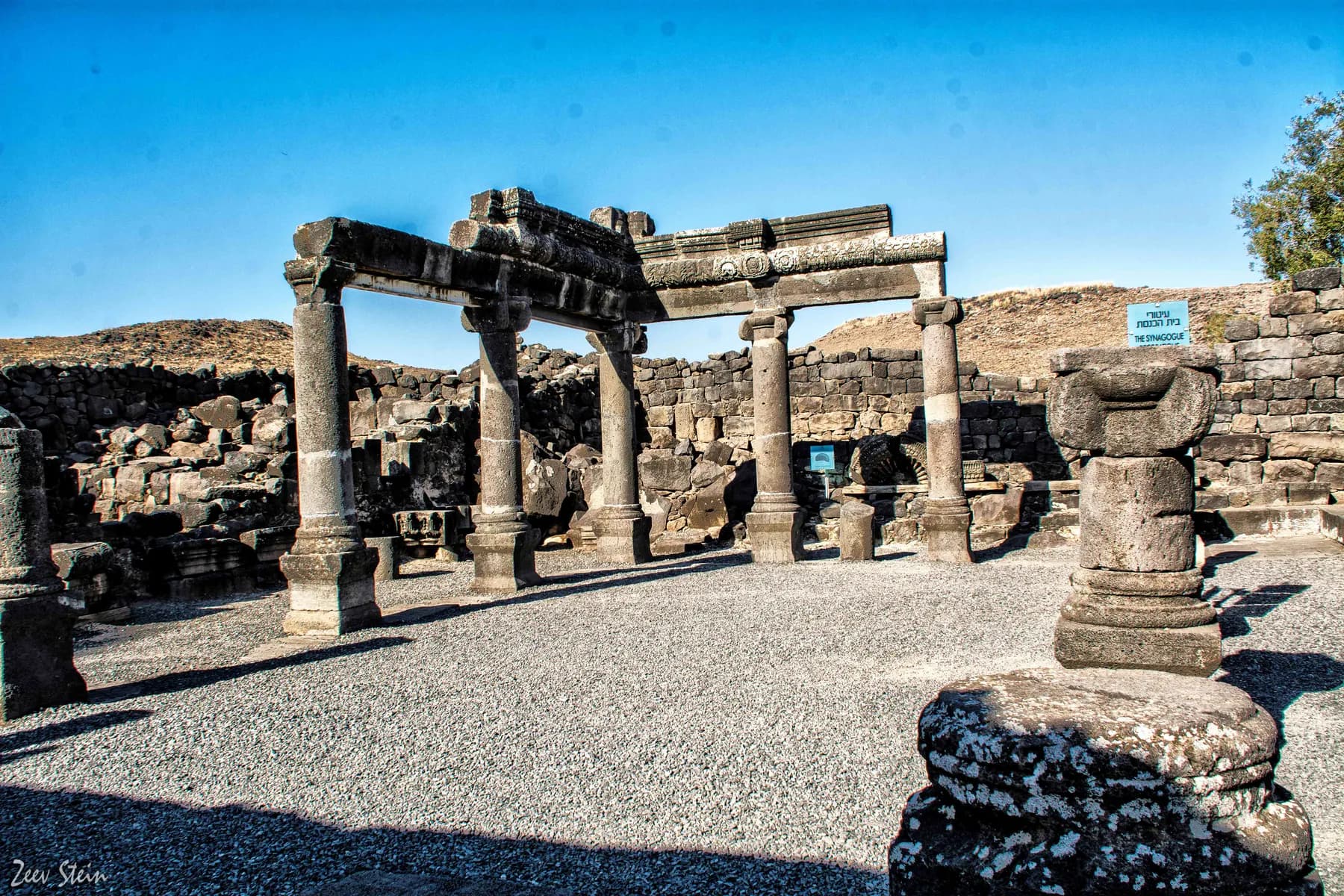
A Talmudic-era town built entirely out of the black basalt it stands on, remembered in the Babylonian Talmud for its wheat and in the Gospels for refusing to listen.
זאב שטיין / CC BY 2.5 · Wikimedia Commons
Extent of the ancient town
about 100 dunams
10 hectares in five quarters, per the parks authority's own brochure
Nave of the synagogue
16.70 by 22.80 m
benches along the walls, twelve columns set in a U, per the Israel Nature and Parks Authority
Adult admission
24 ILS
the parks authority's published price list, read in August 2026; a child pays 10 ILS
Houses dug in the northern quarter
three and a half
what the current excavation had reached after a decade, per Haaretz in May 2025
In short
- How long to give it
- about 90 minutes, or two hours with the olive press path, the loop trail and both viewpoints
- Summer, Sunday to Thursday and Saturday
- 08:00 to 17:00
- Adult
- 24 ILS
כורזים
Korazim is a ruined Jewish town of the Mishnaic and Talmudic centuries, standing on a basalt plateau about four kilometres north of Capernaum and well above the lake. It is a national park rather than a church or a shrine: the Israel Nature and Parks Authority describes it as preserving the remains of a Jewish village of the time of the Mishnah and the Talmud, including a magnificent synagogue. Five quarters are known, and only the central one, plus a few houses of the western quarter, have been dug and rebuilt.
The fact that organises everything else here is the stone. The plateau is basalt, and Korazim was built out of it: walls, doorframes, roof beams, benches, the synagogue floor and the carved lintels. Capernaum's synagogue, four kilometres downhill, was raised in white limestone hauled from quarries some way off. Korazim used what was underfoot, and the result reads almost black in flat light.
The Babylonian Talmud, at Menahot 85a, remembers Korazim for the quality of its wheat, according to the parks authority's brochure, and the three olive presses on the site say the rest. The Gospels remember it differently. Matthew 11:21 and Luke 10:13 put it among the towns Jesus condemned, alongside Bethsaida and Capernaum, which is why pilgrims still stop at a place where nothing Christian was ever built.
The stone
A town quarried out of the ground it stands on
Basalt is hard, it blunts tools, and, as the Hebrew Wikipedia entry puts it, a mistake in it cannot be corrected: there is no filling and no re-cutting. That makes the density of ornament on the Korazim synagogue a statement about money and about the masons who were hired.
The town was laid out on Roman lines, in large insulae each bounded by four streets. East of the synagogue part of one insula has been opened: two houses of well-off families, each with an inner courtyard, living rooms, cisterns and store rooms, with a paved curving lane between the blocks. Some rooms were roofed with basalt beams about two metres long, laid on arches built along the walls, and those beams now lie where they fell.
Next to the synagogue, among the public buildings, is the ritual bath, divided in two by a row of columns and engaged pillars. The immersion pool is reached by two steps above ground and seven below, under a roof of basalt slabs about two metres long. Beside it is an ovoid cistern with a central column holding up a stone ceiling, which the parks authority suggests may have been the otzar, the reservoir of undrawn water a mikveh must be joined to. It is covered today by a metal grate. Of the three olive presses found here, only the one at the edge of the western quarter has been reconstructed and opened.
- Five quarters known, of which the central one is excavated and reconstructed
- Synagogue, mikveh and public buildings grouped at the centre
- Two wealthy houses opened east of the synagogue, with courtyards and cisterns
- One of three olive presses partly rebuilt, at the edge of the western quarter
The synagogue
Galilean type, southern facade, and a date nobody has settled
The synagogue follows the pattern archaeologists call Galilean. The facade faces south, towards Jerusalem, and carries the ornament: a paved plaza lies in front of it and nine steps rise to three doorways, the central and largest crowned by a gable. In the northwestern corner the wall rests directly on hewn bedrock. Benches ran along the walls of the nave, which the parks authority measures at 16.70 by 22.80 metres, and twelve columns set in a U carried a second storey that some scholars, the authority notes, think existed to let daylight in.
The dating is genuinely unsettled and the versions do not reconcile. The material issued by Israel's foreign ministry has the building raised in the late third or early fourth century, destroyed in the latter part of the fourth and rebuilt in the fifth. Negev and Gibson's archaeological encyclopaedia, cited on the English Wikipedia entry, gives a late third-century building, destruction in the fourth and rebuilding in the sixth. Haaretz, reporting from the current dig in May 2025, said the excavators had found a first-century synagogue foundation beneath the monumental fourth-century one.
The carving is the other reason to slow down. The walls carry reliefs of human figures, animals, mythological subjects, plants and geometric patterns, and the parks authority singles out an elaborate conch shell. Steven Fine's work, summarised on the English Wikipedia entry, notes a pair of free-standing stone lions, three-dimensional sculpture being unusual in an ancient synagogue, with a parallel pair at Kfar Bar'am, and lists carvings of wine-making, animals, a Medusa, an armed soldier and an eagle, thought to have been brightly painted once. Haaretz adds Hercules.
The building was not only for prayer. The parks authority says it served for assembly and for court hearings, and that the rooms attached to it were an inn, housing for public figures, charitable institutions and study rooms.
The seat
The Seat of Moses, and the man who paid for the steps
The most quoted object from Korazim is a chair cut from a single block of basalt, the kathedra de-Moshe or Seat of Moses. It was found in 1926, in the season Jacob Ory ran for the British Mandate's Department of Antiquities, according to Haaretz. It matters because the phrase is in Matthew 23:2, where the scribes and Pharisees are said to sit on Moses' seat, and Korazim produced an actual one.
It carries an Aramaic dedication. The Hebrew Wikipedia entry gives the text as remembering for good Yudan son of Ishmael, who made the columns and the steps at his own expense, and asking that his portion be with the righteous. Yudan ben Ishmael is identified there as a third-generation amora of the Land of Israel. What the inscription does not say is who sat in the chair, or whether anyone did, and Haaretz notes that the question is still argued over.
Where it stood is also unsettled. The foreign ministry's account places the Ark of the Law inside the southern wall to the right of the central entrance, and says that to the left stood either the bema or the Seat of Moses, without choosing. The excavators also found a stone stand like a lectern, with a place for a book and hollowed rings at either side; Mordechai Aviam, cited on the Hebrew Wikipedia entry, reads that piece as a seat for a community notable.
One practical warning: what stands in the synagogue today is a replica. The parks authority's own description lists a replica of the basalt seat bearing the donor's inscription, and a replica of the engaged pillar that flanked the Ark. It does not say where the original went.
What is real
A hundred and twenty years of digging, and how much of it went back up
Korazim has been worked in short campaigns separated by long gaps. Charles Wilson identified the synagogue in 1869. The first proper excavation was by Heinrich Kohl and Carl Watzinger in the early 1900s, as part of their survey of ancient Galilean synagogues, and work resumed in the 1920s under the Hebrew University and the Mandate's Department of Antiquities, which is Ory's season and the one that produced the seat.
The modern shape of the site comes from two later campaigns, and the sources disagree about their years. The parks authority's brochure gives work in the central quarter by the Israel Department of Antiquities and Museums between 1962 and 1965, then excavation and restoration between 1980 and 1983 jointly with the National Parks Authority. Ze'ev Yeivin, who directed it, titled his 2000 report for the Israel Antiquities Authority as covering the 1962 to 1964 and 1980 to 1987 seasons. The dates differ by a season or four; the fact of a long second campaign does not.
The rebuilding is not hidden. The parks authority states plainly that the main quarter has been partially excavated and reconstructed, as have a few houses in the western quarter, and that it carried out conservation, built a promenade path and installed the signs. The standing columns and the reassembled facade are original blocks put back in place rather than a wall that never fell, and the two showpieces inside are copies. A rule for a first visit: the low walls, the paving, the benches, the cisterns and the loose carved blocks are as found, and anything at head height has been lifted there.
A display of roughly sixty loose architectural pieces sits to one side: threshold stones, a cornice, slender columns that may have come from the synagogue's upper storey, and a grinding stone. It is the fraction that could not be put back.
Afterwards
Arched houses, a sheikh's tomb, and a village that ended in 1948
The town did not stop at the end of the Talmudic period, and the later layers are the part most visitors miss. The parks authority's brochure has the earliest occupation in the first or second century CE, growth southward in the third and fourth, restoration in the fifth or sixth, a further phase of change in the eighth under early Islamic rule, then a hiatus of several hundred years and renewed settlement in the thirteenth. Haaretz differs at both ends, putting the rise in the second or first century BCE and a slow decline by the eleventh, caused by economic collapse rather than war.
The arched houses of the western quarter are the best preserved buildings on the site. The parks authority dates them to the Mamluk period, the fourteenth and fifteenth centuries, built in the Hauran style on fourth-century foundations, with three double arches carrying stone roof beams. Two survive almost to their full original height, which is more than can be said for anything Talmudic here. The windows set into their inner walls were first recognised at this site and are known as Korazim windows.
Under an old Mount Tabor oak is the tomb of Sheikh Ramadan Abu-Karaza, probably late Mamluk, which local Bedouin associated with one of Saladin's warriors and where people came to make vows and settle disputes. The English Wikipedia entry records the Ottoman-period village of Khirbat Karraza around it, inhabited by Bedouin of the Zangariyye tribe. The brochure notes a sixteenth-century traveller who reported Jewish fishermen at Korazim.
The village was depopulated on 4 May 1948 by the First Battalion of the Palmach during Operation Yiftach, per the English Wikipedia entry, which also records Walid Khalidi reporting in 1992 that some houses were still standing. Visitors usually read the arched houses as ancient; they are roughly a thousand years younger than the synagogue.
- Arched houses, western quarter: Mamluk, 14th to 15th centuries, on 4th-century foundations
- Korazim windows: a Hauran building detail first identified at this site
- Tomb of Sheikh Ramadan Abu-Karaza: probably late Mamluk, under a Mount Tabor oak
- Khirbat Karraza: the Ottoman-era village, depopulated on 4 May 1948
Now
The dig is still running, and the public is allowed in it
Korazim is one of the few Israeli national parks where excavation is a visitor activity rather than a fenced-off nuisance. Haaretz reported in May 2025 that Achia Kohn-Tavor has directed work here with Ariel University since 2014, opening houses in the northern quarter near the ritual bath, and that after all the decades of digging only about three and a half houses have been cleared. The rest of a hundred-dunam town is still in the ground.
The finds are domestic: potsherds, coins of the fourth and fifth centuries, a hoard of Ottoman-period coins, and, found by a child, an early fork. On 1 June 2026, about ten minutes before the day's digging ended, a twelve-year-old from the local Ramat Korazim school named Alon Horvitz picked up a deep blue stone that Kohn-Tavor identified as a nicolo, a banded agate the Romans set in signet rings. The Jerusalem Post reported it as roughly 1,500 years old.
The parks authority sells the experience as Digging Through Time: two to three hours of excavation led by an archaeologist, in English or Hebrew, with a tour of the site included and an optional ancient crafts workshop, booked through the park office on a signed form. One further find is worth looking for on the ground: a winepress of about 16 square metres, floored in mosaic and dated to the Talmudic period, exposed by accident in 2019 during conservation work.
What to look for
Things not to walk past at Korazim
The details that repay knowing about before you are standing in front of them.
The Seat of Moses
A basalt chair found in 1926, inscribed in Aramaic to Yudan son of Ishmael, who paid for the columns and the steps. What stands in the synagogue is a replica; the parks authority's page does not say where the original went.
The Medusa on a synagogue wall
Among the reliefs is a Medusa's head, alongside wine-making scenes, animals, an armed soldier and an eagle, all once brightly painted. A pair of free-standing stone lions is the rarer thing: three-dimensional sculpture in an ancient synagogue.
The mikveh and the grate over the otzar
Two steps down to ground level and seven below it, under a roof of two-metre basalt slabs. The round cistern beside it, now covered by a metal grate, may be the otzar of undrawn water that the law requires a ritual bath to be joined to.
The arched houses of the western quarter
Mamluk buildings of the fourteenth and fifteenth centuries, raised in the Hauran manner on fourth-century foundations, two of them standing almost to their full height. The window detail in their inner walls was first recognised here and is called a Korazim window.
The olive press at the edge of the site
One of three found at Korazim, dated by the parks authority to the fourth or fifth century and partly reconstructed. It sits at the end of a compacted gravel path off the western quarter, which is why most groups never reach it.
The jujube viewpoint
The lookout under the ancient Christ-thorn jujube trees takes in the lake and the whole northwestern basin where the Gospel sites sit, with the parks authority's own sign on Korazim in Christian tradition beside it.
The long view
Korazim, in order
1st or 2nd century CE
The earliest occupation, on the slope of the northern hill, according to the parks authority's brochure. Haaretz's report from the current dig puts the town's rise earlier, in the second or first century BCE.
3rd to 4th centuries CE
The town grows and spreads southward through the Mishnaic and Talmudic period. Most of what a visitor sees today belongs to this phase.
Late 3rd or early 4th century
The basalt synagogue is built, on the dating published through Israel's foreign ministry. Excavators at the current dig report a first-century synagogue foundation beneath it.
1926
Jacob Ory excavates for the British Mandate's Department of Antiquities. The Seat of Moses is found in this season. Ory also described a second synagogue about 200 metres west that later excavators have never been able to confirm.
Later 4th century
The town and the synagogue are destroyed, possibly by an earthquake, and rebuilt in the fifth century or, on another reading, the sixth.
5th or 6th century
The town is restored at the end of the Talmudic period, with repairs and alterations running through the original buildings and the synagogue.
8th century
A further phase of growth and rebuilding under early Islamic rule, then a hiatus of several hundred years.
13th century
Settlement returns to the site after the gap.
14th to 15th centuries
The arched houses of the western quarter are built in the Hauran style on fourth-century foundations, along with the tomb of Sheikh Ramadan Abu-Karaza.
16th century
A traveller passing through reports Jewish fishermen living at Korazim. A small population holds the site from the fifteenth century until the start of the twentieth.
1869
Charles Wilson identifies the synagogue.
Early 1900s
Heinrich Kohl and Carl Watzinger excavate Korazim as part of their survey of ancient Galilean synagogues.
4 May 1948
Khirbat Karraza, the village that had grown up around the ruins, is depopulated by the First Battalion of the Palmach during Operation Yiftach.
1962 to 1965
The Israel Department of Antiquities and Museums works extensively in the central quarter. Ze'ev Yeivin's own report gives the seasons as 1962 to 1964.
1980 to 1983
Excavation and restoration as a joint venture of the National Parks Authority and the Department of Antiquities and Museums. Yeivin's report runs the campaign to 1987; the Hebrew Wikipedia entry gives 1984.
2000
Yeivin publishes The Synagogue at Korazim in the Israel Antiquities Authority Reports series.
2004
A small salvage excavation by the Israel Antiquities Authority, directed by Yosef Stepansky, digs the ancient road known as the Way through Korazim, which crossed the plateau from west to east off the Cairo to Damascus highway.
2014
Achia Kohn-Tavor and Ariel University begin the current excavation of houses in the northern quarter, with tourists, families and school groups digging alongside the team.
2019
A winepress of about 16 square metres with a mosaic floor, dated to the Talmudic period, is exposed by accident during conservation work.
1 June 2026
A twelve-year-old on the school dig finds a nicolo agate that the excavation director dates to roughly 1,500 years ago.
Practical
Visiting Korazim
Where
Korazim National Park, Route 8277 between the Korazim junction and Almagor, about ten minutes east of the Ami'ad junction, on the plateau above the northwestern shore of the lake.
What ticket you need
Korazim is its own national park, not a corner of a larger ticketed site, so the 24 shekel adult ticket is the whole cost of entry and an Israel Nature and Parks Authority subscription covers it. It is not connected to Capernaum, four kilometres downhill, which is a Franciscan sanctuary with its own separate fee, and no ticket bought at either gate is valid at the other.
Opening hours
- Summer, Sunday to Thursday and Saturday
- 08:00 to 17:00source
- Summer, Friday and holiday eves
- 08:00 to 16:00source
- Winter, Sunday to Thursday and Saturday
- 08:00 to 16:00source
- Winter, Friday and holiday eves
- 08:00 to 15:00source
- Holiday eves and the eve of Yom Kippur
- 08:00 to 13:00source
- Last entry
- One hour before the closing time above, so 16:00 in summer and 15:00 in winter on an ordinary daysource
Admission
- Adult
- 24 ILSsource
- Child
- 10 ILSsource
- Student
- 20 ILSsource
- Israeli senior citizen
- 12 ILSsource
- In a group of more than 30
- 20 ILS an adult, 9 ILS a childsource
- Digging Through Time, per person in a group of 30 to 50, entry included
- 79 ILS an adult, 64 ILS a child, 69 ILS an Israeli senior. A group of fewer than 30 pays a minimum of 2,300 ILS, and opening the site outside its published hours costs 200 ILS an hoursource
- Parks authority subscription
- The brochure sells the authority's subscription as unlimited free entry to 55 national parks and nature reserves, of which this is onesource
Access
Better than most archaeological parks in the country, and the parks authority is specific about why. There is no climb to the site: a concrete path runs from the car park, which sits beside the ticket booth and the visitor service centre, to the heart of the antiquities including the synagogue, with handrails alongside the steps and directional and explanatory signage throughout. The parking, ticket booth, visitor service centre, toilets, shaded picnic areas and drinking fountains are all listed as accessible. The path to the olive press and its surroundings, and the loop trail, are compacted gravel of a comfortable width at a gentle gradient, which the authority describes as suitable for people who have difficulty walking and for children. What is not level is the archaeology itself: nine steps climb from the plaza into the synagogue, the excavated houses are uneven basalt with thresholds and low walls, and fallen roof beams lie about. The park also publishes an accessible visit coordination form for people with disabilities, which is the sensible route if a specific question needs answering before the drive.
On site
- Ticket booth and visitor service centre
- Toilets
- Shaded picnic areas with large round concrete tables
- Drinking fountains
- Open-air work and study space with wi-fi
- Marked loop trail and olive press path
- Two viewpoints over the lake and Nahal Korazim
- Display of about sixty loose architectural fragments
- Dogs allowed leashed and muzzled, but not inside the synagogue
Booking
No booking is needed to walk in, but the parks authority runs a reservation system for the park and says that a visitor who has reserved and finds the site full will be asked to show the confirmation at the gate. Digging Through Time is different: it is booked by filling in and signing the park's own form and emailing it to korazim@npa.org.il, with a credit card number left as a guarantee and payment made to the cashier on the day. The park office is on 04-6934982.
Hours and prices are given as the operator publishes them and change without much notice, particularly around Shabbat and the festivals. Check the operator's own page before you travel for this.
Official page at en.parks.org.il →What people wish they had known
- Do not treat the synagogue's set pieces as originals. The Seat of Moses and the engaged pillar beside the Ark are both replicas, which the parks authority says on its own page. The reliefs on the walls and the loose blocks in the architectural display are the real carving, and they are the reason to walk the building slowly.
- Watch the closing time in winter, because it is 16:00 and the gate stops admitting an hour before that. An arrival at half past three in January is a wasted drive, and the Friday and holiday eve closing is an hour earlier again.
- Keep going past the synagogue. Most groups do the central quarter and turn round, which means they miss the arched houses of the western quarter, the only buildings on the site still standing to something like full height, and the reconstructed olive press at the end of the gravel path.
- Come early or late for the light and the heat. The plateau is exposed, the excavated quarters have no shade at all, and black basalt holds the sun. The shaded picnic areas and the old jujube and oak trees are near the entrance, not out among the ruins.
- Reserve through the parks authority's system even though nothing forces you to. The park says a reservation guarantees a place, and that a visitor who has one may be asked to produce it at the gate on a busy day.
- If there is a child in the party, ask the park office about Digging Through Time before travelling rather than on arrival. It runs two to three hours, is led by an archaeologist in English or Hebrew, and has to be booked in advance on a signed form.
The figures
Korazim by the numbers
Each figure carries the year it belongs to and links the source it came from.
| Measure | Figure | As of | Source |
|---|---|---|---|
| Extent of the ancient town | about 100 dunams (10 hectares), in five quarters | 2026 | static-en.parks.org.il |
| Nave of the synagogue | 16.70 by 22.80 m, with twelve columns set in a U | 2026 | en.parks.org.il |
| Steps from the plaza to the synagogue's three doorways | nine | 2026 | en.parks.org.il |
| Adult admission | 24 ILS, with a child at 10 ILS and an Israeli senior at 12 ILS | 2026 | en.parks.org.il |
| Distance from Capernaum | about 4 km, or 2.5 miles, up onto the Korazim plateau | 2026 | en.wikipedia.org |
| Coins recovered at and around the synagogue | a hoard of about 400, mostly Constantinian and of the early 4th century, and a second group of about 1,500 dated between the 4th century and the early 7th | 2026 | he.wikipedia.org |
| Houses cleared in the northern quarter since the current dig began in 2014 | about three and a half | 2025 | haaretz.com |
| Winepress uncovered by accident during conservation work in 2019 | about 16 sq m, floored in mosaic, dated to the Talmudic period | 2026 | he.wikipedia.org |
While you are here
The rest of The Sea of Galilee
Everything else in this destination with a page of its own.
Tracy Hunter from Spokane, USA / CC BY 2.0 · Wikimedia Commons
Archaeological site
Capernaum
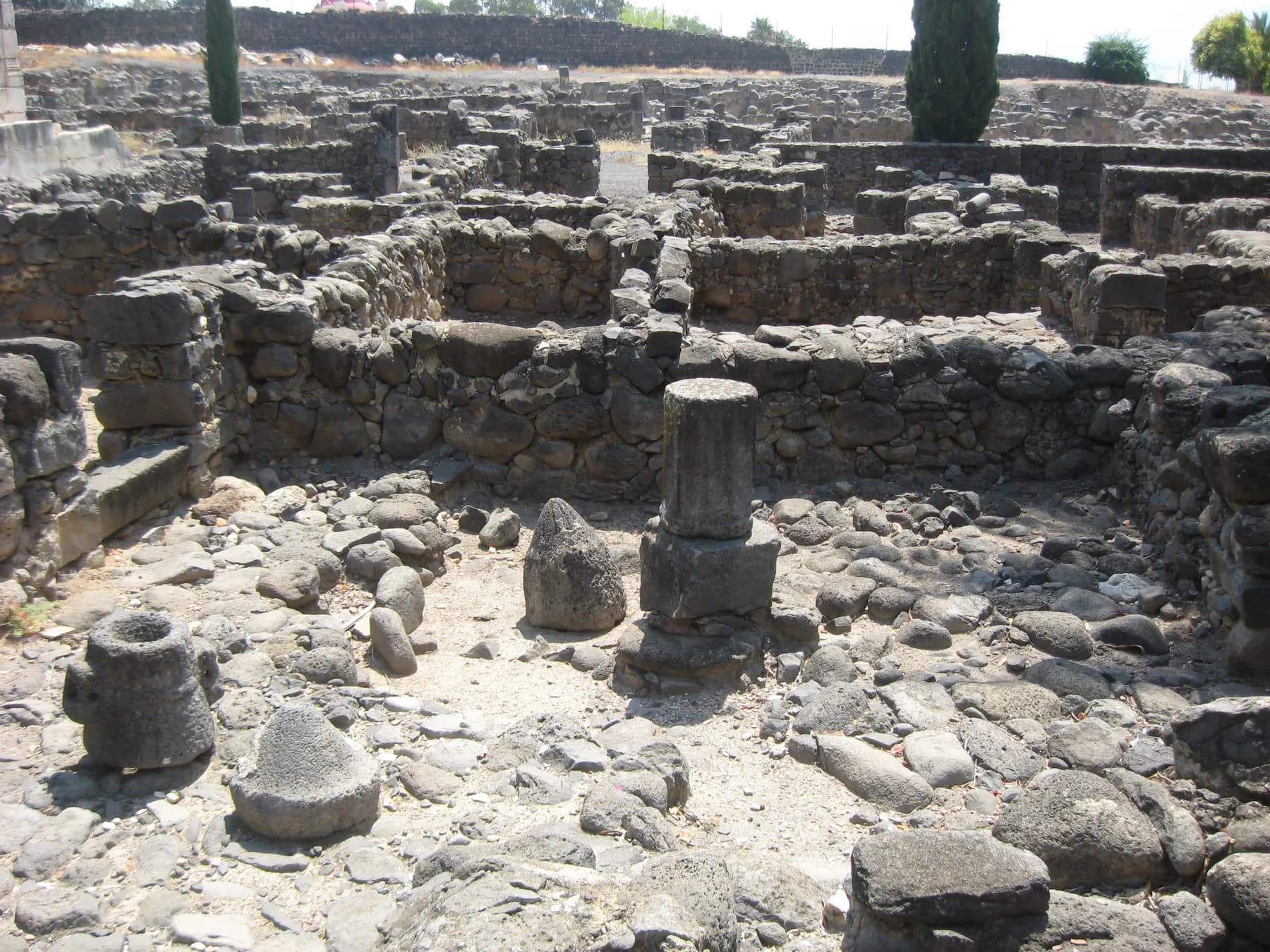
Two thirds of the ruined village belongs to the Franciscans, who finally got the title deeds on 19 September 1894 after eight years of Ottoman paperwork and have dug it in twenty-three seasons since 1968.
Commander, U.S. Naval Forces Europe-Africa/U.S. 6th Fleet / Public domain · Wikimedia Commons
Religious site
Mount of Beatitudes
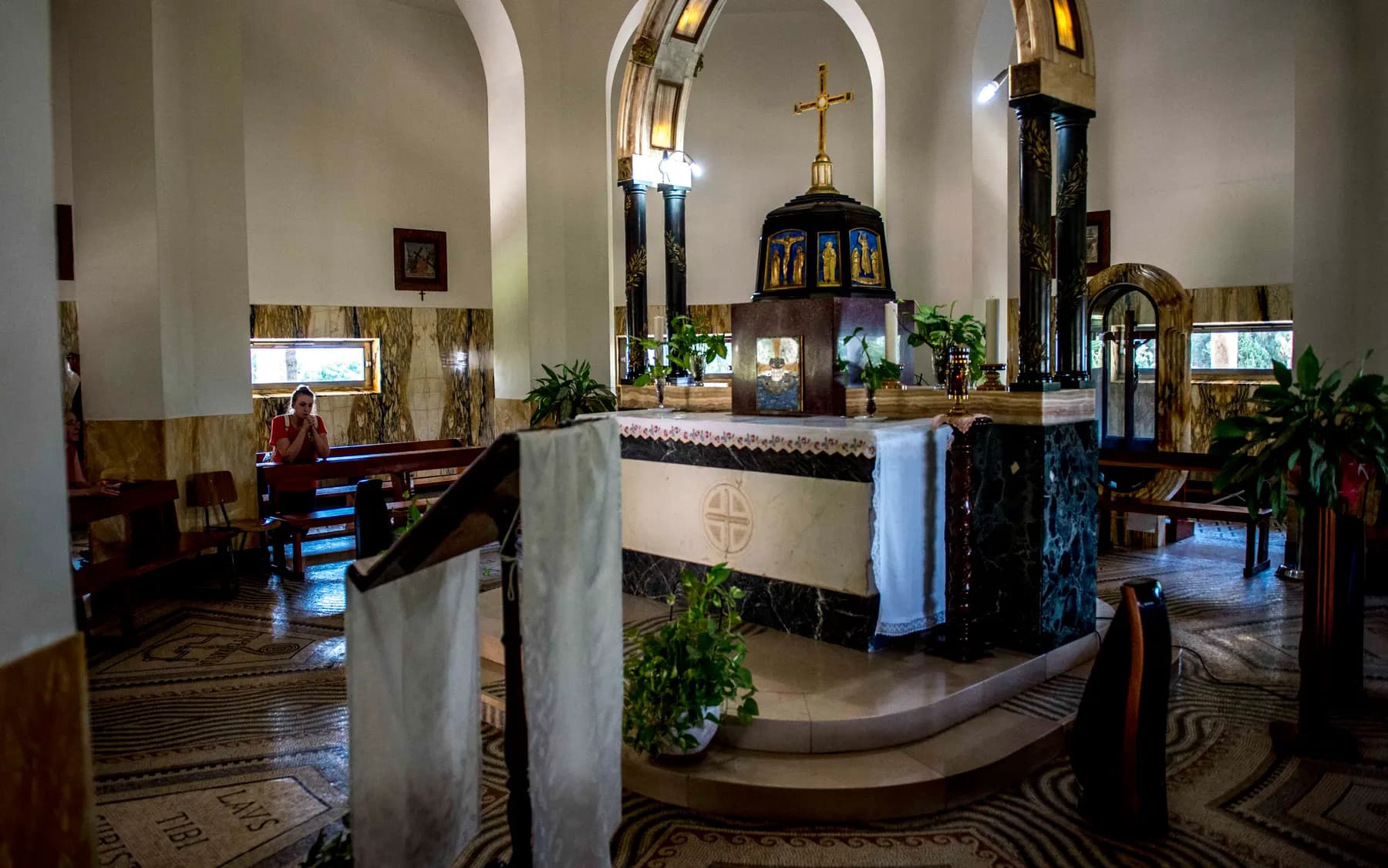
Antonio Barluzzi gave the church eight sides for the eight beatitudes and set it on a hill about 25 metres below sea level, which makes the summit one of the lowest in the world.
יוסי רון / CC BY 2.5 · Wikimedia Commons
Religious site
Tabgha
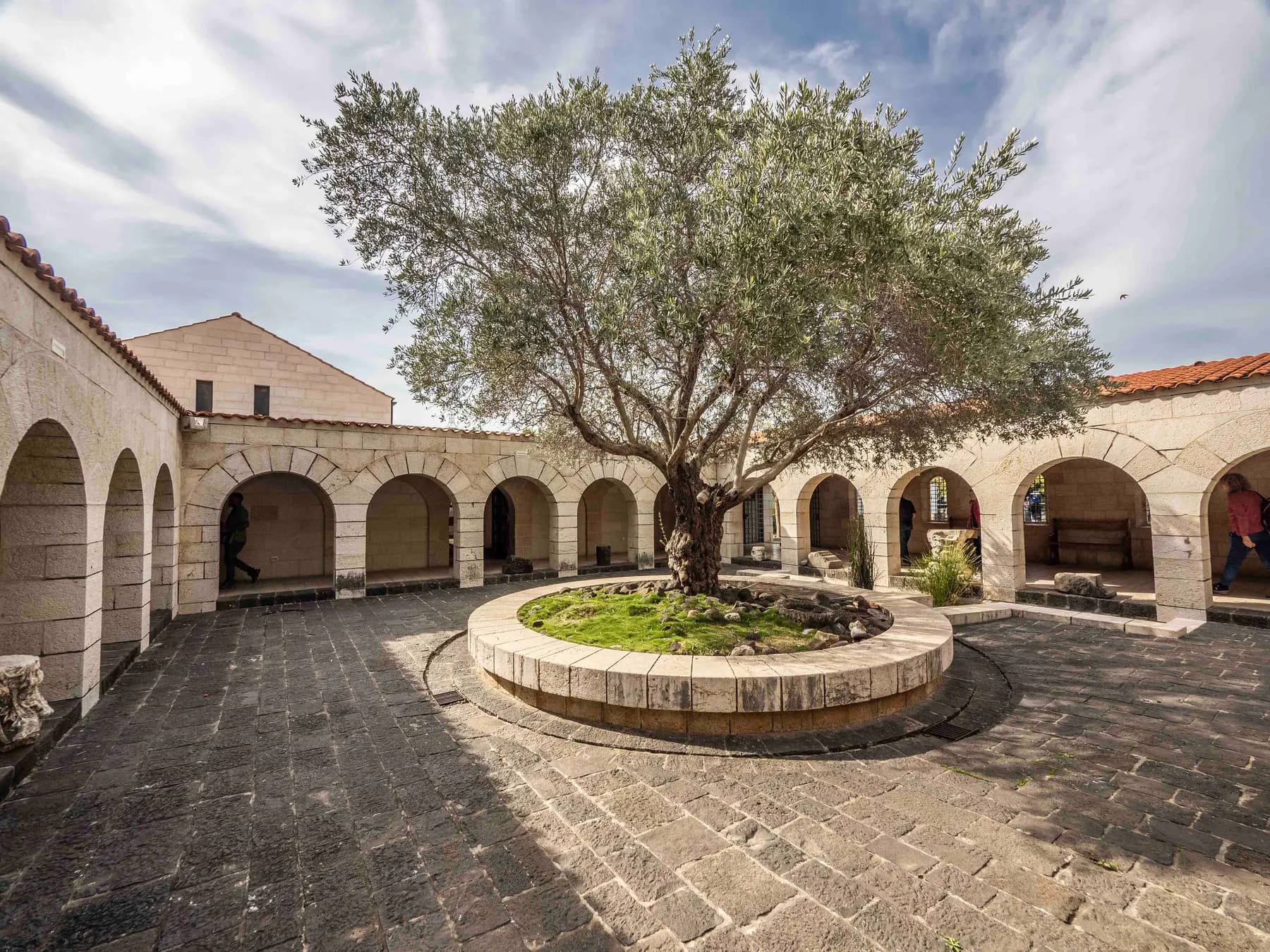
The mosaic in front of the altar shows a basket of four loaves, not the five of the Gospel account, and the usual reading is that the fifth is the one consecrated on the altar above it.
Sources and further reading
Every link below was opened and checked when this page was written. Official statements are marked as such: they are the subject's own account, not an independent one.
- OfficialIsrael Nature and Parks Authorityen.parks.org.ilKorazim National Park
The operator's own page: opening hours, the price list, accessibility, facilities and the site's descriptions of the synagogue, mikveh, dwellings, arched houses, olive presses and the sheikh's tomb.
- OfficialIsrael Nature and Parks Authoritystatic-en.parks.org.ilKorazim National Park brochure (PDF)
The park's printed history: the Talmudic and Gospel references, the 100 dunam extent, the settlement phases and the sequence of excavation seasons.
- OfficialIsrael Nature and Parks Authoritystatic-en.parks.org.ilDigging Through Time, reservation form (PDF)
The public excavation programme, its duration and languages, its group prices and the surcharge for opening outside published hours.
- OfficialIsrael Nature and Parks Authorityparks.org.ilגן לאומי כורזים (Korazim National Park, Hebrew page)
The Hebrew page, which adds the viewpoints, the walking trails including the four kilometre route down to Capernaum, the count of architectural fragments and the full fee table.
- ReportingHaaretzhaaretz.comTourists and child archaeologists break new ground at ancient Chorazin
The current excavation under Achia Kohn-Tavor and Ariel University, the count of houses cleared, the first-century synagogue foundation, the Medusa and Hercules carvings, and the 1926 discovery of the Seat of Moses.
- ReportingThe Jerusalem Postjpost.comRare gemstone discovered by 12-year-old boy during archaeological dig in ancient Jewish village
The nicolo agate found on 1 June 2026 by Alon Horvitz, and the excavation director's reading of it.
- ReferenceJewish Virtual Library, from Israeli Foreign Ministry materialjewishvirtuallibrary.orgArchaeology in Israel: Chorazin
The synagogue's plan and dating sequence, the position of the Ark and the Cathedra of Moses, and the site's 25 acre extent.
- ReferenceWikipediaen.wikipedia.orgChorazin
The excavation chronology, Robinson's objection to the identification, the carved lions and Medusa after Steven Fine, Ory's unconfirmed second synagogue, Khirbat Karraza and its depopulation in 1948.
- ReferenceHebrew Wikipediahe.wikipedia.orgכורזים
Wilson's identification in 1869, the Aramaic text of the Seat of Moses inscription and Yudan ben Ishmael, the two coin groups, Mordechai Aviam on the stone stand, and the mosaic-floored winepress found in 2019.
- ReferenceIsrael Antiquities Authorityhadashot-esi.org.ilKhirbat Umm el-Kalkha, Hadashot Arkheologiyot volume 122
Yosef Stepansky's 2004 salvage excavation of the Way through Korazim, the ancient road that crossed the plateau off the Cairo to Damascus highway.
Korazim: common questions
What is there to see at Korazim National Park?+
The excavated centre of a Jewish town of the Mishnaic and Talmudic centuries, built entirely of black basalt. The main things are the synagogue with its carved facade and reliefs, a ritual bath with an adjoining cistern, two wealthy houses with courtyards and cisterns, a partly reconstructed olive press, the Mamluk arched houses of the western quarter and a Muslim sheikh's tomb under an old oak. Five quarters of the town are known and only the central one, plus a few houses in the west, have been dug.
How much does Korazim National Park cost and when is it open?+
An adult ticket is 24 shekels, a child 10, a student 20 and an Israeli senior citizen 12, on the price list the Israel Nature and Parks Authority publishes for the site. Summer hours are 08:00 to 17:00 from Sunday to Thursday and on Saturday, and 08:00 to 16:00 on Fridays and holiday eves; winter hours are an hour earlier in each case. Entry closes an hour before the listed closing time, and the park shuts at 13:00 on holiday eves and the eve of Yom Kippur.
Is the Seat of Moses at Korazim the original?+
No. The parks authority's description of the site lists what stands in the synagogue as a replica of the basalt seat bearing the donor's inscription, alongside a replica of the engaged pillar that flanked the Ark. The original was found in 1926 during Jacob Ory's season for the Mandate's Department of Antiquities, and carries an Aramaic dedication to Yudan son of Ishmael, who paid for the columns and the steps. The park's page does not say where the original is now.
Why is everything at Korazim black?+
Because the town sits on a basalt plateau and was built out of it. Walls, doorways, roof beams, benches, the synagogue floor and the carved lintels are all local volcanic stone. That is the visible difference from Capernaum, four kilometres downhill, whose synagogue was raised in white limestone brought in from quarries some way off. Basalt is hard and unforgiving to carve, so the quantity of ornament at Korazim says something about how much the town could afford.
Is this the Chorazin cursed in the Gospels?+
It is the site identified with it. Matthew 11:21 and Luke 10:13 name Chorazin among the towns condemned for not repenting, with Bethsaida and Capernaum, and Eusebius later described Korazim as a ruined city. Edward Robinson disputed the identification in the nineteenth century, calling the ruins too slight and noting that they do not sit by the lake as Jerome's description implies, but the identification of Khirbat Karraza with Chorazin was accepted anyway. Nothing Christian was ever built on the site.
How long do you need at Korazim?+
About 90 minutes covers the central quarter, the synagogue, the mikveh and the houses at a reasonable pace. Two hours takes in the arched houses in the west, the olive press at the end of the gravel path, both viewpoints and the display of loose architectural fragments. A coach group doing the synagogue and leaving can be through in half an hour, and that is where most of the site gets missed.
Is Korazim wheelchair accessible?+
In part, and unusually well for an excavated site. The parks authority publishes a concrete path running from the car park, next to the ticket booth and the visitor service centre, to the centre of the antiquities including the synagogue, with handrails beside the steps, and lists accessible parking, ticket booth, visitor centre, toilets, shaded picnic areas and drinking fountains. The olive press path and the loop trail are compacted gravel at a gentle gradient. The archaeology itself is not level: nine steps rise into the synagogue and the excavated houses are uneven basalt with thresholds, low walls and fallen roof beams. The park publishes an accessible visit coordination form for anything more specific.
Can you take part in the excavation?+
Yes, and it is one of the few places in Israel where a visitor can. The dig has run with Ariel University under Achia Kohn-Tavor since 2014, and the park's Digging Through Time programme puts families, groups and school parties into it for two to three hours with an archaeologist, in English or Hebrew, with a guided tour of the site included. It has to be booked in advance on the park's own form, emailed to the site office, and paid at the cashier on the day.
How far is Korazim from Capernaum, and can you walk between them?+
About four kilometres, and yes. The parks authority's Hebrew page describes a four kilometre trail running from Korazim down the Nahal Korazim streambed to Kfar Nahum National Park at Capernaum, following the historic route that linked the two towns, with an ancient farm, now disused, in the middle of it. The walk is downhill in that direction, which matters in summer, and it ends at a different gate with a different ticket.
Is there shade at Korazim?+
Some, but not where the ruins are. The parks authority lists shaded picnic areas, huge Christ-thorn jujube trees and an ancient Mount Tabor oak among the site's attractions, and those are clustered near the entrance and the viewpoints. The excavated quarters are open plateau with no cover, and black basalt radiates heat, so midday in summer is the wrong time to be walking them.