Museum · The Old City of Jerusalem
Tower of David Museum
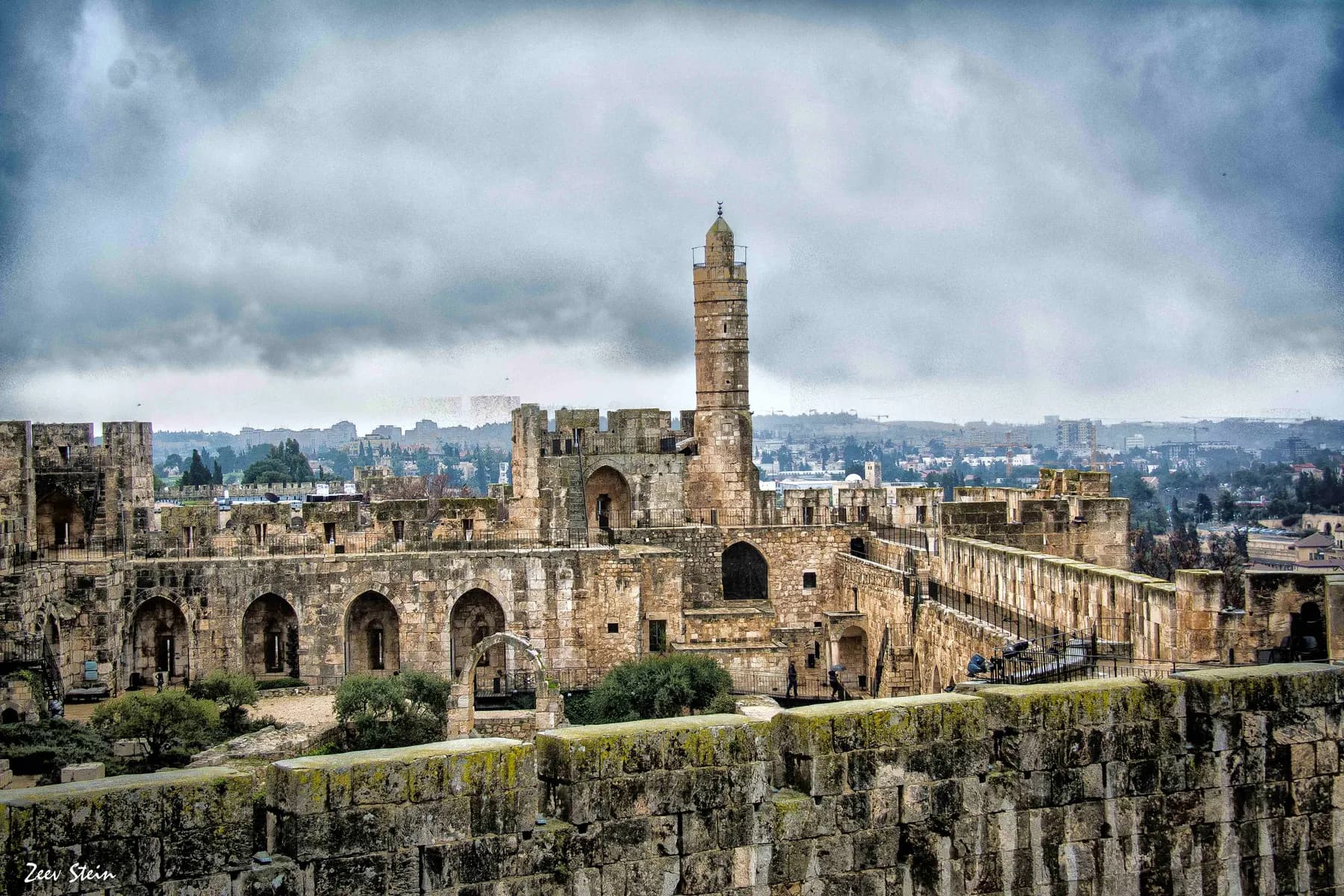
The citadel beside Jaffa Gate is Mamluk and Ottoman work standing on the stump of a Herodian tower, and its museum reopened on 1 June 2023 with a new display of ten galleries.
זאב שטיין / CC BY 2.5 · Wikimedia Commons
Reopened
1 June 2023
after a six-year rebuild the Times of Israel reported at 50 million dollars
Permanent galleries
Ten
in the display installed for the 2023 reopening
Adult admission
₪55
₪50 booked ahead, in the city's official tourism listing for 2026
Herodian courses standing
about 16
at the base of the one surviving tower of the three Herod built in 37–34 BCE
In short
- How long to give it
- about 90 minutes, and longer with the Kishle and the tower climb; the city's tourism listing suggests one to one and a half hours
- Sunday
- 12.00 to 17.00
- Adult
- ₪55, or ₪50 at the advance price
מגדל דוד · القلعة
The Tower of David Museum is a museum of Jerusalem's history housed in the citadel that stands immediately inside Jaffa Gate, and almost nothing in the name is accurate. It is not a tower, King David had no hand in it, and the slim minaret that appears in every photograph taken of it went up in the seventeenth century. What is actually there is a fortress rebuilt by the Mamluks in 1310 and expanded by the Ottomans between 1537 and 1541, sitting on the stump of one of three towers Herod raised at this corner of the city between 37 and 34 BCE.
Since 1 June 2023 it has held a new permanent display of ten galleries, the result of a six-year rebuild that the Times of Israel reported at 50 million dollars. The work went well past the exhibits. A covered entrance pavilion was built opposite Jaffa Gate, two lifts and a set of widened paths and ramps were threaded through an archaeological site, the walls were conserved, and the top two metres of the minaret were taken down and rebuilt after the Israel Antiquities Authority judged them close to collapse.
It is the one place inside the walls that lays out the whole chronology in order, which is why so many itineraries put it first. It is also, on its critics' account, a contested telling of that chronology, and this page says where the disagreement sits rather than stepping around it.
The fabric
A Mamluk fortress standing on a Herodian stump
The citadel as it stands is medieval and Ottoman. The Mamluk Sultanate destroyed the earlier fortress in 1260, and in 1310 the sultan al-Nasir Muhammad ibn Qalawun rebuilt it, giving the complex much of its present shape. Suleiman the Magnificent expanded it between 1537 and 1541, his architects designing the large entrance with a cannon emplacement behind it, and for four hundred years the place was a garrison for Ottoman troops. The city wall running away from it on both sides is the same programme of work: Britannica dates Suleiman's circuit to 1538 to 1540, built largely on Crusader, Byzantine, Herodian and in places Hasmonean foundations.
The genuinely ancient piece is small and easy to walk past. Herod added three towers to the fortifications at this vulnerable north-west corner of the Western Hill between 37 and 34 BCE: Phasael, the tallest at 44 metres, named for the brother who killed himself in captivity; Mariamne, for the wife he had executed; and Hippicus, for a friend. Only the base of one of the three survives. Some sixteen courses of Herodian ashlars still rise from ground level, partly hidden behind a later glacis, with smaller stones of a later period piled back on top of the stump.
Which tower it is has been argued over for a century and a half. Hillel Geva, who excavated the citadel, made the case in the Israel Exploration Journal in 1981 for Hippicus, an identification the nineteenth-century scholars Edward Robinson and James Turner Barclay had already proposed. James Fergusson, Thomas Lewin, Conrad Schick, George Adam Smith, Charles Warren and Claude Conder held out for Phasael, on the strength of its size. The museum's own signage does not settle it, and neither does anything found so far.
Excavation keeps moving the later dates too. Amit Re'em, directing work in the citadel, found in the foundations of the western fortification a dated Arabic inscription naming al-Mu'azzam Isa, Saladin's nephew, who pulled Jerusalem's defences down in about 1212 in expectation of a Crusader attack that never came and cut his name into every tower. Because that stone was reused in the foundation of the wall above it, a fortification long read as twelfth-century Crusader work is in fact thirteenth-century Ayyubid. The same campaign carbon-dated mortar with the Weizmann Institute and recorded the standing structure by photogrammetry.
- Hasmonean: the Western Hill first settled around 150 BCE, behind what Josephus called the First Wall
- Herodian: three towers of 37–34 BCE, one base surviving, about sixteen courses of it above ground
- Ayyubid: the western fortification redated to about 1212 by an inscription of al-Mu'azzam Isa
- Mamluk: rebuilt in 1310 under al-Nasir Muhammad ibn Qalawun, which is most of what is standing
- Ottoman: expanded 1537 to 1541, minaret added 1635 to 1655, Kishle barracks added 1837
The name
Named in the fifth century for the wrong king
Byzantine Christians settled the name. Mistaking the Western Hill for Mount Zion, they took the surviving Herodian tower for the palace of David and from the fifth century called it the Tower of David, borrowing the phrase from the Song of Songs: "Thy neck is like the tower of David builded for an armoury, whereon there hang a thousand bucklers, all shields of mighty men." The identification was wrong when it was made and has never been right since.
In the nineteenth century the name slid across the courtyard. It attached itself to the conspicuous Ottoman minaret at the south-west corner, erected between 1635 and 1655, and since 1967 it has officially covered the entire citadel. The object photographed and captioned as the Tower of David is therefore a mosque minaret roughly a century younger than the city wall around it, and about sixteen and a half centuries younger than the tower the name was invented for.
In Arabic the site was al-Qal'a, simply the Citadel, for close to a thousand years, and part of it was known in the early Muslim and Ayyubid periods as Mihrab Dawud. Mahmoud Hawari, writing in the journal Present Pasts in 2010, reads the renaming and the museum together as an appropriation. He notes that C.N. Johns's British Mandate excavations of the 1930s and 1940s exposed what he calls a remarkable example of Islamic and medieval military architecture, and argues that the museum built here in the 1980s presents a continuity running from David's conquest to Israeli statehood, with Palestinian input excluded from the planning and the implementation.
That was written of the display that stood before 2023, and one of its specific charges, that the place was a museum without objects leaning on reproductions and reconstructions, is partly answered by the new galleries, which put excavated finds and ancient objects on show. The wider argument about whose story the citadel is made to tell is not settled by adding objects to it. Visitors are better off knowing the argument exists than discovering it later.
The redisplay
Six years, ten galleries and a new front door
The museum reopened on 1 June 2023 after six years of work that the Times of Israel put at 50 million dollars, paid for by a long list of funders including Dame Vivien Duffield through the Clore Israel Foundation, the Jerusalem municipality, the ministries of Jerusalem and Jewish Tradition, Heritage and Tourism, the Patrick and Lina Drahi Foundation, Keren Hayesod, the Jerusalem Foundation and American Friends of Museums in Israel.
The most obvious change is the way in. A covered entrance pavilion now stands directly opposite Jaffa Gate with the ticket office and a café in it, and the museum is entered from David Garden, the western entrance at the end of Mamilla Boulevard, rather than through the old gate off David Street. The Times of Israel gives the exhibition space after the rebuild as 20,000 square metres. Fresh excavation was carried out through the citadel under Israel Antiquities Authority supervision while the building work went on.
Inside are ten permanent galleries, arranged so the chronology can be walked rather than read. The Sands of Time timeline runs across twelve interactive screens; a model of Jerusalem made for the Vienna World Fair of 1873 has been restored and put back on show; animated sequences were made by Ari Folman and David Polonsky. Eilat Lieber has directed the museum since 2012, and the display designer Tal Roih de Lange kept the technology out of sight, down to the absence of visible cabling.
One admission ticket covers a good deal: the permanent display, guided tours around the museum, the moat and the Kishle, the climb to the Phasael tower and the citadel courtyard, with an audio guide and disposable headphones handed out at the entrance. The evening shows are sold separately and are not covered by it.
Below the courtyard
The moat, the Kishle and a palace nobody can name
The Kishle is the long building against the Old City wall just south of the citadel, and it is Ottoman: a prison and barracks put up in 1837, later used as a detention centre under the British Mandate. The Jerusalem Foundation, which has funded work here since 1977, records that the museum wanted to turn it into an education centre and that excavation got in first. It is now included in the admission ticket, along with the trench complex, and iTravelJerusalem describes it as open for independent visits for the first time.
Underneath it is the reason it matters. The Antiquities Authority excavated the Kishle in 1999, and from 2002 the Jerusalem Foundation supported the excavation of what it calls what is believed to be the palace compound of Herod the Great, built around 23 BCE. That hedge is the right level of confidence to carry into the room: the identification rests on walls, levels and location rather than on an inscription naming anybody. The route through also presents a stretch of wall attributed to Hezekiah in the First Temple period, a medieval Jewish workshop, the Ottoman fortification and the Mandate-era cells.
The citadel courtyard above is itself an archaeological garden. The Elias Sourasky Archaeological Garden grew out of Foundation-funded excavation, and the remains standing open to the sky in the courtyard run back some 2,700 years. Among the models set out along the courtyard route is a large and detailed model of nineteenth-century Jerusalem, displayed inside a cistern about 1,500 years old.
The roof
The climb to the roof, and who cannot make it
The admission ticket includes the climb to the Phasael tower, which the city's tourism service describes as a 360 degree view of Jerusalem. It is the payoff of the visit for most people: from up there the Old City stops being a maze of lanes and becomes a plan, with the Holy Sepulchre's domes, the Dome of the Rock, the walls and the Mount of Olives all placed in relation to each other in a way no street-level walk manages.
The accessibility answer is honest but it has a limit, and the limit is the roof. Two lifts opened in December 2022: a glass lift in the inner courtyard that carries visitors up from the main exhibition level without touching the ancient stonework, and an interior lift near the main entrance serving the upper galleries. Both were designed by Kimmel Eshkolot Architects under Yotam Cohen-Sagi and approved by an Antiquities Authority that the museum's director described as very conservative about how any intervention looks. With them the museum calls itself almost completely accessible.
A third lift, which would have reached the citadel's highest viewpoint, was not approved. The last stretch to the tower roof is therefore stairs, and the museum commissioned a 360 degree viewing tool for visitors who cannot climb them. Worth knowing as context: historic sites are exempt from Israel's accessibility law, so none of this work was legally required. Anyone with a specific access question is better off ringing the published accessibility line before booking than finding out at the foot of the steps.
What to look for
Things not to walk past at Tower of David Museum
The details that repay knowing about before you are standing in front of them.
The Herodian courses
About sixteen courses of Herod's ashlars still stand at the base of the one surviving tower of the three built here between 37 and 34 BCE. Everything above them is later stone piled back on the stump.
The Ottoman minaret
The slender tower in every photograph was erected between 1635 and 1655 and only acquired the name Tower of David in the nineteenth century. Its top two metres were taken down and rebuilt in December 2022 after the Antiquities Authority found the iron cramps inside had swollen and cracked the stone.
The Kishle
An 1837 Ottoman barracks and prison against the city wall, used as a detention centre under the British, and now open on the museum ticket. Underneath it are the remains identified as Herod's palace compound.
The 1873 model of Jerusalem
A model built for the Vienna World Fair of 1873 and restored for the new display. A second large model of the nineteenth-century city sits in a cistern about 1,500 years old on the courtyard route.
The Phasael tower roof
The climb included in the ticket, and the clearest overhead read of the Old City's layout available to a ticket-holder. The last stretch is stairs, with no lift.
The courtyard garden
The Elias Sourasky Archaeological Garden, laid out over excavations in the citadel courtyard, holds remains running back some 2,700 years. It is walked in the open air rather than in a gallery.
The long view
Tower of David Museum, in order
c. 150 BCE
The Western Hill is first settled in the Hasmonean period, behind the line Josephus calls the First Wall.
37–34 BCE
Herod builds three towers at the vulnerable north-west corner: Phasael, 44 metres tall, Mariamne and Hippicus. One base survives.
c. 23 BCE
The palace compound later excavated beneath the Kishle is built, on the Jerusalem Foundation's dating of what it calls a probable identification with Herod's palace.
70 CE
Jerusalem is destroyed. The three towers are left standing as a demonstration of what Rome had overcome, and the site becomes barracks for Roman troops.
5th century CE
Byzantine Christians, taking the hill for Mount Zion, name the surviving Herodian tower after King David.
636–637
Jerusalem falls to the Muslim conquest and the citadel is refurbished. It is known in Arabic as al-Qal'a.
1099
The citadel holds against the First Crusade and surrenders only on terms of safe passage.
c. 1212
Al-Mu'azzam Isa, Saladin's nephew, dismantles Jerusalem's fortifications in expectation of a Crusader attack and inscribes his name on the towers. His reused inscription redates the western fortification here to the thirteenth century.
1260
The Mamluk Sultanate destroys the citadel.
1310
Sultan al-Nasir Muhammad ibn Qalawun rebuilds it, giving the complex much of the shape it still has.
1537–1541
Suleiman the Magnificent expands the citadel. It serves as an Ottoman garrison for the next four hundred years.
1635–1655
The minaret is erected at the south-west corner. In the nineteenth century it takes over the name Tower of David.
1837
The Kishle, an Ottoman prison and barracks, is built against the Old City wall beside the citadel.
1930s–1940s
The Pro-Jerusalem Society cleans and reopens the citadel for concerts and exhibitions, a museum of Palestinian folklore opens in it, and C.N. Johns excavates the site for the Mandate authorities.
1977–1989
The Jerusalem Foundation begins work on a museum in 1977 and dates the institution's establishment to 1983; the Tower of David Museum of the History of Jerusalem is generally recorded as opening to the public in 1989.
1999
Dale Chihuly installs Homage to Jerusalem through the citadel, more than 10,000 pieces and 42 tons of glass. The Antiquities Authority excavates the Kishle the same year.
December 2022
Two lifts open, and the top two metres of the minaret are removed and rebuilt with a mix of new and salvaged stone after fears of collapse.
1 June 2023
The museum reopens with ten new permanent galleries, a new entrance pavilion opposite Jaffa Gate and conserved walls, after a rebuild reported at 50 million dollars.
Practical
Visiting Tower of David Museum
Where
David Garden, the western entrance to the citadel beside Jaffa Gate, at the end of Mamilla Boulevard, Old City of Jerusalem
Opening hours
- Sunday
- 12.00 to 17.00source
- Monday to Thursday
- 09.00 to 17.00source
- Friday
- 09.00 to 15.00source
- Saturday
- Not listed in the published week on the city's tourism site. The dated Google listing on this page shows a Saturday opening, so the two do not agree: confirm with the museum before travelling.source
- Evening shows
- The King David show and the Night Spectacular run twice a week at present, on separate ticketssource
Admission
- Adult
- ₪55, or ₪50 at the advance pricesource
- Child
- ₪35, or ₪32 at the advance pricesource
- Night Spectacular sound and light show
- ₪65 per person, sold separately from the day ticketsource
- Included in the day ticket
- The permanent display, guided tours, the moat and the Kishle, the climb to the Phasael tower, the courtyard, and an audio guide with headphonessource
Access
Two lifts installed in December 2022 make most of the citadel reachable without stairs: a glass lift in the inner courtyard and an interior lift near the entrance, with widened paths and ramps laid through the archaeological site. The museum describes itself as almost completely accessible. The exception is the roof: a third lift to the citadel's highest viewpoint was not approved, so the climb to the Phasael tower is stairs and a 360 degree viewing tool was commissioned for visitors who cannot make it. Historic sites are exempt from Israel's accessibility law, so the works were voluntary. The accessibility line published for specific questions is 072-3290715.
On site
- Covered entrance pavilion
- Ticket office
- Café
- Museum shop
- Audio guide and headphones included
- Two lifts
- Guided tours
- Evening sound and light shows
Booking
The advance price is lower than the gate price on both adult and child tickets. Tickets for the King David show and the Night Spectacular are bought separately and admit only to the show.
Hours and prices are given as the operator publishes them and change without much notice, particularly around Shabbat and the festivals. Check the operator's own page before you travel for this.
Official page at tod.org.il →What people wish they had known
- The entrance is not the old gateway off David Street. It is David Garden, the western entrance at the end of Mamilla Boulevard, in the new pavilion facing Jaffa Gate, and people lose ten minutes circling the citadel looking for a way in.
- Book ahead rather than at the window: the published adult price falls from ₪55 to ₪50, and the child price from ₪35 to ₪32.
- Sunday opens at midday on the city's published hours, not at nine like the rest of the week, which catches out anyone building a Sunday morning around it.
- The thing most visitors photograph as the Tower of David is a seventeenth-century mosque minaret. The Herodian masonry is the big plain courses low down at the other end of the citadel, and it is worth being told which is which before going in.
- Come here first, not last. The galleries lay out the chronology that every other site in the Old City assumes a visitor already knows, and the Western Wall and the Holy Sepulchre both read differently afterwards.
- The evening shows are separate tickets and run only twice a week at present, so a day ticket bought in the afternoon does not let anyone stay on for the projection.
The figures
Tower of David Museum by the numbers
Each figure carries the year it belongs to and links the source it came from.
| Measure | Figure | As of | Source |
|---|---|---|---|
| Adult admission | ₪55, or ₪50 booked ahead | 2026 | itraveljerusalem.com |
| Permanent galleries in the new display | Ten | 2026 | itraveljerusalem.com |
| Reported cost of the rebuild | 50 million dollars over six years | 2023 | timesofisrael.com |
| Exhibition space after the rebuild | 20,000 sq m | 2023 | timesofisrael.com |
| Height of Phasael, the tallest of Herod's three towers | 44 m | 2026 | en.wikipedia.org |
| Herodian courses still standing at the tower base | about 16 | 2026 | en.wikipedia.org |
| Minaret rebuilt at the top | the upper 2 m, taken down and reconstructed, December 2022 | 2023 | timesofisrael.com |
| Age of the remains in the citadel courtyard | back to about 2,700 years | 2026 | en.wikipedia.org |
While you are here
The rest of The Old City of Jerusalem
Everything else in this destination with a page of its own.
Unknown author Unknown author / CC BY 2.5 · Wikimedia Commons
Activity
The Ramparts Walk
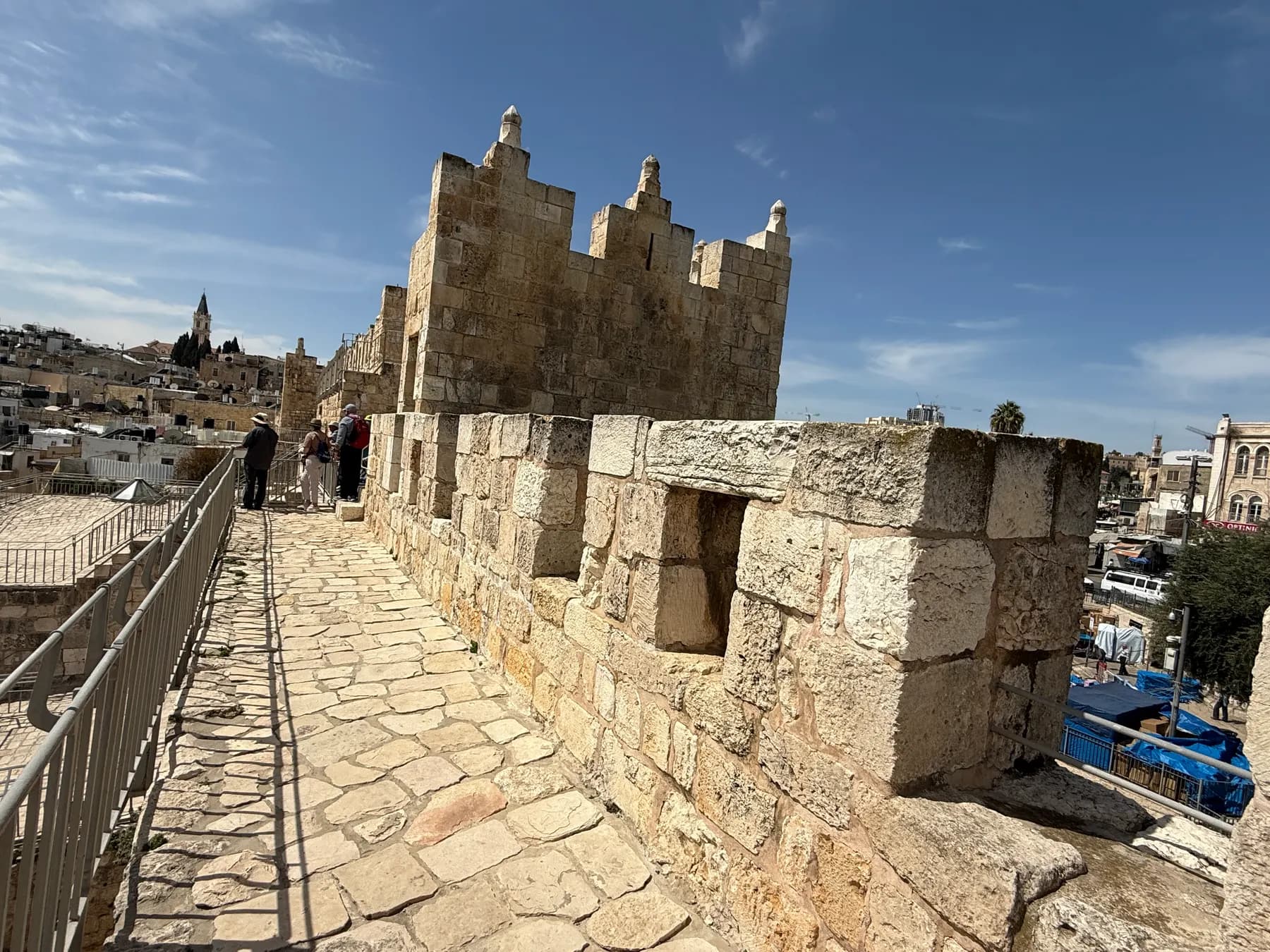
A ticketed footpath along the Ottoman patrol path on top of the Old City wall, walked in two sections that both start at Jaffa Gate and never meet, because the eastern stretch along the Temple Mount is closed to walkers.

שלמה רודד / CC BY 2.5 · Wikimedia Commons
Market
The Arab Souk and the Old City markets
The three parallel covered lanes at the centre of the souk were built as one market in 1152 by Melisende, Queen of Jerusalem, who hired Muslim labourers from Magna Mahomeria, the village now called al-Bireh, to build it.
שלמה רודד / CC BY 2.5 · Wikimedia Commons
Religious site
Church of the Holy Sepulchre
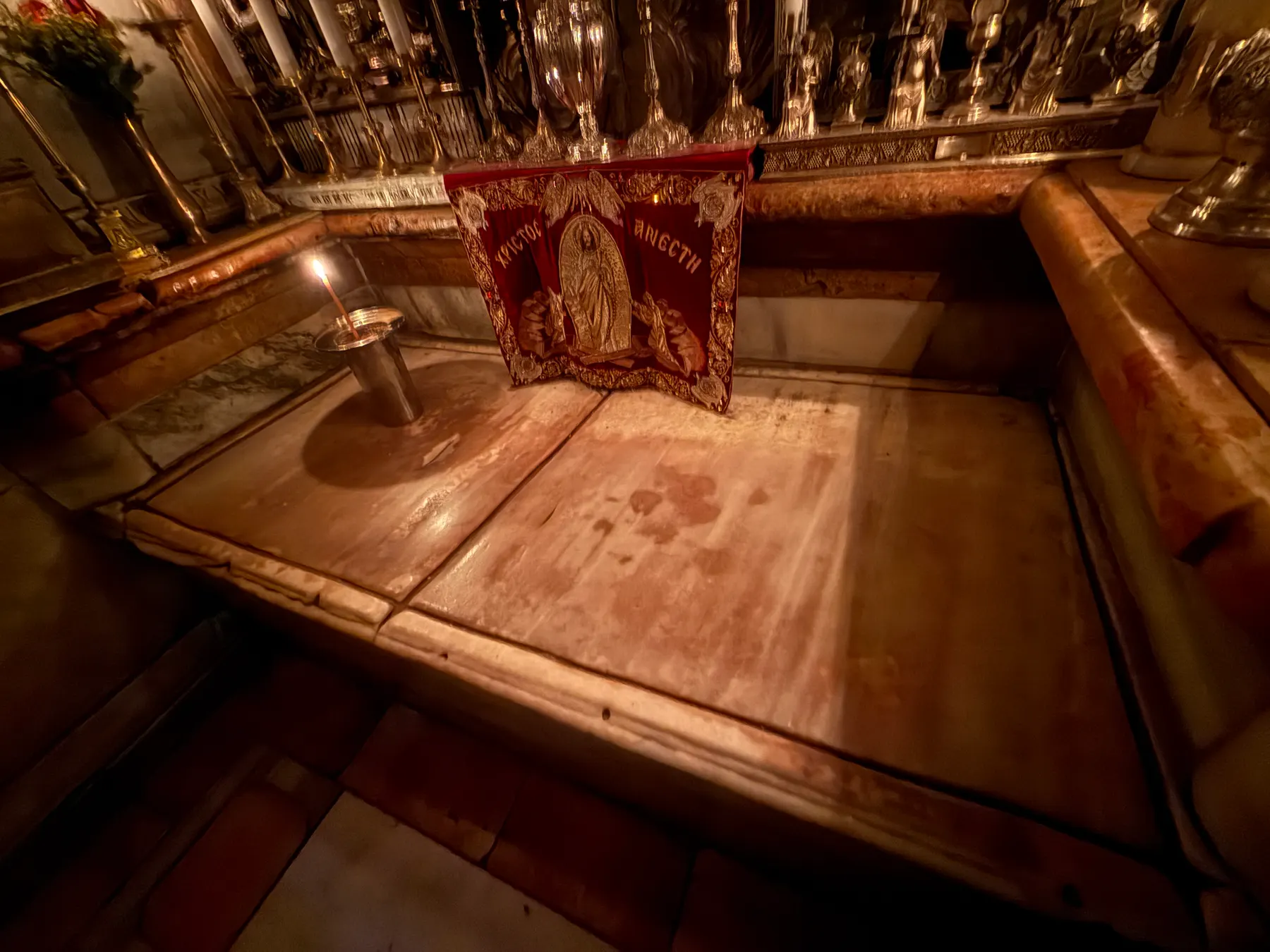
Six Christian communities share one building over Golgotha and the tomb, the doors are opened by two Muslim families, and nobody has been charged to walk in since 1831.
Sources and further reading
Every link below was opened and checked when this page was written. Official statements are marked as such: they are the subject's own account, not an independent one.
- OfficialiTravelJerusalem, Jerusalem's official tourism serviceitraveljerusalem.comThe Tower of David Museum
Published opening hours (Sunday 12.00 to 17.00, Monday to Thursday 09.00 to 17.00, Friday 09.00 to 15.00), admission of ₪55 adult and ₪35 child with advance prices of ₪50 and ₪32, the Night Spectacular at ₪65, the ten-gallery permanent display, what the ticket includes, the David Garden entrance, the 1999 Antiquities Authority excavation of the Kishle, the 1,500-year-old cistern housing the nineteenth-century model, and the accessibility line 072-3290715.
- OfficialThe Jerusalem Foundationjerusalemfoundation.orgTower of David Museum project record
Work begun in 1977 and the institution dated to 1983, the Elias Sourasky Archaeological Garden and the Phasael Tower observatory, the Kishle as a Turkish prison and barracks built in 1837, support from 2002 for excavation of what is believed to be Herod's palace compound of around 23 BCE, and Dale Chihuly's 1999 Homage to Jerusalem of more than 10,000 pieces and 42 tons of glass.
- ReportingThe Times of Israeltimesofisrael.comModern and ancient coexist in $50 million Tower of David renovation
The 1 June 2023 reopening after six years, the 50 million dollar cost and its funders, the new entrance pavilion opposite Jaffa Gate, two lifts, widened paths and ramps, 20,000 square metres of exhibition space, conservation of walls and minaret, the Sands of Time timeline across twelve screens, the restored 1873 Vienna World Fair model, and director Eilat Lieber.
- ReportingThe Times of Israeltimesofisrael.comIsraeli experts removed, rebuilt top of iconic Tower of David amid fears of collapse
The removal and reconstruction of the minaret's top two metres in December 2022, the swollen iron cramps that cracked the stonework, conservator Yossi Vaknin and the Israel Antiquities Authority, and the new section cut at a stone works in Shfaram using a mix of new and salvaged stone.
- ReportingThe Times of Israeltimesofisrael.comArabic inscription found under Tower of David rewrites ancient citadel's past
Excavation director Amit Re'em's find of a dated inscription of al-Mu'azzam Isa, Saladin's nephew, in the western fortification's foundations, redating a wall from twelfth-century Crusader to thirteenth-century Ayyubid, plus photogrammetric recording and mortar carbon-dating with the Weizmann Institute.
- ReportingThe Times of Israeltimesofisrael.comElevators added to Tower of David museum, making ancient citadel accessible
The two lifts opened in December 2022, the glass courtyard lift and the interior lift, Kimmel Eshkolot Architects under Yotam Cohen-Sagi, the refusal of a third lift to the highest viewpoint, the 360 degree viewing tool commissioned instead, and the exemption of historic sites from Israel's accessibility law.
- ReferenceWikipediaen.wikipedia.orgTower of David
Herod's three towers of 37 to 34 BCE with Phasael at 44 metres, the surviving base and its sixteen Herodian courses beneath a later glacis, Geva's 1981 Israel Exploration Journal argument for Hippicus against the older identification with Phasael, the fifth-century Byzantine naming, the Mamluk rebuilding of 1310, the Ottoman expansion of 1537 to 1541, the minaret of 1635 to 1655 and the transfer of the name to it, the Pro-Jerusalem Society and the 1930s folklore museum, and the museum's opening in 1989 with courtyard remains of about 2,700 years.
- ReferenceMahmoud Hawari, Present Pasts 2 (1), University College Londonup-j-pp.ubiquityjournal.websiteThe Citadel of Jerusalem: A Case Study in the Cultural Appropriation of Archaeology in Palestine
The Arabic name al-Qal'a used for close to a thousand years, C.N. Johns's Mandate-era excavations of the 1930s and 1940s and the Islamic and medieval military architecture they exposed, and the argument that the museum's narrative runs from David's conquest to Israeli statehood as a museum without objects, with Palestinian input excluded.
- ReferenceEncyclopaedia Britannicabritannica.comWall of Süleyman
The Old City wall erected in 1538 to 1540 by Süleyman the Magnificent, largely on foundations of the Crusader period and in places Byzantine, Herodian and Hasmonean, which is the same building campaign that expanded the citadel.
- ReferenceBibleGatewaybiblegateway.comSong of Songs 4:4, King James Version
The verse the Byzantine name was borrowed from: "Thy neck is like the tower of David builded for an armoury, whereon there hang a thousand bucklers, all shields of mighty men."
Tower of David Museum: common questions
Is the Tower of David anything to do with King David?+
No. The name was given by Byzantine Christians in the fifth century who mistook the Western Hill for Mount Zion and assumed the tower standing there was David's palace, taking the phrase from the Song of Songs. The oldest structure on the site is Herodian, from 37 to 34 BCE, roughly nine centuries after David. In the nineteenth century the name transferred again, to an Ottoman minaret of 1635 to 1655, and since 1967 it has been applied officially to the whole citadel.
How much is a ticket, and is it worth it?+
The city's official tourism listing gives ₪55 for an adult and ₪35 for a child, dropping to ₪50 and ₪32 at the advance price. For that the ticket covers the ten new galleries, the moat, the Kishle, the courtyard, the climb to the tower and an audio guide, which is a lot of site for the money. It is worth it most to a visitor at the start of their time in the Old City, because it explains the layers everything else is built on.
How long does a visit take?+
Allow about ninety minutes, and rather more if the Kishle and the tower climb are both done properly. The city's tourism listing suggests one to one and a half hours, which is realistic for the galleries alone and tight for the whole site. Timed entry to the evening shows is separate and does not overlap with a day visit.
Can a wheelchair get round it?+
Most of it, yes, which is unusual for an archaeological site of this kind. Two lifts opened in December 2022, one of them a glass lift in the inner courtyard, and widened paths and ramps run through the citadel; the museum describes itself as almost completely accessible. The exception is the roof: a third lift to the highest viewpoint was not approved, so the climb to the Phasael tower is stairs, and a 360 degree viewing tool was commissioned instead. An accessibility line, 072-3290715, is published for specific questions.
Is the night show included in the ticket?+
No. The King David show and the Night Spectacular are sold separately, and a day ticket does not admit anyone to either. The city's tourism listing gives ₪65 per person for the Night Spectacular and notes that the shows run twice a week at present. Both are projected onto the citadel walls and the archaeological remains in the courtyard, and neither requires a particular language.
What is the Kishle?+
An Ottoman barracks and prison built in 1837 against the Old City wall just beside the citadel, later used as a detention centre under the British Mandate. It is included in the museum ticket along with the moat, and iTravelJerusalem describes it as open for independent visits for the first time. Beneath it are the remains of what the Jerusalem Foundation calls a probable identification with the palace compound of Herod the Great, built around 23 BCE.
How much of what I am looking at is original and how much was rebuilt?+
Most of the standing fortress is genuinely old but not ancient: it is Mamluk work of 1310 and Ottoman expansion of 1537 to 1541. The Herodian element is roughly sixteen courses of ashlars at the base of one tower, part-hidden by a later glacis. Some of what looks oldest is newest: the top two metres of the minaret were taken down in 2022 and rebuilt with a mix of new stone cut in Shfaram and salvaged originals, because iron cramps inside had swollen and split the masonry.
Is the museum's account of Jerusalem's history disputed?+
Yes, and openly. Mahmoud Hawari argued in Present Pasts in 2010 that the citadel, known in Arabic as al-Qal'a for close to a thousand years, has been renamed and redisplayed to present a continuity from David's conquest to Israeli statehood, with Palestinian involvement absent from the planning. He also called the museum of that era one without objects, relying on reproductions. The 2023 galleries do put excavated finds on show, which answers part of that, but the argument about whose story the building tells is live and a visitor is better off knowing it.
When is it open on Friday and Saturday?+
The city's official tourism listing gives Friday from 09.00 to 15.00 and does not list a Saturday opening at all, while the dated Google listing shown on this page does show one. Sunday opens late, at midday. Because the two published sources disagree on Saturday, and because the museum's own site is the only authority that matters for a specific date, check there before planning a Shabbat visit.
Where exactly is it, and how do I get in?+
It is the citadel immediately inside Jaffa Gate, on the south side. The entrance is from David Garden, the western entrance at the end of Mamilla Boulevard, through the covered pavilion built opposite Jaffa Gate in the recent works, where the ticket office and café are. Coming up from the new city through Mamilla, it is the first thing reached; coming from inside the Old City, it means stepping back out of Jaffa Gate rather than looking for a door on David Street.