Religious site · The Old City of Jerusalem
Church of the Holy Sepulchre
Six Christian communities share one building over Golgotha and the tomb, the doors are opened by two Muslim families, and nobody has been charged to walk in since 1831.
שלמה רודד / CC BY 2.5 · Wikimedia Commons
Doors open
04:00 in winter
05:00 from April to September, on the Custody of the Holy Land's listing
Admission
Free
no ticket; the door fee was abolished in 1831 by Ibrahim Pasha
Communities inside
Six
three hold shared ownership under the Status Quo, three hold lesser rights
Constantine's complex dedicated
13 September 335
the date the Custody gives for the formal inauguration
In short
- How long to give it
- about 60 to 90 minutes for Calvary, the Stone of Unction, the Rotunda and the two lower chapels, plus however long the queue for the tomb is running
- Summer, April to September (Custody sanctuary page)
- 5:00 to 21:00 daily, with September closing at 20:30
- Entry to the basilica
- Free. No ticket, no reservation and no timed entry
כנסיית הקבר
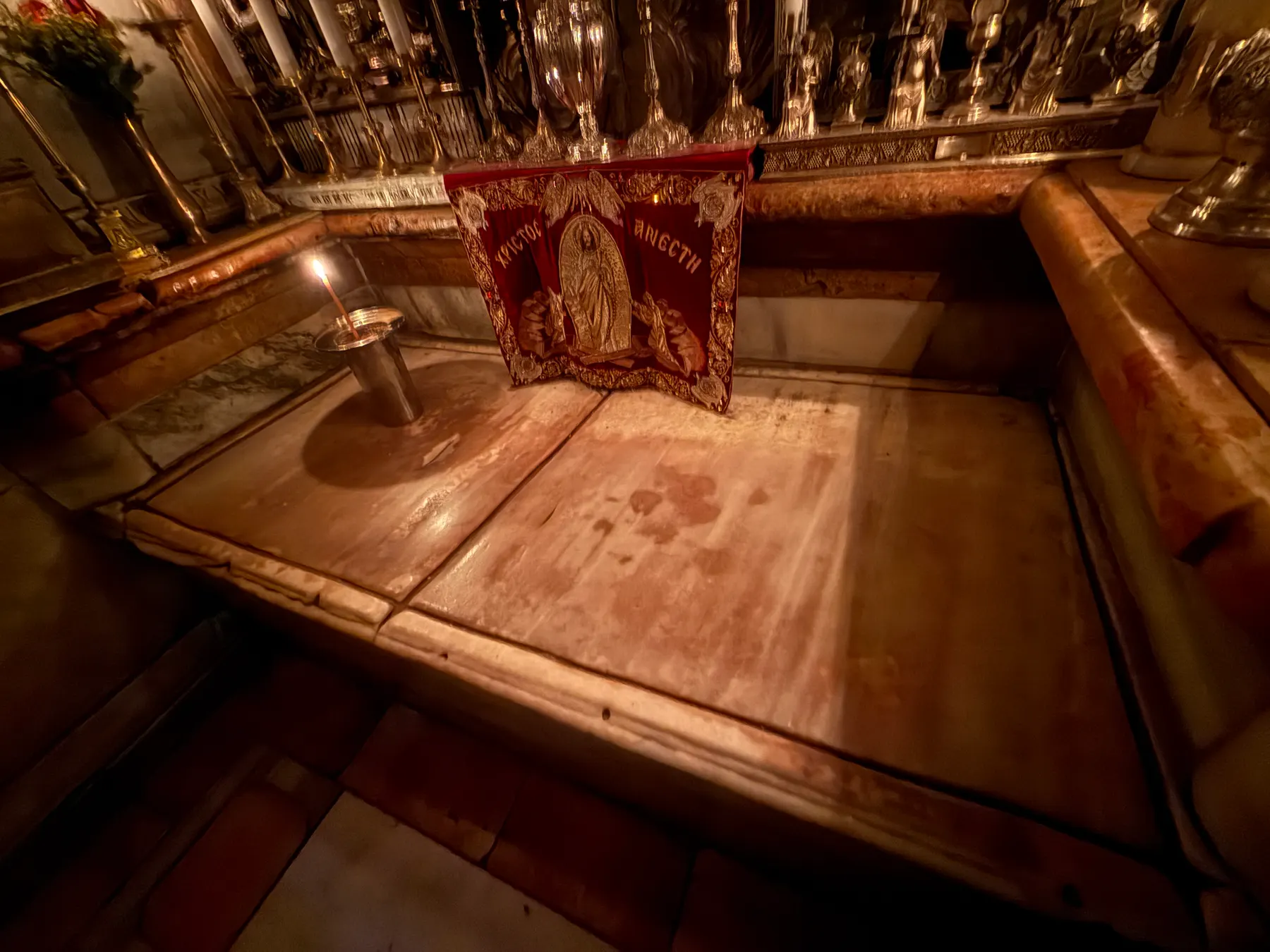
The Church of the Holy Sepulchre is a single roof pulled over two separate places: the rocky knoll that Christian tradition identifies as Golgotha, and, a short walk west of it, the rock-cut tomb in which Jesus is said to have been buried. They were not one building until the Crusaders made them one, and the church still reads as a set of chapels stitched together rather than as a designed interior. It is free, and it opens before dawn.
Almost everything about how it works is inherited rather than decided. The three communities that own the shared parts (the Greek Orthodox, the Latin Catholics represented by the Franciscan Custody of the Holy Land, and the Armenian Apostolic Church) take the daily opening in turn, and the door is unlocked with a Muslim doorkeeper from one of two families who have held that privilege since the thirteenth century. Three further communities, the Copts, the Syriac Orthodox and the Ethiopians, hold rights to particular altars and rooms. Nothing in the common areas changes unless all of them agree, which is why the interior looks the way it does.
What follows is the practical part first, including the reason the church's clock disagrees with a visitor's watch for half the year, then what is original here, what is a nineteenth-century rebuild after a fire, and what the archaeologists under the floor have found since May 2022.
Orientation
It opens before dawn, and it runs on winter time all year
The Custody of the Holy Land, the Franciscan body responsible for the Catholic share, publishes the hours in two places and the two do not quite match. Its sanctuary page gives summer, April to September, as 5:00 to 21:00 daily with September closing at 20:30, and winter as 4:00 to 19:00. The list kept by its Christian Information Centre at Jaffa Gate, updated on 7 August 2026, gives summer as 5:00 to 20:45 with October closing at 20:00, and winter as 4:00 to 19:00 with March closing at 19:30. Both are the Custody; the Information Centre list is revised more often.
The reason the opening time moves is not the season but the clock. The Custody states that winter time is always used inside the church, because the agreed rules do not allow a change to summer time, so services in summer fall one hour later by a visitor's watch than the times on the church's own timetable. The doors are opened at 4:00 by that internal clock all year. In summer that is 5:00 outside.
The evening closing is negotiated rather than set: the communities agreed on 7:00 between October and March and 9:00 between April and September, with each sexton present and settling who opens next morning. Feast days override all of it, and Holy Week overturns it completely. The one fixed appointment worth catching is the Franciscan procession, which leaves the Chapel of the Blessed Sacrament at 17:00 in summer and 16:00 in winter and works round fourteen stations.
Foundations
A quarry, then a garden, then a Roman temple, then a church
The ground under the church was industrial before it was anything else. A quarry worked here from roughly the eighth to the first centuries BCE, cutting meleke limestone for building inside the walls; when it was abandoned the hollows were used for vegetable plots and family tombs were cut into the quarry faces. Golgotha, on this reading, was a knoll of unquarried rock above the workings, outside the city and beside a road. It did not stay outside: the Custody dates Herod Agrippa's north-west extension of the walls to 41 to 42 CE, which brought the quarry and its tombs into the built-up city.
After the revolt, Hadrian's colony of Aelia Capitolina put a cult structure on the spot, on an embankment that sealed the older ground. What stood there is genuinely unsettled: Eusebius says a temple of Venus, Jerome implies the Capitoline triad, and the archaeologists there now report the Hadrianic area is smaller than Virgilio Corbo proposed and can hardly be the Capitolium. In 324 to 325 Bishop Macarius began pulling it down at Constantine's request, and the hill was cut back around the burial chamber.
What Constantine's architects built was a complex rather than a church: a five-aisled Martyrium basilica off the Cardo, a colonnaded courtyard with the rock of Golgotha at its corner, and behind that the Anastasis rotunda with the tomb at its centre, inaugurated on 13 September 335. The rest is a sequence of losses. Persian troops burned it in 614. The caliph al-Hakim ordered it destroyed in 1009 and the demolition was close to total, only the buried lower parts of the rotunda surviving; Byzantine money rebuilt it by 1048 on a reduced plan. Then the Crusaders roofed the courtyard and gathered the separate holy places into the single church that stands today, completed in 1149.
Fabric
The oldest thing here is the rock, not the architecture
The church is often described as fourth-century and almost none of what is visible is. The shell is Crusader Romanesque: the facade with its two doors, of which only the left has opened for centuries, the bell tower of 1172, the ambulatory and its chapels, the Chapel of St Helena. The Rotunda keeps Constantine's plan and some lower masonry, but the massive piers a visitor walks between replaced the originals, and their capitals are modern work in a fifth-century Byzantine manner.
The Edicule, the small marble house over the tomb, is not old at all. A fire in 1808 brought down the rotunda dome and destroyed the shrine's exterior, and the Greek Orthodox rebuilt both in 1809 to 1810 to a design by Nikolaos Komnenos of Mytilene, in the Ottoman Baroque of the day. It is that building, not a fourth-century one, whose onion dome appears in every photograph. The Stone of Unction just inside the door came from the same reconstruction, and the tradition attached to it is attested only from 1288.
The twentieth century then nearly lost the shrine. After the 1927 earthquake the British braced the church with iron and timber, and from 1947 the Edicule itself was held together by an external cage of iron girders, which stayed on for seven decades because under the Status Quo no community could authorise the repair alone. It came off only in 2016, after the Israel Antiquities Authority declared the shrine unsafe: a team from the National Technical University of Athens under Antonia Moropoulou dismantled it and reassembled it with titanium bolts, working at night so pilgrims could keep coming. The Guardian put the cost at four million dollars, overseen largely by the World Monuments Fund, and the team at about fifty specialists. Mortar sampled while the burial slab was lifted in October 2016 dated to around 345 CE, placing the shrine in Constantine's century rather than the Crusaders'.
- Ancient: the rock of Golgotha, which rises about 5 metres inside the church and is visible behind glass, and the rock-cut tomb chamber inside the Edicule
- Crusader: the facade and its lunettes, the bell tower of 1172, the ambulatory chapels, the Chapel of St Helena, the catholicon
- Nineteenth century: the Edicule and the Stone of Unction, both from the rebuilding of 1809 to 1810 after the fire
- Modern: the dome over the Edicule, unveiled on 2 January 1997, the mosaics in the catholicon dome, the toilets, and the floor now being relaid
The Status Quo
A building where nobody may change anything alone
The arrangement governing the church is called the Status Quo, and it is less a treaty than a freeze. The Custody dates its promulgation to 1852, when the sultan issued a status quo nunc fixing the rights exactly as they then stood, largely as the Greeks had pressed for; other accounts trace the understanding to a firman of 1757. There is no single official text, which is part of why disputes are slow: in its absence, the Custody notes, private notes have to be relied on and the legal position stays confused.
In practice anything in a shared space needs the consent of everyone with rights there. The best-known illustration is a wooden ladder resting on a ledge under a second-tier window of the facade, in place since at least the 1720s; the oldest known depiction is an engraving by the Franciscan Elzéar Horn that the Custody dates to 1728. Even its ownership is contested: the usual account gives it to the Armenians, who hold access rights to that cornice, while the Israeli writer Amos Elon argued in 1995 that it is Greek. Nobody moves it.
The keys are the other survival. After the Khwarezmian sack of 1244 the sultan Ayyub undertook that they would be entrusted to two Muslim families who would open the church for pilgrims, and the Judeh and Nuseibeh families have done so ever since. The Custody distinguishes two forms of the ritual: a simple opening, in which the sexton whose turn it is unlocks one leaf alone, and a solemn opening, in which he opens the left leaf and the Muslim doorkeeper the right.
The arrangement is durable but not calm. On 25 February 2018 the three communities closed the church indefinitely over a Knesset bill on church land sales and a municipal tax policy, and the ministerial committee postponed the bill the same day. On Palm Sunday 2026, police stopped the Latin Patriarch from entering to celebrate Mass, in what his office called the first such exclusion in centuries. It was reversed the next morning.
Excavation
The floor has been open since May 2022
The floor of the basilica is being relaid by the Fondazione Centro Conservazione e Restauro La Venaria Reale of Turin, and the archaeology that goes with it is run by the Department of Antiquities of Sapienza University of Rome under Francesca Romana Stasolla. Digging began in May 2022 and has run day and night in sections, so that services and pilgrim routes are never all blocked at once: the north aisle first, then the Rotunda, then the ambulatory and the entrance area.
The quarry has come up everywhere. In the southern Rotunda the excavators exposed the quarry face itself, its depth ranging from a few centimetres to more than two metres, with wedge marks and the cuts for lifting out blocks still legible. Roman foundations sit directly on that rock, attributed to the works Hadrian promoted here, reduced to a few courses and in places burned. Most had been seen before by Charles Coüasnon in 1974, but the concrete slab poured over that trench has been lifted so the whole area can be read together.
Beneath the nineteenth-century Edicule the team found the first monumentalisation of the tomb: a carefully worked circular pavement of reused marble taking in the whole tomb, matching the plan in the oldest depictions of the shrine. The Custody's 2024 statement reconstructs a small round sanctuary with an antechamber reached by three steps and ringed by twelve columns. Two smaller finds are worth knowing: two fragmentary bricks stamped by the Legio X Fretensis, and the Stone of Unction itself, lifted, restored by Daniela Russo of the Venaria Reale foundation and put back, which established that its medieval position was near where it now stands. None of it settles a theological question, and the excavators do not claim it does.
Inside
What to do with the first twenty minutes
The church is entered from a small courtyard, the parvis, reached down a short flight of steps off the market lane of Suq ed-Dabbagha. Only the left-hand door opens. Directly inside is the Stone of Unction, and immediately to the right, easy to walk straight past, a steep narrow stair up to Calvary. That is the commonest mistake made here: people head for the tomb and never climb to the rock they came to see.
Calvary at the top is divided in two. The Greek Orthodox chapel on the left has its altar over the rock, with a silver disc beneath through which the rock can be touched. The Latin chapel to the right has a silvered bronze altar given by Grand Duke Ferdinando de' Medici in 1588 and a twelfth-century mosaic of the Ascension on its vault, one of the few pieces of Crusader decoration still in place.
Left from the entrance is the Rotunda and the Edicule. Entry is regulated during the day by the Greek Orthodox and pilgrims go in a few at a time, through the Chapel of the Angel and then a low marble door into the burial chamber, where forty-three votive lamps hang from the ceiling. Behind the Edicule are the Coptic altar and, in the western apse, the shaft tomb traditionally called that of Joseph of Arimathea, the quietest corner of the building. From the eastern ambulatory a long stair goes down to the Armenian Chapel of St Helena and a further flight to the rock-cut Chapel of the Finding of the Cross, where quarry tool marks are visible in the ceiling.
What to look for
Things not to walk past at Church of the Holy Sepulchre
The details that repay knowing about before you are standing in front of them.
The rock of Golgotha, up the stair on the right
The knoll rises about 5 metres inside the church and is visible behind glass panels on either side of the Greek altar, with an opening in the silver disc below through which pilgrims touch it. It is the first thing inside the door and the thing most visitors miss.
The window cut into the tomb
The 2016 to 2017 restoration left a small window in the marble facing of the burial chamber so that the original limestone wall of the cave can be seen rather than taken on trust. Mortar sampled during that work dated to about 345 CE.
The immovable ladder
A wooden ladder on a ledge under a window of the facade, in place since at least the 1720s because moving it would require the consent of every community with rights there. Look up before going in; it is easy to miss from directly below.
The Crusader graffiti on the St Helena stair
The walls of the long staircase down to the Armenian chapel are covered with small crosses cut by pilgrims over centuries. It is the most direct trace of ordinary medieval visitors anywhere in the building.
The Chapel of the Finding of the Cross
The lowest room in the church, cut into the rock, where quarry tool marks survive on the ceiling and the wall plaster is the ash-rich hydraulic type used for cisterns in the first century. It is where the building's industrial prehistory is easiest to see.
The afternoon procession
The Franciscans process through the whole church at 17:00 in summer and 16:00 in winter, incensing the altars in turn and finishing at the tomb. It is the one moment when the building's separate compartments are treated as a single route.
The long view
Church of the Holy Sepulchre, in order
8th to 1st centuries BCE
A quarry works this ground for meleke limestone. When it is abandoned the hollows are cultivated and family tombs are cut into the rock faces.
41 to 42 CE
Herod Agrippa extends the city wall north-west and the quarry, the tombs and Golgotha end up inside Jerusalem.
After 130 CE
Hadrian's colony of Aelia Capitolina raises a cult structure on an embankment over the site, sealing it.
324 to 325
Bishop Macarius begins demolishing the Roman structure at Constantine's request. The tomb is uncovered and the hill cut back around it.
13 September 335
Constantine's complex is formally inaugurated: the Martyrium basilica, the colonnaded courtyard with Golgotha at its corner, and the Anastasis rotunda over the tomb.
614
The Persian conquest is followed by three days of destruction. The complex is set on fire and the relic of the True Cross taken; Heraclius returns it in 630.
1009
The caliph al-Hakim orders the church destroyed. The demolition is close to total; only the buried lower parts of the rotunda survive.
1048
Byzantine-funded reconstruction is completed under Constantine Monomachus, on a reduced plan with the rotunda at its centre.
1149
The Crusaders complete the church that still stands, roofing the courtyard and bringing Golgotha and the tomb under one roof for the first time.
1172
The bell tower is added beside the facade. Its upper level, 29 metres up, collapses in the earthquake of 1545 and is never replaced.
1244
After the Khwarezmian sack, the sultan Ayyub undertakes that the keys will be held by two Muslim families who open the church for pilgrims. The Judeh and Nuseibeh families still do.
1728
The Custody's dating for Elzéar Horn's engraving of the facade, the oldest known depiction of the ladder that has never been moved since.
1757
A sultan's decree assigns the Greeks ownership of parts of the church, and is treated by some accounts as the origin of the Status Quo.
1808 to 1810
Fire brings down the rotunda dome and wrecks the shrine. The Greek Orthodox rebuild both, to designs by Nikolaos Komnenos of Mytilene. The present Edicule and the Stone of Unction date from this work.
1831
Ibrahim Pasha abolishes the entrance fee that the Muslim doorkeepers had collected at the door.
1852
The sultan promulgates the status quo nunc, freezing each community's rights as they then stood. It remains the framework for every dispute.
1927 to 1947
After a major earthquake the British brace the church with iron girders, and from 1947 hold the Edicule together with an external cage of them.
1959 to 1973
The Greek, Latin and Armenian communities agree a joint restoration. Works begin in 1960 and Virgilio Corbo excavates alongside them for two decades.
2 January 1997
The restored dome over the Edicule is unveiled after a joint programme by the three communities.
May 2016 to March 2017
The National Technical University of Athens dismantles and rebuilds the Edicule. The burial slab is lifted in October 2016; the restored shrine is unveiled on 22 March 2017.
25 February 2018
The three communities close the church indefinitely in protest at an Israeli land bill and a municipal tax policy. The ministerial committee postpones the bill.
May 2022
Sapienza University of Rome begins excavating under the floor as it is relaid, working day and night in sections.
29 March 2026
Police stop the Latin Patriarch from entering to celebrate Palm Sunday Mass, in what his office calls the first such exclusion in centuries. The decision is reversed the next morning.
Practical
Visiting Church of the Holy Sepulchre
Where
Christian Quarter, Old City of Jerusalem, entered from the parvis off Suq ed-Dabbagha
What ticket you need
This is not inside a ticketed park and needs no ticket of any kind. Two of its immediate neighbours do charge: the Custody's own hours list gives ₪5 for the Russian Orthodox Church of St Alexander Nevsky and ₪7.50 for the tower and museum of the Lutheran Church of the Redeemer, which that list marks as currently closed. Against the Holy Sepulchre it prints no fee at all.
Opening hours
- Summer, April to September (Custody sanctuary page)
- 5:00 to 21:00 daily, with September closing at 20:30source
- Summer, April to September (Christian Information Centre list, updated 7 August 2026)
- 5:00 to 20:45, with October closing at 20:00source
- Winter, October to March
- 4:00 to 19:00 daily, with March closing at 19:30source
- Christmas Day and the Presentation of the Lord (2 February)
- Opens at 8:00, closes at 19:00source
- Holy Week
- Holy Thursday it closes after the celebration; Good Friday it closes briefly in the morning and stays closed all day; Orthodox Holy Saturday it is closed until the Holy Fire ceremony ends in mid-afternoon, then stays open into the next eveningsource
- Franciscan procession through the church
- 17:00 in summer, 16:00 in winter, dailysource
- Confessions (Latin area)
- Summer 9:00 to 12:45, 15:30 to 16:30 and 18:00 to 19:00; winter one hour earlier in each blocksource
Admission
Access
Mixed, and honestly difficult in parts. The parvis is reached down a short flight of steps that runs its full width, and only the left-hand door opens. Once inside, the main floor is broadly level: the Stone of Unction, the Rotunda, the Edicule, the catholicon and the ambulatory can all be reached without steps, although the floor is currently being relaid in sections and parts are hoarded off. Calvary cannot: it is up a steep, narrow stair immediately right of the entrance, out by a second stair, and there is no lift. The Chapel of St Helena is down a long flight and the Chapel of the Finding of the Cross lower still. Neither the Custody's sanctuary page nor its Christian Information Centre publishes an accessibility statement for the church.
On site
- Toilets, added by agreement of the three communities
- Daily confessions in the Latin area
- Franciscan sacristy, for night vigil permission
- Christian Information Centre at Jaffa Gate, for hours and mass bookings
- No cafe, no shop and no cloakroom inside the church
Booking
Nothing needs booking to walk in. Groups wanting to celebrate mass inside book through the Franciscan Pilgrims' Office, and permission to pray in the basilica at night is obtained in person from the Franciscans of the Sepulchre during the sacristy's opening hours rather than online.
Hours and prices are given as the operator publishes them and change without much notice, particularly around Shabbat and the festivals. Check the operator's own page before you travel for this.
Official page at custodia.org →What people wish they had known
- Go at opening rather than late. The doors are unlocked at 4:00 by the church's own clock, which is 5:00 outside in summer, and the first two hours are the only reliably quiet ones. By mid-morning the queue for the tomb fills the Rotunda.
- Climb the stairs immediately to the right of the door before doing anything else. Calvary is up there, and the crowd flows left towards the tomb, so most visitors reach the rock of the crucifixion last or not at all.
- The slab just inside the entrance is not the tomb. That is the Stone of Unction, and the present stone was laid in the 1810 rebuilding after the fire. The tomb is under the Edicule in the Rotunda, off to the left.
- Times printed by the church are not the times on a phone in summer. The Custody states that winter time is used inside the building all year, so a service listed at 4:30 happens at 5:30 by a visitor's watch between April and September.
- Nobody may charge for entry. Admission is free and always has been since 1831, so a person selling tickets, queue-jumps or compulsory guiding at the parvis is not acting for the church.
- Check the date before planning a Holy Week visit. The Latin and Orthodox Easters usually fall on different dates, the church closes for most of Good Friday and stays shut until the Holy Fire ceremony ends on Orthodox Holy Saturday, and the Palm Sunday and Easter services are the fullest hours of the year.
The figures
Church of the Holy Sepulchre by the numbers
Each figure carries the year it belongs to and links the source it came from.
| Measure | Figure | As of | Source |
|---|---|---|---|
| Dedication of Constantine's complex | 13 September 335 | 2026 | custodia.org |
| Mortar between the tomb's rock surface and its marble slab | dated to about 345 CE | 2017 | nationalgeographic.com |
| Edicule restoration | about $4 million, May 2016 to March 2017, roughly 50 specialists | 2017 | theguardian.com |
| Height of the Crusader bell tower | 29 metres, its upper level lost in the earthquake of 1545 | 2026 | custodia.org |
| Height of the rock of Golgotha inside the church | about 5 metres | 2026 | custodia.org |
| Votive lamps over the burial bed | 43, belonging to the different communities | 2026 | custodia.org |
| Depth of the quarry face exposed in the southern Rotunda | from a few centimetres to more than 2 metres | 2023 | custodia.org |
| Columns reconstructed around the first monumentalised tomb | 12, around an antechamber reached by three steps | 2024 | custodia.org |
While you are here
The rest of The Old City of Jerusalem
Everything else in this destination with a page of its own.
רחל וייסלר / CC BY 2.5 · Wikimedia Commons
Religious site
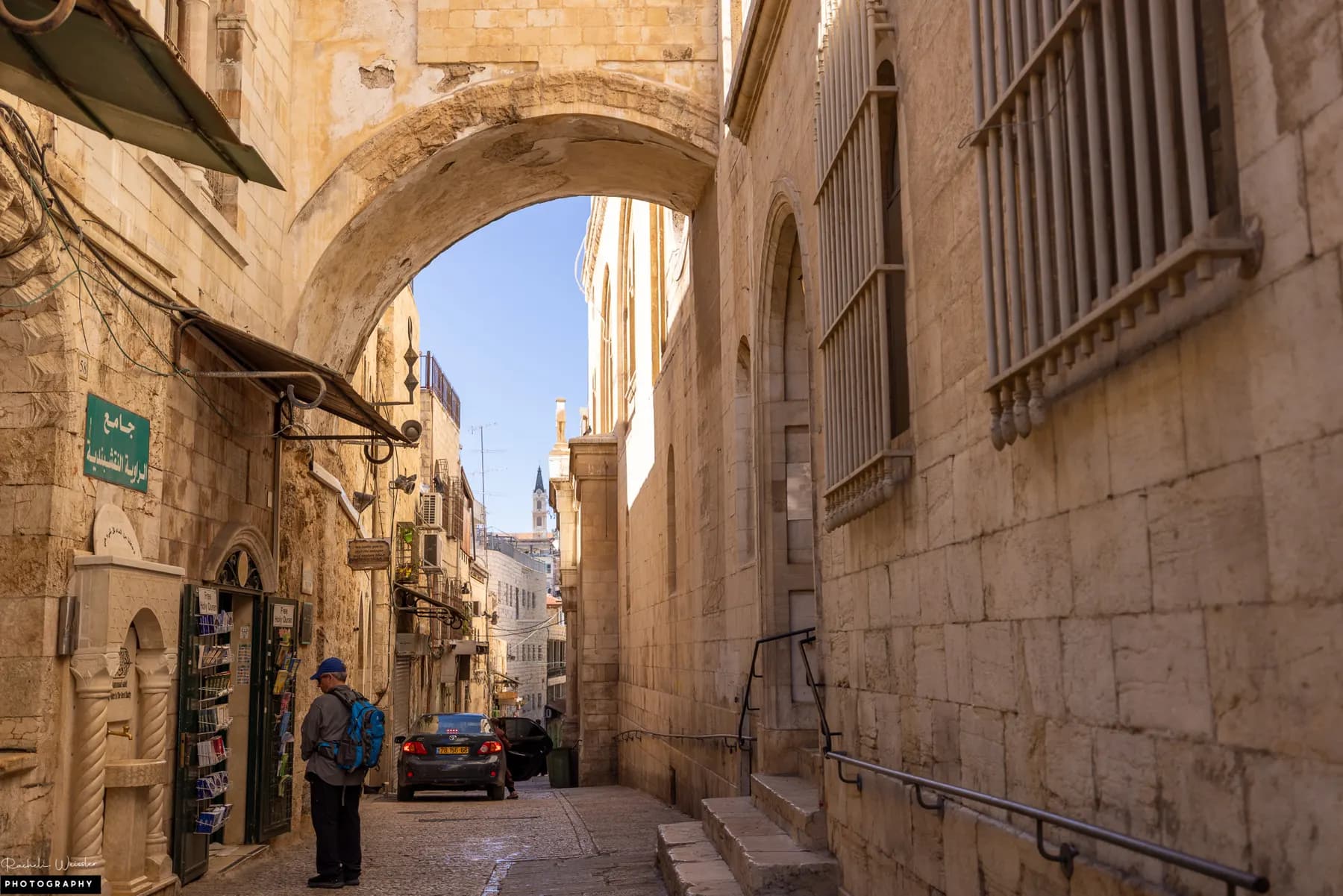
Via Dolorosa
Fourteen stations over roughly half a kilometre of working market lanes, of which nine are in the street and the last five are inside the Church of the Holy Sepulchre.

שלמה רודד / CC BY 2.5 · Wikimedia Commons
Market
The Arab Souk and the Old City markets
The three parallel covered lanes at the centre of the souk were built as one market in 1152 by Melisende, Queen of Jerusalem, who hired Muslim labourers from Magna Mahomeria, the village now called al-Bireh, to build it.
זאב שטיין / CC BY 2.5 · Wikimedia Commons
Museum
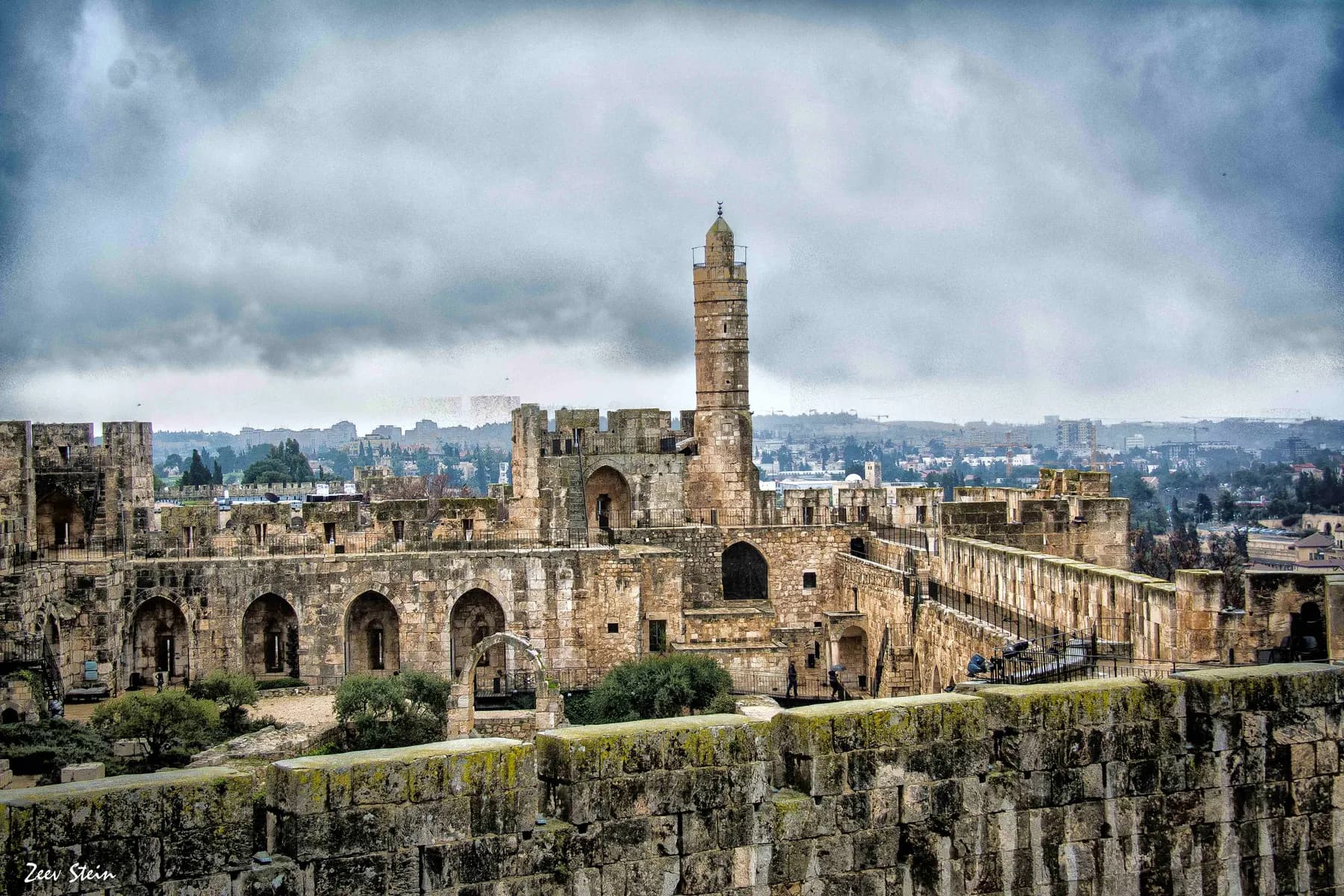
Tower of David Museum
The citadel beside Jaffa Gate is Mamluk and Ottoman work standing on the stump of a Herodian tower, and its museum reopened on 1 June 2023 with a new display of ten galleries.
Sources and further reading
Every link below was opened and checked when this page was written. Official statements are marked as such: they are the subject's own account, not an independent one.
- OfficialCustody of the Holy Landcustodia.orgBasilica of the Holy Sepulchre
The published opening and closing times including the feast-day exceptions, the statement that winter time is used inside the church all year, the daily procession at 17:00 and 16:00, the confession hours, the history from the quarry to the 1959 agreement, the 1831 abolition of the door fee, the simple and solemn opening rituals, the 29-metre bell tower, the rock of Golgotha at about 5 metres, the Chapel of the Angel at roughly 3.5 by 4 metres and the 43 lamps over the burial bed
- OfficialChristian Information Centre, Custody of the Holy Landcicts.orgOpening Hours of Holy Places and Tourist Sites in Jerusalem
The list updated 7 August 2026: summer 5:00 to 20:45 with October closing at 20:00, winter 4:00 to 19:00 with March closing at 19:30, the 8:00 opening on Christmas Day and 2 February, the procession times, and the entrance fees printed against neighbouring churches (₪5 at St Alexander Nevsky, ₪7.50 at the Redeemer tower) with none against the Holy Sepulchre
- OfficialCustody of the Holy Land / Sapienza University of Romecustodia.orgReport on the archaeological excavation work in the Basilica of the Holy Sepulchre
Francesca Romana Stasolla's report of 14 June 2023: excavation continuous from May 2022, day and night, tied to the floor restoration by the Venaria Reale foundation of Turin, the areas dug so far, and the two fragmentary bricks stamped by the Legio X Fretensis
- OfficialCustody of the Holy Land / Sapienza University of Romecustodia.orgHoly Sepulchre: Statement on the work in progress
The January 2023 statement: the quarry face in the southern Rotunda falling from north-west to south-east and ranging from a few centimetres to over two metres deep, the Hadrianic-period Roman foundations resting directly on it, the lifting of the concrete slab over Coüasnon's 1974 trench, and the circular reused-marble pavement found beneath the present Edicule
- OfficialCustody of the Holy Land / Sapienza University of Romecustodia.orgThe Holy Sepulchre, news on the area of the Rotunda and the Hadrian structure
The progress report of 7 November 2024: the site as a worked quarry with dry-stone walls for small cultivation plots, the Hadrianic cult area smaller than Corbo proposed and hard to identify as the Capitolium, and the reconstruction of the first shrine as a round sanctuary with a three-step antechamber ringed by twelve columns
- OfficialCustody of the Holy Land / Sapienza University of Romecustodia.orgCommuniqué after the visit to the archaeological site of the Holy Sepulchre
The August 2024 statement: excavation resumed on 4 December 2023, the Stone of Unction lifted and restored by Daniela Russo of the Venaria Reale foundation and its medieval position established nearby, the Roman wall cutting the Calvary rock, and the southern section of the Constantinian Martyrium apse
- ReportingNational Geographic (Kristin Romey)nationalgeographic.comExclusive: Age of Jesus Christ's purported tomb revealed
Mortar sampled between the tomb's original limestone surface and the marble slab covering it dated to around 345 CE, against a historical account of the tomb being enshrined around 326, and the caution that archaeology cannot identify the individual buried there
- ReportingThe Guardian (Harriet Sherwood)theguardian.comJesus's tomb unveiled after $4m restoration
The nine-month restoration by about 50 experts from the National Technical University of Athens, the World Monuments Fund's oversight and Bonnie Burnham's warning of a possible collapse, the night working, the marble slab lifted in October 2016 and the window cut for pilgrims
- ReportingHaaretz (Jonathan Lis and Nir Hasson)haaretz.comJerusalem's Church of Holy Sepulchre Closes in Protest Amid Row With Israel
The closure announced on 25 February 2018 by the Greek Orthodox, Roman Catholic and Armenian Apostolic churches over a land expropriation bill and the municipality's tax policy, and the ministerial committee's decision to postpone the bill
- ReportingCNN (Christopher Lamb and Tim Lister)cnn.comIsrael reverses course after barring Palm Sunday Mass in Jerusalem
Police stopping Cardinal Pierbattista Pizzaballa from entering the church on Palm Sunday 2026 and the reversal the following day
- ReportingBBC News (Maia Davies)bbc.comLatin Patriarch will have access to Jerusalem holy site after police stopped entry
Independent account of the same episode, including the Patriarchate's statement that it was the first time in centuries a Latin Patriarch had been turned away on Palm Sunday, and the security reason given
- ReferenceWikipediaen.wikipedia.orgChurch of the Holy Sepulchre
The 1149 completion under Queen Melisende, the 1809 to 1810 rebuilding by Nikolaos Komnenos of Mytilene after the 1808 fire, the iron girders fitted in 1947 and removed in 2016 to 2017, the six denominations and which three hold the major shares, the Stone of Unction added in 1810 and attested only from 1288, the catholicon dome at 19.8 metres and the 1970 to 1978 confirmation that the site was a meleke quarry
- ReferenceWikipediaen.wikipedia.orgImmovable Ladder
The ladder in place since at least the 1720s, the Custody's dating of Elzéar Horn's engraving to 1728, the Armenian claim through their right of access to the cornice, and Amos Elon's 1995 argument that it is Greek Orthodox property
Church of the Holy Sepulchre: common questions
Is the Church of the Holy Sepulchre free to enter?+
Yes. There is no admission charge, no ticket and no reservation. The Custody's own list of opening hours for Jerusalem's holy places prints entrance fees where they exist, ₪5 for the nearby Church of St Alexander Nevsky for instance, and prints none against the Holy Sepulchre. A door fee did exist for centuries, collected by the Muslim doorkeepers beside the entrance, and it was abolished in 1831 by Ibrahim Pasha.
What are the opening hours?+
Roughly 4:00 to 19:00 from October to March and 5:00 to about 21:00 from April to September, on the Custody's published figures. The two Custody sources differ slightly on the summer closing: its sanctuary page says 21:00 with September closing at 20:30, while its Christian Information Centre list, updated on 7 August 2026, says 20:45 with October closing at 20:00 and March at 19:30. The church opens later, at 8:00, on Christmas Day and on 2 February.
How long do I need?+
About 60 to 90 minutes is enough to climb to Calvary, see the Stone of Unction, walk the Rotunda, go down to the Chapel of St Helena and the Chapel of the Finding of the Cross, and come out again. The variable is the tomb: entry to the Edicule is regulated during the day by the Greek Orthodox and pilgrims go in a few at a time, so the queue can add an hour or more at busy times and can be almost nothing at 6:00.
Can I go inside the tomb?+
Yes, in small groups and briefly. Visitors pass through the antechamber known as the Chapel of the Angel, about three and a half metres by four, and then through a low marble door into the burial chamber, where the marble slab covering the rock shelf is on the right under forty-three hanging lamps. The 2016 restoration cut a window into the marble facing so the original cave wall is visible. Nobody lingers; a sexton keeps the line moving.
Is this really where Jesus was buried?+
Archaeology can date the shrine, not identify its occupant, and the people doing the digging are explicit about that. What can be said is that the ground was a disused quarry with rock-cut tombs outside the city wall in the first century, that the site was deliberately sealed under a Roman cult structure and then deliberately uncovered under Constantine in 324 to 325, and that mortar between the tomb's rock surface and its covering slab dates to about 345 CE, which puts the shrine in Constantine's century. Whether the Roman delegation identified the right tomb in the 320s is a separate question that no excavation can answer.
Why do six churches share one building?+
Because the arrangement was frozen rather than designed. Communities acquired rights to particular altars, chapels and hours over centuries of Ottoman patronage and litigation, and in 1852 the sultan issued a status quo nunc fixing those rights exactly as they stood; some accounts trace the framework to a decree of 1757. The Greek Orthodox, the Latin Catholics and the Armenians own the shared parts; the Copts, the Syriac Orthodox and the Ethiopians hold lesser rights to specific spaces. Nothing in a shared area can be altered without unanimity, which is why the church is patched rather than restored.
What is the ladder on the front of the church?+
A wooden ladder resting on a ledge under a second-tier window, which has been in that position since at least the 1720s and cannot be moved because moving it would require every community with rights there to agree. The oldest known image of it is an engraving by the Franciscan Elzéar Horn that the Custody dates to 1728. Even whose ladder it is remains disputed: it is usually described as Armenian, since the Armenians have access rights to that cornice, but the writer Amos Elon argued in 1995 that it belongs to the Greek Orthodox.
Who has the key to the church?+
Two Muslim families, the Judeh and the Nuseibeh. The arrangement dates from after the Khwarezmian sack of 1244, when the sultan Ayyub undertook that the church would be repaired and its keys given to two Muslim families who would open it for pilgrims. The Custody describes the daily ritual precisely: in a simple opening the sexton whose community's turn it is opens one leaf of the door alone, and in a solemn opening he opens the left leaf while the Muslim doorkeeper opens the right.
Is it wheelchair accessible?+
Partly, and the church publishes no accessibility statement. There are steps down into the parvis and only the left-hand door opens, but once inside, the Stone of Unction, the Rotunda, the Edicule and the ambulatory are on one broadly level floor. Calvary is not reachable without climbing a steep, narrow stair, and there is no lift; the Chapel of St Helena is down a long flight and the Chapel of the Finding of the Cross lower again. The floor is also being relaid in sections, so parts of the level ground are hoarded off at any given time.
What should I wear, and can I take photographs?+
Cover shoulders and knees, as at every working church in the Old City, and expect to be turned back at the door otherwise. Photography is generally tolerated in the body of the church but not during services, and not inside the Edicule while people are praying there. The building is in continuous liturgical use from before dawn until after closing, with the Greek Orthodox celebrating at half past midnight and the Armenians two hours later, so there is rarely a moment when nothing is happening.