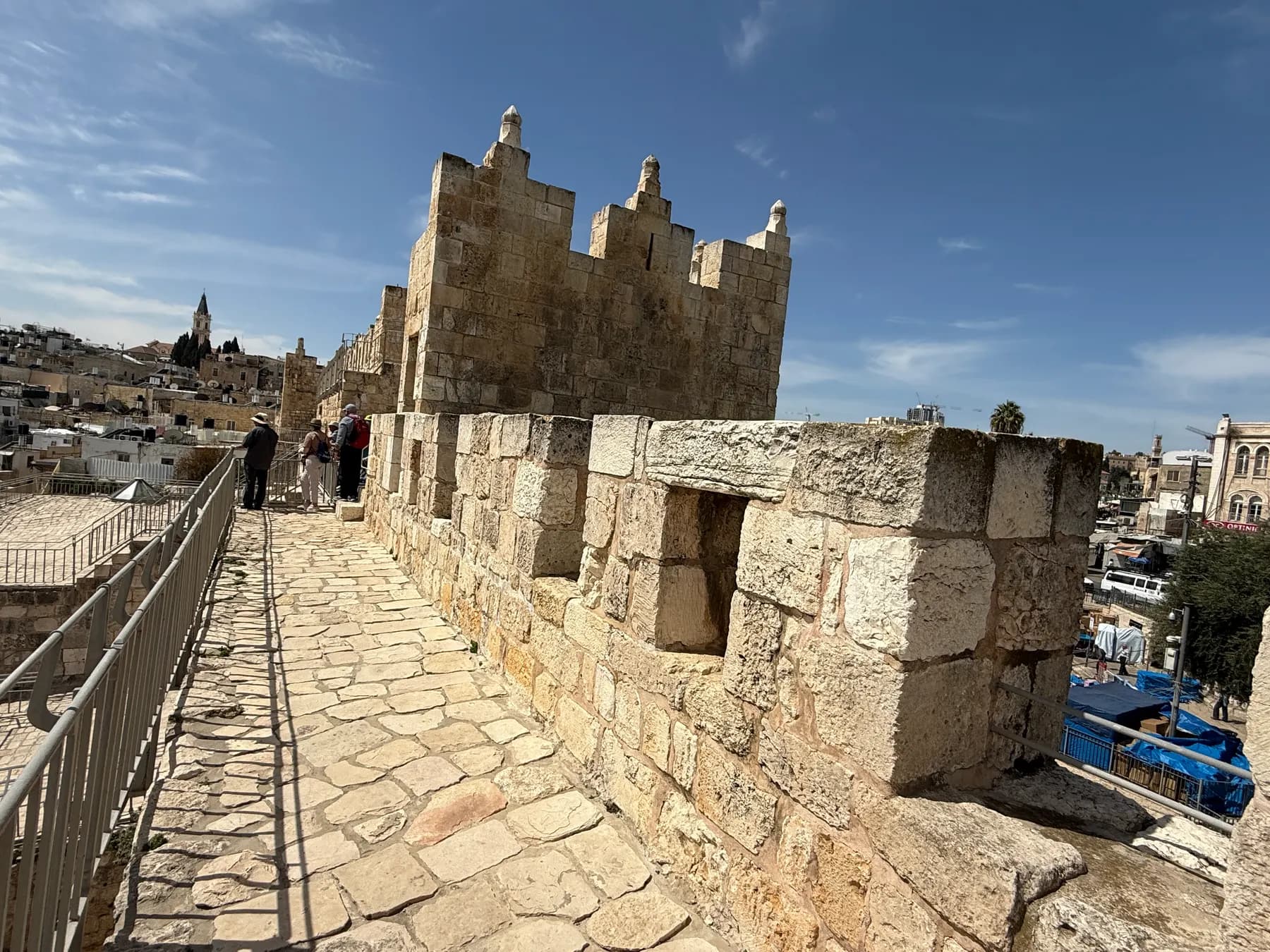
Activity · The Old City of Jerusalem
The Ramparts Walk
A ticketed footpath along the Ottoman patrol path on top of the Old City wall, walked in two sections that both start at Jaffa Gate and never meet, because the eastern stretch along the Temple Mount is closed to walkers.
Unknown author Unknown author / CC BY 2.5 · Wikimedia Commons
Adult ticket
₪25
including the Roman Square at Damascus Gate, in the operator's 2026 price list
The two sections
about 1.5 km and 1 km
northern and southern, per the Hebrew Wikipedia entry on the promenade
Highest point
777 m above sea level
above the Armenian Quarter, near Zion Gate
Wall built
1538–40
under Süleyman the Magnificent, per Britannica, on older foundations
In short
- How long to give it
- about an hour for each section, or about two hours for both
- Northern section, Sunday to Thursday and Saturday
- 9:00 to 17:00, and to 16:00 in winter
- Adult
- ₪25, including the Roman Square at Damascus Gate
טיילת החומות
The Ramparts Walk is a ticketed footpath along the top of the wall Süleyman the Magnificent built round Jerusalem's Old City, sold as one ticket at Jaffa Gate and walked in two separate sections that both begin there. The northern section runs above the Christian and Muslim quarters; the southern runs above the Armenian and Jewish quarters. They do not join into a circuit. The eastern stretch, the wall that carries the Temple Mount, is not open to walkers, and iTravelJerusalem, the city's official tourism site, states that the route covers most of the wall except the Temple Mount area. The Jewish Virtual Library puts the same fact the other way round: one cannot walk along the wall surrounding the Temple Mount.
What is underfoot is the wall's patrol path. The operator's own route notes say Ottoman soldiers used it for four hundred years, moving between the gates and the guard towers, and that the path was restored and converted into a promenade rather than invented as one. The Hebrew Wikipedia entry credits the design to the architect Nahum Meltzer and dates the broad conservation and opening programme to the 1980s. Railings, lighting, signage and stretches of completed and strengthened paving are the modern additions. The masonry mostly is not.
It is among the cheapest ticketed things inside the walls, at ₪25 for an adult in the operator's 2026 price list, and one of the few that hands over the plan of the Old City rather than another fragment of it. The cost is stairs. There are a great many of them, no lifts and no ramps, and the operator says without hedging that the site is not accessible and that prams may not be taken up.
The route
Two walks, one gate, and a gap that cannot be crossed
Both sections are entered at Jaffa Gate, and the operator's English page says so explicitly, because the arrangement catches people out: the promenade looks continuous on a map and is not. The two stairways up sit on either side of the gate, and the ticket booth is inside it.
The southern section is the shorter of the two, about a kilometre by the Hebrew Wikipedia entry's reckoning. It leaves Jaffa Gate above the Armenian Quarter, passes Zion Gate and continues above the Jewish Quarter. The operator's English page gives the end as Zion Gate, with the option of carrying on to near Dung Gate and the Western Wall prayer plaza; its Hebrew route sheet for the same walk simply gives the end point as Dung Gate. Either way it finishes at the busiest corner of the Old City, which makes it the more useful of the two if the rest of the day is going to the Western Wall.
The northern section runs about a kilometre and a half. It leaves Jaffa Gate above the Christian Quarter, crosses the New Gate and Damascus Gate, and carries on above the Muslim Quarter. Here the operator's own pages disagree with each other. The English attraction page ends the walk at the Flower Gate, which is Herod's Gate; the Hebrew route sheet lists the New Gate, Damascus Gate, the Flower Gate and Lions' Gate as its exit points and ends the walk at Lions' Gate. The practical reading is that the northern wall has several ways down and that how far east the path currently runs is worth asking at the booth.
Older guidance, including the Jewish Virtual Library, says the path can be joined at Jaffa, Damascus, Lions' and Zion Gates. The operator's current pages do not: they say the entrance to both promenades is from Jaffa Gate, and sell the ticket there. Group parties can arrange to go up from the outlying gates in advance.
- Southern: Jaffa Gate, above the Armenian and Jewish quarters, to Zion Gate and on towards Dung Gate
- Northern: Jaffa Gate, above the Christian and Muslim quarters, through the New Gate and Damascus Gate
- Not walkable: the eastern wall, along the Temple Mount
- Both sections are entered at Jaffa Gate, and the ticket covers both
The wall
What Süleyman built, and where the figures stop agreeing
Britannica dates the present wall to 1538–40, erected by the Ottoman sultan Süleyman the Magnificent largely on the foundations of earlier walls: chiefly Crusader, in places Byzantine, Herodian and even Hasmonean. That is the sentence to keep, because almost every other figure attached to this wall is contested.
The measurements are a good example of how thin the published record is. The Jewish Virtual Library gives the circuit as approximately two and a half miles and the height as 20 metres. Wikipedia's article on the Walls of Jerusalem gives 4,018 metres, an average height of 12 metres, a thickness of 2.5 metres and 34 watchtowers, and attributes the design to Mimar Sinan or his office. Wikipedia's article on the Old City gives approximately 4.5 kilometres, a height varying between 5 and 15 metres, a thickness of 3 metres at the base and 35 towers, and dates the building to 1535–42. The wall is one object and the sources describe three slightly different ones. A visitor standing on it will notice the variation directly: the parapet is high in some stretches and low in others, and the path rises and falls with the ground.
The gates were not all cut at once, which is why the walk crosses openings of very different ages. Jaffa Gate was inaugurated in 1538 with the rebuilding and keeps its L-shaped bent entry, a defensive design meant to slow an attacker at the turn. The Ottomans opened a new gate in the northern wall in 1875, the one now called Herod's Gate or the Flower Gate. The New Gate was cut through the north-western wall in 1887, to reach the neighbourhoods then spreading outside. In 1898 a wide breach was made in the wall beside Jaffa Gate so that the German emperor Wilhelm II could ride or drive in rather than pass through the gate itself; the breach is still there, and the southern walk begins beside it.
The Old City and its walls were inscribed as a UNESCO World Heritage site in 1981.
Underfoot
A soldiers' path, fitted with railings
The line the walk follows is original and the surface a visitor treads is not entirely so, and the operator is straightforward about which is which. Its route notes describe four hundred years of Ottoman soldiers using the patrol path between the gates and the guard towers, and then the path being restored and converted into a promenade. The Hebrew Wikipedia entry lists what conversion meant: railings added, paving sections completed and strengthened, lighting installed and signage put up.
Access came in stages and none of them were quick. After the 1948 war the Old City fell to the Jordanian Arab Legion, and the armistice line ran close beside the wall for nineteen years. After the Six-Day War, parts of the patrol path were open to the public but walking them carried a genuine risk of falling, and preparation work started then. The broad conservation project, and the promenade as a designed thing under Nahum Meltzer, belong to the 1980s. The Jerusalem Walls National Park at the foot of the wall was laid out in the same post-1967 period, and is a separate site from the one on top.
One earlier decision shapes the view more than any of this. The British, who took the city from the Ottomans in 1917, made regulations to preserve its appearance: the unbuilt valleys around the walls were to stay unbuilt, as a green belt separating old from new, and building hard against the walls was forbidden. The operator notes that Israeli planning authorities adopted the same approach and that it still holds. It is the reason the wall still reads as a wall from above rather than as a retaining structure for later building.
The promenade has closed before. Writing in Zman Israel on 31 January 2020, Aviva and Shmuel Bar-Am reported that the walk had been shut for years because the stairs and railings were unsafe, and had recently been repaired, reinforced and reopened. That history is worth carrying to the ticket booth: a stretch being closed for works is a normal state for this site, not an anomaly.
The view
Courtyards, roofs and a Roman square in the ticket
The reason to pay for this rather than walk the lanes is sightline. From the wall the Old City stops being a sequence of covered alleys and becomes a plan: roof terraces, water tanks, school yards, laundry, church domes and the gaps between quarters that are invisible from the street. The southern section reaches 777 metres above sea level above the Armenian Quarter near Zion Gate, the high point of the whole promenade, and the panorama there takes in Mount Zion and the Jewish Quarter as well as the modern city outside.
The adult ticket also admits the holder to the Roman Square beneath Damascus Gate, and the two sites share an operator: the East Jerusalem Development Company, known as PAMI, a governmental body the Times of Israel describes as established in 1966. The paper reported the Roman site reopening to the public on 26 February 2025 under the name City Gate, with an eastern arch standing about 4.85 metres and a guard tower about 12 metres high that gives access to the ramparts, and a Latin inscription recording that the colonia Aelia Capitolina built it by decree of the city councillors. Bar-Am's earlier account describes original paving down there and a game board incised into one slab, apparently cut by Roman soldiers about 2,000 years ago, along with remains of Hadrian's central arch which the article gives as 40 metres wide.
The northern route passes the Stork Tower, Burj al-Laqlaq, which stands at the north-eastern corner of the wall, and that corner is roughly where the walkable wall gives out. Beyond it the eastern face runs down past the sealed Golden Gate along the Temple Mount, and no ticket buys a way along it.
Timing
Published hours that do not agree with each other
This is the part to check on the day, because the operator publishes different hours on different pages of the same site, and the difference is more than an hour. The Hebrew route sheet for the northern section gives Sunday to Thursday and Saturday, 9:00 to 17:00, with 16:00 in winter. The Hebrew route sheet for the southern section gives Sunday to Thursday 9:00 to 16:00, and Friday and festival eves 9:00 to 14:00. The English attraction page publishes only the summer arrangement.
July and August are the exception and are stated precisely. In July the promenade opens Sunday to Wednesday and Saturday 9:00 to 17:00, Thursday 9:00 to 21:00, and Friday 9:00 to 14:00. In August it opens Sunday to Thursday 9:00 to 21:00, Friday 9:00 to 14:00, and Saturday 9:00 to 17:00. Those evening closings are the best hours the site has: low sun on the stone, a breeze on the wall, and the lanes below emptying.
Time it against the two sections rather than the ticket. The operator's route sheets budget about an hour for each section walked on its own; its attraction listing gives one to two hours for a visit. Two hours covers both with stops, provided the closing time is not the earlier of the two published ones. Last admission is not published anywhere the operator states it, which is another reason not to arrive at ten to closing.
The walk is exposed and stepped, and the operator's own advice is short and worth following: comfortable walking shoes, a hat and water. Prams are not admitted and small children are better carried.
What to look for
Things not to walk past at The Ramparts Walk
The details that repay knowing about before you are standing in front of them.
The high point above the Armenian Quarter
At 777 metres above sea level near Zion Gate, this is the highest point on the promenade. The panorama takes in Mount Zion, the Jewish Quarter and the modern city beyond the walls.
The Roman Square under Damascus Gate
Included in the adult ticket and run by the same operator, it reopened on 26 February 2025 as City Gate. Its 12-metre guard tower gives access to the ramparts, and its arch stands about 4.85 metres.
The 1898 breach beside Jaffa Gate
The wide gap in the wall next to the gate was cut so that Kaiser Wilhelm II could enter Jerusalem without passing through the gate itself. The southern walk starts beside it.
The Stork Tower
Burj al-Laqlaq marks the north-eastern corner of the wall, near where the walkable stretch runs out. Beyond it the eastern face belongs to the Temple Mount and is closed to walkers.
The New Gate and Damascus Gate crossings
The northern route passes over both, one cut through the wall in 1887 for the neighbourhoods spreading outside, the other the busiest entrance in the Old City. Looking straight down into the Damascus Gate crowd is the single clearest thing the walk shows.
The green belt the British left
Regulations made after 1917 kept the valleys round the walls unbuilt and forbade building against them, and Israeli planning kept the rule. It is why the wall still reads as a wall from above.
The long view
The Ramparts Walk, in order
1538–40
Süleyman the Magnificent rebuilds the city wall on older foundations, chiefly Crusader; Jaffa Gate is inaugurated in 1538 with its L-shaped bent entry
1875
The Ottomans open a new gate in the northern wall, now called Herod's Gate or the Flower Gate, at the far end of the northern route
1887
The New Gate is cut through the north-western wall, on the line of the northern walk
1898
A wide breach is made beside Jaffa Gate so that Kaiser Wilhelm II can enter without using the gate; it is still open
1917
The British take the city and legislate to keep the valleys round the walls unbuilt, a green belt rule Israeli planning later adopts
1948–67
The Old City falls to the Jordanian Arab Legion and the armistice line runs beside the wall for nineteen years
1967
After the Six-Day War parts of the patrol path become accessible, with a real risk of falling, and preparation work begins; the Jerusalem Walls National Park is laid out at the foot of the wall
1981
The Old City of Jerusalem and its walls are inscribed as a UNESCO World Heritage site
1980s
A broad conservation programme opens sections to the public; the promenade is designed by the architect Nahum Meltzer, with railings, lighting, signage and made-up paving
January 2020
Zman Israel reports the walk reopening after years shut because the stairs and railings were unsafe
26 February 2025
The Roman site under Damascus Gate reopens as City Gate, run by the same operator and covered by the ramparts ticket
Practical
Visiting The Ramparts Walk
Where
Jaffa Gate, the Old City, Jerusalem
What ticket you need
The ticket is the operator's own and covers both rampart sections plus the Roman Square beneath Damascus Gate. It does not cover the Tower of David Museum, which stands immediately inside Jaffa Gate on a separate ticket, and it is unrelated to the Jerusalem Walls National Park laid out at the foot of the wall after 1967.
Opening hours
- Northern section, Sunday to Thursday and Saturday
- 9:00 to 17:00, and to 16:00 in wintersource
- Southern section, Sunday to Thursday
- 9:00 to 16:00source
- Southern section, Friday and festival eves
- 9:00 to 14:00source
- July
- Sunday to Wednesday and Saturday 9:00 to 17:00, Thursday 9:00 to 21:00, Friday 9:00 to 14:00source
- August
- Sunday to Thursday 9:00 to 21:00, Friday 9:00 to 14:00, Saturday 9:00 to 17:00source
- A caution on the above
- The operator's own pages publish different closing times for the two sections; confirm at the Jaffa Gate boothsource
Admission
Access
Not accessible. The operator states plainly that the routes are not adapted for people with disabilities, that the site includes many stairs, and that prams may not be taken up. Wheelchairs cannot do this walk. Small children are better carried in a carrier. The parapet varies in height along the route and there are unguarded drops on either side of the wall.
On site
- Ticket booth at Jaffa Gate
- Public toilets at Jaffa, Damascus and Lions' Gates and at Dung Gate
- Free audio guide in the Jerusalem Development Authority app
- Railings, lighting and signage along the route
- Several marked exit points on each section
- Buses 20 and 99 to Jaffa Gate
- Alrov and Karta car parks on Yitzhak Kariv Street
Booking
Tickets are sold at Jaffa Gate and no advance booking is required for individuals. Guided group tours, group rappelling from the wall, group ascents from the outlying gates and visits outside regular hours are all by prior arrangement, on 072-329-0703.
Hours and prices are given as the operator publishes them and change without much notice, particularly around Shabbat and the festivals. Check the operator's own page before you travel for this.
Official page at itraveljerusalem.com →What people wish they had known
- Both sections start at Jaffa Gate, not at the gate nearest your hotel. People walk to Damascus Gate or Zion Gate expecting a way up and find none: the operator sells and admits at Jaffa Gate only, and group ascents from the outlying gates have to be arranged beforehand.
- Do not plan to walk round. The eastern wall along the Temple Mount is closed to walkers, so the two sections are out-and-back or exit-and-descend, and there is no loop to complete.
- Check the closing time on the day rather than from any single page. The operator publishes 16:00 for the southern section and 17:00 for the northern on its own route sheets, with an hour less in winter, and only July and August run into the evening.
- Take the southern section if the afternoon is going to the Western Wall and the northern if the interest is the lanes and roofs; the northern is half as long again and passes over the busiest part of the Old City.
- Keep the ticket. It admits the holder to the Roman Square beneath Damascus Gate, which is a separate site under the same operator and easy to walk past without realising it is already paid for.
- Wear shoes with grip and bring a hat and water, which is the operator's own advice. The wall is stepped, uneven in places and exposed, and there is nowhere on it to buy anything.
The figures
The Ramparts Walk by the numbers
Each figure carries the year it belongs to and links the source it came from.
| Measure | Figure | As of | Source |
|---|---|---|---|
| Adult admission | ₪25, including the Roman Square | 2026 | itraveljerusalem.com |
| Concession admission | ₪12 for a child aged 5 to 18, student, soldier or pensioner | 2026 | itraveljerusalem.com |
| Northern section length | about 1.5 km | 2026 | he.wikipedia.org |
| Southern section length | about 1 km | 2026 | he.wikipedia.org |
| Highest point on the promenade | 777 m above sea level, near Zion Gate | 2026 | he.wikipedia.org |
| Wall circuit | 4,018 m, with 34 watchtowers and an average height of 12 m | 2026 | en.wikipedia.org |
| Wall circuit, second published figure | approximately two and a half miles, height 20 m | 2026 | jewishvirtuallibrary.org |
| Roman arch under Damascus Gate | about 4.85 m high, beside a guard tower of about 12 m | 2025 | timesofisrael.com |
While you are here
The rest of The Old City of Jerusalem
Everything else in this destination with a page of its own.
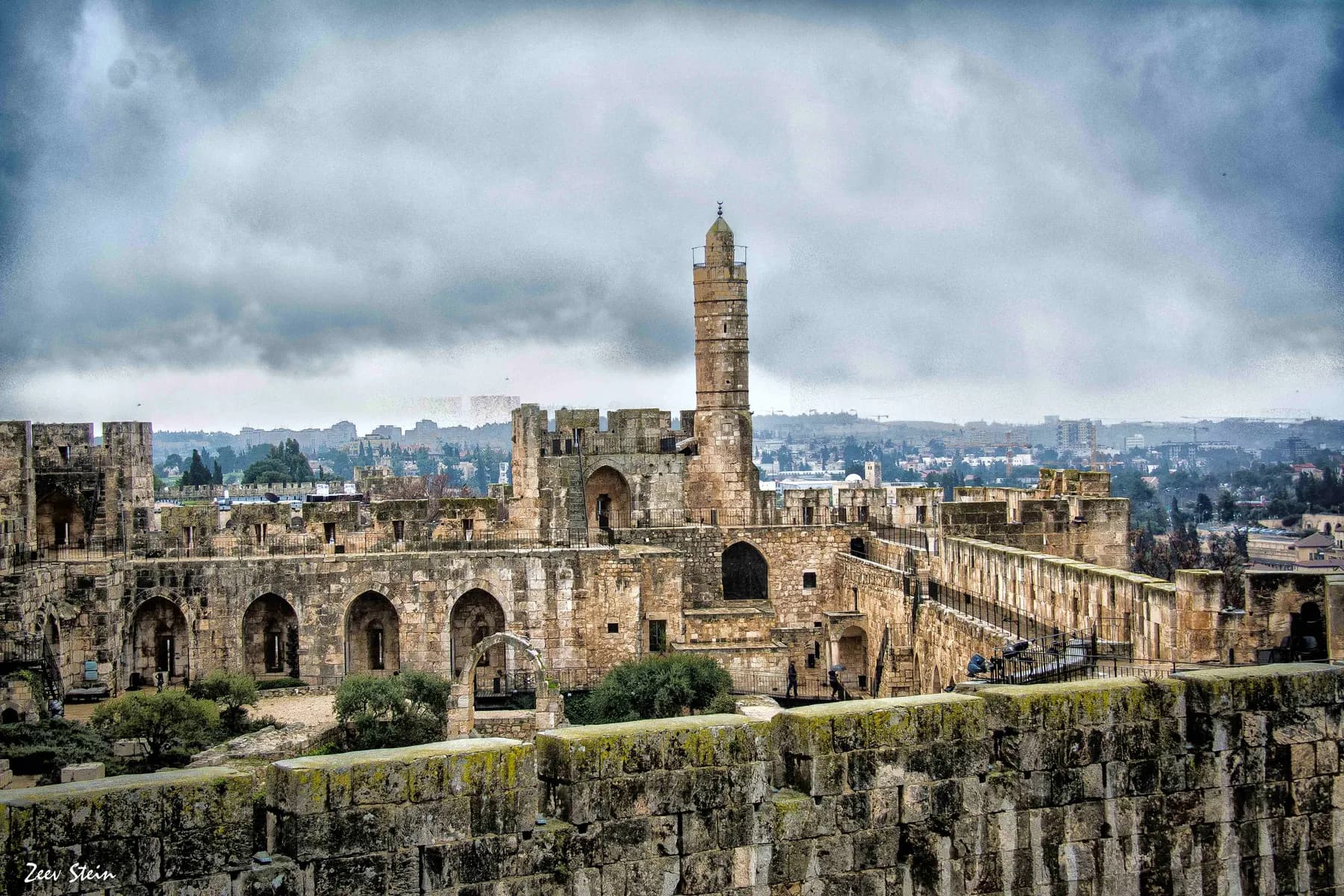
זאב שטיין / CC BY 2.5 · Wikimedia Commons
Museum
Tower of David Museum
The citadel beside Jaffa Gate is Mamluk and Ottoman work standing on the stump of a Herodian tower, and its museum reopened on 1 June 2023 with a new display of ten galleries.

שלמה רודד / CC BY 2.5 · Wikimedia Commons
Market
The Arab Souk and the Old City markets
The three parallel covered lanes at the centre of the souk were built as one market in 1152 by Melisende, Queen of Jerusalem, who hired Muslim labourers from Magna Mahomeria, the village now called al-Bireh, to build it.
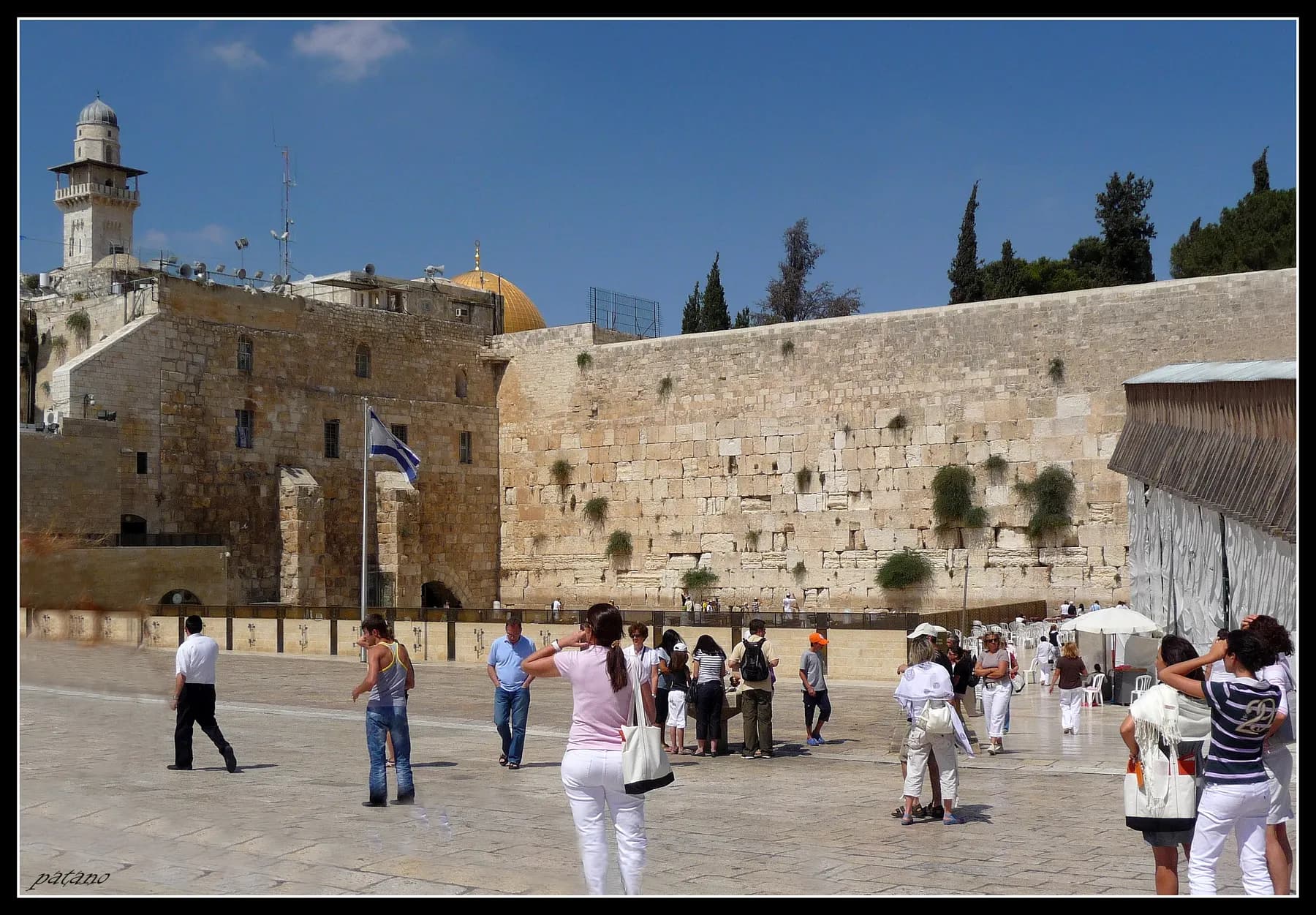
patano / CC BY-SA 3.0 · Wikimedia Commons
Religious site
The Western Wall
The prayer plaza shows about 50 metres of a retaining wall that runs 488 metres in total, and it is open free of charge at every hour of every day of the year.
Sources and further reading
Every link below was opened and checked when this page was written. Official statements are marked as such: they are the subject's own account, not an independent one.
- OfficialiTravelJerusalemitraveljerusalem.comRamparts Walks
The operator's English listing: adult ₪25 including the Roman Square and ₪12 concession, both sections entered from Jaffa Gate, the southern route to Zion Gate and towards Dung Gate, the northern route through the New Gate and Damascus Gate to the Flower Gate, the route covering most of the wall except the Temple Mount area, the July and August hours, 1 to 2 hours, and not accessible.
- OfficialiTravelJerusalemitraveljerusalem.comטיילת החומות בעיר העתיקה ירושלים (The Ramparts Walk in the Old City)
The operator's Hebrew listing, which prices and dates more precisely than the English one: adult ₪25 including the Roman Square, ₪12 for a child aged 5 to 18, student, soldier or pensioner, the day-by-day July and August hours, and the notes that the site is not accessible, includes stairs and does not admit prams.
- OfficialiTravelJerusalemitraveljerusalem.comסיור על חומותייך ירושלים: טיילת החומות הצפונית (Northern Ramparts route)
The northern route sheet: four hundred years of Ottoman soldiers on the patrol path between gates and guard towers, the path restored and converted into a promenade, the British green belt regulations of 1917 and their adoption by Israeli planning, the post-1967 preparation of the promenade and the national park at the foot of the wall, hours of 9:00 to 17:00 and 16:00 in winter, start at Jaffa Gate with exits at the New, Damascus, Flower and Lions' Gates, buses 20 and 99, the Alrov and Karta car parks, and the public toilets and their hours.
- OfficialiTravelJerusalemitraveljerusalem.comסיור על חומותייך ירושלים: טיילת החומות הדרומית (Southern Ramparts route)
The southern route sheet: start at Jaffa Gate and end at Dung Gate, hours of 9:00 to 16:00 Sunday to Thursday and 9:00 to 14:00 on Friday and festival eves, the July and August extension to 21:00, about an hour on foot, the telephone number 072-329-0703, and the group tours, rappelling and out-of-hours visits available by prior arrangement.
- ReportingZman Israelzman.co.ilטיול לשבת: טיילת החומות בירושלים עושה קאמבק (Weekend trip: the Ramparts Walk makes a comeback)
Aviva and Shmuel Bar-Am, 31 January 2020: the walk closed for years because the stairs and railings were unsafe and then repaired, reinforced and reopened; the Roman plaza's original paving and a game board about 2,000 years old incised in a slab; Hadrian's central arch given as 40 metres wide; and the Stork Tower at the north-eastern corner of the wall.
- ReportingThe Times of Israeltimesofisrael.comBiblical-themed exhibit inaugurated at Roman site under Damascus Gate
The site reopened on 26 February 2025 as City Gate, run by the East Jerusalem Development Company (PAMI), a governmental body established in 1966 that also manages the Ramparts Walk; the eastern arch about 4.85 metres high; the 12-metre guard tower giving access to the ramparts; and the Latin inscription recording that the colonia Aelia Capitolina built it by decree of the city councillors.
- ReferenceEncyclopaedia Britannicabritannica.comWall of Süleyman
The present wall erected in 1538–40 by Süleyman the Magnificent, largely on the foundations of earlier walls dating chiefly to the Crusades but in places to Byzantine, Herodian and even Hasmonean times.
- ReferenceEncyclopaedia Britannicabritannica.comJerusalem: the Old City
The city wall erected in 1538–40, the UNESCO World Heritage designation of 1981, and the absence of vehicular traffic within most of the Old City.
- ReferenceJewish Virtual Libraryjewishvirtuallibrary.orgJerusalem: the Old City
Walls approximately two and a half miles long and 20 metres high, seven gates in daily use with the Golden Gate sealed, the path along the walls historically joined from the Jaffa, Damascus, Lions' and Zion Gates, and the statement that one cannot walk along the wall surrounding the Temple Mount.
- ReferenceWikipediaen.wikipedia.orgWalls of Jerusalem
A length of 4,018 metres, average height 12 metres, thickness 2.5 metres, 34 watchtowers and seven main gates; the attribution to Mimar Sinan or his office; construction between 1537 and 1541; the 1898 breach beside Jaffa Gate for Wilhelm II; and the 1981 UNESCO listing.
- ReferenceWikipediaen.wikipedia.orgOld City (Jerusalem)
The competing set of figures: walls of approximately 4.5 kilometres, height between 5 and 15 metres, thickness 3 metres at the base, 35 towers, construction in 1535–42, six original gates and the New Gate added in 1887, and an area of 0.9 square kilometres.
- ReferenceWikipedia (Hebrew)he.wikipedia.orgטיילת החומות (The Ramparts Walk)
Section lengths of about 1 kilometre southern and about 1.5 kilometres northern, the high point of 777 metres above sea level near Zion Gate, the risk of falling on the patrol path after 1967, the conservation project of the 1980s, the design by the architect Nahum Meltzer, and the railings, paving, lighting and signage added to the original path.
- ReferenceWikipediaen.wikipedia.orgJaffa Gate
The gate inaugurated in 1538 as part of Süleyman's rebuilding, its L-shaped entryway as a defensive measure, and the 1898 breach in the wall beside it made so that Wilhelm II need not pass through the gate.
- ReferenceWikipediaen.wikipedia.orgHerod's Gate
The gate's Hebrew and Arabic names, Sha'ar HaPrakhim and Bab az-Zahra, the wicket gate in the 1530s tower, and the new gate opened in the northern wall in 1875 to serve the neighbourhoods developing north of the Old City.
The Ramparts Walk: common questions
How much does the Ramparts Walk cost?+
₪25 for an adult and ₪12 for a child aged 5 to 18, a student, a soldier or a pensioner, in the operator's 2026 price list. The adult ticket also includes the Roman Square beneath Damascus Gate. Both the northern and southern sections are covered by the one ticket.
Where does the Ramparts Walk start?+
At Jaffa Gate, for both sections. The operator states that the entrance to both the northern and southern promenades is from Jaffa Gate, and the ticket booth is there. Older guidance listing Damascus, Lions' and Zion Gates as access points no longer matches what the operator publishes, though those gates remain exit points.
How long does it take?+
The operator budgets about an hour for each section walked on its own, and its attraction listing gives one to two hours for a visit. Two hours is a fair allowance for both with stops for photographs. Neither section is long in distance: the northern is about 1.5 kilometres and the southern about 1.
Can you walk all the way round the Old City wall?+
No. The eastern stretch, the wall that carries the Temple Mount, is closed to walkers, so there is a permanent gap in the circuit. The operator says the route runs along most of the wall except the Temple Mount area, and the Jewish Virtual Library says the same thing from the other direction.
Is the Ramparts Walk wheelchair accessible?+
No. The operator states that the routes are not adapted for people with disabilities, that the site includes many stairs and that prams are not admitted. There are no lifts and no ramps. Small children should be carried in a carrier rather than pushed.
Is it open on Shabbat?+
The operator's Hebrew route sheet for the northern section lists Saturday among its opening days, 9:00 to 17:00, and to 16:00 in winter. The route sheet for the southern section lists only Sunday to Thursday plus Friday and festival eves. Its English page describes a summer Friday and Saturday arrangement in which only the southern ramparts open, 9:00 to 14:00. The operator's own pages do not agree, so confirm at the booth.
Is the Ramparts Walk worth it?+
For the price of a sandwich it is the only way to see the plan of the Old City rather than one lane at a time, which is what most first visits lack. It is a poor choice for anyone who cannot manage stairs, and a poor choice in the middle of a summer afternoon. Evening hours in July and August are the best the site offers.
Is there shade on the wall?+
Almost none, which is why the operator asks visitors to bring a hat and water. The path is the old patrol walk on top of an exposed wall, with the parapet the only cover. In July and August the sensible plan is the evening opening, which runs to 21:00 on the days the operator lists.
How much of the wall is original?+
The wall is Süleyman's, dated by Britannica to 1538–40 and built largely on the foundations of earlier walls, chiefly Crusader and in places Byzantine, Herodian and Hasmonean. The route follows the original Ottoman patrol path. What is modern is the fitting-out: railings, lighting, signage and stretches of completed and strengthened paving, added in the conservation programme of the 1980s to a design by the architect Nahum Meltzer.
Can you do the walk with young children?+
The operator lists the attraction as suitable for children but bars prams and advises carrying small ones. The path is stepped and uneven, the drops on either side are real, and the railings were added rather than built in. Older children who walk confidently are the right audience for it.