Religious site · The Old City of Jerusalem
Via Dolorosa
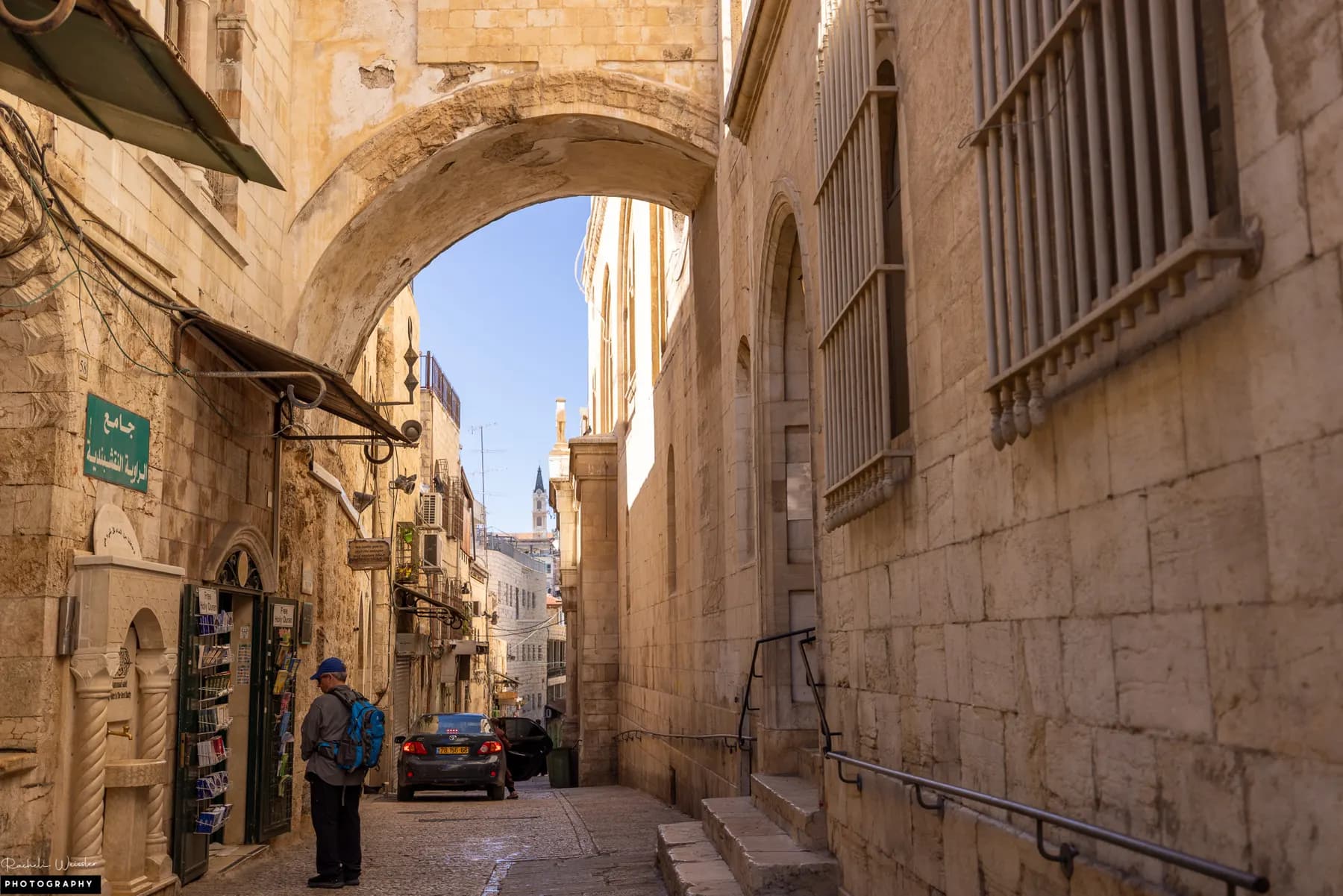
Fourteen stations over roughly half a kilometre of working market lanes, of which nine are in the street and the last five are inside the Church of the Holy Sepulchre.
רחל וייסלר / CC BY 2.5 · Wikimedia Commons
Stations
14
nine in the open street, the last five inside the Church of the Holy Sepulchre
Length of the route
about 600 m
the figure in the English Wikipedia entry; See the Holy Land publishes about 500 m
Admission
Free
the route is a public street, and iTravelJerusalem lists free entry
Friday procession
16:00 summer, 15:00 winter
the Franciscan Via Crucis, per the Custody's Christian Information Centre
In short
- How long to give it
- about 90 minutes at a walking pace with short stops, or half a day if the chapels, the Lithostrotos, the Terra Sancta Museum and a proper look at the Holy Sepulchre are included
- The route itself
- A public street. No gate, no closing time and no ticket
- Walking the Via Dolorosa
- Free
ויה דולורוזה
The Via Dolorosa is a devotional route, not an excavated one. It runs for roughly half a kilometre through the Muslim and Christian Quarters, from a school courtyard about 200 metres inside Lions' Gate to the Church of the Holy Sepulchre, and it is marked by fourteen numbered stations that record what Christian tradition says happened to Jesus between his condemnation and his burial. Nine of those stations are out in the street. The last five are indoors, in the church at the end.
Two things confuse first-time walkers, and both are worth knowing at the start. The first is that the route is not a monument with a gate: it is an ordinary set of Old City lanes carrying deliveries, schoolchildren, shopkeepers and pilgrims at the same time, and outside the chapels there is nothing to buy a ticket for. The second is that the fourteen stations are a European number. They were fixed in Europe in the seventeenth and eighteenth centuries and then supplied in Jerusalem to match, which is why several of them mark episodes that appear nowhere in the New Testament.
None of that makes the walk pointless, and the Franciscans who have led it since the Middle Ages have never claimed archaeological certainty for it. It does mean the honest description of the ground is layered: some of the masonry along the way is Hadrianic, some is Crusader, a good deal of it is nineteenth and twentieth century, and the paving that was shown for generations as the stones Jesus stood on is now dated to about a century after him.
The walk
Nine stations in the street, five under one roof
The walk begins in the Muslim Quarter at the courtyard of the Umariyeh school, on the site traditionally identified with the Antonia Fortress, and ends in the Christian Quarter inside the Church of the Holy Sepulchre. Published lengths differ: the English Wikipedia entry gives about 600 metres, See the Holy Land gives about 500 metres, and neither is unreasonable because the route has no fixed kerb line and walkers cut corners differently. On the ground it is ten minutes of walking and considerably more than that of stopping.
The first nine stations are outdoors. Station I is the school courtyard, which is not always open. Station II is the Franciscan complex opposite it, holding the Church of the Flagellation and the Chapel of the Condemnation, with the Ecce Homo arch spanning the lane just beyond. Stations III and IV stand a short way down Al-Wad Road at Armenian Catholic chapels, station V at the corner where the route turns uphill and Simon of Cyrene is said to have taken the cross, station VI at the Greek Catholic Church of St Veronica, station VII at the junction with Souq Khan al-Zeit, station VIII by a Greek Orthodox monastery and station IX at the entrance to the Coptic Orthodox patriarchate, above the Holy Sepulchre.
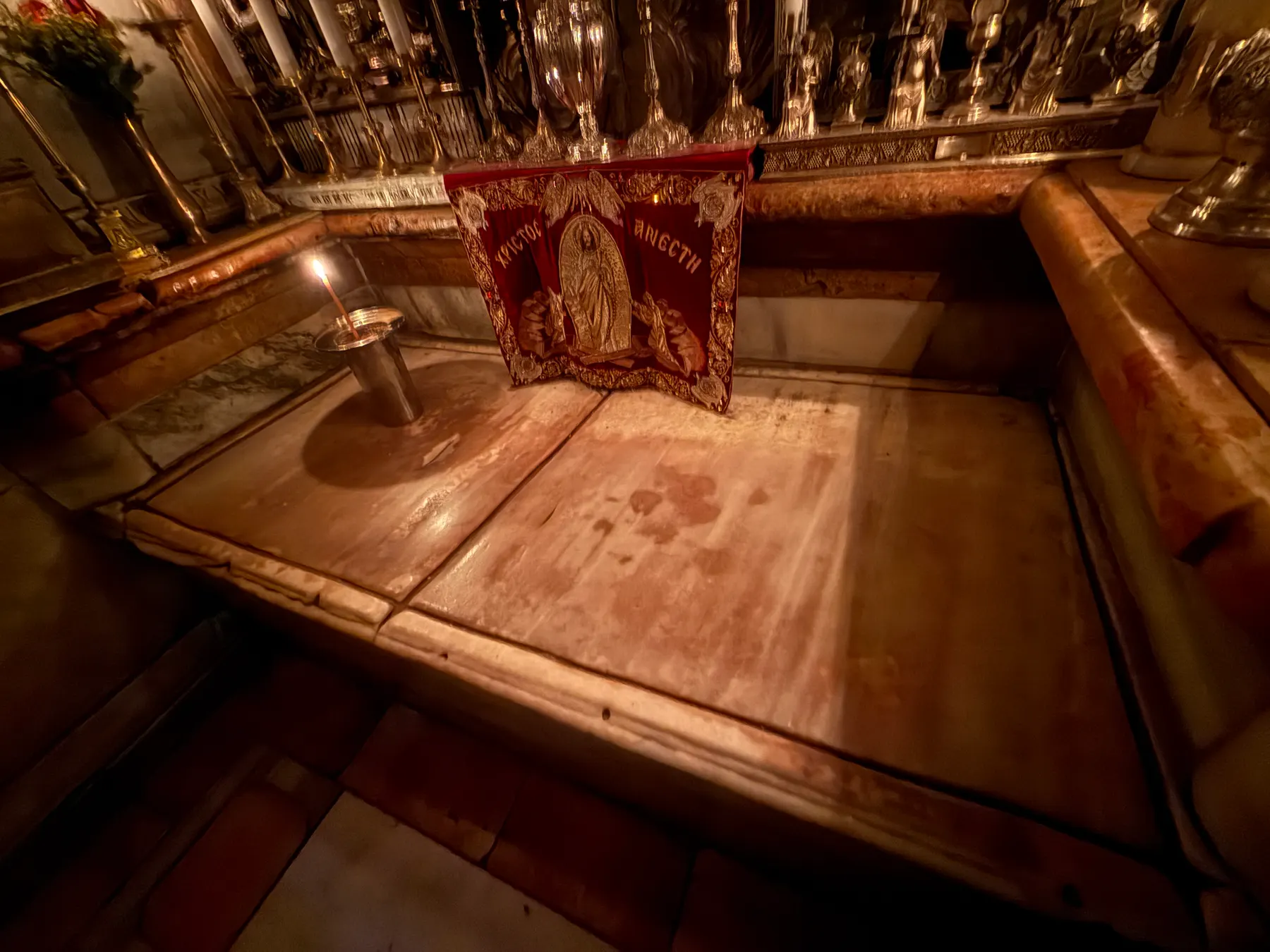
Stations X to XIV are all inside the church. Station X, where Jesus is stripped, is at the Chapel of the Franks; XI, the nailing to the cross, and XII, the death, are the Catholic and Greek chapels on the rock of Calvary; XIII is the Catholic altar of Our Lady of Sorrows; and XIV is the tomb itself, in the edicule under the rotunda.
The markers themselves are modest and easy to miss: Roman numerals set into walls above head height, with bronze sculptures added at the stations in 2019 showing what each one commemorates. There are no barriers, no route signs and no ticket booths. Several of the stations sit in the middle of a busy retail street, and the ninth is reached by leaving the souk and climbing.
- Stations I to IX: outdoors, from the Umariyeh school through Al-Wad Road and Souq Khan al-Zeit
- Stations X to XIV: indoors, in the Church of the Holy Sepulchre, from the Chapel of the Franks to the edicule
- Markers: Roman numerals on the walls, with bronze sculptures added in 2019
- Direction: walked from Lions' Gate towards the church, the reverse of how the Franciscans first walked it
History
The number fourteen came back from Europe
Pilgrims were walking to Calvary long before anyone counted stations. Byzantine accounts of the fourth and fifth centuries describe processions setting out from the Mount of Olives and entering the city through what is now Lions' Gate, with no designated stops along the way. By the eighth century the procession had moved west, taking in Mount Zion and Hagia Sophia, where the praetorium was then believed to have stood, and after the East and West split there were competing routes, each favouring the churches its own communion controlled. In the Crusader period the street on the present line was called Jehoshaphat Street.
The Franciscans arrived with a formal mandate. Their province of the Holy Land dates to 1217, and Pope Clement VI's bull Nuper Carissimae established the Custody. From about 1350 the friars ran an official circuit for pilgrims, and it ran the wrong way round: out from the Holy Sepulchre to Pilate's house, rather than following the events in order. Around 1517 they reversed it, and it has been walked in narrative order ever since.
The counting happened elsewhere. Europeans who could not travel to Jerusalem built copies of the route at home, with anything from seven to thirty stops; the fourteen-station version is usually traced to the Way of the Cross at Leuven in 1505. Pope Innocent XI allowed the Franciscans to erect stations in their own churches in 1686, and in 1731 Pope Clement XII extended the right to all churches and fixed the number at fourteen. Britannica's account of what followed is blunt: in the eighteenth century the Franciscans bowed to Western devotional feeling and provided fourteen stations in Jerusalem to match.
That is why the present route dates to the eighteenth century rather than to antiquity, and why some individual stations were only put where they now stand in the nineteenth. Stations I, IV, V and VIII in particular were settled that late. Five of the fourteen, including the three falls, the meeting with his mother and Veronica wiping his face, are not recorded in the New Testament at all.
The fabric
What is Hadrianic, what is Crusader and what is 1929
The oldest visible thing on the route is not first-century. The arch that crosses the lane beyond the second station, long called the Ecce Homo arch after Pilate's words, was built by Hadrian as the triple-arched gateway to the eastern of the two forums of Aelia Capitolina, the colony founded on the ruins of Jerusalem after 130 CE. It postdates the events it is named for by roughly a century.
The same applies to the most famous pavement in the city. Beneath the convent of the Sisters of Zion, next to that arch, lies the Struthion Pool, an open-air rock-cut cistern built by Herod the Great in the first century BCE and measuring 52 by 14 metres. It was later covered by two barrel vaults carrying a flagstone pavement, and that pavement was shown for generations as the Lithostrotos, the stone pavement of John's gospel where Jesus was condemned. The French Dominican archaeologist Pierre Benoit reexamined it and dated the vaults and the flagstones to the second century CE, contemporary with the Ecce Homo arch. The stones are Roman. They are not the stones of the trial.
The buildings at the stations are mostly modern. The complex at the second station has Crusader origins but was neglected for centuries under Ottoman rule; Ibrahim Pasha of Egypt gave it to the Franciscans in 1838, a hasty reconstruction followed in 1839 with money from Duke Maximilian Joseph in Bavaria, and the church standing there now was built between 1928 and 1929 by the Italian architect Antonio Barluzzi, working deliberately in a twelfth-century manner. Its dome is shaped as a crown of thorns. Most of the other station chapels are nineteenth or twentieth century foundations of the various communities.
At the end of the route the building is genuinely old. The Church of the Holy Sepulchre was built by Constantine around 326 CE and consecrated in 335, destroyed by the Fatimid caliph al-Hakim in 1009, rebuilt by 1048 and substantially remade by the Crusaders in the twelfth century, which is the layout a visitor walks through today. Its interior arrangements are frozen by the Status Quo of 1852, which divides rights among six communities and requires their consensus for any change.
- Hadrianic, about 130 CE: the Ecce Homo arch, the vaults over the Struthion Pool and the flagstones above them
- Herodian, first century BCE: the Struthion Pool itself, cut as an open cistern
- Crusader, twelfth century: the fabric of the Church of the Holy Sepulchre at stations X to XIV
- Nineteenth and twentieth century: most of the station chapels, and the Church of the Flagellation of 1928 to 1929
- 2019: the bronze sculptures now marking the stations
The dispute
Nobody can show where Pilate actually sat
The whole route hangs on one unresolved question: where the praetorium was, meaning where the Roman governor heard the case. The traditional answer, and the reason the walk starts where it does, is the Antonia Fortress, the citadel Herod the Great built at the north-west corner of the Temple Mount and named for Mark Antony. The argument for it is practical: a prefect would want to be beside the Temple during the pilgrim festivals, when trouble was likeliest.
The argument against it is also strong. Philo and Josephus indicate that Roman governors stayed at Herod's palace on the western hill, near the present Jaffa Gate, and that palace was rediscovered beneath the citadel there in 2001. In 2009 the archaeologist Shimon Gibson identified a paved courtyard with a raised platform on the site, which matches the gospel description of the judgment seat. On that reading the real route would have begun at the other end of the Old City altogether. A third suggestion places the praetorium at the Hasmonean palace, roughly between the two.
Archaeology has not helped the traditional site. Pierre Benoit found no support for the four-towered Antonia of the standard reconstructions, and the surviving remains suggest a footprint of about 112 by 40 metres. More awkward still, the ground at the first two stations was occupied in Jesus's lifetime by a large open-air pool, which is a poor place to hold a trial, and the pavement above it was not laid until Hadrian rebuilt the area.
Scholars have not settled this and are unlikely to. What the Via Dolorosa preserves is a route hallowed by centuries of walking rather than one demonstrated by excavation, and the Franciscans who lead it say as much.
On the day
A pilgrim route through a working souk
The route is free and open at any hour because it is a street. What is not always open is everything on it. The first station is a school courtyard entered with the caretaker's permission, published as Monday to Thursday and Saturday from 14:30 to 18:00 and Friday from 14:30 to 16:00, which means most morning walkers find it shut. The Church of the Flagellation at the second station is listed by the Custody's Christian Information Centre as 07:00 to 18:00 in summer and to 17:00 in winter, though other published accounts give a long midday closure, and the Ecce Homo basilica with the Lithostrotos is listed as 08:00 to 17:00.
The one fixed event is the procession. Franciscan friars lead a Via Crucis along the whole route every Friday, starting from the Omariyeh school opposite the Flagellation monastery at 16:00 in summer and 15:00 in winter, escorted by kawas in Ottoman uniform. It is the busiest the lanes get and the one time the route is walked as a body rather than in ones and twos.
The last five stations depend on the Church of the Holy Sepulchre being open, and it keeps its own hours: the Christian Information Centre publishes 05:00 to 20:45 in summer, closing at 20:00 in October, and 04:00 to 19:00 in winter, closing at 19:30 in March. Entry is free. Arriving at the ninth station after the church has shut leaves the walk five stations short.
Two paid stops sit directly on the route and are worth knowing about. The Terra Sancta Museum in the Flagellation monastery charges ₪15 for an adult and ₪10 reduced for one section, or ₪20 for a combined ticket, and its multimedia presentation runs about fifteen minutes in ten languages. The Church of St Alexander Nevsky beside the Holy Sepulchre, where Russian excavations exposed part of the Roman city, charges ₪5.
What to look for
Things not to walk past at Via Dolorosa
The details that repay knowing about before you are standing in front of them.
The Ecce Homo arch
The arch over the lane past the second station is the surviving span of Hadrian's triple gateway to the eastern forum of Aelia Capitolina. It is the most photographed thing on the route and about a century too late to have witnessed anything it is named for.
The Struthion Pool and the Lithostrotos
Under the convent of the Sisters of Zion, a Herodian rock-cut cistern 52 by 14 metres, vaulted over by the Romans. The flagstones above it were shown for generations as the pavement of the trial until Pierre Benoit dated them to the second century.
Barluzzi's crown of thorns
The Church of the Flagellation at the second station was rebuilt in 1928 to 1929 by Antonio Barluzzi in a twelfth-century manner, with the dome shaped as a crown of thorns and three windows on the scenes of the trial.
The turn at Souq Khan al-Zeit
The seventh station stands where the route meets the market street running on the line of the Roman cardo. It is the point where a devotional walk becomes a shopping street, and the contrast is the most honest thing about the Via Dolorosa.
The ninth station on the church roof
Station IX is reached by leaving the souk and climbing to the Coptic Orthodox patriarchate, which sits directly above the Church of the Holy Sepulchre. The Ethiopian monastic village on the roof is next door.
The Friday Via Crucis
Franciscans have led the procession here since the Middle Ages and still do, at 16:00 in summer and 15:00 in winter, with kawas in Ottoman dress clearing the way ahead of them.
The long view
Via Dolorosa, in order
First century BCE
Herod the Great builds the Antonia Fortress at the north-west corner of the Temple Mount and cuts the Struthion Pool, an open cistern of 52 by 14 metres, beside it.
After 130 CE
Hadrian refounds the city as Aelia Capitolina. His triple-arched gateway to the eastern forum, later called the Ecce Homo arch, is built, and the Struthion Pool is vaulted over and paved.
4th to 5th centuries
Byzantine pilgrims process from the Mount of Olives into the city and on to Calvary, with no designated stops on the way.
8th century
The processional route shifts west by way of Mount Zion, where the praetorium is then believed to have stood.
1217
The Franciscan province of the Holy Land is founded. Pope Clement VI's bull Nuper Carissimae later establishes the Custody.
12th century
In the Crusader period the street on the present line is known as Jehoshaphat Street.
c. 1350
Franciscans begin leading an official pilgrim circuit, running from the Holy Sepulchre out to Pilate's house: the reverse of the order of events.
1505
The Way of the Cross at Leuven is built, the version from which the number fourteen is usually traced.
c. 1517
The Franciscans reverse the Jerusalem route so that it follows the events in order, from Pilate's house to Golgotha.
1686
Pope Innocent XI authorises the Franciscans to erect stations in their own churches.
1731
Pope Clement XII extends the right to all churches and fixes the number of stations at fourteen.
18th century
The Franciscans provide fourteen stations in Jerusalem to match Western devotional practice. The modern route is established.
1838
Ibrahim Pasha of Egypt gives the derelict complex at the second station to the Franciscans; a hasty reconstruction follows in 1839, funded by Duke Maximilian Joseph in Bavaria.
19th century
Stations I, IV, V and VIII are given the positions they hold today.
1928 to 1929
Antonio Barluzzi rebuilds the Church of the Flagellation at the second station, with a dome shaped as a crown of thorns.
2001
Herod's palace, the rival candidate for the praetorium, is rediscovered beneath the citadel inside Jaffa Gate.
2009
Shimon Gibson identifies a paved courtyard with a raised platform at the palace site, matching the gospel description of the judgment seat.
2016 to 2017
The edicule over the tomb, the fourteenth station, is restored after decades held together by steel girders.
2019
Bronze sculptures are installed at the stations, showing what each one commemorates.
Practical
Visiting Via Dolorosa
Where
Via Dolorosa, Muslim and Christian Quarters, Old City of Jerusalem. The first station is at the Umariyeh school, about 200 metres inside Lions' Gate
What ticket you need
The route is not inside a ticketed park and needs no ticket at any point. It does end inside another site: stations X to XIV are all within the Church of the Holy Sepulchre, which is free but keeps its own opening hours and is governed by the Status Quo of 1852, so the last five stations are only walkable while the church is open.
Opening hours
- The route itself
- A public street. No gate, no closing time and no ticketsource
- Station I, Umariyeh school courtyard
- Monday to Thursday and Saturday 14:30 to 18:00; Friday 14:30 to 16:00; entry with the caretaker's permissionsource
- Station II, Church of the Flagellation and Chapel of the Condemnation
- 07:00 to 18:00 in summer, to 17:00 in wintersource
- Terra Sancta Museum, Flagellation monastery
- Daily 09:00 to 18:00 April to September, 09:00 to 17:00 October to Marchsource
- Ecce Homo basilica and the Lithostrotos
- 08:00 to 17:00source
- Stations X to XIV, Church of the Holy Sepulchre
- 05:00 to 20:45 in summer, closing 20:00 in October; 04:00 to 19:00 in winter, closing 19:30 in Marchsource
- Franciscan Via Crucis procession
- Fridays, 16:00 in summer and 15:00 in winter, starting from the Omariyeh school opposite the Flagellation monasterysource
Admission
- Walking the Via Dolorosa
- Freesource
- Church of the Holy Sepulchre, stations X to XIV
- Freesource
- Terra Sancta Museum, one section
- ₪15 adult, ₪10 reduced for groups of five or more, students and over-65ssource
- Terra Sancta Museum, combined ticket
- ₪20, or ₪15 reduced, covering the multimedia and archaeological sectionssource
- Church of St Alexander Nevsky, beside the Holy Sepulchre
- ₪5source
Access
Poor for wheelchairs over the full route, and it should not be attempted as a whole. The Old City lanes here are stepped, cobbled and change level constantly, the ninth station is reached by climbing out of the souk, and the market is often too crowded to turn a chair in. Individual points are better: the Terra Sancta Museum states that its entrance from Via Dolorosa street is barrier-free and its multimedia section is wheelchair accessible, though it has no toilets. A realistic plan for a wheelchair user is to reach the Church of the Holy Sepulchre directly for stations X to XIV, and take the outdoor stations from the flatter western end where possible.
On site
- Station chapels of several communities
- Terra Sancta Museum, ticketed
- Lithostrotos and Struthion Pool at the Sisters of Zion
- Franciscan Via Crucis on Fridays
- Shops, bakeries and cafes along Al-Wad Road and Souq Khan al-Zeit
- Christian Information Centre at Jaffa Gate for route maps
- Security checks at the Old City gates
- No toilets at the Terra Sancta Museum
Booking
Nothing needs booking to walk the route, and there is nobody to book with. Groups wanting the Terra Sancta Museum are asked to reserve by email in advance, and access to the school courtyard at the first station depends on the caretaker rather than on a timetable. The Christian Information Centre at Jaffa Gate hands out route maps and is closed on Sundays, on Christian holidays and on Saturday afternoons.
Hours and prices are given as the operator publishes them and change without much notice, particularly around Shabbat and the festivals. Check the operator's own page before you travel for this.
Official page at itraveljerusalem.com →What people wish they had known
- Walk it in the morning and the first station will almost certainly be locked. The Umariyeh school courtyard opens in the afternoon and only with the caretaker's permission, so anyone who wants to stand in it should start after 14:30 rather than at breakfast.
- Work backwards from the church, not forwards from the gate. The last five stations are inside the Church of the Holy Sepulchre and it closes at 19:00 in winter, so a late start ends the walk five stations short of the point.
- Friday afternoon is either the best time or the worst. The Franciscan procession sets out at 16:00 in summer and 15:00 in winter and fills the lanes completely: join it deliberately, or come on another day.
- Do not look down expecting first-century paving. The Lithostrotos flagstones under the Sisters of Zion, shown for generations as the pavement of the trial, were dated by Pierre Benoit to the second century, contemporary with the Ecce Homo arch above the street.
- Published opening times for the chapels disagree with each other, and a long midday closure is normal. The Custody's own information centre lists the Church of the Flagellation as open through the day, while other accounts give a break in the early afternoon, so treat any single listing as a guide rather than a guarantee.
- This is a retail street with a devotion running through it, not a sanctuary. Shopkeepers are working, deliveries come through on hand-carts, and the stations are marked by small numerals well above eye level, so a printed map from the Christian Information Centre at Jaffa Gate saves a good deal of doubling back.
The figures
Via Dolorosa by the numbers
Each figure carries the year it belongs to and links the source it came from.
| Measure | Figure | As of | Source |
|---|---|---|---|
| Stations on the route | 14, of which the last five are inside the Church of the Holy Sepulchre | 2026 | en.wikipedia.org |
| Length of the route | about 600 m, beginning about 200 m inside Lions' Gate | 2026 | en.wikipedia.org |
| Length of the route, second published figure | about 500 m | 2026 | seetheholyland.net |
| Struthion Pool, cut under Herod the Great | 52 by 14 m | 2026 | en.wikipedia.org |
| Surviving footprint of the Antonia Fortress | about 112 by 40 m | 2026 | en.wikipedia.org |
| Terra Sancta Museum admission | ₪15 adult and ₪10 reduced per section, ₪20 combined | 2026 | terrasanctamuseum.org |
| Terra Sancta Museum multimedia presentation | about 15 minutes, in ten languages | 2026 | terrasanctamuseum.org |
| Church of St Alexander Nevsky admission | ₪5 | 2026 | cicts.org |
While you are here
The rest of The Old City of Jerusalem
Everything else in this destination with a page of its own.
שלמה רודד / CC BY 2.5 · Wikimedia Commons
Religious site
Church of the Holy Sepulchre
Six Christian communities share one building over Golgotha and the tomb, the doors are opened by two Muslim families, and nobody has been charged to walk in since 1831.

שלמה רודד / CC BY 2.5 · Wikimedia Commons
Market
The Arab Souk and the Old City markets
The three parallel covered lanes at the centre of the souk were built as one market in 1152 by Melisende, Queen of Jerusalem, who hired Muslim labourers from Magna Mahomeria, the village now called al-Bireh, to build it.
Religious site
The Temple Mount and Haram al-Sharif
Everything standing on the esplanade is later than the esplanade itself, which Herod's engineers made from about 19 BCE by wrapping a hilltop in four retaining walls and filling in behind them.
Sources and further reading
Every link below was opened and checked when this page was written. Official statements are marked as such: they are the subject's own account, not an independent one.
- OfficialiTravelJerusalem, Jerusalem Development Authorityitraveljerusalem.comVia Dolorosa
The official tourism listing: free entry, the fourteen stations marking New Testament events and later traditions, the last five inside the Church of the Holy Sepulchre, the Friday Franciscan march, and the thirteenth-century formulation of the tradition
- OfficialiTravelJerusalem, Jerusalem Development Authorityitraveljerusalem.comChurch of the Holy Sepulchre
Free entry to the church at the end of the route, its fourth-century foundation under Constantine, the Crusader-period fabric, and the Muslim families holding the keys since the thirteenth century
- OfficialChristian Information Centre, Custody of the Holy Landcicts.orgUpdated opening hours of holy places and tourist sites in the Holy Land
The Custody's published hours: the Basilica of the Holy Sepulchre at 05:00 to 20:45 in summer and 04:00 to 19:00 in winter, the Church of the Flagellation at 07:00 to 18:00, the Ecce Homo basilica and Lithostrotos at 08:00 to 17:00, the Via Crucis from the Omariyeh school at 16:00 summer and 15:00 winter, and ₪5 at St Alexander Nevsky
- OfficialTerra Sancta Museum, Custody of the Holy Landterrasanctamuseum.orgPlan your visit
₪15 regular and ₪10 reduced per section, ₪20 or ₪15 combined, free categories, daily hours of 09:00 to 18:00 in summer and 09:00 to 17:00 in winter, the fifteen-minute multimedia tour in ten languages, the barrier-free entrance from Via Dolorosa street and the absence of toilets
- OfficialTerra Sancta Museum, Custody of the Holy Landterrasanctamuseum.orgTerra Sancta Museum
The museum's three sections, the address at 1 Via Dolorosa in the Monastery of the Flagellation, and the Art and History section at St Saviour still to open
- ReferenceSee the Holy Landseetheholyland.netVia Dolorosa
The route at about 500 metres, the location of each of the fourteen stations, the opening times of the Umariyeh school courtyard, the Friday procession at 4pm and 3pm in winter with kawas in Ottoman uniform, the bronze sculptures of 2019, and the three candidate sites for the praetorium
- ReferenceWikipediaen.wikipedia.orgVia Dolorosa
The route at about 600 metres beginning about 200 metres inside Lions' Gate, the fourteen stations and the five inside the church, the Byzantine and eighth-century routes, Jehoshaphat Street in the Crusader period, the Franciscan circuit from about 1350 and its reversal around 1517, the Hadrianic identification of the Ecce Homo arch, and the 2001 and 2009 findings at Herod's palace
- ReferenceWikipediaen.wikipedia.orgStations of the Cross
The Franciscan province of the Holy Land founded in 1217, the European copies with seven to thirty stations, Pope Innocent XI's authorisation of 1686 and Pope Clement XII's standardisation at fourteen in 1731
- ReferenceEncyclopaedia Britannicabritannica.comStations of the Cross
The number fourteen traced to Leuven in 1505, the early pilgrims observing fewer stations, and the statement that in the eighteenth century the Franciscans provided fourteen stations in Jerusalem in response to Western devotional feeling
- ReferenceEncyclopaedia Britannicabritannica.comVia Dolorosa
The street in the Old City followed as the path along which Jesus carried the cross to Golgotha, and its repaving for Holy Week processions
- ReferenceWikipediaen.wikipedia.orgStruthion Pool
The pool cut by Herod the Great at 52 by 14 metres, the two barrel vaults and the flagstone pavement above it, and Pierre Benoit's redating of both to the second century CE, contemporary with the Ecce Homo arch
- ReferenceWikipediaen.wikipedia.orgAntonia Fortress
Herod's citadel named for Mark Antony at the north-west corner of the Temple Mount, Pierre Benoit finding no support for four corner towers, the surviving footprint of about 112 by 40 metres, and the modern view that the praetorium was at Herod's palace
- ReferenceWikipediaen.wikipedia.orgChurch of the Flagellation
The Crusader origins, the gift of the complex to the Franciscans by Ibrahim Pasha in 1838, the 1839 reconstruction funded by Duke Maximilian Joseph in Bavaria, and Antonio Barluzzi's rebuilding of 1928 to 1929 with its crown-of-thorns dome
- ReferenceWikipediaen.wikipedia.orgChurch of the Holy Sepulchre
Constantine's building of about 326 CE consecrated in 335, the destruction of 1009 and rebuilding by 1048, the Crusader remaking of the twelfth century, the Status Quo of 1852 and its six communities, and the restoration of the edicule in 2016 to 2017
Via Dolorosa: common questions
What is the Via Dolorosa?+
It is the devotional route through the Old City of Jerusalem that Christian tradition identifies with the path Jesus took from his condemnation to his crucifixion and burial. It is marked by fourteen stations, nine of them in the open street and the last five inside the Church of the Holy Sepulchre. It is an ordinary set of city lanes rather than an enclosed site, and it runs through the Muslim Quarter into the Christian Quarter.
How long is it and how long does it take to walk?+
About 600 metres on the English Wikipedia's figure, or about 500 metres on See the Holy Land's, which is ten to fifteen minutes of actual walking. Allow about 90 minutes to walk it with stops at the stations, and half a day if the chapels, the Lithostrotos, the Terra Sancta Museum and the Church of the Holy Sepulchre are all included. The limiting factor is crowds in the souk rather than distance.
Is the Via Dolorosa free?+
Yes. The route is a public street, iTravelJerusalem lists free entry, and the Church of the Holy Sepulchre at the end charges nothing either. Three things on the way are ticketed and none of them is compulsory: the Terra Sancta Museum at the second station at ₪15 for an adult, the combined museum ticket at ₪20, and the Church of St Alexander Nevsky beside the Holy Sepulchre at ₪5.
Where does it start, and how do I find the first station?+
At the courtyard of the Umariyeh school in the Muslim Quarter, about 200 metres inside Lions' Gate, on the site traditionally identified with the Antonia Fortress. It is a school, so it is open only in the afternoon and only with the caretaker's permission: Monday to Thursday and Saturday from 14:30 to 18:00, and Friday from 14:30 to 16:00. The Franciscan complex holding the second station is directly opposite and is far easier to find.
Did Jesus actually walk this route?+
Probably not this exact line, and the Franciscans who lead the walk do not claim otherwise. The route depends on the praetorium having been at the Antonia Fortress, and Philo and Josephus indicate Roman governors stayed at Herod's palace on the western hill instead; that palace was rediscovered under the citadel at Jaffa Gate in 2001, and in 2009 Shimon Gibson identified a paved courtyard with a raised platform there. A third proposal puts the praetorium at the Hasmonean palace between the two. The question is not settled.
Why are there fourteen stations?+
Because Europe decided there should be. The number is usually traced to the Way of the Cross built at Leuven in 1505, Pope Innocent XI allowed the Franciscans to erect stations in their churches in 1686, and Pope Clement XII fixed the number at fourteen for all churches in 1731. Britannica records that in the eighteenth century the Franciscans then provided fourteen stations in Jerusalem to match. Five of them, including the three falls and Veronica wiping his face, are not in the New Testament.
When is the Franciscan procession?+
Every Friday, at 16:00 in summer and 15:00 in winter, according to the Custody's Christian Information Centre. It starts at the Omariyeh school opposite the Flagellation monastery and walks the full route to the Church of the Holy Sepulchre, led by Franciscan friars and escorted by kawas in Ottoman uniform. It is the fullest the lanes get all week.
Is any of it original, or is it all reconstruction?+
Very little is first-century, and the two most famous pieces of fabric are Roman but later. The Ecce Homo arch over the lane was built by Hadrian as the gateway to the eastern forum of Aelia Capitolina after 130 CE, and the Lithostrotos flagstones beneath the Sisters of Zion were dated by Pierre Benoit to the same period, though the Struthion Pool they cover is Herodian. The Church of the Flagellation at the second station was built between 1928 and 1929 by Antonio Barluzzi, and most other station chapels are nineteenth or twentieth century. The Church of the Holy Sepulchre at the end is substantially Crusader work of the twelfth century.
Can it be done in a wheelchair?+
Not as a whole route, honestly. The lanes are stepped and cobbled, they change level repeatedly, the ninth station involves a climb out of the souk, and the market is frequently too crowded to manoeuvre in. Some individual points are accessible: the Terra Sancta Museum states that its entrance from Via Dolorosa street is barrier-free and its multimedia section is wheelchair accessible, though it has no toilets. Reaching the Church of the Holy Sepulchre directly for the last five stations is the practical alternative.
Is it worth it if I am not religious?+
Yes, though for different reasons than a pilgrim would give. The walk is the cleanest way to cross the Old City from the eastern wall to the Christian Quarter on foot, it passes through the working markets of Al-Wad Road and Souq Khan al-Zeit, and it takes in a Hadrianic gateway, a Herodian cistern and a Crusader church in under an hour. The layering of a devotional route over a retail street is also the most characteristic thing about this city, and it is easier to see here than anywhere else in it.