Religious site · Masada
The Masada Synagogue
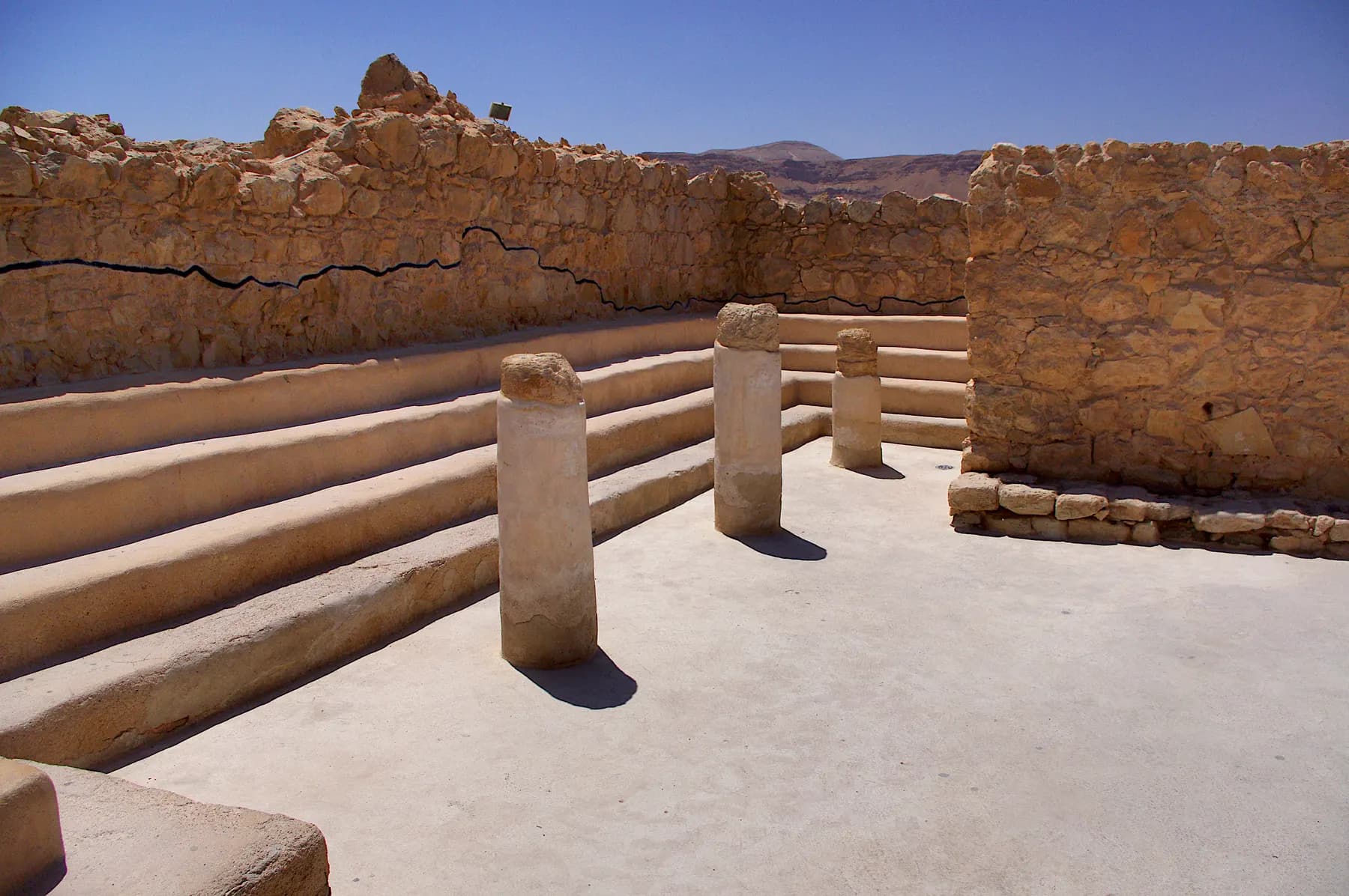
A rectangular room set into the northwestern casemate wall, used as a stable in Herod's day on the parks authority's account and rebuilt during the revolt with four tiers of plastered benches and two pits in the back room floor that held parts of Deuteronomy and Ezekiel.
Jan Helebrant / CC0 · Wikimedia Commons
The hall
12.5 × 10.5 m
as measured in the Israeli foreign ministry's description of the site
Tiers of benches
4
plastered, running along the walls, built during the revolt
Pits in the back room floor
2
holding parts of Deuteronomy and of Ezekiel, apparently a genizah
Biblical scrolls found at Masada
7
per the Israel Antiquities Authority, recovered near the section identified as a synagogue
In short
- How long to give it
- about 20 minutes for the synagogue and the casemate wall beside it, inside the two to three hours most visitors give the whole plateau
- The synagogue itself
- No separate hours: it is on the plateau, opens and closes with the national park, and has no gate or ticket of its own
- The synagogue
- No separate charge: it is inside the park boundary and covered by the park ticket
בית הכנסת במצדה
The Masada synagogue is a rectangular room set into the northwestern stretch of the casemate wall on the summit, and it is one of a very small number of buildings anywhere that can be argued to have served as a synagogue before the Second Temple was destroyed in 70 CE. The Israel Nature and Parks Authority, which runs the mountain, describes it as a structure that served in Herod's time as a stable and was converted into a synagogue by the rebels of the First Jewish Revolt.
What stands there is plain. Four tiers of plastered benches run along the walls, two rows of columns once carried the roof down the middle of the hall, and a small room is partitioned off at the back. Two pits had been dug into that back room's floor. Yigael Yadin's expedition found parts of two biblical scrolls in them, Deuteronomy and Ezekiel, and the parks authority reads the pits as the synagogue's genizah, the burial place for sacred text too worn to use. The Israeli foreign ministry's description of the site gives the hall as 12.5 by 10.5 metres and says it was oriented towards Jerusalem.
It is also, unusually for a room excavated out of a first-century siege, still in use. The parks authority runs a family ceremonies programme called Mosaic across 22 of its heritage sites, and at Masada the ancient synagogue is one of the settings it offers for a bar mitzvah, a bat mitzvah or a wedding canopy. Masada is the only one of the 22 where the authority keeps a Torah scroll.
The building
A room inside the wall, with the seating built up in tiers
Herod ringed the summit with a casemate wall: two parallel skins of masonry with chambers between them, so that the fortification and the accommodation are the same building. The synagogue occupies a stretch of that wall in the northwestern sector of the plateau, which is why it reads from outside as part of the defences rather than as a separate structure. Encyclopaedia Judaica's Masada entry, written by the archaeologist Guy D. Stiebel, places it there and describes what the revolt-period builders did to it: they turned the plan into a large hall with two rows of columns in the centre and a back service room, and built a series of four peripheral tiers of plastered benches along the walls.
Tiered benches around the walls are the feature that carries the argument. They face inwards, on all sides, which describes a room built for people to listen to something read in the middle of it rather than a room built to be walked through. The parks authority's own account of the plateau says only that tiered stone benches were built against the walls, and leaves the inference to the reader.
The published descriptions record benches, columns and a back room, and very little else: no mosaic floor, no carved Torah shrine, no dedicatory inscription set into the stone. That absence is itself part of the interest. The decorated synagogue with a mosaic zodiac is a later thing, a building type that emerges after 70 CE, and nothing here anticipates it.
There is a ritual immersion pool close by. Stiebel's entry lists the mikveh near the synagogue among the several on the mountain, and notes that Masada was the first site anywhere at which stepped plastered pools of this kind were recognised as mikva'ot, an identification that afterwards became a standard marker of Jewish settlement. Britannica states flatly that the synagogue and ritual bath found on Masada are the earliest yet found in Palestine.
- Set into the northwestern sector of the casemate wall, not freestanding
- A hall with two rows of columns down the centre and a back service room
- Four tiers of plastered benches along the walls, built during the revolt
- Two pits cut into the floor of the back room, read as a genizah
- A ritual immersion pool nearby, among several on the plateau
The argument
Two arms of the Israeli state describe the same room differently
The parks authority's page on the plateau says the structure served in Herod's time as a stable and was converted into a synagogue by the rebels. The Israeli foreign ministry's description of Masada, reproduced by the Jewish Virtual Library, says the synagogue was part of the Herodian construction, incorporated into the northwestern section of the casemate wall and oriented towards Jerusalem, and that it also served the Jews who lived at Masada during the revolt. Those are two different buildings in the same place: one a stable that became a prayer hall in the 60s CE, the other a prayer hall from the start that the rebels remodelled.
Stiebel's encyclopaedia entry hedges in a way that shows where the evidence runs out. The building was seemingly used as a stable in the first half of the first century CE; during the revolt its plan was transformed; the building was identified by Yadin as a synagogue. The identification was supported afterwards, he writes, by parallels from Herodium and more decidedly from Gamla, and by the discovery of the scroll fragments under the back room floor and an ostracon inscribed ma'aser kohen, priest's tithe, in the main hall.
The wider question is not settled either. Buildings claimed as synagogues from before the destruction of the Temple form a short and contested list: Gamla, Masada, Herodium, Migdal, Modi'in, Qiryat Sefer and a handful of others, and scholars accept some and argue about the rest. Masada appears on that list with the qualification attached. Against that, Britannica's entry states without qualification that the synagogue and ritual bath at Masada are the earliest yet found in Palestine.
What nobody disputes is what the room was doing in the year the mountain fell. People sat on those benches, a scroll of Deuteronomy and a scroll of Ezekiel were buried under the floor of the back room, and a potsherd naming a priest's tithe was dropped in the hall. The disagreement is about the previous seventy years, not about the last one.
The floor
Deuteronomy in one pit, Ezekiel in the other
Two pits were dug into the floor of the small room at the back. Portions of biblical parchment came out of them, and the parks authority calls the pits apparently the synagogue's genizah. A genizah is not a hiding place: worn or damaged sacred writing may not simply be thrown away, so it is stored and eventually buried. If that reading is right, the pits are not a wartime measure at all but ordinary practice, carried out in a fortress under siege.
The two texts are known. Stiebel's entry names them as parts of Ezekiel and Deuteronomy. The foreign ministry's account is more specific about the second: Ezekiel 37, the vision of the valley of the dry bones, the passage in which a plain of scattered bones is knitted back into a living army. The parks authority's own ceremonies page repeats that identification when describing the room to families planning a bar mitzvah there.
An ostracon inscribed ma'aser kohen, tithe for the priest, was found in the main hall. It is a two-word potsherd and it carries a fair amount: tithes imply agricultural produce being separated according to law, and a priest implies someone on the rock entitled to receive them.
The scroll finds do not stop at the door. Immediately south of the synagogue, in what excavators named the casemate of the scrolls, parchment and papyrus fragments from the period of the revolt were recovered. The Israel Antiquities Authority records that the Masada manuscripts were found not in caves but within the structures of the reconfigured palace, near the section identified as a synagogue, and that they amount to fragments of seven biblical scrolls: Genesis, two copies of Leviticus, Deuteronomy, Ezekiel and two copies of Psalms, plus the Songs of the Sabbath Sacrifice and a Hebrew text of Ben Sira. The biblical fragments match the traditional Masoretic text, which the authority reads as evidence that a stabilised text was already in place in the first century CE.
- Two pits in the back room floor, read as a genizah
- Parts of Deuteronomy and of Ezekiel, including the valley of the dry bones
- An ostracon in the hall inscribed ma'aser kohen, priest's tithe
- The casemate of the scrolls immediately south, with parchment and papyrus from the revolt
- Seven biblical scrolls from Masada in all, matching the Masoretic text
What survives
Where the ancient stone stops, and how to see the join
Masada is one of the rare sites where the answer to "what is original here" is drawn on the wall. The UNESCO evaluation of the property, reproduced alongside the foreign ministry's description, records that there have been no additions or reconstruction beyond an acceptable level of anastylosis, that inappropriate materials used in early conservation are being replaced, and that limited restoration has been carried out to aid interpretation with the original archaeological levels clearly defined by a prominent black line set in the new mortar joints. On the benches and the walls of the synagogue, everything below that line came out of the ground; everything above it was put back.
The reason so much survived to be marked is the emptiness. After the Byzantine monastic settlement broke up in the sixth century the mountain was left alone for more than thirteen centuries, and the buildings collapsed onto themselves and were buried by their own debris. Yadin's expedition excavated nearly the whole plateau over two seasons from 1963, and the current management plan commits to no further research excavation on the main site in the present generation.
This room also sits close to the violence. Stiebel records that the section of the western casemate wall directly above the Roman ramp is entirely missing, in all likelihood breached by the battering ram, and that ballista balls, arrowheads and slingshots were found in the immediate area of the breach. The parks authority's own description of the synagogue as a ceremony venue notes that archaeologists found hundreds of ballista balls on its floor. The room where the scrolls were buried and the wall the Tenth Legion knocked down are a short walk apart.
The practical consequence is that this is a plan to be read rather than an interior to be stood inside. The columns are stumps, the benches are partly rebuilt, and the roof is long gone.
In use
The only national park in Israel that keeps a Torah scroll
The parks authority runs a programme called Mosaic that lets families hold a bar mitzvah, a bat mitzvah or a chuppah at heritage sites it manages, and it lists 22 of them, from Bar'am and Gamla in the north to Tel Arad and Tel Be'er Sheva in the south. Masada is one, and the authority's page for it names the ancient synagogue first among the ceremony settings on the mountain, followed by a room in the casemate wall and other locations chosen after a preparatory visit.
One line in the programme's own list of questions singles the place out. Asked whether a Torah scroll will be available, the authority answers that a Torah scroll is currently available only at Masada National Park. Everywhere else in the scheme, families bring their own.
The practical rules are published and they are worth reading before booking anything. A preliminary tour of the site is compulsory. During regular opening hours the park is not closed to other visitors while a ceremony is under way, so a family holding one on the summit is holding it in public; ceremonies before opening or after closing can be arranged with the site management at extra cost. Catering generally cannot be brought in, though light refreshments can be agreed. Tables, chairs and a water heater can be hired. The fees for a ceremony are additional to the entrance fee. Reservations at Masada go through the site's own reservations manager, Heli Markovitz, on 08-9959333 or masadaevents@npa.org.il, with a downloadable form to fill in and return.
For an ordinary visitor with a park ticket, the effect is that the synagogue is the one ruin on the plateau where the thing being described may be happening in front of you.
- One of 22 heritage sites in the parks authority's Mosaic ceremonies programme
- The ancient synagogue is listed first among the ceremony settings at Masada
- The only site in the scheme where the authority provides a Torah scroll
- A preliminary tour is compulsory before a ceremony is confirmed
- The park stays open to other visitors during ceremonies held in opening hours
What to look for
Things not to walk past at The Masada Synagogue
The details that repay knowing about before you are standing in front of them.
The four tiers of benches
Plastered seating stepped up along the walls and facing inwards on every side, built by the rebels. It is the single feature that makes the room legible as a place of assembly rather than a chamber in a wall.
The back room and its two pits
A small space partitioned off at the rear, with two pits cut into the floor that held parts of Deuteronomy and of Ezekiel. The parks authority reads them as the synagogue's genizah.
The black line in the mortar
A conservation convention used across Masada and recorded in the UNESCO evaluation: original archaeological levels are marked with a prominent black line set into the new mortar joints, so the join between ancient and rebuilt is visible on the stone.
The casemate of the scrolls
The chamber immediately south of the synagogue, where a collection of parchment and papyrus fragments from the time of the revolt was found. It is the reason the whole northwestern stretch of wall matters to textual scholars.
The mikveh nearby
One of several stepped immersion pools on the plateau, and part of the group that made Masada the first site anywhere at which such pools were recognised as ritual baths.
The breach above the ramp
A short walk to the south and west, the stretch of casemate wall directly above the Roman ramp is entirely missing, most probably knocked out by the battering ram. Ballista balls were found on the synagogue floor as well as around the breach.
The long view
The Masada Synagogue, in order
37–4 BCE
Herod's reign, and the building of the casemate wall around the summit with chambers between its two skins. The room later identified as the synagogue is part of that wall in the northwestern sector.
First half of the 1st c. CE
The building was seemingly used as a stable, on Guy Stiebel's account in Encyclopaedia Judaica, and on the parks authority's account it served as a stable in Herod's time. The Israeli foreign ministry's description instead treats it as a synagogue from the Herodian construction onwards.
66–73/74 CE
The First Jewish Revolt. The rebels holding Masada remodel the room into a hall with two rows of columns and four tiers of plastered benches, partition off a back chamber, and bury scroll fragments in two pits cut into its floor.
6th century CE
The Byzantine monastic settlement on the mountain breaks up, after which the site is left alone for more than thirteen centuries and the buildings are buried by their own collapse.
1963–1965
Yigael Yadin's expedition excavates nearly the whole plateau. The room is identified as a synagogue, the two pits are opened, and the ma'aser kohen ostracon is recovered from the main hall.
1966
Masada is declared a national park, bringing the synagogue under the management of what is now the Israel Nature and Parks Authority.
1995
Ehud Netzer and Guy Stiebel uncover a storage cave from the early years of Herod's reign under the northeastern corner of the synagogue building, holding sixteen storage jars in place alongside wine amphorae.
2001
UNESCO inscribes Masada as a World Heritage Site. The evaluation records that restoration has been limited and that original archaeological levels are marked by a black line in the new mortar joints.
Practical
Visiting The Masada Synagogue
Where
Northwestern casemate wall, Masada plateau, Masada National Park, Judaean Desert, above the western shore of the Dead Sea
What ticket you need
The synagogue sits inside Masada National Park, on the northwestern edge of the summit. The park entrance fee covers it: there is no separate ticket, no separate gate and no separate opening time. What costs extra is getting to the top, since the cable car is charged on top of the entrance fee, and the two footpaths are free but close on a heat schedule set against the Israel Meteorological Service forecast.
Opening hours
- The synagogue itself
- No separate hours: it is on the plateau, opens and closes with the national park, and has no gate or ticket of its ownsource
- Park, summer, Sunday to Thursday and Saturday
- 08:00 to 17:00source
- Park, summer, Friday and holiday eves
- 08:00 to 16:00source
- Park, winter, Sunday to Thursday and Saturday
- 08:00 to 16:00source
- Park, winter, Friday and holiday eves
- 08:00 to 15:00source
- Last entry and last cable car
- Entry to the park closes one hour before the stated time, and the last cable car ascends one hour before closingsource
- Walking up in heat
- In normal hot weather the last ascent on the Snake Path is 10:00 and the last descent 11:00; in very hot weather 08:00 and 09:00; in extreme summer heat 07:00 and 08:00, with the Roman ramp trail then closing to ascent at 11:00 and to descent at noonsource
- Ceremonies in the synagogue
- Held during opening hours with the park still open to other visitors, or before opening and after closing by arrangement with the site management at extra costsource
Admission
- The synagogue
- No separate charge: it is inside the park boundary and covered by the park ticketsource
- Adult, park entry, cable car excluded
- ₪37source
- Child
- ₪21source
- Student, or adult in a group
- ₪31source
- Child in a group
- ₪18source
- Israeli senior citizen
- ₪19source
- Masada Museum, where the excavated finds are shown
- ₪20 on its own, included with park entry, reservation required either waysource
- Ceremony in the synagogue
- Charged on top of the entrance fee, at rates set out in the Mosaic programme price list and arranged with the sitesource
Access
Getting to the room can be done without steps, and that is the part people worry about. The parks authority states that the cable car and the bridge at the top are wheelchair accessible, and that the plateau has concrete paths, toilets, railings on steps, benches, shaded gathering places and entry to most of the key sites and lookouts, with models and relief maps adapted for visually impaired visitors. The synagogue is on the plateau itself, so it does not involve the long stepped descent that the authority singles out as the exception in the Northern Palace. The authority does not name the synagogue individually in its access notes, so a visitor who needs certainty should use its accessible visit coordination form before travelling. Walking up is a different matter: the Snake Path is a steep earthen path largely made of built steps with railings, graded high difficulty and timed at about an hour, and the Roman ramp trail from the Arad side is steep with many steps. Neither is usable in a wheelchair.
On site
- Concrete paths on the plateau
- Railings on steps
- Benches and shaded gathering places
- Toilets on the plateau
- Models and relief maps adapted for visually impaired visitors
- Accessible cable car and upper bridge
- No shade or water inside the room itself
Booking
Nothing needs booking to walk into the synagogue, but the parks authority asks visitors to reserve a time slot for Masada National Park online and says that if the slot is full on arrival you will be asked to show the reservation confirmation to get in. The Masada Museum at the foot, which displays the finds from Yadin's excavation, is entered by reservation only. A ceremony in the synagogue is booked separately through the site's reservations manager, Heli Markovitz, on 08-9959333 or masadaevents@npa.org.il, with a downloadable application form, and a preliminary tour of the site is compulsory before it is confirmed.
Hours and prices are given as the operator publishes them and change without much notice, particularly around Shabbat and the festivals. Check the operator's own page before you travel for this.
Official page at en.parks.org.il →What people wish they had known
- Find the benches before you look for anything else. First-time visitors walk into the room expecting a building and see a low ruin; the thing that makes it a synagogue rather than a chamber in a wall is that the seating steps up on all four sides and faces inwards.
- Look for the black line in the mortar joints. The UNESCO evaluation records it as the marker between original archaeological levels and restoration, and it is the quickest way to tell, in any building on the plateau, how much of what you are looking at came out of the ground.
- Do not expect to see the scrolls here. The fragments from the two pits are museum objects, and the finds from the excavation are displayed in the Masada Museum at the foot of the mountain, which is entered by reservation and can be booked with the park ticket rather than decided on the way out.
- Walk the few metres south to the casemate of the scrolls and then on towards the western wall. The point where the Roman ramp meets the summit, and the missing stretch of casemate above it, are close enough that the two halves of the story can be seen in one visit.
- If a ceremony is under way, the park is still open. The authority is explicit that it does not close the site during opening hours while a family holds a bar mitzvah, so the polite move is to give the room a few minutes and come back rather than to walk through it.
- Get here early in the day for reasons that have nothing to do with crowds. The room is unroofed and unshaded, the paths up close on a heat schedule in summer, and the last ascent on the Snake Path can be as early as 07:00 in extreme heat.
The figures
The Masada Synagogue by the numbers
Each figure carries the year it belongs to and links the source it came from.
| Measure | Figure | As of | Source |
|---|---|---|---|
| The hall | 12.5 by 10.5 m, incorporated into the northwestern section of the casemate wall | 2026 | jewishvirtuallibrary.org |
| Tiers of plastered benches along the walls | 4, built during the revolt | 2007 | encyclopedia.com |
| Pits cut into the back room floor | 2, holding parts of Deuteronomy and of Ezekiel | 2026 | en.parks.org.il |
| Biblical scrolls recovered at Masada | 7: Genesis, two of Leviticus, Deuteronomy, Ezekiel and two of Psalms, plus the Songs of the Sabbath Sacrifice and a Hebrew Ben Sira | 2026 | deadseascrolls.org.il |
| Storage jars found in place under the northeastern corner of the building | 16, in a cave from the early years of Herod's reign, excavated in 1995 | 2007 | encyclopedia.com |
| Heritage sites in the parks authority's Mosaic ceremonies programme | 22, of which Masada is the only one holding a Torah scroll | 2026 | en.parks.org.il |
| Adult park entry, which covers the synagogue | ₪37, cable car excluded | 2026 | en.parks.org.il |
| Masada Museum, holding the finds from the excavation | ₪20 on its own, reservation required | 2026 | en.parks.org.il |
While you are here
The rest of Masada
Everything else in this destination with a page of its own.
Godot13 / CC BY-SA 4.0 · Wikimedia Commons
Archaeological site
Herod's Northern Palace
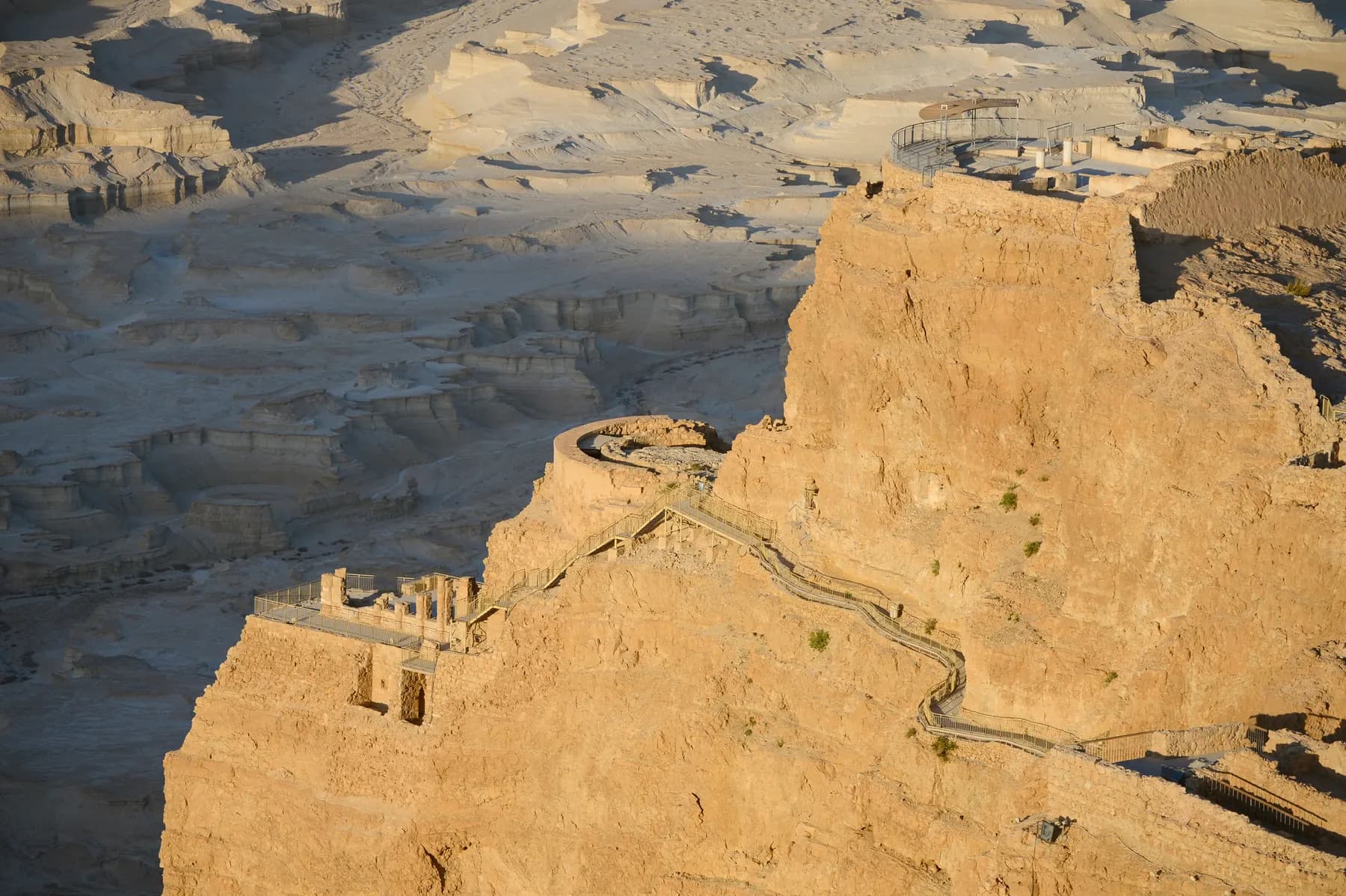
Herod's architects hung a private house on three rock terraces at the northern tip of Masada, with about 30 metres of height between the top terrace and the bottom one and retaining walls holding the lower two onto the cliff.
Jan Helebrant / CC0 · Wikimedia Commons
Archaeological site
The Roman Assault Ramp
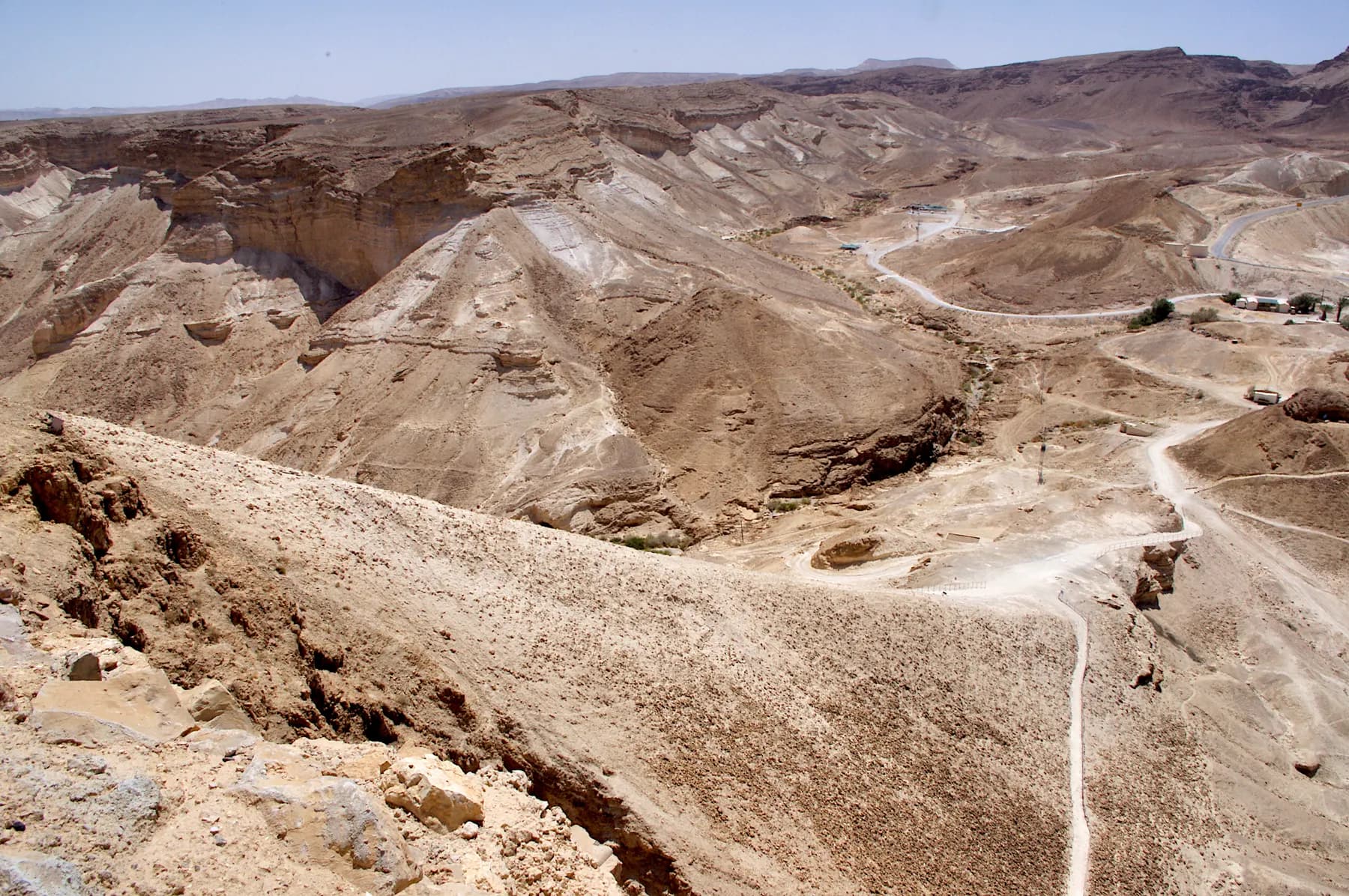
The bank the Tenth Legion raised against Masada's western cliff in the siege of 73 or 74 CE, whose foot the parks authority puts only about 60 metres below the summit, and which now carries the shortest footpath to the top.
Armineaghayan / CC BY-SA 4.0 · Wikimedia Commons
Museum
The Masada Museum in Memory of Yigael Yadin
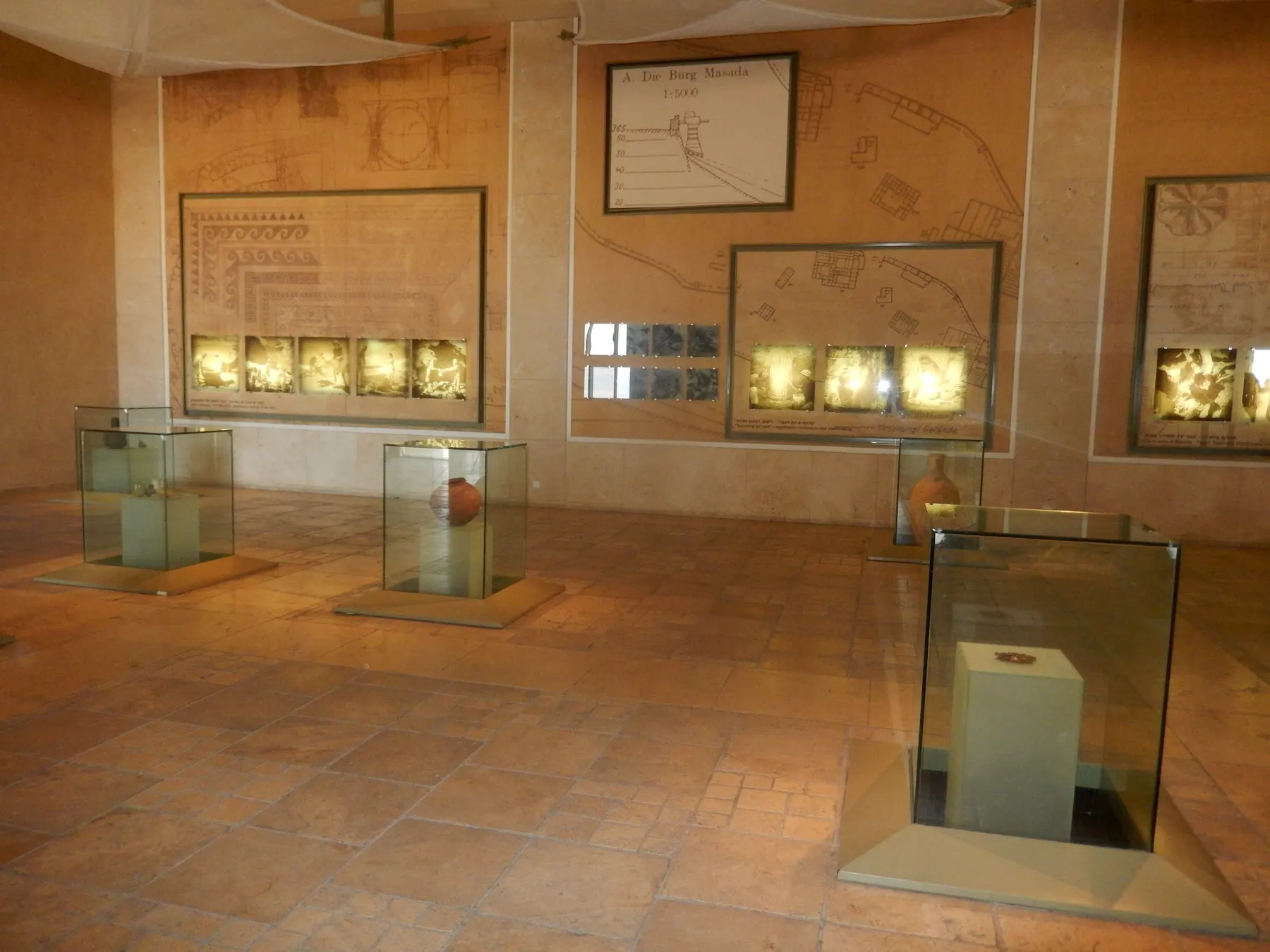
Nine rooms at the foot of the mountain, painted from dark grey to black so that the objects Yigael Yadin's expedition dug out of Masada between 1963 and 1965 are the only lit things in them.
Sources and further reading
Every link below was opened and checked when this page was written. Official statements are marked as such: they are the subject's own account, not an independent one.
- OfficialIsrael Nature and Parks Authorityen.parks.org.ilMasada National Park: The Plateau
The operator's own account of the synagogue: remains of one of the only synagogues preserved from the time of the Second Temple, a structure that served in Herod's time as a stable and was converted into a synagogue by the rebels, two pits dug into the floor where portions of biblical parchment were found and which were apparently the synagogue's genizah, tiered stone benches built against the walls, and the casemate of the scrolls to the south holding a rare collection of finds from the time of the revolt including scrolls and papyri. Also the history of research from Robinson and Smith in 1838 to Yadin in 1963 and Netzer and Stiebel afterwards
- OfficialIsrael Nature and Parks Authorityen.parks.org.ilMasada National Park
Summer and winter opening hours, entry closing an hour before the stated time and the last cable car an hour before closing, entrance fees of ₪37 adult, ₪21 child, ₪31 student and adult in group, ₪18 child in group and ₪19 Israeli senior, the heat schedule that sets the last ascent on the Snake Path at 10:00, 08:00 or 07:00 according to the Israel Meteorological Service forecast, the reservation system, the declaration of the national park in 1966, and the access statement covering the cable car, the bridge and the plateau
- OfficialIsrael Nature and Parks Authorityen.parks.org.ilMosaic: Masada National Park
The operator's ceremonies page for Masada, naming the ancient synagogue and a room in the casemate wall as ceremony settings, describing the stone benches built against its walls, the two pits that revealed biblical scrolls including Ezekiel's vision of the valley of the dry bones, the casemate of the scrolls, the hundreds of ballista balls found on the floor, and the contact details for booking, including the reservations manager Heli Markovitz on 08-9959333
- OfficialIsrael Nature and Parks Authorityen.parks.org.ilMosaic: family ceremonies at heritage sites
The programme itself: 22 heritage sites listed for bar mitzvah, bat mitzvah and chuppah ceremonies, the statement that a Torah scroll is currently available only at Masada National Park, the compulsory preliminary tour, the rule that the site is not closed to other visitors during opening hours, the option of ceremonies before opening or after closing at extra cost, the restriction on catering, the equipment available for hire, and the note that ceremony fees are additional to entrance fees
- OfficialIsrael Nature and Parks Authorityen.parks.org.ilThe Masada Museum in Memory of Yigael Yadin
The museum displaying the archaeological finds from the Hebrew University expedition headed by Yigael Yadin: admission of ₪20 on its own, included with site entry, advance reservation required and entry only on presentation of a reservation, closing half an hour before the site, and recorded tours in seven languages on T-coil compatible headphones
- OfficialIsrael Nature and Parks Authorityen.parks.org.ilWorld Heritage Sites
The parks authority's record of the 2001 UNESCO inscription of Masada, the criteria cited, the description of the excavations begun in 1963 as having unearthed most of the structures and thousands of finds in an excellent state of preservation, and the authority's account of its own conservation and access work over recent decades
- OfficialIsrael Antiquities Authority, Leon Levy Dead Sea Scrolls Digital Librarydeadseascrolls.org.ilDiscovery sites of the Dead Sea Scrolls: Masada
The national antiquities body's account of the Masada manuscripts: full-scale excavation between 1963 and 1965, manuscripts found not in caves but within the structures of the reconfigured palace near the section identified as a synagogue, fragments of seven biblical scrolls (Genesis, two copies of Leviticus, Deuteronomy, Ezekiel and two copies of Psalms) plus the Songs of the Sabbath Sacrifice and a Hebrew Ben Sira, and the observation that the biblical scrolls match the Masoretic text
- ReferenceEncyclopaedia Judaica, entry by Guy D. Stiebel, via Encyclopedia.comencyclopedia.comMasada, in Encyclopaedia Judaica (2nd edition)
The scholarly description of the building: a rectangular structure in the northwestern sector of the casemate wall, seemingly used as a stable in the first half of the first century CE, transformed during the revolt into a large hall with two rows of columns in the centre and a back service room, with four peripheral tiers of plastered benches along the walls; identified by Yadin as a synagogue with parallels at Herodium and Gamla; parts of two biblical scrolls, Ezekiel and Deuteronomy, buried in pits in the back room floor as a possible genizah; the ma'aser kohen ostracon from the main hall; the mikveh near the synagogue and Masada's place as the first site where mikva'ot were recognised as such; the storage cave with sixteen jars found under the northeastern corner of the building by Netzer and Stiebel in 1995; and the missing section of western casemate wall above the ramp with ballista balls, arrowheads and slingshots around the breach
- ReferenceJewish Virtual Library, reproducing the Israeli Ministry of Foreign Affairs description and the UNESCO evaluationjewishvirtuallibrary.orgMasada: desert fortress overlooking the Dead Sea
The foreign ministry's account: the synagogue as part of the Herodian construction, a hall measuring 12.5 by 10.5 m incorporated into the northwestern section of the casemate wall and oriented towards Jerusalem, with four tiers of plastered benches and roof columns added by the Jews living at Masada during the revolt, and called the best example of the early synagogues predating 70 CE; the ma'aser kohen ostracon and the fragments of Deuteronomy and Ezekiel 37 including the vision of the dry bones. The same page carries the UNESCO statement of authenticity, that there have been no additions or reconstruction beyond an acceptable level of anastylosis, that limited restoration was carried out to aid interpretation with original archaeological levels clearly defined by a prominent black line set in the new mortar joints, that the site lay untouched for more than thirteen centuries, and that no further research excavation will be carried out on the main site in the present generation
- ReferenceEncyclopaedia Britannicabritannica.comMasada
The statement that the synagogue and ritual bath discovered on Masada are the earliest yet found in Palestine, together with Herod's constructions, the 1955 to 1956 survey, and Yadin's complete excavation from 1963 to 1965 with thousands of volunteers
- ReferenceWikipediaen.wikipedia.orgAncient synagogues in Palestine
The survey of buildings claimed as synagogues from before the destruction of the Second Temple, listing Gamla, Masada and Herodium among them, noting that a significant part of the scientific community accepts some while others are debated, and marking Masada specifically as contested, attributed to the Sicarii in the first century CE and including a genizah
- ReferencePenelope, University of Chicagopenelope.uchicago.eduThe Wars of the Jews, Book VII (Whiston translation)
The only ancient narrative of Masada, describing the fortress, its wall and towers, the storerooms, Silva's ramp and the fall of the rock. It is also the negative evidence for this page: the two occurrences of the word synagogue in Book VII both concern Antioch, and Josephus's inventory of the buildings on the summit does not include one, so the identification of this room rests on excavation rather than on any ancient text
The Masada Synagogue: common questions
Is the Masada synagogue really from the Second Temple period?+
The room was in use as a synagogue during the First Jewish Revolt, which ended before the Temple was destroyed in 70 CE, and on that basis the parks authority calls it one of the only synagogues preserved from the time of the Second Temple. What is argued about is the phase before that. The parks authority says the structure was a stable in Herod's day; the Israeli foreign ministry's description says the synagogue was part of the Herodian construction. Buildings identified as pre-70 synagogues are a short and contested list in general, and Masada sits on it with the qualification attached.
Was it really a stable before it was a synagogue?+
That is the Israel Nature and Parks Authority's account, and Guy Stiebel's Encyclopaedia Judaica entry agrees that the building was seemingly used as a stable in the first half of the first century CE. The word "seemingly" is doing real work there. The competing account, published by the Israeli foreign ministry, treats the room as a synagogue from the Herodian construction onwards, so a visitor is entitled to hear both.
What was found under the floor?+
Two pits dug into the floor of the small back room held parts of two biblical scrolls, Deuteronomy and Ezekiel, the latter including the vision of the valley of the dry bones. The parks authority reads the pits as the synagogue's genizah, the burial place for worn sacred text. An ostracon inscribed ma'aser kohen, tithe for the priest, was found in the main hall, and a further collection of parchment and papyrus fragments came from the casemate of the scrolls immediately to the south.
Can you see the scrolls at Masada?+
Not in the synagogue. The finds from Yigael Yadin's excavation are displayed in the Masada Museum at the foot of the mountain, which the parks authority prices at ₪20 on its own, includes with park entry, and admits by advance reservation only. The museum closes half an hour before the site does, and its recorded tour runs in seven languages.
Is it still used for bar mitzvahs?+
Yes. The parks authority runs a family ceremonies programme called Mosaic across 22 heritage sites, and its page for Masada lists the ancient synagogue first among the settings available for a bar mitzvah, a bat mitzvah or a chuppah. Masada is the only site in the programme where the authority itself provides a Torah scroll. Ceremonies are booked through the site's own reservations manager and require a preliminary visit.
How much of what I am looking at is rebuilt?+
Less than most reconstructed sites, and the boundary is marked. The UNESCO evaluation of Masada records that there have been no additions or reconstruction beyond an acceptable level of anastylosis, that limited restoration was carried out to aid interpretation, and that the original archaeological levels are clearly defined by a prominent black line set in the new mortar joints. Below the line is ancient stone; above it is not.
How long does the synagogue take to see?+
About 20 minutes is enough for the room, the back chamber and the stretch of casemate wall beside it, inside the two to three hours most visitors give the whole plateau. It is a small building and its interest is in the plan rather than in standing architecture, so a visitor who knows what the benches and the pits are will get more out of it in ten minutes than one who does not will get in an hour.
Can you get to it in a wheelchair?+
Getting to the plateau is possible: the parks authority states that the cable car and the bridge at the top are wheelchair accessible, and that the summit has concrete paths, toilets, railings on steps, benches and shaded gathering places, with entry to most of the key sites and lookouts. The synagogue is on the plateau, not below it like the Northern Palace, so it avoids the long stepped descent the authority names as its exception. The authority does not list the synagogue individually, so anyone who needs certainty should use its accessible visit coordination form first. Neither footpath up the mountain is usable in a wheelchair.
Is there shade at the synagogue?+
No. The room is unroofed and open to the sky, like the rest of the plateau. The parks authority provides shaded gathering places on the summit but not in the buildings themselves, and it closes the footpaths to ascent as early as 07:00 in extreme summer heat. Bring water up with you and plan the visit around the morning.
Where exactly is it on the mountain?+
In the northwestern stretch of the casemate wall, the double wall with chambers between its two skins that Herod built around the summit. That puts it on the far side of the plateau from the cable car station and the Snake Path gate, and reasonably close to the western wall above the Roman ramp, the stretch that is entirely missing and was most probably breached by the battering ram.