Activity · Masada
The Snake Path
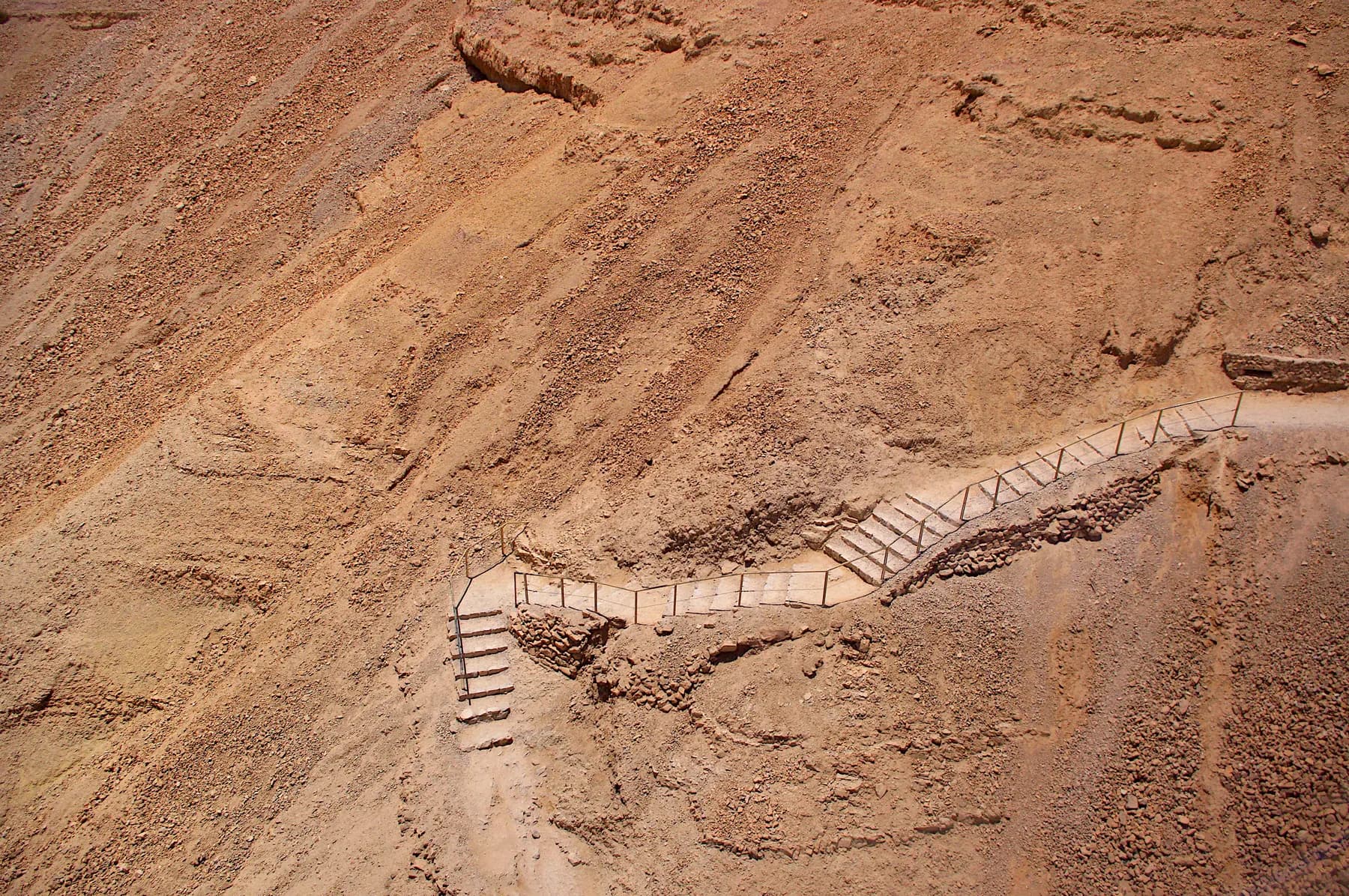
The parks authority measures the climb at 350 metres over about two kilometres and roughly 900 steps, on a line up the east face that Josephus already knew as the serpent.
Jan Helebrant / CC0 · Wikimedia Commons
Height climbed
350 m
booth at the foot to the Snake Path Gate, per the parks authority
Length
about 2 km
with about 900 steps along the way
Time up
about 1 hour
difficulty graded high by the parks authority
Opens
1 hour before sunrise
last ascent as early as 07:00 in extreme summer heat
In short
- How long to give it
- about an hour up, per the parks authority, and about half a day for the climb, the plateau and the way down
- Path opens for ascent
- about one hour before sunrise, daily; sunrise times are not published by the operator
- Adult, park entry, cable car excluded
- ₪37
שביל הנחש
The Snake Path is the walking route up the eastern face of Masada, running from the ticket booth beside the Palm Tree car park on the Dead Sea side to the Snake Path Gate in the wall at the top of the mountain. The Israel Nature and Parks Authority gives it as about two kilometres long, climbing 350 metres, with about 900 steps along the way, and times the ascent at about an hour at a difficulty it grades high. It is the older and harder of the two ways most visitors choose between: the other is the cable car, which starts from the same complex and now finishes at the same gate.
The name is not a modern flourish. Josephus, describing the rock for a Roman readership at the end of the first century, wrote that of the two ways up it, the one coming from the lake towards sunrise 'is called the serpent; as resembling that animal in its narrowness, and its perpetual windings'. What is underfoot today is not that path intact. The parks authority says the climbable route was built on the basis of part of the ancient one, after the first Israeli expedition traced its full course in the 1950s and reconstructed the gate at its head.
Almost everything practical about the path is decided by heat rather than by opening hours. It opens for ascent about an hour before sunrise, and on days of extreme summer heat the last ascent is 07:00 and the last descent 08:00, set against the Israel Meteorological Service forecast rather than a fixed timetable.
The climb
Two kilometres of switchbacks, and about 900 steps
The path starts at the Snake Path cashier's booth beside the Palm Tree car park, in the eastern complex reached from Route 90 along the Dead Sea, and ends at the Snake Path Gate at the entrance to the mountain top. Between those two points the parks authority puts 350 metres of height, about two kilometres of walking and about 900 steps. It grades the difficulty high and gives the ascent as about an hour, which is an hour of continuous climbing rather than a walk: the route doubles back on itself across the east face the whole way, which is where the name comes from.
The surface is not one thing. The parks authority's own accessibility note describes a steep earthen path, much of which is built as steps with handrails fitted the full height. The steps and the railings are twentieth-century engineering laid along an ancient line; the stretches that are simply packed desert soil are the ones that still read as a path rather than as a staircase.
Opening is tied to sunrise and closing is tied to the forecast. The path opens for ascent about an hour before sunrise, and the parks authority tells visitors to look the sunrise time up themselves rather than publishing it. In ordinary hot weather the last ascent is 10:00 and the last descent 11:00; in very hot weather 08:00 and 09:00; in extreme summer heat 07:00 and 08:00. Underneath all of that sits a flat daily rule that catches people out in winter as well: the path closes for ascent two hours before the park closes, and for descent one hour before.
- 350 m of climbing over about 2 km, with about 900 steps
- About an hour to the top, difficulty graded high
- Opens for ascent about an hour before sunrise, every day
- Last ascent 07:00 and last descent 08:00 on days of extreme summer heat
- Closes for ascent two hours, and for descent one hour, before the park closes
Josephus
The path in the text, and the path on the mountain
Josephus gives the rock two ways up: one from the lake towards sunrise, and another on the west, where the ascent is easier. The eastern one, he writes, 'is called the serpent; as resembling that animal in its narrowness, and its perpetual windings'. He has it breaking off at the prominent precipices, returning frequently into itself, and forcing a walker to go first on one leg and then on the other, with nothing but destruction if the feet slip.
His measurement does not fit the path people walk. Josephus has the serpent running thirty furlongs before the top, and in the same passage gives Herod's wall around the summit as seven furlongs, carrying thirty-eight towers. The Encyclopaedia Judaica entry on Masada, written by the archaeologist Guy Stiebel, puts the measured casemate wall at about 1,400 metres, with roughly 70 rooms, 30 towers and four gates. Read the two ancient figures on the same scale, seven furlongs against a measured 1,400 metres, and thirty furlongs comes out at something over five kilometres, against the two the parks authority measures today. Either the ancient route was far longer and looser than the one now signposted, or the figure is the sort of number an ancient writer supplies for effect.
There is a smaller disagreement about which face the path is on. Stiebel places the Snake Path Gate in the north-east, one of the wall's four gates. Britannica describes the winding trail as being on the mesa's north-eastern face. The parks authority says simply the eastern side. On the ground the difference is slight: the path works up the east face and lands at its northern end.
What is original
How much of this is the ancient path
The route was lost and recovered in pieces. Charles Warren and Claude Conder of the Palestine Exploration Fund surveyed Masada and the Roman camps in 1865 and located the Snake Path. In January 1942 Shmarya Guttman led what the parks authority calls the Masada Seminar, in which 46 members of the HaNoar HaOved youth movement surveyed the mountain and found further sections of it.
The full course came out of the first Israeli archaeological expedition, which Guttman brought to the site in the 1950s and which also identified the water supply system and recognised the Northern Palace as Herod's. That expedition unearthed and reconstructed the Snake Path Gate. The year is worth pausing on, because the operator publishes two: the English version of its Snake Path page says 1954, while the Hebrew version of the same page, and its own page on the plateau, both say 1953.
What visitors climb is therefore a reconstruction with an ancient line beneath it, and the parks authority's wording is careful enough to quote as it stands: the part of the Snake Path that visitors can now climb 'was built based on the ancient path'. The steps, the handrails and the graded surface are modern. The switchbacks, the exposure, and the fact that a route exists at all on that face are not.
- 1865: Warren and Conder of the Palestine Exploration Fund locate the path
- January 1942: 46 members of HaNoar HaOved find further sections during Guttman's Masada Seminar
- 1953 or 1954: the first Israeli expedition traces the full route and reconstructs the Snake Path Gate
- Modern: the built steps, the handrails and the graded walking surface
The top
Where the path puts you down
The Snake Path Gate is where both ways up now finish. The cable car that replaced the 1971 system in 1998 climbs from the eastern complex to the same gate, entered across a suspension bridge, so a walker arriving on foot and a passenger arriving after a three-minute ride step onto the plateau at the same point. The older car did not do that: it stopped below the summit and left its passengers a staircase to climb.
Immediately by the gate stands the commander's headquarters, which the parks authority describes as a series of rooms decorated with frescoes, most of them geometric patterns or imitation marble and some with plant designs. It is the first Herodian interior on the route and the easiest to walk straight past, because most people arriving up the path are looking for a bench rather than for wall painting.
From the gate onwards the mountain is a different order of comfort from the face below it. The parks authority lists concrete paths on the plateau, toilets, railings on steps, benches and shaded gathering places, entry to most of the key complexes and lookouts, and models and relief maps made accessible to visually impaired visitors.
Heat
Why the path shuts before the day gets going
The timetable is written around the forecast because of where this is. The World Meteorological Organization records 49.9°C at Sedom, on the same shore, on 17 July 2019, the highest temperature measured anywhere in Israel since June 1942, when Tirat Tzvi reached 54°C. Long before a reading like that becomes a record it becomes a hazard on an open rock face, and that is what moves the last ascent back to 07:00.
The risk is not theoretical. In May 2015 a 20-year-old American student, Briana McHam, died after a fall from the Snake Path during a heatwave in which the Dead Sea region went past 40°C. A Magen David Adom paramedic quoted by The Times of Israel described finding her at the foot of the cliff, unconscious and showing signs of heatstroke, and the report notes that her group did not realise she was missing for over an hour. The same day, on another trail in the region, 56 walkers had to be brought out.
Winter carries the opposite hazard. The parks authority warns that in winter, spring and autumn flooding is a danger, tells visitors to check the Israel Meteorological Service forecast shortly before setting out, and says not to walk in or cross wadi beds when flooding looks likely. The path itself climbs out of that ground quickly; the approach roads and the wadis at the foot of it do not.
Getting down
Walking down, or paying for the cable car
Walking up and riding down is a common plan, and it costs extra. Entry to the national park, cable car excluded, is ₪37 for an adult and ₪21 for a child, with ₪31 for a student or an adult in a group of over 30, ₪18 for a child in a group and ₪19 for an Israeli senior citizen. A one-way cable car ticket, which does not include entry, is listed on the parks authority's Hebrew price table at ₪32 for an adult and ₪16 for a child; the return fare is ₪54 and ₪32. The Yigael Yadin museum in the same complex is a further ₪20 and is entered by reservation only.
The descent has its own cut-off, and it is earlier than most people expect. On days of extreme summer heat the path shuts for descent at 08:00, so a walker who set off at first light has a narrow window in which to come back down the way they went up. Anyone outside it takes the cable car, whose last entry is an hour before the park closes.
The Snake Path is also not the only way up on foot. The Roman ramp path climbs the western flank from Arad on road 3199, takes about half an hour and is graded intermediate, and it is a separate entrance with a long drive between the two sides of the mountain. Two further eastern routes exist and are much less used, the Runner's Path and the Elazar Ascent, and the parks authority closes both at 07:00 on days of extreme heat.
What to look for
Things not to walk past at The Snake Path
The details that repay knowing about before you are standing in front of them.
The Snake Path Gate
The gate in the summit wall that the path was built to reach, unearthed and reconstructed by the first Israeli expedition in the 1950s. Since 1998 the cable car lands here too, across a suspension bridge.
The commander's headquarters
A series of frescoed rooms just inside the gate, decorated mostly with geometric patterns and imitation marble. It is the first Herodian interior anyone climbing the path walks into, and the one most often missed.
The switchbacks themselves
The route returns on itself the whole way up the east face, which is what Josephus was describing when he called it the serpent. The doubling back is the reason a 350 metre climb takes two kilometres.
The marl plain below
East of the mountain the pale marl plain runs to the Dead Sea, scored with rills and gullies left by sediment from the ancient Lisan Sea. The Roman siege works sit on it, and the path looks straight down onto them.
The handrails
The parks authority describes a steep earthen path, much of it built as steps with handrails fitted the full height. Noticing where the built work stops is the quickest way to see what is reconstruction and what is not.
The long view
The Snake Path, in order
1st c. CE
Josephus describes two ways up Masada, and names the eastern one the serpent, running thirty furlongs to the summit through perpetual windings.
1865
Charles Warren and Claude Conder of the Palestine Exploration Fund survey Masada and the Roman camps and locate the Snake Path.
January 1942
Shmarya Guttman leads the Masada Seminar. Forty-six members of the HaNoar HaOved youth movement survey the mountain and find further sections of the path.
1953 or 1954
The first Israeli archaeological expedition, brought to Masada by Guttman, discovers the full route of the Snake Path and unearths and reconstructs the Snake Path Gate. The parks authority dates this to 1953 on two of its pages and to 1954 on a third.
1971
The first cable car is built. It carries a small number of visitors to a point below the summit, from which they climb a staircase, so the Snake Path Gate stays the walkers' entrance.
1998
The cable car is replaced to handle larger numbers. The upper station loses its steps and entry is across a suspension bridge at the Snake Path Gate, so both routes now arrive at the same place.
May 2015
An American student dies after a fall from the path during a heatwave in which the Dead Sea region passed 40°C.
Practical
Visiting The Snake Path
Where
Snake Path cashier's booth, Palm Tree car park, eastern entrance to Masada National Park, off Route 90
What ticket you need
The Snake Path is inside Masada National Park and is not separately ticketed: it is covered by the park entrance fee, bought at the Snake Path cashier's booth at the foot on the eastern side. The cable car is charged on top of that, and the museum is charged and reserved separately again.
Opening hours
- Path opens for ascent
- about one hour before sunrise, daily; sunrise times are not published by the operatorsource
- Daily closing rule
- closes for ascent two hours before the park closes, and for descent one hour beforesource
- Normal hot weather
- last ascent 10:00, last descent 11:00source
- Very hot weather
- last ascent 08:00, last descent 09:00source
- Extreme summer heat
- last ascent 07:00, last descent 08:00source
- Park, summer, Sunday to Thursday and Saturday
- 08:00 to 17:00source
- Park, summer, Friday and holiday eves
- 08:00 to 16:00source
- Park, winter, Sunday to Thursday and Saturday
- 08:00 to 16:00source
- Park, winter, Friday and holiday eves
- 08:00 to 15:00source
Admission
- Adult, park entry, cable car excluded
- ₪37source
- Child
- ₪21source
- Student
- ₪31source
- Adult in a group of over 30
- ₪31source
- Child in a group of over 30
- ₪18source
- Israeli senior citizen
- ₪19source
- Cable car, one way, entry not included
- ₪32 adult, ₪16 childsource
- Cable car, return, entry not included
- ₪54 adult, ₪32 childsource
- Yigael Yadin museum, at the foot of the path
- ₪20, by reservation onlysource
Access
Not accessible. The parks authority describes the Snake Path as a steep earthen path, much of it built as steps with handrails fitted the full height, and it is graded high difficulty. There is no wheelchair route and no step-free line up the east face. Visitors who cannot manage the climb take the cable car, which is wheelchair accessible and reaches the same gate across a suspension bridge with no steps at the upper station; from there the plateau has concrete paths, railings, benches, shaded gathering places, accessible toilets and models and relief maps adapted for visually impaired visitors. The parks authority runs a coordination form for accessible visits.
On site
- Cashier's booth at the foot of the path
- Palm Tree car park
- Covered parking at the eastern complex
- Visitor centre, museum and shops
- Handrails on the built steps
- Cable car for the return leg
- Toilets and shaded gathering places on the plateau
Booking
The parks authority runs an online reservation system for the national park and asks visitors to book a time slot. If the slot is full when you arrive you will be asked to show the reservation confirmation to get in. It also recommends reaching the Snake Path about 30 minutes before it opens in order to buy tickets and start climbing in time, a recommendation its English page attributes to the heat and its Hebrew page to the crowd that gathers for sunrise.
Hours and prices are given as the operator publishes them and change without much notice, particularly around Shabbat and the festivals. Check the operator's own page before you travel for this.
Official page at en.parks.org.il →What people wish they had known
- Work backwards from sunrise, not from the park's opening time. The path opens about an hour before sunrise, the parks authority does not publish the sunrise time, and it recommends arriving about 30 minutes before the path opens to buy a ticket and start in time.
- Check the forecast the evening before, because the closing times move with it. Ordinary hot weather puts the last ascent at 10:00, very hot weather at 08:00 and extreme summer heat at 07:00.
- Do not assume you can walk back down. The path shuts for descent an hour before the park closes, and as early as 08:00 in extreme heat, which is why a one-way cable car ticket is worth carrying.
- The Snake Path and the Roman ramp path are on opposite sides of the mountain, with a long drive between the two entrances. Pick the side before you set out: the ramp path is reached from Arad on road 3199, not from Route 90.
- In winter, spring and autumn the hazard is water rather than heat. The parks authority tells visitors to check the Israel Meteorological Service forecast before travelling and not to walk in or cross wadi beds when flooding looks likely.
- Book a time slot online. If the site is at capacity you will be asked to produce the reservation confirmation at the entrance.
The figures
The Snake Path by the numbers
Each figure carries the year it belongs to and links the source it came from.
| Measure | Figure | As of | Source |
|---|---|---|---|
| Height climbed | 350 m | 2026 | en.parks.org.il |
| Length of the path | about 2 km | 2026 | en.parks.org.il |
| Steps | about 900 | 2026 | en.parks.org.il |
| Time to the top | about 1 hour, difficulty graded high | 2026 | en.parks.org.il |
| Last ascent and descent in extreme summer heat | 07:00 and 08:00 | 2026 | en.parks.org.il |
| Park entry, cable car excluded | ₪37 adult, ₪21 child | 2026 | en.parks.org.il |
| One-way cable car for the descent, entry not included | ₪32 adult, ₪16 child | 2026 | parks.org.il |
| Casemate wall at the top of the path | about 1,400 m, with roughly 70 rooms, 30 towers and four gates, the Snake Path Gate in the north-east | Encyclopaedia Judaica, Guy Stiebel | encyclopedia.com |
While you are here
The rest of Masada
Everything else in this destination with a page of its own.
Godot13 / CC BY-SA 4.0 · Wikimedia Commons
Activity
The Masada Cable Car
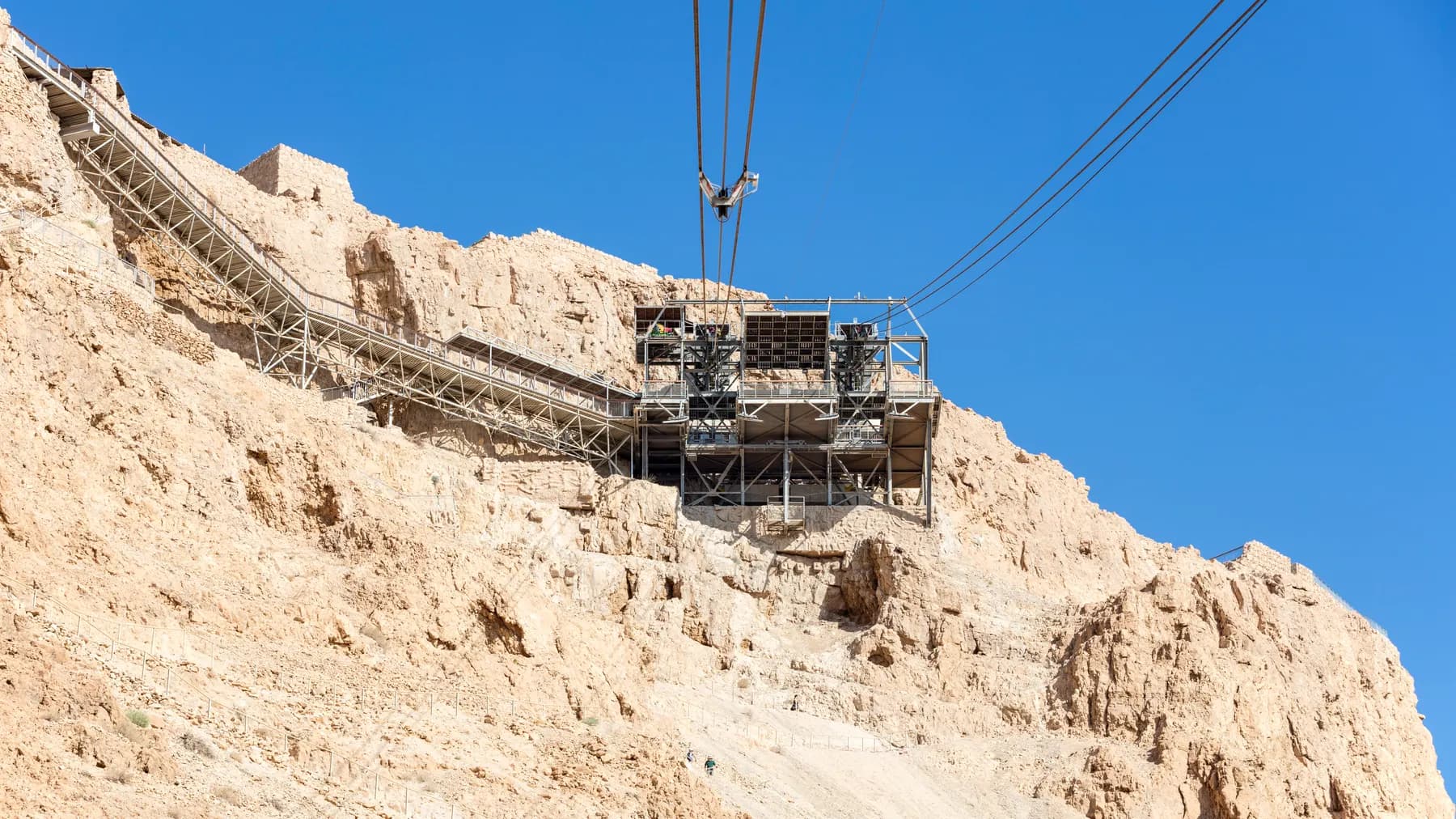
Its lower station stands 257 metres below sea level and its upper station 33 metres above, which is why ropeway databases file it as the lowest aerial tramway in the world.
Jan Helebrant / CC0 · Wikimedia Commons
Archaeological site
The Roman Assault Ramp
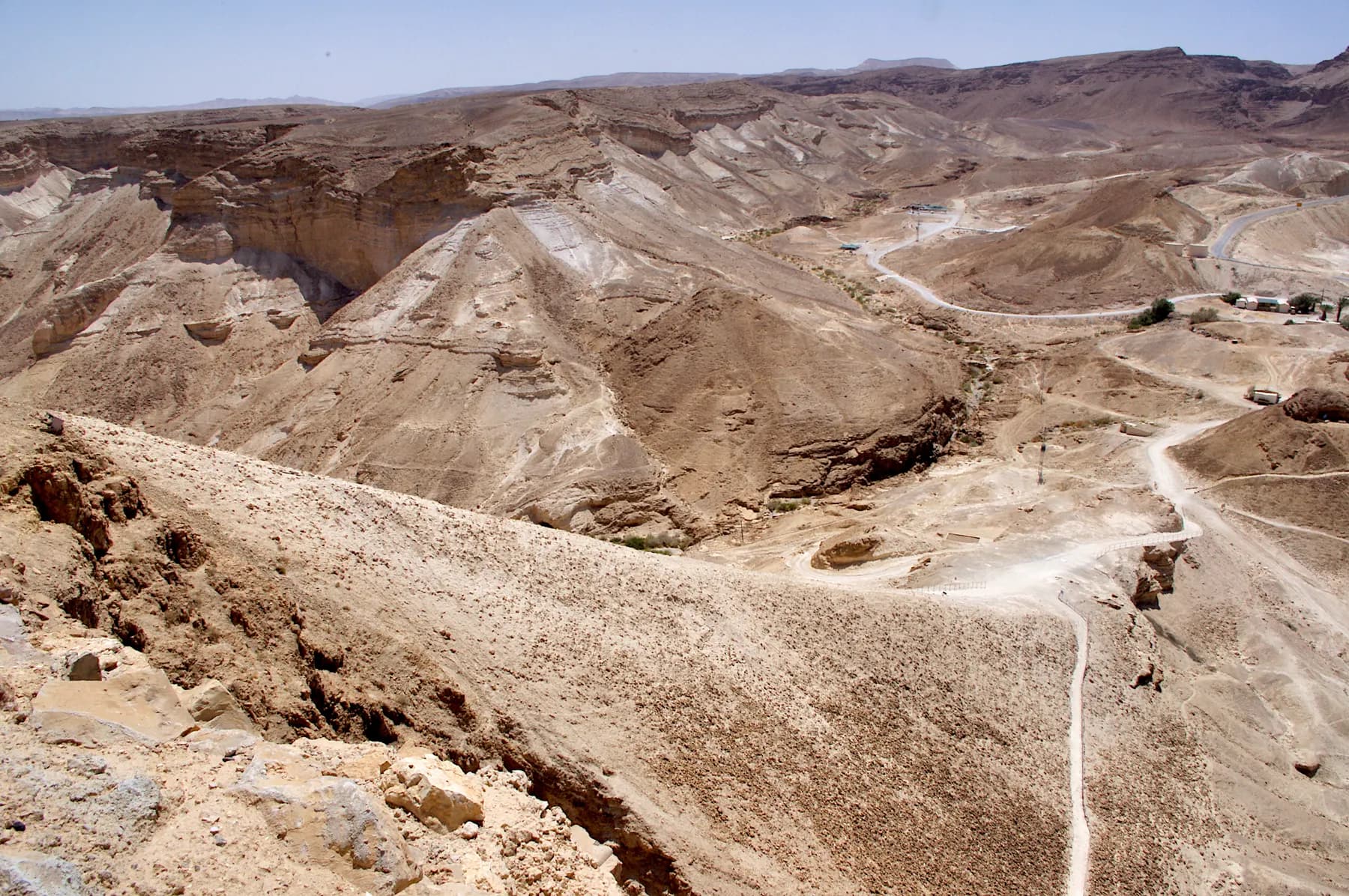
The bank the Tenth Legion raised against Masada's western cliff in the siege of 73 or 74 CE, whose foot the parks authority puts only about 60 metres below the summit, and which now carries the shortest footpath to the top.
Armineaghayan / CC BY-SA 4.0 · Wikimedia Commons
Museum
The Masada Museum in Memory of Yigael Yadin
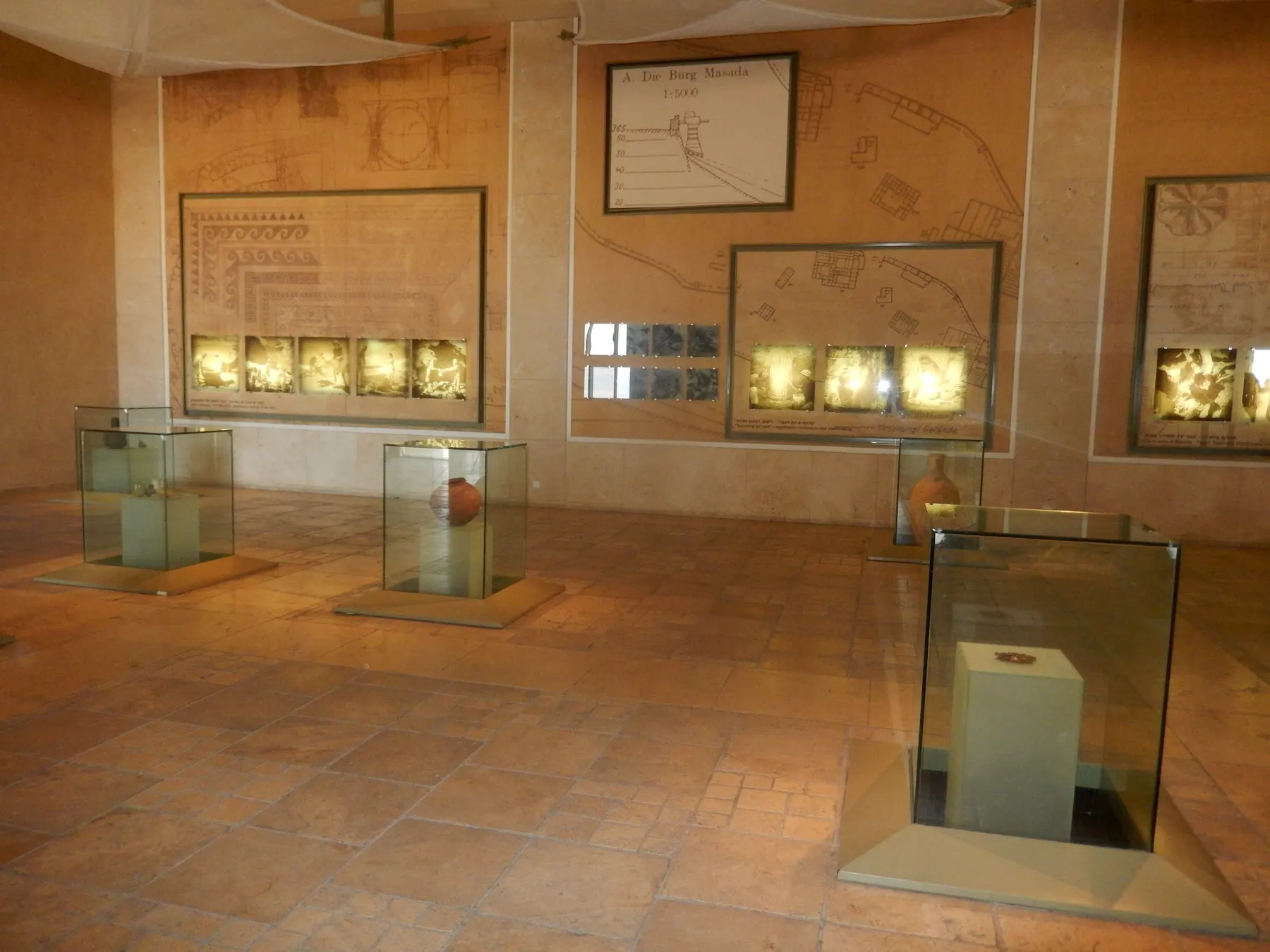
Nine rooms at the foot of the mountain, painted from dark grey to black so that the objects Yigael Yadin's expedition dug out of Masada between 1963 and 1965 are the only lit things in them.
Sources and further reading
Every link below was opened and checked when this page was written. Official statements are marked as such: they are the subject's own account, not an independent one.
- OfficialIsrael Nature and Parks Authorityen.parks.org.ilThe Snake Path at Masada National Park
The path climbs 350 m, runs about 2 km and has about 900 steps; ascent about an hour and difficult; opens one hour before sunrise and closes one hour before the site closes; the 1942 Masada Seminar with 46 members of HaNoar HaOved; the first expedition dated here to 1954, discovering the full route and unearthing and reconstructing the Snake Path Gate; the path built on the basis of the ancient path; the Palm Tree car park and cashier's booth as the lower end; extreme-heat closures at 07:00 and 08:00 and the Runner's Path and Elazar Ascent closing at 07:00
- OfficialIsrael Nature and Parks Authorityen.parks.org.ilMasada National Park
Summer and winter opening hours, entry closing an hour before the stated time, the full heat schedule for the Snake Path and the Roman ramp trail, the daily rule closing the path for ascent two hours and for descent one hour before the park closes, the recommendation to arrive 30 minutes early, the entrance fees of ₪37 adult and ₪21 child with student, group and senior rates and the ₪20 museum, accessibility at the eastern entrance and on the plateau, the flood warning, and the reservation system
- OfficialIsrael Nature and Parks Authority (Hebrew)parks.org.ilשביל הנחש בגן לאומי מצדה
The Hebrew version of the same page, giving the same 350 m, 2 km and about 900 steps but dating Guttman's first archaeological expedition to 1953 rather than 1954, and describing the path as an ancient one used by those who came to the fortress
- OfficialIsrael Nature and Parks Authority (Hebrew)parks.org.ilגן לאומי מצדה, price table
The fee tables that the English page does not carry: one-way cable car at ₪32 adult and ₪16 child and return at ₪54 and ₪32, both excluding entry, alongside the entrance fees; and the Hebrew wording attributing the advice to arrive half an hour early to the sunrise crowd rather than to the heat
- OfficialIsrael Nature and Parks Authorityen.parks.org.ilMasada National Park – The Plateau
The commander's headquarters by the Snake Path Gate and its frescoes; Warren and Conder of the Palestine Exploration Fund locating the Snake Path in 1865; Schulten's misreading of the Northern Palace as a fortification at the upper end of the path; and the first Israeli excavation dated to 1953, discovering the full route of the path
- OfficialIsrael Nature and Parks Authorityen.parks.org.ilThe Masada Cable Car
The present cable car ascends to the Snake Path Gate and is entered across a suspension bridge with no steps at the upper station; the 1971 car stopped below the summit and left a staircase; replaced in 1998 and its electronics upgraded in 2020; about three minutes each way; entry allowed up to one hour before closing; wheelchair accessible; charged on top of the entrance fee
- ReportingThe Times of Israeltimesofisrael.comAmerican tourist, 20, plunges to death at Masada
The May 2015 death of Briana McHam, a 20-year-old student from Florida, after a fall from the Snake Path in a heatwave with the Dead Sea region above 40°C; the Magen David Adom paramedic's account of finding her unconscious with signs of heatstroke; the hour that passed before her group noticed; and 56 walkers extricated from another trail in the region the same day
- DataWorld Meteorological Organizationwmo.intRecord-breaking temperatures in Israel, July 2019
49.9°C recorded at Sedom, on the same stretch of the Dead Sea shore, on 17 July 2019, the highest temperature in Israel since June 1942, when 54°C was measured at Tirat Tzvi
- ReferencePenelope, University of Chicagopenelope.uchicago.eduThe Wars of the Jews, Book VII (Whiston translation)
Two ways up the rock, one from the lake towards sunrise and one on the west where the ascent is easier; the eastern one 'called the serpent; as resembling that animal in its narrowness, and its perpetual windings'; walking it one leg at a time with nothing but destruction if the feet slip; thirty furlongs before the top; and Herod's wall of seven furlongs carrying thirty-eight towers
- ReferenceEncyclopaedia Judaica, entry by Guy Stiebel (via Encyclopedia.com)encyclopedia.comMasada
The snake path mentioned by Josephus on the east; the casemate wall measured at about 1,400 m with about 70 rooms, 30 towers and four gates; the Snake Path Gate placed in the north-east alongside the western, southern and northern gates
- ReferenceEncyclopaedia Britannicabritannica.comMasada
The winding trail called the Snake Path described as being on the mesa's north-eastern face and revealed during excavations; the mountain given as 434 m above the level of the Dead Sea; footpath ascents contrasted with the cable car as the less rigorous access route
The Snake Path: common questions
How long does the Snake Path take?+
The parks authority gives the ascent as about an hour and grades the difficulty high. That is an hour of steady climbing over about two kilometres and 350 metres of height, with roughly 900 steps. Coming down is quicker, but it is governed by its own cut-off: the path closes for descent an hour before the park closes, and by 08:00 on days of extreme summer heat.
How many steps are there on the Snake Path?+
About 900, on the parks authority's own count, spread along roughly two kilometres of path. They are not continuous. The operator describes a steep earthen path much of which is built as steps with handrails fitted the full height, so long stretches are graded soil rather than stairs.
What time does the Snake Path open?+
About one hour before sunrise, every day, which means the opening time moves through the year. The parks authority does not publish sunrise times and expects visitors to look them up. It also recommends arriving about 30 minutes before the path opens, to buy a ticket and get going in time.
Is the Snake Path worth it, or should I just take the cable car?+
Both routes now end at the same place, the Snake Path Gate, so the difference is the hour on the face and not the destination. The cable car takes about three minutes, is wheelchair accessible, and costs extra on top of the entrance fee. The path is free of any charge beyond entry, and it is the only way to arrive on foot at sunrise, since the cable car does not run before the park opens at 08:00.
Can I walk up and take the cable car down?+
Yes, and it is a common plan. A one-way cable car ticket is listed on the parks authority's Hebrew price table at ₪32 for an adult and ₪16 for a child, and it does not include the park entrance fee of ₪37 and ₪21. Entry to the cable car is allowed up to one hour before the park's closing time.
Is there shade or drinking water on the path?+
The parks authority lists neither. Its accessibility notes cover shaded gathering places, benches and toilets on the plateau and the facilities at the eastern complex at the foot, and describe the path itself only as a steep earthen path of built steps with handrails. Treat the two kilometres in between as unserviced and carry what you need for it.
Is the Snake Path the original ancient route?+
Partly. Josephus describes an eastern path he calls the serpent, and Warren and Conder located a route in 1865, but the parks authority is careful to say that the part visitors climb today 'was built based on the ancient path'. The steps, the handrails and the graded surface are modern work. Josephus also puts his serpent at thirty furlongs, which is several times the length of the modern path, so the two are not simply the same line.
Can the Snake Path be done with a wheelchair or a pushchair?+
No. It is a steep earthen path with hundreds of built steps and a high difficulty grade, and the parks authority lists no accessible route on the east face. The cable car is the accessible way up: it is wheelchair accessible, the upper station has no steps, and entry to the plateau is across a suspension bridge. On the plateau itself there are concrete paths, railings, accessible toilets and adapted models.
Are there other paths up Masada?+
Three others are published. The Roman ramp path climbs the western flank from Arad on road 3199, takes about half an hour and is graded intermediate. Two more eastern routes, the Runner's Path and the Elazar Ascent, get much less traffic; on days of extreme heat the parks authority closes both at 07:00, earlier than it closes the ramp path.
How dangerous is it?+
The serious risk is heat rather than the drop, which is why the closing schedule is tied to the Israel Meteorological Service forecast. In May 2015 an American student died after a fall from the path during a heatwave in which the region went past 40°C, and The Times of Israel reported that her group did not notice she was missing for over an hour. In winter, spring and autumn the parks authority warns instead about flash flooding in the wadis at the foot of the mountain.