Market · Jaffa
Jaffa Flea Market
The market was pushed onto these streets in the late nineteenth century, when the Ottoman government cleared the ground where the clock tower now stands for its own administrative compound.
Rakoon / CC0 · Wikimedia Commons
Trading as a flea market
70+ years
the Tel Aviv-Yafo tourism service's own description of the market, 2026
Stall hours
09:00–17:00
Sunday to Thursday, per the market's English information site
Entry
Free
public streets with no gate and no ticket
Rebuilt
2001
the year the municipality and the tourism ministry began the restoration project
In short
- How long to give it
- about 90 minutes for the stalls, or two to three hours with lunch
- Stalls and shops, Sunday to Thursday
- 09:00–17:00
- Entry
- Free. The market trades on public streets: there is no gate, no ticket office and no admission charge published by the municipality or by the market's own information site.
שוק הפשפשים
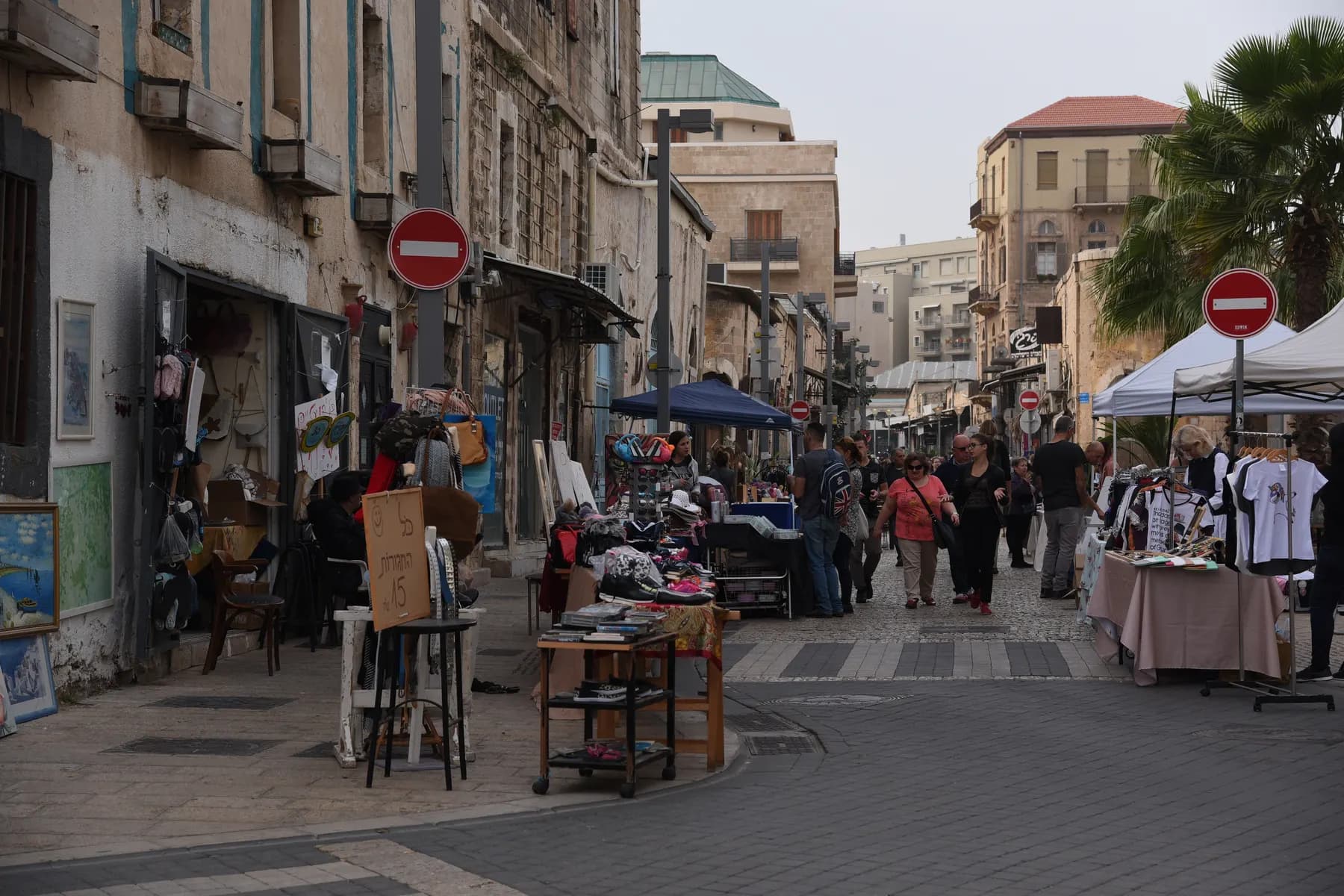
The Jaffa flea market is a working street market of four blocks southeast of the clock tower, where second-hand furniture, household goods from earlier decades, rugs, records, jewellery and used clothing are sold from stalls and lock-up shops. Its Hebrew name, Shuk HaPishpeshim, translates literally as the market of the fleas. The lanes around and through it now carry the densest concentration of bars and restaurants anywhere in Jaffa, and the two trades keep different hours in the same few metres of street.
It is not an ancient market on an ancient site, and the municipality does not claim it is. The Tel Aviv-Yafo tourism service describes it as the descendant of an older marketplace that the Ottoman government dispossessed in the late nineteenth century, clearing the ground around the clock tower for its civil administration compound and pushing the traders onto part of the site they still occupy. The same service says the market has operated as a flea market for more than seventy years, and that it later took in the adjoining Greek Market.
What a visitor walks into is a rebuilt market. In 2001 the municipality and the Ministry of Tourism began a preservation and revitalisation project here, and the result was neater lanes, a covered exhibition space, and room for galleries, studios, cafes and bars alongside the junk. Whether that was a rescue or a slow eviction is an argument the traders and the residents have been having in public since at least 2012, and this page sets out both halves of it.
Ground
Four streets, and three different markets inside them
The market sits in the block bounded by Yehuda Margoza, Olei Zion, Amiad and Beit Eshel streets, a short walk southeast and downhill from the clock tower on Yefet Street. That is the whole of it. Anyone expecting the scale of a Jerusalem or Istanbul bazaar will find something much smaller and much more mixed up, with second-hand stock, restaurant tables and residential doorways sharing the same pavement.
The Hebrew reference account divides the compound into three parts, and the division is worth carrying because it explains why the market changes character from one lane to the next. There is a building with two pedestrian lanes cut through it; an open lot known as the Amiad market, ringed by municipal warehouses and wholesalers' storage; and the Olei Zion pedestrian mall, where shops, restaurants and cafes share a surface that vehicles still use in places.
The market's own English information site puts the densest run of stalls along Olei Zion Street and the lanes off it. The street frontages have gone to design shops, jewellery studios and galleries, and the side lanes closed to traffic have gone to bars. None of this is signposted, so the practical approach is to walk the covered building first, then Olei Zion, then decide whether the rest is shopping or lunch.
- Streets: Yehuda Margoza, Olei Zion, Amiad, Beit Eshel
- The covered building, with two pedestrian lanes through it
- The open Amiad lot, ringed by storage
- The Olei Zion pedestrian mall, shops and restaurants
- The Greek Market, absorbed from the east
Late Ottoman
The market the government moved, and the building that moved it
Jaffa's fortifications were dismantled during the 1870s, and the city spread east and north onto ground the walls had held it off. The new commercial quarter grew on that ground, and the Ottoman authorities put their own buildings in the middle of it: a government house, a prison, and a wide plaza outside the old town.
The clock tower went up in the same plaza. Construction began in September 1900 and finished in 1903, paid for by subscription from Jaffa's Arab, Armenian, Maronite and Jewish communities and raised for the silver jubilee of Sultan Abdülhamid II. The market that had been trading on that ground was moved off it. The municipal tourism service is direct about the mechanism: the traders were dispossessed to make way for the civil administration compound, and the flea market is the descendant of what was moved.
The Greek Market immediately east has a separate origin. Time Out's Tel Aviv guide says it was built by the Greek Orthodox monastery of Jaffa in the late nineteenth century, on ground just east of the clock square, and gives its address as 1 Pinkhas Ben Ya'ir Street. The flea market expanded into it later, which is why the two are now usually described as one place.
The building that displaced the market did not outlast it. The New Saraya, the Ottoman government house on that square, was destroyed by a Lehi truck bomb on 4 January 1948; the English Wikipedia article on Jaffa puts the dead at 26, mostly civilians, including children at a food distribution. The market two streets away kept trading, and the Hebrew reference account dates its consolidation into roughly its present form to the British Mandate period.
2001
What is genuinely old here, and what was put back
Almost nothing a visitor touches in the flea market is older than the late Ottoman and Mandate-era commercial buildings around it, and a good deal of the surface is much newer than that. The restoration was begun in 2001 by Tel Aviv-Yafo municipality together with the Ministry of Tourism, designed by the practice the Hebrew reference account names as Kislov Kay Architects, and it is the reason the market looks the way it does.
The project created the Amiad Centre for exhibitions, fairs and shows, laid out a shaded square for the traders, renovated the surrounding streets, and made room for galleries, artists' studios, restaurants and cafes. It is a considerable piece of work and it is not disguised: the paving, the shading and the lighting all read as recent, and the traders' pitches sit inside a designed frame rather than a grown one.
The one genuinely ancient thing on open view is not a market building at all. Under the lobby of the Market House hotel on Beit Eshel Street, sections of glass floor show the remains of a Byzantine chapel found when the site was developed. The Globe and Mail described the arrangement in December 2015; the hotel's own material dates the remains to the eighth century. The lobby is a hotel lobby, so this is a matter of walking in and looking down rather than of buying a ticket.
Beyond that, the age claims a visitor hears here attach to the goods rather than the fabric. Treat a stallholder's dating of a chair or a tile as a sales position, not a provenance, and treat the market itself as what the municipality says it is: a nineteenth-century displacement that became a flea market in the twentieth and was rebuilt in the twenty-first.
Change
Antiques by day, bars by night, and the quarrel between them
The restoration filled the market, and the argument about what filled it started almost at once. In March 2012 Haaretz's Roy Arad reported traders describing the change as a yuppie occupation of Jaffa: the market was neater, the cafes and bars were doing well, sales at the antique shops had fallen, and the streets he described were empty in the afternoon.
Five months later the same paper printed the other half of the quarrel. Odeya Ganor's article of 21 August 2012 described residents who had organised against businesses trading until four in the morning in a mixed commercial and residential zone where the rules require them to close at one. The municipality held mediation meetings, reported no change a month and a half later, and said it was drafting a new policy. Bar owners interviewed for the piece said enforcement had tightened and that they were being ticketed at least once a week.
The structural cause of that dispute is still printed in the market's own hours. The stalls shut at 17:00 from Sunday to Thursday and at 14:00 on Friday; the eating and drinking that replaced them runs late into the night and through Saturday, when most of the stallholders are closed. Two economies, one set of streets, and the second one is louder.
The municipality has leaned into the evening use rather than away from it. Its tourism service says the flea market's Thursday-night events in July and August, with music, street theatre and special illumination, have become part of Jaffa's calendar, and that some of the side streets in the market compound have been closed to vehicles to serve as venues for pubs and restaurants. It also says plans call for turning further streets in the Greek Market over to restaurants and lifestyle businesses.
Trade
How the buying actually works
Two economies share the pavement and they are priced in completely different ways. On the second-hand stalls, prices are unmarked and haggling is expected: the municipal guide describes a hodge-podge of new and second-hand merchandise where antiques and knick-knacks can sometimes be had for very little. In the studios and labels that took the street frontages, prices are fixed retail and an offer is an embarrassment.
Time Out's guide to the market lists both inside the same few streets: the jewellers Ruby Star and the Mirit Weinstock studio, the fashion studio Common Raven and the clothing house Maskit, alongside stalls it describes bluntly as ranging from poor-quality bric-a-brac to genuine vintage treasures and antique furniture. Both descriptions are accurate on the same morning, sometimes on the same lane.
The Greek Market keeps its own rhythm. Time Out gives its hours as Tuesday to Friday, 10.00 to 17.00, and says artisans and artists fill the compound every Friday with crafts, flowers, antiques and vintage keepsakes. That Friday session, rather than the antiques trade, is what most visitors mean when they say the market was busy.
Days matter more than hours. Friday morning is the fullest trading session of the week and it is finished by early afternoon. Saturday, most stallholders are shut and the restaurants are not, which makes a Saturday visit a meal in a closed market rather than a shopping trip.
- Second-hand and refurbished furniture
- Household goods and kitchenware from earlier decades
- Used clothing, rugs, vinyl and costume jewellery
- Design studios, galleries and contemporary jewellery at fixed prices
- Crafts, flowers and vintage keepsakes at the Greek Market on Fridays
What to look for
Things not to walk past at Jaffa Flea Market
The details that repay knowing about before you are standing in front of them.
The covered market building
Two pedestrian lanes cut through a single structure, and the densest surviving run of second-hand stalls in the compound. It is the part of the market that still looks like the name.
Amiad Square and the Amiad Centre
The open lot ringed by municipal and wholesalers' storage, reworked in the 2001 project into a shaded trading square with a centre for exhibitions, fairs and shows.
Olei Zion Street
The pedestrian spine of the market, with stalls in the morning and restaurant tables at night. The public toilets are at number 14, which is worth knowing before you need them.
The Greek Market
Built by Jaffa's Greek Orthodox monastery in the late nineteenth century just east of the clock square, at 1 Pinkhas Ben Ya'ir Street. Time Out gives its hours as Tuesday to Friday, and Friday is its artisans' day.
The chapel under the Market House lobby
On Beit Eshel Street, sections of glass floor in a hotel lobby show the remains of a Byzantine chapel uncovered when the site was developed. It is the oldest thing on public view in the market and costs nothing to look at.
The long view
Jaffa Flea Market, in order
1870s
Jaffa's fortifications are dismantled and the city expands east onto open ground, where a new commercial quarter grows.
Late 19th century
The Ottoman government dispossesses the existing marketplace from the ground around the clock square to build its civil administration compound; the traders are moved southeast onto part of the present site. In the same period the Greek Orthodox monastery of Jaffa builds the Greek Market just to the east.
September 1900 to 1903
The clock tower is built in the plaza, funded by subscription from Jaffa's Arab, Armenian, Maronite and Jewish communities for the silver jubilee of Sultan Abdülhamid II.
1920–1948
Under the British Mandate the market consolidates into roughly the form it has today, on the streets it still occupies.
4 January 1948
A Lehi truck bomb destroys the New Saraya, the Ottoman government house on the square whose construction had displaced the market. The English Wikipedia article on Jaffa puts the dead at 26, mostly civilians.
2001
Tel Aviv-Yafo municipality and the Ministry of Tourism begin a preservation and revitalisation project, designed by Kislov Kay Architects: the Amiad Centre, a shaded traders' square, renovated streets, and space for galleries, studios, restaurants and cafes.
2012
Haaretz reports both sides of the change within five months: antique dealers describing a yuppie occupation and falling sales in March, and residents organising against bars trading until four in the morning in August.
18 August 2023
The Tel Aviv light rail's Red Line opens, running through Jaffa along Jerusalem Boulevard. It does not operate on Shabbat.
Practical
Visiting Jaffa Flea Market
Where
Between Yehuda Margoza, Olei Zion, Amiad and Beit Eshel streets, Jaffa, Tel Aviv-Yafo
Opening hours
- Stalls and shops, Sunday to Thursday
- 09:00–17:00source
- Stalls and shops, Friday
- 09:00–14:00source
- Saturday
- Closed for the stalls; the bars, cafes and restaurants tradesource
- The Greek Market
- Tuesday to Friday, 10.00 to 17.00, with an artisans' and makers' session on Fridaysource
- Summer Thursday nights
- Market events with music, street theatre and special illumination, in July and Augustsource
Admission
- Entry
- Free. The market trades on public streets: there is no gate, no ticket office and no admission charge published by the municipality or by the market's own information site.source
Access
The market lanes are close to level and largely pedestrianised, so this is not the climb that Old Jaffa on the headland above is. The surfaces are hard paving and the passages are narrowed by stock, tables and parked delivery vehicles, so a wheelchair or a pushchair will get through some lanes easily and be blocked in others, particularly on a Friday morning. Neither the municipal tourism service nor the market's own information page publishes an accessibility statement, so individual shops and restaurants are worth asking about in advance.
On site
- Public toilets at Olei Zion 14
- Metered street parking on blue and white bays, up to three hours
- Cafes, bars and restaurants throughout the compound
- Dan bus line 41 from Tel Aviv's central bus station
- Hotels on Beit Eshel Street at the market's edge
Booking
Nothing in the market itself is booked. The restaurants that have taken over the surrounding lanes are the exception on Thursday and Friday evenings, which is when the compound is fullest.
Hours and prices are given as the operator publishes them and change without much notice, particularly around Shabbat and the festivals. Check the operator's own page before you travel for this.
Official page at visit-tel-aviv.com →What people wish they had known
- Arriving mid-afternoon is the commonest mistake. The stalls start packing up well before 17:00 from Sunday to Thursday, and from 14:00 on Friday, so an afternoon arrival buys the bar crowd rather than the market.
- A Saturday visit is a meal, not a shopping trip. Most stallholders are closed and the restaurants are not, which is a fine afternoon and a poor one for buying anything second-hand.
- Haggle on the stalls and not in the studios. Unmarked prices on second-hand goods are an invitation; the jewellery studios and design labels on the street frontages price as ordinary retail and do not negotiate.
- Treat it as three markets rather than one. The covered building, the open Amiad lot and the Olei Zion mall carry different stock at different prices, and walking only the restaurant lanes misses most of the trade.
- The Greek Market next door keeps different hours: Tuesday to Friday on Time Out's listing, with the artisans' session on Friday. It is easy to walk past the alley into it without noticing.
- Street parking is metered blue and white bays capped at three hours, and parts of the compound are closed to vehicles. Coming by light rail along Jerusalem Boulevard avoids the problem entirely, except on Shabbat, when the line does not run.
The figures
Jaffa Flea Market by the numbers
Each figure carries the year it belongs to and links the source it came from.
| Measure | Figure | As of | Source |
|---|---|---|---|
| Operating as a flea market | more than 70 years | 2026 | visit-tel-aviv.com |
| Stall hours, Sunday to Thursday | 09:00–17:00 | 2026 | en.shuktlv.co.il |
| Stall hours, Friday | 09:00–14:00 | 2026 | en.shuktlv.co.il |
| Restoration project begun | 2001 | 2001 | he.wikipedia.org |
| Clock tower built on the displaced market's ground | September 1900 to 1903 | 1903 | en.wikipedia.org |
| New Saraya destroyed | 4 January 1948 | 1948 | en.wikipedia.org |
| Permitted closing time for bars in the mixed zone | 01:00 | 2012 | haaretz.com |
| Light rail Red Line opened | 18 August 2023 | 2023 | jta.org |
While you are here
The rest of Jaffa
Everything else in this destination with a page of its own.
Sasha1506 / CC BY-SA 4.0 · Wikimedia Commons
Landmark
Jaffa Clock Tower
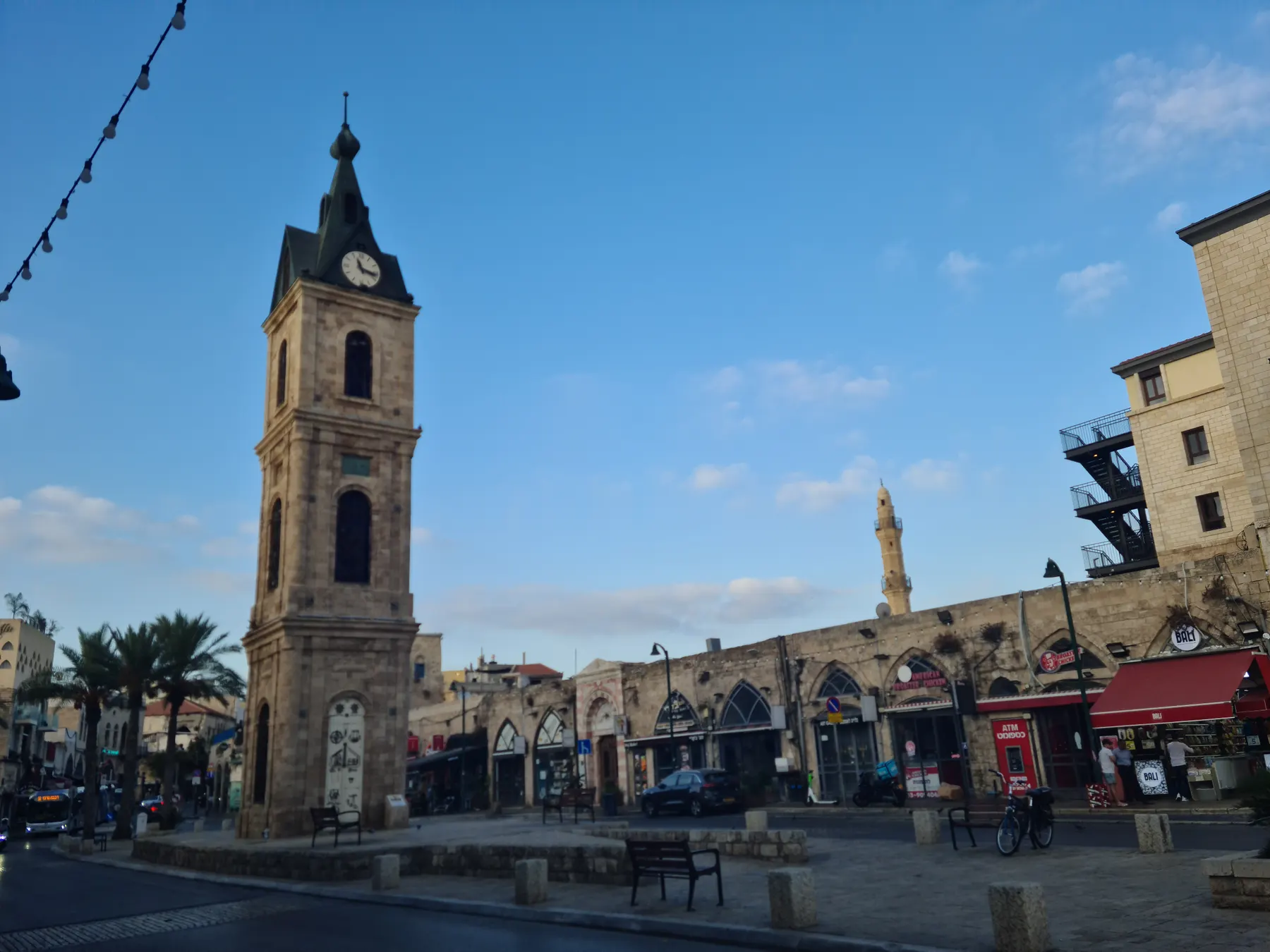
Built for the silver jubilee of Sultan Abdul Hamid II with money raised from Jaffa's Muslim, Jewish, Christian and Armenian residents, it was the first public clock in a town where until then only churches and mosques rang the hours.
Fallaner / CC BY-SA 4.0 · Wikimedia Commons
Landmark
Kedumim Square
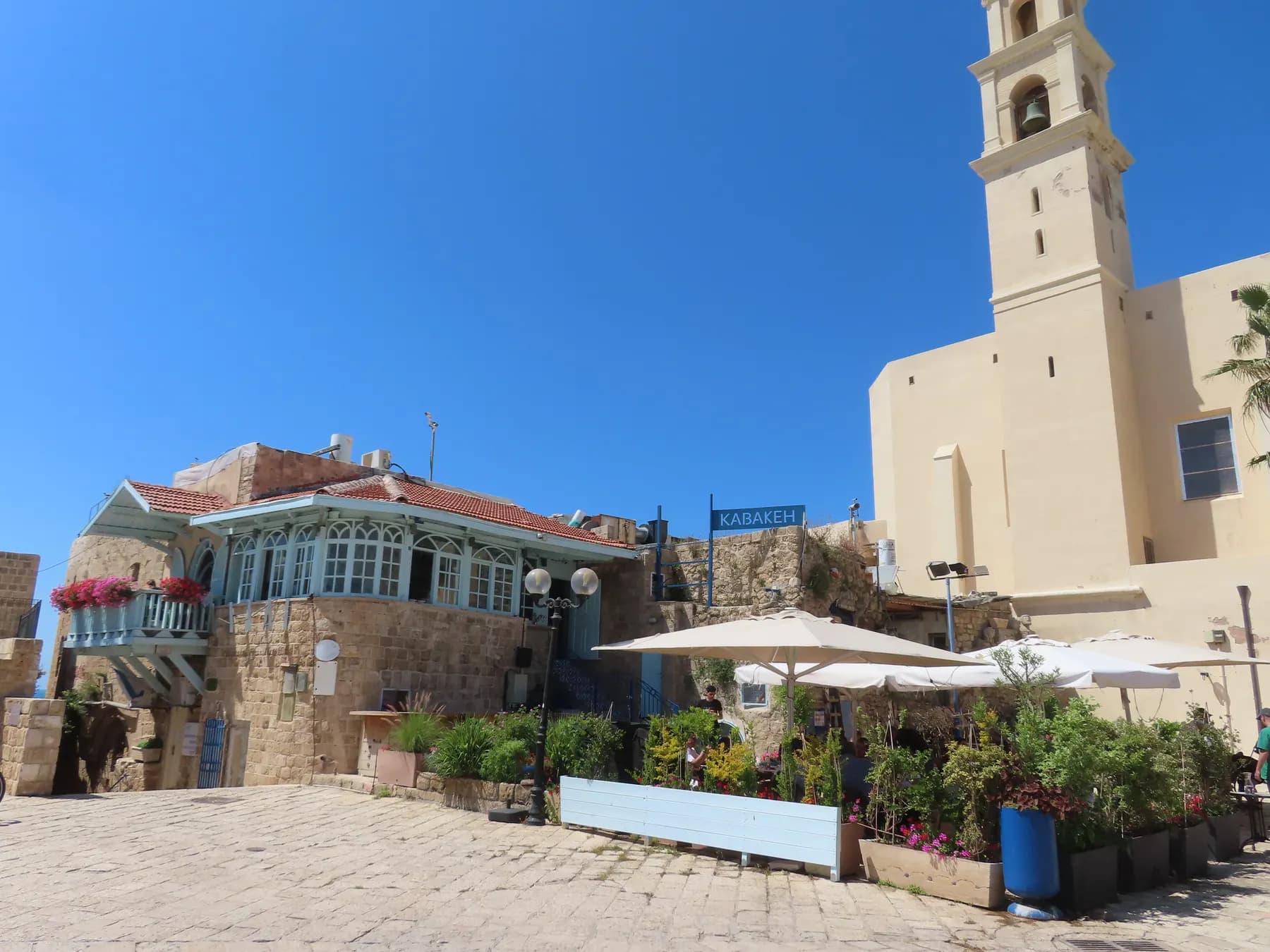
The flagged main square of Old Jaffa is a space the British made by demolition in June 1936, and the Israel Antiquities Authority excavation under its fountain found the drains of one of the houses that came down.
שלמה רודד / CC BY 2.5 · Wikimedia Commons
Landmark
Jaffa Port
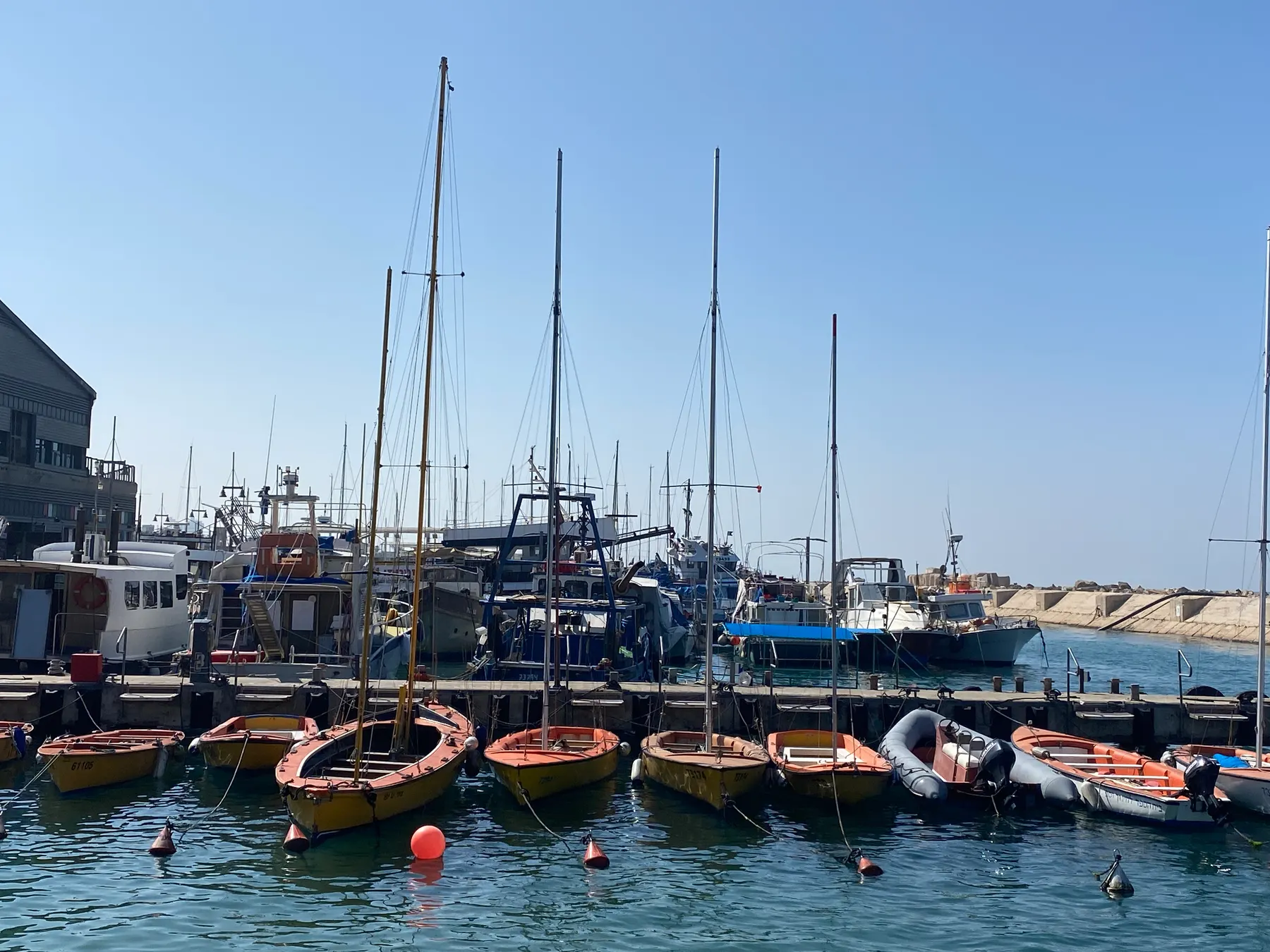
The quay, the breakwater and the three long sheds along it are British work of the mid-1930s, built for the orange trade on ground reclaimed from the sea, and two of those sheds were taken down and built again between 2019 and 2023.
Sources and further reading
Every link below was opened and checked when this page was written. Official statements are marked as such: they are the subject's own account, not an independent one.
- OfficialTel Aviv-Yafo municipal tourism servicevisit-tel-aviv.comThe Jaffa Flea Market
The municipality's own page: the Ottoman dispossession that created the market, more than seventy years as a flea market, the absorbed Greek Market, and the July and August Thursday-night events.
- OfficialTel Aviv-Yafo municipal tourism servicevisit-tel-aviv.comJaffa Flea Market: a Full Guide
The municipal guide's description of the merchandise, the streets closed to traffic for pubs and restaurants, and the plans for the Greek Market.
- OfficialThe Jaffa Flea Market (en.shuktlv.co.il)en.shuktlv.co.ilUseful Information, Shuk HaPishpeshim
The market's own English visitor site, and the only place that publishes stall hours: Sunday to Thursday 09:00 to 17:00, Friday 09:00 to 14:00, closed Saturday. Also the street list, the toilets at Olei Zion 14, parking and bus line 41.
- OfficialThe Jaffa Flea Market (en.shuktlv.co.il)en.shuktlv.co.ilAbout the Jaffa Flea Market
The market's own account of its origins in the Ottoman period and its present trade in refurbished furniture, household items and second-hand clothes.
- ReportingHaaretzhaaretz.comFlea Market Traders Decry Yuppie 'Occupation' of Jaffa
Roy Arad, 2 March 2012: antique dealers on the renovated market, the successful cafes and bars, and their own falling sales.
- ReportingHaaretzhaaretz.comLoud music in Jaffa Flea Market leads to high-volume protests
Odeya Ganor, 21 August 2012: businesses trading until 04:00 against a 01:00 rule in the mixed zone, residents organising, municipal mediation and a promised new policy.
- ReportingTime Out Israeltimeout.comThe ultimate guide to the Jaffa flea market
The range from poor-quality bric-a-brac to vintage furniture, and the named shops, studios, bars and restaurants now inside the market.
- ReportingTime Out Israeltimeout.comGreek Market
The Greek Market's construction by the Greek Orthodox monastery of Jaffa in the late nineteenth century, its address at 1 Pinkhas Ben Ya'ir Street, its hours and its Friday artisans' session.
- ReportingThe Globe and Mailtheglobeandmail.comTel Aviv's Market House Hotel, a biblical blend of old and new in Jaffa
Amy Rosen, 3 December 2015: the sections of glass flooring in the lobby revealing the remains of a Byzantine chapel.
- ReportingJewish Telegraphic Agencyjta.orgTel Aviv's long-awaited light rail system is finally opening, but not on Shabbat
The Red Line's opening on 18 August 2023, its 34 stations, the Jerusalem Boulevard alignment through Jaffa, and its non-operation on Shabbat.
- ReferenceHebrew Wikipediahe.wikipedia.orgShuk HaPishpeshim (Jaffa)
The three zones of the compound, the consolidation of the market under the British Mandate, and the 2001 project by the municipality and the Ministry of Tourism designed by Kislov Kay Architects.
- ReferenceEnglish Wikipediaen.wikipedia.orgJaffa
The dismantling of the city fortifications during the 1870s, and the destruction of the New Saraya by a Lehi truck bomb on 4 January 1948 with 26 dead.
- ReferenceEnglish Wikipediaen.wikipedia.orgJaffa Clock Tower
Construction from September 1900 to 1903, the funding by subscription across Jaffa's communities, and the tower's place in the new commercial centre beside the market.
Jaffa Flea Market: common questions
What are the Jaffa flea market's opening hours?+
The stalls and shops trade 09:00 to 17:00 Sunday to Thursday and 09:00 to 14:00 on Friday, on the market's own English information site, and are closed on Saturday. The bars, cafes and restaurants around them keep their own much later hours, including on Saturday. The Tel Aviv-Yafo tourism service, which is the municipal operator's page for the market, does not publish stall hours at all, so treat any timing as approximate and check with a specific shop if you are travelling for it.
Is the Jaffa flea market free?+
Yes. It occupies public streets, there is no gate or ticket office, and neither the municipal tourism service nor the market's own information site publishes an admission charge. The only money involved is what you spend, and the second-hand stalls expect that figure to be negotiated.
What is the best day to go?+
Friday morning is the fullest trading session of the week, and it is over by early afternoon. A weekday morning from Sunday to Thursday is quieter and easier to shop in, and Thursday evening is the busiest for eating and drinking. In July and August the municipality runs Thursday-night market events with music, street theatre and special illumination.
Is the market open on Saturday?+
The stalls are not, but the neighbourhood is. Most stallholders close for Shabbat, while the cafes, bars and restaurants in and around the compound trade through it. That makes Saturday a good afternoon for lunch and a wasted one for buying furniture.
Can you haggle at the Jaffa flea market?+
On the second-hand stalls, yes, and it is expected: prices are unmarked and the municipal guide describes antiques and knick-knacks that can sometimes be picked up for very little. In the design shops, galleries and jewellery studios that occupy the street frontages, no. The rule of thumb is that anything with a price label is a fixed price.
Is it worth it, or has it become a tourist trap?+
Both descriptions have been published by the same newspaper. Haaretz reported in March 2012 that antique dealers saw the renovated market as a yuppie occupation with cafes and bars thriving while their own sales fell, and in August 2012 that residents were fighting businesses trading until four in the morning. The second-hand trade is genuinely still there, mainly in the covered building and along Olei Zion, but it is now a minority of what the streets do, and a visitor who comes only for antiques should come early in the day.
How long do you need?+
About 90 minutes covers the stalls at a walking pace, and two to three hours is realistic if lunch is part of it. The compound is only four streets, so the time goes on stopping rather than on distance. Adding the clock tower, Kedumim Square and the port makes a comfortable half day.
Is the flea market wheelchair accessible?+
Partly, and less predictably than the flat map suggests. The lanes are close to level and largely pedestrianised, so there is none of the climbing that Old Jaffa on the headland above involves, but stock, tables and delivery vehicles narrow the passages and some lanes are effectively blocked at busy times. No accessibility statement is published by the municipality or by the market's information page, so ask individual businesses.
How do you get there without a car?+
The Tel Aviv light rail's Red Line, open since 18 August 2023, runs through Jaffa along Jerusalem Boulevard, a short walk from the market, and does not operate on Shabbat. The market's own information page gives Dan bus line 41 from Tel Aviv's central bus station. Driving is the awkward option: street parking is metered blue and white bays capped at three hours, and parts of the compound are closed to traffic.
What is actually old in the flea market?+
Less than the atmosphere implies. The commercial buildings are late Ottoman and Mandate-era, the market took its present form under the Mandate, and the paving, shading and lighting date from the restoration begun in 2001. The oldest thing on public view is the Byzantine chapel under sections of glass floor in the Market House hotel lobby on Beit Eshel Street, uncovered when the site was developed and dated by the hotel to the eighth century.