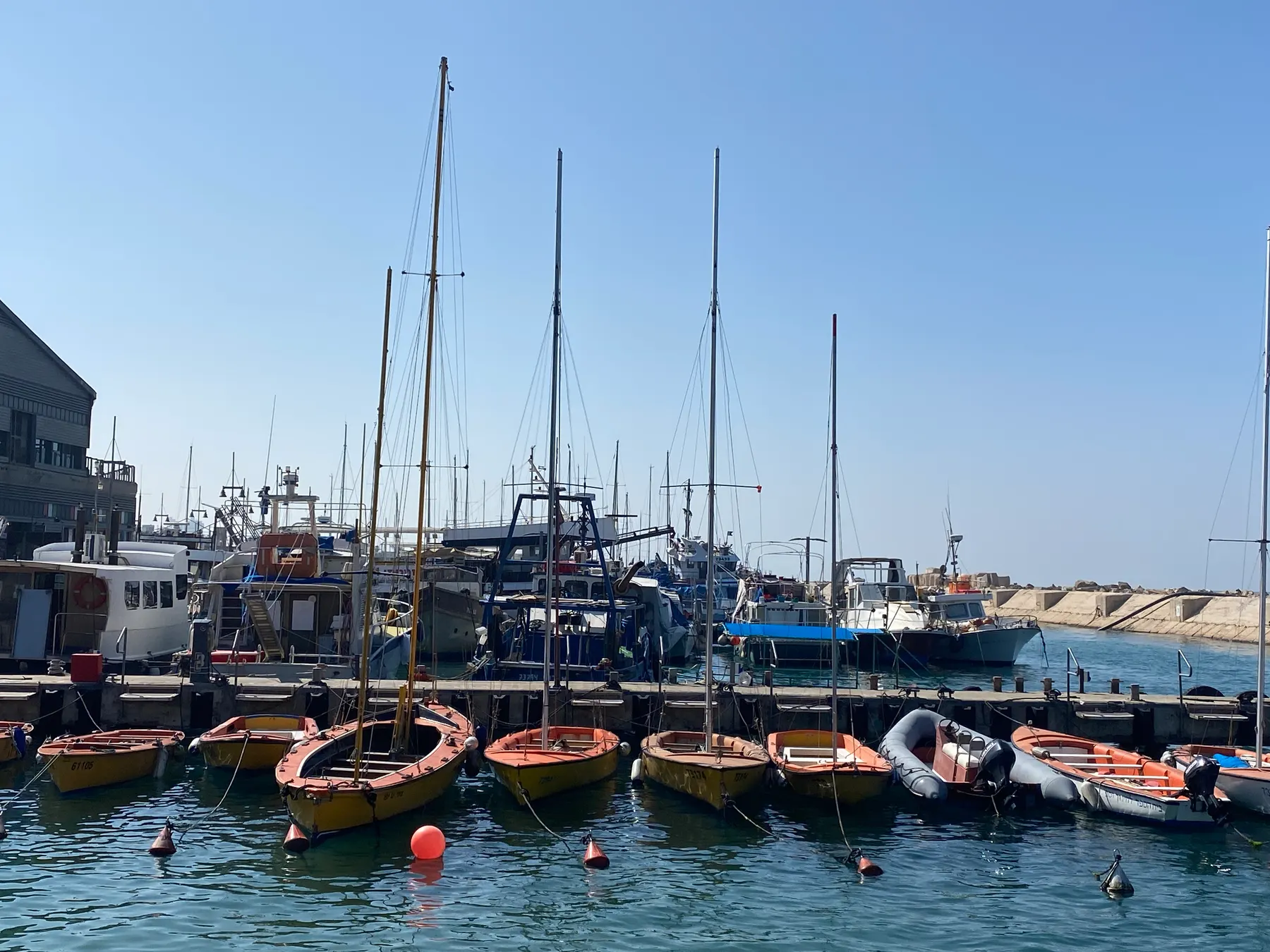
Landmark · Jaffa
Jaffa Port
The quay, the breakwater and the three long sheds along it are British work of the mid-1930s, built for the orange trade on ground reclaimed from the sea, and two of those sheds were taken down and built again between 2019 and 2023.
שלמה רודד / CC BY 2.5 · Wikimedia Commons
The quay you walk on
mid-1930s
the British built the warehouses and the rest of the port then, on the account of the Jaffa Port researcher Shmuel Giler
One warehouse
about 2,500 m²
the floor area of a single Mandate-era shed, a size not previously built in the country, reported by xnet in 2020
Rebuilding Warehouses 2 and 3
₪150 million
the cost given both by the municipal company Atarim and by Haaretz when the buildings opened in June 2023
Wave power on the sea wall
100 kW
the installed capacity of the EWP EDF One pilot, formally opened at the port on 5 December 2024
In short
- How long to give it
- about 60 to 90 minutes for the quay, the two rebuilt warehouses and the view along the breakwater, or half a day with a meal and a boat trip
- The quay, the warehouse square and the harbour front
- No published gate hours. The port is a public street and a working fishing harbour rather than a ticketed site, and the municipal tourism service describes it as a place to walk around rather than one to be admitted to.
- Entry to the port
- No charge. There is no ticket office and no gate; the quay, the warehouse square and the harbour front are public space.
נמל יפו
Jaffa Port is the small working harbour at the foot of the Old Jaffa hill: a fishing basin with a breakwater arm around it, a marina, and a line of long steel-framed warehouses along the quay that now hold restaurants, bars, a theatre and a yard of stacked shipping containers. It is a public street rather than a site, with no gate and no ticket desk.
The antiquity is real and almost none of it is visible. Ships have used the shelter of the reef here since the Bronze Age, but the quay, the breakwater and the sheds are twentieth-century engineering, and the two largest buildings on the quay were dismantled between 2019 and 2023 and put up again in new steel. What the visitor sees is a 1930s port converted twice: once after 1965, when the cargo trade left and the fishermen stayed, and again in the last few years, at a cost the municipality's own company puts at 150 million shekels.
The page below separates the three layers, because the tour patter collapses them into one. The natural anchorage and the estuary that may have preceded it are the archaeologists' subject. The quay and the warehouses are the British Mandate's. The containers and the wave energy floats on the sea wall are the current municipality's, and the argument about how much of the old fabric survived them is not settled.
Orientation
A working fishing harbour with a shopping street bolted to it
The port occupies a shallow basin on the north-west side of the Jaffa headland. Approach it down from Old Jaffa or along the seafront from the north and the first thing in view is the basin: fishing boats and small craft on moorings, a low breakwater arm running out and turning, and a green-and-white light at the end of it. Behind the quay stand the three warehouses that give the port its shape, numbered 1, 2 and 3.
Commercial shipping has been gone for sixty years. The Tel Aviv-Yafo municipal tourism service dates the end of all commercial activity to 1965 and describes what has run here since: a base for local fishermen, a yacht marina added some years later, and cruises, fishing excursions and seasonal tuna trips setting out from it.
Down here the ground itself is partly made: the British reclaimed a stretch of sea to lay the port out, and everything a visitor stands on is later than that. The one visible feature older than the Mandate is the line of rocks off the harbour mouth, and those are geology rather than architecture.
Before the quay
A reef for a breakwater, and possibly a lost river mouth
Jaffa was a harbour before it had any harbour works, because of a geological accident. The Israeli coast runs in long ridges of kurkar, the wind-cemented sandstone of fossilised dunes, and where a ridge is partly submerged it breaks the surface as a line of rocks a short way offshore. Ehud Galili and Sarah Arenson, in their 2014 survey of Israel's underwater heritage for the journal Riparia, classify that arrangement as a deep-water natural anchorage in 3 to 7 metres of water, list Jaffa among the sites that have one, and note the type was in use as early as the Middle Bronze Age. The rocks off the harbour mouth, the ones the myth attaches to Andromeda, are that ridge, and their job was to take the sea before it reached the boats.
There may also have been an earlier basin that no longer exists. In 2022 Shelley Wachsmann, Aaron Burke, Richard Dunn and Simona Avnaim-Katav published the Ioppa Maritima Project's 2014 geological investigation in the International Journal of Nautical Archaeology. Their reading of the cores is that from roughly 5,000 to 2,000 years before the present a small estuarine system lay east and north of Tel Yafo and could have served as a harbour: a valley flooded by rising sea level, its mouth partly blocked by coastal sand, then filled by sediment, wetland growth and human activity until only a depression was left, in the area now occupied by Bloomfield Stadium and Groningen Park.
Note the hedging, because the authors keep it. This is a potential early harbour, not a proven one, and no ancient built harbour works on the scale of Caesarea's have been shown at Jaffa. That is worth holding on to when reading the operator's own material: Atarim, the municipal company that runs the coastline, calls Jaffa 'the world's oldest active port' on its pages, and the excavation and coring literature makes no such claim.
- Anchorage type: partly submerged kurkar ridge, 3 to 7 m of water, in use from the Middle Bronze Age (Galili and Arenson, 2014)
- Possible earlier estuarine harbour east and north of the tell, c. 5,000 to 2,000 years before present (Wachsmann and colleagues, 2022)
- That basin is now dry ground around Bloomfield Stadium and Groningen Park
- No built ancient harbour works comparable to Caesarea's have been demonstrated here
1930s
Frederick Palmer's steel sheds, built for the orange trade
The port that exists is a Mandate project. The architect Shmuel Giler, who has worked on the development of the neighbouring Givat Aliya beach and who was researching the history of Jaffa Port at the University of Haifa when xnet interviewed him in 2020, dates the warehouses and the rest of the port to the middle of the 1930s, and gives the reason plainly: the enormous growth in the export of Jaffa oranges. To make room the British reclaimed part of the sea, as they had at other ports short of land, and built the sheds on the made ground.
The scale was new. Each warehouse covers about 2,500 square metres, and nothing of that size had been built in the country before, so the design went to the engineer Frederick Palmer, a partner in the London firm Rendel, Palmer and Tritton, which also handled Haifa Port, reckoned at the time one of the largest engineering projects in the Middle East. The solution chosen was a steel frame, and the frames were riveted: rows of rivet heads along every column and beam, the detail Giler says was lost when the members were replaced.
The commercial timing could hardly have been worse. Arab unrest spreading from Jaffa in April 1936 and the general strike that followed cut Jewish traders off from the harbour, and the municipal tourism service records that a replacement port was built up the coast at Tel Aviv in response. The trade never fully came back. Deep-water cargo went to Haifa and later to Ashdod, and Jaffa's commercial activity stopped altogether in 1965.
The lighthouse above the harbour belongs to the same story and its dates are not agreed. The Lighthouse Directory, Russ Rowlett's reference list at the University of North Carolina, gives the present ten-metre concrete tower as 1936, built when the British rebuilt the port, and dates the station itself to 1862 on the authority of Findlay's 1879 light list, while noting a postcard of an 1875 Jaffa lighthouse built by French engineers for the Ottoman Empire. What is not in dispute is the ending: the light was deactivated in 1966 and its lantern and lens went to the new lighthouse at Ashdod.
- Warehouses and port works: mid-1930s, on ground reclaimed from the sea
- About 2,500 m² per warehouse, on riveted steel frames
- Designed by Frederick Palmer of Rendel, Palmer and Tritton, engineers of Haifa Port
- 1936: unrest and the general strike push traffic to a new port at Tel Aviv
- 1965: commercial activity ends; 1966: the Jaffa light is deactivated and its optic goes to Ashdod
Conservation
Listed for preservation, then taken down and built again
All three warehouses were designated for preservation. Warehouse 1 was dealt with first, renovated by the municipality through its economic development authority with the conservation architect Rami Gil, in a job that kept the structure, the openings, the louvres and the public passages through the building. That work was more than a decade old by the time the rest of the port was touched.
Warehouses 2 and 3 went to Kisselov Kaye Architects, a Jaffa practice, and Atarim began the works in November 2019, describing a project that would upgrade and reinforce the sheds in the southern part of the port while the rest of it kept trading. The permit was for rehabilitation rather than demolition. Its wording, quoted by xnet, allowed dismantling the roof, the external walls and the internal partitions while preserving the building's skeleton, then building new envelope walls and a new roof in line with the conservation guidelines.
That is not what happened. Michael Jacobson reported in xnet in October 2020 that once the cladding and roofs were off and the old frame stood exposed, a tractor pulled the frame down, and that neighbours photographed it. Tamar Tokhler, who runs the Tel Aviv district of the Council for Conservation of Heritage Sites, was asked whether the municipality was misrepresenting the work and answered that Warehouse 3 had clearly been demolished and Warehouse 2 had begun to be. Giler put it at nothing left of Warehouse 3 and Warehouse 2 taken down by eighty per cent, the riveted British steel replaced by plain new beams. The municipality's conservation department, in the person of Dr Yermi Hoffman, said the historic buildings were not being destroyed, that damaged elements were being replaced with identical steel under supervision, and that 'we replaced more than we thought'.
The architects describe something different again, and not dishonestly. Writing in the design magazine Portfolio in June 2022, Tea Kisselov set out the intention as keeping the contour, the mass and the historic construction of the hangars while inserting a stack of containers detached from the outer steel envelope: a new world inside an old world, under an exposed Mandate-era truss canopy. The two accounts are of the same project and not of the same building.
The result opened in June 2023, four years on, at a cost of 150 million shekels. Haaretz, reporting the opening, wrote that the new commercial area replaces warehouses standing in the port since before Israel's founding and that the decision to demolish them had drawn criticism alongside the praise. Atarim, giving the same figure, calls the work renovation and restoration, credits Kisselov Kaye for the buildings and 1:1 Landscape Architecture for the square between them, and lists what went in: Warehouse 2 for culture, with the Barby music club, the Elmina Arab-Hebrew theatre for children and young people, a play centre, shops, restaurants and bars, and Warehouse 3 as a sustainability complex built from recycled containers, programmed by the Latzet Mehakufsa association, which has run the Terminal design complex in Bat Yam since 2009.
- Warehouse 1: conserved earlier by the municipality with the conservation architect Rami Gil
- Warehouses 2 and 3: works from November 2019, architects Kisselov Kaye, square by 1:1 Landscape Architecture
- Permit allowed dismantling roof and walls while keeping the skeleton; the skeletons came down
- Opened June 2023 at ₪150 million, with criticism from conservation bodies and neighbours on record
Now
Boats, a container yard and ten floats on the sea wall
The fishing is not decoration. Warehouse 2 served as storage for the fishermen before the rebuilding, and Atarim set out the works as being partly for them: more warehouse space, a fishermen's club, lavatories and showers, a goods lift, a sheltered space and a designated area for cooling containers and selling fish, with temporary shaded storage during the four years of building so the harbour could keep working. Boats go out and come back on their own schedule and nobody publishes it.
The least touristic thing in the port is the Na Laga'at centre, whose name translates as 'please touch'. The municipal tourism service describes a theatre company whose ensemble of more than forty blind, deaf and deaf-blind actors and other employees stages productions with English translation shown overhead, with a restaurant and café in the same complex. It works on performance dates rather than opening hours.
The oddest thing in the port is on the sea wall. Eco Wave Power's EWP EDF One installation mounts ten floats along the breakwater; they rise and fall with the swell and drive a land-based conversion unit that turns the movement into fluid pressure and then electricity. Installed capacity is 100 kilowatts, which the Times of Israel puts at roughly a hundred households, and it is Israel's first wave energy project connected to the grid. The partners are the company, EDF Renewables Israel, the Tel Aviv-Yafo municipality and Atarim. Grid cables were laid in January 2020 and the first float went up in February 2022, but the formal opening slipped more than a year because of the war and took place on 5 December 2024, with President Isaac Herzog and the mayor Ron Huldai at the ribbon. In its own report for March 2026 the company said the system ran continuously through the month and produced more than 1,200 kilowatt hours.
The floats belong to a wider municipal idea for the port as a testing ground for marine technology, which Atarim writes up under the heading of the blue economy: an ecological concrete meant to let marine life colonise harbour structures, a plant-derived antifouling paint first trialled on boats here, and a berth-booking platform for marinas. None of it is signposted, so a visitor who does not know to look at the sea wall will walk past all of it.
What to look for
Things not to walk past at Jaffa Port
The details that repay knowing about before you are standing in front of them.
Warehouse 1
The one shed conserved rather than rebuilt, kept by the municipality with the conservation architect Rami Gil so that the frame, the openings, the louvres and the passages through it survived. Compare it with the two to the south and the argument about the rest of the port becomes visible in about a minute.
The container yard in Warehouse 3
A three-dimensional stack of painted shipping containers standing free inside the hangar volume, programmed by the Latzet Mehakufsa association around sustainability, workshops and reuse. The architects call it a new world inside an old world; conservation officers call the shell around it new construction.
The rocks off the harbour mouth
A partly submerged kurkar ridge that acted as the natural breakwater and is the reason a port grew here at all. The Andromeda story attaches to these rocks and is far older than anything built on the quay.
The wave energy floats
Ten floats bolted along the sea wall, the visible half of Israel's first grid-connected wave power project at 100 kilowatts. There is no viewing platform and no sign; look along the breakwater from the quay.
Na Laga'at
The theatre and restaurant complex whose ensemble includes more than forty blind, deaf and deaf-blind actors and staff, with English surtitles above the stage. It runs on performance dates, so book before travelling rather than dropping in.
The fishing quay itself
Nets, ice, small boats and a working rhythm that has outlasted every plan made for this harbour since 1965. It is the part of the port nobody redesigned, and the reason the rebuilding included a fishermen's club, showers and a cooled area for selling fish.
The long view
Jaffa Port, in order
c. 5,000 to 2,000 years before present
On the Ioppa Maritima Project's coring results, a small estuarine system lies east and north of Tel Yafo and could have served as a harbour, before sediment and wetland growth fill it in.
Middle Bronze Age onwards
The partly submerged kurkar ridge off the headland is in use as a natural deep-water anchorage, in the classification Galili and Arenson apply to Jaffa and nine other sites on this coast.
1862 or 1865
A lighthouse is established at Jaffa under the Ottomans, built by French engineers; the sources differ on the year, and a surviving postcard shows an 1875 tower.
mid-1930s
The British build the port as it now stands, reclaiming ground from the sea for three steel-framed warehouses of about 2,500 m² each, designed by Frederick Palmer of Rendel, Palmer and Tritton, to handle the Jaffa orange export.
1936
Unrest and a general strike cut Jewish traders off from Jaffa, and a replacement port is built up the coast at Tel Aviv.
1965
Jaffa Port ceases all commercial activity, leaving the quay to fishermen and, later, to a yacht marina.
1966
The Jaffa light is deactivated and its lantern and lens are transferred to the new lighthouse at Ashdod.
November 2019
Atarim begins the works on Warehouses 2 and 3 in the southern part of the port, under a permit for rehabilitation rather than demolition.
October 2020
xnet reports that the old steel frames were pulled down after being exposed; the Council for Conservation of Heritage Sites says Warehouse 3 was clearly demolished, and the municipality says damaged elements were replaced with identical steel.
February 2022
The first of ten wave energy floats is installed on the port's sea wall for the EWP EDF One project.
June 2023
The rebuilt Warehouses 2 and 3 open to the public after four years and ₪150 million, launched with the Fresh Paint art fair.
5 December 2024
The 100 kilowatt wave energy plant is formally opened at the port, Israel's first connected to the grid, after a delay of more than a year caused by the war.
Practical
Visiting Jaffa Port
Where
Nemal Yafo Street, Jaffa Port, Tel Aviv-Yafo
What ticket you need
The port is not part of a ticketed park and is not the same thing as Old Jaffa. The old town, Kedumim Square and HaPisga garden are on the hill above and are also free, but the walk between them and the quay is a genuine climb.
Opening hours
- The quay, the warehouse square and the harbour front
- No published gate hours. The port is a public street and a working fishing harbour rather than a ticketed site, and the municipal tourism service describes it as a place to walk around rather than one to be admitted to.source
- Warehouses 2 and 3
- The venues inside keep their own hours, which are set tenant by tenant. Atarim relaunched the buildings in June 2023 around fairs and events rather than fixed opening times, and the mix of restaurants, bars, theatre and workshops has changed since.source
- Na Laga'at
- Runs on performance and sitting times rather than opening hours; check the centre's own calendar before travelling.source
Admission
Access
The port is the flat part of Jaffa and the easiest to reach on wheels. The quay, the square between the warehouses and the harbour front are level, and the seafront approach from the north involves no steps. The climb is between the port and the old town on the hill above it, which is steep and partly stepped, so a visitor who cannot manage that should treat the port and Old Jaffa as two separate trips rather than one walk. The breakwater arm is not a public walkway: the Lighthouse Directory records that the pier is not walkable and the light at its end is reachable only by boat. Individual venues inside the warehouses vary, and their access should be checked with them.
On site
- Fishing quay and moorings
- Yacht marina
- Restaurants, bars and cafés in the warehouses and along the quay
- Na Laga'at theatre, restaurant and café
- Barby music club and the Elmina theatre in Warehouse 2
- Container complex and workshop space in Warehouse 3
- Cruises, fishing trips and seasonal tuna excursions
- Paid car park at the port
- Level seafront approach from the north
Booking
Nothing about the port needs booking, but the things inside it do. Theatre performances, the tasting experiences and the boat trips all sell separately and run on their own calendars, and the quayside fish restaurants fill on Friday evenings. The port's own website was returning a block to automated requests when this page was checked, so hours and prices for individual venues should be confirmed with each business.
Hours and prices are given as the operator publishes them and change without much notice, particularly around Shabbat and the festivals. Check the operator's own page before you travel for this.
Official page at namalyafo.co.il →What people wish they had known
- Do not come here looking for ancient stones. The quay, the breakwater and the warehouses are British work of the mid-1930s, the two big sheds on the quay were rebuilt and reopened in 2023, and the oldest thing in sight is the line of rocks offshore.
- The breakwater is not a walk. The green light at its end sits on a pier the Lighthouse Directory records as not walkable and reachable only by boat, so the photograph most people arrive wanting has to be taken from a cruise boat or from the terrace above the port.
- The port has no hours but its buildings do. Arriving mid-morning finds a car park, some fishermen and a closed hangar; the warehouses fill up in the late afternoon and evening, and the Friday-night fish restaurants need booking.
- Old Jaffa is above the port, not in it. Visitors routinely allow one stop for both and then discover the climb. Treat the quay and the hill as two separate halves of a day, and do the hill in the late light.
- Look at the sea wall. Ten wave energy floats and the pipework of a small power plant sit along it with no sign and no viewing point, and almost everyone walks past Israel's first grid-connected wave energy project without noticing it.
- Read the buildings sceptically. Warehouse 1 was conserved; Warehouses 2 and 3 were taken down to the ground and rebuilt, which the municipality describes as restoration and the Council for Conservation of Heritage Sites describes as demolition.
The figures
Jaffa Port by the numbers
Each figure carries the year it belongs to and links the source it came from.
| Measure | Figure | As of | Source |
|---|---|---|---|
| Possible early estuarine harbour at Jaffa | c. 5,000 to 2,000 years before present, east and north of Tel Yafo | 2022 | doi.org |
| Natural anchorage type at Jaffa | partly submerged kurkar ridge in 3 to 7 m of water, in use from the Middle Bronze Age | 2014 | ancientportsantiques.com |
| Floor area of one Mandate-era warehouse | about 2,500 m², on riveted steel frames designed by Frederick Palmer | 2020 | xnet.ynet.co.il |
| Cost of rebuilding Warehouses 2 and 3 | ₪150 million over four years, opened June 2023 | 2023 | atarim.gov.il |
| How much of the old fabric came down | Warehouse 3 entirely and Warehouse 2 by about 80 per cent, on Shmuel Giler's account; the municipality says damaged elements were replaced with identical steel | 2020 | xnet.ynet.co.il |
| Wave energy plant on the sea wall | 10 floats, 100 kW installed, opened 5 December 2024 | 2024 | timesofisrael.com |
| Wave plant output, as reported by the operator | more than 1,200 kWh during March 2026 | 2026 | ecowavepower.com |
| Jaffa lighthouse | present tower 1936, station dated to 1862 in Findlay's 1879 light list, deactivated 1966 | 2025 | ibiblio.org |
While you are here
The rest of Jaffa
Everything else in this destination with a page of its own.
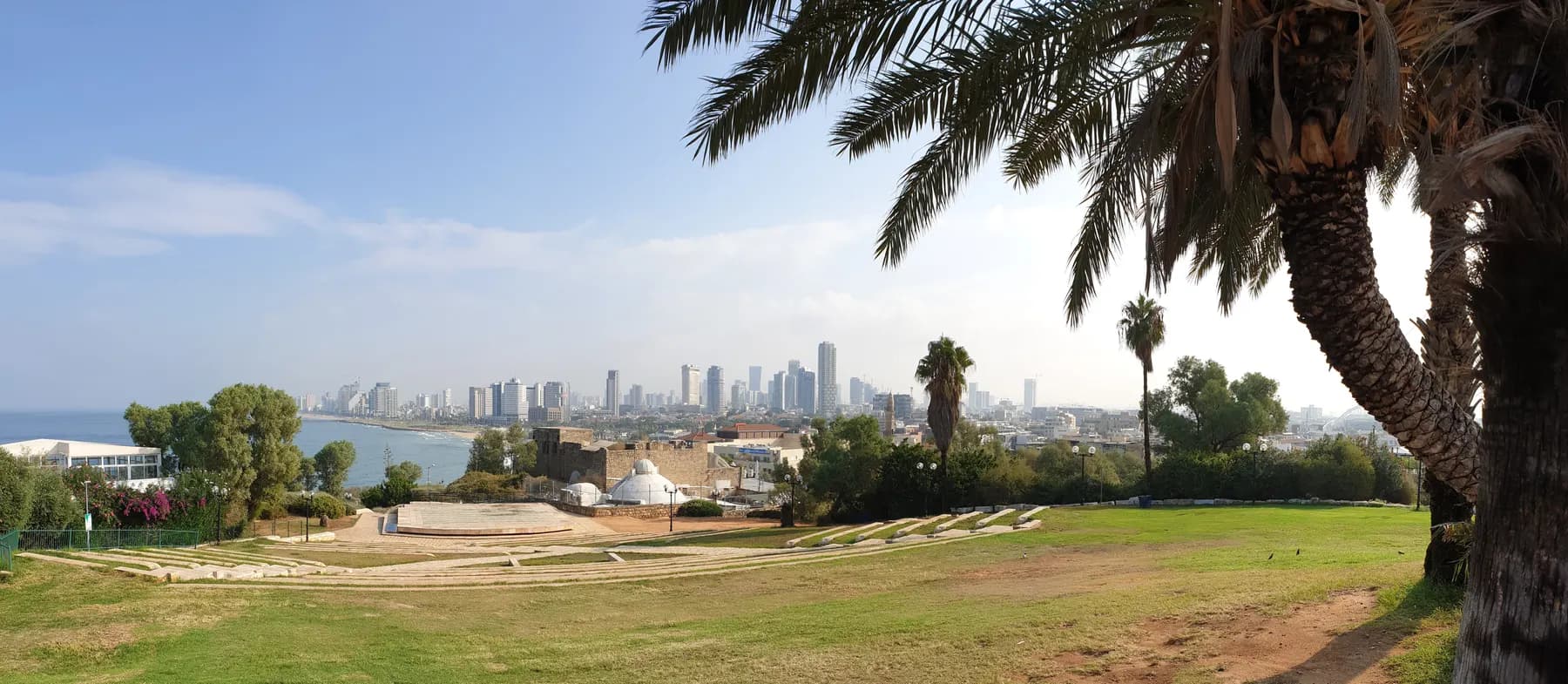
Anagoria / CC BY 3.0 · Wikimedia Commons
Viewpoint
HaPisga Garden (Abrasha Park)
The lawns on top of Old Jaffa are not old: they are the ground left empty after the British blew a quarter of the town apart in June 1936, laid out as a public garden under a 1956 plan and planted by Tel Aviv's city gardener Avraham Karavan, whose nickname Abrasha the park still carries.
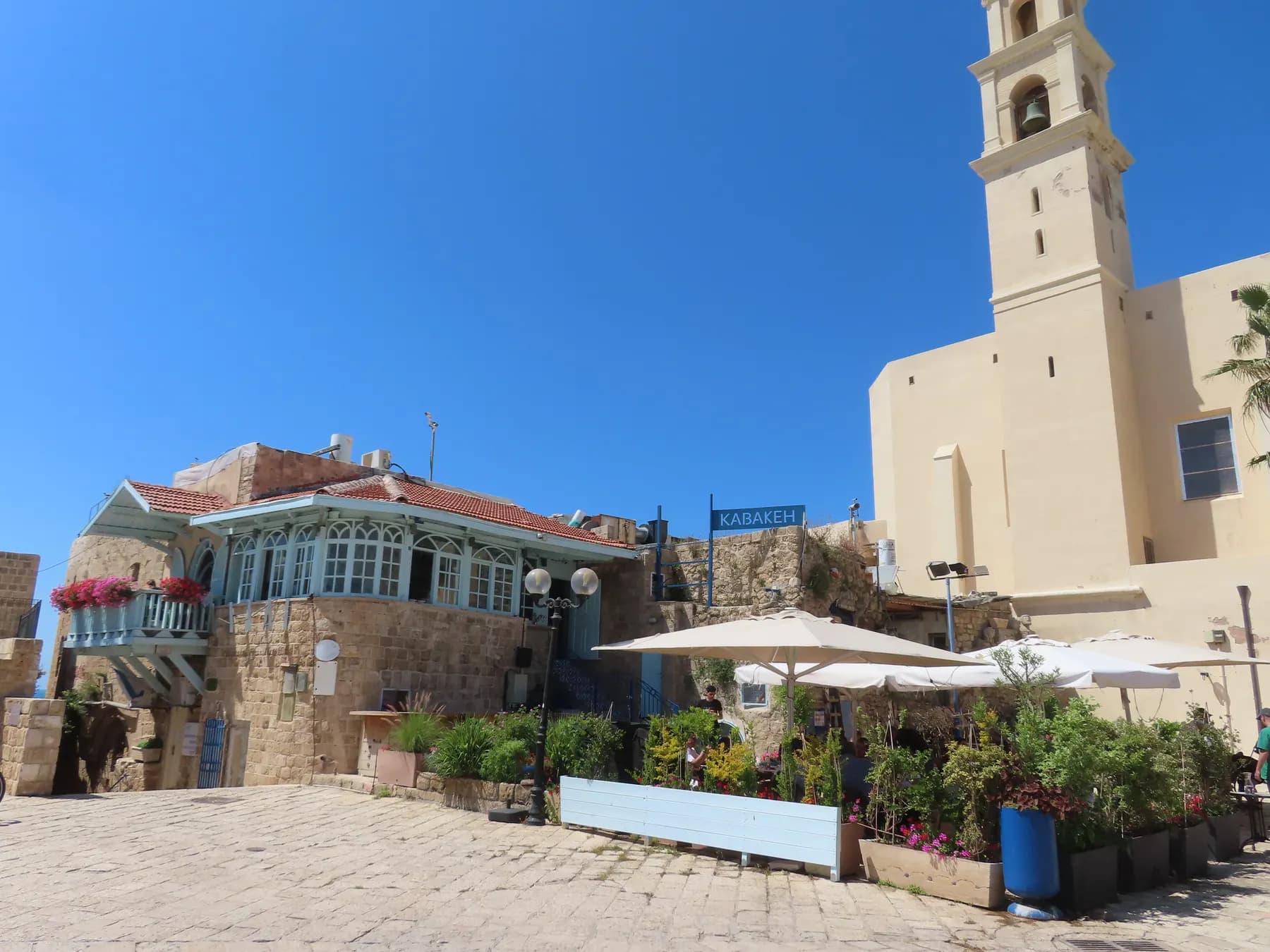
Fallaner / CC BY-SA 4.0 · Wikimedia Commons
Landmark
Kedumim Square
The flagged main square of Old Jaffa is a space the British made by demolition in June 1936, and the Israel Antiquities Authority excavation under its fountain found the drains of one of the houses that came down.
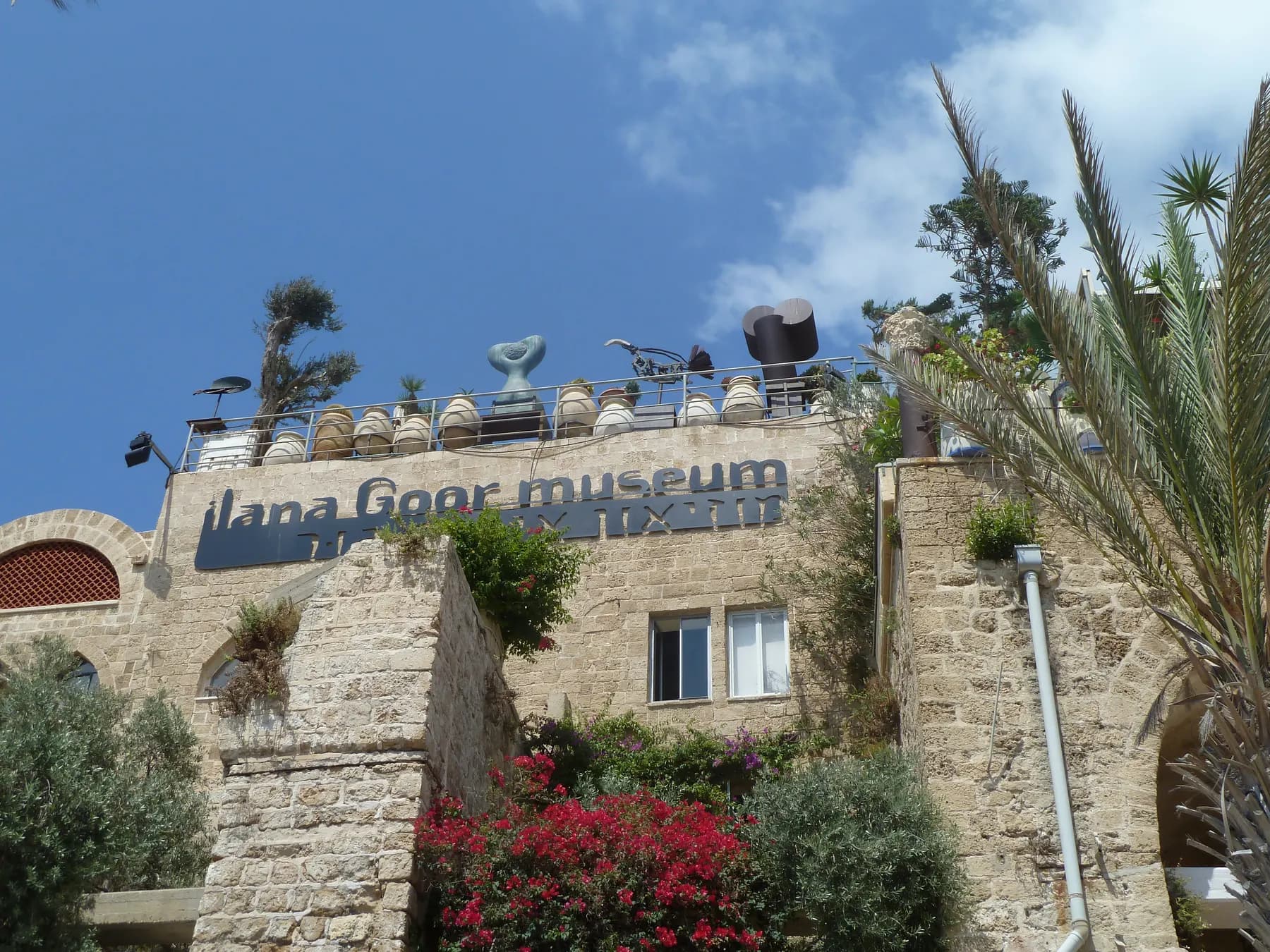
Deror_avi / CC BY-SA 3.0 · Wikimedia Commons
Museum
Ilana Goor Museum
A stone building of 1742, put up as an inn for Jewish pilgrims landing at Jaffa, which the sculptor Ilana Goor bought in two stages and opened as a museum of her own work and her collection in September 1995.
Sources and further reading
Every link below was opened and checked when this page was written. Official statements are marked as such: they are the subject's own account, not an independent one.
- OfficialAtarim Group, Tel Aviv-Yafo Municipalityatarim.gov.ilJaffa Port is open for renovations
Works beginning in November 2019 on Warehouses 2 and 3 in the southern part of the port, the intended uses (music centre, street theatre, scouts and marine education, small commercial units, food), the provisions for the fishermen (warehouse space, club, lavatories, showers, freight lift, sheltered space, cooled containers and fish sales), and the temporary shaded storage that kept the harbour working through the build
- OfficialAtarim Group, Tel Aviv-Yafo Municipalityatarim.gov.ilנמל יפו המתחדש: פתחנו (The renewed Jaffa Port: we have opened)
Four years of works on Warehouses 2 and 3 at a cost of 150 million shekels, the launch with the Fresh Paint fair in June, Kisselov Kaye as architects with 1:1 Landscape Architecture for the square between the buildings, the Barby club and the Elmina theatre in Warehouse 2, and Warehouse 3 as a recycled-container sustainability complex tendered to the Latzet Mehakufsa association
- OfficialAtarim Group, Tel Aviv-Yafo Municipalityatarim.gov.ilThe future of the Sea: Innovation at the ancient port
The port as a beta site for marine innovation, the wave energy floats on the breakwater, the ecological concrete and antifouling paint trials and the marina booking platform, and the operator's own description of Jaffa as the world's oldest active port
- OfficialVisit Tel Aviv, Tel Aviv-Yafo Municipalityvisit-tel-aviv.comJaffa Port
The 1936 loss of access and the replacement port built at Tel Aviv, the end of all commercial activity in 1965, the port's continuing role as a base for local fishermen, the later yacht marina, the cruises, fishing and seasonal tuna trips, and Na Laga'at's ensemble of more than forty blind, deaf and deaf-blind actors and employees with English surtitles
- OfficialEco Wave Power Globalecowavepower.comEco Wave Power reports March 2026 production results at Jaffa Port
The company's own report that the Jaffa Port system ran continuously through March 2026 and generated more than 1,200 kilowatt hours, with about six days of moderate waves in the 1 to 2 metre range
- Reportingxnet, Yedioth Ahronoth (Michael Jacobson, 18 October 2020)xnet.ynet.co.ilעיריית ת''א הכריזה על שימור מבנים בריטיים בנמל יפו, ואז הרסה אותם (Tel Aviv declared the British buildings at Jaffa Port for preservation, then demolished them)
The British construction of the port in the mid-1930s for the orange export with ground reclaimed from the sea, warehouses of about 2,500 m² each designed by Frederick Palmer of Rendel, Palmer and Tritton, the wording of the rehabilitation permit, the demolition of the exposed steel frames, Tamar Tokhler of the Council for Conservation of Heritage Sites on Warehouses 2 and 3, Shmuel Giler's estimate that Warehouse 3 was lost entirely and Warehouse 2 by eighty per cent, and Dr Yermi Hoffman's reply for the municipal conservation department
- ReportingHaaretz (Naama Riba, 4 June 2023)haaretz.comInside the Colorful New Transformation of Jaffa's Port
The opening of the new warehouse commercial area four years after construction began, the cost of 150 million shekels, the fact that it replaces warehouses standing in the port since before Israel's founding, and the criticism drawn by the decision to demolish the older structures
- ReportingPortfolio magazine (Limor Margolis, 21 June 2022)prtfl.co.ilמה חדש // מחסנים 2 ו-3, נמל יפו (What's new: Warehouses 2 and 3, Jaffa Port)
Tea Kisselov of Kisselov Kaye Architects on the design intention: preserving the contour, mass and historic construction of the hangars, the container stack detached from the outer steel envelope as a new world inside an old world, and the exposed Mandate-era truss canopy overhead
- ReportingWalla Bait VeItzuvhome.walla.co.ilאין כמו יפו: כך יראה נמל העיר העתיקה בקרוב (Nothing like Jaffa: how the old city's port will soon look)
The three warehouses built by the British in the 1930s and designated for preservation, the earlier conservation of Warehouse 1 by the municipality through its economic development authority with the conservation architect Rami Gil keeping the structure, openings, louvres and public passages, the award of Warehouses 2 and 3 to Kisselov Kaye, and Warehouse 2's use at the time as culture space and fishermen's storage
- ReportingThe Times of Israeltimesofisrael.comIsraeli wave energy project draws interest from Qatar, Saudi Arabia and even Iran
The 100 kilowatt installed capacity of the Jaffa Port wave plant, its status as Israel's first grid-connected wave energy project, the partnership with EDF Renewables Israel, the formal opening on 5 December 2024 after a delay of more than a year caused by the war, and the attendance of President Isaac Herzog, minister Idit Silman and mayor Ron Huldai
- ReportingNew Atlasnewatlas.comFirst float of grid-connected wave energy system installed in Jaffa Port
The EWP EDF One project's ten floats mounted on the sea wall, the land-based conversion unit that turns float movement into fluid pressure and then electricity, the grid-connection cables laid in January 2020 and the first float installed in February 2022
- ReferenceInternational Journal of Nautical Archaeology (Wachsmann, Burke, Dunn and Avnaim-Katav, vol. 51 no. 2, 2022, pp. 267-303)doi.org'He Went Down to Joppa and Found a Ship Going to Tarshish' (Jonah 1:3): Landscape Reconstruction at Jaffa and a Potential Early Harbour
The Ioppa Maritima Project's 2014 geological investigation and its finding that from c. 5,000 to 2,000 years before present a small estuarine system east and north of Tel Yafo could have served as a harbour, formed by sea-level rise flooding a small valley, its mouth partly blocked by coastal sands, and later filled by sediment, wetland development and human activity, leaving a depression around Bloomfield Stadium and Groningen Park
- ReferenceRiparia vol. 0, 2014, pp. 151-177 (Ehud Galili and Sarah Arenson)ancientportsantiques.comManagement of the underwater and coastal archaeological heritage in Israel's seas
The classification of deep-water natural anchorages in 3 to 7 metres of water formed by a partly submerged kurkar ridge making a small islet offshore, their use from the Middle Bronze Age, and the list of sites of this type, which includes Jaffa
- ReferenceRuss Rowlett, University of North Carolina at Chapel Hillibiblio.orgLighthouses of Israel (The Lighthouse Directory)
The Jaffa light as a roughly 10 m concrete tower of 1936 with the station dated to 1862 in Findlay's 1879 light list and a postcard of an 1875 tower built by French engineers for the Ottomans, its official deactivation in 1966 with the lantern and lens transferred to Ashdod, and the separate green harbour light of around 2018 at the end of the breakwater, accessible only by boat because the pier is not walkable
Jaffa Port: common questions
How old is Jaffa Port really?+
The anchorage is ancient and the port is not. Ships have used the shelter of the offshore kurkar ridge here since at least the Middle Bronze Age, and a 2022 study of cores from the area argues a small estuarine basin east and north of the tell could have served as a harbour from roughly 5,000 to 2,000 years ago. Everything a visitor can stand on, though, is twentieth century: the quay, the breakwater and the warehouses were built by the British in the mid-1930s.
Is Jaffa Port the oldest port in the world?+
That is the operator's claim, not the archaeologists'. Atarim, the municipal company that runs the Tel Aviv-Yafo coastline, describes Jaffa as the world's oldest active port on its own pages. The excavation and coring literature on Jaffa does not make that claim, and it identifies a potential early harbour rather than a demonstrated continuous one, so treat the superlative as marketing.
Is there an entrance fee?+
No. The quay, the warehouse square and the harbour front are public space with no gate and no ticket desk. Money goes on the restaurants, the boat trips, the theatre and the car park.
What is actually original down there?+
Warehouse 1 and the ground plan. Warehouse 1 was conserved by the municipality with the conservation architect Rami Gil, keeping its frame, openings, louvres and public passages. Warehouses 2 and 3 were dismantled between 2019 and 2023 and rebuilt: on Shmuel Giler's account nothing of Warehouse 3 survived and Warehouse 2 came down by about eighty per cent, while the municipality says damaged frame elements were replaced with identical steel under supervision.
Can you walk out along the breakwater?+
No. The Lighthouse Directory records that the pier carrying the green harbour light is not walkable and that the light is accessible only by boat. The usable viewpoints are the quay itself and the terrace on the hill above the port.
Is it still a working fishing harbour?+
Yes, and that is the point of it. Fishermen have worked out of the basin continuously since commercial shipping ended in 1965, Warehouse 2 was their storage before the rebuilding, and the 2019 to 2023 works included a fishermen's club, more storage, showers, a goods lift and a designated area for cooling containers and selling fish.
How long is worth spending, and is it worth it at all?+
About an hour to ninety minutes for the quay, the two rebuilt warehouses and the view, or half a day with a meal and a boat trip. It is worth it if the interest is a working harbour, an unusually frank conservation argument and good fish. It is not worth a special trip for ruins, because there are none visible.
What is inside the warehouses now?+
Culture in one and containers in the other. Atarim lists Warehouse 2 as holding the Barby music club, the Elmina Arab-Hebrew theatre for children and young people, a play centre, shops, restaurants and bars, and Warehouse 3 as a sustainability and community complex built from recycled shipping containers, programmed by the Latzet Mehakufsa association. Tenants change, so check before making a journey for one of them.
Is the port accessible in a wheelchair?+
The port itself is the flat, manageable part of Jaffa: the quay, the square between the warehouses and the harbour front are level and the seafront approach from the north has no steps. The difficulty is the hill between the port and Old Jaffa, which is steep and partly stepped and is best avoided by treating the two as separate visits. The breakwater is closed to walkers regardless.
Where are Andromeda's rocks from here?+
Off the harbour mouth on the north-west side, a short way out. They are the exposed crest of the kurkar ridge that made this a usable anchorage in the first place, which is why the myth and the geology sit in the same place. The clearest view is from the quay looking seaward or from the terrace above the port.