Neighbourhood · Jaffa
Ajami
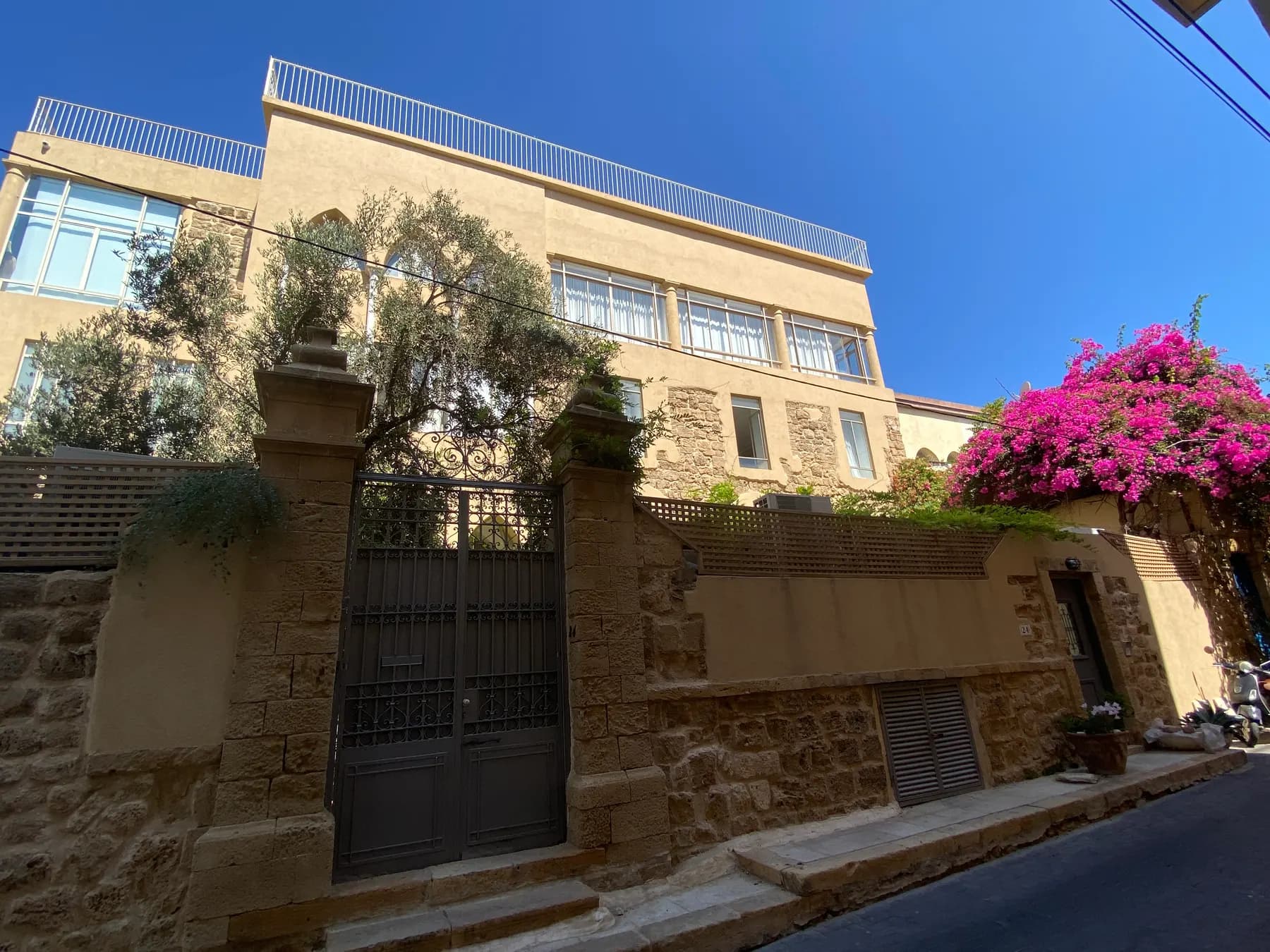
The quarter south of Old Jaffa where the Arabs who stayed after 1948 were concentrated behind a fence, now a grid of kurkar villas above a coastal park built on forty years of construction rubble.
שלמה רודד / CC BY 2.5 · Wikimedia Commons
Laid out
mid-1800s
by well-off Maronite Christian families, on streets running parallel to the shore
Arabs left in Jaffa after 1948
3,000 to 4,000
concentrated here under martial law; Britannica says 4,000, other accounts fewer
Rubble mound on the beach
about 15 m high
construction waste tipped on the shore for decades, cutting the quarter off from the sea
Midron Yafo park
200 dunams
built over that mound and inaugurated on 30 April 2010
In short
- How long to give it
- About two hours to walk Yefet Street, the villa streets below it and the park; half a day with lunch and time on the shore
- The neighbourhood
- A residential quarter of public streets. No gate, no closing time and no ticket office.
- Walking the quarter
- Free
עג'מי · العجمي
Ajami is the residential quarter of Jaffa that begins where the Old City ends, running south along the shore from the port towards Givat Aliya. It is a street plan rather than a monument. What is there is sandstone villas with courtyards and arched windows, a Maronite church at the bottom of Dolphin Street, a mosque of 1895, a Scottish school on the main road, hummus counters with a queue at noon, and a wide green slope down to the water that did not exist twenty years ago.
The quarter was laid out from about the middle of the nineteenth century, in both the Hebrew and English accounts of it, by wealthy Maronite Christians who built in kurkar, the local wind-cemented sandstone, on streets parallel to the sea. It filled quickly after Jaffa's walls came down in 1879, and by the mid-1920s it held roughly 950 houses. Almost none of that is signposted, and nothing in Ajami is ticketed.
The other thing to know before walking it is that the fabric records what happened next. Ajami is where Jaffa's remaining Arab population was concentrated in 1948, behind a fence and under military government; it is where thousands of empty properties passed to state housing companies under a 1950 law; and it is where the housing authority spent the 1970s knocking each vacated house down rather than repairing it. The vacant lots between the restored villas are not building plots. They are where houses stood.
Outside the walls
The quarter the Maronites laid out along the shore
The name is older than the neighbourhood. Ajami is named for Ibrahim al-Ajami, who in Muslim tradition was among the companions of the Prophet Muhammad and who is held to have been buried south of the area. The mosque built over his shrine in 1895, by Haj Yousef al-Manawi, carries his name and stands in the northern part of the quarter beside the Hassan Arafeh public school. Its status as waqf property was later annulled under Israel's absentee property law, which is the short version of a long argument.
The neighbourhood itself dates from the middle of the nineteenth century, when Maronite Christian families with money began building outside the walled town on streets set parallel to the water. In 1895 Father Antonios Shbeir Ghostaoui established a church and monastery on 1,600 square metres of ground; between 1901 and 1920 that was replaced by a larger building, whose first stone was laid at a ceremony on 28 February 1904. The church stands at the southern tip of Dolphin Street and is a working parish rather than a visitor attraction.
The building type is the point. Houses went up in kurkar, with high ceilings, arched openings and a walled courtyard, and the size of the courtyard told you what the family was worth. Jaffa's walls were demolished in 1879, which released the pressure inside the old town and pushed building outward; by 1924 Ajami held something like 950 houses. Poorer residents arrived in the early twentieth century and built simpler structures in the gaps, which is why the street frontage switches between a merchant's villa and a single-storey house within a few metres.
Yefet Street is the spine, running north to south with the Old City at its head. Tabeetha School, founded in 1863 and run by the Church of Scotland, has been at number 21 since long before the state existed and still takes children of any nationality or religion. It is a useful reminder that the quarter was never only Maronite, and never only Arab.
- 1879: Jaffa's walls demolished, and building spreads south
- 1895: the al-Ajami mosque built over the shrine, and a Maronite church and monastery founded on 1,600 sq m
- 28 February 1904: first stone of the larger Maronite church
- By 1924: roughly 950 houses in the quarter
- 1863: Tabeetha School founded on Yefet Street by the Church of Scotland
1948
The fenced quarter, and three numbers that do not agree
Britannica records that the Irgun Zvai Leumi attacked Jaffa on 26 April 1948 and that on 13 May the city was securely under the control of Jewish paramilitaries, with nearly all of its 70,000 Arab Muslims and Christians displaced in the battle. Those who stayed were moved into Ajami and held under military government. The English-language Wikipedia article on Jaffa puts the end of that military administration at 1 June 1949.
How many stayed is genuinely disputed, and the disagreement is worth stating rather than smoothing over. Britannica gives 4,000, concentrated in the Ajami neighbourhood south of the old city. Wikipedia's article on Jaffa gives 3,800, subject to strict martial law. Its article on Ajami gives roughly 3,000, against an estimated displacement of about 90 per cent of the city. The three accounts describe the same event and differ by a third, so a page that prints one figure and calls it the answer is overstating what is known.
The mechanics of the concentration are documented in blunter language than tour guides tend to use. Palestinians were moved into Ajami, which was ringed by Jewish quarters; officials proposed enclosing it with a barbed-wire fence that would rigorously separate the Arab neighbourhood from the Jewish section; residents needed special permits to pass the wire. Wikipedia's account calls the result a sealed-off ghetto. That is its characterisation, not a neutral term, and it is the term the sources on the period use.
The property law is what fixed the arrangement in place. Under a 1950 absentee property law, according to Associated Press reporting carried by The Times of Israel in 2021, the Israeli government confiscated thousands of empty properties and handed them to state-run public housing companies. Arab residents who had stayed ended up as tenants in those buildings, which is why a dispute over who owns a house in Ajami can start in 1948 and still be live this year.
Fabric
What is original, what came down, and what is new
Most of what looks nineteenth-century in Ajami is nineteenth-century. The quarter was not rebuilt as a theme of itself in the way the Old City above it was, and the villas, courtyard walls and arched windows on the streets between Yefet and the sea are the real thing, in varying states of repair. What is missing is the rest of them.
The Hebrew account of the neighbourhood is precise about how they went. In the 1950s the authorities settled on demolition and reconstruction as the policy for Ajami. From the 1970s the housing authority stopped renovating houses and stopped moving new tenants in, and demolished each building as it emptied. The vacant lots scattered through the quarter are the result, and they are the single most reliable way to read the last seventy years off the streetscape.
The reversal came in the 1980s, when the municipality recognised the quarter's historical and architectural value and drew up a conservation plan. Restoration since then has been thorough and expensive, and it is the reason a visitor now sees polished stone, new shutters and a Land Rover in a courtyard where the same house stood derelict in 1985. It is also the reason the argument in the section below exists at all.
The one unambiguously new landmark is on the shore: the Peres Center, designed by the Italian architect Massimiliano Fuksas, 2,500 square metres of glass and concrete opened in December 2009 on the Ajami seafront. Whatever is thought of it, it is honest about its date, which is more than can be said for a good deal of reconstruction elsewhere in Jaffa.
The slope
A park built on the rubble that hid the sea
For most of living memory Ajami could not see the water it was built to face. The shore below the neighbourhood was used as a tip for construction waste: the Hebrew article on the quarter dates the dumping from 1975 and describes a mound about 15 metres high that separated the houses from the sea, while the Hebrew article on the park dates the tipping to late 1969 and records the beach erosion and environmental damage that followed. The two accounts differ on the start date by six years and agree on everything that matters.
The park laid over that mound is Midron Yafo, the Jaffa slope. It covers 200 dunams, roughly 20 hectares, and runs from the port north of the quarter down to the Givat Aliya beach at its southern end. It was designed by the Braudo-Maoz landscape architecture practice, begun in December 2005 at the initiative of the mayor Ron Huldai, largely finished in 2008 and formally inaugurated on 30 April 2010 after delays caused by drought and irrigation restrictions. The cost is given as about 60 million shekels.
What was built is a set of paths rather than a garden: routes running north to south and others dropping east to west from the neighbourhood to the shoreline promenade, three viewpoints with an amphitheatre, a sports and recreation area, planting, shaded spots and a car park. It works better as a way to the sea than as a destination in itself, and it is where the local population actually is on a Friday afternoon.
Two practical points follow from what it is made of. The planting is young by the standards of Mediterranean parks, so shade is patchy and the sea wind does most of the cooling; and the whole thing is a slope, because the ground under it is a made mound. Neither is a reason to skip it. Both are reasons to go late in the day.
- 200 dunams, from Jaffa Port to the Givat Aliya beach
- Designed by Braudo-Maoz landscape architecture
- Work began December 2005; largely complete 2008
- Inaugurated 30 April 2010, at a cost given as about ₪60 million
- Three viewpoints, an amphitheatre, a shoreline promenade, sports area and car park
Today
Hummus at noon, a film, and an argument about rent
The best-known address in Ajami is a hummus counter. Abu Hassan, on HaDolphin Street, was opened in the early 1970s by Ali Karawan, who had sold hummus from a cart and made an unsuccessful first attempt at a shop in 1959. The menu is short: hummus, masabacha, ful medames, labaneh, and the mixed plate that combines them. Its reputation rests on the food and on the room, where labourers, tourists, Arabs and Jews share cramped tables, and on the queue that forms at the door around midday.
The quarter also gave its name to a film. Ajami, directed by Scandar Copti and Yaron Shani and released in 2009, was shot here with a cast largely of non-professionals who lived in the neighbourhood. It was the first predominantly Arabic-language film Israel submitted for the Academy Award for Best Foreign Language Film, and it was nominated. Nobody runs location tours for it, and after watching it most people find they do not want one.
The live argument is about housing. Associated Press reporting from 2021 quotes residents describing rents of 5,000 to 6,000 shekels a month against a salary of 6,000, and traces the pressure to a policy from 2011 of selling off the state-owned properties: the housing company Amidar says it has no intention of expelling anyone and offers homes to sitting tenants first at a significant discount, while residents say the discount is still beyond low-income families and that developers buy what tenants cannot. Wikipedia's account of the quarter records some 497 eviction and demolition orders issued by Amidar against residents of Ajami and neighbouring Jabaliyya.
Alongside that, and older than the current phase of it, the Arab-Jewish Community Center has run in the quarter since 1993, organising encounters between Jaffa's different communities and age groups. Ajami is a mixed neighbourhood in the strict sense: the people arguing about it live on the same streets. A visitor walking through is walking through a dispute, and the appropriate behaviour is the ordinary one of somebody in a residential street they do not live on.
What to look for
Things not to walk past at Ajami
The details that repay knowing about before you are standing in front of them.
The Maronite church on Dolphin Street
Founded with its monastery in 1895 on 1,600 square metres and rebuilt larger between 1901 and 1920, with the first stone laid on 28 February 1904. It sits at the southern tip of the street and is a working parish, so visits go quietly and around services.
The al-Ajami mosque
Built in 1895 by Haj Yousef al-Manawi over the shrine of Sheikh Ibrahim al-Ajami, the companion of the Prophet for whom the whole quarter is named. It stands in the northern part of Ajami next to the Hassan Arafeh school.
Midron Yafo park
Two hundred dunams of paths, viewpoints and an amphitheatre laid over the construction rubble that had blocked the neighbourhood from the sea, inaugurated on 30 April 2010. The east to west paths are the way down to the water.
Abu Hassan on HaDolphin Street
The hummus counter Ali Karawan opened in the early 1970s, after years with a handcart and a failed shop in 1959. Go at or before noon, expect to queue, and expect to share a table.
The villa streets between Yefet and the sea
Kurkar houses with courtyards, arched windows and high ceilings, built by Maronite families from the mid-nineteenth century. Read them alongside the vacant lots, which are where their neighbours stood until the 1970s.
The Peres Center on the shore
Massimiliano Fuksas designed the 2,500 square metre building that opened on the Ajami seafront in December 2009. It is the one landmark here that makes no claim to be old.
The long view
Ajami, in order
Mid-1800s
Wealthy Maronite Christian families begin laying out streets parallel to the shore south of the walled town, building in kurkar with walled courtyards.
1863
Tabeetha School is founded on Yefet Street by the Church of Scotland; it still operates at number 21.
1879
Jaffa's city walls are demolished, and the town spreads outward into Ajami.
1895
The al-Ajami mosque is built over Sheikh Ibrahim al-Ajami's shrine by Haj Yousef al-Manawi, and Father Antonios Shbeir Ghostaoui founds a Maronite church and monastery on 1,600 square metres.
28 February 1904
The first stone of the larger Maronite church is laid at a public ceremony; the building is completed within the 1901 to 1920 period.
1924
The quarter holds roughly 950 houses, and less prosperous residents have filled the gaps between the merchant villas.
26 April 1948
The Irgun Zvai Leumi attacks Jaffa, on Britannica's account, to ensure the city would fall inside the Jewish state.
13 May 1948
Jaffa is securely under the control of Jewish paramilitaries. The Arab residents who remain, put at between 3,000 and 4,000 depending on the source, are concentrated in Ajami under martial law and behind wire.
1 June 1949
The military administration of Jaffa ends, on the English Wikipedia account of the city.
1950
An absentee property law lets the government confiscate thousands of empty properties and transfer them to state-run public housing companies, according to Associated Press reporting.
1950s
The authorities adopt demolition and reconstruction as the policy for the quarter.
From 1969 to 1975
The shore below Ajami becomes a tip for construction waste, building a mound put at about 15 metres high that cuts the neighbourhood off from the sea. The two Hebrew accounts differ on when the dumping began.
1980s
The municipality recognises the quarter's historical and architectural value and prepares a conservation plan.
1993
The Arab-Jewish Community Center opens in the quarter.
December 2005
Work begins on Midron Yafo park, designed by Braudo-Maoz landscape architecture at the initiative of mayor Ron Huldai.
2009
The film Ajami, shot in the neighbourhood with mostly non-professional actors, becomes the first predominantly Arabic-language film Israel submits for the foreign-language Oscar; the Peres Center opens on the shore in December.
30 April 2010
Midron Yafo park is formally inaugurated, at a cost given as about 60 million shekels.
2011 onwards
The state pushes the sale of its Jaffa housing stock, which residents interviewed by the Associated Press in 2021 describe as the mechanism pricing Arab families out of the quarter.
Practical
Visiting Ajami
Where
Between Yefet Street and the sea, south of Old Jaffa, Tel Aviv-Yafo
What ticket you need
Ajami sits outside any ticketed park and needs no ticket of its own. The one paid attraction on its shore is the Peres Center's innovation visitor centre, which runs guided visits in groups of 20 lasting one hour and 45 minutes and is arranged in advance through the centre rather than at the door, so check that separately before building a day around it.
Opening hours
- The neighbourhood
- A residential quarter of public streets. No gate, no closing time and no ticket office.
- Midron Yafo park
- An unfenced public park on the shore. No published closing time, though the paths are not brightly lit and the practical window is daylight to early evening.
- The Maronite church, the mosque and the school
- Working institutions rather than attractions. Access is at the discretion of each community and services and school hours take priority.
- Abu Hassan, HaDolphin Street
- A lunchtime business; the queue at the door forms around middaysource
- Old Jaffa above it
- Kedumim Square, the visitor centre and the old town are a ten minute walk northsource
Admission
- Walking the quarter
- Free
- Midron Yafo park and the shoreline promenade
- Free
- The beach at Givat Aliya
- Free
Access
Mixed, and the honest answer differs street by street. The quarter itself is close to flat, but its pavements are narrow, broken in places and frequently parked across, so a wheelchair or a pushchair will often be in the roadway on quiet residential streets. The park is the accessible part: its promenade and its north to south routes are made paths, graded for bicycles as well as walkers. The routes that drop from the neighbourhood to the water are a different matter, because the ground they descend is an artificial mound the Hebrew sources put at about 15 metres, so anyone with limited mobility should come along the promenade from the port rather than straight down. The beach at the southern end is sand, with no published matting. The churches and the mosque are old buildings with steps and publish no accessibility information.
On site
- Made paths and a shoreline promenade in Midron Yafo park
- Three viewpoints and an amphitheatre
- Sports and recreation area
- Car park at the park
- Beach at Givat Aliya at the southern end
- Hummus counters, bakeries and cafes on and around Yefet Street
- Working churches, a mosque and a community centre
- No visitor centre, no ticket office and no public toilets in the residential streets
Booking
Nothing in Ajami is booked or ticketed. The municipality's tourism service promotes Old Jaffa above it rather than the quarter itself, so there is no official walking route, no audio guide and no published map of the neighbourhood: the streets between Yefet Street and the park are the walk.
Hours and prices are given as the operator publishes them and change without much notice, particularly around Shabbat and the festivals. Check the operator's own page before you travel for this.
Official page at visit-tel-aviv.com →What people wish they had known
- Do not judge Ajami from Yefet Street. Most people walk south out of Kedumim Square, meet a busy main road with traffic on it, and turn back within five minutes. The quarter is in the residential streets west of Yefet, between it and the sea, and it takes a deliberate turn to find them.
- Use the park as the route to the water, not as the destination. The east to west paths through Midron Yafo are the crossing points from the neighbourhood down to the shoreline promenade, and trying to reach the sea anywhere else means a made slope with no way through.
- Eat before you walk, not after. The hummus counters here are lunchtime businesses, the queue at Abu Hassan forms around midday, and a plan that puts food at three in the afternoon usually ends at a cafe instead.
- Treat the courtyards as what they are. The photogenic doorways belong to occupied houses, several of them held by public housing tenants in a live dispute about their tenancy, and a camera pointed through a gate reads exactly as it would at home.
- Go late in the afternoon in summer. The park's planting is young, its shade is patchy, and the sea breeze rather than the trees is what makes the slope comfortable.
- Read the empty plots. They are not building sites awaiting development so much as the record of a policy: from the 1970s the housing authority demolished each house here as it emptied rather than repairing it.
The figures
Ajami by the numbers
Each figure carries the year it belongs to and links the source it came from.
| Measure | Figure | As of | Source |
|---|---|---|---|
| Houses in Ajami by 1924 | about 950 | 2026 | en.wikipedia.org |
| Arab residents remaining in Jaffa after 1948, concentrated in Ajami | 4,000 on Britannica's account; 3,800 in Wikipedia's article on Jaffa; roughly 3,000 in its article on Ajami | 2026 | britannica.com |
| End of the military administration of Jaffa | 1 June 1949 | 2026 | en.wikipedia.org |
| Eviction and demolition orders issued by Amidar in Ajami and Jabaliyya | some 497 | 2026 | en.wikipedia.org |
| Height of the construction-waste mound tipped on the shore | about 15 metres | 2026 | he.wikipedia.org |
| Area of Midron Yafo park | 200 dunams, about 20 hectares | 2026 | he.wikipedia.org |
| Cost of Midron Yafo park | about ₪60 million, inaugurated 30 April 2010 | 2026 | he.wikipedia.org |
| The Peres Center building on the Ajami shore | 2,500 square metres, opened December 2009, designed by Massimiliano Fuksas | 2026 | en.wikipedia.org |
While you are here
The rest of Jaffa
Everything else in this destination with a page of its own.
Museum
Peres Center for Peace and Innovation
The Israeli Innovation Center occupies four levels of the Peres Peace House, the building of alternating concrete and translucent glass that Massimiliano and Doriana Fuksas put on the Jaffa shore between 1999 and 2009.
שלמה רודד / CC BY 2.5 · Wikimedia Commons
Landmark
Jaffa Port
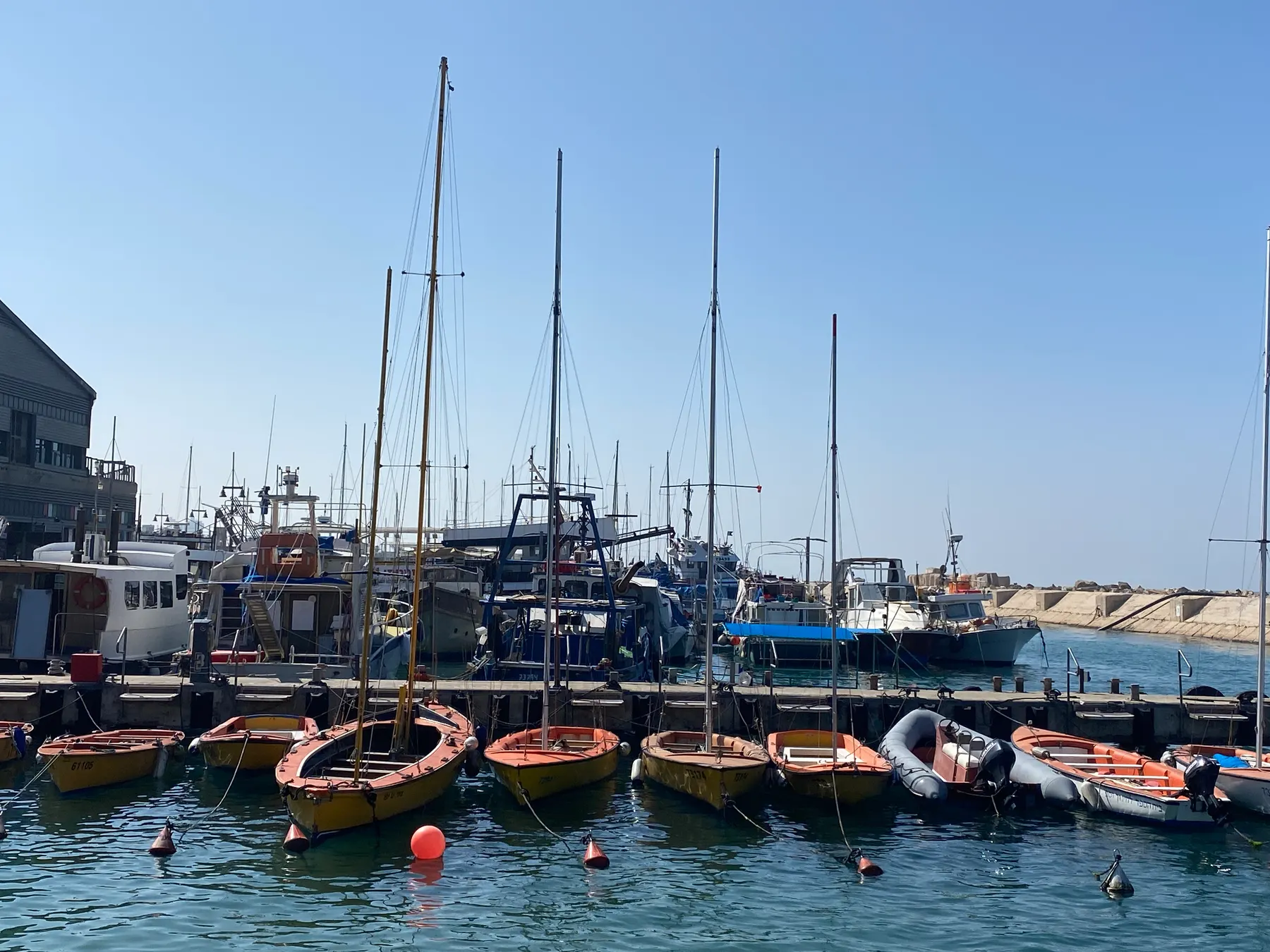
The quay, the breakwater and the three long sheds along it are British work of the mid-1930s, built for the orange trade on ground reclaimed from the sea, and two of those sheds were taken down and built again between 2019 and 2023.
Rakoon / CC0 · Wikimedia Commons
Market
Jaffa Flea Market
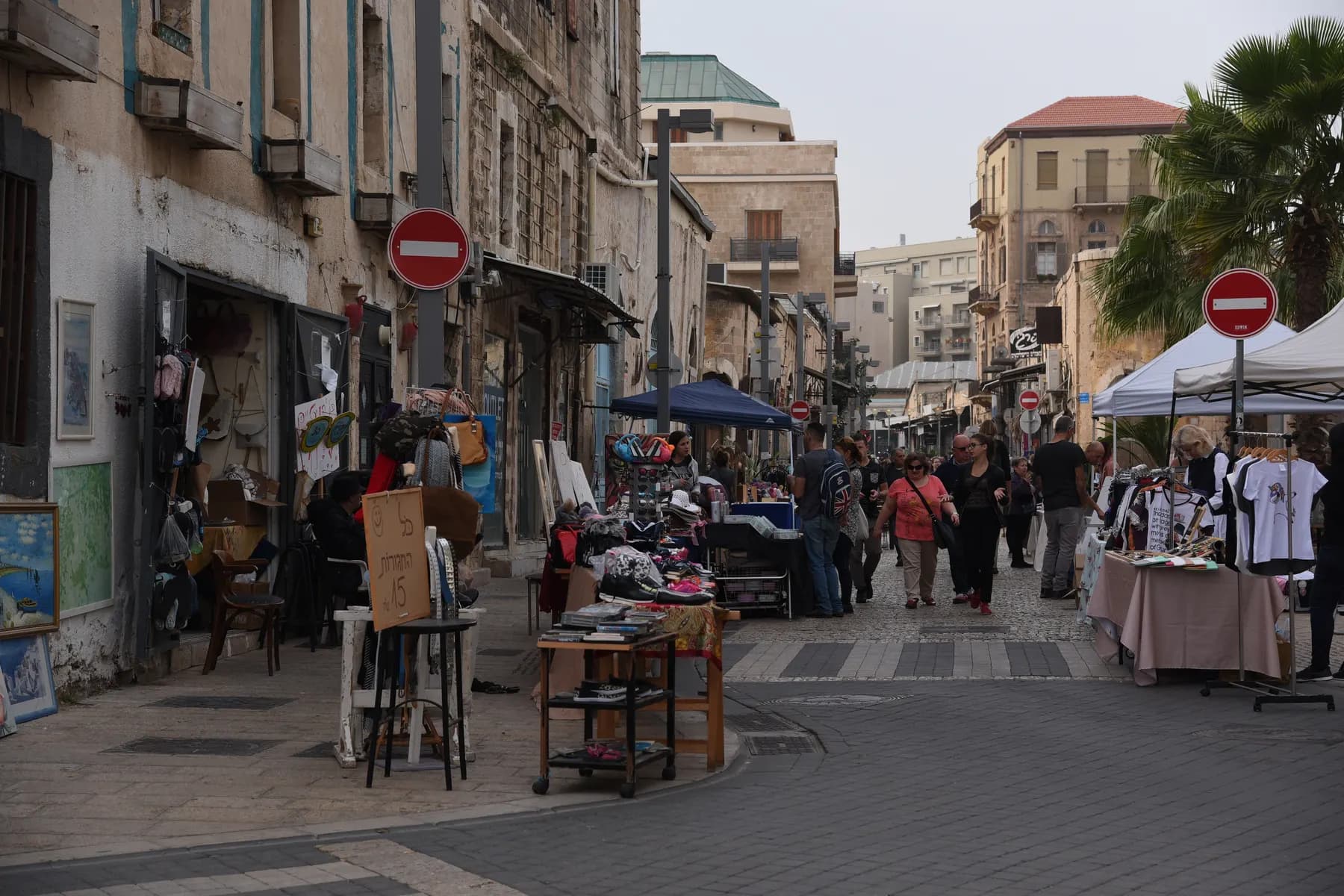
The market was pushed onto these streets in the late nineteenth century, when the Ottoman government cleared the ground where the clock tower now stands for its own administrative compound.
Sources and further reading
Every link below was opened and checked when this page was written. Official statements are marked as such: they are the subject's own account, not an independent one.
- OfficialVisit Tel Aviv, Tel Aviv-Yafo Municipalityvisit-tel-aviv.comOld Jaffa: meet the old city
The municipal tourism service's own page on Old Jaffa, used for what lies immediately north of Ajami: Kedumim Square and the visitor centre, the Mahmoudiya Mosque and Abu Nabbut, the antiquities building and HaPisga park. It publishes no hours, prices or Ajami-specific detail, which is why this page carries none from it.
- OfficialVisit Tel Aviv, Tel Aviv-Yafo Municipalityvisit-tel-aviv.comThe Jaffa Flea Market
The market southeast of the clock tower, its seven decades of operation and the summer Thursday-night events, used here only to place the nearest concentration of shops and bars relative to Ajami.
- OfficialPeres Center for Peace and Innovationperes-center.orgPeres Center for Peace and Innovation
The centre's own site, for the innovation visitor centre on the Ajami shore, its guided visits in groups of 20 lasting one hour and 45 minutes, and the fact that visits are arranged through the centre in advance.
- ReportingAssociated Press, via The Times of Israel (Ilan Ben Zion, 28 April 2021)timesofisrael.comAs tensions boil, Jaffa's Arab Israelis say gentrification is pushing them out
The 1950 absentee property law and the transfer of thousands of confiscated properties to state-run housing companies, the push from 2011 to sell them, Amidar's statement that it has no intention of expelling people and offers homes to tenants first at a significant discount, residents' account of rents of 5,000 to 6,000 shekels against a 6,000 shekel salary, and about 20,000 Arab residents in Jaffa.
- ReferenceEncyclopaedia Britannicabritannica.comJaffa
The 26 April 1948 Irgun attack, the displacement of nearly all of the city's 70,000 Arab Muslims and Christians, the fall of the city on 13 May, and the 4,000 who remained 'concentrated in the Ajami neighborhood, south of the old city'.
- ReferenceWikipediaen.wikipedia.orgAjami, Jaffa
Origin of the name in Ibrahim al-Ajami's maqam and the 1895 mosque built by Haj Yousef al-Manawi, the Maronite foundation of 1895 on 1,600 sq m and its replacement of 1901 to 1920 with the first stone on 28 February 1904, roughly 950 houses by 1924, the confinement of the remaining Palestinians behind a barbed-wire separation after 13 May 1948, the annulment of the mosque's waqf status, the some 497 Amidar eviction and demolition orders, and the Peres Center.
- ReferenceWikipediahe.wikipedia.orgAjami (Hebrew Wikipedia)
Boundaries against Old Jaffa, Givat Aliya and Tzahlon, the mid-nineteenth-century Maronite laying out of streets parallel to the shore, kurkar houses with courtyards, the 1950s demolition-and-reconstruction policy, the halt to renovation from the 1970s with each vacated house demolished, the construction waste tipped on the shore from 1975 to a mound about 15 metres high, and the conservation plan of the 1980s.
- ReferenceWikipediahe.wikipedia.orgMidron Yafo (Hebrew Wikipedia)
The park's 200 dunams from Jaffa Port to Givat Aliya beach, the waste tipping dated from late 1969, the Braudo-Maoz design at Ron Huldai's initiative, work from December 2005, completion in 2008, inauguration on 30 April 2010 after drought-related delays, the cost of about 60 million shekels, and the paths, promenade, three viewpoints, amphitheatre, sports area and car park.
- ReferenceWikipediaen.wikipedia.orgJaffa
The 3,800 Arabs who remained after the exodus, concentrated in the Ajami district under strict martial law, and the military administration continuing until 1 June 1949; also the description of Jaffa today as a mixed city.
- ReferenceWikipediaen.wikipedia.orgAjami (film)
The 2009 film by Scandar Copti and Yaron Shani set and shot in the neighbourhood, its cast of non-professional actors, and its status as the first predominantly Arabic-language film submitted by Israel for the Academy Award for Best Foreign Language Film, for which it was nominated.
- ReferenceWikipediaen.wikipedia.orgAbu Hassan (restaurant)
The HaDolphin Street original, Ali Karawan's handcart, the unsuccessful 1959 attempt and the opening in the early 1970s, the short menu of hummus, masabacha, ful medames and labaneh with the mixed plate, and the midday queue.
- ReferenceWikipediaen.wikipedia.orgTabeetha School
Founded 1863, run by the Church of Scotland at 21 Yefet Street, and open to children regardless of race, nationality, gender or religion.
- ReferenceWikipediaen.wikipedia.orgPeres Center for Peace
The building's location in Ajami on the Jaffa coast, Massimiliano Fuksas as architect, the opening in December 2009, and the floor area of 2,500 square metres.
- ReferenceWikipediaen.wikipedia.orgGiv'at Aliyah
The neighbourhood immediately south of Ajami, its shift from Arab fishing and merchant families to European immigrants after 1948, and the southernmost beach of Tel Aviv-Yafo within the Givat Aliya nature reserve.
Ajami: common questions
What is Ajami?+
Ajami is the residential quarter of Jaffa immediately south of the Old City, laid out from the mid-nineteenth century by Maronite Christian families and named after Sheikh Ibrahim al-Ajami, whose shrine is at its northern end. It is the neighbourhood where Jaffa's remaining Arab residents were concentrated after 1948, and it is now a mixed quarter of restored sandstone villas, public housing, vacant lots and a coastal park. It is an ordinary lived-in neighbourhood rather than a heritage site.
Do I need a ticket, and what are the opening hours?+
There is no ticket and there are no opening hours: Ajami is a quarter of public streets and Midron Yafo park below it is unfenced and free. The only paid thing on its shore is the Peres Center's innovation visitor centre, which is arranged in advance rather than at the door. The churches, the mosque and the school are working institutions, so access to them depends on the community and on what is happening that day.
Is there actually anything to see, or is it just houses?+
It is largely houses, and that is the subject. The interest is in the kurkar villas with their courtyards and arched windows, the Maronite church at the foot of Dolphin Street, the 1895 mosque, and the vacant lots between them that record the demolitions of the 1950s to 1970s. Anyone who wants monuments and captions will be happier in the Old City ten minutes north; anyone who wants to understand what happened to Jaffa should walk here.
Is it worth it if I only have half a day in Jaffa?+
Probably not, if it is a first visit and the Old City has not been seen. With half a day the port, Kedumim Square and the flea market are the denser experience, and Ajami rewards a second visit or a slower one. Two hours covers Yefet Street, the villa streets below it and a stretch of the park, and the northern end is a walk of roughly ten minutes from Kedumim Square. If the point of the trip is to understand Jaffa rather than to photograph it, invert the advice and come straight here.
Can I swim below Ajami?+
Yes, at the southern end, where Midron Yafo park runs down to the Givat Aliya beach, the southernmost beach of Tel Aviv-Yafo. The shore directly below the quarter is the rebuilt slope and its promenade rather than a swimming beach. Check which beaches are staffed by lifeguards and in what season before planning to swim, because that is set by the municipality and changes.
Is there shade?+
Not much, and less than the map suggests. Midron Yafo park was only inaugurated in 2010 and its planting is still young, so the shade is patchy and concentrated at the shaded spots the designers built in. The residential streets have mature trees in courtyards more often than over the pavement. In July and August the sensible plan is late afternoon.
Is Ajami wheelchair accessible?+
The park is, the neighbourhood partly is, and the drop between them is the problem. Midron Yafo's promenade and its north to south routes are made paths graded for bicycles; the quarter's own streets are flat but have narrow, uneven and heavily parked pavements. The east to west descents cross a made mound the Hebrew sources put at about 15 metres high, so it is better to approach the shore along the promenade from the port than to come down through the neighbourhood.
What happened here in 1948?+
The Arab residents who remained in Jaffa after the city fell on 13 May 1948 were concentrated in Ajami under martial law, with a barbed-wire separation from the surrounding Jewish quarters and permits required to leave. How many remained is disputed: Britannica says 4,000, the English Wikipedia article on Jaffa says 3,800, and its article on Ajami says roughly 3,000. The military administration ended on 1 June 1949, and a 1950 absentee property law transferred thousands of empty houses to state housing companies.
Is this the neighbourhood from the film Ajami?+
Yes. The 2009 film by Scandar Copti and Yaron Shani was shot in these streets with a cast largely of non-professional actors who lived here, and it was the first predominantly Arabic-language film Israel submitted for the Academy Award for Best Foreign Language Film, where it was nominated. There are no location tours and no markers. Watching it before a visit is a better preparation than looking for the corners in it.
Is it safe to walk around?+
It is an ordinary residential quarter of Tel Aviv-Yafo, walked daily by the people who live in it, and the usual city common sense is what applies. The reputation it carries dates from decades when it was the poorest neighbourhood in the city and is out of date as a description of the streets. The real caution is social rather than physical: this is a neighbourhood in the middle of a housing dispute, and it is not a set.