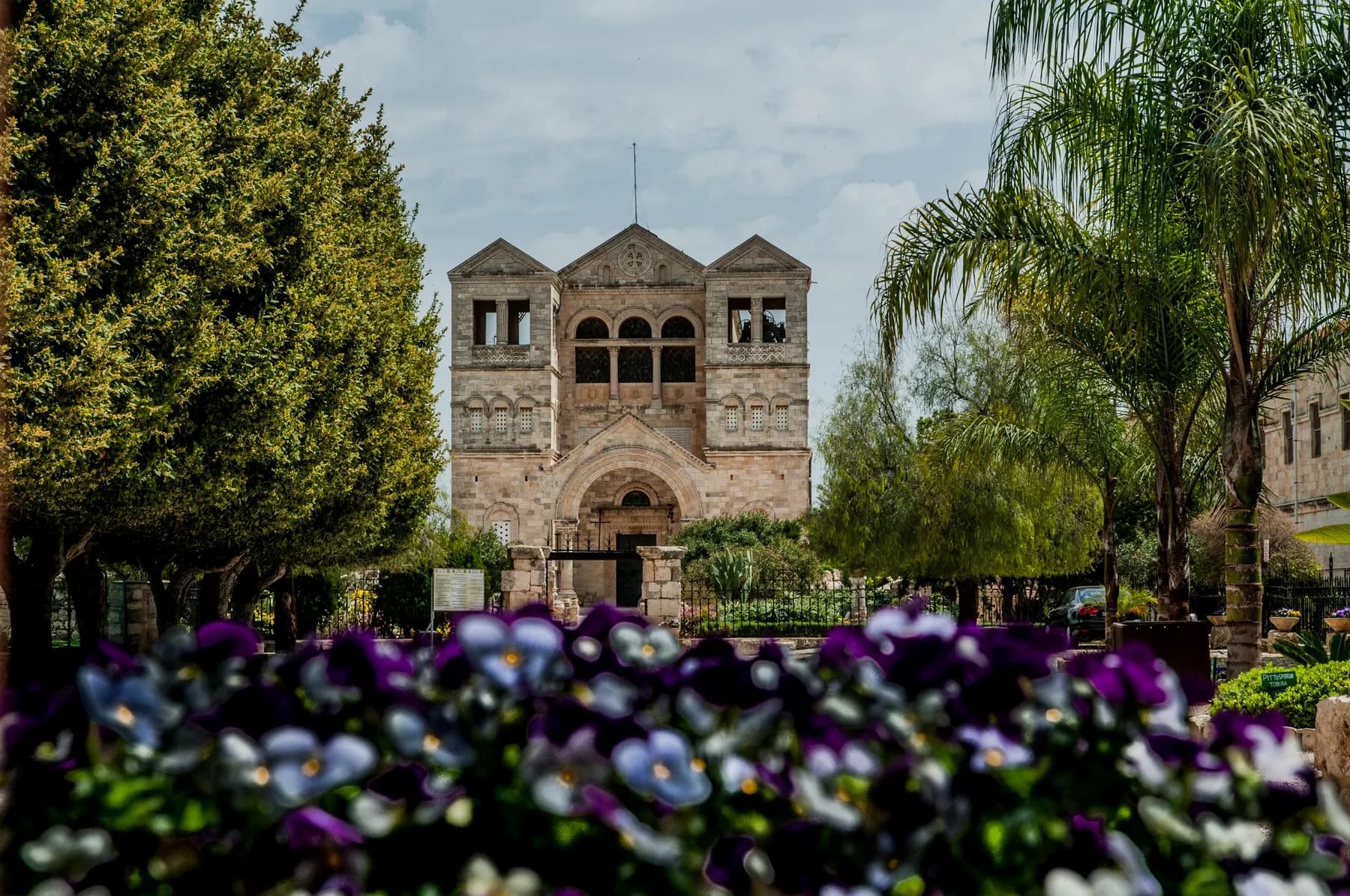
Religious site · The Galilee
Mount Tabor
Antonio Barluzzi's first church in the Holy Land stands on this dome of a hill above the Jezreel Valley, built between 1921 and 1924 over a Byzantine apse and the ruins of a Benedictine abbey that Baibars levelled in 1263.
עמוס גל / CC BY-SA 4.0 · Wikimedia Commons
Summit
588 metres
Britannica's figure and the Custody's; the Parks Authority publishes 562 m and Wikipedia 575 m for the same hill
The basilica
1921 to 1924
Antonio Barluzzi's first completed church, on the account the Custos gave at its centenary in 2023
Admission
Free
the Israel Nature and Parks Authority states entry is free of charge; the Custody publishes hours and no ticket price
Bends on the summit road
about sixteen
counted the same way by two unconnected visitor accounts; coaches cannot take them, so taxis run from the foot
In short
- How long to give it
- about 90 minutes on the summit for the basilica, the crypt, the Benedictine ruins and the terraces, or half a day if the five-kilometre green trail is walked up from Shibli
- Monday to Friday
- 08:00 to 17:00
- The mountain, the reserve and the car parks
- Free. The Israel Nature and Parks Authority states that entry to the place is free of charge and that there is a car park
הר תבור · جبل طابور
Mount Tabor is an isolated dome of a hill at the eastern end of the Jezreel Valley, about 8 kilometres from Nazareth as the crow flies, carrying two working monasteries on its summit: a Franciscan one on the south-east side and a Greek Orthodox one on the north-east. The Franciscan Basilica of the Transfiguration is the building visible from the plain, and the one open to visitors.
Even the height is not agreed. Britannica and the Custody of the Holy Land both give 588 metres; the Custody's own news desk wrote 580 in 2023; Wikipedia says 575; the Israel Nature and Parks Authority, which manages the reserve the hill sits inside, publishes 562. The number that matters to a visitor is the other one: the summit stands roughly 400 to 450 metres above the ground immediately around it, which is why a modest hill dominates a very large view.
Geologically it is a monadnock, an isolated rise from level ground with no volcanic origin, and despite sitting beside the Nazareth hills it is a separate formation. That shape explains most of what follows. It made the hill a refuge and a fortress, fought over from the Book of Judges to May 1948, and the obvious candidate for the gospels' unnamed high mountain. It is also why the road to the top folds back on itself about sixteen times and why buses have to stop at the bottom.
The hill
A separate mountain, and four published heights for it
Tabor rises from flat land at the eastern end of the Jezreel Valley, about 18 kilometres west of the Sea of Galilee, with the villages of Daburiyya, Shibli and Umm al-Ghanam ringing its base. It is a monadnock: an isolated hill rising abruptly from level or gently sloping ground, not a volcano, and geologically distinct from the Nazareth range beside it.
The published elevations do not agree and nobody has reconciled them. The Custody of the Holy Land's page for the sanctuary says 588 metres above sea level and 450 metres above the plain, and Britannica's 1,929 feet is the same figure. A Custody news report from August 2023 says 580. Wikipedia gives 575. The Israel Nature and Parks Authority, which declared the mountain a nature reserve and national park in 1991, publishes 562 metres and around 400 above the surrounding terrain. The spread is about 26 metres, and no source explains where its figure came from.
Most of the hill is wooded, in Palestine oak and the Mount Tabor oak that carries the mountain's name in its Latin binomial, Quercus ithaburensis. Wikipedia's account records up to 400 plant species here and notes that the woodland was largely felled under Ottoman rule for the charcoal trade and replanted by the Jewish National Fund in the 1960s and 1970s. What a visitor walks through is a reconstruction of an older landscape, not a survival of it.
Sieges
The hill everyone wanted, from Deborah to the Golani Brigade
Tabor sat above an important junction: the Via Maris ran past its foot from the Jezreel Valley north towards Damascus, crossing the Galilee's north to south route. A defensible dome above a road junction attracts armies. In Judges the prophetess Deborah tells Barak to draw ten thousand men to Tabor, and it is the descent from the hill that breaks Sisera's Canaanite force in the plain below.
The Roman-period episodes are the best documented. In 55 BCE, during a Hasmonean revolt against the proconsul of Syria Aulus Gabinius, Alexander of Judaea was beaten at Tabor and as many as 10,000 of his men were killed. In 66 CE the mountain was one of nineteen sites in Galilee fortified on the orders of Yosef ben Matityahu, the commander who later wrote the war up as Flavius Josephus. Vespasian sent Placidus with 600 cavalry; unable to force the summit, he lured the defenders down to negotiate and cut them off from the slope, and the rest held out on top until their water ran out.
The medieval sequence, listed below, is a fortress changing hands roughly once a generation, and its end is what matters on the ground: in 1263 the Mamluk sultan Baibars took the mountain and destroyed every building on it. Everything medieval a visitor sees today is a ruin from before that year.
On 16 April 1799, in the plain between Tabor and the Hill of Moreh, about 3,000 French under Kléber and Bonaparte routed an Ottoman army of about 35,000 sent from Damascus to lift the siege of Acre, for the loss of two dead and sixteen wounded. At the start of May 1948 the Golani Brigade took the mountain. Most of the Arab al-Sabihi tribe living on it were forced out to Syria and Jordan; the Shibli clan refused to leave, and the village at the foot of the road, Shibli-Umm al-Ghanam, is theirs.
- Judges 4-5: Deborah, Barak and the descent on Sisera
- 55 BCE: Alexander of Judaea beaten here by Gabinius' Romans
- 66-67 CE: Josephus fortifies the summit; Placidus starves it out
- 1101: Benedictines rebuild the basilica and fortify the abbey
- 1212: al-Adil's fortress; 1217: the Fifth Crusade fails to take it
- 1263: Baibars levels everything on the mountain
- 16 April 1799: Kléber and Bonaparte rout the army of Damascus below
- May 1948: the Golani Brigade takes the hill
The tradition
The gospels never name the mountain, and the argument is on the page
Matthew, Mark and Luke all put the Transfiguration on a high mountain and none says which. The identification with Tabor is a later inference, and the Custody of the Holy Land sets out its reasoning openly rather than asserting the site: Matthew and Mark say Jesus led the three disciples up by themselves, and the Greek can also be read as separately, which suits a hill standing apart from every other summit in Galilee.
The naming runs back to the fourth century at the latest. Cyril, bishop of Jerusalem, states the Tabor tradition in the year 348, and Jerome repeats it. Wikipedia traces the earliest identification to Origen in the third century, an attribution the Custody notes is accepted by some scholars and not by others.
There has never been a consensus. Eusebius of Caesarea, who died in 339, preferred Mount Hermon, and the Custody's own page notes drily that Eusebius knew the psalm verse pairing Tabor and Hermon and hedged by placing the event on both. Nineteenth-century scholarship doubted Tabor outright, Henry Alford in 1868 among them. What the mountain holds with confidence is the tradition, continuously, since the fourth century.
Older layers sit under the Christian one. The Custody records a Canaanite sanctuary of Baal on the summit and the export of that cult to Rhodes, where Zeus Atabyrios carried an epithet meaning of Tabor. In the Second Temple period this was one of the peaks on which beacons were lit to carry news of the new month north.
The building
Barluzzi's first church, and the roof that did not work
A new shrine was begun in 1912 with the engineer Giulio Barluzzi and stopped by the Italian-Turkish war. The commission passed to Giulio's younger brother Antonio, who had drawn plans before the First World War and returned to Jerusalem after it to find the new Custos, Ferdinando Diotallevi, holding them. The foundation stone went down on 21 October 1919, the seventh centenary of Francis of Assisi's arrival in the Holy Land. Custos Francesco Patton, opening the centenary jubilee in August 2023, dated the building to 1921 to 1924 and called it Barluzzi's first work.
The style is Syro-Roman, after the churches of the fourth and fifth centuries, and the plan is three naves with two towers at the west end. The towers are not decorative: on the Custody's account they stand over the ancient oratories of Moses and Elijah, and each holds a chapel dedicated to one of them, Elijah in the south tower and Moses in the north. Steps climb from the side aisles to the raised high altar under the apse mosaic, and a second staircase, as wide as the central nave, drops into an open crypt where the ancient apse has been preserved in place.
The mosaics were made by the firm Monticelli to preparatory drawings by Rodolfo Villani, and the crypt scheme takes trans-figuration literally: Jesus in the successive figures of his birth, the Eucharist, the cross and the resurrection. Wikipedia's account adds that on 6 August, the feast of the Transfiguration, the sun strikes a glass plate set into the floor and briefly lights the gold mosaic above the altar.
The most interesting thing about the building is a failure, and only one source states it. Wikipedia's article says Barluzzi roofed the church in alabaster panels to flood it with light, but that the alabaster could not be made watertight and had to be covered with an ordinary opaque roof. The Custody's own page does not mention it and no second published account was found, so it is set down here as Wikipedia's claim rather than as fact. The light theme itself is not in doubt: the alabaster window survives in the crypt.
The fabric still needs work. The engineering practice R-Struct records its 2019 appointment to consolidate and seismically improve the two bell towers and rebuild the bell frame, having found corroded steelwork with plates detached and holes opened in the profiles.
The summit
What else is up there, and which half of it opens
The road ends at a fork. Left goes to the Greek Orthodox property, right through the arched Crusader gateway everyone calls the Gate of the Winds into the Franciscan enclosure. Just inside on the left are a small cemetery and the Chapel of the Descendentibus, unglazed and rebuilt in 1923, named for the disciples coming down the mountain in Mark 9.
North of the basilica lie the ruins of the medieval Benedictine monastery: a chapel, and behind it the chapter hall and the refectory. The watchtower south of the church is Saracen work, on the Custody's attribution, and the wall lines further down the slope are Roman. Quarry caves in the summit rock supplied the stone, and one of them, under the Greek church, is open to visitors.
The Franciscan monastery in front of the sanctuary was built in 1873 to 1875, with a Casa Nova attached as a pilgrim hostel. Since 2006 it has been run with the help of Mondo X, an Italian association founded in 1961 whose members are people recovering from drug dependency.
The Greek Orthodox side is the half most visitors never see. Its main church was begun in 1859 by the Romanian monk Irinarh Rosetti, who died that year, and finished by his disciple Nectarie Banul in 1862; the Custody dates the church of St Elias on the same property to 1911, raised on Crusader foundations that stand in turn on Byzantine ones, as the mosaic floor shows. The Parks Authority states that it opens only a few days a year, the all-night vigil falling on 19 August.
The night before 6 August is the one to know about. Christian families from across Galilee come up the evening before and sleep in tents on the summit, a custom the Custody traces to Ottoman times, when the friars owned the place but were allowed onto it only once a year.
- The Gate of the Winds, the Crusader arch into the Franciscan enclosure
- Chapel of the Descendentibus, rebuilt 1923, unglazed
- Benedictine chapel, chapter hall and refectory, north of the basilica
- Saracen watchtower to the south; Roman wall lines further down
- Franciscan monastery and Casa Nova, 1873 to 1875
- Greek Orthodox monastery church, 1859 to 1862, rarely open
- The Melchizedek grotto, restored 2009, usually locked
The road
Sixteen bends, no coaches, and four ways up on foot
The summit road is the practical problem and the reason the visit needs planning. It is narrow, steep and folds back on itself repeatedly on the climb from between Daburiyya and Shibli; two unconnected visitor accounts count the bends at sixteen. The Israel Nature and Parks Authority states the consequence flatly: the winding road makes it impossible to travel by bus, so a visitors' centre has been set up at the foot near Shibli, and taxi rides to the top are organised from there. Private cars and vans can drive up; coach groups transfer at the bottom.
There are two free car parks at the top. The one by the Church of the Transfiguration is the larger and fills; the Greek Orthodox one is usually emptier and leaves a walk of roughly 500 metres to the main entrance. Neither the Parks Authority nor the Custody publishes a fare for the taxis, so budget for a negotiated local price rather than a posted one.
On foot there are four marked routes, all listed by the Parks Authority: a black loop around the mountaintop past the viewpoints, a steep green trail up from the west side of Shibli along the Foresters' Road, a blue trail from near Gazit Junction up the eastern slope, and a red trail from east of Umm al-Ghanam. The Israel National Trail comes in on the blue, joins the black and leaves on the green; the walk up from Shibli is about five kilometres.
What to look for
Things not to walk past at Mount Tabor
The details that repay knowing about before you are standing in front of them.
The crypt and the ancient apse
A staircase as wide as the central nave drops from the church floor into an open crypt where the apse of the earlier church has been kept in place. The mosaics down there work through the Nativity, the Eucharist, the cross and the resurrection as successive figures of the one person.
The chapels in the two towers
Elijah in the south tower, Moses in the north, each raised over what the Custody identifies as the ancient oratory of that prophet. It is the plan of the building making the same argument as the mosaic above the altar.
The terraces beside the basilica
The panorama runs from the Golan and the Gilead highlands in the east round to Gilboa and Samaria, Carmel in the west and Upper Galilee to the north. On a clear day Mount Hermon is visible, snow-covered into early summer.
The Benedictine ruins north of the church
A chapel, a chapter hall and a refectory from the fortified abbey the Benedictines raised in 1101 and Baibars destroyed in 1263. Most groups walk past them on the way to the door.
The Gate of the Winds
The Crusader arch you pass through to enter the Franciscan property, renovated by monks in the nineteenth century. Beyond it on the left are the cemetery and the unglazed Chapel of the Descendentibus, rebuilt in 1923.
The alabaster peacock window in the crypt
Peacocks, symbols of the resurrection, set around a chalice and the triangle of the Trinity. It is the surviving fragment of Barluzzi's plan to build the whole church out of light.
The long view
Mount Tabor, in order
13th century BCE
Mount Tabor appears in Egyptian records from the reign of Ramses II, on Britannica's account.
c. 11th century BCE
Judges 4-5: Deborah sends Barak and ten thousand men to Tabor, and the descent breaks Sisera's Canaanite force in the plain.
55 BCE
Alexander of Judaea is defeated at Tabor by the Roman proconsul Aulus Gabinius. As many as 10,000 of his men are killed.
66 CE
Josephus fortifies the summit as one of nineteen rebel strongholds in Galilee. Vespasian sends Placidus with 600 cavalry; the defenders surrender when the water runs out.
348
Cyril, bishop of Jerusalem, states the tradition that the Transfiguration happened on Tabor. Eusebius, who died in 339, had preferred Hermon.
c. 570
The pilgrim of Piacenza reports three basilicas on the summit, matching the three tents Peter offered to build.
8th century
A document of Charlemagne's era records four churches on the mountain served by eighteen monks.
1099
Crusaders fortify the summit monastery to protect pilgrims.
1101
Benedictine monks rebuild the ruined basilica and raise a fortified abbey, whose chapel, chapter hall and refectory are still on the ground.
1212
The Ayyubid sultan al-Adil I takes the hill and builds a large fortress on the summit.
1217
The armies of the Fifth Crusade besiege al-Adil's fortress and fail to take it.
1229
Under Frederick II's treaty with al-Kamil, Christians occupy the mountain again and the monks return.
1263
The Mamluk sultan Baibars takes the fortress and razes every church on Mount Tabor. Pilgrimage all but stops.
1581
Grand Vizier Sinan Pasha founds the al-Tujjar caravanserai on the lower slopes, on the argument that merchants and pilgrims were unsafe here.
1631
The Druze emir Fakhr ad-Din allows the Franciscans to open a community on the mountain. The Greek Orthodox receive the same concession shortly after.
16 April 1799
In the plain between Tabor and the Hill of Moreh, about 3,000 French under Kléber and Bonaparte rout an Ottoman army of about 35,000 sent from Damascus to relieve Acre.
1859 to 1862
The Greek Orthodox monastery church is begun by the Romanian monk Irinarh Rosetti and completed by his disciple Nectarie Banul.
1873 to 1875
The Franciscan monastery is built in front of the sanctuary, with a Casa Nova attached for pilgrims.
1911
The Greek Orthodox church of St Elias is raised on Crusader foundations that stand in turn on Byzantine ones, as its mosaic floor shows.
1912
The guardian of Tabor starts work on a new shrine with the engineer Giulio Barluzzi. The Italian-Turkish war stops the project.
21 October 1919
The foundation stone of the basilica is laid, on the seventh centenary of Francis of Assisi's arrival in the Holy Land.
1921 to 1924
Antonio Barluzzi builds the Basilica of the Transfiguration, his first completed church, over the Byzantine and Crusader remains.
1923
The Chapel of the Descendentibus at the entrance to the shrine is rebuilt in Byzantine style, without glazing.
May 1948
The Golani Brigade takes Mount Tabor. Most of the Arab al-Sabihi tribe are forced out; the Shibli clan stay, and their village sits at the foot of the road.
1960s and 1970s
The Jewish National Fund replants the hill, felled for charcoal under Ottoman rule, with Tabor oak and Palestine oak.
1991
Mount Tabor is declared a nature reserve and national park by the Israel Nature and Parks Authority.
2006
The Mondo X community, an Italian association working with people recovering from drug dependency, begins maintaining the Franciscan complex.
2019
The engineering practice R-Struct is appointed to consolidate and seismically improve the two bell towers and rebuild the corroded bell frame.
6 August 2023
Custos Francesco Patton opens the Jubilee of the centenary of the basilica by unsealing the Holy Door.
Practical
Visiting Mount Tabor
Where
Mount Tabor summit, above Shibli-Umm al-Ghanam, Lower Galilee. Franciscan monastery: P.O.B. 16, Monte Tabor, 1610001 Nazareth
What ticket you need
The summit sits inside Mount Tabor Nature Reserve and National Park, declared in 1991, but no ticket is involved: the Parks Authority states entry is free and the religious institutions themselves operate and maintain the churches and the antiquities at the top. In practice the mountain is a free public reserve wrapped around two private monastic enclosures that keep their own hours, and the Greek Orthodox one is shut almost all year.
Opening hours
- Monday to Friday
- 08:00 to 17:00source
- Saturday and Sunday
- 08:00 to 12:00 and 14:00 to 16:30, so the shrine shuts over the middle of the day at the weekend and not on weekdayssource
- Yom Kippur
- Closedsource
- Holy Week
- The Custody notes that times may change. Telephone the monastery on +972 4 667 6300 before travelling in that weeksource
- Greek Orthodox monastery
- The Israel Nature and Parks Authority states it opens only a few days a year. The all-night vigil is on 19 August, which is 6 August by the Julian calendarsource
Admission
- The mountain, the reserve and the car parks
- Free. The Israel Nature and Parks Authority states that entry to the place is free of charge and that there is a car parksource
- Basilica of the Transfiguration
- No charge. The Custody of the Holy Land publishes opening hours and a telephone number for the shrine and no ticket price of any kindsource
- Taxi from the visitors' centre to the summit
- No fare is published. The Parks Authority states only that taxi rides to the top are organised from the visitors' centre near Shibli, because the winding road makes it impossible to travel by bus. Agree the price in shekels before setting offsource
Access
Mixed, and the split is not where people expect. The summit itself is easy: the road goes to the top and there are car parks inside both monastery enclosures, so nobody has to climb the hill to reach the church door. Inside the basilica is harder. Steps lead up from the side aisles to the raised high altar, and the crypt with the preserved ancient apse is reached only by the wide staircase down from the nave, so a wheelchair user sees the church and the apse mosaic but not the crypt. The walking routes are not an option for wheelchairs: the green trail from Shibli is explicitly described by the Parks Authority as steep, and it is about five kilometres. Neither the Custody nor the Parks Authority publishes an accessibility statement for this site, so anything beyond the above should be confirmed with the monastery on +972 4 667 6300.
On site
- Two free car parks at the summit
- Organised taxis from the visitors' centre at Shibli
- Casa Nova pilgrim hospice
- Franciscan monastery and parish shrine
- Greek Orthodox monastery, rarely open
- Marked trails in four colours
- Israel National Trail passes through
- Picnic esplanade in front of the basilica
- No bus access to the summit
Booking
Nothing is booked to visit. Groups arriving by coach must transfer to taxis at the visitors' centre near Shibli, because the road cannot take a bus, and that transfer is the step tour itineraries most often leave out. Mass and group liturgies are arranged through the Franciscan monastery on +972 4 667 6300 or +972 4 662 0720.
Hours and prices are given as the operator publishes them and change without much notice, particularly around Shabbat and the festivals. Check the operator's own page before you travel for this.
Official page at custodia.org →What people wish they had known
- The coach does not go up. Small vehicles only: the Parks Authority says outright that the winding road makes bus travel impossible, and groups transfer to taxis at the visitors' centre near Shibli. Itineraries that promise a coach to the summit are describing something that cannot happen.
- The weekend hours are the trap. The Custody opens the shrine straight through from 08:00 to 17:00 Monday to Friday, but on Saturday and Sunday it shuts from 12:00 to 14:00, which is exactly when most day trips from Nazareth or Tiberias arrive.
- Do not plan around the Greek Orthodox church. It is the second monastery on the summit and the Parks Authority states it opens only a few days a year, so for almost every visitor the mountain means the Franciscan side and the view.
- Take the crypt. The wide staircase down from the nave leads to the preserved ancient apse, and the mosaics there are the point of the whole building, but groups on a schedule stop at the altar rail and turn round.
- Park at the Greek Orthodox lot if the church lot is full. It is usually emptier and costs about 500 metres of walking, which is less than circling the summit road looking for a space.
- If the visit is on 5 or 6 August, expect the mountain to be full. Christian families from across Galilee camp overnight on the summit the night before the Transfiguration, a custom the Custody traces to the Ottoman period when the friars could come up only once a year.
The figures
Mount Tabor by the numbers
Each figure carries the year it belongs to and links the source it came from.
| Measure | Figure | As of | Source |
|---|---|---|---|
| Summit elevation | 588 m (1,929 ft) | 2026 | britannica.com |
| Height above the plain | about 450 m | 2026 | custodia.org |
| Elevation as the Parks Authority publishes it | 562 m, and about 400 m above the surrounding terrain | 2026 | en.parks.org.il |
| Distance from Nazareth, as the crow flies | 8 km | 2026 | custodia.org |
| Distance west of the Sea of Galilee | 18 km | 2026 | en.wikipedia.org |
| Declared a nature reserve and national park | 1991 | 1991 | en.parks.org.il |
| Plant species recorded on the mountain | up to 400 | 2026 | en.wikipedia.org |
| Population of Shibli-Umm al-Ghanam at the foot | 6,476 | 2024 | en.wikipedia.org |
While you are here
The rest of The Galilee
Everything else in this destination with a page of its own.
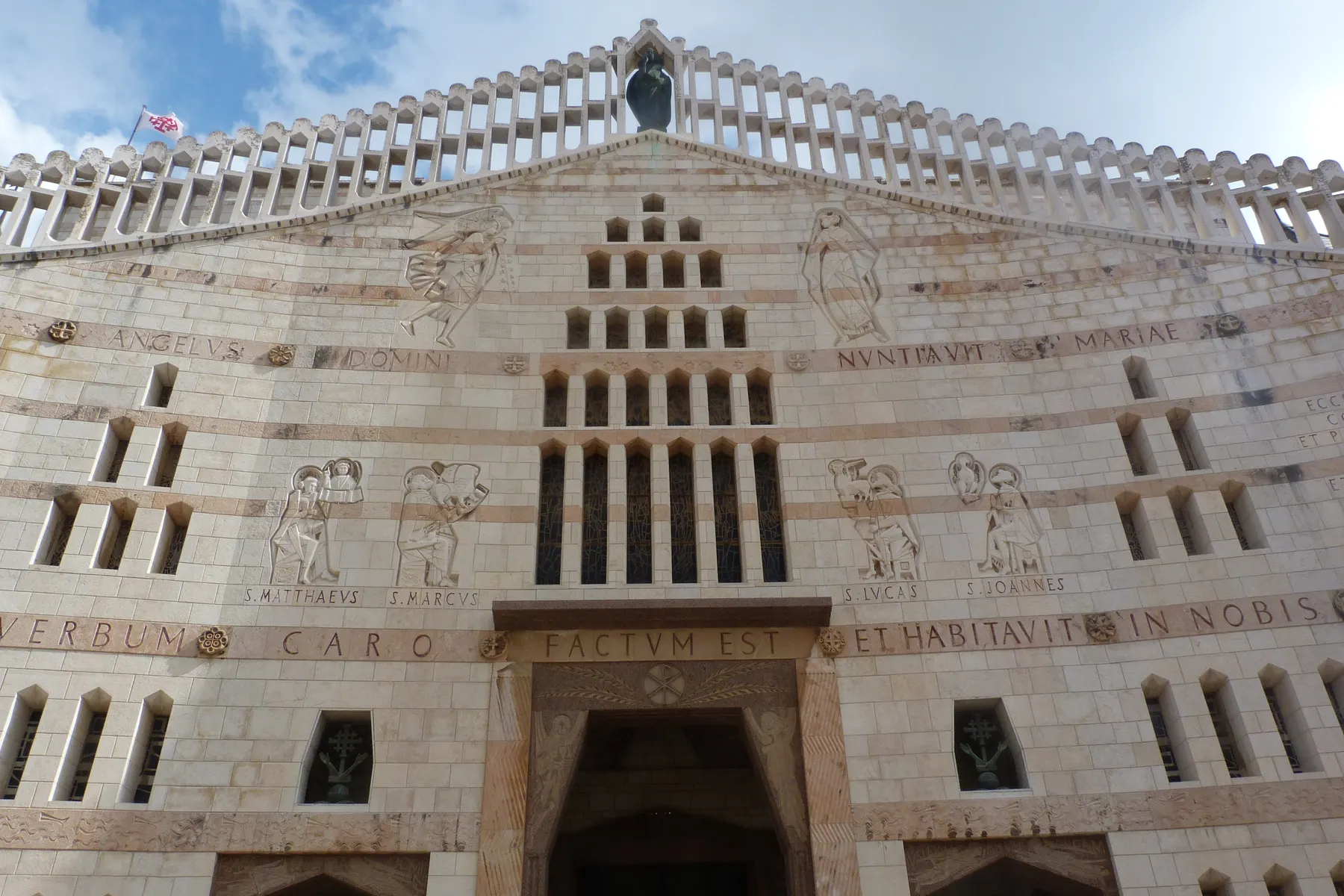
כובש המלפפונים / CC BY-SA 4.0 · Wikimedia Commons
Religious site
Basilica of the Annunciation
The Custody of the Holy Land dropped Antonio Barluzzi's design for this church and built Giovanni Muzio's instead: two churches stacked over one rock-cut cave, with the excavated village of Nazareth left open in the floor between them.
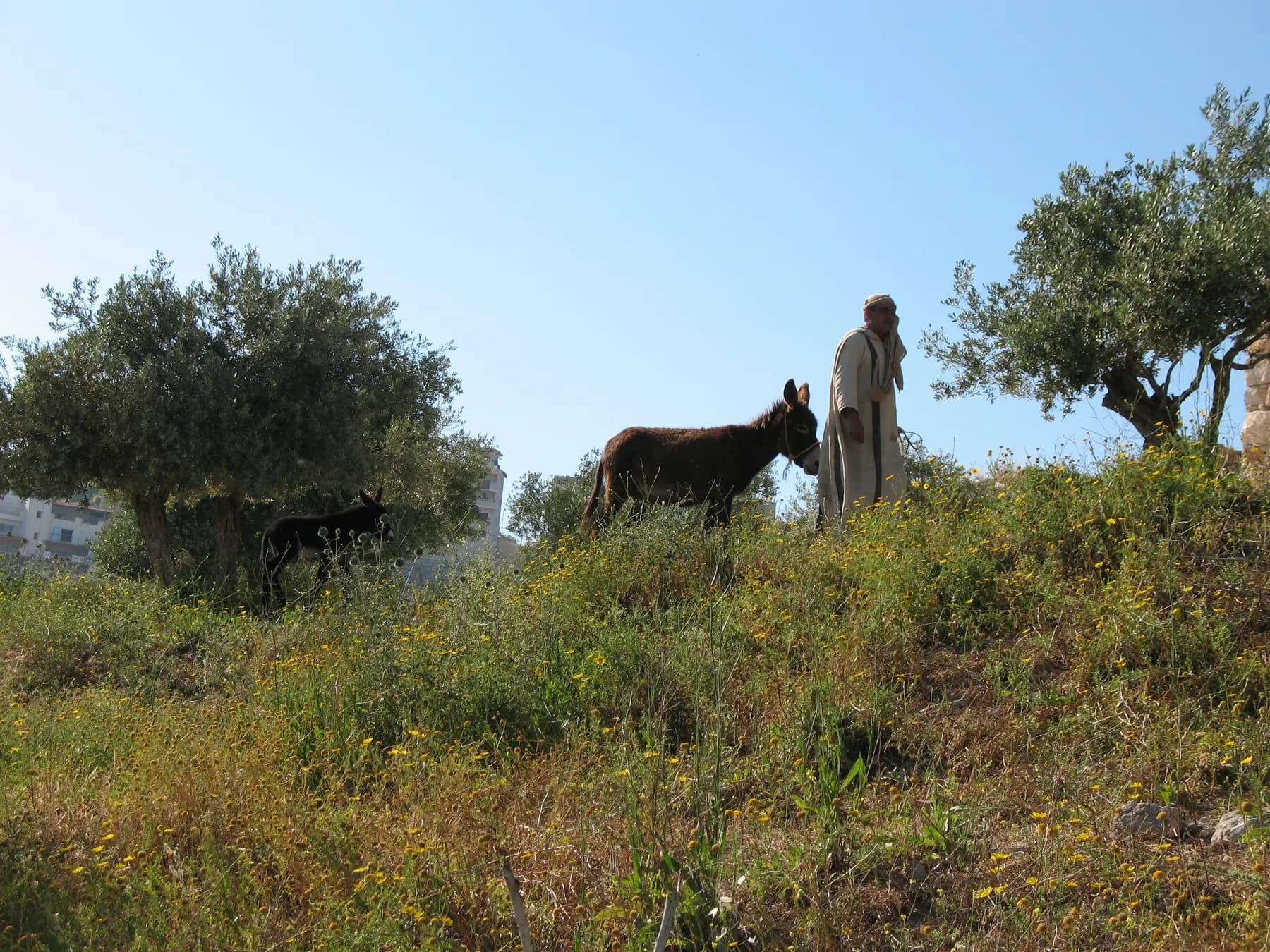
Museum
Nazareth Village
The hillside was quarried and farmed in the Late Hellenistic and Early Roman periods, and the wine press cut into its bedrock sits about 500 metres from the centre of the village Nazareth grew out of.
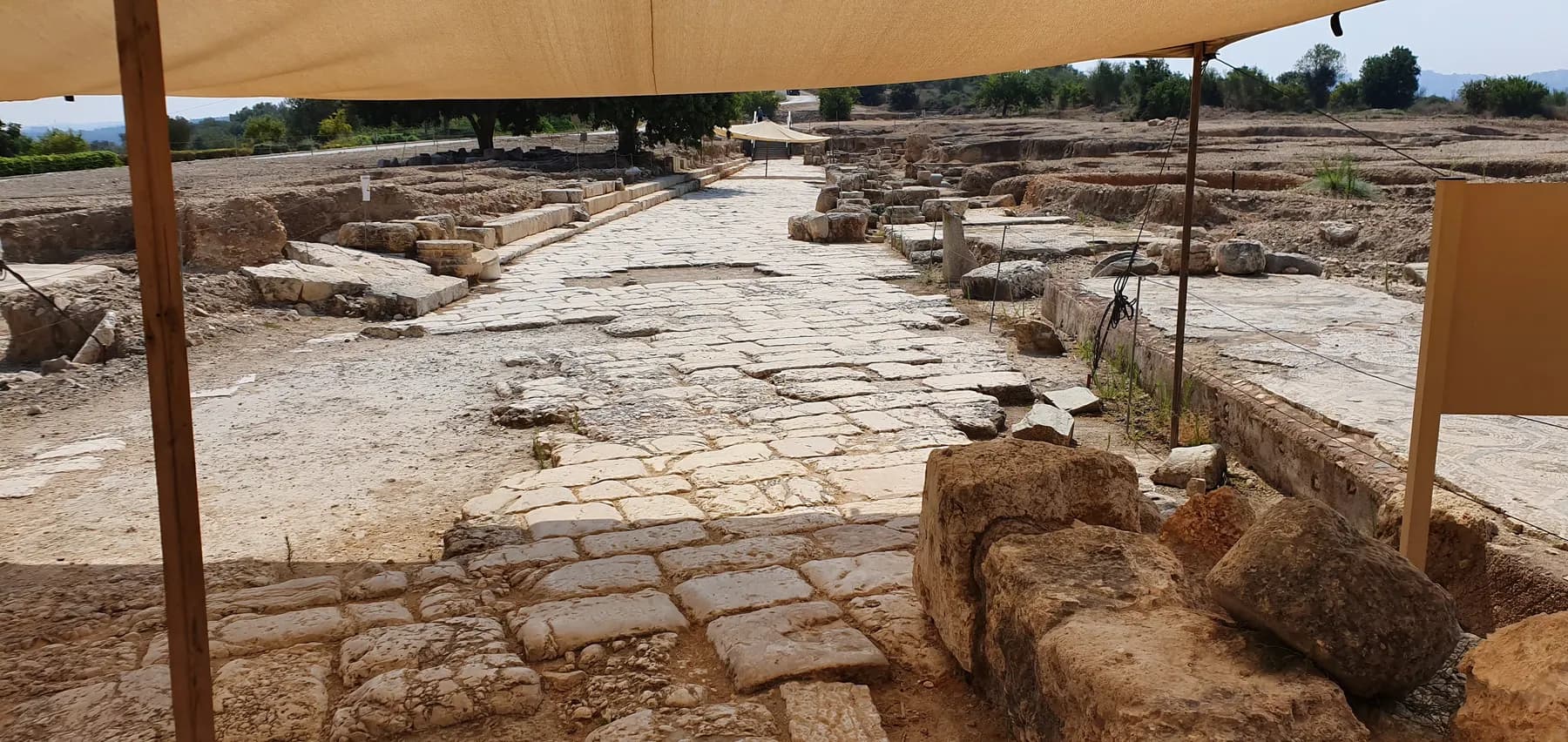
Yair Haklai / CC BY-SA 4.0 · Wikimedia Commons
Archaeological site
Zippori National Park
The Roman capital of the Galilee, where the dining room of a third-century mansion holds the face known as the Mona Lisa of the Galilee and a rock-cut reservoir 260 metres long runs under the hill to the east.
Sources and further reading
Every link below was opened and checked when this page was written. Official statements are marked as such: they are the subject's own account, not an independent one.
- OfficialCustody of the Holy Landcustodia.orgMount Tabor: Basilica of the Transfiguration
Opening hours, telephone and postal address; 588 m and 450 m above the plain; 8 km from Nazareth; the Baal and Zeus Atabyrios cult; the Piacenza pilgrim's three basilicas and the four churches with eighteen monks; the Crusader and Benedictine sequence to Baibars in 1263; Fakhr ad-Din in 1631; the 1921-24 basilica and its plan, towers, crypt and mosaics; the Gate of the Winds, Descendentibus chapel, Saracen watchtower and Roman walls; the 1873-75 monastery, Casa Nova and Mondo X; the Greek Orthodox property, St Elias of 1911 and the Melchizedek grotto; the panorama from the terraces
- OfficialIsrael Nature and Parks Authorityen.parks.org.ilMount Tabor Nature Reserve and National Park
Free entry and car park; the winding road that buses cannot use and the organised taxis from the visitors' centre near Shibli; the black, green, blue and red trails and the Israel Trail's line through them; the Greek Orthodox church opening only a few days a year; 562 m and about 400 m above the surrounding terrain; the 1991 declaration; the oak woodland, the flowering seasons and the quarry caves
- OfficialCustody of the Holy Landcustodia.orgA double celebration on Mount Tabor for the Transfiguration of Jesus and the Jubilee of the Centenary of the Basilica
Dated 6 August 2023. Custos Francesco Patton dating the basilica to 1921-24 and calling it Barluzzi's first work; the opening of the Holy Door; the altitude given here as 580 metres; the overnight tent vigil by Galilean families and its Ottoman origin in the friars' once-a-year right of access; the procession to the Descendentibus chapel
- OfficialTerra Sancta Museum, Custody of the Holy Landterrasanctamuseum.orgThe centenary of the Basilica of Mount Tabor or the Transfiguration through the prism of art
The foundation stone laid on 21 October 1919 on the seventh centenary of Francis of Assisi's arrival; the abandoned 1912 project with the engineer Giulio Barluzzi; the mosaics executed by the firm Monticelli to preparatory drawings by Rodolfo Villani; the crypt scheme and the alabaster window with peacocks around a chalice and the Trinity triangle
- OfficialR-Struct Engineering Srlrstruct.comChurch of the Transfiguration on Mount Tabor: consolidation and seismic improvement of the bell towers
The engineering practice's own record of its commission: appointed 2019, consolidation and seismic improvement of the bell towers, corroded steelwork with detached plates and holes in the profiles, and a rebuilt bell frame on neoprene damping supports
- ReportingCatholic Exchangecatholicexchange.comMount Tabor and the Church of the Transfiguration
The Roman-Syrian style of the fourth and fifth centuries and the twin towers joined by a Byzantine arch; the chapels of Moses and Elijah; the alabaster window of peacocks lighting the lower sanctuary; the four mosaic scenes on the arch
- ReportingRoseanne T. Sullivanroseannetsullivan.substack.comVisit to Mount Tabor, the Mount of the Transfiguration
A first-hand account giving the second, independent count of about sixteen hairpin switchbacks, the local taxi monopoly at the foot of the mountain, and the conduct notice posted at the gate
- ReferenceEncyclopaedia Britannicabritannica.comMount Tabor
The elevation at 1,929 feet or 588 metres; the appearance of the mountain in Egyptian records under Ramses II in the 13th century BCE; Barak and Deborah; churches on the summit from the 4th century; the Franciscan church and hospice and the Greek Orthodox church today
- ReferenceWikipediaen.wikipedia.orgMount Tabor
575 m and the monadnock description; 18 km west of the Sea of Galilee; the Via Maris junction; Joshua 19:22; the 55 BCE defeat of Alexander of Judaea; Josephus, Placidus and the 600 cavalry; the Crusader, Ayyubid and Mamluk sequence with al-Adil in 1212 and the 1217 siege; the al-Tujjar caravanserai of 1581; the Golani Brigade in May 1948 and the Shibli clan; the Greek Orthodox church of 1859-62 by Irinarh Rosetti and Nectarie Banul; up to 400 plant species and the JNF replanting; the Yitzhak Sadeh race each April; and the nineteenth-century doubts about the Tabor identification, Henry Alford in 1868 and John Lightfoot in 1825
- ReferenceWikipediaen.wikipedia.orgChurch of the Transfiguration
The only located account of Barluzzi's alabaster roof, which could not be made watertight and had to be covered with an opaque one; the three Crusader grottoes; the Chapel of Elijah in the south tower and Moses in the north; the 6 August sunbeam striking a glass plate in the floor to light the gold mosaic; the 4th to 6th century Byzantine and 12th century Crusader churches underneath
- ReferenceWikipediaen.wikipedia.orgAntonio Barluzzi
Barluzzi's dates and training; the pre-war request for Tabor plans by Father Razzoli and their recovery by Custos Ferdinando Diotallevi; the chronological works list giving Mount Tabor as 1921-24; his other Holy Land churches
- ReferenceWikipediaen.wikipedia.orgBattle of Mount Tabor (1799)
16 April 1799; Kléber's 2,000 men and Bonaparte's 2,000 reinforcements against Abdullah Pasha al-Azm's roughly 35,000; the wheat-screened approach; French losses of two dead and sixteen wounded and an estimated 6,000 lost from the army of Damascus
- ReferenceGems in Israelgemsinisrael.comMt. Tabor, Har Tavor
One of the two independent counts of sixteen hairpin curves on the summit road; the stretch taxis from the lower car park and their unreliability; the Crusader gateway renovated by monks in the nineteenth century; an example of the third-party opening hours that do not match the Custody's
- ReferenceLaidback Triplaidbacktrip.comA Visitors Guide to Mount Tabor in Israel
The two free car parks at the summit, the church lot filling before the Greek Orthodox one, and the roughly 500 metres from the latter to the main entrance; also an example of published hours that disagree with the Custody's own
Mount Tabor: common questions
What are the opening hours?+
The Custody of the Holy Land publishes 08:00 to 17:00 Monday to Friday, and 08:00 to 12:00 with 14:00 to 16:30 on Saturday and Sunday. The shrine is closed on Yom Kippur, and the Custody warns that times may change during Holy Week. Third-party travel guides print several other versions of these hours, none of which match the operator's own page, so use the Custody's.
Is there an entrance fee?+
No. The Israel Nature and Parks Authority states that entry to Mount Tabor is free of charge and that there is a car park, and the Custody publishes hours and a telephone number for the basilica with no ticket price at all. The only money most visitors spend is the taxi from the foot of the mountain, and neither operator publishes a fare for that, so agree the price in shekels before setting off.
Can you drive to the top?+
Yes, in a car or a van, but not in a coach. The summit road climbs from between Daburiyya and Shibli through a series of tight hairpins, counted at sixteen in two independent visitor accounts, and the Parks Authority states that the winding road makes it impossible to travel by bus. A visitors' centre at the foot near Shibli exists for exactly this reason, and taxi rides to the top are organised from it.
Is this really the mountain of the Transfiguration?+
None of the three gospels that describe the Transfiguration names the mountain, so the identification is a tradition rather than a finding. It is an old tradition: Cyril of Jerusalem states it in 348, Wikipedia traces an earlier hint to Origen in the third century, and Jerome repeats it. It has always been contested, with Eusebius of Caesarea preferring Mount Hermon and nineteenth-century scholars such as Henry Alford doubting Tabor outright. The Custody of the Holy Land argues its own case on its page rather than asserting the site, which is unusually candid.
How high is Mount Tabor?+
There is no single agreed figure. Britannica and the Custody of the Holy Land both give 588 metres, a Custody news report from 2023 says 580, Wikipedia says 575, and the Israel Nature and Parks Authority publishes 562. What all of them agree on is the effect: the summit stands roughly 400 to 450 metres above the flat ground immediately around it, which is why the view is out of proportion to the height.
How long do you need there?+
About 90 minutes on the summit covers the basilica, the crypt, the Benedictine ruins north of the church and the terraces at an unhurried pace. Add the drive or taxi from the foot and it is a half-day trip from Nazareth or Tiberias. Anyone walking up the green trail from Shibli, about five kilometres and steep, should treat it as a full half day on its own.
Is it wheelchair accessible?+
Partly. The road goes to the top and there are car parks inside both monastery enclosures, so reaching the church door involves no climb at all. Inside, steps lead up from the side aisles to the raised high altar and the crypt is reached only by the wide staircase down from the nave, so the crypt is out of reach. Neither the Custody nor the Parks Authority publishes an accessibility statement for the site, so anything more specific is worth confirming with the monastery on +972 4 667 6300.
Can you walk up Mount Tabor?+
Yes, on four marked routes listed by the Parks Authority. A green trail climbs steeply from the west side of Shibli village along the Foresters' Road; a blue trail starts near Gazit Junction and follows the electricity line up the eastern slope; a red trail comes up from east of Umm al-Ghanam; and a black trail loops around the summit past the viewpoints. The Israel National Trail arrives on the blue, joins the black and leaves on the green, and the walk up from Shibli is about five kilometres.
What survives from before 1924?+
More than the modern church suggests. The crypt keeps the ancient apse in place, the two bell towers stand over what the Custody identifies as the oratories of Moses and Elijah, and north of the basilica are the chapel, chapter hall and refectory of the Benedictine abbey of 1101. The watchtower to the south is Saracen work and the wall lines further down the slope are Roman. Everything Baibars destroyed in 1263 is a ruin, and everything standing to full height on the summit was built between 1859 and 1924.
Is there anything to see other than the churches?+
The view and the woodland, both of which are the reason the site is a national park as well as a shrine. The terraces beside the basilica take in the Golan and the Gilead highlands east, Gilboa and Samaria south, Carmel west and Upper Galilee north. The hill carries Tabor oak and Palestine oak with up to 400 plant species recorded on it, including the Gilboa iris and the Persian lily, though the woodland is a replanting of the 1960s and 1970s after Ottoman-era felling for charcoal rather than an original forest.