Religious site · The Galilee
Basilica of the Annunciation
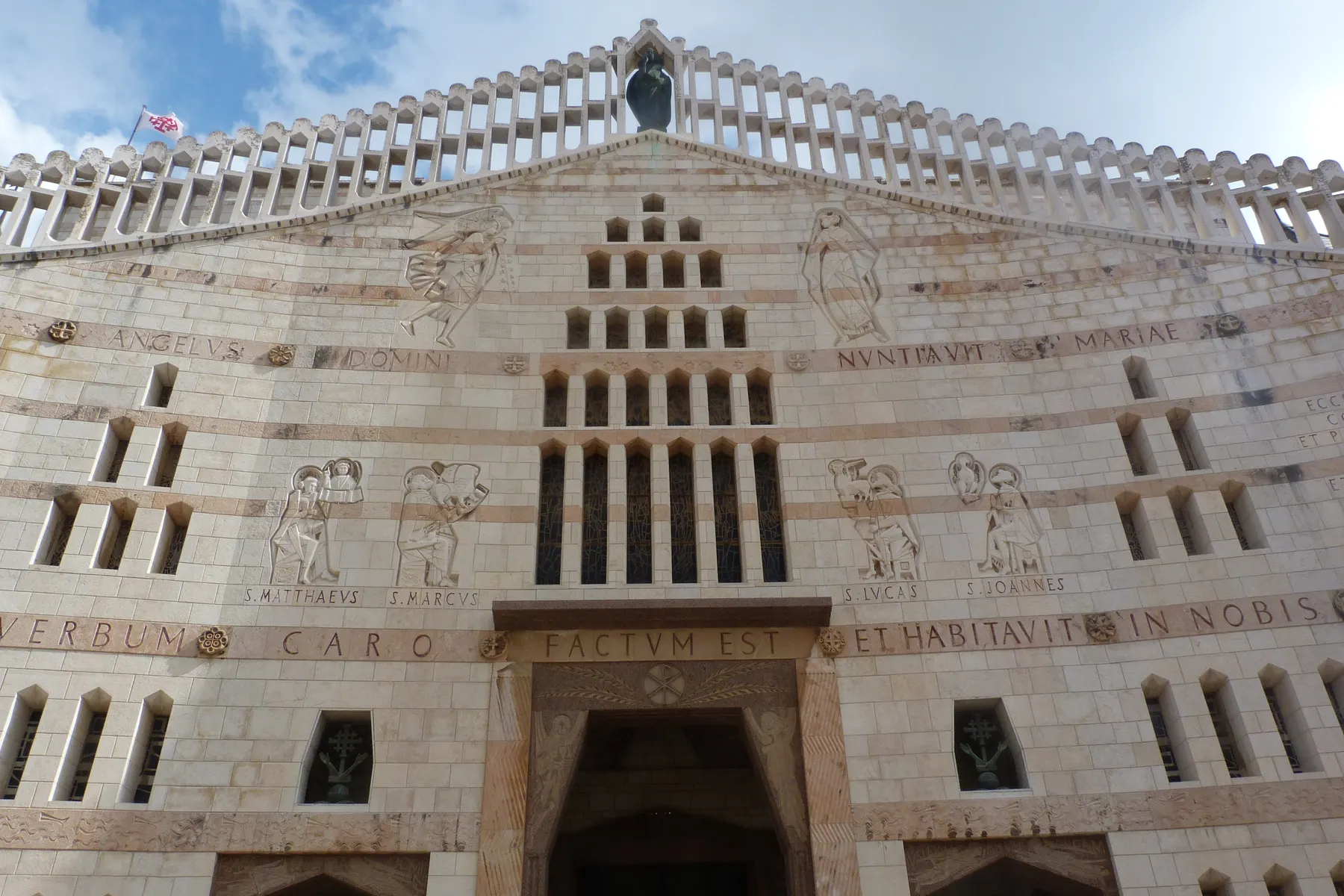
The Custody of the Holy Land dropped Antonio Barluzzi's design for this church and built Giovanni Muzio's instead: two churches stacked over one rock-cut cave, with the excavated village of Nazareth left open in the floor between them.
כובש המלפפונים / CC BY-SA 4.0 · Wikimedia Commons
Consecrated
23 March 1969
a Sunday, after eight years of building, on the Custody of the Holy Land's own account
Lower basilica opens
05:45
and shuts at 21:00; the upper church keeps different hours, 08:00 to 18:00
Admission
Free
the Custody publishes opening times for the basilica and no ticket price at all
Cleared in 1955
about 90 by 60 metres
the ground Bellarmino Bagatti dug north of the grotto between April and June that year
In short
- How long to give it
- about 75 minutes for both churches, the grotto and the courtyard panels, or about two hours if the museum has been arranged and the platform over the excavated village is walked properly
- Lower basilica and Grotto, daily
- 05:45 to 21:00
- Basilica, grotto and courtyard
- No charge. The Custody publishes opening times and no ticket price of any kind, and it does publish a 10 shekel entrance fee for its site at Capernaum in the same list, so the omission is not an oversight
כנסיית הבשורה · كنيسة البشارة
The Basilica of the Annunciation is the Latin Catholic parish church of Nazareth and the Franciscan sanctuary built over a rock-cut cave that Catholic tradition identifies as the house where Mary was told she would bear Jesus. It is two churches in one building: a dim lower basilica whose floor is an archaeological site, and a bright upper church entered from a different door on a different level, with a hole cut between them so the grotto can be seen from above.
The superlative attached to it is real but is never quoted the same way twice. The Custody of the Holy Land calls it the biggest monument of its kind in the Middle East; the anthropologist Susan Slyomovics writes that it is labelled the largest house of Christian worship for Roman Catholics in the region; Wikipedia adds a qualifier about the Congregation for the Oriental Churches that does not obviously apply to a Franciscan sanctuary in the Latin Patriarchate. No published measurement underlies any of them. It is very large, and the ranking is a label rather than a finding.
The floor is the part worth slowing down for. When the eighteenth-century Franciscan church was pulled down to clear the site, the Franciscan archaeologist Bellarmino Bagatti excavated what lay underneath, and Giovanni Muzio then designed around what Bagatti found: a Crusader cathedral, a Byzantine church and monastery, an older structure below both, and the silos, cisterns and cave-rooms of an agricultural village. Most visitors spend an hour here and see the grotto and the mosaics. The village underfoot is what groups walk over without noticing.
The grotto
One cave, and a building bent entirely around it
The Grotto of the Annunciation is small and irregular: the Custody measures it at 5.5 metres north to south and 6.14 metres west to east, with a little apse cut into the eastern wall. It is reached from the lower basilica by going down the seven steps of the eastern stairway, through the Chapel of the Angel, and out by the second stair. Both staircases sit where the Crusader entrances were, on the same principle as the two stairs into the grotto at Bethlehem.
The cave was never a shrine to begin with. It was a storage and working room under a house, of the kind cut into soft limestone all over this hillside, and the giveaways are still at the door: a pair of grain silos with circular mouths, first century and just after, set left and right of the entrance beyond the iron balustrade. Above and beside the grotto stand the Crusader piers that carried the arches of the twelfth-century church.
Three columns hold up the Crusader pier over the cave. Two stand outside the modern wall on the left, the larger known to pilgrims as the Angel column; the third is inside, broken and hanging from the roof, and is called the Virgin's column because it was believed to mark exactly where Mary sat. The column pushing up through the roof was split open in the Ottoman period by people who thought there was treasure inside it.
The altar carries the inscription Verbum caro hic factum est, here the Word was made flesh, and it survives from the small Franciscan church of 1730 rather than being modern. Behind it, up a stair built into the wall, is the cave the friars call Mary's kitchen. Humidity has been eating the grotto's surfaces, and ventilation holes were cut in recent years to slow it.
Archaeology
What Bagatti found, and the argument that started over it
In March 1955 the 1730 church, its 1877 extension, the old convent and the schools all came down. Between April and June that year Bagatti and his collaborator Gaetano Pierri, with more than 120 local labourers digging daily, cleared roughly 90 by 60 metres north of the grotto. Wikipedia dates the demolition to 1954 and the Custody to March 1955, a difference of a season that has never been reconciled.
The Byzantine complex came up first: a church oriented east to west with three naves, a semicircular apse, an atrium in front and a monastery along its southern side, the whole running about 48 metres west to east and 27 metres north to south. Its mosaics are the best-known thing about it, and one carries a Greek inscription naming Conon, deacon of Jerusalem, as the donor. The Custody links that name to Conon of Nazareth, a second-century martyr who told a court he was descended from the family of Jesus. Crosses in the floor date the mosaics before 427, the year Theodosius II forbade the practice.
Below the Byzantine floor, when the mosaics were lifted in 1959 for safekeeping, came something older: blocks of painted and inscribed plaster, about seventy architectural pieces from a demolished religious building, and a rock-cut basin about two metres square and 1.6 metres deep with steps down one side. Bagatti first read the basin as a wine vat and then decided it was a Jewish-Christian baptismal pool. Joan Taylor's study of the Holy Land sites argues the opposite: that this basin and the near-identical one at St Joseph's were agricultural, for pressed grapes, and that the whole Jewish-Christian framework Bagatti and Emmanuele Testa built here rests on a definition of Jewish-Christian theology that was itself derived from their own excavation reports. The Custody's page prints Taylor's objection beside Bagatti's reading, which is unusually candid for a sanctuary describing its foundations.
The Crusader layer is the most spectacular and the least complete. The cathedral was begun soon after Tancred took Nazareth in 1102, was still being enlarged under Archbishop Letard in the 1170s, and was never finished: five Romanesque capitals carved for it were found in 1909 hidden in a cave under the convent parlour floor, apparently never installed and buried to keep them from being smashed. They are in the site museum now.
- Iron Age to Roman village: caves, silos, cisterns, an oil press, tombs from the Middle Bronze Age
- Pre-Byzantine structure: plastered blocks, graffiti, the disputed rock-cut basin
- Byzantine church and monastery: three naves, mosaics with crosses, the Conon inscription
- Crusader cathedral: begun after 1102, enlarged in the 1170s, sacked in 1187 and destroyed under Baibars
- Franciscan church of 1730, lengthened in 1877, demolished to clear the site
The building
The basilica Barluzzi did not get to build
The Custody first gave the commission to Antonio Barluzzi, who had already built the Transfiguration on Mount Tabor, the Beatitudes, the Visitation at Ain Karem and Dominus Flevit, and whose Nazareth drawings appeared in the Custody's own magazine in 1954. His scheme was a single great church on a central plan under one cupola, flanked by four bell towers, with the grotto at the middle in the manner of the Holy Sepulchre.
It was dropped. The Custody's own account puts the reason on the archaeology: once the village and the successive churches came out of the ground the Holy See asked that the remains stay visible, and a domed church centred on the grotto could not do that. The commission passed to the Milanese architect Giovanni Muzio on the proposal of Custos Alfredo Polidori, in a year the Custody's page does not state. La Nuova Bussola Quotidiana has Barluzzi still drawing designs for Nazareth in 1958, after a heart attack, and dying in 1960, nine years before Muzio's building was consecrated.
Muzio, born in 1893 and one of the Novecento Italiano circle in Milan, waived his fee. What he designed instead of a domed hall was a stacked pair of churches founded on the Crusader walls: a low, dark lower basilica in front of the grotto for prayer, and a large bright upper church for the parish and for pilgrimage, with a wide oculus over the grotto so that the two spaces read as one. The three apses below are rebuilt on the twelfth-century plan. The style is usually described as Italian Brutalism, and the fabric is reinforced concrete, laid in three separate sections so the building can move in an earthquake.
The lantern carries the argument. The cupola is built of prefabricated panels in a continuous zigzag that can be read as the letter M repeated without end, arranged in rays like the petals of a lily and meant to be seen as a lily inverted over the shrine below, opening downwards, with sixteen triangular windows around it. The concave white and pink stone facade is by the sculptor Angelo Biancini, with a three-metre bronze Christ Blessing on the tympanum, and the doors are by Roland Friedrichsen, the central Holy Door a gift from Bavaria. The contractor was the Israeli firm Solel Boneh, and the Custody credits the brick layers and stone cutters of Nazareth in its own account of the work.
The Madonnas
A gallery of national Virgins, and what each country chose to send
The most distinctive thing inside is not the architecture but the decoration scheme, which Muzio built into the plan: the upper church and the portico around the courtyard carry images of the Virgin donated by Catholic communities around the world, each rendered in the visual language of the country that sent it. The Custody names fourteen on the upper church walls: Cameroon, Hungary, Brazil, the United States, Poland, Spain and Italy on one side, England, Australia, Argentina, Venezuela, Lebanon, Japan and Canada on the other. Dozens more line the portico.
The effect is a room where the same woman is Japanese, Cameroonian and Venezuelan in turn within twenty paces. They are gifts of different dates and very different quality, not a commissioned cycle by one hand.
The rest of the upper church is Italian and French mid-century religious art of a kind that has aged unevenly. The apse mosaic is by Salvatore Fiume, with the popes from Benedict XV to Paul VI worked into its lower right corner. The tall pointed windows on the south and west are by the Parisian glassmaker Max Ingrand; the sixteen dome windows in concrete and coloured glass are by the Swiss painter Yoki Aebischer; Adriano Alessandrini's marble floor sets out the Marian dogmas in order from the Council of Ephesus in 431. Down in the lower church the windows are by Lydia Roppolt and were a gift from Austria, the organ is by Tamburini of Cremona, and the cross in the central apse is by the Haifa sculptor Ben Shalom, copied from the crucifix that spoke to Francis at San Damiano.
Outside
The plaza that was nearly a mosque, and the parish that uses the church
The open paved square in front of the basilica has a history most visitors know nothing about. In 1997 permission was given to lay out a plaza there, on the site of a demolished Ottoman school called al-Harbyeh, to hold the crowds expected for the millennium and the papal visit. A group of Muslim activists occupied part of the plot, arguing that it was waqf land holding the shrine of Shihab al-Din, described in the accounts as a nephew of Saladin. There were street clashes at Easter 1999, and a cornerstone for a mosque was laid.
Israeli governments under Benjamin Netanyahu and Ehud Barak approved a mosque there. On 6 March 2002 the Sharon cabinet cancelled that approval and reinstated the plaza plan, after sustained pressure from the Vatican and the Holy Land churches, and the president of the United States Conference of Catholic Bishops welcomed the decision the same day. In March 2003 the Nazareth District Planning Committee asked the district court to let it demolish the mosque foundations without waiting for the waqf's appeal, and the structure was cleared.
The basilica is a working parish church, not only a pilgrimage site. The Custody counts about 5,000 Latin faithful around it, in a city of 75,704 people, roughly 69 per cent Muslim and 31 per cent Christian, which the Central Bureau of Statistics recorded in 2024 as holding the largest Christian population of any city in Israel, 18,900. The Terra Sancta College attached to the convent teaches around 800 Christian and Muslim pupils.
The weekly rhythm is worth timing a visit around. An international Mass is said in the grotto at 11:00 every Saturday, followed by the Angelus, and a candlelit procession leaves the square in front of the convent on Saturday evenings. Once the upper church closes the lower basilica is given over to silent prayer, 18:00 to 21:00 daily. The Crown of Nazareth, a devotion peculiar to this sanctuary built on five episodes from the life of Jesus in this town, is prayed on Tuesdays. The feast of the Annunciation on 25 March is the year's high point, with the Latin Patriarch presiding and the Golden Rose given by John Paul II in 2000 carried around the grotto.
What to look for
Things not to walk past at Basilica of the Annunciation
The details that repay knowing about before you are standing in front of them.
The two columns at the grotto
One large column outside the modern wall, known to pilgrims as the Angel column, and one broken and hanging from the roof inside, called the Virgin's column. The one pushing up through the roof was split open in Ottoman times by treasure hunters.
The Conon mosaic
A Byzantine floor beside the grotto entrance with a Greek inscription naming Conon, deacon of Jerusalem, as its donor. The crosses worked into these floors put them before 427, when Theodosius II banned the practice.
The oculus over the grotto
Muzio cut a wide round opening through the floor of the upper church so the cave below stays visible from the parish church above. Stand at its rail and the two levels become one space, which is the whole argument of the building.
The cupola from directly underneath
Prefabricated panels in a continuous zigzag, readable as the letter M repeated endlessly, laid out in rays like lily petals and meant to be seen as an inverted lily opening downwards over the shrine. Sixteen triangular windows light it.
The five Crusader capitals in the museum
Carved for the twelfth-century cathedral, apparently never installed, and found in 1909 hidden in a cave beneath the convent parlour floor. The museum they sit in was founded by Prosper Viaud in 1910 and is visited on request.
The suspended platform over the village
The raised deck outside the upper church's north door protects the excavated caves, silos and cisterns of the Iron Age village and links the basilica to the Church of St Joseph. Most groups walk across it without looking down.
The long view
Basilica of the Annunciation, in order
2nd century AD
A stone from Caesarea Maritima, found in 1962, lists priestly families and places Happizzez at Nazareth: the earliest non-gospel evidence for the village.
c. 570
The anonymous pilgrim of Piacenza describes the House of Mary in Nazareth as a church, alongside a synagogue still in Jewish use.
670
The pilgrim Arculf reports two churches in Nazareth: one over the house where Gabriel spoke to Mary, one at the place of the Nutrition.
1102
Tancred takes Nazareth. A Crusader cathedral rises over the Byzantine ruins, and the see of Beit She'an is transferred here.
1170s
Archbishop Letard enlarges the cathedral. The work is never finished, and five carved capitals are put aside unused.
4 July 1187
After Hattin, Saladin's troops take Nazareth. The inhabitants had sheltered inside the fortified basilica.
1260 or 1263
Baibars' Mamluk forces destroy the Crusader basilica. Wikipedia gives 1260, the Custody April 1263. Only the grotto stays accessible, on payment to Muslim guards.
1620
The Druze emir Fakhr ad-Din II grants the grotto to the Franciscans. Custos Thomas Obicini of Novara takes possession.
15 October 1730
A small Franciscan church over the grotto is consecrated, built under Dahir al-Umar in the six months of the pasha's pilgrimage to Mecca.
1877
The 1730 church is lengthened to hold a growing Latin community.
1909
Prosper Viaud finds five Romanesque Crusader capitals hidden in a cave under the convent parlour. He founds the site museum the following year.
1954
Antonio Barluzzi's design for a domed church on a central plan is published in the Custody's magazine. It is not built.
March 1955
The 1730 church and its 1877 extension are demolished. Bellarmino Bagatti's excavation begins, clearing about 90 by 60 metres.
1959
Site works begin for Muzio's basilica. Lifting the Byzantine mosaics exposes an older building and the disputed rock-cut basin beneath them.
September 1960
The building contract is signed. Solel Boneh takes the work, with masons and stone cutters from Nazareth.
1964
Pope Paul VI visits the sanctuary while it is still under construction, during the first papal journey out of Italy in modern times.
23 March 1969
The basilica is consecrated, eight years after the works began, two days before the feast of the Annunciation.
25 March 2000
John Paul II says Mass here during the Great Jubilee pilgrimage and leaves the Golden Rose, still carried in the annual procession.
1997 to 2002
The Shihab al-Din affair over the plot in front of the basilica: an occupation, clashes at Easter 1999, government approval for a mosque, then its cancellation by the cabinet on 6 March 2002.
2003
The planning committee seeks immediate demolition of the mosque foundations ahead of the waqf's appeal, and the structure is cleared. The plaza is laid out.
Practical
Visiting Basilica of the Annunciation
Where
Casa Nova Street, Nazareth
What ticket you need
This is not inside a ticketed park, but it is inside a walled Franciscan compound that holds four things on different timetables: the basilica, the archaeological museum, the platform over the excavated village and the Church of St Joseph to the north. All are free, none keeps the same hours as the others, and the museum has to be asked for.
Opening hours
- Lower basilica and Grotto, daily
- 05:45 to 21:00source
- Upper basilica, daily
- 08:00 to 18:00, which is three hours less at each end of the day than the church below itsource
- Church of St Joseph, on the same compound
- 07:00 to 18:00source
- Archaeological museum
- Monday to Saturday 08:00 to 12:00 and 14:00 to 18:00, closing at 17:00 in winter. The Custody states it is visited on request, through the conventsource
- Pilgrims' office
- Monday to Saturday 09:00 to 12:00 and 14:00 to 17:30, on +972 4 656 0001source
- Silent prayer only
- 18:00 to 21:00 daily in the lower basilica, after the upper church has closedsource
Admission
- Basilica, grotto and courtyard
- No charge. The Custody publishes opening times and no ticket price of any kind, and it does publish a 10 shekel entrance fee for its site at Capernaum in the same list, so the omission is not an oversightsource
- Archaeological museum
- No price is published. The Custody says the museum can be visited on request, arranged through the convent, and that it is entered from the rose garden beside the monastery doorsource
- Mensa Christi church in the souk
- Visited by permission of the Guardian of the Convent, not on a walk-up basissource
Access
The upper basilica and the courtyard are the reachable parts. Its main door is on the north, level with the raised platform over the excavations, so a wheelchair can get in and across the upper church without steps. The grotto cannot be entered that way: the Custody's own description has it reached by going down the seven steps of the eastern stairway, through the Chapel of the Angel and up a second stair, and the only internal link between the two churches is a pair of spiral staircases beside the entrance. Anyone who cannot manage steps should plan to enter the lower church from the south facade at ground level, see the grotto from the barrier in the lower basilica, and then move round the outside of the building rather than through it.
On site
- Free entry
- Archaeological museum, on request
- Pilgrims' office for mass bookings
- Casa Nova guesthouse opposite
- Daily mass and confession
- Church of St Joseph in the same compound
- Live stream from the grotto
Booking
Nothing is booked to visit. Groups wanting to celebrate mass in the grotto or the upper basilica book through the Pilgrims' Office Contact Centre at the basilica, open Monday to Saturday, or through the convent on +972 4 655 4542. A friar is on duty in the sanctuary to receive pilgrims, and a priest is available for confession.
Hours and prices are given as the operator publishes them and change without much notice, particularly around Shabbat and the festivals. Check the operator's own page before you travel for this.
Official page at custodia.org →What people wish they had known
- The two churches do not open together. The grotto is open from 05:45 to 21:00 and the upper basilica only from 08:00 to 18:00, so anyone arriving at half past six in the evening gets the cave, the archaeology and none of the mosaics, and anyone arriving at seven in the morning gets the same.
- Sunday morning is the parish's, not the tour's. Mass runs in the grotto and in the upper basilica in Arabic on Sunday mornings, and walking a group through the middle of it is the commonest mistake made here.
- Ask for the museum in advance. The five Crusader capitals and the plastered fragments are in a museum that the Custody says is visited on request, entered from the rose garden by the monastery door, and it is not part of the walk-through.
- Do not confuse this with the other Church of the Annunciation. The Greek Orthodox church of St Gabriel, ten minutes north over the spring at Mary's Well, marks a different version of the same event from the Protoevangelium of James, and is a separate building with separate hours.
- The panels in the portico outside are half the point and get skipped. Groups head for the door, do the upper church and leave; the courtyard arcade carries dozens more national Madonnas than the fourteen the Custody lists inside.
- Dress as for a working church: shoulders and knees covered, for the basilica and for St Joseph's. The compound is a parish, a school of about 800 pupils and a friary as well as a sanctuary.
The figures
Basilica of the Annunciation by the numbers
Each figure carries the year it belongs to and links the source it came from.
| Measure | Figure | As of | Source |
|---|---|---|---|
| Height of the basilica | 55 metres | 2026 | custodia.org |
| Grotto of the Annunciation | 5.5 m north to south by 6.14 m west to east | 2026 | custodia.org |
| Byzantine church and monastery footprint | about 48 m by 27 m | 2026 | custodia.org |
| Ground cleared in the 1955 excavation | about 90 m by 60 m | 1955 | custodia.org |
| Local labourers on Bagatti's dig | more than 120 | 1955 | custodia.org |
| Latin parish gathered at the sanctuary | about 5,000 | 2026 | custodia.org |
| Christians living in Nazareth | 18,900 | 2024 | jpost.com |
| Population of Nazareth | 75,704 | 2024 | en.wikipedia.org |
While you are here
The rest of The Galilee
Everything else in this destination with a page of its own.
Museum
Nazareth Village
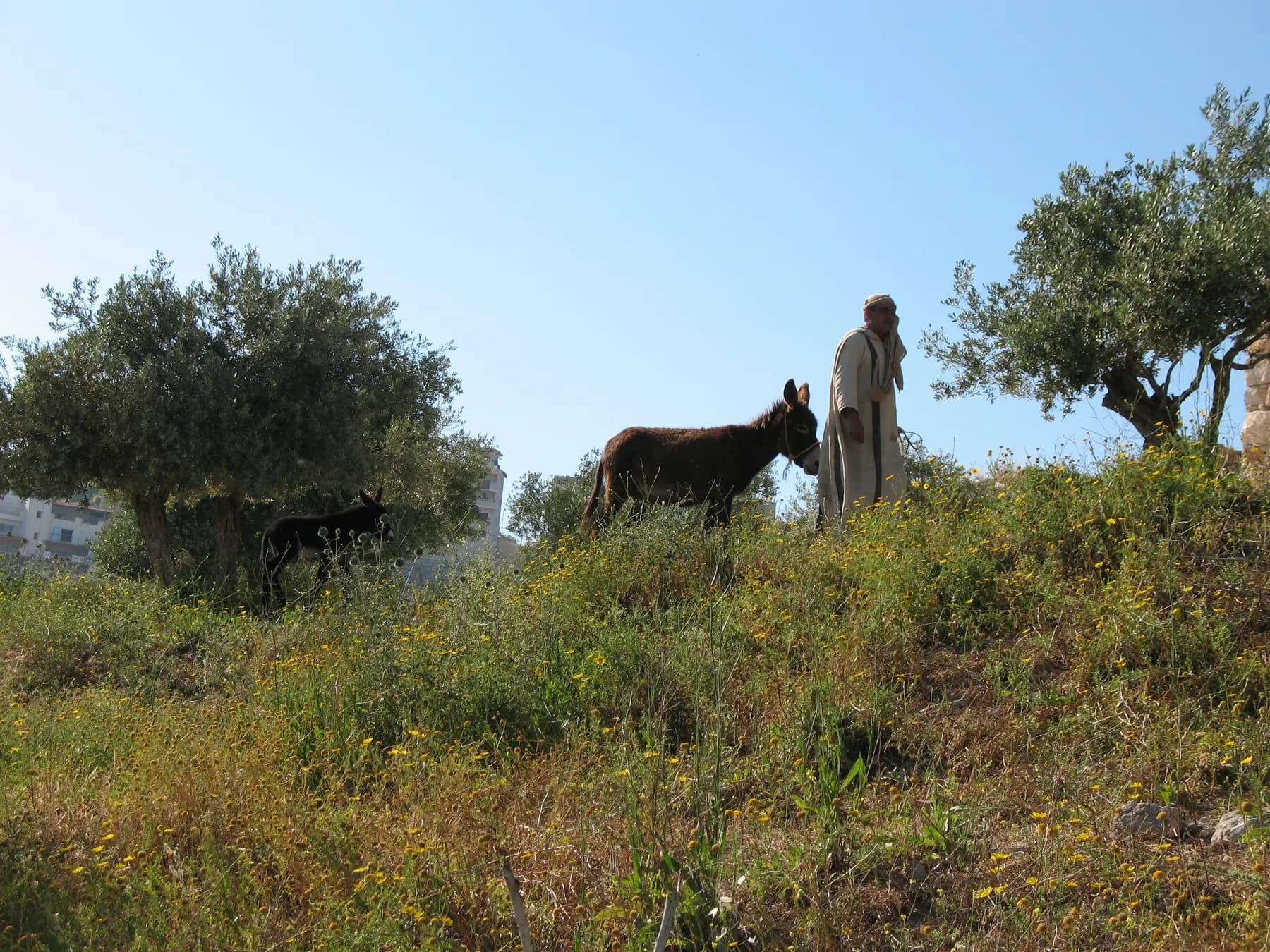
The hillside was quarried and farmed in the Late Hellenistic and Early Roman periods, and the wine press cut into its bedrock sits about 500 metres from the centre of the village Nazareth grew out of.
Yair Haklai / CC BY-SA 4.0 · Wikimedia Commons
Archaeological site
Zippori National Park
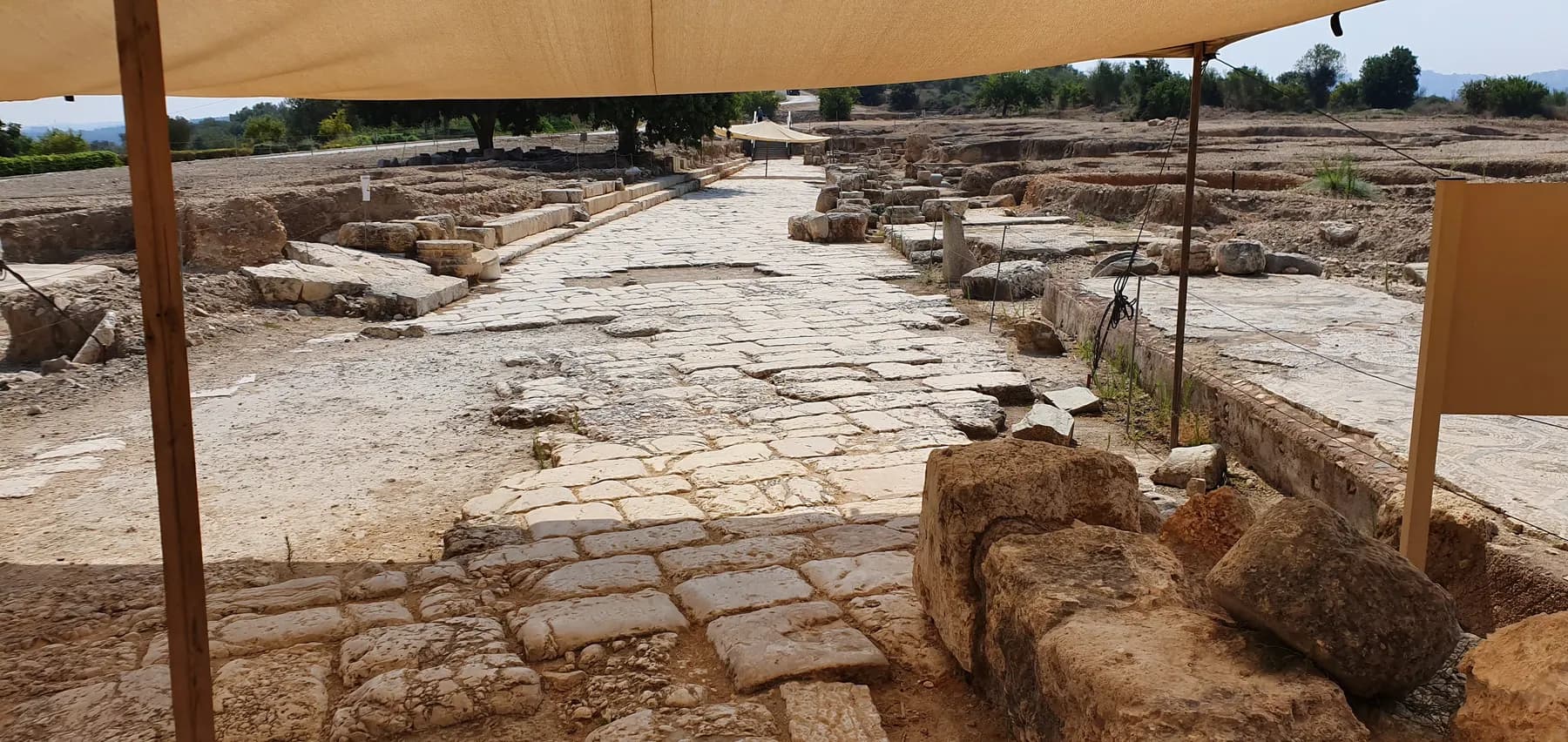
The Roman capital of the Galilee, where the dining room of a third-century mansion holds the face known as the Mona Lisa of the Galilee and a rock-cut reservoir 260 metres long runs under the hill to the east.
עמוס גל / CC BY-SA 4.0 · Wikimedia Commons
Religious site
Mount Tabor
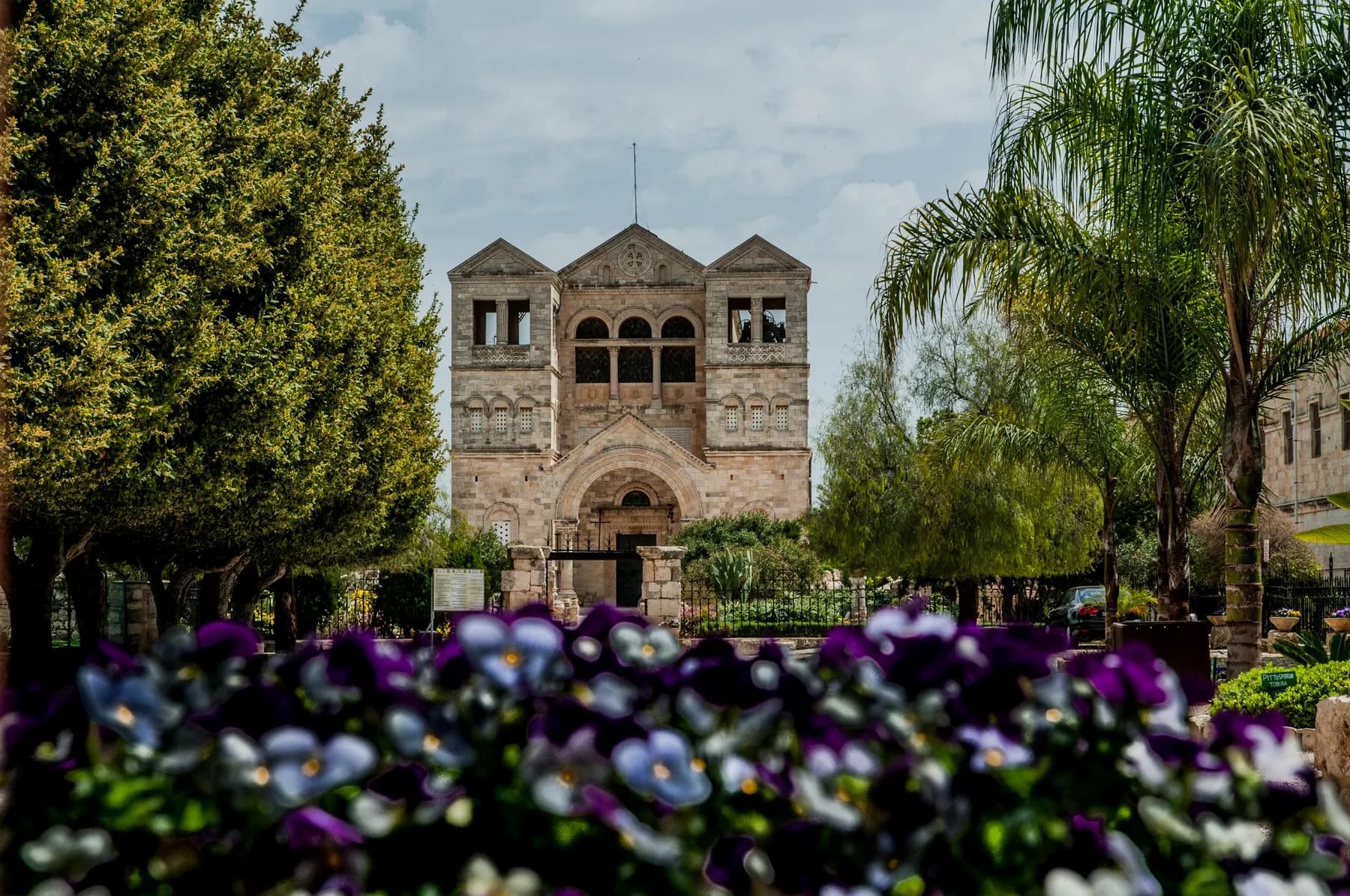
Antonio Barluzzi's first church in the Holy Land stands on this dome of a hill above the Jezreel Valley, built between 1921 and 1924 over a Byzantine apse and the ruins of a Benedictine abbey that Baibars levelled in 1263.
Sources and further reading
Every link below was opened and checked when this page was written. Official statements are marked as such: they are the subject's own account, not an independent one.
- OfficialCustody of the Holy Landcustodia.orgNazareth: Basilica of the Annunciation
Opening hours for both churches, the museum and the pilgrims' office; the grotto measurements; the Byzantine and Crusader remains; Bagatti's 1955 excavation; the Barluzzi and Muzio commissions; the artists, doors and Madonna panels; mass and devotion times
- OfficialUnited States Conference of Catholic Bishopsusccb.orgStatement on the Israeli government's decision to cancel plans for a mosque in Nazareth
Dated 6 March 2002, confirming the cancellation of the mosque approval and the reinstatement of the plaza plan beside the basilica
- ReportingLa Nuova Bussola Quotidiana (Daily Compass)newdailycompass.comBarluzzi, an architect-mystic. The Gaudi of the Holy Land
Barluzzi's Holy Land churches with dates, his continued Nazareth designs in 1958 after a heart attack, the preference for Muzio, and his death in 1960
- ReportingHaaretzhaaretz.comNazareth panel wants mosque razed before appeal decision
The Nazareth District Planning Committee's March 2003 petition to demolish the mosque foundations ahead of the waqf's appeal
- DataThe Jerusalem Post, on Central Bureau of Statistics figuresjpost.comNazareth tops Israel's Christian cities as Christmas arrives
The CBS December 2024 release: about 184,200 Christians in Israel, with Nazareth the largest Christian city at 18,900
- ReferenceWikipediaen.wikipedia.orgBasilica of the Annunciation
Solel Boneh as contractor 1960 to 1969, the Italian Brutalism description, Baibars in 1260, the 1954 demolition date, the papal visits of 1964 and 2000, and the Slyomovics quotation on the size claim
- ReferenceWikipediaen.wikipedia.orgNazareth
The Shihab al-Din affair from the 1997 plaza permission to the 2002 cancellation, the al-Harbyeh school and waqf shrine, and the city population of 75,704 with its religious split
- ReferenceWikipediaen.wikipedia.orgGiovanni Muzio
Muzio's dates, his place in the Novecento Italiano circle in Milan, and the Nazareth basilica as his major work outside Italy
- ReferenceSee the Holy Landseetheholyland.netChurch of the Annunciation
The cupola read as an inverted lily, the three separate sections of reinforced concrete for earthquake movement, the Conon mosaic inscription and the graffito Bagatti read as Hail Mary
- ReferenceOxford University Press, Joan E. Taylorglobal.oup.comChristians and the Holy Places: The Myth of Jewish-Christian Origins
The critique of the Bagatti and Testa reading of the Nazareth material, and the argument that no Christians venerated holy places before the fourth century
- ReferenceBibleWalksbiblewalks.comNational mosaics in the Basilica of the Annunciation
A country-by-country survey of the Madonna panels, distinguishing those on the upper church walls from the much larger set in the courtyard portico
- ReferenceMasha Halevi, The Catholic Historical Review 96:1 (2010), via Project MUSEmuse.jhu.eduThe Politics Behind the Construction of the Modern Church of the Annunciation in Nazareth
The scholarly treatment of the commission and the politics around it. Listed for the reader: the full text sits behind Project MUSE's verification wall and was not read for this page
Basilica of the Annunciation: common questions
What are the opening hours?+
The lower basilica with the grotto is open daily from 05:45 to 21:00, and the upper basilica from 08:00 to 18:00, on the Custody of the Holy Land's own published times. The Church of St Joseph in the same compound runs 07:00 to 18:00. From 18:00 to 21:00 the lower basilica is given over to silent prayer rather than sightseeing. Times shift around the feast of the Annunciation on 25 March and around Holy Week.
Is there an entrance fee?+
No. The Custody publishes opening times for the basilica and no admission price at all, and on the same page it does publish a 10 shekel entrance fee for its site at Capernaum, so the absence of a figure here is deliberate rather than a gap. There is no ticket office and no queue for one. The archaeological museum publishes no price either and is arranged on request.
Why are there two Churches of the Annunciation in Nazareth?+
Because two traditions place the event in two spots. The Catholic basilica marks the house, following Luke, where Gabriel came to Mary indoors. The Greek Orthodox Church of St Gabriel, about ten minutes north, marks the spring, following the Protoevangelium of James, in which Mary first hears the voice while drawing water and only then hears the full message at home. The two churches have coexisted with the split for centuries and both are open to visitors.
Is the grotto really Mary's house?+
It is a first-century rock-cut room from the village that stood here, which is a much stronger claim than most holy places can make, and the veneration of this particular cave is documented back to the Byzantine period. Whether it is the house of Mary is a question archaeology cannot answer. Bellarmino Bagatti argued that the graffiti and the structures below the Byzantine floor show unbroken Jewish-Christian veneration from the first centuries; Joan Taylor's study argues there is no evidence Christians venerated holy places at all before the fourth century. Both readings are in print and the disagreement is live.
Is it wheelchair accessible?+
Partly, and the split is between the two levels. The upper basilica is entered from the north at the level of the raised platform over the excavations, so it and the courtyard are reachable without steps. The grotto is not: the Custody describes reaching it by seven steps down the eastern stair, through the Chapel of the Angel and up again, and the only internal connection between the two churches is a pair of spiral staircases. Entering the lower church from the south facade gives a view of the grotto from the barrier without going down into it.
How long do you need there?+
About 75 minutes covers the lower basilica, the grotto, the upper church and the courtyard panels at an unhurried pace. Two hours is better if the museum has been arranged in advance and the platform over the excavated village is walked properly rather than crossed. Groups on a coach schedule are often through the whole thing in 35 minutes, which gets the cave and misses the archaeology entirely.
Is there a dress code?+
Yes, in practice. Shoulders and knees should be covered for both churches. This is the parish church of Nazareth's Latin community of about 5,000 people, sharing a compound with a friary and a school, and the friars welcome pilgrims and visitors without policing the door, which is precisely why turning up dressed for a beach day reads badly.
Is it really the largest church in the Middle East?+
It is very large and the claim is widely made, but every version of it carries a different qualifier. The Custody calls it the biggest monument of its kind in the Middle East. Susan Slyomovics describes it as labelled the largest house of Christian worship for Roman Catholics in the region. Wikipedia narrows it to churches under the Congregation for the Oriental Churches, a qualifier that does not obviously fit a Franciscan sanctuary in the Latin Patriarchate. No published measurement underlies any of them.
What is underneath the church?+
A Crusader cathedral begun after 1102 and never finished, a Byzantine church and monastery of about 48 by 27 metres with mosaic floors, an older structure below those with plastered blocks and a rock-cut basin, and the caves, silos, cisterns and oil press of an agricultural village occupied from the Iron Age. Bagatti cleared roughly 90 by 60 metres of it from March 1955, and Muzio then designed the basilica so that most of it stays visible from inside the lower church or from the platform outside.
What is the square in front of the basilica?+
A plaza laid out after a long dispute. Permission for it was given in 1997 for the millennium crowds; a group of Muslim activists occupied the plot, arguing it was waqf land holding the shrine of Shihab al-Din, and a mosque was approved there by two Israeli governments before the Sharon cabinet cancelled the approval on 6 March 2002. The foundations were cleared in 2003 after the planning committee sought immediate demolition. The square a visitor crosses today is the result.