Museum · The Dead Sea
Moshe Novomeisky Visitor Center
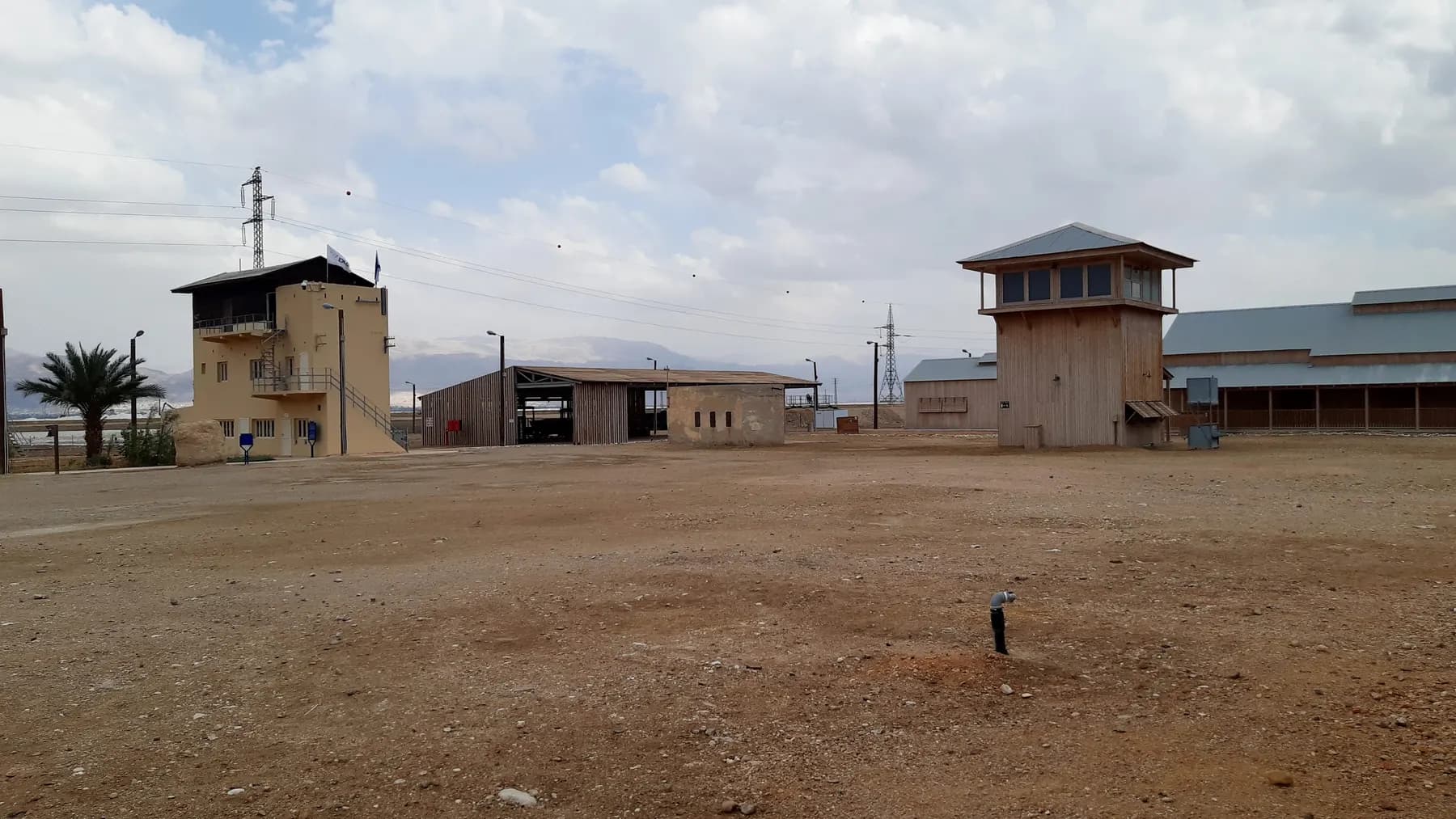
The restored workers' camp of Palestine Potash at Sdom, lived in from 1934 until the early 1950s, open only on a guided tour of about ninety minutes.
israel zeller ישראל זלר / CC BY 2.5 · Wikimedia Commons
Adult admission
₪30
operator's posted price, VAT included; ₪25 for a child aged 5 to 18
Tour length
about 90 minutes
the operator's booking page puts the same tour at 1 hour 40
Camp founded
1 May 1934
the day the first group sailed south to build the Sdom works
Opened to visitors
2021
on ground the conservation council had already been restoring for years
In short
- How long to give it
- about 90 minutes, which the operator's booking page states as 1 hour 40
- Sunday to Thursday
- 10:00 to 16:00, last tour 14:00
- Adult
- ₪30
מרכז מבקרים ע"ש משה נובומייסקי
The Moshe Novomeisky Visitor Center is a heritage museum inside the workers' camp of Palestine Potash Ltd at Sdom, at the southern end of the Dead Sea and a short turn off Route 90. The camp housed the company's southern workforce from 1934 until the early 1950s. Several of its buildings have been restored, and the only way to see them is a guided tour booked online for a fixed date and time: the operator states that the site cannot be visited without a guide.
The man in the name was a mining engineer from eastern Siberia who spent most of the 1920s trying to persuade the British to let him take minerals out of the lake. Moshe Novomeisky first came to look at the Dead Sea in 1911, settled in Palestine in 1920, and finally incorporated Palestine Potash Ltd in October 1929, with a concession that took effect on 1 January 1930. The company built first at the northern end of the lake and then, when it ran out of room, in the south, where the camp on this ground went up in 1934.
The centre is also, plainly, a company museum. The initiative came from ICL, which owns the Dead Sea Works that succeeded Palestine Potash, and the buildings were restored with the Council for Conservation of Heritage Sites in Israel. The dates and the industrial record are checkable and are set out below; the framing, which the operator's own published vision describes as deepening the identity of the plants as holders of Zionist and economic values, is the operator's. Both are worth knowing before buying a ticket.
Founding
Twenty men sailed south in 1934 to build a factory out of nothing
Palestine Potash already had a works at the northern end of the lake when it ran out of space there. The southern basin was shallow, hot and empty, which made it close to ideal for the solar evaporation ponds the process needs and close to unliveable for the people who would tend them. On 1 May 1934 a first group of about twenty workers sailed down the lake to start building, and the camp they raised at the foot of Mount Sodom is the ground the visitor centre stands on.
The early arrangements were improvised to the point of absurdity. A cave in the salt mountain, known as Colonel's Cave after Thomas Gregory Tulloch, the British engineer who held the concession jointly with Novomeisky and oversaw construction of the southern plant, was enlarged and fitted out as worker housing. A power station, a small port and a narrow railway followed, the railway running the six kilometres between camp and plant and carrying both the workers and the potash down to the loading dock. A cinema arrived later, which in this landscape counted as infrastructure rather than luxury.
The population figures give the pace. Roughly thirty people lived here in 1934; by 1938 there were about 650, of whom some 380 belonged to a kibbutz labour brigade. The plant was standing in 1936 and made its first potash shipment in 1937, and it quickly overtook the older works in the north: before 1948 the southern plant accounted for something like 80 per cent of the company's combined potash output.
By the standards of the country at the time this was an enormous business. Potash made up around half of Palestine's industrial exports by 1940. In 1945 the company sold 90,040 tonnes of potash and 347 tonnes of bromine. The operator's own chronology records output passing 100,000 tonnes a year in 1941, the figure the concession letter had demanded of it.
The founder
A Siberian mining engineer and a concession that took fifteen years
Moshe Novomeisky was born on 25 November 1873 in Barguzin, a village near Lake Baikal in eastern Siberia, and took a mining engineering degree at Königsberg in 1897. He worked Siberian gold and mineral lakes, headed the National Council of Siberian Jews and the regional Zionist organisation during the revolution, and left when the Bolsheviks took power, settling in Palestine in 1920. He had first travelled to look at the Dead Sea in 1911.
Prising a concession out of the British took the rest of the decade. He applied in 1921. A public tender went out in May 1925 and drew five bids, three of which were shortlisted; the operator's chronology notes that Novomeisky's proposal was the strongest technically and the weakest financially. The Colonial Office rejected every bid in 1926. On 9 April 1927 the High Commissioner, Lord Plumer, agreed in principle to a concession for Novomeisky and Tulloch provided they could produce satisfactory financial guarantees, and in 1928 the House of Lords argued bitterly over granting it to a Jew at all.
Palestine Potash Ltd was incorporated on 23 October 1929, with Lord Lytton as chairman and a board of eleven: six British subjects, four Americans and Novomeisky himself. The concession took effect on 1 January 1930, ran seventy-five years to the end of 2004, and obliged the company to pay five per cent of sales value in royalties to the Mandate and Transjordan governments on top of annual fees and taxes.
He did not keep it. The Israeli government decided in December 1951 to nationalise the company and bought its assets in July 1952, when he was seventy-eight; the operator's own timeline dates the change to June 1952, and the difference of a month or so is not resolved by anything published here. The successor took the name Dead Sea Works. Novomeisky wrote two memoirs, My Siberian Life and Given to Salt, died in Paris on 27 March 1961 and is buried in the Trumpeldor cemetery in Tel Aviv.
1948
The camp that was ordered to surrender and refused
The United Nations partition resolution of 29 November 1947 placed the northern Dead Sea, and with it the company's original works, inside the proposed Arab state. Fighting began the next day, and the convoys carrying potash up to Jerusalem came under fire. Levi Spiegelman, who had commanded the Haganah at Sdom for some eleven years, was badly wounded in one of those convoys in December 1947 and later died of his injuries.
His replacement, Goel Levitsky, took command in January 1948. On 18 May a delegation from the high command arrived and ordered him to surrender to the Arab Legion. He went over their heads to David Ben-Gurion, asked permission to stay and fight, was given it, and from 20 May commanded roughly 700 people in the camp: the Sdom workforce plus those evacuated from the northern works and from Kibbutz Beit HaArava on the night of 19 to 20 May. He was recommended for a citation for it.
The northern plant was looted and destroyed within days, though accounts differ on exactly when. The English-language record has the Arab Legion entering the site on 22 May; the operator's chronology puts the destruction at the end of the month. Work at Sdom stopped, a small group under Moshe Langotsky stayed to keep the plant alive, the water pipeline from A-Safi was cut and water had to be brought in by boat from the north, and from June supplies arrived by air. Land contact was restored on 25 November 1948, when the Palmach reached Sdom in Operation Lot and the siege lifted.
That eleven-month episode is the emotional centre of the tour, and it also explains why a chemicals company built a museum here at all. The camp is presented as a piece of the founding of the state rather than as a disused industrial compound, and the exhibition is arranged to land on it.
Fabric
What is original at Sdom, what was rebuilt, and what is a screen
The buildings are real and have been worked on for a long time. The Council for Conservation of Heritage Sites in Israel says it was part of the rehabilitation of the workers' camp from decades before the visitor centre existed, sat on the steering committee that created it, and invested millions of shekels in the site. Its work covered the old dining hall, the administration building known as the mud house, and the security house, along with the locomotives, carriages and track that served the plant through the 1930s and 1940s. The Tamar Regional Council carried the planning permissions and the road junction.
The interpretation inside those buildings is entirely new. The tour opens in a hall built around a large model of the Dead Sea showing how the rift formed; it moves into the restored dining hall, where Novomeisky is introduced; a virtual reality sequence puts the visitor inside the camp at its height, walking among its workers; a further section covers the War of Independence; and the visit closes on what Dead Sea minerals are used for now and on what the operator itself calls the dilemma between conservation and development.
So the honest description is a restored and partly reconstructed camp with a modern exhibition installed in it, presented by the company that owns the successor plant. That is not a criticism of the fabric, which is genuine and was rescued rather than invented, but it does mean a visitor should not expect to find rooms left as their occupants left them.
The working potash plant is not part of the visit and cannot be toured. Nor is Mount Sodom, although the camp sits at its foot and the eighty-metre shaft of Colonel's Cave, named for Novomeisky's British partner, lies on a marked trail on the mountain above.
- Original fabric, conserved: the dining hall, the administration building known as the mud house, and the security house
- Original rolling stock, restored: the locomotives, carriages and track that served the plant in the 1930s and 1940s
- Entirely new: the Dead Sea model hall, the virtual reality sequence and every display screen
- Not included in the ticket: the working Dead Sea Works plant, which is a live industrial site
- Not on the site at all: Colonel's Cave, a shaft on Mount Sodom above the camp
Booking
There is no way to walk around this one on your own
Every visit is a guided tour, and the operator states that the site cannot be visited without a guide. Tickets are sold only through the centre's own website, for a named date and a named time slot, and the advice is to arrive a quarter of an hour early to get organised before the group sets off. Arrive late and staff will try to fit you into the first tour with space, which on a quiet weekday can be a long wait.
The published hours need care, because the operator publishes two different sets. The booking page gives Sunday to Thursday 10:00 to 16:00 with the last tour at 14:00, Friday and holiday eves the same, and Saturday closed, which matches the notice on the home page. The page headed 'important to know' still carries an older timetable of 09:00 to 17:00 Sunday to Thursday and Saturday with a last tour at 15:00, and 09:00 to 15:00 on Fridays and holiday eves. The booking calendar is the one that governs. The operator adds that summer months run to different hours, with afternoon and evening slots added, and that times have been changed because of the security situation.
Prices as posted by the operator, VAT included: ₪30 for an adult, ₪25 for a child aged 5 to 18, ₪20 for a senior citizen, a pensioner, a soldier in regular service or a visitor holding a disability card, ₪19 for a student or overseas youth, ₪15 for a pupil visiting with a school or a youth movement, and ₪25 a head for an adult within a group of at least thirty paying visitors. Children under five go in free. Cancel more than 48 hours ahead and there is no charge; cancel inside 24 hours and the full price is due.
Access is unusually well documented for a site this size. There is one main entrance, and the operator states a continuous accessible route from the car park through the reception building to the toilets, the exhibition buildings and the cafeteria, with four accessible parking bays about six metres from the accessible entrance. Reception has a hearing assistance system. The presentation halls carry infrared audio, personal headsets can be had from the guide, and the films are subtitled. Beacons along the route feed the Step Hear app, which gives spoken orientation and a short description of each display. There are nine public toilet rooms and one fully accessible cubicle. Animals are not admitted.
What to look for
Things not to walk past at Moshe Novomeisky Visitor Center
The details that repay knowing about before you are standing in front of them.
The restored dining hall
The camp's mess building is one of the structures the conservation council rebuilt, and the tour uses it to introduce Novomeisky. It is the closest thing on the site to a room the workers would recognise.
The mud house
The administration building, known as the mud house, is named for what it was made of and was conserved alongside the dining hall and the security house. It is a reminder of how little there was to build with in 1934.
The locomotives and the track
The small railway ran the six kilometres from camp to plant, carrying workers on the way out and potash on the way back. Its engines, carriages and rails were restored as part of the same conservation programme.
The Dead Sea model hall
The tour begins at a large physical model showing how the rift valley and the lake formed. It is a modern build rather than a historic room, and it is the piece that makes the rest of the industrial story legible.
The virtual reality sequence
Headsets drop the visitor into the camp at its height, walking among a workforce of several hundred. It is the only part of the visit that shows the place populated, since none of the buildings are furnished as they were.
The long view
Moshe Novomeisky Visitor Center, in order
1911
Moshe Novomeisky, a mining engineer from Barguzin in eastern Siberia, makes his first visit to the Dead Sea to assess its minerals.
1920
Novomeisky settles in Palestine, having left Siberia after the Bolshevik takeover.
1921
He applies to the British authorities for a concession to extract potash from the Dead Sea.
1925-1926
A public tender in May 1925 draws five bids, three of them shortlisted. The Colonial Office rejects all of them in 1926.
9 April 1927
The High Commissioner, Lord Plumer, agrees in principle to a concession for Novomeisky and Thomas Gregory Tulloch, subject to financial guarantees.
23 October 1929
Palestine Potash Ltd is incorporated, chaired by Lord Lytton, with a board of eleven directors.
1 January 1930
The concession takes effect, for seventy-five years to the end of 2004, at a royalty of five per cent of sales value. The first works is built at the northern end of the lake.
1 May 1934
A first group of about twenty workers sails south to build the Sdom plant. The workers' camp goes up at the foot of Mount Sodom, along with the evaporation ponds.
1936-1937
The Sdom potash plant is completed and makes its first shipment. The camp's population reaches about 650 by 1938.
1941
Potash output passes 100,000 tonnes a year, the figure the concession letter required.
19-20 May 1948
The northern works and Kibbutz Beit HaArava are evacuated to Sdom. Goel Levitsky, ordered to surrender, obtains Ben-Gurion's permission to hold the camp with roughly 700 people inside it.
25 November 1948
Operation Lot: the Palmach reaches Sdom and the siege ends. The northern plant has already been looted and destroyed.
December 1951 to July 1952
The government decides to nationalise Palestine Potash and buys its assets. Dead Sea Works takes over. The camp is wound down in the early 1950s.
around 2010
Dead Sea Works and the Council for Conservation of Heritage Sites in Israel begin conserving the camp buildings with a view to opening the site to visitors.
2021
The Moshe Novomeisky Visitor Center opens in the restored camp.
Practical
Visiting Moshe Novomeisky Visitor Center
Where
Off Route 90 near Sdom, at the southern end of the Dead Sea. The operator gives the postal address as D.N. Moshe Novomeisky Visitors Center, Dead Sea 8691000, and the telephone as 08-3009199.
What ticket you need
This is a standalone ticket and not part of a national park. The centre stands beside the working Dead Sea Works complex, but the plant itself is a live industrial site and is not on the tour.
Opening hours
- Sunday to Thursday
- 10:00 to 16:00, last tour 14:00source
- Friday and holiday eves
- 10:00 to 16:00, last tour 14:00source
- Saturday
- Closedsource
- Summer (July and August)
- Different hours, with afternoon and evening slots added; the operator says to check the times shown once a date is chosensource
- A second, older timetable on the same site
- The 'important to know' page still shows 09:00 to 17:00 Sunday to Thursday and Saturday with a last tour at 15:00, and 09:00 to 15:00 on Fridays and holiday eves. The booking calendar governs.source
Admission
- Adult
- ₪30source
- Child aged 5 to 18
- ₪25source
- Under 5
- Freesource
- Senior citizen or pensioner, on production of a card
- ₪20source
- Soldier in regular service, on production of a card
- ₪20source
- Visitor holding a disability card
- ₪20source
- Student or overseas youth, on production of a card
- ₪19source
- Pupil with a school or youth movement
- ₪15source
- Adult within a group of at least 30 paying visitors
- ₪25source
Access
Well provided and well documented. One main entrance, with a continuous accessible route from the car park through the reception building to the toilets, the exhibition buildings and the cafeteria; four accessible parking bays about six metres from the accessible entrance; a hearing assistance system at reception; infrared audio in every presentation hall with personal headsets available from the guide; subtitled films; Step Hear beacons giving spoken orientation and short descriptions along the route; nine public toilet rooms and one fully accessible cubicle. The operator states the centre is adapted for people with mobility impairments. The route is level ground rather than a climb, so a wheelchair user can do the whole tour.
On site
- Car park
- Four accessible parking bays
- Reception building
- Cafeteria
- Toilets
- Hearing assistance at reception
- Infrared audio in the presentation halls
- Step Hear audio beacons
- Subtitled presentations
- Guided tours only
Booking
Tickets are sold only on the centre's own website, for a specific date and time slot, and there is no unguided admission. Arrive fifteen minutes before the slot. Cancellation is free more than 48 hours ahead, costs 50 per cent inside 48 hours, and the full price inside 24 hours. Groups of thirty or more book through a separate route on the same site.
Hours and prices are given as the operator publishes them and change without much notice, particularly around Shabbat and the festivals. Check the operator's own page before you travel for this.
Official page at deadseanovo.co.il →What people wish they had known
- Book before setting off. There is no walk-in ticket and no unguided admission: the operator sells only timed slots on its own website, and a car that turns up at the gate may find the next tour with space is hours away.
- Ignore the hours on the 'important to know' page. The operator publishes two conflicting timetables; the booking calendar and the home page notice are the current ones, and they close the centre on Saturday.
- Allow more than the ninety minutes. The operator quotes about an hour and a half on one page and an hour and forty minutes on another, and asks visitors to arrive fifteen minutes early, so the realistic block is two hours.
- Do not plan to see the plant. The evaporation ponds and the working potash factory next door are not on the tour, and the mountain trails on Mount Sodom above the camp are a separate outing with their own hazards.
- Bring a hat and water even though the visit is largely indoors. The yard between the buildings is open ground in the hottest inhabited corner of the country, and the tour crosses it repeatedly.
- If the timetable matters, check for the summer schedule. In July and August the operator adds afternoon and evening slots that do not exist for the rest of the year, which is the only way to visit this site in cool air.
The figures
Moshe Novomeisky Visitor Center by the numbers
Each figure carries the year it belongs to and links the source it came from.
| Measure | Figure | As of | Source |
|---|---|---|---|
| Adult admission | ₪30 | 2026 | deadseanovo.co.il |
| Workers in the first group sent south to found the camp | about 20 | 1934 | he.wikipedia.org |
| Camp population | about 650 | 1938 | he.wikipedia.org |
| Length of the works railway between camp and plant | 6 km | 1930s | he.wikipedia.org |
| Potash sold by Palestine Potash | 90,040 tonnes | 1945 | he.wikipedia.org |
| Bromine sold by Palestine Potash | 347 tonnes | 1945 | he.wikipedia.org |
| Share of Palestine's industrial exports made up by potash | about half | 1940 | en.wikipedia.org |
| Length of the concession granted from 1 January 1930 | 75 years | 1930 | he.wikipedia.org |
While you are here
The rest of The Dead Sea
Everything else in this destination with a page of its own.
Hoshvilim / CC BY-SA 4.0 · Wikimedia Commons
Landmark
Mount Sodom and Lot's Wife
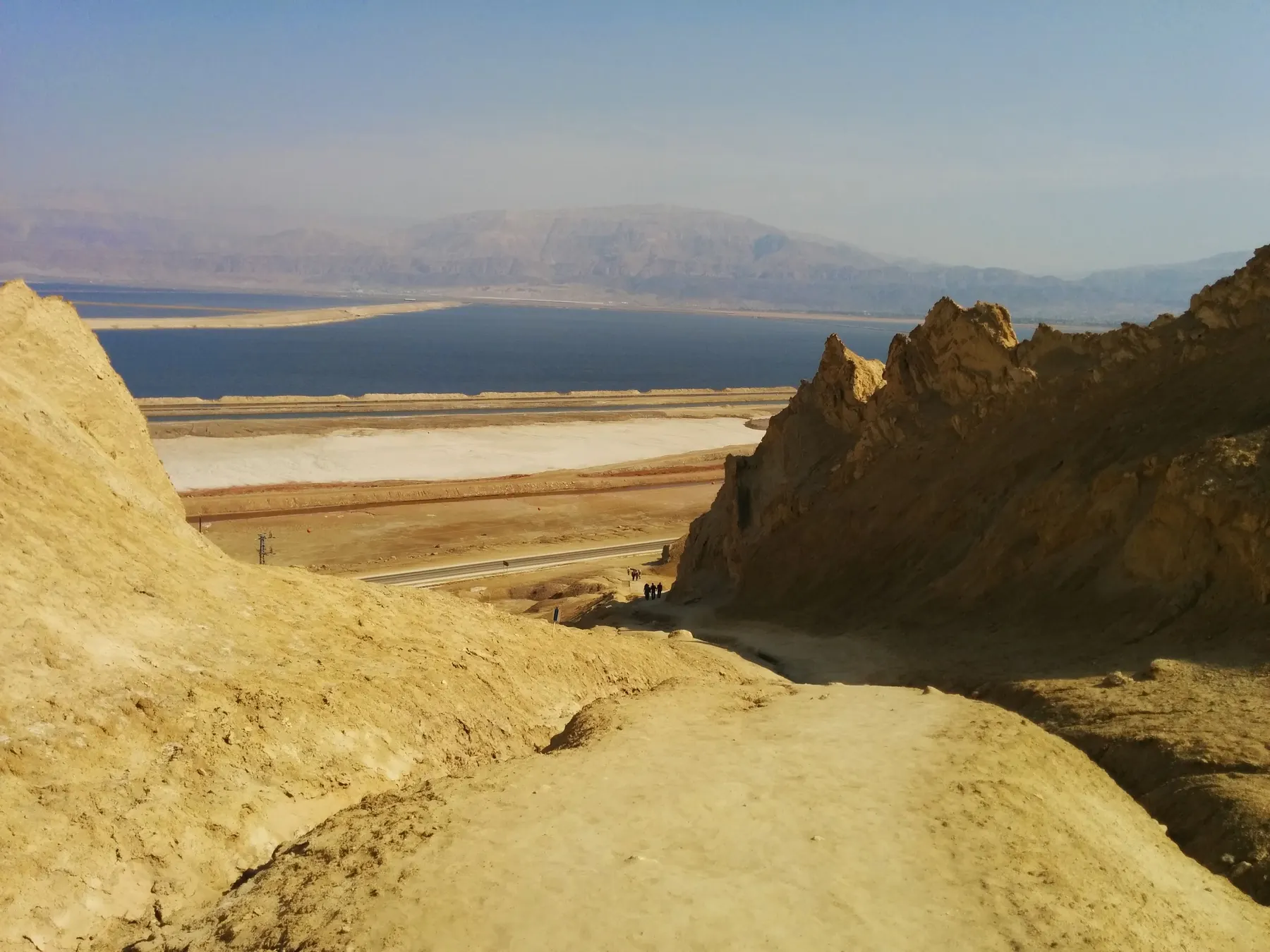
A wall of rock salt that radar measurements show is still rising by up to 8.3 millimetres a year, with the longest salt cave in the world running through the inside of it.
ליזי שאנן / CC BY 2.5 · Wikimedia Commons
Beach
Ein Bokek Beach
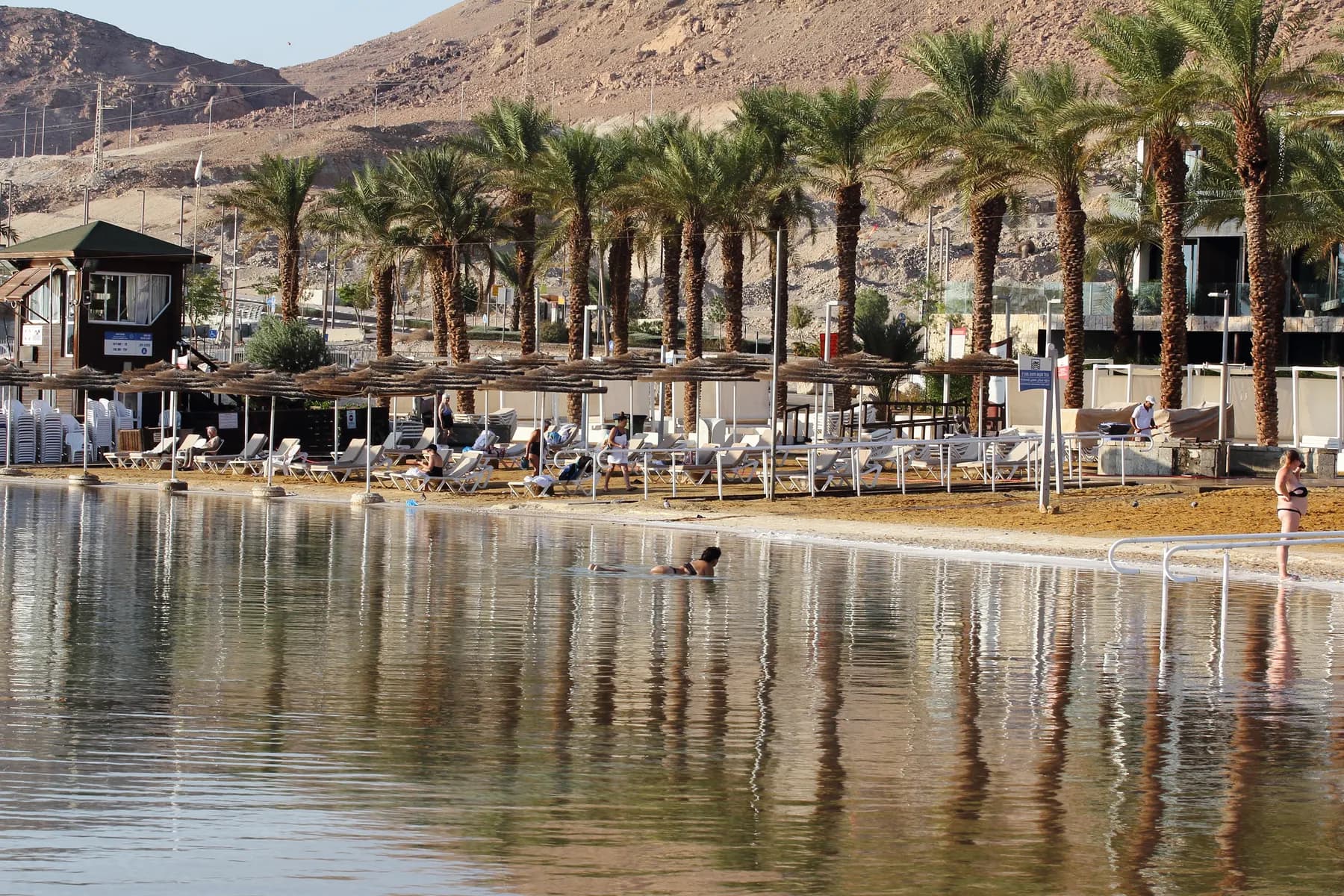
The free, lifeguarded public beach in front of the southern hotel strip, where the water is not the open Dead Sea but Pond 5, an evaporation pond of the mineral works, and the beach itself was raised two metres and rebuilt between 2012 and 2016.
In-bar / CC BY-SA 4.0 · Wikimedia Commons
Nature reserve
Ein Gedi Nature Reserve
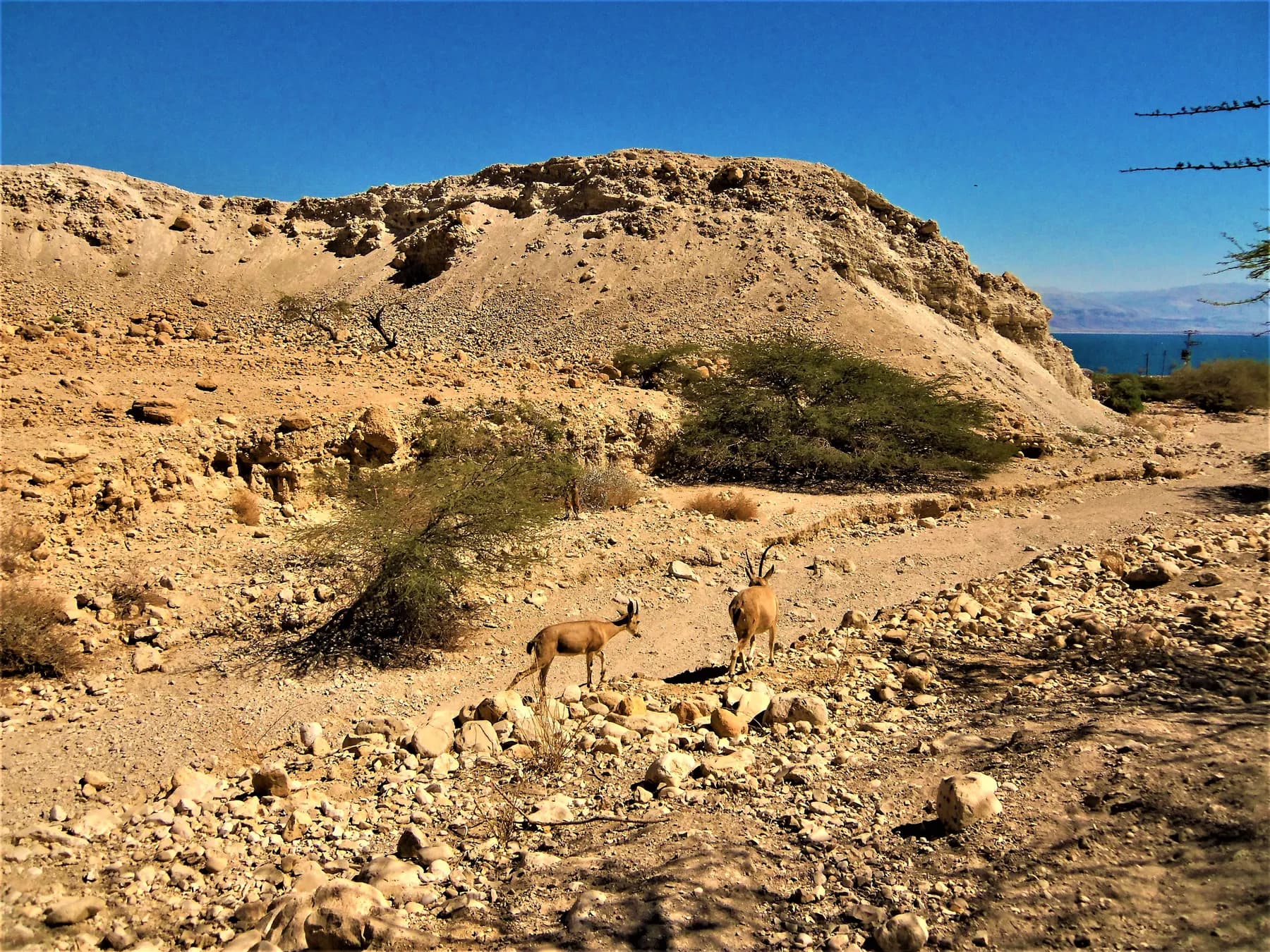
Four springs push about three million cubic metres of fresh water a year through two desert canyons here, and the parks authority has been rebuilding the trails between them since a flood tore through the reserve in May 2025.
Sources and further reading
Every link below was opened and checked when this page was written. Official statements are marked as such: they are the subject's own account, not an independent one.
- OfficialMoshe Novomeisky Visitor Centerdeadseanovo.co.ilThe Experience at the Center
the operator's own account of the tour route, the restored buildings and the guided-only rule
- OfficialMoshe Novomeisky Visitor Centerdeadseanovo.co.ilEntrance ticket to the visitor centre
the current price list in shekels, the opening hours, the last tour times and the cancellation policy
- OfficialMoshe Novomeisky Visitor Centerdeadseanovo.co.ilImportant information
the second, older timetable the operator still publishes, and the booking instructions
- OfficialMoshe Novomeisky Visitor Centerdeadseanovo.co.ilHistory, our story
the dated chronology from 1911 to 1952, including the tender, the concession, the 1948 siege and Operation Lot
- OfficialMoshe Novomeisky Visitor Centerdeadseanovo.co.ilPartners
which buildings and rolling stock the Council for Conservation of Heritage Sites restored, and the Tamar Regional Council's role
- OfficialMoshe Novomeisky Visitor Centerdeadseanovo.co.ilVision
ICL's stated purpose for the centre, quoted rather than paraphrased so the framing is visible
- OfficialMoshe Novomeisky Visitor Centerdeadseanovo.co.ilAccessibility arrangements
the accessible route, parking bays, hearing systems, Step Hear beacons and toilet provision
- OfficialMoshe Novomeisky Visitor Centerdeadseanovo.co.ilHome page
the current notice that the centre opens Sunday to Friday and is closed on Saturday, and the contact details
- OfficialICL Groupicl-group.comOur history
the successor company's own dating of the 1929 concession, the northern works and the 1934 southern factory at Sodom
- ReferenceHebrew Wikipediahe.wikipedia.orgPalestine Potash Company
the 1 May 1934 sailing, the concession terms and royalty, the 1945 sales figures and the nationalisation dates
- ReferenceHebrew Wikipediahe.wikipedia.orgThe salt plant at Sdom
the camp's population, Colonel's Cave, the six-kilometre works railway, and the conservation work begun around 2010
- ReferenceHebrew Wikipediahe.wikipedia.orgMoshe Novomeisky
independent confirmation that a visitor centre in his name opened at the old Sdom workers' camp in 2021
- ReferenceWikipediaen.wikipedia.orgMoshe Novomeysky
the biography, Plumer's 1927 acceptance, the share of industrial exports in 1940 and the Arab Legion's entry on 22 May 1948
- ReferenceEncyclopaedia Judaica, via Encyclopedia.comencyclopedia.comNovomeysky, Moshe
Barguzin, the Siberian years, the decade spent obtaining the concession and the two memoirs
Moshe Novomeisky Visitor Center: common questions
What is the Moshe Novomeisky Visitor Center?+
It is a heritage museum built inside the restored workers' camp of Palestine Potash Ltd at Sdom, at the southern end of the Dead Sea. The camp housed the company's southern workforce from 1934 until the early 1950s, and several of its buildings, including the dining hall, the administration building and the security house, have been conserved. The exhibition inside them covers the founding of the potash industry, the life of the camp and the siege of 1948.
How much does it cost?+
The operator posts ₪30 for an adult and ₪25 for a child aged 5 to 18, with VAT included. A senior citizen, a pensioner, a soldier in regular service or a visitor holding a disability card pays ₪20; a student or overseas youth pays ₪19; a pupil visiting with a school or youth movement pays ₪15. Children under five are free.
Do I need to book in advance?+
Yes, and it is the single thing most first-time visitors get wrong. Tickets are sold only through the centre's own website, for a specific date and time slot, and the site cannot be visited without a guide. If you arrive late for a booked slot, staff will try to place you on the first tour with room, which may be some hours later.
How long does the visit take?+
Roughly ninety minutes for the tour itself. The operator's description of the experience says about an hour and a half and its booking page says an hour and forty minutes, and it asks visitors to arrive fifteen minutes early, so budget two hours from car park to car park.
Is it open on Shabbat?+
No. The centre's home page states that it is open Sunday to Friday and closed on Saturday, and the booking page repeats it. Friday and holiday eves run to the same hours as the rest of the week on the current timetable, with the last tour at 14:00.
Is it wheelchair accessible?+
Yes, and it is one of the better-documented accessible sites in the region. The operator describes a continuous accessible route from the car park through reception to the toilets, exhibition buildings and cafeteria, four accessible parking bays about six metres from the entrance, a hearing assistance system at reception, infrared audio and subtitles in the presentation halls, Step Hear beacons along the route, and one fully accessible toilet cubicle among nine. The ground is level rather than a climb.
Is any of it original, or is it all reconstruction?+
The buildings are original fabric that has been conserved, not replicas. The Council for Conservation of Heritage Sites in Israel says it spent millions of shekels on the dining hall, the administration building known as the mud house and the security house, and on the locomotives, carriages and track. Everything inside them, including the Dead Sea model hall, the virtual reality sequence and the screens, is new.
Can I see the potash plant itself?+
No. The Dead Sea Works next door is a working industrial site and is not part of the tour. The visit stays inside the historic camp, and closes with a display on what the minerals are used for today rather than with a look at the production line.
Is it suitable for children?+
The operator states the guided tour suits all ages, and the virtual reality section is the part younger visitors tend to remember. It is a talk-led museum visit of an hour and a half in a hot place, though, so a child who will not stand still through a guided tour will struggle. Under-fives go free but there is nothing here built for them.
Is it worth it if I only have one day at the Dead Sea?+
Only if the industrial and pre-state history is what draws you, because the visit costs the better part of a morning and takes you to the far southern end of the lake. A day-tripper with one slot to spend will usually get more out of Masada or Ein Gedi. The case for coming is that this is the one place on the shore that explains how the lake became an industry, and it is a short detour if you are already staying at Ein Bokek or driving on to Eilat.