
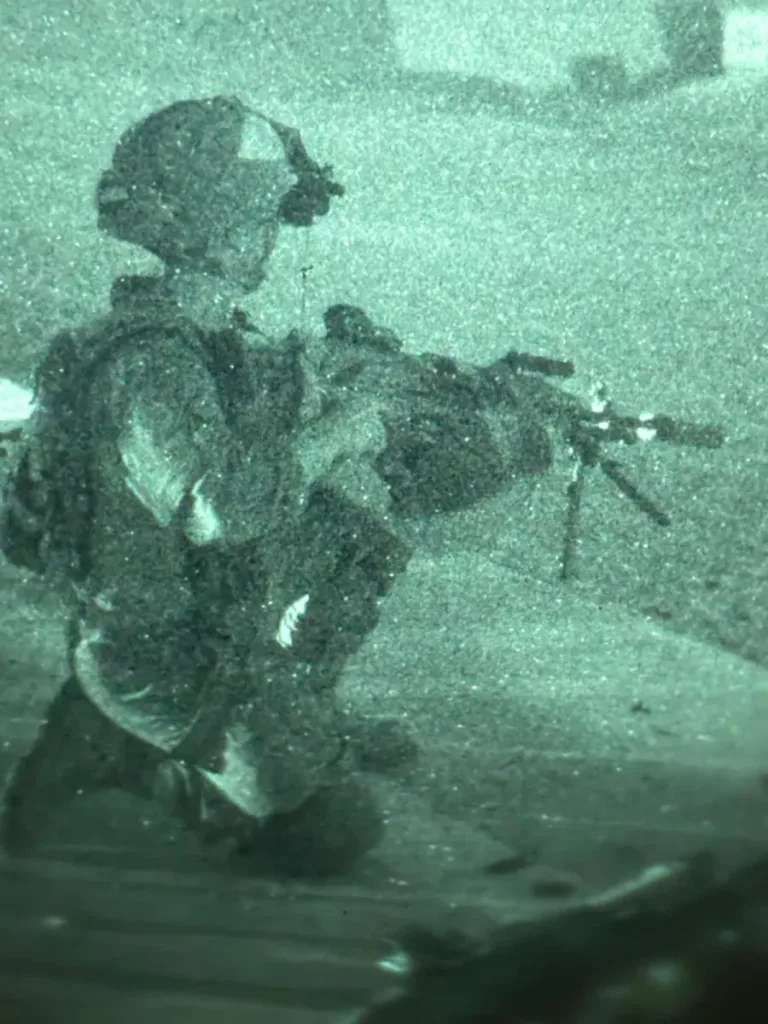
In light of the evolving battlefield in recent years, and in direct response to combat lessons learned, the firing array in the Marom Brigade has undergone a comprehensive ‘facelift’ for the operational firing instructors course, which is set to take effect with the next cohort, in a few months.
In the past, the program was a supplementary and limited format, held twice a year, primarily for special units, with most of its trainees and training staff being conscripts. The updated training, on the other hand, will be mandatory, led by career NCOs and officers with rich operational experience, and will be intended mainly for commanders and NCOs across all combat battalions.
The comprehensive change was born out of a mutual need. At the battalion level, professional firing instructors are required to build ongoing readiness, lead training, and instill lessons learned among the combat soldiers. In practice, however, marksmanship instructors at the training bases are primarily responsible for imparting basic rifle skills during initial training.
Concurrently, the array identified the importance of transferring accumulated professional knowledge directly to the units and to the soldier at the operational edge.
“If we remain in a training facility, we will become irrelevant, because combat doesn’t happen here,” explains Major A., Head of Armament and Equipment Professions. “We understood that we need to act like an octopus: the head is in the department, and the course graduates are the arms – those that reach the soldier in the field, to the training, and to the combat procedure.”
The main goal, as he explains, is to grant the units full autonomy in training, thereby ensuring maximum capabilities at the moment of engagement with the enemy.
During the war, the program’s activity in its old format was reduced, as forces were engaged in operational missions. “Our understanding sharpened that the content is not adapted to the changing pace of the battlefield,” he emphasizes. “Therefore, we utilized the period for accelerated operational learning, for collecting lessons learned from the units, and for rebuilding the course.”
And as part of this concept, the training model has also changed: “If in the past we trained our people for yesterday’s combat zone, today the trainee meets commanders who experienced the campaign themselves, investigated the events, and know how to translate that into actual training.”
And now, they have returned from the field with new methods and capabilities. “Among them,” he demonstrates, “fragmenting ammunition, or professional response to dealing with drones. Beyond that, we have incorporated all the armament and equipment that has joined in the last three years into the lesson plans.”
The first part of the training is dedicated to rifle skills and personal weapon firing proficiency, while the continuation delves into marksmanship professions, the marksman’s kit, and advanced optics. Additionally, trainees practice the world of machine guns and learn to operate the new armament and equipment. All of this, along with dealing with developing threats, primarily the drone threat.
One of the key advantages of the updated course lies in the scope of resources and experience gained: “In a short period, soldiers can fire a higher quantity than an average combat soldier does throughout their military service – day and night, using a wide range of weapons, optics, night vision devices, and specialized ammunition.”
And from the array’s perspective, this is just the beginning. In the future, they aspire to have a career combat firing NCO in every combat battalion, for whom the course will serve as mandatory professional training. “This is a move that will ensure a permanent professional authority that will plan and lead firing training, preserve knowledge, and maintain continuous operational readiness,” notes Major A.
Meanwhile, when new equipment is introduced, these soldiers will be able to undergo further training, and then return to their units to teach all the combat soldiers. “This is how we streamline information transfer,” he testifies.
“We have distilled into this course everything that the professional body knows to provide,” concludes the Head of Department. “This is training that produces direct and measurable impact. It doesn’t end with the trainee – but returns with them to the battalion, becomes knowledge, becomes training, and ultimately reaches the last combat soldier.”