

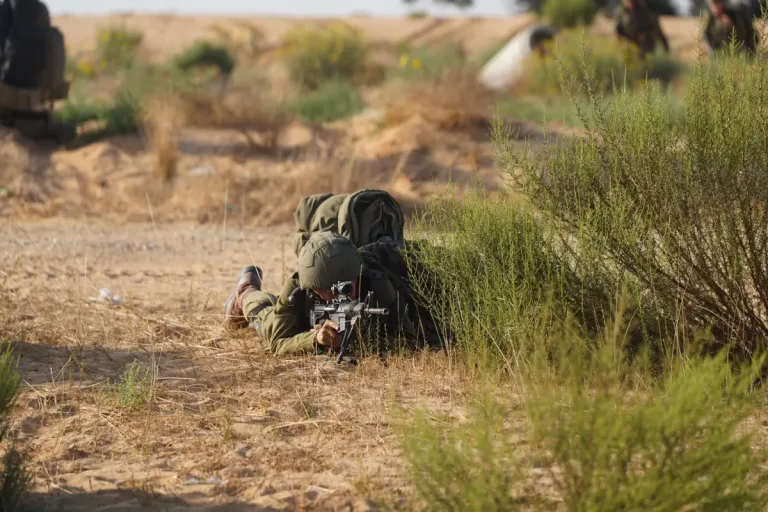
At various points during the war, the Border Defense Corps realized that significant changes were needed in training – to make it more precise, sharper, and more relevant to the reference scenarios that forces might encounter in the post-training reality.

The first change decided upon, starting with the latest cohort, was the extension of the training track, to make it more similar to other infantry training tracks. Instead of six months, the combat soldiers will undergo eight full months of training, including basic training and advanced training. A special pilot program to raise the qualification level from Rifleman 06 to Rifleman 07 is already underway.
“We are raising the physical and mental bar,” explains Lt. Col. A’, commander of the Border Defense Corps. “For example, heavier weights have been added to training, marches have been extended, and we have incorporated exercises that simulate sharp transitions between operations under stressful conditions.”

The climax comes during the “War Week,” during which they simulate operating in built-up and destroyed areas, dealing with incursions into communities, “jumping” between different arenas, and maneuvering alongside tanks and snipers.
The change is also taking root in the actual combat, through the extensive integration of weapons, command and control systems, and advanced technologies, alongside a significant increase in the number of live-fire exercises. “If in the past they fired thousands of rounds here during the course, today they are firing tens of thousands,” emphasizes the commander. “We want them to be confident in their weapon, in their comrades, and most importantly, in themselves.”

Alongside these processes, the training of the first “Jaguar” company is also concluding these days – a new female combat soldier company that will operate JLTV vehicles (Light Tactical All-Terrain Vehicle). Out of approximately 600 candidates who enlisted in the corps, about 60 female soldiers were selected for the role.
The “Jaguar” is twice the size of a regular Humvee. What began as a transport vehicle in the US Army has been adapted by the IDF into a platform that allows for rapid response in complex border scenarios, featuring high off-road capability, firepower, and long-range protection systems.

Each crew consists of 4 female soldiers: a commander, a driver, and two synchronized system operators. In addition to the unique skills they acquire, they all also complete full infantry training, so that they can continue to fight even outside the vehicle.
“The company was established out of a real need identified from the lessons of October 7th,” explains Captain T’, commander of the Jaguar company. “This is an independent and lethal force designed to arrive first, block, and neutralize the enemy.” The pilot program already began on a small scale in the Jordan Valley Brigade, but now an official track is being established, from which companies will be deployed to various sectors – the Jordanian border, the Egyptian border, and so on.


After completing this updated training, the corps explains, the combat soldiers will arrive at the operational lines better prepared and equipped with improved means: “This is a real conceptual change, designed to adapt us to the new operational reality on the country’s borders.”