The Turbocharged Humvee Now Climbing Mount Hermon for the IDF
The 810th Brigade's new Lavi adds about 30 horsepower and a first-of-its-kind turbo to a thirty-year-old workhorse, and cuts minutes off the climb.
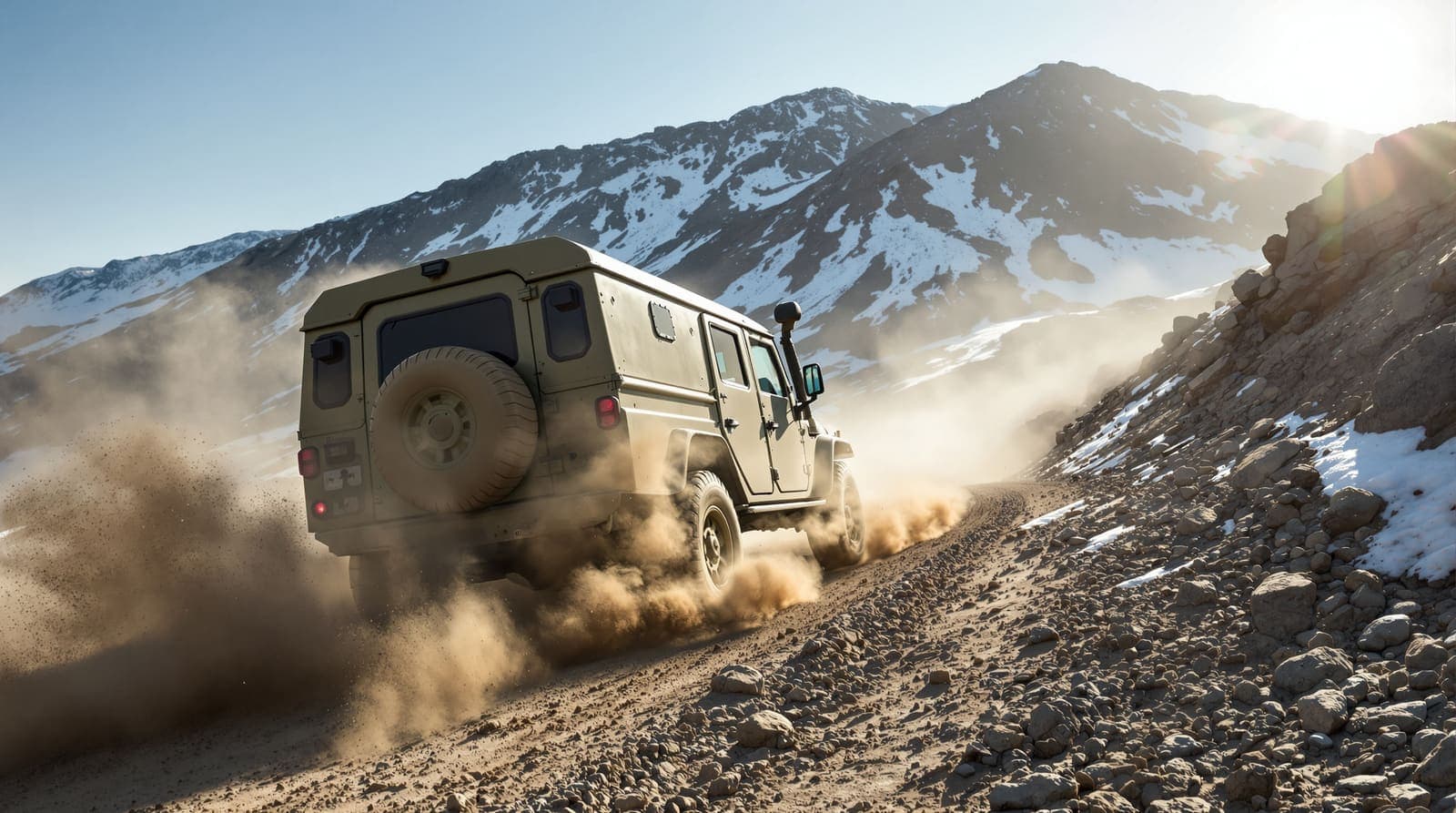
Illustration
The IDF has begun using a rebuilt version of its veteran Humvee, named the Lavi, in the mountain transport unit of the Mount Hermon Regional Brigade, known by its number, 810. The brigade operates between Mount Dov and Mount Hermon in Israel's far north, where slopes are steep, snow is routine and positions sit above 2,000 metres: terrain that tests a vehicle before its engine is even started.
From the outside the Lavi is hard to tell from the Humvee the army has run for nearly thirty years. The differences are mechanical. The old vehicle produces about 160 horsepower; the Lavi produces about 190, with more torque (the pulling force that keeps a transport vehicle moving on a steep gradient) and a greater load capacity. The unit's commander, identified by the army only as Major A., said the engine is new, a turbo system has been added that earlier models did not have, cooling has been upgraded and the brakes reinforced, with a new steering and ventilation mechanism and LED lighting in place of incandescent bulbs.
Why thin air is an engine problem
The turbo is the change the commander singled out, and he described it as the first of its kind on the vehicle and exclusive to the new model. His explanation was physiological: as altitude rises the proportion of oxygen in the air falls, and an engine struggles to breathe for the same reason a person does. The turbo forces air in more efficiently, so the vehicle keeps its power where it would otherwise lose it.
The practical effect he offered was a stopwatch one. Reaching the summit of Mount Hermon used to take him several minutes; now it takes fewer. In an operational area, he said, a minute can decide whether a mission works.
What the brigade actually uses it for
The missions have not changed, only the way they are performed: carrying soldiers, evacuating casualties, and running logistical resupply to outposts. What has changed, the commander said, is the confidence the vehicle gives: enough that the unit attempts more. He recalled one operation in southern Lebanon, where Israeli ground forces have been operating against Hezbollah positions since 16 March 2026, Al Jazeera reported; the topography made the approach difficult, he said, and the vehicle performed quickly and precisely despite the load it was carrying. The Lavi remains light and unarmoured, which he presented as the point rather than a shortcoming.
The army did not replace the Humvee because it had a better idea; it concluded the Humvee could not be replaced. It is neither the fastest nor the strongest vehicle available, the commander said, but in combat it is durable and it suits the job. The programme predates the current war and was pushed along by it. The Jerusalem Post, reporting on the upgraded vehicle on 30 June 2026, said the new version was already in use with the 810th Brigade in both Syria and Lebanon.
The ground the 810th holds
Conditions on the Hermon explain the specification. The IDF has held positions on the Syrian side of the mountain through the winter, building bases at 2,400 metres with structures reinforced against up to six metres of snow and another near the peak at 2,800 metres, installing de-icing systems and hypothermia treatment rooms and stockpiling food and water against the possibility of being cut off in a storm, Ynetnews reported in December 2024, with temperatures on the ridge falling to around minus 10C.
The unit is still learning the vehicle: practising how to handle malfunctions, mapping how it behaves in particular places, working out what needs improving. The commander's stated ambition is to double the number in service within a year and retire the old vehicles.
What is still unclear
The army did not say how many Lavis it has, what they cost, who builds them, or which other units are due to receive them. It gave no figures for load capacity or range, and no timetable for retiring the older Humvees. The officer quoted throughout was identified only by rank and initial.
Sources and further reading
Every link below was opened and checked when this page was written. Official statements are marked as such: they are the subject's own account, not an independent one.
- ReportingThe Jerusalem Postjpost.comIDF unveils upgraded Hummer, already in use in Syria and Lebanon
Independent account of the Lavi's upgrades and where it is deployed, June 2026
- ReportingYnetnewsynetnews.comIDF prepares to stay on Syrian Mount Hermon for the whole winter
Altitudes, snow depths and cold-weather preparations on the Hermon
- ReportingAl Jazeeraaljazeera.comIsraeli military launches 'ground operations' in southern Lebanon
The Lebanon operations the unit commander refers to
How we checked this
The specifications, quotes and unit details are taken only from the IDF's own account of the Lavi's introduction, published 28 June 2026; no figure has been added or sharpened. The vehicle's deployment in Syria and Lebanon is from Jerusalem Post reporting of 30 June 2026, and the description of conditions on Mount Hermon from Ynetnews, December 2024.
Our sourcing and corrections policy →The week from Israel, in one email
The stories that mattered, sourced and checked by the Israel.com newsroom. Free, weekly, one-click unsubscribe.
One list, unsubscribe in a click. See our privacy policy.
More in Security
All security →

Latest
- Trump cuts short Camp David weekend, returns to White House early
- Kinneret Drops 6 cm to -213.470 m, Sinking 0.47 m Below the Lower Red Line
- All three barred outlets expected to challenge ban in court
- Herzog erases Elor Azaria's criminal record on eve of Yom Kippur
- IDF says Rafah Brigade commander Nael Abu Obeid was killed in Gaza
- Strikes reported at Nabatieh al-Fawqa after south Lebanon bomb wounds two