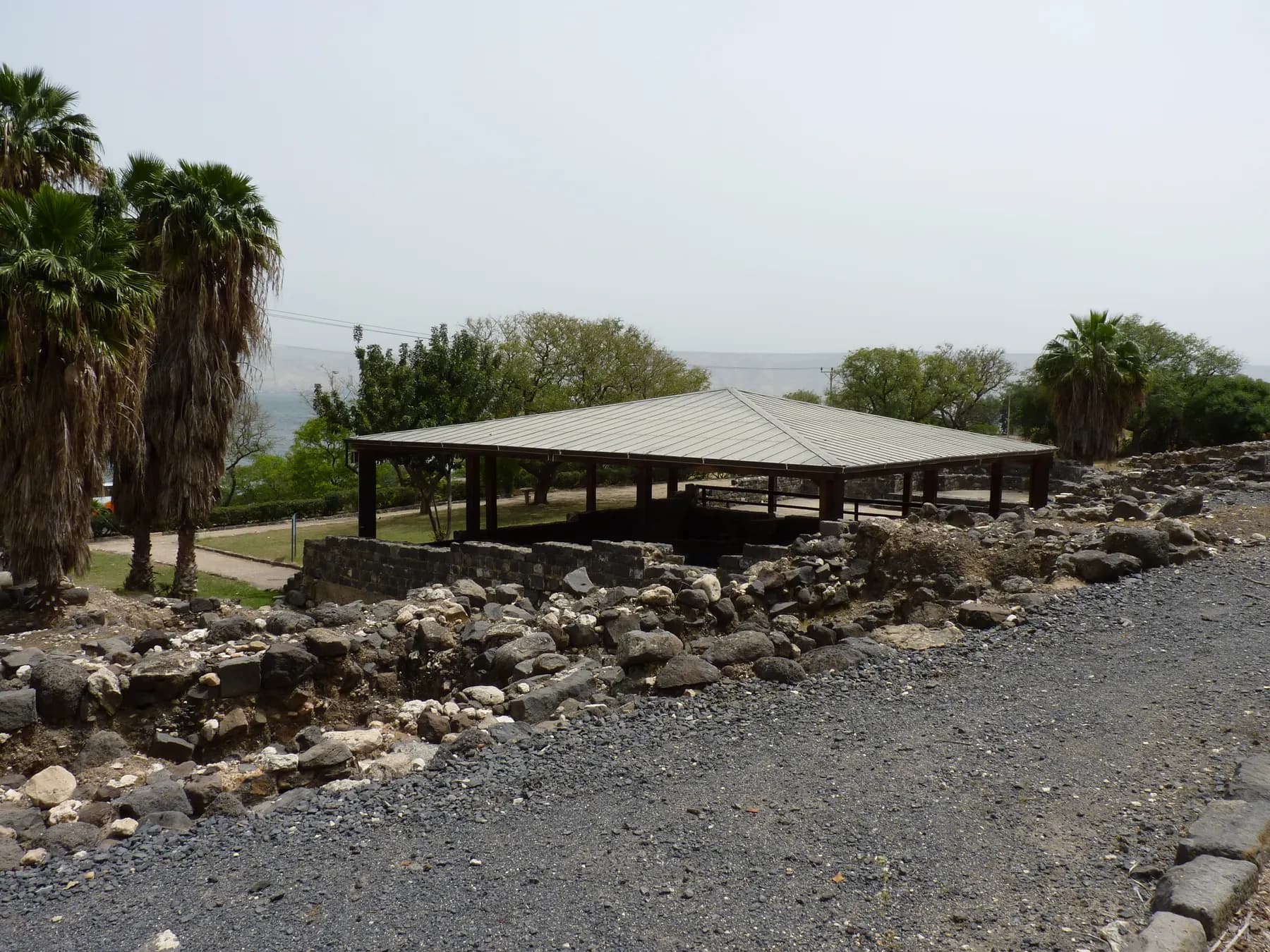
Archaeological site · The Sea of Galilee
Hamat Tiberias
Seventeen springs come out of the ground here at about 60 degrees Celsius, and the synagogue beside them has a mosaic floor that puts a zodiac wheel around the sun god Helios.
Ricardo Tulio Gandelman from Rio de Janeiro, Brazil / CC BY 2.0 · Wikimedia Commons
Thermo-mineral springs inside the park
17
flowing at about 60 degrees Celsius, per the Israel Nature and Parks Authority
Date of the mosaic floor
4th century CE
the second half of it, per Negev and Gibson; the earliest mosaic pavement found in a synagogue in the country
Turkish bathhouse
built 1780
Hamam Suleiman, in basalt, serving bathers until 1944 per the parks authority
Adult admission
16 ILS
with children at 7 ILS, as published by the parks authority in August 2026
In short
- How long to give it
- about 90 minutes for the synagogue, the hammam museum and the spring, and two to three hours if you use the pools and the reflexology path
- Summer, Sunday to Thursday and Saturday
- 08:00 to 17:00
- Adult
- 16 ILS
חמת טבריה
Hamat Tiberias is a small national park at the southern entrance to Tiberias, on the strip between Route 90 and the lake, and it holds two unrelated things that happen to sit on the same seventeen hot springs. One is an excavated synagogue whose fourth-century mosaic floor sets a zodiac wheel around Helios, the Greek sun god, driving his four-horse chariot. The other is a working thermal site: an open spring channel, warm mineral pools you are allowed to paddle in, and an Ottoman bathhouse of 1780 that took paying bathers until 1944.
The springs are the reason for everything else. The Israel Nature and Parks Authority puts them at seventeen, rising at roughly 60 degrees Celsius and carrying about 36.5 grams of salts per litre, mostly chlorides of sodium and calcium. Most of that water leaves the park through underground channels to the commercial baths across the road. Britannica notes the springs have been known for over 2,000 years for their supposed medicinal qualities, and marks the claim as supposed rather than demonstrated.
The site is compact and flat, which makes it a rare archaeological park in Israel with no climb in it at all. Ninety minutes covers the synagogue, the bathhouse museum and the spring; longer if you use the pools. What it is not is the spa. Hamei Tveria, the commercial complex across the road, is a separate business with a separate ticket, and confusing the two is the commonest mistake made here.
Water
Seventeen springs, and the pipework built to take them away
The parks authority's own account is precise about the water. Seventeen thermo-mineral springs rise inside the park boundary at about 60 degrees Celsius, at a salt concentration of about 36.5 grams per litre, mostly chlorides of sodium and calcium with smaller amounts of potassium, bromide and sulphate. Almost none of it is left to run on the surface. The flow is gathered into underground channels that carry it to the Tiberias hot baths, and those channels were built with chimneys to release the steam pressure, so the visible sign of the springs for most of the park is steam venting out of vertical shafts.
Surplus water, and water returning from the baths after use, is collected in a Mekorot facility inside the site and put into the National Saline Water Carrier, the conduit that keeps saline spring flows out of the Sea of Galilee. The Hebrew Wikipedia entry notes that the carrier crosses the park from north to south, which is a fair summary of what this place is.
One spring is left open on purpose. The parks authority calls it the Roman Spring, a small flow running down an open channel where visitors can put a hand in and taste how hot and how salty the water actually is. It tends to dry up when the level of the Kinneret drops. Elsewhere the water is held in pools; paddling is permitted, and the Hebrew page notes the pools are emptied for routine cleaning an hour before the site closes each day.
The parks authority has also laid a barefoot reflexology path through the site, included in the entrance fee, which is the clearest signal that this park is no longer run purely as an antiquities enclosure. Moshe Gilad, writing in Haaretz in June 2025, described it as somewhere to spend several hours, some of them wet.
- 17 springs, about 60 degrees Celsius, about 36.5 g of salts per litre (parks authority)
- Steam chimneys on the underground channels to the baths
- The Roman Spring: an open channel, dry in low-water years
- Warm pools, paddling permitted, emptied for cleaning an hour before closing
- A barefoot reflexology path, no extra charge
History
A town called Hot, and the road crew that found it
Hammat is the Hebrew and Semitic word for a hot spring, and the settlement here carried the name long before the city beside it existed. Herod Antipas founded Tiberias in 18 CE and named it for the emperor Tiberius; Hammat was already there, separately walled, and the Hebrew Wikipedia entry has the two remaining distinct towns until they merged in the eleventh century. Archaeologists have connected the place to the biblical Hammath of Joshua 19:35, though the excavated finds run only from the first to the eighth centuries CE, so the link is an argument from the name rather than from the ground.
The context for a synagogue this ambitious is that Tiberias had become the centre of Jewish religious authority. The Sanhedrin sat here from 193 CE until the late fourth century, when Theodosius I prohibited its activity, and the patriarchs named in the mosaic's own inscriptions belong to that world.
The site was found by accident. In 1920, while the Tiberias to Samakh road was being cut, labourers turned up ancient remains and asked the Jewish Palestine Exploration Society to look at them properly. Nahum Slouschz arrived in November 1920 and dug what is now called Hammath Tiberias North, on the lakeshore about 500 metres north of the city's south wall, continuing into 1921. It was the first archaeological excavation in the country conducted under Jewish auspices. He found a square basilical hall, a carved stone seat and a 60 cm limestone menorah now in the Israel Museum. Then the trenches were backfilled, and a hotel was later built over the whole thing. That synagogue is not on this site and cannot be visited.
The building the national park exists for came out of the ground forty years later. Moshe Dothan, working for the Department of Antiquities, found it in December 1961 and excavated through 1963; the Hebrew Wikipedia entry, citing contemporary press reports, says the dig was financed by the Hamei Tveria baths company. What he uncovered was a stack of synagogues, one on top of another, running to the early Islamic period.
The mosaic
Nine Greek dedications, twelve signs and a sun god
The mosaic belongs to the second synagogue on the site, and it is the reason people come. The parks authority describes the sequence: a first synagogue built about 230 CE over an earlier public building and apparently destroyed within the same century, of which only a scrap of mosaic survives at the southern edge of the main floor and slightly below it; then the building whose floor you look at, which the authority places in the third and fourth centuries and whose pavement Avraham Negev and Shimon Gibson date to the second half of the fourth century, making it the earliest mosaic pavement found in any synagogue in the country.
The floor is laid in three panels. At the north end two lions flank nine Greek dedications naming donors. One of them records Severus, brought up in the household of the illustrious patriarchs, and it is from him that the building takes the name it is usually known by. Every personal name in the inscriptions is Greek. At the south end, facing Jerusalem, is the Torah shrine with two seven-branched menorahs beside it, a shofar, an incense shovel and two of the four species, the lulav and the etrog.
Between them is the zodiac. Helios stands in the centre, head haloed and turned to his right, a rayed crown on his head, right hand raised, left hand holding a whip and a globe, wearing the red paludamentum of an emperor, with a crescent moon on one side and a star on the other. The twelve signs run anticlockwise around him, which is the reverse of the usual arrangement, and three of them, Cancer, Sagittarius and Gemini, have not survived. Libra and Aquarius are both nude male figures; the fact that the Libra figure is uncircumcised has been used to argue that the mosaicist was not Jewish. The label beside Aquarius is written in mirror script. In the four corners sit women personifying the seasons, with the produce that goes with each: pomegranate, fig, vine and almond for autumn, ears of grain and a sickle for summer, roses for spring, a jar pouring water for winter.
What all of this was doing in a synagogue is still argued about. The parks authority's own reading is that Judaism here felt secure enough not to be threatened by such images, pointing out that the same scheme turns up at Beth Alpha and elsewhere. Walter Zanger, writing for the Biblical Archaeology Society, calls Hammath Tiberias the second most famous and the most technically accomplished of these floors, and rules out astrology, astronomy and, in his view, a calendar. Jodi Magness has argued the sun figure should be understood as the angel Metatron. Researchers still differ, and the site does not settle it.
What is real
The wall through the chariot, and what the shelter is
The mosaic is original and in place, and it is damaged in ways worth being able to read. A band runs straight across the floor, cutting the composition: that is the footing of a wall built on top of the pavement long after the synagogue had gone, which the Hebrew Wikipedia entry assigns to the Fatimid period. It took out most of Helios's chariot. What is left of the quadriga is part of a horse and a few hooves.
The building around the floor is entirely modern. The parks authority states plainly that the synagogue has undergone conservation, restoration and reconstruction, and that the structure is glass-walled so that visitors keep eye contact with the landscape, the remains of the ancient houses and the later synagogue, and that it is air conditioned. It doubles as the park's visitor centre. So the walls are a shelter, not antiquity; the pavement inside them is the antiquity.
Above and around it lies the later synagogue, a bigger hall divided into three by two rows of columns, with a semicircular prayer niche at the southern end. Here the sources disagree, and the disagreement is not trivial. The parks authority says this building went on functioning with slight changes until the eleventh century. Dothan's own account, as summarised in both the Hebrew and English Wikipedia entries, counts four synagogues rather than three and has the last of them destroyed at the start of Abbasid rule in the middle of the eighth century, with houses built over the ruins afterwards.
One more layer of damage is recent. On the morning of 29 May 2012, staff arriving at the park found the mosaic smashed and sprayed with graffiti overnight, including slogans against the then director of the Israel Antiquities Authority and against excavation of Jewish graves. Dina Avshalom-Gorni, the authority's district archaeologist for the eastern Galilee and Golan, told Ynet the damage was irreversible and that the floor had stood for 1,600 years. Conservation work followed.
At the southern end of the park are the remains of Roman-period baths: stone arches that carried an upper structure which has not survived, and a plastered bathing pool. The parks authority says the bath area has not yet been excavated apart from those elements, so most of that corner of the site is still unknown.
The bathhouse
Hamam Suleiman, and the spa that is not this place
The other building worth time is Ottoman. Hamam Suleiman was built in 1780, in basalt, during the rule of Jezzar Pasha over the Damascus district, and it served the people of the region and pilgrims coming to be healed in the water until 1944. Muslim geographers had recorded baths working here even in the eighth century, when the parks authority says there was no real settlement at Hammat but the bathing carried on regardless. The building is named for King Solomon, and Zev Vilnay recorded the folk explanation: Solomon set demons to stoke furnaces underground and made them deaf, so they never heard he had died and are heating the water still.
The hammam has been conserved, is air conditioned, and now works as a museum of how the bathhouse was used, with a separate antiquities display room elsewhere in the park. Haaretz reported in June 2025 that it had received a further and substantial restoration.
Across Route 90 is Hamei Tveria, the commercial spa. It draws on the same seventeen springs; the water arrives at about 60 degrees and is cooled to 37 or 38 degrees for the pools and baths, and it is a paying leisure and treatment complex with indoor and outdoor pools, saunas and a gym. It is not part of the national park, a national parks ticket buys nothing there, and its opening hours have nothing to do with the park's. The two are separated by a road and by about two hundred years of purpose.
What to look for
Things not to walk past at Hamat Tiberias
The details that repay knowing about before you are standing in front of them.
Helios in the centre panel
The sun god stands in a rayed crown holding a whip and a globe, in the red cloak of a Roman emperor, with a crescent moon beside him. The later wall built across the floor destroyed most of his chariot, leaving a horse and a few hooves.
The Severus inscription
Nine Greek dedications between two lions at the north end of the floor, one of them naming Severus, brought up in the household of the illustrious patriarchs. Every personal name on the floor is Greek.
The four seasons in the corners
Women personifying the seasons, each with the produce that belongs to her: ears of grain and a sickle for summer, pomegranate, fig, vine and almond for autumn, roses for spring, a water jar for winter.
Hamam Suleiman
A basalt Ottoman bathhouse of 1780 that took bathers until 1944, conserved, air conditioned and now a museum of bathing customs. Haaretz reported a further restoration of it in June 2025.
The Roman Spring and the steam chimneys
One spring is left running in an open channel so visitors can feel the heat and taste the salt. The vertical shafts venting steam nearby are pressure-release chimneys on the buried channels that carry the water to the baths.
The barefoot reflexology path
A textured path the parks authority built to be walked without shoes, included in the entrance fee, running between the warm pools. Paddling in the pools is permitted.
The long view
Hamat Tiberias, in order
18 CE
Herod Antipas founds Tiberias and names it for the emperor Tiberius. Hammat, the spring town beside it, is already there and separately walled.
1st century CE
A public building with rooms set around a courtyard stands on the site of the future synagogue.
After 135 CE
The priestly course of Ma'aziah, one of the twenty-four, settles at Hammat after the Bar Kokhba revolt, on Michael Avi-Yonah's reconstruction.
193 to the late 4th century
The Sanhedrin sits at Tiberias, until Theodosius I prohibits its activity.
c. 230 CE
The first synagogue is built over the earlier public building. It is destroyed, apparently within the same century; a scrap of its mosaic survives below the southern edge of the later floor.
306 CE
An earthquake strikes Tiberias. The second synagogue was probably repaired after it.
Second half of the 4th century
The mosaic floor with the Helios zodiac, the nine Greek dedications and the Torah shrine panel is laid: the earliest mosaic pavement known from a synagogue in the country.
Early 5th century
An earthquake destroys the Severus synagogue.
5th to 6th centuries
A larger synagogue is built over it, a hall divided into three by two rows of columns, with a semicircular prayer niche at the southern end.
Mid-8th century
On Dothan's account the last synagogue is destroyed at the start of Abbasid rule and houses are built over it. The parks authority instead has the later synagogue in use until the 11th century.
11th century
Hammat and Tiberias, until then two walled towns, merge into one city.
1780
Hamam Suleiman is built in basalt under Jezzar Pasha, ruler of the Damascus district.
November 1920
Cutting the Tiberias to Samakh road turns up ancient remains. Nahum Slouschz arrives for the Jewish Palestine Exploration Society and finds the northern synagogue, in the first excavation in the country under Jewish auspices.
1921
Slouschz completes the northern dig. The synagogue is reburied and a hotel is later built over it.
1944
Hamam Suleiman stops serving bathers.
December 1961 to 1963
Moshe Dothan finds and excavates the Severus synagogue for the Department of Antiquities, uncovering the zodiac floor.
29 May 2012
The mosaic is smashed and sprayed with graffiti overnight. The Israel Antiquities Authority's district archaeologist calls the damage irreversible; conservation work follows.
June 2025
Haaretz reports a further substantial restoration of the Turkish hammam inside the park.
Practical
Visiting Hamat Tiberias
Where
Hamat Tiberias National Park, on the western shore of the Sea of Galilee at the southern entrance to Tiberias. The entrance is off Route 90, between kilometre markers 412 and 413, opposite the Hamei Tveria spa.
What ticket you need
Hamat Tiberias is not inside a larger ticketed park, and the thing that catches people out is the opposite. The Hamei Tveria spa complex directly across Route 90 is a private commercial business with its own admission, and the national park ticket, the Israel Pass and the Matmon subscription buy nothing there. The park's own pools are for paddling and the reflexology path, not for a spa day.
Opening hours
- Summer, Sunday to Thursday and Saturday
- 08:00 to 17:00source
- Summer, Friday and holiday eves
- 08:00 to 16:00source
- Winter, Sunday to Thursday and Saturday
- 08:00 to 16:00source
- Winter, Friday and holiday eves
- 08:00 to 15:00source
- Yom Kippur eve
- 08:00 to 13:00. The Hebrew page adds Rosh Hashanah eve and Passover eve on the same short daysource
- Last entry
- One hour before the closing time listed. Note that the parks authority's English page prints each range back to front, as 17:00 to 08:00, which is a right-to-left formatting fault rather than a night openingsource
- Late evenings, Wednesday and Thursday
- The Hebrew page lists 08:00 to 21:00 on Wednesdays and Thursdays outside August, with the pools emptied at 20:00. The English page does not carry this, so telephone 04-6725287 if an evening visit is the point of the tripsource
- Pools
- Emptied for routine cleaning one hour before the site closes, every daysource
Admission
- Adult
- 16 ILSsource
- Child
- 7 ILSsource
- Student
- 14 ILSsource
- Israeli senior citizen
- 8 ILSsource
- In a group
- 14 ILS an adult and 6 ILS a child. The Hebrew page defines a group as more than 30 peoplesource
- Rates listed only in Hebrew
- Pupil 6 ILS, reserve duty 14 ILS, and free entry for soldiers in compulsory, national or civil service against a valid cardsource
- Israel Pass and Matmon
- The parks authority carries its Israel Pass panel on this park's page. The Classic pass covers 3, 6 or all sites, up to about 70 national parks and nature reserves, and runs for two weeks from first entry; Matmon is the annual subscriptionsource
Access
Flat throughout, with no climb and no stairs on the main route: unusually for an archaeological park in Israel, this one is on level ground beside the road. The parks authority lists as accessible the entrance gate, the foyer, concrete or asphalt paths at a moderate gradient to every point of interest, toilets, showers and changing rooms, shade shelters, the pools, benches, picnic tables and drinking fountains, handrails beside the steps, and the directional, identification and information signage. It notes that some paths are made of compacted gravel rather than a hard surface. The ancient synagogue building serves as the visitor centre and has seating, subtitles on its film and an audio assistance system. The authority publishes an accessible visit coordination form for people with disabilities, which is the right route if a specific need has to be checked before travelling.
On site
- Ticket desk and entrance foyer
- Air-conditioned synagogue shelter, used as the visitor centre
- Hamam Suleiman museum of bathing
- Antiquities display room
- Warm mineral pools, paddling permitted
- Barefoot reflexology path
- Toilets, showers and changing rooms
- Shade shelters, picnic tables, benches and drinking fountains
- Service centre selling drinks, fast food, ice cream, snacks, souvenirs, hats and sunscreen
- Lawn
- Dogs allowed on a lead and muzzled, but not inside the synagogue
Booking
No booking is needed to walk in, but the parks authority runs a visit coordination system for this park and says that a visitor who has registered and finds the site full should show the confirmation at the gate to be admitted. Guided visits are arranged through the authority's Lower Galilee guidance centre on 04-8276637. The park itself answers on 04-6725287.
Hours and prices are given as the operator publishes them and change without much notice, particularly around Shabbat and the festivals. Check the operator's own page before you travel for this.
Official page at parks.org.il →What people wish they had known
- Do not park at the spa. The Hamei Tveria complex and the national park face each other across Route 90 and share the same springs and nothing else, including the ticket. The park entrance is between kilometre markers 412 and 413.
- Bring a towel and something to change into if the pools are the plan. There are showers and changing rooms, but the pools are drained for cleaning an hour before closing, so a late-afternoon arrival gets the mosaic and not the water.
- Look for the band cutting straight across the mosaic before you look at anything else. It is the footing of a wall built on top of the floor centuries later, and it explains why Helios has a horse and a few hooves instead of a chariot.
- Take the glass walls for what they are. The structure over the synagogue is a modern air-conditioned shelter and visitor centre; only the pavement inside it is ancient.
- Check the hours in Hebrew as well as English if you want a late visit. The Hebrew page lists Wednesday and Thursday evenings to 21:00 outside August and the English page does not, and the English page also prints its time ranges back to front.
- Ninety minutes is enough unless you swim. Pair it with something else in Tiberias rather than building a day around it, and note that the site is flat, so it suits a group that cannot manage Arbel or Capernaum's uneven basalt.
- A few minutes away is the tomb of Rabbi Meir Ba'al HaNes, a pilgrimage site with its own crowds and its own parking problem, which explains a good deal of the traffic on this stretch of road.
The figures
Hamat Tiberias by the numbers
Each figure carries the year it belongs to and links the source it came from.
| Measure | Figure | As of | Source |
|---|---|---|---|
| Thermo-mineral springs inside the park | 17 | 2026 | parks.org.il |
| Temperature at the spring | about 60 degrees Celsius | 2026 | parks.org.il |
| Salt concentration of the water | about 36.5 grams per litre, mostly chlorides of sodium and calcium | 2026 | parks.org.il |
| Greek dedications in the northern panel | nine, flanked by two lions | 2026 | parks.org.il |
| First synagogue on the site | built about 230 CE, over an earlier public building | 2026 | parks.org.il |
| Adult admission | 16 ILS, with children at 7 ILS and Israeli senior citizens at 8 ILS | 2026 | parks.org.il |
| Hamam Suleiman | built 1780, in use until 1944 | 2026 | parks.org.il |
| Age of the mosaic when it was vandalised in 2012 | 1,600 years, per the Israel Antiquities Authority's district archaeologist | 2012 | ynet.co.il |
While you are here
The rest of The Sea of Galilee
Everything else in this destination with a page of its own.
Activity
Hamat Gader
The water reaches the surface here at 42 degrees all year, and the Roman bath complex excavated beside the modern pools was begun in the second century by the Tenth Legion, garrisoned at Gadara on the ridge that is now in Jordan.
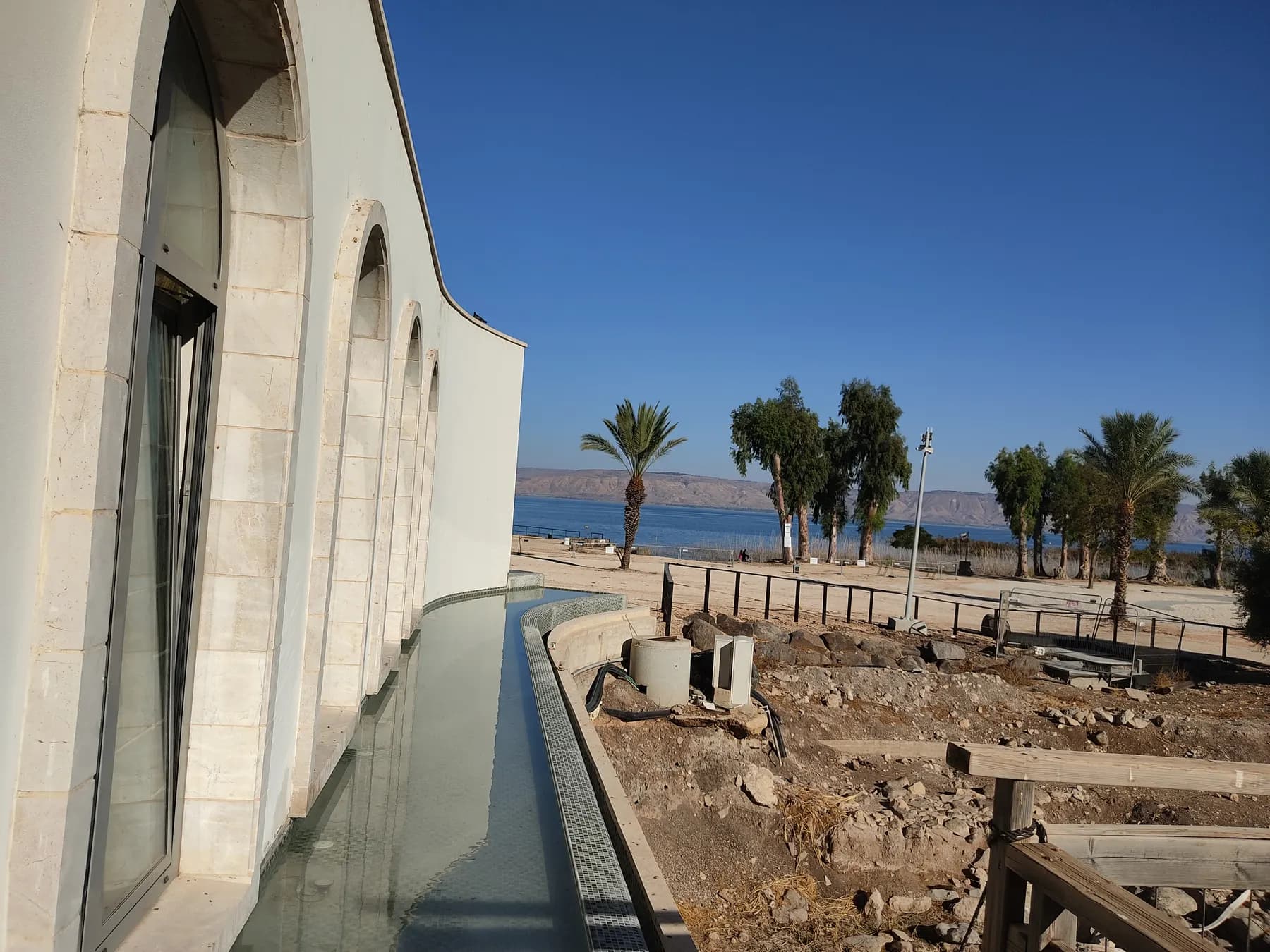
Ovedc / CC BY-SA 4.0 · Wikimedia Commons
Archaeological site
Magdala
A guest house for pilgrims was going up here until the required salvage dig hit a synagogue from the time of the Second Temple in September 2009, and the buildings were redrawn around it.
Yinonk / CC BY 4.0 · Wikimedia Commons
Viewpoint
Mount Arbel
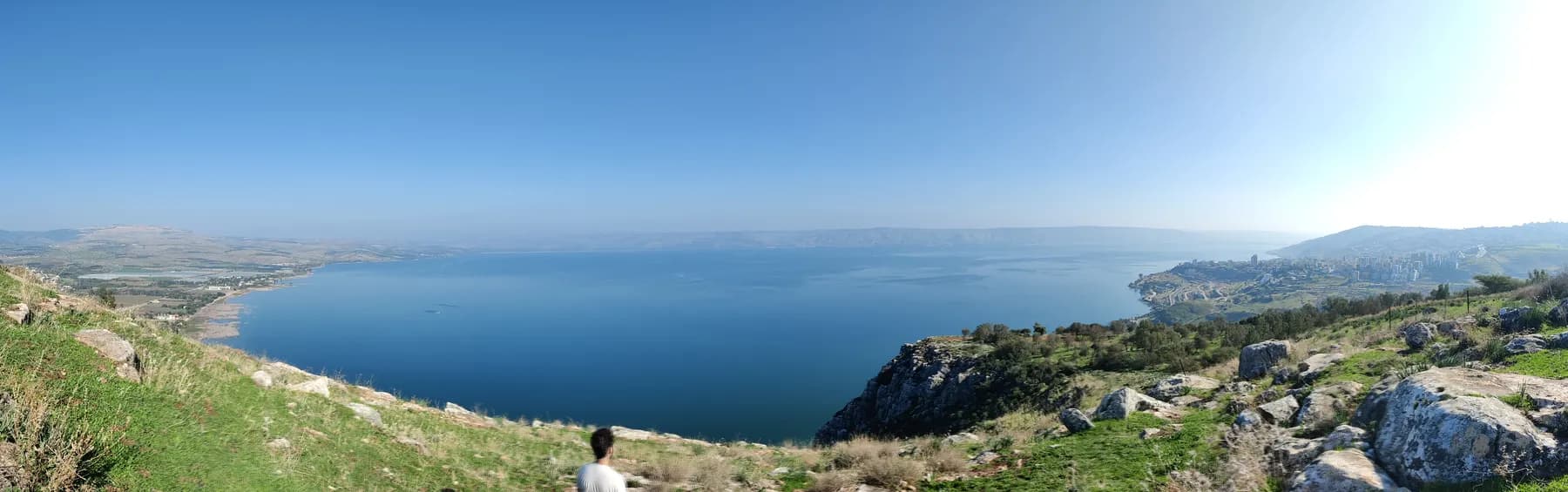
A limestone and dolomite cliff standing 181 metres above sea level and about 390 metres above the Sea of Galilee, with several hundred caves cut into its face and a seventeenth-century fortress built across them.
Sources and further reading
Every link below was opened and checked when this page was written. Official statements are marked as such: they are the subject's own account, not an independent one.
- OfficialIsrael Nature and Parks Authorityparks.org.ilHamat Tiberias National Park
The operator's English page, read in August 2026: 17 thermo-mineral springs at about 60 degrees Celsius and about 36.5 grams of salts per litre as chlorides of sodium and calcium with potassium, bromide and sulphate; the underground channels to the Tiberias hot baths with steam-release chimneys; the Mekorot facility feeding the National Saline Water Carrier; the Roman Spring and its tendency to dry when the Kinneret falls; the three building stages of the Severus synagogue from about 230 CE; the three panels of the mosaic with nine Greek dedications between two lions, the zodiac around Helios and the Torah shrine with two menorahs, shofar and lulav; the four seasons in the corners; the Severus inscription; the early fifth-century earthquake and the later synagogue functioning to the eleventh century; the glass-walled air-conditioned reconstruction; Hamam Suleiman built in 1780 under Jezzar Pasha and in use until 1944; the Roman bath remains; opening hours; and the fee table giving 16 ILS adult, 7 ILS child, 14 ILS adult in group, 6 ILS child in group, 14 ILS student and 8 ILS Israeli senior citizen
- OfficialIsrael Nature and Parks Authorityparks.org.ilגן לאומי חמת טבריה
The Hebrew version of the same page, which carries more than the English one: the accessibility statement listing the entrance gate, foyer, concrete or asphalt paths at moderate gradient to all points of interest, toilets, showers and changing rooms, shade shelters, pools, benches, picnic tables and drinking fountains, handrails beside steps and signage, with a note that some paths are compacted gravel and that the synagogue serves as a visitor centre with seating, subtitled film and an audio assistance system; Wednesday and Thursday opening to 21:00 outside August with pools emptied at 20:00; pools emptied daily an hour before closing; Rosh Hashanah eve and Passover eve closing at 13:00; the barefoot reflexology path included in the fee; the service centre stock; dogs on a lead and muzzled but not in the synagogue; the extra fee lines for pupils, reserve duty and serving soldiers; and the Lower Galilee guidance centre number 04-8276637
- OfficialIsrael Nature and Parks Authorityen.parks.org.ilIsrael Pass
The pass options and their conditions: Classic and Ride cards with 3, 6 or all-site entry valid two weeks from first entry, the Matmon annual card, up to about 70 parks and reserves included, one entry per park per card, and the exclusions including the City of David and the Masada cable car
- ReportingBiblical Archaeology Societybiblicalarchaeology.orgJewish Worship, Pagan Symbols
Walter Zanger's survey of the synagogue zodiac floors, in the edition dated 1 July 2025, which calls Hammath Tiberias the second most famous and the most technically accomplished of them, notes the wheel is interrupted by a later wall built on top and that there is no righteous ancestors panel here, and argues against reading these floors as astrology, astronomy, calendar or mere decoration, partly from the misplacement of the seasons at Beth Alpha
- ReportingYnetynet.co.ilביה"כ העתיק בחמת טבריה נותץ ורוסס בגרפיטי
Ziv Reinstein's report of 29 May 2012 on the vandalism: park staff finding the mosaic smashed and sprayed overnight, police opening an investigation, graffiti aimed at the then director of the Israel Antiquities Authority and at excavation of Jewish graves, and Dina Avshalom-Gorni, the authority's district archaeologist for the eastern Galilee and the Golan, saying the damage was irreversible and that the floor had stood 1,600 years. Also the note that the tomb of Rabbi Meir Ba'al HaNes stands close to the site
- ReportingHaaretzhaaretz.co.ilהגן הלאומי חמת טבריה: עכשיו גם החמאם הטורקי זכה לשיקום מרשים
Moshe Gilad's travel piece of 11 June 2025, reporting a further substantial restoration of the Turkish hammam. The opening is readable without a subscription and confirms the geography plainly: seventeen mineral-rich hot springs credited with healing properties rise south of Tiberias, the commercial Hamei Tveria spa operates on one side of the road and the national park on the other, and the park has become somewhere to spend several hours, some of them wet
- ReferenceWikipediaen.wikipedia.orgHammat Tiberias
The excavation history and the scholarly dating, drawing on Negev and Gibson's Archaeological Encyclopedia of the Holy Land and Marilyn Chiat's Handbook of Synagogue Architecture: the rediscovery in 1920 during construction of the Tiberias to Samakh road; Slouschz's 1921 dig at Hammath Tiberias North under the Jewish Palestine Exploration Society, the first under Jewish auspices, with its square basilical hall, chair of Moses and 60 cm limestone menorah now in the Israel Museum, now under a hotel; Dothan's excavation of Synagogue B in 1961 to 1963; the four construction stages from a first-century public building to a synagogue destroyed in the eighth century; the mosaic dated to the second half of the fourth century as the earliest known from a synagogue; the anticlockwise arrangement of the signs; the uncircumcised nude Libra figure and the inference that the mosaicist was not Jewish; the Severus inscription; and the Sanhedrin at Tiberias from 193 CE
- ReferenceHebrew Wikipediahe.wikipedia.orgחמת טבריה
Used for detail absent from the English entry, citing Dothan's 1968 Qadmoniot article and contemporary press: the National Saline Water Carrier crossing the park from north to south; Hammat and Tiberias as separate walled towns until the eleventh century; the priestly course of Ma'aziah settling here after the Bar Kokhba revolt, per Michael Avi-Yonah; Slouschz arriving in November 1920; Dothan's discovery in December 1961 financed by the Hamei Tveria company; the four superimposed synagogues, the repair after the 306 earthquake, the partial destruction in the seventh century and the final destruction in the mid-eighth at the start of Abbasid rule with houses built over it; the Fatimid-period wall band cutting the mosaic and destroying Helios's chariot; the description of Helios with rayed crown, whip, globe and red paludamentum; Cancer, Sagittarius and Gemini as the three signs that did not survive; the mirror-written Aquarius label; the seasonal produce in the corners; and Vilnay's legend behind the name Hamam Suleiman
- ReferenceBornblum Eretz Israel Synagogues Website, Kinneret Academic Collegesynagogues.kinneret.ac.ilHammath Tiberias
The academic site record for the synagogue in the national park: excavator Moshe Dothan, 1961 to 1963; a broadhouse with columns and a highly decorated mosaic with zodiac, menorahs and ritual objects; Aramaic, Hebrew and Greek inscriptions with their publications, including the 2023 Corpus Inscriptionum Iudaeae/Palaestinae volume; and the site condition given as national park with an entrance fee
- ReferenceBornblum Eretz Israel Synagogues Website, Kinneret Academic Collegesynagogues.kinneret.ac.ilHammath Tiberias North
The record for the other synagogue, the one not in the park: excavated by Nahum Slouschz in 1921 and Eliezer Oren in 1970, a square basilica with a stone chair in situ, a chancel screen decorated with a menorah and a mosaic floor, and a site condition given plainly as under a modern hotel
- ReferenceEncyclopaedia Britannicabritannica.comTiberias
The founding of Tiberias by Herod Antipas in 18 CE and its naming for the reigning emperor; the derivation of Hammat and Hamei Teverya from the Hebrew for hot; and the springs known for over 2,000 years for their supposed medicinal qualities, with the qualifier left in
- ReferenceWikipediaen.wikipedia.orgZodiac mosaics in ancient synagogues
The wider set these floors belong to, following Rachel Hachlili: at least eight synagogues in Roman Palestine with zodiac mosaics between the fourth and sixth centuries, Hammat Tiberias the fourth-century example against Husaifa in the fifth and Na'aran and Beth Alpha in the sixth, plus Sepphoris, Susiya, En Gedi, Meroth, Yafi'a and Huqoq. Also the note that Jodi Magness identifies the sun figure with the angel Metatron
Hamat Tiberias: common questions
What is actually at Hamat Tiberias National Park?+
A fourth-century synagogue with a mosaic floor showing a zodiac wheel around Helios, seventeen hot springs, an Ottoman bathhouse of 1780 that now works as a museum, an antiquities display room, warm pools you may paddle in and a barefoot reflexology path. The parks authority calls the floor one of the most spectacular mosaics from any ancient synagogue in Israel. It is a small, flat site at the southern entrance to Tiberias.
How much does it cost and what are the opening hours?+
The parks authority publishes 16 ILS for an adult, 7 ILS for a child, 14 ILS for a student and 8 ILS for an Israeli senior citizen. Summer hours are 08:00 to 17:00 Sunday to Thursday and Saturday, and 08:00 to 16:00 on Fridays and holiday eves; winter hours are an hour earlier in each case. Entry closes an hour before the site does. Check the operator's page before travelling, because these move.
Can you bathe in the hot springs inside the national park?+
You can paddle, not bathe properly. The park has pools fed by the springs and the parks authority permits going into the water, and there are showers and changing rooms, but the pools are emptied for cleaning an hour before closing each day. For a full thermal bathing complex you want Hamei Tveria across the road, which is a separate commercial business with its own ticket.
Is the national park the same thing as the Tiberias Hot Springs spa?+
No, and this is the mistake most often made here. Hamei Tveria is a private spa and treatment complex on the other side of Route 90; the national park is a state-run archaeological site with the synagogue and the hammam. They draw on the same seventeen springs. A national parks ticket, an Israel Pass or a Matmon subscription is worth nothing at the spa gate.
How old is the zodiac mosaic, and is it original?+
The pavement is original and in place, and Negev and Gibson date it to the second half of the fourth century CE, which makes it the earliest mosaic floor known from a synagogue in the country; the parks authority describes the building as of the third and fourth centuries. The building around it is not original: it is a modern glass-walled, air-conditioned shelter that also serves as the visitor centre. The floor was smashed and sprayed with graffiti in May 2012 and has since been conserved.
Why is a Greek sun god on the floor of a synagogue?+
Nobody has settled this, and the honest answer is that the site does not explain itself. The parks authority's reading is that the Jewish community here was confident enough not to feel threatened by such imagery, noting that the same scheme appears at Beth Alpha and elsewhere. Walter Zanger, writing for the Biblical Archaeology Society, rules out astrology, astronomy and a calendar and treats the panels as loaded with meaning rather than decoration, while Jodi Magness has argued the figure should be read as the angel Metatron.
How long does a visit take?+
About 90 minutes covers the synagogue, the hammam museum, the antiquities room and the Roman Spring. Two to three hours is realistic if you use the pools and walk the reflexology path barefoot. The park is small enough that it works better paired with something else in Tiberias than as the anchor of a day.
Is it accessible for wheelchairs and people who cannot climb?+
Yes, more so than most archaeological sites in the country. The ground is flat and beside the road, with no climb at all, and the parks authority lists accessible paths of concrete or asphalt at a moderate gradient to every point of interest, plus accessible toilets, showers, changing rooms, shade shelters, pools and signage. It notes that some paths are compacted gravel rather than a hard surface, and it publishes an accessible visit coordination form for anyone who needs to check a specific requirement in advance.
Is there shade, and when is the best time of day to come?+
There are shade shelters, lawns and drinking fountains, and both the synagogue shelter and the hammam are air conditioned, so this is a more forgiving summer site than most. The heat still matters in July and August, when the park closes at 17:00 and the pools drain at 16:00. Morning is the safe answer; on Wednesday and Thursday evenings outside August the Hebrew page lists opening until 21:00, which is the pleasantest time to be here if it holds.
Where is the other synagogue Nahum Slouschz found?+
Under a hotel, and it cannot be visited. Slouschz excavated Hammath Tiberias North on the lakeshore in 1920 and 1921, in the first archaeological dig in the country conducted under Jewish auspices, then the trenches were backfilled and the site was later built over. The 60 cm limestone menorah he recovered is in the Israel Museum. Everything on show in the national park comes from Moshe Dothan's excavation of 1961 to 1963.