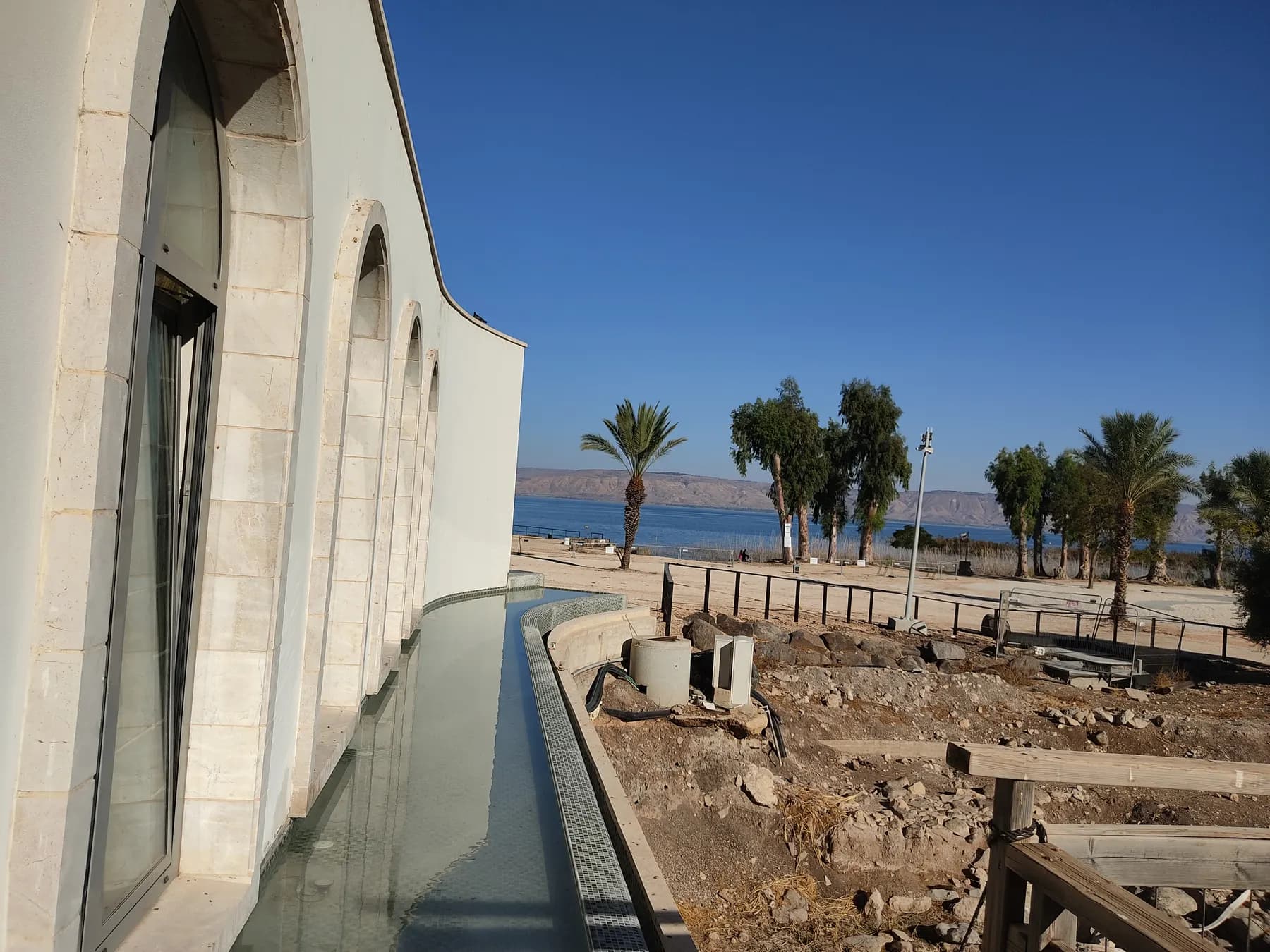
Archaeological site · The Sea of Galilee
Magdala
A guest house for pilgrims was going up here until the required salvage dig hit a synagogue from the time of the Second Temple in September 2009, and the buildings were redrawn around it.
Ovedc / CC BY-SA 4.0 · Wikimedia Commons
Synagogue found
September 2009
in an Israel Antiquities Authority salvage dig before building work
Floor area of that synagogue
about 120 sq m
with stone benches along the walls and six columns
Second Temple synagogues on one site
two
the second announced by the University of Haifa in December 2021
Chapel and park opened
28 May 2014
Duc in Altum and the archaeological park, inaugurated together
In short
- How long to give it
- about 90 minutes, or an hour if the chapel is the only reason for coming
- Visitor centre and archaeological park, Monday to Sunday
- 08:00 to 17:30
- The operator's own tariff
- Not published online. The Magdala Center posts hours but no prices, and asks visitors wanting ticket, group or tour information to email visit@magdala.org or ring +972 4 620 9900
מגדל
Magdala is a first-century Jewish town on the north-western shore of the Sea of Galilee, dug since 2009 and open as a privately run archaeological park with a modern Catholic prayer centre standing beside it. It lies about six kilometres north of Tiberias on Highway 90, below the Arbel cliff, and it is a visitor site more or less by accident. The Legionaries of Christ had bought the ground to put up a guest house for pilgrims. Israeli law required a salvage excavation first. The excavation found a synagogue that was standing while the Temple in Jerusalem was still standing, and the building plans were redrawn around it.
The dig also produced a carved stone block, about half a metre across, with a seven-branched menorah cut into one face. It is the earliest known carving of a menorah found inside a synagogue, and what it was for is still argued over by named professors who do not agree. The block a visitor sees in the synagogue today is a replica. The original was taken away and, as of a report in December 2021, is displayed a short drive north at the Yigal Allon Centre on Kibbutz Ginosar, in an Israel Antiquities Authority exhibition.
Two things are worth knowing before arriving. The archaeological remains and the prayer centre are the same visit and the same ticket, but they are not the same kind of thing: one is excavated first-century masonry, the other was designed and built between 2009 and 2014. And the town's link to Mary Magdalene, which is why most people come, is the part of the story that the scholarship is least sure about.
The find
The guest house that had to be redrawn
Building anything on antiquities in Israel means a salvage excavation first, paid for by the developer and run under the Israel Antiquities Authority. In 2009 the developer was the Magdala project of the Legionaries of Christ, the plan was accommodation for pilgrims on the Galilee shore, and the excavation was directed by Dina Avshalom-Gorni with Arfan Najar. In September that year the shape of a rosette came up out of the soil on a limestone block, and the building it sat in turned out to be a synagogue in use during the first century.
That was not the expected outcome. Very few synagogues securely dated to the period when the Second Temple was still functioning have been excavated anywhere, and this one is unusually decorated: a hall of roughly 120 square metres in basalt and limestone, stone benches built against the walls, six columns, coloured frescoes on the plaster and a floor partly laid in mosaic. Coins recovered from it run, on the Magdala Center's own account, from 5 to 63 CE.
The commercial consequence is visible on the ground. Rather than lose the find, the complex was redesigned around it: the archaeological park, the visitor centre, the guest house and the prayer building now sit in a ring, and the excavated streets run between them. Digging has continued since, including seasons directed by Marcela Zapata-Meza of the Universidad Anáhuac México from 2010.
The stone
A carved block that four scholars read four ways
The Magdala Stone stood in the middle of the synagogue floor. It is a carved block roughly 0.6 m long, 0.5 m wide and 0.4 m high, and every face is worked. The front carries a seven-branched menorah on a decorated base, flanked by two-handled jars. The sides carry pillared arcades. The top has a rosette, palmette capitals, and a pair of concentric circles with tapering shapes beneath them.
What any of it means is genuinely open. Mordechai Aviam of Kinneret College reads the circles as the wheels of God's chariot and the shapes beneath as flame, and takes the block as the base of a Torah reading table. Rina Talgam of the Hebrew University agrees that the chariot is there and treats the whole object as a way of visiting the Temple without going to Jerusalem, a democratisation of it. Zeev Weiss, also of the Hebrew University, rejects both readings and thinks the stone was simply a rest for the Torah scroll when it was not being read, the raised corners keeping it from sliding off. The excavators who found it described the circles as rosettes, a royal emblem, and left it there.
None of that is settled, and the site does not pretend it is. What is not in dispute is the date, before the Temple was destroyed in 70 CE, and the fact that a small lakeside town had a building of this quality at all.
The town
Ritual baths fed from below, a market street and a quay
The synagogue is the headline, but the town around it is the reason the site holds attention for an hour. Excavations directed by Marcela Zapata-Meza uncovered four mikva'ot, stepped ritual baths built of basalt with mosaic-floored preparation rooms, arranged in two buildings either side of a street. They are unusual in Israel because they were filled from groundwater rather than from collected rainwater, which is what the halakhic requirement normally forces builders to arrange.
South of the synagogue runs a paved market street with shop rooms along one side, and merchants' houses with coloured mosaic floors still in place. Down at the water there is a stone wharf and a warehouse with storage vessels in its cellar. The harbour itself was worked on by the Franciscan Magdala Project under Stefano De Luca between 2007 and 2011, on the Franciscan-owned ground next door; the excavators recorded three phases of use, late Hellenistic, early to middle Roman and Byzantine, with quays and mooring stones surviving.
In December 2021 the University of Haifa announced a second Second Temple synagogue less than 200 metres away, found in advance of work on Highway 90 by the archaeologist Yehuda Govrin under the Zinman Institute's scientific supervision. It is plainer than the first: a square hall in basalt and chalk, a bench, six roof pillars, and a side room with a shelf that may have held scrolls. Adi Erlich, who leads the Zinman Institute, pointed out what two synagogues in one settlement do to the old assumption that Jews had little need of them while the Temple stood. That second building is not part of the visitor park, and the antiquities authority said at the time that opening it to the public would have to be discussed.
What is what
Ancient pavement downstairs, new building upstairs
Magdala is one of the easier sites in the country to misread, because the excavated town and the devotional buildings interlock rather than sitting apart. The prayer centre, Duc in Altum, is entirely modern: designed by the Nakhla practice of Nazareth, its first stone blessed by Pope Benedict XVI in May 2009, inaugurated with the archaeological park on 28 May 2014. Its octagonal Women's Atrium has eight pillars, seven named for women who followed Jesus and the eighth left for women of faith in general. The main hall holds up to 250 people around an altar built in the shape of a boat, with the lake through the window behind it.
The exception is downstairs. The Encounter Chapel on the lower level is floored with the actual first-century pavement of Magdala's port and market area, excavated in place and left where it was found. The stone benches around it, by contrast, are modern work in an antique manner, and the large painting on the wall is a contemporary commission. A study in the journal Arts describes this deliberate blending of excavation and new build as the site's central device, and notes that the four mosaic chapels illustrate Gospel episodes that happened around the Sea of Galilee, none of which the New Testament actually places at Magdala.
That is not a complaint, and the mosaics are good. It is simply the distinction a visitor needs in order to know what is being looked at.
- Ancient and in place: the synagogue walls and benches, the market street, the merchants' houses and their mosaic floors, the four mikva'ot, the wharf and warehouse, and the Encounter Chapel floor
- Ancient but not here: the Magdala Stone itself, reported in December 2021 to be on show at the Yigal Allon Centre at Ginosar
- A copy: the stone standing in the synagogue
- Modern throughout: Duc in Altum and all its chapels, the boat-shaped altar, the mosaics, the Magdala Mosaic map of first-century Galilee, the visitor centre and the guest house
The name
Whether Mary Magdalene came from this particular place
The Gospels call her Mary the Magdalene, and the standard reading is that the word is a place name meaning 'of Magdala'. The site is sold on that basis, and the whole Magdala project is built around it. It is also the weakest link in the chain, and the argument against it is made by a serious scholar in a mainstream venue.
Joan Taylor, writing in Biblical Archaeology Review in August 2022, argues that the town excavated here is Taricheae, the Greek name meaning a place where fish are salted, and that the early sources put Mary's Magdala elsewhere: a small village called Migdal Nunayya near Tiberias. On her reading the name Magdala attached itself to these ruins only in the Byzantine period, when Christian visitors wanted a location and chose one. Other scholars hold that Taricheae was also known as Magdala in Roman times; Taylor's reply is that there is no evidence for it.
What the ancient sources do put here is a battle. Josephus, who commanded in Galilee before changing sides, describes Vespasian moving on Taricheae in 67 CE with two thousand archers posted on the slopes of Arbel and his son Titus sent against the rebels on the plain. Those who got away by boat were run down on the water. Josephus writes that the lake afterwards was all bloody and full of dead bodies. Whatever the town was called, it was a working port with a fleet in it, and the coins recovered from the site suggest people went on living here long after the revolt was over.
What to look for
Things not to walk past at Magdala
The details that repay knowing about before you are standing in front of them.
The 2009 synagogue
A hall of about 120 square metres with stone benches against the walls, six columns, mosaic flooring and frescoed plaster, in use while the Second Temple was still standing. Very few buildings of this date and this kind have been excavated anywhere.
The stone in the middle of it
The block on the synagogue floor is a copy, and it is still worth standing over. The carving on the original is the earliest known image of the seven-branched menorah found inside a synagogue.
The four mikva'ot
Stepped basalt ritual baths in two buildings either side of a street, with mosaic-floored preparation rooms. They were filled from groundwater rather than rainwater, which makes their plumbing unusual in Israel.
The Encounter Chapel floor
On the lower level of Duc in Altum, the floor is the excavated first-century pavement of the port and market area, left where it was found. It is the one part of the prayer centre that is ancient.
The boat altar and the window behind it
The main hall of Duc in Altum seats up to 250 around an altar shaped like a fishing boat, with clear glass and the Sea of Galilee behind. Pope Francis blessed the tabernacle on it on 26 May 2014.
The market street and the wharf
A paved street with shop rooms along one side runs south of the synagogue past merchants' houses with mosaic floors, and finishes at a stone wharf and a warehouse with storage vessels in the cellar.
The long view
Magdala, in order
2nd to 1st centuries BCE
First phase of the harbour, recorded by the Franciscan excavators as late Hellenistic. The town is established on the lakeshore below Arbel.
5 to 63 CE
The date range of coins recovered from the synagogue, on the Magdala Center's own account. The building is in use through the years of Jesus's Galilean ministry.
67 CE
Vespasian moves against Taricheae during the First Jewish Revolt, with archers on the Arbel slopes and Titus in command on the plain. Josephus describes the lake afterwards as full of dead bodies.
1971 to 1977
Virgilio Corbo and Stanislao Loffreda carry out the first systematic excavation, on the Franciscan property, finding structures and streets running from the 1st century BCE to the 4th century CE.
2007 to 2011
The Franciscan Magdala Project under Stefano De Luca works the harbour, recording quays, mooring stones and three phases of use into the Byzantine period.
May 2009
Pope Benedict XVI blesses the first stone of the new building on the neighbouring plot bought by the Legionaries of Christ.
September 2009
The Israel Antiquities Authority salvage dig under Dina Avshalom-Gorni and Arfan Najar uncovers a first-century synagogue and the carved block now called the Magdala Stone. The construction plans are redrawn around the remains.
2010 onwards
Seasons directed by Marcela Zapata-Meza of the Universidad Anáhuac México expose four mikva'ot fed by groundwater, along with the market street and merchants' houses.
26 May 2014
Pope Francis blesses the tabernacle on the boat-shaped altar during his pilgrimage to the Holy Land.
28 May 2014
Duc in Altum and the archaeological park are inaugurated together and open to visitors.
December 2021
The University of Haifa announces a second Second Temple synagogue less than 200 metres from the first, found ahead of works on Highway 90. In the same month the original Magdala Stone is reported on display at the Yigal Allon Centre, Ginosar.
August 2022
Joan Taylor argues in Biblical Archaeology Review that the excavated town is Taricheae and that Mary Magdalene's Magdala was somewhere else.
28 May 2024
The tenth anniversary. The Magdala Center reports more than 1.3 million visitors and more than 12,000 Masses in the chapel over the decade.
Practical
Visiting Magdala
Where
Magdala, Highway 90, about 6 km north of Tiberias, Sea of Galilee
What ticket you need
Magdala is not a national park. It is run by the Magdala Center under the New Gate to Peace Foundation, so an Israel Nature and Parks Authority pass does not cover it and the parks authority publishes nothing about it. One ticket covers the archaeological park and Duc in Altum together.
Opening hours
Admission
- The operator's own tariff
- Not published online. The Magdala Center posts hours but no prices, and asks visitors wanting ticket, group or tour information to email visit@magdala.org or ring +972 4 620 9900source
- Adult, as reported by the regional guide Galil and Golan
- ₪17source
- Student or senior, same source
- ₪12source
- Children under 12, same source
- Freesource
Access
The Magdala Center publishes no accessibility statement, so this is a description rather than a promise. The site's advantage is that it is flat: the excavated town sits on level ground at the water's edge rather than on a slope, and the walk from the visitor centre through the park to the prayer centre involves no climb. Against that, the surfaces are archaeological, so there is uneven stone and there are steps down into the excavated areas, and the Encounter Chapel is on the lower level of Duc in Altum. Anyone who needs a step-free route should ring the visitor centre on +972 4 620 9900 before travelling and ask what can be done.
On site
- Visitor centre
- Gift shop
- Coffee shop
- Toilets
- Car park
- Guest house on site
- Chapel open for Mass and prayer
- Volunteer-guided tours
Booking
Individuals can turn up in opening hours. Groups, guided tours and religious services are arranged in advance: the visitor centre handles tickets, group discounts and tours at visit@magdala.org, and Duc in Altum books Masses and other services separately at ducinaltum@magdala.org.
Hours and prices are given as the operator publishes them and change without much notice, particularly around Shabbat and the festivals. Check the operator's own page before you travel for this.
Official page at magdala.org →What people wish they had known
- The stone in the synagogue is a copy. People come specifically to see the Magdala Stone and go away thinking they have; the original was removed and was reported in December 2021 to be on show at the Yigal Allon Centre at Ginosar, about six kilometres north, which is the same building as the ancient boat.
- Check the two closing times separately. The visitor centre and the archaeological park shut at 17:30 and Duc in Altum stays open until 18:00, so arriving late means the chapel and not the ruins.
- Do not budget on a price found online. The Magdala Center publishes hours but no tariff, and the figures circulating on travel sites are third-hand; email visit@magdala.org if the cost matters to the plan.
- The lower level of Duc in Altum is the archaeological part of the chapel, not a crypt to skip. Its floor is the excavated first-century pavement of the port and market area.
- Dress for a working church as well as a dig. Duc in Altum holds Mass daily and covered shoulders and knees are the expectation inside it.
- Magdala is not in the Israel Nature and Parks Authority system, so a parks pass bought for Capernaum, Korazim or Hamat Tiberias buys nothing here.
The figures
Magdala by the numbers
Each figure carries the year it belongs to and links the source it came from.
| Measure | Figure | As of | Source |
|---|---|---|---|
| Floor area of the synagogue found in 2009 | about 120 sq m | 2026 | en.wikipedia.org |
| Coins recovered from that synagogue | dated 5 to 63 CE | 2026 | magdala.org |
| Distance between the two Second Temple synagogues | less than 200 m | 2021 | timesofisrael.com |
| Ritual baths excavated | four, filled from groundwater rather than rainwater | 2026 | biblicalarchaeology.org |
| Dimensions of the Magdala Stone | about 0.6 m by 0.5 m by 0.4 m high | 2026 | en.wikipedia.org |
| Capacity of the boat chapel at Duc in Altum | up to 250 people | 2026 | magdala.org |
| Visitors in the first ten years of the chapel and park | more than 1.3 million | 2024 | exaudi.org |
| Masses celebrated at Duc in Altum in that decade | more than 12,000 | 2024 | exaudi.org |
While you are here
The rest of The Sea of Galilee
Everything else in this destination with a page of its own.
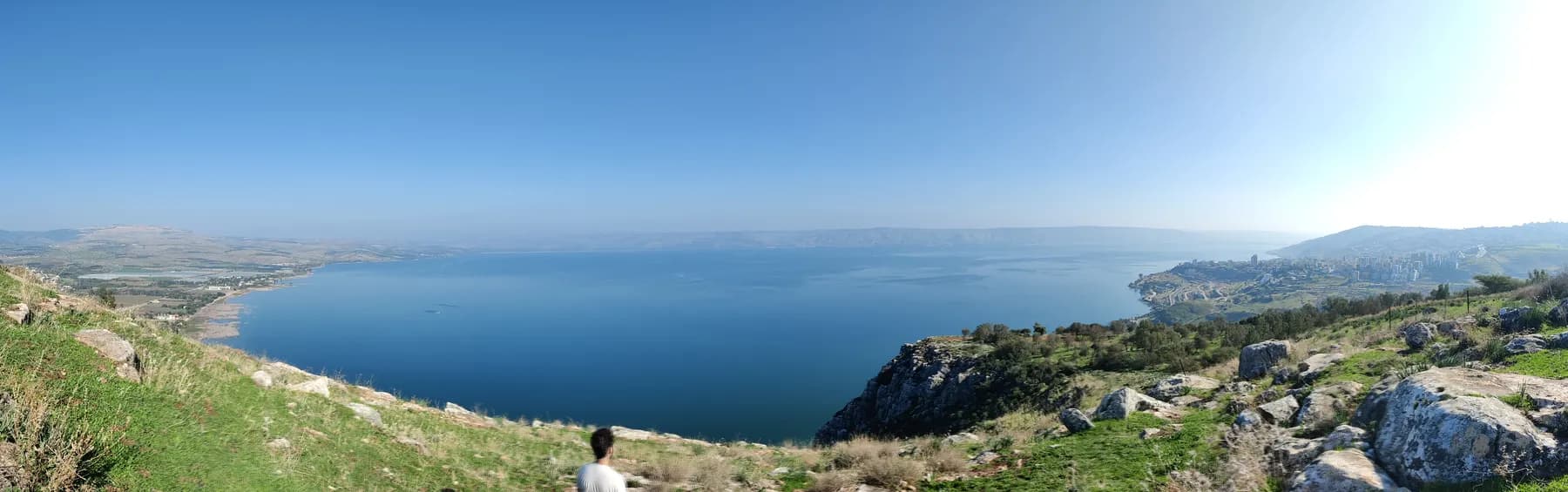
Yinonk / CC BY 4.0 · Wikimedia Commons
Viewpoint
Mount Arbel
A limestone and dolomite cliff standing 181 metres above sea level and about 390 metres above the Sea of Galilee, with several hundred caves cut into its face and a seventeenth-century fortress built across them.
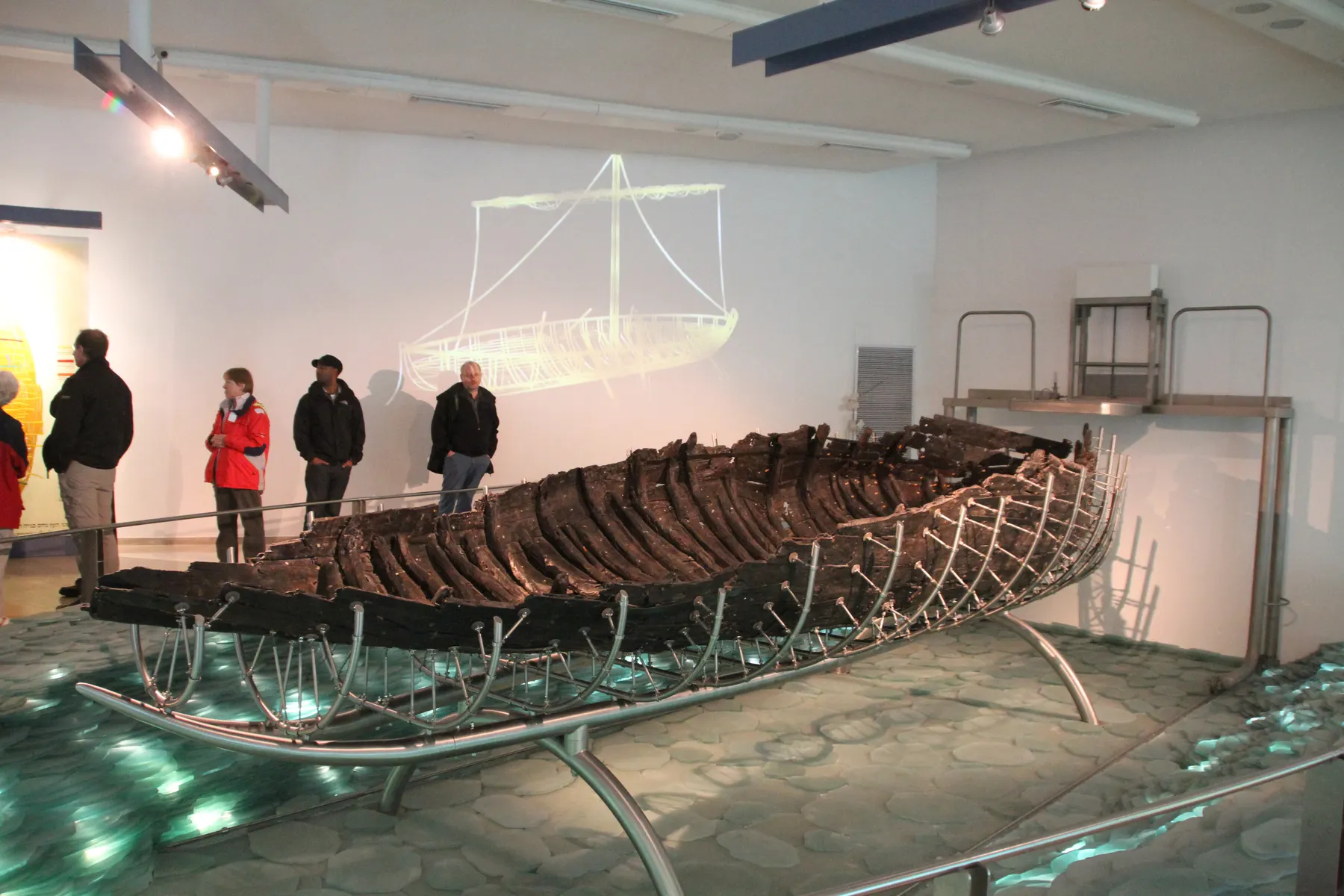
Gerd Eichmann / CC BY-SA 4.0 · Wikimedia Commons
Museum
The Jesus Boat at Ginosar
An eight-metre fishing hull that lay in the lakebed clay for two thousand years, was dug out in eleven days and nights in February 1986, and then sat in a pool of synthetic wax until 2000 before it could be shown.
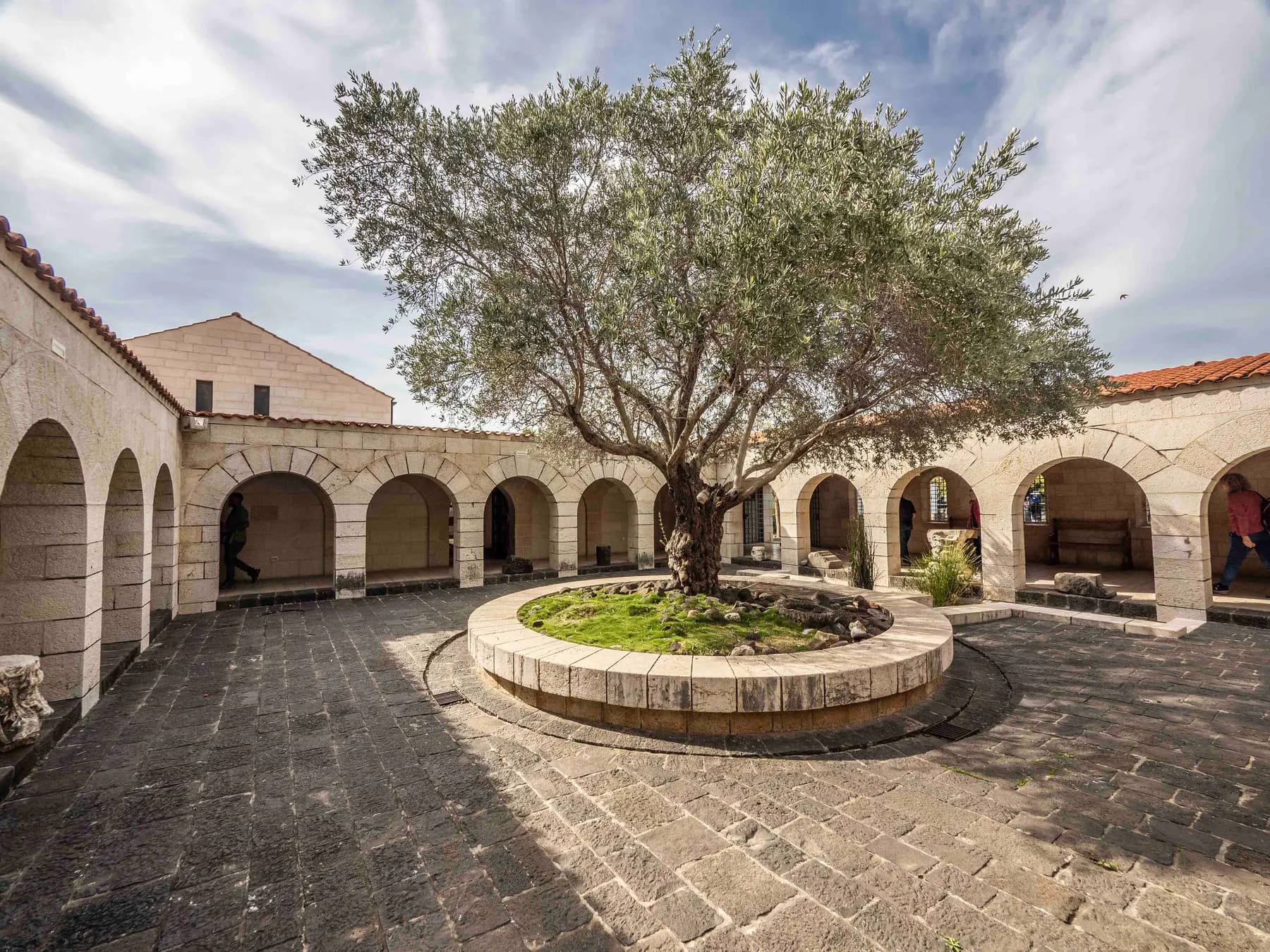
יוסי רון / CC BY 2.5 · Wikimedia Commons
Religious site
Tabgha
The mosaic in front of the altar shows a basket of four loaves, not the five of the Gospel account, and the usual reading is that the fifth is the one consecrated on the altar above it.
Sources and further reading
Every link below was opened and checked when this page was written. Official statements are marked as such: they are the subject's own account, not an independent one.
- OfficialMagdala Centermagdala.orgPlan Your Visit
Opening hours for the visitor centre and archaeological park (08:00 to 17:30) and for Duc in Altum (08:00 to 18:00), the guest house arrangement, the site's position about 6 km north of Tiberias on Highway 90, driving routes from Jerusalem and Tel Aviv, the bus numbers and the Rav-Kav requirement, and the visitor centre contacts. No admission prices are published anywhere on it
- OfficialMagdala Centermagdala.orgMagdala, Archeological Park
The operator's own account of the synagogue as the oldest found in Galilee, the coins dated 5 to 63 CE, the merchants' villas and mikva'ot, the paved market street with shops along its eastern side, and the stone wharf and partitioned warehouse with storage vessels in its cellar
- OfficialMagdala Centermagdala.orgDuc In Altum
The eight pillars of the Women's Atrium, the boat-shaped altar and the hall's capacity of up to 250, Pope Francis blessing the tabernacle on 26 May 2014, the four mosaic chapels for 30 people each, and the Encounter Chapel on the lower level standing on the original first-century marketplace floor
- ReportingThe Times of Israeltimesofisrael.comSecond ancient synagogue found in Migdal alters ideas of Jewish life 2,000 years ago
The December 2021 announcement: the dig by Yehuda Govrin under the Zinman Institute at the University of Haifa, brought on by work on Highway 90; the building less than 200 m from the 2009 synagogue; the square basalt and chalk hall, bench, six pillars and scroll shelf; and quotes from Adi Erlich and Dina Avshalom-Gorni
- ReportingHaaretzhaaretz.comThe Magdala Stone: Does It Show God's Chariot in the Temple?
The open disagreement set out with affiliations: Mordechai Aviam of Kinneret College on the chariot and the Torah table base, Rina Talgam of the Hebrew University on the democratisation of the Temple, Zeev Weiss of the Hebrew University rejecting both and reading it as a Torah rest, and the excavators' own rosette interpretation
- ReportingJNS, 15 December 2021jns.orgMagdala Stone and other rare artifacts on view in Galilee
The original Magdala Stone displayed at the Yigal Allon Center on Kibbutz Ginosar in the Israel Antiquities Authority's Sanhedrin Trail exhibition, curated by Einat Ambar Armon, alongside about 150 other artefacts
- ReportingExaudiexaudi.orgMagdala celebrates the 10th Anniversary of Duc In Altum and Archaeological Park
The 28 May 2014 inauguration of Duc in Altum together with the archaeological park, more than 1.3 million visitors and more than 12,000 Masses over the first ten years, more than 4,500 volunteers from over 35 countries, and Fr Juan Solana LC as founder and director
- ReferenceBiblical Archaeology Societybiblicalarchaeology.orgThe Magdala Stone: The Jerusalem Temple Embodied
Face-by-face description of the carving, the menorah as the oldest known carved image of it from a public building, and Rina Talgam's reading of the synagogue as a minor temple alongside Motti Aviam's shewbread interpretation
- ReferenceJoan E. Taylor, Biblical Archaeology Review, August 2022biblicalarchaeology.orgMagdala's Mistaken Identity
The case that the excavated site is Taricheae, that the only Magdala in early sources is Migdal Nunayya near Tiberias, and that the name was attached to these ruins by Byzantine-period Christians, with the counter-position that Taricheae was also called Magdala noted and rejected
- ReferenceWorld History Encyclopediaworldhistory.orgThe Archaeological Excavations at Magdala
The excavation history: Corbo and Loffreda on the Franciscan property from 1971 to 1977, Israel Antiquities Authority test pits in 2002, the Franciscan Magdala Project under Stefano De Luca, the seasons from 2010 under Marcela Zapata-Meza, the identification of the mikva'ot fed by underground water as unique in Israel, the 2009 synagogue under Dina Avshalom-Gorni and Arfan Najar, the meaning of Taricheae, and Josephus on the Roman assault of 67 CE
- ReferenceBiblical Archaeology Societybiblicalarchaeology.orgDiscoveries in Mary Magdalene's Hometown
The four mikva'ot found by the Magdala Archaeological Project under Marcela Zapata-Meza of Anahuac University of Mexico, the fish-salting sense of Taricheae, and the caution that the Magdalene epithet is attached to a place only in later literary sources
- ReferenceArts (MDPI), peer-reviewedmdpi.comA Holy Land within The Holy Land: Duc in Altum as a Case in Point
The Nakhla practice of Nazareth as architects, the first stone blessed by Pope Benedict XVI in May 2009 and the 2014 inauguration, the octagonal plan and Women's Atrium, the boat altar in green-blue marble, the Chilean artists behind the mosaics, the Encounter Chapel built on the first-century harbour pavement with mock-antique benches, and the observation that none of the four mosaic episodes is placed at Magdala in the New Testament
- ReferenceWikipediaen.wikipedia.orgMigdal Synagogue
The floor area of about 120 square metres, the benches, frescoes and partial mosaic floor, the 2009 salvage dig by Dina Avshalom-Gorni at a hotel construction site at Migdal Beach, and the architect's redesign of the complex to take in the antiquities as a public archaeological park
- ReferenceWikipediaen.wikipedia.orgMagdala stone
Dimensions of roughly 0.6 m by 0.5 m by 0.4 m after Aviam 2013, the pre-70 CE dating, the disagreement over the arcades and the object beneath the menorah, and the removal of the original with a replica left at the site, citing Kershner's 2015 reporting
Magdala: common questions
What is actually at Magdala?+
An excavated first-century Jewish town and a modern Catholic prayer centre, on one ticket. The town includes a synagogue of about 120 square metres with benches and mosaic flooring, four stepped ritual baths, a paved market street, merchants' houses with mosaic floors, a stone wharf and a warehouse. The prayer centre, Duc in Altum, was built between 2009 and 2014 and contains an octagonal atrium, a hall with a boat-shaped altar, four mosaic chapels and a lower chapel floored with excavated first-century pavement.
Is the Magdala Stone on site?+
No, what stands in the synagogue is a replica. The original carved block was removed for safekeeping and study, and a December 2021 report placed it on display at the Yigal Allon Centre on Kibbutz Ginosar, in an Israel Antiquities Authority exhibition. The copy is worth looking at anyway, because the carving is the point: a seven-branched menorah on a decorated base between two jars, arcades on the sides, and a rosette and paired circles on top.
How much does it cost to get in?+
The operator does not publish a price. The Magdala Center's own visit page gives opening hours and asks anyone wanting information on tickets, group discounts or tours to contact the visitor centre at visit@magdala.org or +972 4 620 9900. The regional guide Galil and Golan reports ₪17 for an adult, ₪12 for a student or senior and free entry under 12, which is the most specific published figure available, but it is not the operator's own statement.
How long does a visit take?+
About 90 minutes is comfortable for the archaeological park and the chapel together. An hour is enough if the chapel is the reason for coming and the ruins are a walk through on the way. Groups on a Galilee pilgrimage circuit often build in a Mass at Duc in Altum, which adds around an hour on top.
Did Mary Magdalene really come from here?+
The traditional answer is yes and the scholarship is not unanimous. The epithet Magdalene is normally read as 'of Magdala', and this site claims that identification. Joan Taylor argued in Biblical Archaeology Review in August 2022 that the excavated town is Taricheae, the fish-salting port, and that Mary's Magdala was a different and smaller village, Migdal Nunayya near Tiberias, with the name transferring to these ruins only in the Byzantine period. Other scholars hold that Taricheae was also called Magdala in Roman times. Nothing found in the ground settles it.
Can you see the second synagogue that was found in 2021?+
Not as part of the visit. It was excavated less than 200 metres away ahead of works on Highway 90, announced by the University of Haifa in December 2021, and it sits outside the visitor park. The Israel Antiquities Authority said at the time that opening it to the public was something it intended to discuss. The building is plainer than the first: a square hall in basalt and chalk with a bench, six roof pillars and a side room with a shelf that may have held scrolls.
Is Magdala wheelchair accessible?+
Partly, and the operator publishes nothing on the subject, so nobody should treat this as a guarantee. The site is flat, which is the main thing in its favour: the excavated town is at lake level and there is no climb between the visitor centre, the park and the chapel. But the surfaces are archaeological, there are steps down into the dug areas, and the Encounter Chapel is on the lower level of Duc in Altum. Ring +972 4 620 9900 before travelling.
Is it worth it if you are not religious?+
Yes, on the archaeology. Synagogues securely dated to the years when the Second Temple was still standing are rare, this one is the most decorated of them, and the mikva'ot filled from groundwater are a piece of first-century engineering that is unusual in Israel. The devotional half of the site is unmistakably devotional and takes up a good part of the ground, so anyone with no interest in that will get through the visit faster than 90 minutes.
Is there anywhere to eat or stay?+
There is a coffee shop and a gift shop at the visitor centre, and a guest house on the site itself, run by the Magdala Center and open year round for short and long stays by advance reservation at reservation1@magdala.org. Tiberias, six kilometres south on Highway 90, has the range of restaurants and hotels. There is nothing else within walking distance.
How do you get there without a car?+
Through Tiberias. The Magdala Center's directions have intercity buses from Jerusalem (912, 959, 961, 963 or 966) and from Tel Aviv (845 or 836) running to Tiberias central bus station, and from there a local bus (48, 54, 55, 56, 59, 450, 541 or 840) or a taxi covers the six kilometres north on Highway 90. A Rav-Kav card is needed for the buses. Check timings for Fridays and Saturdays, when Israeli intercity services thin out or stop.