Archaeological site · The Old City of Jerusalem
Western Wall Tunnels
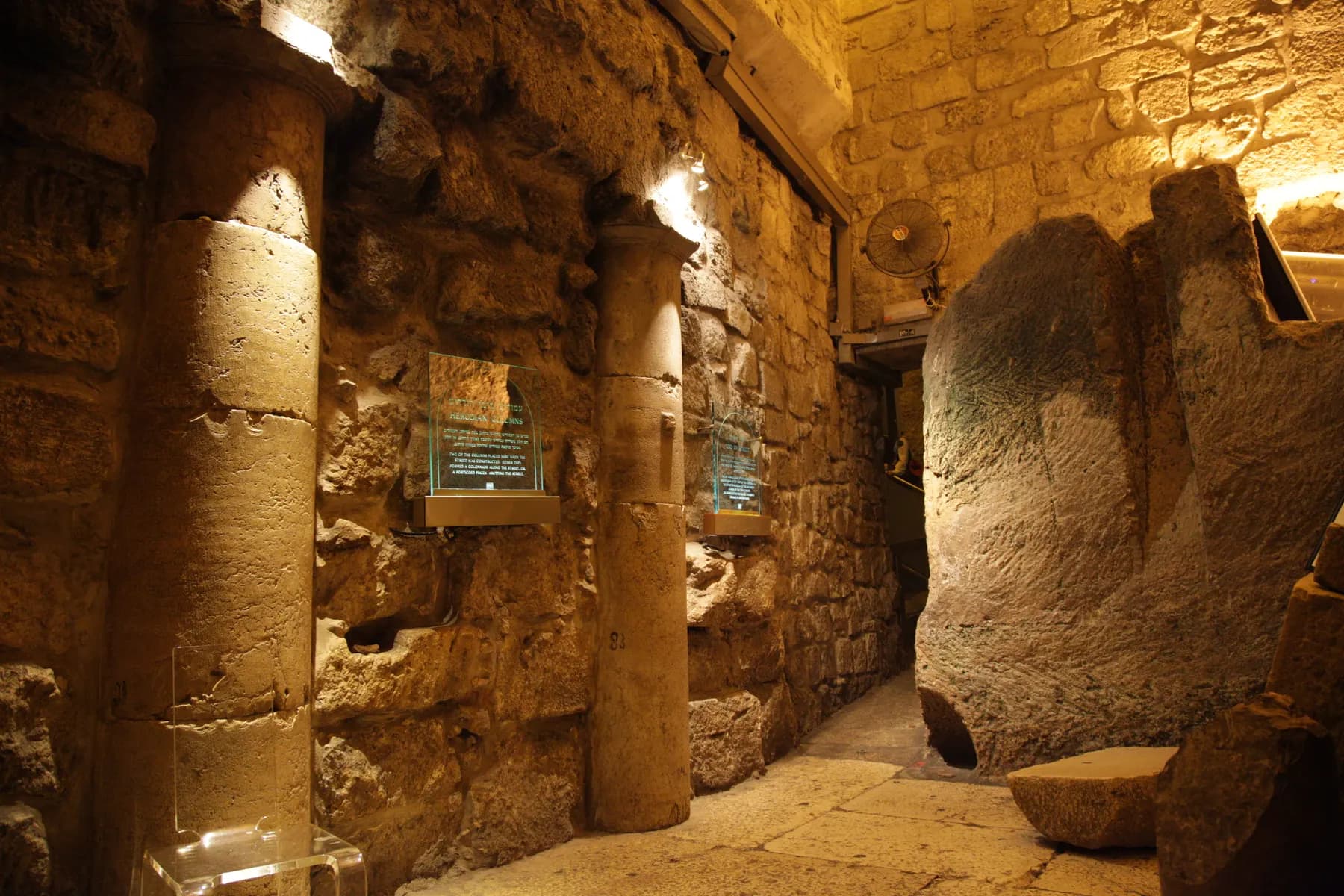
A guided walk along the buried continuation of the Western Wall, past a single limestone block about 13.6 metres long that is among the largest building stones ever set in place by hand.
Xavier Gillet, Bordeaux, France ( xavier33300 on flickr) / CC BY-SA 2.0 · Wikimedia Commons
Adult admission
₪38
on both routes, in the Western Wall Heritage Foundation's 2026 listing
Time underground
about 70 minutes
the Foundation's own figure for the guided tour, entry every 20 minutes
The Western Stone
about 13.6 m long
and 3.3 m high, with its depth still hidden inside the wall
Routes to choose from
Two
the Great Stone Route, and the Great Bridge Route opened in November 2021
In short
- How long to give it
- about 70 minutes underground on the Foundation's own figure, and closer to an hour and a half door to door once the security check at the plaza and the wait for the guide are counted
- Great Stone Route (the classic tour)
- Sunday to Thursday 09:00 to 22:00; Friday 09:00 to 13:00. Entry every 20 minutes
- Adult, either route
- ₪38, with a local guide
מנהרות הכותל
The Western Wall Tunnels are the buried continuation of the Western Wall, reached by a guided walk that leaves the prayer plaza and runs north under the houses of the Muslim Quarter. Only a short stretch of the wall stands in the open air at the plaza, and the published figures for that stretch do not agree: the Western Wall Heritage Foundation calls it a mere 70 metres, the English Wikipedia entry gives roughly 60, and Britannica about 50. Everything else is underground, and this is the only way to walk along it.
The word tunnel oversells the digging and undersells the result. Very little of the route was cut through rock. Most of it threads through spaces that were already there: Herodian street level, vaulted halls, medieval cisterns, a Hasmonean water channel and a Roman pool, all sealed under later building and cleared out again after 1967. The Foundation, which took over the work in 1988, describes an excavation that ran for more than twenty years under a living neighbourhood, with sewage, structural shoring and rabbinic as well as scientific supervision as constant constraints.
It is also the most politically loaded ticket in the Old City. The northern exit onto the Via Dolorosa was cut open in September 1996 on Benjamin Netanyahu's authorisation, and the riots that followed killed dozens of people across Jerusalem, the West Bank and Gaza, and drew a United Nations Security Council resolution within four days. None of that is on the signage. It is worth knowing before going down.
Orientation
Not one tunnel, and not under the Temple Mount
The route begins in the lobby on the northern side of the Western Wall plaza, to the left as a visitor faces the stones, and runs parallel to the wall rather than beneath the platform it holds up. That distinction matters more than any other fact on this page, because the belief that Israeli archaeologists were digging under the Haram al-Sharif is what turned a tourist exit into a week of killing in 1996. Dan Bahat, the archaeologist who oversaw the work, put it flatly to Politico: the tunnel paralleled the compound, it did not run under it.
What a visitor walks along is the base of the retaining wall, at the level the ground stood at when the wall was built, roughly two storeys below the lanes above. The English Wikipedia entry on the tunnel puts the length of wall exposed this way at 300 metres, which is the figure most guidebooks repeat; the same entry gives the wall's total length as 488 metres, and elsewhere quotes 445, so the proportion is best treated as approximate rather than exact.
Beyond the northern end of the wall the route continues into structures that have nothing to do with Herod. There is a rock-cut water channel dated to the Hasmonean period, whose source has never been identified, and it ends at the Struthion Pool, a large rectangular cistern that Josephus already knew by that name in the first century and that Hadrian later vaulted over so a pavement could be laid across it. A modern wall now divides the pool in two. The far half belongs to the Convent of the Sisters of Zion, and visitors cannot pass between them.
1867 to 1996
A Victorian sapper started it and it took 128 years to finish
Charles Wilson began exposing the wall in 1864 and gave his name to the arch above present ground level, a span the Wikipedia entry gives as 12.8 metres wide, which once carried a bridge from the Upper City to the Temple Mount. Charles Warren, a Royal Engineers officer working for the Palestine Exploration Fund, followed in 1867 to 1870, sinking shafts with gunpowder that are still visible today. Warren's shafts unsettled the city above him. In 1868 the municipal council warned the Ottoman governor, Nazif Pasha, that the work endangered the buildings overhead, and the governor waited until Warren was away on survey before having the entrance sealed with heavy stones.
It stayed sealed for a century. After June 1967 Israel's Ministry of Religious Affairs approved a plan, known at first to only a handful of officials, to reopen Warren's tunnel and extend it along the whole buried length of the wall, partly in order to create Jewish prayer space away from the contested platform above. Rabbi Yehuda Getz, newly appointed rabbi of the Western Wall, led it. Residents above began reporting cracks in their houses, and by 1970 Jordan was protesting that a medieval Islamic school had been damaged; the Israeli government attributed the damage to sewage works.
In the summer of 1981 Getz had a blocked doorway opened that led beneath the platform itself, in the belief that the Ark of the Covenant lay under the Dome of the Rock. Word got out, Arab workers and yeshiva students confronted each other underground, and the door was resealed. It has stayed that way. The tunnel opened to visitors, partly, in 1990, with a single entrance that forced everyone to walk back the way they had come: Bahat remembered nonstop collisions in a corridor lit by bare bulbs.
The fix was a hole a few inches thick. Bahat had prepared a northern exit onto the Via Dolorosa years earlier and left the last of the rock in place, because the decision was political rather than archaeological. Yitzhak Rabin and Shimon Peres both refused it. Netanyahu, three months into his first term and urged on by mayor Ehud Olmert, approved it, and the last rock came out at midnight after Yom Kippur on 23 September 1996. Olmert broke a false wall with a sledgehammer for the cameras the next morning, and the rioting began within the hour.
The stones
The Western Stone, and how much it actually weighs
The set piece of the classic route is a single ashlar in the course the Foundation calls the Great Course, from which the Great Stone Route takes its name. Its exposed face can simply be measured with a tape: about 13.6 metres long and 3.3 metres high. What cannot be measured is its depth, because that runs back into the wall, and for most of the twentieth century that unknown produced a spectacular published weight of 550 to 600 tonnes.
In June 2006 Harry Jol of the University of Wisconsin at Eau Claire ran ground-penetrating radar across it and concluded the block is roughly 1.8 to 2.5 metres deep, not the 16.5 metres earlier estimates had assumed. That brings the weight down to something in the region of 250 to 300 tonnes. The Foundation's own site has since moderated its figure to several hundred tons. Either way it was moved and set without powered machinery, and the blocks flanking it in the same course are about 12 and about 8 metres long.
The masonry around it is the reason the walk is worth doing even for someone who has already stood at the plaza. At the plaza only the topmost Herodian courses are visible above the paving. Down here the wall is exposed to something close to its ancient street level, with the drafted margins around each block, the courses stepped slightly back as they rise, and the pilasters that decorated the outer face all legible in a way they simply are not upstairs.
- Exposed face of the Western Stone: about 13.6 m long by 3.3 m high
- Estimated depth on 2006 radar: about 1.8 to 2.5 m, against a pre-2006 estimate of 16.5 m
- Estimated weight: about 250 to 300 tonnes on the radar figure, 550 to 600 tonnes before it
- Neighbouring blocks in the same course: about 12 m and about 8 m long
Fabric
What is Herodian, what is medieval and what was built in the 1970s
The wall itself is ancient and unreconstructed: it was cleared, not rebuilt. Almost everything a visitor stands on, walks under or holds on to is not. The walkways, handrails, lighting, air conditioning, signage and drainage were all installed to make an excavation into a visitable route, and the Foundation lists them frankly as engineering problems it had to solve, along with the sewage, before the public could be let in.
In between those two extremes sits a great deal of genuine but much later fabric. The excavation ran through Ayyubid, Mamluk and Umayyad building, including a stretch of the Western Wall repaired in the Umayyad period, and through vaults and cisterns raised over the centuries to carry buildings up to the level of the Temple Mount platform. The Chain of Generations Center, a museum of glass sculpture by Jeremy Langford in the lobby at the start of the route, occupies restored Second Temple period, Crusader and Mamluk rooms.
Dating is still being revised. Johanna Regev, Joe Uziel, Elisabetta Boaretto and colleagues published radiocarbon results in PLOS ONE on 3 June 2020 that put the first bridge at Wilson's Arch between 20 BCE and 20 CE and its widening, to about 14.8 metres, between 30 and 60 CE, which is after Herod rather than under him. A small theatre-like structure beneath the arch was begun between 95 and 135 CE and abandoned unfinished. The study narrowed a spread of roughly seven centuries in the previous literature to two phases of under fifty years each.
The most recent surprise is not architecture at all. On 19 May 2020 the Israel Antiquities Authority announced a system of rooms hewn straight into the bedrock under the Beit Strauss building at the entrance to the tunnels, hidden beneath the white mosaic floor of a Byzantine period structure and reached by rock-cut stairs. The excavation directors, Barak Monnickendam-Givon and Tehila Sadiel, dated it to the Second Temple period from cooking pots, oil lamps, a stone mug and a fragment of a stone basin, and were explicit that what it was for remains a mystery: a pantry, a dwelling, or a place to hide.
Choosing
Two routes now, and the newer one goes a level deeper
Until recently there was one tour. There are now two, they cost the same, and a visitor with one slot has to pick. The Great Stone Route is the classic walk: along the buried length of the wall, past the point closest to the Holy of Holies, to the Western Stone. The Great Bridge Route, inaugurated by Prime Minister Naftali Bennett on 28 November 2021 after what the Foundation describes as roughly eight years of development and conservation work, drops a further level under the Old City to the piers of the bridge that carried pilgrims towards the Temple, through rooms and halls of the Second Temple period and past courses of the Western Wall exposed for the first time in about 1,700 years.
The practical difference is stairs. The Foundation states that the Great Stone Route is partly accessible, including as far as the Great Stone itself, and that organised groups can arrange an accessible version limited to five wheelchairs, with narrow wheelchairs available to borrow at the entrance for passages under 48 centimetres wide. The Great Bridge Route it describes bluntly as not wheelchair accessible, with many stairs and unsuitable for pushchairs, though there is a place to leave them.
The point closest to the Holy of Holies is on the older route, and it is a small working synagogue rather than a viewing platform. It sits outside Warren's Gate, an ancient sealed entrance to the Temple Mount about 46 metres into the tunnel that served for centuries as a synagogue known as the Cave. Rabbi Getz built the present one because, if the Holy of Holies stood where tradition places it beneath the Dome of the Rock, this is the nearest a Jew can pray to it. Photography is not the reason people stop here.
- Great Stone Route: the classic walk along the wall to the Western Stone, partly wheelchair accessible, Sunday to Thursday 09:00 to 22:00
- Great Bridge Route: one level deeper, opened November 2021, many stairs, no wheelchair access, Sunday to Thursday 07:00 to 23:00
- Both: guided only, booked ahead, groups of 18 to 35, ₪38 adult and ₪25 concession
- Also in the same lobby: the Chain of Generations Center, ₪30 adult, about 40 minutes, booked and paid in advance
What to look for
Things not to walk past at Western Wall Tunnels
The details that repay knowing about before you are standing in front of them.
The Western Stone
A single block about 13.6 metres long and 3.3 metres high, set without powered machinery. The wall in front of it is lit so the joints are visible, which is the only way to grasp how little mortar is involved.
Warren's Gate and the small synagogue
About 46 metres in, a sealed ancient gateway into the Temple Mount that early Muslim rulers allowed Jews to pray beside. The synagogue outside it is the closest accessible point to where tradition places the Holy of Holies.
The Herodian street level
A short paved stretch at the foot of the wall, at the height the ground stood at when the stones were laid. It is the one place in Jerusalem where the wall can be seen from where a first-century passer-by would have seen it.
The Hasmonean channel and the Struthion Pool
A rock-cut water channel of unknown source, ending in a large vaulted cistern that Josephus names in the first century and Hadrian later roofed over. A modern wall splits it; the other half is inside a convent.
The rock-cut rooms under Beit Strauss
Announced in May 2020 and reached by carved stairs beneath a Byzantine mosaic floor: three chambers cut into bedrock in the Second Temple period whose purpose the excavators say is still unknown.
The hall under Wilson's Arch
The roofed prayer space at the northern end of the plaza sits under the first arch of a Herodian-era bridge, radiocarbon dated to between 20 BCE and 20 CE and widened a generation later. It is free and needs no ticket.
The long view
Western Wall Tunnels, in order
c. 19 BCE
Herod the Great begins the expansion of the Temple Mount. The western retaining wall goes up to hold the enlarged platform, its lower courses laid at a street level now two storeys below the Old City.
20 BCE to 20 CE
Radiocarbon range for the first bridge at Wilson's Arch, published by Regev and colleagues in PLOS ONE in 2020.
30 to 60 CE
The bridge is widened to about 14.8 metres, in the years of the Roman prefects rather than under Herod.
70 CE
The Temple is destroyed. The retaining walls stand, and the ground around them slowly rises as the city is rebuilt over its own ruins.
95 to 135 CE
A small theatre-like structure is begun beneath Wilson's Arch and left unfinished, on the 2020 radiocarbon ranges.
1864
Charles Wilson begins exposing the wall and identifies the arch that carries his name, about 12.8 metres wide.
1867 to 1870
Charles Warren, working for the Palestine Exploration Fund, sinks shafts along the wall using gunpowder. His shafts are still part of the visitable route.
1868
The city council warns the Ottoman governor, Nazif Pasha, that the digging endangers the buildings above. The governor seals the entrance while Warren is away surveying.
Summer 1968
Israel's Ministry of Religious Affairs approves a plan, initially secret, to reopen and extend Warren's tunnel along the whole buried length of the wall. Rabbi Yehuda Getz leads it.
1970
Jordan protests that the excavation has damaged a medieval Islamic school. Israel attributes the cracks appearing in houses above to sewage works.
Summer 1981
Getz opens a doorway leading beneath the Temple Mount platform, searching for the Ark of the Covenant. Word leaks, Arab workers and yeshiva students clash underground, and the door is resealed.
1988
The Western Wall Heritage Foundation is established by the Ministry of Religion and takes over the excavation, its preservation and its opening to the public.
1990
The tunnel opens partly to visitors, with one entrance, so everyone has to walk back out along the same narrow corridor.
23 to 24 September 1996
The last few inches of rock at the northern end are cut through hours after Yom Kippur, and mayor Ehud Olmert opens the Via Dolorosa exit the next morning. Rioting begins within the hour and spreads across the West Bank and Gaza.
28 September 1996
The United Nations Security Council adopts resolution 1073 by 14 votes to none, with the United States abstaining, calling on Israel to reverse the acts that led to the violence.
19 May 2020
The Israel Antiquities Authority announces a rock-cut system of rooms of the Second Temple period beneath Beit Strauss at the entrance to the tunnels.
3 June 2020
PLOS ONE publishes the radiocarbon and microarchaeology study that fixes the construction sequence at Wilson's Arch, narrowing about seven centuries of previous estimates to two phases.
Summer 2021
The Chain of Generations Center reopens in the tunnels lobby after a technical rebuild.
28 November 2021
Prime Minister Naftali Bennett inaugurates the Great Bridge Route, a second tour one level deeper, after about eight years of development and conservation work.
Practical
Visiting Western Wall Tunnels
Where
Western Wall Tunnels entrance, northern side of the Western Wall plaza, Old City of Jerusalem, entered from the Dung Gate
What ticket you need
The tunnels are not inside a ticketed park and do not need a park ticket, but they are not covered by anything either. The Western Wall plaza immediately outside is free and open around the clock, and so is the roofed hall under Wilson's Arch at its northern end; the moment you go through the door in the lobby you are on a ticket. The Jerusalem Archaeological Park, which covers the wall's southern continuation past Robinson's Arch, is a third site with a third ticket.
Opening hours
- Great Stone Route (the classic tour)
- Sunday to Thursday 09:00 to 22:00; Friday 09:00 to 13:00. Entry every 20 minutessource
- Great Bridge Route
- Sunday to Thursday 07:00 to 23:00; Friday 07:00 to 13:00. Entry every 20 minutessource
- Chain of Generations Center
- Sunday, Tuesday and Wednesday 10:00 to 18:00; Monday and Thursday 09:00 to 17:00; Friday 09:00 to 13:00source
- Saturday
- The Foundation lists no Saturday hours for either tunnel route, and Friday closes earlysource
Admission
- Adult, either route
- ₪38, with a local guidesource
- Child under 18, student, soldier in compulsory service, senior or visitor with a disability
- ₪25, on production of the relevant certificatesource
- Organised group with its own guide
- ₪30 adult and ₪19 child, plus ₪295 per group for guidingsource
- Chain of Generations Center (separate ticket, same lobby)
- ₪30 adult, ₪15 concession, booked and paid in advancesource
Access
Mixed, and the two routes differ. The Foundation calls the Great Stone Route partly accessible, including as far as the Great Stone itself, and says organised groups can arrange an accessible version for up to five wheelchairs; narrow wheelchairs can be borrowed at the entrance to the car park or in the lobby against a photo ID, which is what visitors whose own chair is wider than 48 centimetres will need for the tight passages. The Great Bridge Route is not wheelchair accessible at all: it has many stairs, and the Foundation says it is unsuitable for pushchairs, with a place to leave them instead. Getting to the plaza in a wheelchair means using the Dung Gate, which is the only step-free approach. The route is narrow, uneven and enclosed throughout, and anyone uneasy in confined spaces should say so when booking rather than at the halfway point.
On site
- Ticket office and lobby on the plaza
- Guided tours only, in several languages
- Chain of Generations Center (separate ticket)
- A Look into the Past virtual reality room (separate ticket)
- Gateway to Heaven audio-visual presentation (separate ticket)
- Wheelchairs to borrow, against a photo ID
- Pushchair parking for the Great Bridge Route
- Lit and air-conditioned walkways
- No mobile phone reception underground
- No food or drink sold on the plaza
Booking
Booking ahead is not a recommendation, it is the only way in. Both routes are guided, both must be reserved in advance, and the Foundation runs guided groups of between 18 and 35 people with entry every 20 minutes, so a walk-up slot depends entirely on a gap in a schedule that is often full. Groups bringing their own guide book separately and pay a per-group guiding fee.
Hours and prices are given as the operator publishes them and change without much notice, particularly around Shabbat and the festivals. Check the operator's own page before you travel for this.
Official page at english.thekotel.org →What people wish they had known
- Book before leaving home. Both routes are guided-only with entry every 20 minutes and groups capped at 35, so the commonest mistake is arriving at the plaza and expecting to buy a ticket at the door.
- Pick the route deliberately. The Great Stone Route is the wall, the Western Stone and the synagogue by Warren's Gate; the Great Bridge Route is a level lower, is newer and has many stairs. They cost the same and cover different ground, and nobody tells you this at the ticket window.
- Expect to lose your phone signal. The Foundation states there is reception on the plaza but none inside the tunnels, so agree a meeting point with anyone waiting above before going down.
- Do not plan it for a Friday afternoon or a Saturday. Friday entry stops at 13:00 on the classic route, and the Foundation publishes no Saturday hours for either tunnel tour.
- Wear shoes you can walk on uneven stone in, and treat the width warnings seriously: some passages take a wheelchair only if it is under 48 centimetres wide, which is narrower than most.
- Leave time on the plaza before or after. It is free, it is open at every hour, and the roofed hall under Wilson's Arch at its northern end is part of the same Herodian bridge the tunnels run beneath.
The figures
Western Wall Tunnels by the numbers
Each figure carries the year it belongs to and links the source it came from.
| Measure | Figure | As of | Source |
|---|---|---|---|
| Length of wall the tunnel exposes | 300 m, against a total wall length given as 488 m | 2026 | en.wikipedia.org |
| Exposed face of the Western Stone | about 13.6 m long and 3.3 m high | 2026 | en.wikipedia.org |
| Estimated weight of the Western Stone | about 250 to 300 tonnes on 2006 ground-penetrating radar, against 550 to 600 tonnes before it | 2006 | en.wikipedia.org |
| Distance from the tunnel entrance to Warren's Gate | about 46 m | 2026 | en.wikipedia.org |
| Adult admission, either route | ₪38, guided and booked in advance | 2026 | english.thekotel.org |
| Guided group size | between 18 and 35 people, entry every 20 minutes | 2026 | english.thekotel.org |
| Killed in the riots after the 1996 exit was opened | 74 Palestinians and 16 Israeli soldiers on Politico's count; the Wikipedia entry on the riots gives 59 and 16 | 1996 | andrewlawler.com |
| Development and conservation work before the Great Bridge Route opened | about 8 years, inaugurated 28 November 2021 | 2021 | thekotel.org |
While you are here
The rest of The Old City of Jerusalem
Everything else in this destination with a page of its own.
patano / CC BY-SA 3.0 · Wikimedia Commons
Religious site
The Western Wall
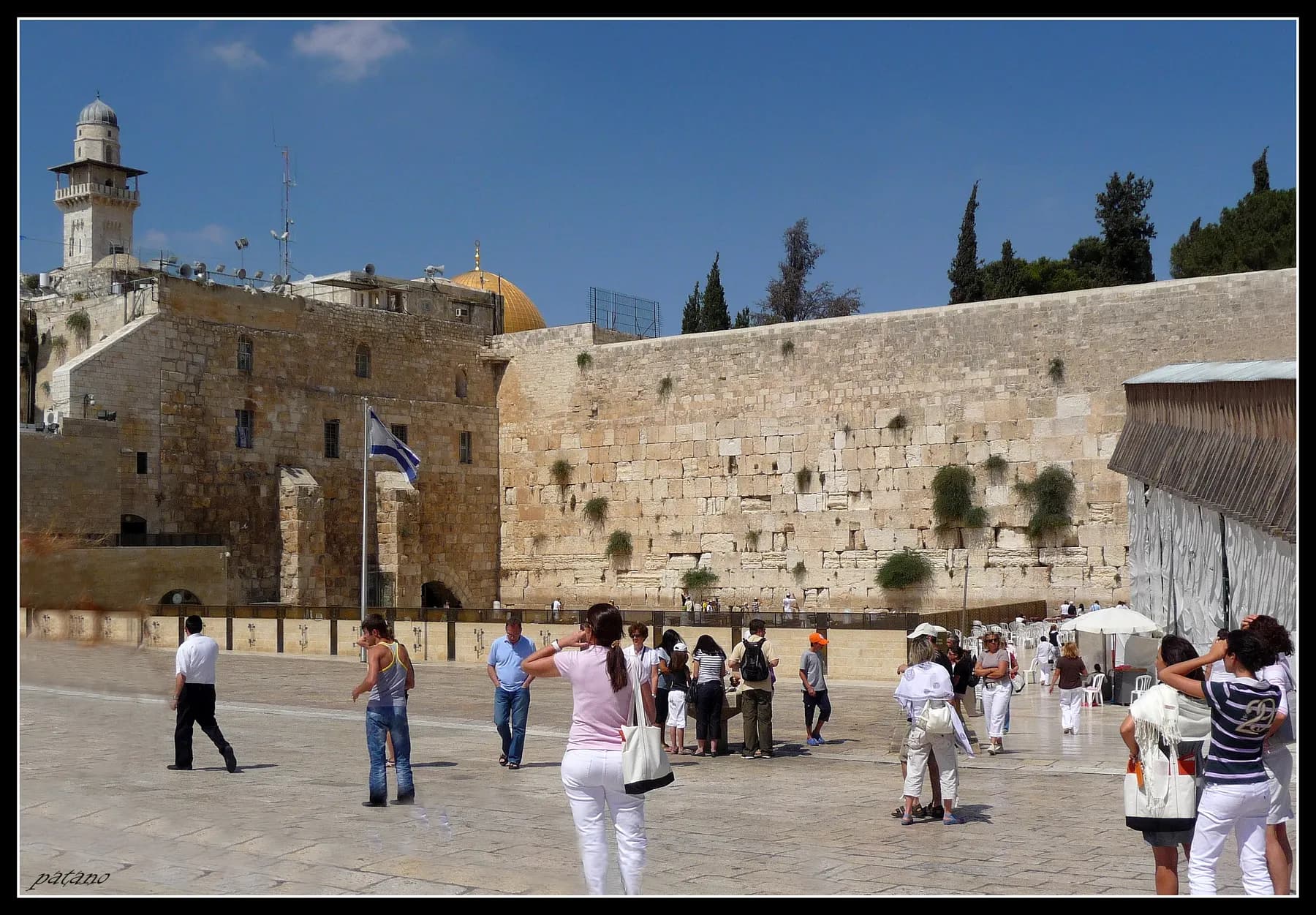
The prayer plaza shows about 50 metres of a retaining wall that runs 488 metres in total, and it is open free of charge at every hour of every day of the year.
Religious site
The Temple Mount and Haram al-Sharif
Everything standing on the esplanade is later than the esplanade itself, which Herod's engineers made from about 19 BCE by wrapping a hilltop in four retaining walls and filling in behind them.
רחל וייסלר / CC BY 2.5 · Wikimedia Commons
Religious site
Via Dolorosa
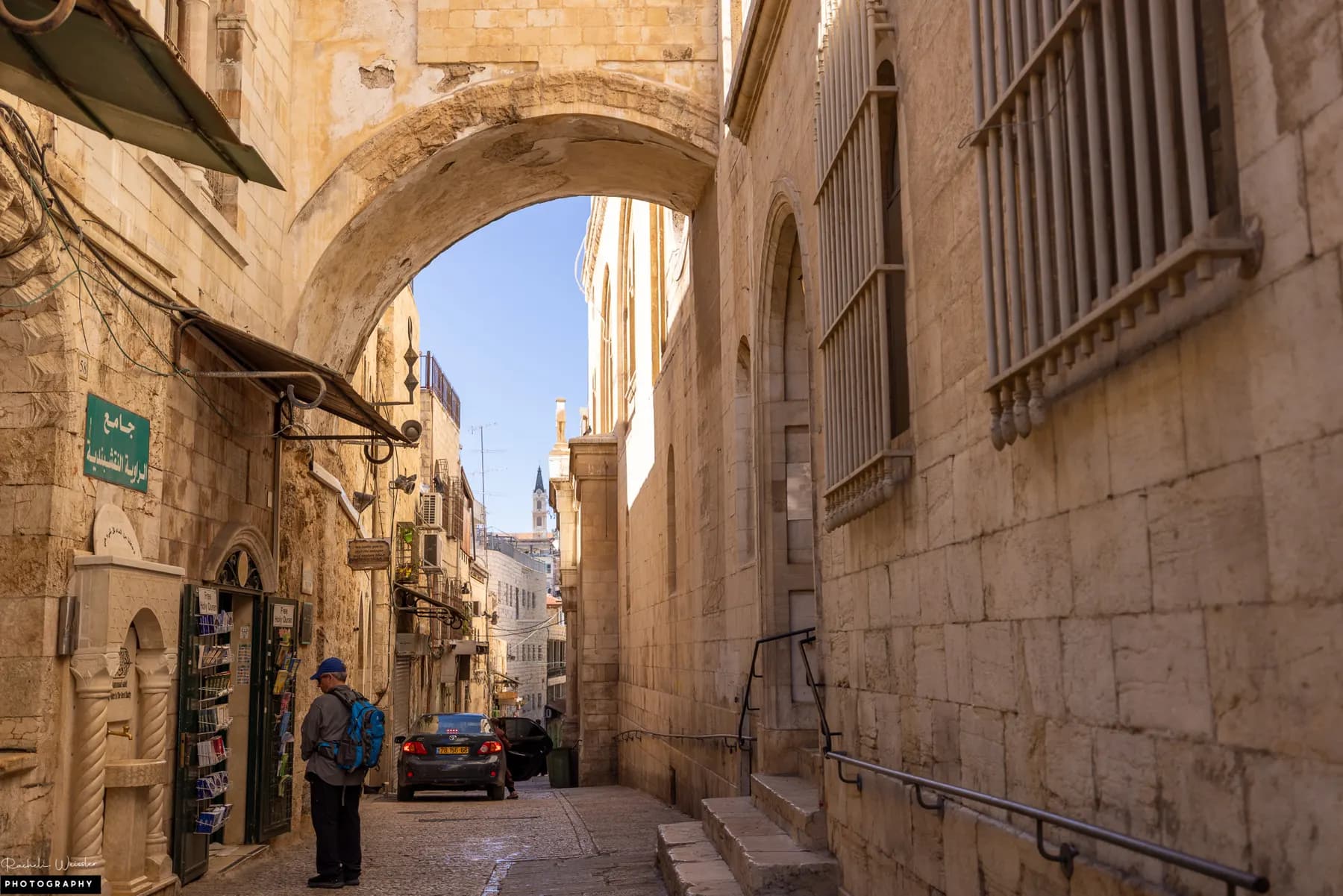
Fourteen stations over roughly half a kilometre of working market lanes, of which nine are in the street and the last five are inside the Church of the Holy Sepulchre.
Sources and further reading
Every link below was opened and checked when this page was written. Official statements are marked as such: they are the subject's own account, not an independent one.
- OfficialWestern Wall Heritage Foundationenglish.thekotel.orgThe Great Stone Route
The operator's page for the classic route: ₪38 adult and ₪25 concession, ₪30 and ₪19 for organised groups plus ₪295 per group for guiding, hours of Sunday to Thursday 09:00 to 22:00 and Friday 09:00 to 13:00, entry every 20 minutes, groups of 18 to 35, the tour of an hour and ten minutes, partial wheelchair access limited to five per group, the 48 centimetre passage width, and the statement that only about 70 metres of the wall is exposed at the plaza
- OfficialWestern Wall Heritage Foundationenglish.thekotel.orgThe Great Bridge Route
The newer route one level deeper: what it passes, the newly exposed courses of the Western Wall, hours of Sunday to Thursday 07:00 to 23:00 and Friday 07:00 to 13:00, the same ₪38 and ₪25 prices, and the statement that it has many stairs, no wheelchair access and no pushchairs
- OfficialWestern Wall Heritage Foundationthekotel.orgThe Great Bridge: the Prime Minister inaugurates a new route
The inauguration on 28 November 2021 by Prime Minister Naftali Bennett with Rabbi Shmuel Rabinowitz and the Foundation's director Mordechai Eliav, after about eight years of development and archaeological conservation work
- OfficialWestern Wall Heritage Foundationenglish.thekotel.orgThe Chain of Generations Center
Reopened to the public in summer 2021, glass sculpture by Jeremy Langford, ₪30 adult and ₪15 concession, about 40 minutes, advance booking and payment only, accessible for up to two wheelchairs per tour
- OfficialWestern Wall Heritage Foundationenglish.thekotel.orgWhat should be taken into account when visiting the Western Wall
The statement that there is mobile reception on the plaza but none inside the Western Wall Tunnels, that wheelchair access to the plaza is only from the Dung Gate, that no food or drink is sold on the plaza, and the walking times from the gates and car parks
- OfficialWestern Wall Heritage Foundationenglish.thekotel.orgThe Western Wall Heritage Foundation
The Foundation established by the Ministry of Religion in 1988, the excavation begun by the Ministry of Religion after June 1967 and running for over twenty years beneath a residential neighbourhood, and the engineering it had to solve before opening: sewage, walkways, accessible paths, air conditioning, lighting, guide training and a reservations system
- ReportingAndrew Lawler, Politicoandrewlawler.comNo Way Out: How the Opening of a Tunnel Blocked the Path to Peace in Jerusalem
Published 24 September 2021: Warren's gunpowder from 1867 and the 1868 letter to governor Nazif Pasha, the secret plan of summer 1968 under Rabbi Yehuda Getz, the Jordanian protest of 1970, Getz's search for the Ark in summer 1981, the partial opening in 1990 and Dan Bahat's account of the collisions, Netanyahu's approval at Olmert's urging, the cutting of the last inches after Yom Kippur on 23 September 1996, and a toll of 74 Palestinians and 16 Israeli soldiers dead with more than 1,000 Palestinians and 58 Israelis wounded
- ReportingThe Times of Israeltimesofisrael.comLiving underground before the Romans? 2,000-year-old rooms found by Western Wall
The announcement of 19 May 2020: three rock-hewn rooms beneath the Beit Strauss complex and under the white mosaic floor of a Byzantine building, directed for the Israel Antiquities Authority by Barak Monnickendam-Givon and Tehila Sadiel, dated by cooking pots, oil lamps, a stone mug and a qalal fragment, with the purpose stated to be still a mystery
- ReportingSmithsonian Magazinesmithsonianmag.comUnderground Chambers Discovered Near Jerusalem's Western Wall
Independent report of the same find: a courtyard and two chambers cut into bedrock and linked by carved stairs, about 120 feet from the Western Wall, with the excavators quoted asking what the function of the hewn system was and stating that they do not know
- ReferenceRegev, Uziel, Boaretto and others, PLOS ONEpmc.ncbi.nlm.nih.govRadiocarbon dating and microarchaeology untangle the history of Jerusalem's Temple Mount: a view from Wilson's Arch
Published 3 June 2020: the first bridge at Wilson's Arch dated between 20 BCE and 20 CE, its widening to about 14.8 metres dated between 30 and 60 CE, the theatre-like structure beneath it begun between 95 and 135 CE and left unfinished, and the narrowing of roughly seven centuries of earlier estimates to two phases of under fifty years
- ReferenceWikipediaen.wikipedia.orgWestern Wall Tunnel
Charles Wilson from 1864 and Wilson's Arch at 12.8 metres wide, Charles Warren in 1867 to 1870, the 300 metres of wall the tunnel exposes against a total of 488, Warren's Gate about 46 metres in and the synagogue built outside it by Rabbi Getz, the Hasmonean channel of unidentified source, the Struthion Pool divided by a modern wall with the far half in the Convent of the Sisters of Zion, the Umayyad, Ayyubid and Mamluk fabric, the Chain of Generations Center, and the daylight-only northern exit
- ReferenceWikipediaen.wikipedia.orgWestern Stone
The exposed face at about 13.6 metres by 3.3 metres, Harry Jol's June 2006 ground-penetrating radar giving a depth of about 1.8 to 2.5 metres against a previous estimate of 16.5, the resulting weight of 250 to 300 tonnes against earlier figures of 550 to 600, the Foundation's own revision to several hundred tons, the Great Course, and the flanking blocks of about 12 and about 8 metres
- ReferenceWikipediaen.wikipedia.orgWestern Wall Tunnel riots
The riots from 24 September 1996 and their spread to the West Bank and Gaza, a toll of 59 Palestinians and 16 Israelis, the 1868 Ottoman sealing, the reopening under religions minister Zerach Warhaftig, the 1982 clash over Getz's doorway, the partial opening in 1990, and the refusals by Rabin and Peres to authorise the exit
- ReferenceWikipediaen.wikipedia.orgUnited Nations Security Council Resolution 1073
Adopted 28 September 1996 by 14 votes to none with the United States abstaining, calling on Israel to cease and reverse the acts that aggravated the situation, and giving a further death toll of 14 Israelis and 56 Arabs with about 300 wounded
Western Wall Tunnels: common questions
Do you need to book the Western Wall Tunnels in advance?+
Yes, and there is no way round it. The Western Wall Heritage Foundation runs both routes as guided tours by prior reservation only, with entry every 20 minutes and guided groups of between 18 and 35 people. Touring the site is possible only in the company of a certified guide. Turning up on the day and hoping for a cancellation is unreliable, particularly in the school holidays and around festivals.
How much does it cost?+
₪38 for an adult on either route, in the Foundation's published prices. A child under 18, a student, a soldier in compulsory service, a senior citizen or a visitor with a disability pays ₪25 on production of the relevant certificate. Groups arriving with their own guide pay ₪30 an adult and ₪19 a child, plus ₪295 per group for guiding. The Chain of Generations Center in the same lobby is a separate ₪30 ticket.
How long does the tour take?+
About 70 minutes underground. The Foundation describes the tour as approximately one hour and states that admission includes a guided tour of an hour and ten minutes. Allow around an hour and a half in total for the security check at the plaza entrance, finding the lobby and waiting for your guide to gather the group.
Do the tunnels go under the Temple Mount or Al-Aqsa?+
No. The route runs alongside the outside of the Western Wall, parallel to the platform rather than beneath it. Dan Bahat, the archaeologist who directed the work, made exactly this point in 1996, when the belief that Israelis were digging under the compound was what turned the opening of a tourist exit into a week of violence. One doorway leading under the platform was opened in 1981 and resealed within days, and it has stayed sealed.
What is the difference between the Great Stone Route and the Great Bridge Route?+
The Great Stone Route is the original tour: along the buried length of the wall, past the point closest to the Holy of Holies, ending at the Western Stone. The Great Bridge Route, opened in November 2021, descends a further level to the bridge that carried pilgrims towards the Temple, through Second Temple period rooms and past courses of the wall newly re-exposed. They cost the same. The newer one has more stairs and no wheelchair access.
Is it wheelchair accessible?+
The Great Stone Route partly is, and the Great Bridge Route is not. The Foundation says the classic route is partially accessible including as far as the Great Stone, that an accessible version can be arranged for organised groups up to a limit of five wheelchairs, and that narrow wheelchairs can be borrowed at the entrance against a photo ID for passages that will not take a chair wider than 48 centimetres. The newer route it describes as having many stairs and no wheelchair access at all.
Is it claustrophobic, and is it suitable for children?+
Parts of it are genuinely tight, low and enclosed, and the route is walked in single file in places with a group behind you, so there is no easy way to turn back. Children generally do well because the tour is short and constantly changing, but the Foundation's own age floor for its other indoor attractions is five, and pushchairs will not go down the Great Bridge Route at all. Say so when booking if confined spaces are a problem.
Where does the tour come out?+
A northern exit onto the Via Dolorosa, in the Muslim Quarter, was cut in September 1996 precisely so that visitors would not have to walk back through the group coming the other way. Reporting since describes visitors leaving that way rather than doubling back, and the Wikipedia entry notes the exit opens in daylight hours only for security reasons. The Foundation does not state the arrangement on its route pages, so confirm it when you book.
Is it worth it if you have already seen the Western Wall?+
Yes, and it is close to the only reason to buy a ticket in this part of the Old City. At the plaza the wall is visible from its upper courses only, and even the length on show is small: the Foundation calls it a mere 70 metres of a wall that runs 488. Underground you see the same wall at the level it was built from, with the drafted margins, the pilasters and the Western Stone. What you do not get is the atmosphere of the plaza, which is free.
Why were people killed over a tunnel exit?+
Because of where the exit came out and what people believed lay behind it. Opening a door from a Jewish holy site into the heart of the Muslim Quarter, next to a main entrance to the Haram al-Sharif, was read as a claim on the ground above, and word spread from the minarets that Jews were digging under the compound. Rioting began within an hour of the ceremony on 24 September 1996 and spread to Ramallah, Bethlehem, Nablus and Gaza. Published death tolls differ: Politico gives 74 Palestinians and 16 Israeli soldiers, the Wikipedia entry on the riots gives 59 and 16. The Security Council passed a resolution on the fourth day.