The Case for Piping Saudi Crude to Ashkelon in Eight Months
A strategy essay argues a 200km desert link to Israel's existing Eilat-Ashkelon line could bypass the Red Sea entirely - a plan with no Saudi-Israeli relations behind it.
Illustration
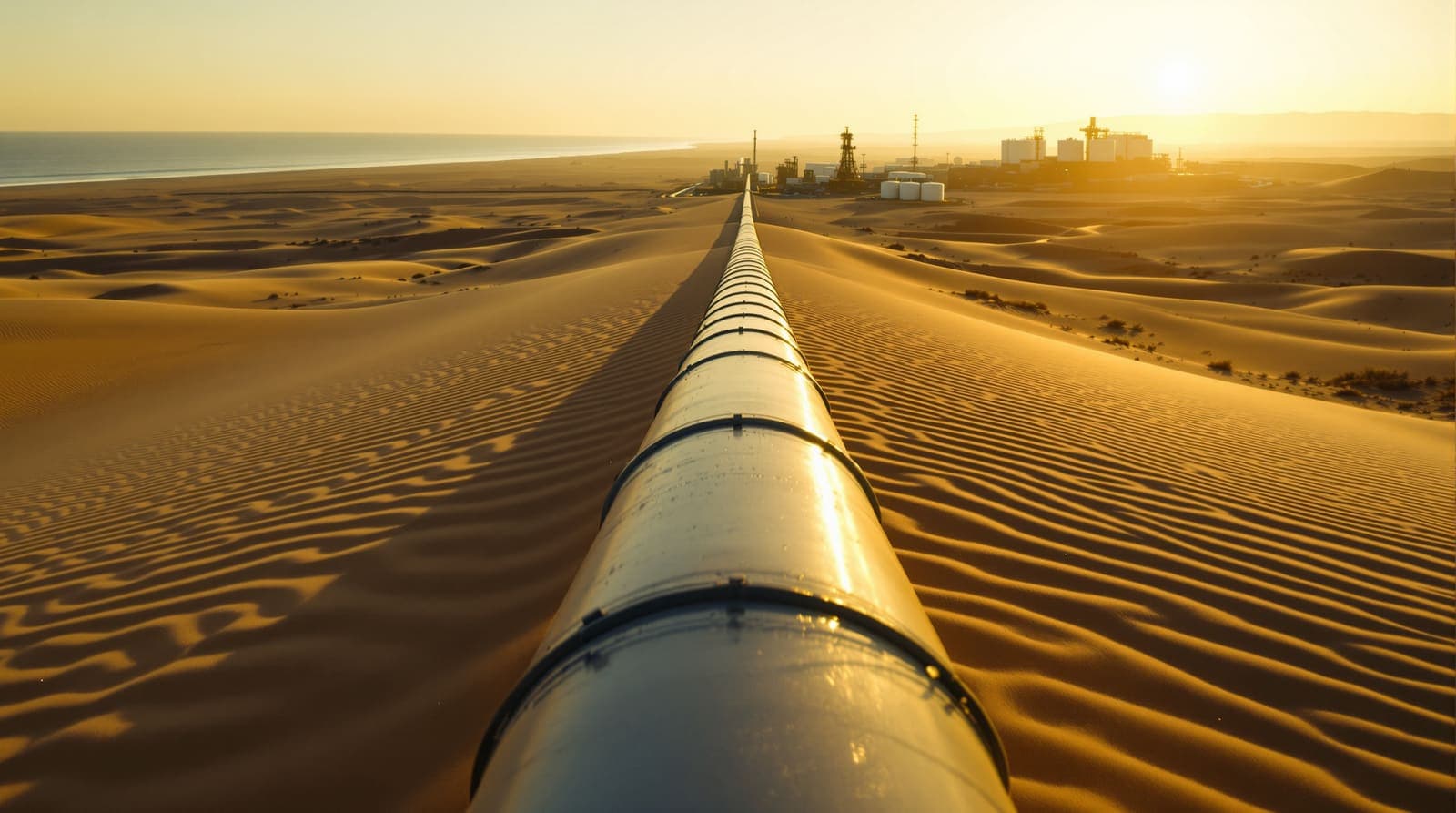
An unsigned strategy essay published on 14 March 2026 makes a single, large argument: that the cheapest way to take Iranian pressure off global energy markets is to lay a short overland pipeline from Saudi Arabia's north-western oil network to Israel's Mediterranean port of Ashkelon, and that it could be done in eight months. This is an opinion piece, not a report of a decision, and no such project has been announced by any government.
The essay's mechanism is the part worth examining. It proposes connecting Saudi Aramco's network, which it says already reaches the kingdom's north-western desert near Tabuk, to the Israeli terminal at Eilat across roughly 200 kilometres of flat desert, then pushing the crude north along the existing Eilat-Ashkelon pipeline to the Mediterranean. It describes that Israeli line as a 42-inch pipe with a northbound capacity of around 60 million tonnes a year, or 1.2 million barrels per day, and calls it "the national spine, built, paid for, and operational".
The Israeli pipeline the plan depends on
That spine is real, and it is older and more troubled than the essay lets on. The line is operated by the state-owned Europe Asia Pipeline Company, which The Times of Israel reported in January 2025 was set up in 1968, during the War of Attrition, to move Iranian oil to the Mediterranean while bypassing the Suez Canal. The same report, covering findings by Israel's State Comptroller, put the pipeline's length at 254 kilometres and said about 119 kilometres of it runs through areas of high to very high environmental sensitivity, with 101 kilometres crossing nature reserves and parks. The comptroller found the company had not acted on recommendations dating back to 2015 to add two valves and relocate a third, and criticised it for paying performance bonuses in a year that saw a significant oil leak.
The essay anticipates the environmental objection and answers it with design promises: a "zero-tanker", entirely subterranean land connection that would leave Eilat's waters and coral reefs untouched, fibre-optic cable laid alongside the pipe for leak detection, automatic shut-off valves every 500 metres, and pipe-within-a-pipe containment in sensitive zones. Those are proposals, not commitments by anyone.
The chokepoint problem is genuine
The premise the essay builds on holds up. Attacks on Red Sea shipping pushed traffic away from the route on a scale visible in the data. The US Energy Information Administration found that oil flows through the Bab el-Mandeb strait fell to 4.0 million barrels per day in the first eight months of 2024, from 8.7 million barrels per day across 2023, while volumes routed around the Cape of Good Hope rose to 9.2 million barrels per day from 6.0 million. The agency describes the strait as 18 miles wide at its narrowest, with tanker traffic squeezed into two two-mile channels, and notes that closure forces ships around southern Africa at higher cost and longer transit.
The knock-on to the canal was severe. Euronews reported in April 2025 that Suez Canal revenue fell to about $4 billion in 2024 from $10.3 billion in 2023, with 13,213 vessels transiting against more than 26,000 the year before. The essay's own framing figures (that Bab al-Mandab handles 12 per cent of seaborne oil and 8 per cent of global liquefied natural gas, that rerouting adds roughly $1 million per round trip and 14 days, that container shipping costs tripled) are the essay's, and are not sourced within it.
The piece the argument is missing
A pipeline from Saudi Arabia to an Israeli port requires Saudi Arabia and Israel to have a relationship. They do not. In an assessment published on 23 February 2026, three weeks before this essay appeared, the Institute for National Security Studies in Tel Aviv concluded that from Riyadh's perspective normalisation with Israel is not currently on the agenda, and that Saudi officials have described the establishment of an independent Palestinian state along 1967 lines, with East Jerusalem as its capital, as an unequivocal and non-negotiable precondition.
The essay does not address this. Its eight-month timeline is presented as an engineering and permitting problem ("infrastructure projects typically take years because of bureaucracy, not engineering") solved by an emergency infrastructure declaration in Jerusalem, host nation support, American logistical help and around a hundred crews working in parallel. The diplomatic precondition, which is the binding constraint, is assumed away.
What the essay does not establish
The piece carries no byline, no citations and no costing. It does not say who would build or finance the link, what tariff structure would apply, or whether Jordan, whose territory the essay places at the junction point of the metering station, has been consulted. It gives no evidence that any of the four governments it names has considered the proposal. It should be read as advocacy for an idea, not as a report that anything is being built.
Sources and further reading
Every link below was opened and checked when this page was written. Official statements are marked as such: they are the subject's own account, not an independent one.
- ReportingThe Times of Israeltimesofisrael.comReport blasts state oil company for not addressing problems in Eilat-Ashkelon line
State Comptroller findings on EAPC, the pipeline's history, length and environmental exposure
- ReportingEuronewseuronews.comEgypt's Suez Canal revenue fell sharply in 2024 on regional tensions
Suez Canal revenue and transit figures for 2024 against 2023
- DataUS Energy Information Administrationeia.govRed Sea attacks reduce oil flows through Bab el-Mandeb Strait
Measured collapse in Bab el-Mandeb oil transit and the shift around the Cape of Good Hope
- DataUS Energy Information Administrationeia.govThe Bab el-Mandeb Strait is a strategic route for oil and natural gas shipments
Geography and traffic constraints of the strait the proposal seeks to bypass
- ReferenceInstitute for National Security Studiesinss.org.ilSaudi Arabia's New Approach to Israel and the Normalization Process
State of Saudi-Israeli normalisation in February 2026 and Riyadh's stated preconditions
How we checked this
This article summarises an opinion essay; every claim about the proposed pipeline, its timeline and its engineering is the essay's own and is attributed as such. The independent material - EAPC's history and the State Comptroller's findings, Bab el-Mandeb and Suez traffic data, and the status of Saudi-Israeli normalisation - comes from Times of Israel, US Energy Information Administration, Euronews and INSS pages that were fetched and checked. No government has announced such a project.
Our sourcing and corrections policy →The week from Israel, in one email
The stories that mattered, sourced and checked by the Israel.com newsroom. Free, weekly, one-click unsubscribe.
One list, unsubscribe in a click. See our privacy policy.
More in Israel
All israel →


Latest
- IDF says Khan Younis strike killed Nukhba operative tied to Steinberg's death
- Yair Golan sues Sara Netanyahu for millions over Channel 14 remarks
- Ariel man, 53, found alive after entering Palestinian village overnight
- Houthi forces reported streaming into Yemen's port city of Mocha
- Israel says three Hamas weapons depots destroyed in strikes across Gaza
- Advisers warned Trump the Iran war could outlast his presidency