A 50-Metre Tunnel Near Jerusalem That Nobody Can Date
Archaeologists cut into what looked like a natural cavity near Kibbutz Ramat Rachel and found a hand-quarried passage with no pottery or coins to date it.
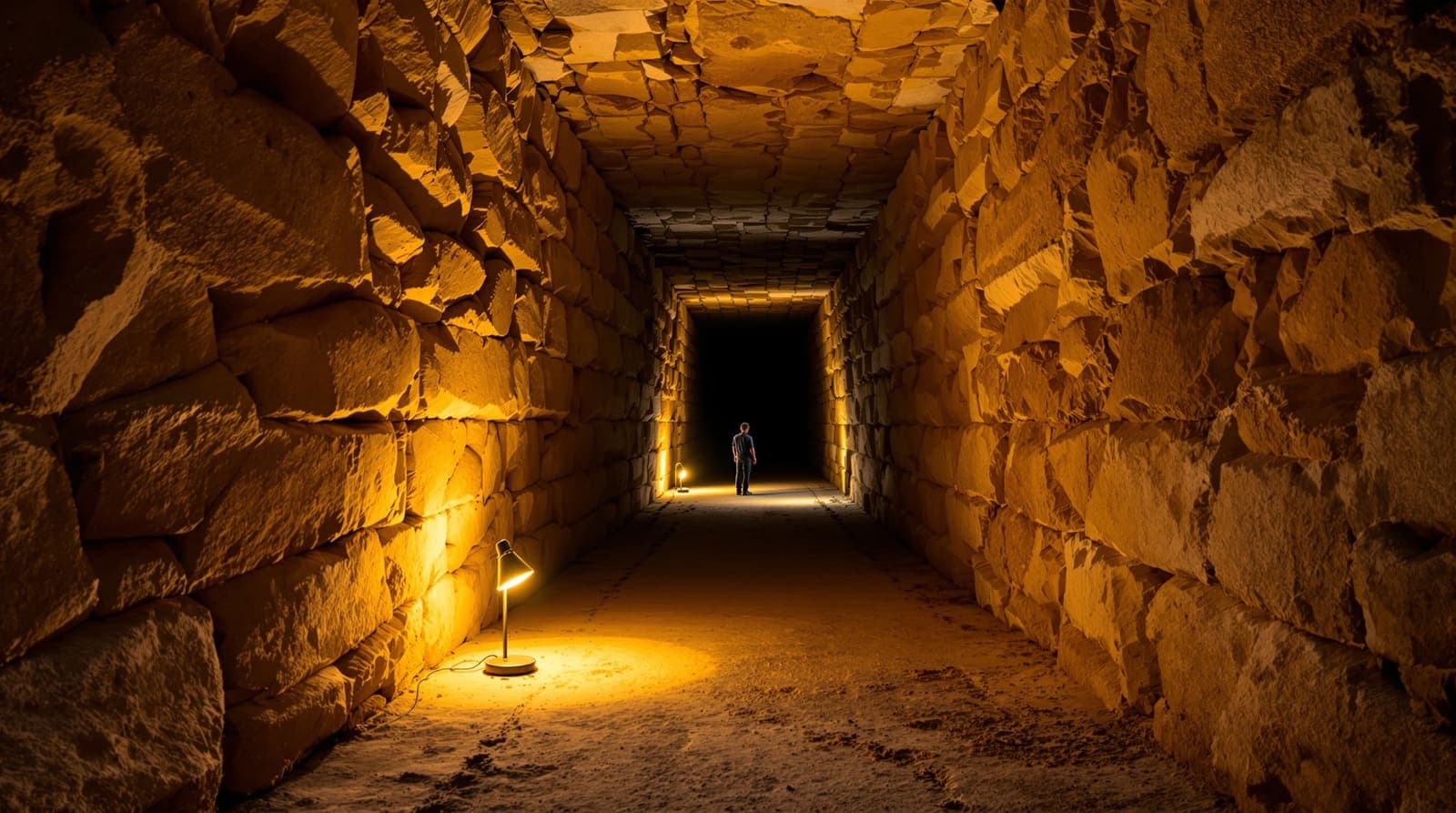
Illustration
Archaeologists working on the southern edge of Jerusalem have uncovered a tunnel carved deep into bedrock near Kibbutz Ramat Rachel, and cannot say what it was for or when it was made. The dig was run by the Israel Antiquities Authority, the government body responsible for excavation and heritage, ahead of a new residential neighbourhood being advanced by the Israel Lands Authority north of the kibbutz.
The passage runs roughly 50 metres, or about 164 feet, underground. It came to light unexpectedly. "We were excavating in relatively rocky and exposed terrain when suddenly we discovered a natural karstic cavity," the excavation directors, Dr Sivan Mizrahi and Zinovi Matskevich, said in a joint statement, a karstic cavity being a void dissolved out of limestone by water. "To our amazement, as the excavation progressed, this cavity developed into a long tunnel. Parts of it are still collapsed, so the tunnel has not yet revealed all of its secrets."
Built with effort, filled with silence
The complex was entered by a staircase descending from the surface to a hewn opening. Inside, the archaeologists found the passage choked with layers of soil laid down over hundreds and possibly thousands of years. Test excavations at several points showed sections reaching up to five metres, about 16 feet, in height and roughly three metres, about 10 feet, across.
"The quarrying was executed meticulously," Mizrahi and Matskevich said. "It is clear that whoever carved this tunnel invested tremendous effort, careful planning, and possessed the capabilities and resources necessary to achieve this goal."
Three theories, and only one still standing
The first idea was that the tunnel was an ancient water installation driven towards an underground spring. That was dropped: the walls carried no trace of the plaster normally used to stop seepage in water systems, and geological advice indicated there was no underground water in the area. A second possibility, that it served an agricultural or industrial installation, was judged unlikely because nothing comparable is known nearby.
What remains is quarrying. The team now believes the tunnel may have been driven to reach a chalk layer suitable for cutting building stone or burning into lime. A shaft carved into the ceiling, which may have been a ventilation opening, and quarrying debris on the floor both point that way. Even so, the directors were careful: "It is possible that the quarrying and construction of the tunnel were never completed, and therefore its intended purpose and nature remain unknown."
Dating is the harder problem. No pottery, coins or other artefacts turned up that could fix a period. "The date of the tunnel is also a mystery to us, since not even the smallest find was uncovered that could indicate when it was created," the directors said. Both The Times of Israel and The Jerusalem Post reported the find on 14 May 2026 and described the same sequence of theories raised and set aside.
Why a building site in Israel turns into a dig
The tunnel was found because someone wanted to build houses. Under Israeli law, development on or near an archaeological site triggers a salvage excavation before construction can proceed, a requirement The Times of Israel noted in its account of this dig. The result is that a large share of Israeli archaeology is driven by the property market rather than by research questions, and that discoveries surface where bulldozers happen to be pointed.
A hill that has surprised people before
The site lies only a few hundred metres from an Iron Age public building and from Tel Ramat Rachel. The kibbutz itself sits inside Jerusalem's municipal boundary between the Arnona and Talpiot neighbourhoods, overlooking Bethlehem, and was founded in 1926. Excavations at the tel have produced remains running from the Iron Age through the Islamic period, including palatial and administrative structures and stamped seal impressions, which one of the site's excavators has described as marking a palace or administrative centre where agricultural produce was gathered as government tax revenue.
Shikma Sig, the Jerusalem Region planner at the Israel Lands Authority, said the tunnel and the surrounding finds would become part of a public archaeological park built into the new neighbourhood. "The neighborhood offers a rare combination of modern urban development and preservation of historical heritage," she said. Dr Amit Re'em, the antiquities authority's Jerusalem district archaeologist, was blunter about the state of knowledge: "Usually we have explanations for the discoveries we uncover, but sometimes, as in this case, we stand astonished and amazed."
Israel's Minister of Heritage, Rabbi Amichai Eliyahu, tied the announcement to the timing, saying that during Jerusalem Day week the discovery was a reminder of what lies beneath the city's soil.
What is still unclear
The statement gave no date range for the tunnel, not even a wide one, and no radiocarbon or other scientific dating results. It did not say how much of the passage remains blocked by collapse, or whether the excavators intend to clear it. And while quarrying is the surviving theory, the directors themselves said the work may never have been finished, which would mean the tunnel never had a use to discover.
Sources and further reading
Every link below was opened and checked when this page was written. Official statements are marked as such: they are the subject's own account, not an independent one.
- ReportingThe Times of Israeltimesofisrael.comMysterious ancient tunnel, possibly thousands of years old, discovered in Jerusalem
Independent account of the 14 May 2026 announcement and of Israel's salvage-excavation rule
- ReportingThe Jerusalem Postjpost.comAncient tunnel with unknown age, purpose found near Kibbutz Ramat Rachel
Second account of the dimensions and the discarded theories
- ReferenceWikipediaen.wikipedia.orgRamat Rachel
Location and founding of the kibbutz, and the archaeology of Tel Ramat Rachel
How we checked this
The account of the excavation, the measurements and all quotations come from the Israel Antiquities Authority material of 14 May 2026 reproduced in the original statement. The salvage-excavation requirement and the independent confirmation of the find were checked against Times of Israel and Jerusalem Post reports of the same date; background on Tel Ramat Rachel is from a reference source and is flagged as such.
Our sourcing and corrections policy →The week from Israel, in one email
The stories that mattered, sourced and checked by the Israel.com newsroom. Free, weekly, one-click unsubscribe.
One list, unsubscribe in a click. See our privacy policy.
More in Israel
All israel →


Latest
- IDF says Khan Younis strike killed Nukhba operative tied to Steinberg's death
- Yair Golan sues Sara Netanyahu for millions over Channel 14 remarks
- Ariel man, 53, found alive after entering Palestinian village overnight
- Houthi forces reported streaming into Yemen's port city of Mocha
- Israel says three Hamas weapons depots destroyed in strikes across Gaza
- Advisers warned Trump the Iran war could outlast his presidency