A 2.5cm Shard by the Western Wall Points to an Assyrian Tax Demand
Archaeologists in Jerusalem found the first Assyrian inscription ever unearthed in the city: a fragment of a royal seal that appears to reference an overdue tribute payment.
Illustration
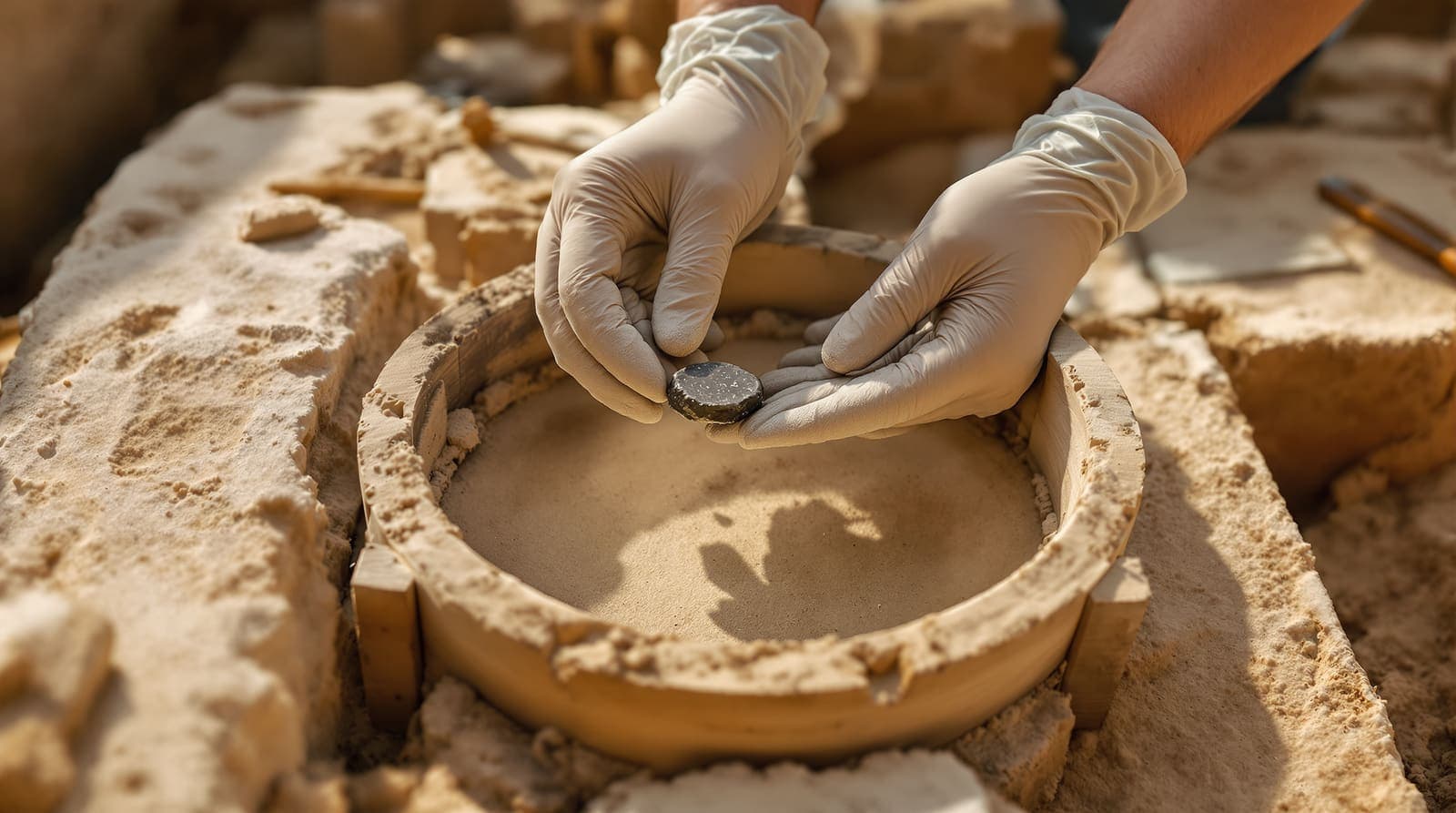
Archaeologists in Jerusalem have uncovered an Assyrian inscription dating to the First Temple period, the first of its kind found in the city, according to the excavation team. The piece is a fragment of pottery just 2.5 centimetres across, found next to the Western Wall, bearing writing in cuneiform script in Akkadian, the language of the Assyrian Empire, and dated to roughly 2,700 years ago.
The excavation was led by Dr Ayala Zilberstein of the Israel Antiquities Authority, in collaboration with the City of David Foundation and with support from the Hebrew University of Jerusalem and Tel Aviv University. “I was sifting through the dirt and suddenly noticed a sherd with a strange decoration,” said the archaeologist who found it, Moriah Cohen. “Examining it closely, it looked to me to be cuneiform, but that seemed totally unreasonable. I screamed out of excitement.”
A tax demand, not a monument
Analysis indicates the fragment was part of a royal seal, or bulla, used to close an official letter sent from the Assyrian court. “Bullae or sealings of this type bore an impression that was sometimes accompanied by a short inscription in Assyrian cuneiform script noting the dispatch's contents or its destination,” the Assyriologists Dr Peter Zilberg and Dr Filip Vukosavović said. “These differ in size and shape from the local Judahite impressions.”
The inscription appears to concern a delay in the payment of tribute or another obligation to Assyria. It specifies a due date corresponding to the first of the month of Av and refers to a senior chariot officer responsible for carrying messages on behalf of the royal court. The text does not name the king of Judah. Researchers suggest it was sent to the court of Hezekiah, Manasseh, or early in Josiah's reign, a period during which Judah was a vassal state of Assyria.
What tribute meant for a vassal kingdom
Assyrian rule over the small kingdoms of the Levant ran on payment. The biblical account in II Kings describes Sennacherib forcing Judah into vassalage and demanding 300 talents of silver and 30 talents of gold, as The Times of Israel noted in its report on the find, which places the sherd between the late eighth and mid-seventh centuries BCE. A late payment was not an accounting matter but a political signal, which is why the researchers were careful about how far they would push the interpretation. “While we cannot determine whether this demand stemmed from a mere technical delay or a deliberate political move, the very existence of such an official appeal points to friction between Judah and the imperial government,” they said. Some scholars are exploring whether the inscription relates to Hezekiah's rebellion against Sennacherib.
The clay came from Mesopotamia
Petrographic analysis showed the sherd was not made locally. “The bulla's mineral composition generally corresponds to the geology of the Tigris Basin region. A chemical analysis is underway to precisely determine its provenance,” said Dr Anat Cohen-Weinberger of the Israel Antiquities Authority. That points to production in one of the Assyrian administrative centres (Nineveh, Ashur or Nimrud) and means the object travelled to Jerusalem attached to a document, rather than being made by a local scribe imitating an imperial hand.
The City of David Foundation, a partner in the excavation, says the fragment was recovered through wet sifting of excavated soil at Emek Tzurim National Park, a process run jointly with the Israel Nature and Parks Authority in which visitors help wash and sort material from digs, which is how an object 2.5 centimetres wide gets noticed at all. The Media Line reported that the sherd came out of soil associated with a collapsed First Temple period building on Jerusalem's Western Hill.
What has not been established
The chemical analysis to pin down where the clay came from was still under way when the find was announced. The text does not name the Judean king it was addressed to, so the attribution to Hezekiah, Manasseh or Josiah is a range rather than an identification, and the connection to Hezekiah's rebellion remains a line of inquiry rather than a finding. The announcement did not give the excavation's start date or say how much of the seal impression survives beyond the inscribed fragment.
Sources and further reading
Every link below was opened and checked when this page was written. Official statements are marked as such: they are the subject's own account, not an independent one.
- OfficialCity of David Foundationcityofdavid.org.ilRare Ancient Assyrian Inscription Found
Excavation partner's account, including how the fragment was recovered by wet sifting
- ReportingThe Times of Israeltimesofisrael.comBiblical tax notice: 1st-ever Assyrian inscription found near Jerusalem's Temple Mount
Independent account of the find, its dating and the biblical tribute context
- ReportingThe Media Linethemedialine.orgAssyrian Inscription Near Western Wall Points to Judah's Tax Trouble
Findspot detail and independent confirmation of the reading of the inscription
How we checked this
The description of the object, the researchers named and all quotations are from the excavation announcement of 22 October 2025 as supplied; the find, its dimensions, its dating and the petrographic result were confirmed against Times of Israel and Media Line reporting and the City of David Foundation, a partner in the dig. The identification of the Judean king remains open in the source material.
Our sourcing and corrections policy →The week from Israel, in one email
The stories that mattered, sourced and checked by the Israel.com newsroom. Free, weekly, one-click unsubscribe.
One list, unsubscribe in a click. See our privacy policy.
More in Economy
All economy →

Latest
- IDF says Khan Younis strike killed Nukhba operative tied to Steinberg's death
- Yair Golan sues Sara Netanyahu for millions over Channel 14 remarks
- Ariel man, 53, found alive after entering Palestinian village overnight
- Houthi forces reported streaming into Yemen's port city of Mocha
- Israel says three Hamas weapons depots destroyed in strikes across Gaza
- Advisers warned Trump the Iran war could outlast his presidency