Arbe's New Radar Aims to See Through Dust on Mines and Farms
The Tel Aviv company says its 4D imaging radar keeps working in the dust, fog and darkness that defeat conventional sensors on diggers, harvesters and haul trucks.
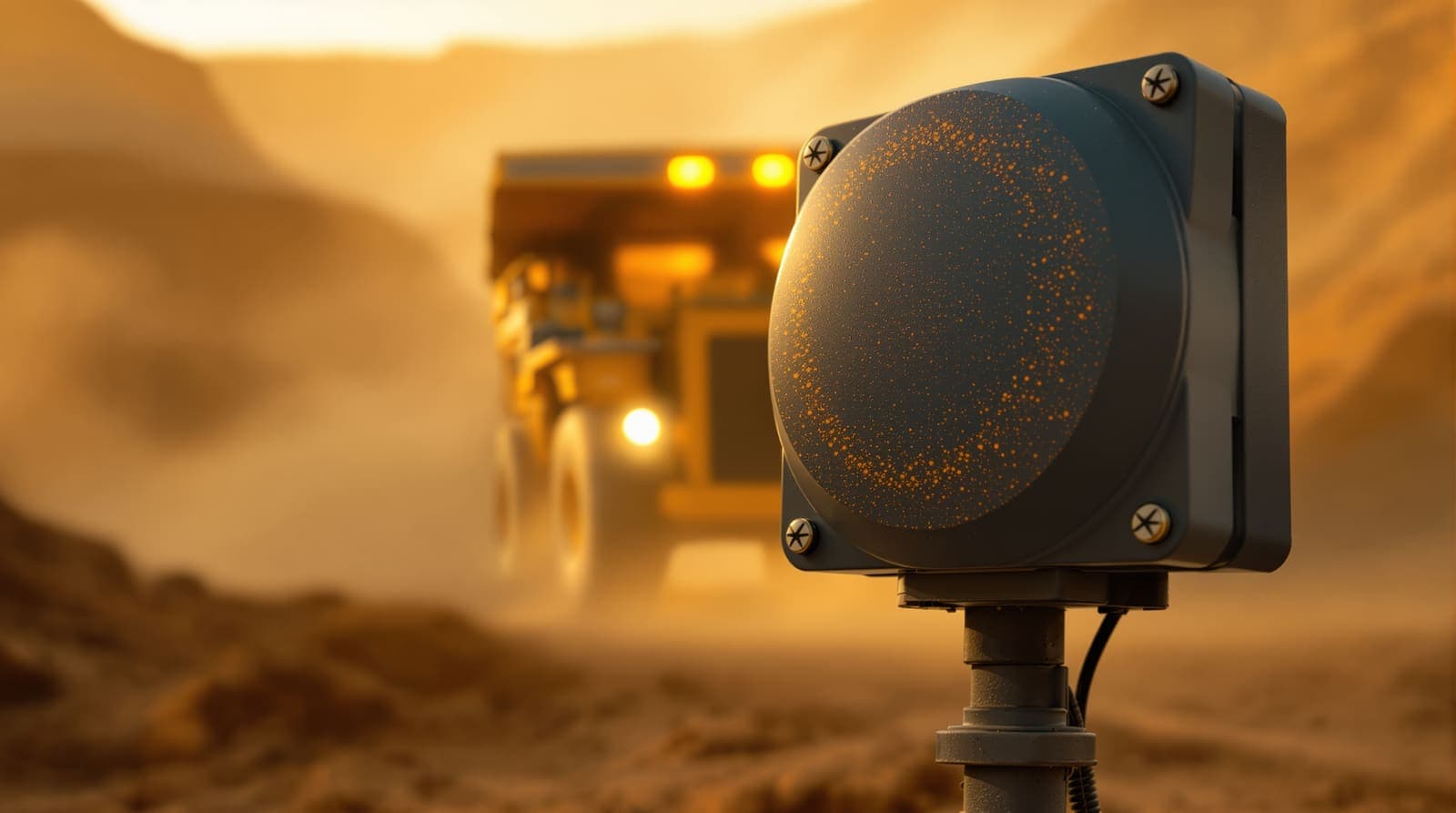
Illustration
Arbe Robotics has introduced a high-definition 4D imaging radar built for off-highway machinery (the diggers, harvesters and haul trucks used in agriculture, mining and construction), the company announced on 9 March 2026.
The Tel Aviv-based firm said the radar is designed to hold up in conditions that defeat conventional sensors: dust, fog, darkness and rough terrain. It is intended to support autonomous operation by improving object detection, collision avoidance and situational awareness. Arbe said the system delivers ultra-high resolution, wide field-of-view coverage and real-time processing, and can track moving objects even where satellite positioning signals are weak. "Advanced high-definition radar is becoming a foundational sensing technology across multiple industries," chief executive Kobi Marenko said.
What "4D" means in a radar spec sheet
A conventional imaging radar builds a two-dimensional picture from range and azimuth. A 4D imaging radar, as the technical literature defines it, adds the third spatial coordinate and then velocity from Doppler analysis, using multiple antenna arrays to detect, map and track many static and moving targets at once. The same reference notes the property that matters on a building site: radar does not need a clear optical line of sight, so it keeps working in darkness, smoke, steam, glare and bad weather, where cameras and lidar depend on light that dust and fog scatter.
Arbe describes its product line on its own website as 4D imaging radar technology spanning a chipset, a Phoenix HD radar unit and AI-based processing, aimed at driver assistance and autonomous driving. On its investor relations pages, the company says it was founded in 2015, gives its address as HaHashmonaim Street 107 in Tel Aviv, and claims its imaging radar offers "an order of magnitude higher resolution than any other competing radar solution in the market". The solution is described there as three parts: a radio-frequency chipset with a large channel array, a dedicated radar processor chip, and AI-based post-processing. The company trades under the ticker ARBE.
Why heavy machinery is a separate market from cars
Autonomy in the off-highway world has different physics from autonomy on a motorway. Machines work at low speed in confined spaces where a person can appear a metre from a blade, so the sensing problem is less about seeing 200 metres down a carriageway and more about resolving a nearby object precisely enough to stop. The environment is also filthy by design: quarries and ploughed fields throw up airborne particles continuously rather than occasionally. Arbe's own materials list heavy machinery, all-terrain vehicles and industrial uses alongside automotive applications, which is consistent with a company extending an automotive sensor into adjacent markets.
What the announcement did not say
Arbe did not name a customer, an equipment manufacturer partner or a deployment. It gave no price, no production timetable and no numerical specifications for the resolution or field of view it described as ultra-high and wide. Nor did the statement say whether the off-highway radar is the same hardware as the company's automotive product or a distinct variant, or how it is expected to be priced against lidar for the same machines.
Sources and further reading
Every link below was opened and checked when this page was written. Official statements are marked as such: they are the subject's own account, not an independent one.
- OfficialArbe Roboticsarberobotics.comArbe: 4D Imaging Radar Technology
Company's own description of its radar product line and target applications
- OfficialArbe Roboticsir.arberobotics.comArbe Robotics Ltd. investor relations
Founding year, Tel Aviv address, ticker and the company's resolution claim
- ReferenceWikipediaen.wikipedia.orgImaging radar
Definition of 4D imaging radar and why radar outperforms cameras and lidar in poor visibility
How we checked this
The product description and the chief executive's quote are taken from the company announcement of 9 March 2026 in the original release. The corporate details (founding year, Tel Aviv address, ticker and resolution claim) were checked against Arbe's own website and investor relations pages, and the explanation of 4D imaging radar against technical reference material.
The account of the incident itself rests on the official statement and has not been independently confirmed by Israel.com. Where the statement is silent, this page says so rather than filling the gap.
Our sourcing and corrections policy →The week from Israel, in one email
The stories that mattered, sourced and checked by the Israel.com newsroom. Free, weekly, one-click unsubscribe.
One list, unsubscribe in a click. See our privacy policy.
More in Israel
All israel →
Latest
- IDF says Khan Younis strike killed Nukhba operative tied to Steinberg's death
- Yair Golan sues Sara Netanyahu for millions over Channel 14 remarks
- Ariel man, 53, found alive after entering Palestinian village overnight
- Houthi forces reported streaming into Yemen's port city of Mocha
- Israel says three Hamas weapons depots destroyed in strikes across Gaza
- Advisers warned Trump the Iran war could outlast his presidency