
By Shalhevet Eyal • April 14, 2026
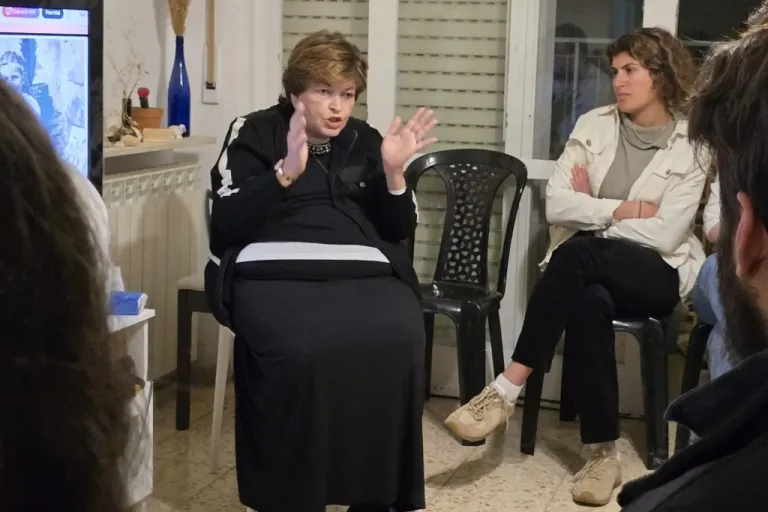
Jerusalem, 14 April, 2026 (TPS-IL) — In a quiet Jerusalem living room, as Israel marked Holocaust Remembrance Day on Monday night, about 30 young adults sat shoulder to shoulder, listening as Esther Zicherman recounted a story that is both deeply personal and part of a fading collective memory. As the generation of survivors disappears, a unique Israeli phenomenon has emerged: children of survivors sharing family stories in private homes.
Esther, 71, a retired Jerusalem resident and mother of nine, spoke with poise and confidence — this was only the second time she had publicly shared her family’s history. Her parents, both Holocaust Survivors from Hungary, rebuilt their lives after the war, carrying with them loss that was rarely spoken aloud but always present.
Esther’s father, Eliezer Davidovich, worked in a forced labor battalion and later in the Russian army. His first wife and seven children were murdered while he was away. Meanwhile, Pearl survived in hiding and imprisonment. Pearl’s family became separated during the war — years later, she reunited with her mother and other relatives in Israel. Esther’s parents met shortly after the war when they briefly returned to Sopron, their hometown in northwestern Hungary. Six million Jews were killed by the Nazis and their allies, and survivors were picking up the pieces of their shattered lives.

Traffic comes to a standstill on a Tel Aviv highway as a siren sounds a two-minute moment of silence commemorating the six million Jews killed by the Nazis and their allies on Holocaust Remembrance Day on April 14, 2026. Photo by Gideon Markowicz/TPS-IL
Despite that history, Esther remembers a childhood that felt, in many ways, ordinary. The Holocaust was not hidden, but neither did it dominate daily life. “There was no heavy silence,” she explained. “The subject was also brought up, but occasionally.”
Still, its emotional weight surfaced in quiet moments. “I do remember, let’s say, my father… about his children, so it was like tears were glistening in his eyes. I never saw him really cry.”
The most powerful moment of the evening came when Esther read aloud a letter her father had written one year after the war to dead wife. Eliezer apologized for not being able to be with her and help raise their children. As she read, the room shifted. Some listeners wiped away tears. Others stared ahead, eyes wide, absorbing the unimaginable. A few quietly sobbed. The document has been passed down through the family.
“It’s a very, very moving letter,” Esther said earlier, explaining how it has become a ritual within her family. “We read it every Yom HaShoah,” referring to Holocaust Remembrance Day.
‘Most of the Things I Found Out Later’
For years, she never considered speaking publicly. “I never thought about it,” she said when asked about a sense of responsibility. It was her son who first urged her to share the story.
“At first, I refused,” she said. “But he said to me, what do you care? Come tell it.”
What began as a reluctant agreement has taken on greater meaning as the generation of survivors dwindles. Much of what she knows about her father, she only discovered after his death.
“He didn’t talk that much,” she said. “He certainly didn’t brag about what he did. Most of the things I found out later.”
Those discoveries included his efforts to smuggle Jews out of postwar Hungary and his refusal to accept compensation for his losses. “He said, what do they think, that they will buy me with money?” she recalled.
Her father also feared something else: that the world might one day deny what happened. After the war, he obtained official documents proving the existence of his murdered children.
“He said there will come a day when people… will say they didn’t exist,” Zicherman recounted. “So I want to have their certificates in hand.”
That instinct — to preserve, to document, to bear witness — now passes to the next generations.
Asked whether this year’s Holocaust Remembrance Day felt different from previous years, Esther said she did not experience it as a shift in tone so much as a continuation of a long-held, uneasy perspective on memory and history.
“What message could there be?” she said. She explained that she is often asked whether she believes another Holocaust could happen, and answered that her view has not changed over time. Recalling the morning of October 7, 2023, when Hamas attacked Israel, Esther said she was at home with her daughters when the sirens began and confusion filled the country. In that moment, she said, her daughter asked her whether another Holocaust was possible.
“I told her, of course, I have no doubt that there could be another Holocaust,” she said, adding that she does not believe even the existence of the State of Israel can fully prevent such an outcome. At the same time, she stressed the importance of remembrance and testimony. “It is important that they know, that they don’t forget, that the story won’t be erased,” she said, though she added that she does not place faith in humanity’s ability to prevent repetition, or in what she called “the goodness of the Gentiles.”
Esther herself finds Holocaust Remembrance Day emotionally overwhelming. “I don’t have the mental strength,” she admitted. “I try not to hear.”
Yet by speaking that night, she did the opposite — ensuring that others would hear.