
By Pesach Benson • May 4, 2026
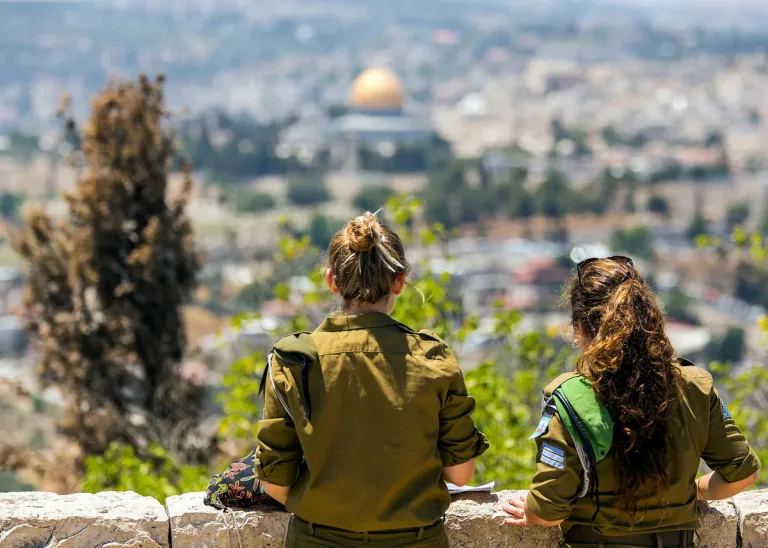
Jerusalem, 4 May, 2026 (TPS-IL) — Among Israeli wounded veterans, a growing group of female soldiers is finding strength in shared trauma and connection following one of the deadliest days of the war.
A new initiative called Project Neshek brought eight wounded women soldiers to New York for a week-long break aimed at rebuilding emotional resilience and peer support.
Female soldiers often carry what organizers describe as a “silent burden” within Israel’s wounded veterans community, said Rabbi Uriel Vigler and his wife, Shevy Vigler, founders of Belev Echad. The New York-based nonprofit supports Israeli soldiers wounded in action through respite programs, rehabilitation, and emotional assistance. Project Neshek operates under its umbrella.
“We wanted to give them a place where they don’t have to explain their pain, but can simply be seen and supported,” the Viglers said. “Their resilience is the heartbeat of our organization.”
As part of the program, participants were flown to New York for a break from the intensity of war and recovery. Organizers said the goal was not escape, but perspective—allowing survivors to process trauma in a supportive environment.
“We came here to breathe,” the participants said. “We are not alone anymore.”
Among the participants was Shai Bachar, who survived the October 7 Hamas-led attacks at the Nahal Oz base near the Gaza border, where she served as an army social worker attached to the Israel Defense Forces (IDF) Golani Brigade.
She described the early morning hours as a sudden transition into a life-threatening situation, during which she helped coordinate communications while sheltering under fire.
“At 6:25 a.m., we woke up to explosions,” Bachar recalled. “About 20 of us, mostly headquarters staff in pajamas, hid in an open-ended shelter. There were holes in the walls; we could see them, but they couldn’t see us.”
As the situation unfolded, Bachar said survivors were forced to assist the wounded while still under threat. Over the course of approximately 11 hours, she relayed information to commanders while hearing fighting outside. She said she lost 46 friends that day.
“I saw evil incarnate. I smelled the fire,” she said. “We stayed alive, but something inside us changed forever.”
Another participant, Adi Na’imi, described hiding under a desk with a technician for about 12 hours, armed only with kitchen knives, while hearing the violence outside at the Kissufim base.
“We heard shouting in Arabic right outside the window,” she said. “We just held those knives, hoping they would protect us from the worst.” The two were eventually rescued by soldiers.
For the participants, the trip was not presented as tourism but as a form of collective recovery. Many said they found understanding among others who had experienced similar events.
“In this week, we don’t try to be strong all the time,” the group said. “We allow space for difficulty, but also for laughter. We get to know each other at a depth that doesn’t require many words.”
The goal of Project Neshek, organizers said, is not to distance participants from reality, but to help them Return to it with additional emotional support. Through the creation of a shared community of survivors, Belev Echad aims to ensure that wounded female soldiers do not carry their experiences alone.
“I thank God every day for the gift of life,” Bachar said. “And I think of my friends who are no longer here. There isn’t an hour that goes by without remembering them. They deserved a post-army trip too.”