
By TPS-IL • May 24, 2026
Jerusalem, 24 May, 2026 (TPS-IL) — A Facebook group created by descendants of Holocaust survivors who were detained by British authorities in Cyprus after World War II has evolved into an unexpected archive of collective memory, helping reconstruct family histories that in many cases were nearly lost, according to a new study at Ben-Gurion University.
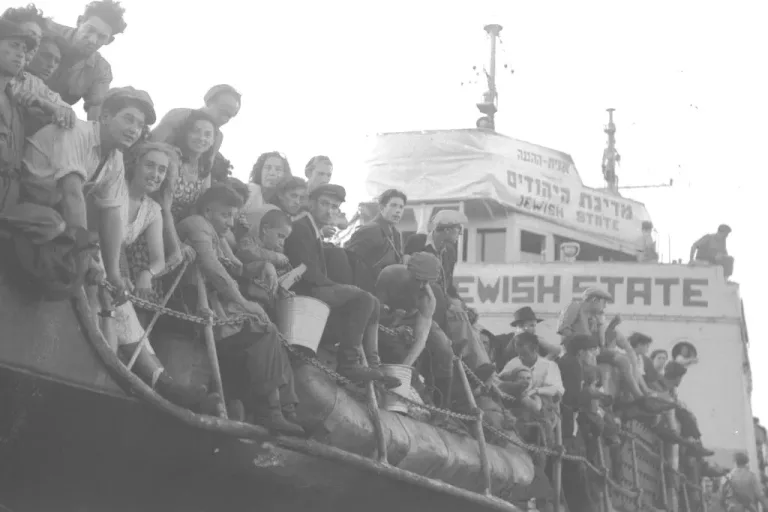
The research, conducted by Dr. Ayelet Klein-Cohen and published in the peer-reviewed journal *Memory, Mind and Media*, examines how descendants of survivors use social media to preserve family stories, documents, and photographs connected to the Cyprus detention camps. These camps, operated by British authorities in the British Mandate of Palestine context, held tens of thousands of Jewish refugees between 1946 and 1949 as they attempted to reach Mandatory Palestine.
Klein-Cohen said the Facebook community demonstrates how digital platforms can help descendants recover fragmented family histories.
“If this causes a group of people anywhere in the world to feel that they too want to explore the history of the past for themselves, then the power of this study is that it may inspire someone to do the same thing in another context,” she said.
She explained that participants in the group have gained a deeper understanding of their personal and family narratives.
“In essence, the study speaks about the way in which descendants of Holocaust survivors seek less familiar stories in order to develop a deeper understanding of themselves and of family stories connected to Cyprus,” she told TPS-IL. “At the same time, it points to the ability of social networks to allow less familiar narratives to surface and become part of public discourse, especially stories connected to traumatic events, the search for personal identity, and the process of dealing with intergenerational trauma.”
According to the research, the online group functions as a collaborative space where descendants share testimonies, search for relatives, and piece together fragments of stories that often remained untold within families for decades.
Klein-Cohen analyzed 687 posts and comments published by group members during 2022. She emphasized that the study was qualitative and not intended to provide statistical representation of all descendants of Cyprus camp survivors.
“For me, what makes this community especially unique is the fact that there is no formal body behind it and no official institution,” she said. “There is no archive behind it. Yet people still gather around it and share stories and memories with one another.”
Asked about the relationship between historical fact and memory, Klein-Cohen said it is an inherent tension in historical research.
“The moment something happens, it is over, and memory takes over, for better and worse. That is the eternal tension between memory and history,” she explained.
The Cyprus detention camps were established by the British in August 1946 in an effort to restrict Jewish immigration to Mandatory Palestine under British policy at the time. More than 50,000 Jewish refugees, many of them Holocaust survivors, passed through the camps before the establishment of the State of Israel. An estimated 80 percent were between the ages of 13 and 35. Conditions included overcrowding, poor sanitation, and a lack of privacy.
Despite their historical significance in the broader story of postwar Jewish migration and the founding of Israel, Klein-Cohen said the Cyprus camps have received relatively limited public attention compared to other Holocaust and post-Holocaust narratives.
Historian Nahum Bogner, who has extensively researched the Cyprus story, told the researchers that “the case of the Cyprus deportation was omitted as if it were by an invisible hand” and that “in what was published, a clear priority was given to the heroic episodes at sea,” referring to attempts at illegal immigration to Mandatory Palestine.
According to Klein-Cohen, descendants participating in the group are not simply sharing nostalgia but actively reconstructing fragmented family histories across generations.
One post cited in the study was written by a woman identified only as Maya, who said her grandparents were detained in Cyprus after being released from the Bergen-Belsen concentration camp.
“In my family, as in many others, they rarely spoke about the difficult and painful chapters of life that preceded their new beginning in Israel. Like many others of the second and third generations, I was left with very little information about my family’s past, with many questions, and with a desire, or even a need, to discover more,” the post stated.
Klein-Cohen said such testimonies illustrate how digital communities are filling gaps left by silence in many survivor families.
She described the online space as “a dynamic public sphere through a Facebook group,” where descendants collectively preserve and reinterpret memory.
The study also highlights a broader shift in how Holocaust memory is transmitted across generations.
While traditional commemoration has often centered on museums, ceremonies, and formal archives, Klein-Cohen said digital platforms increasingly allow descendants to shape memory from below through personal testimony and collective participation.