
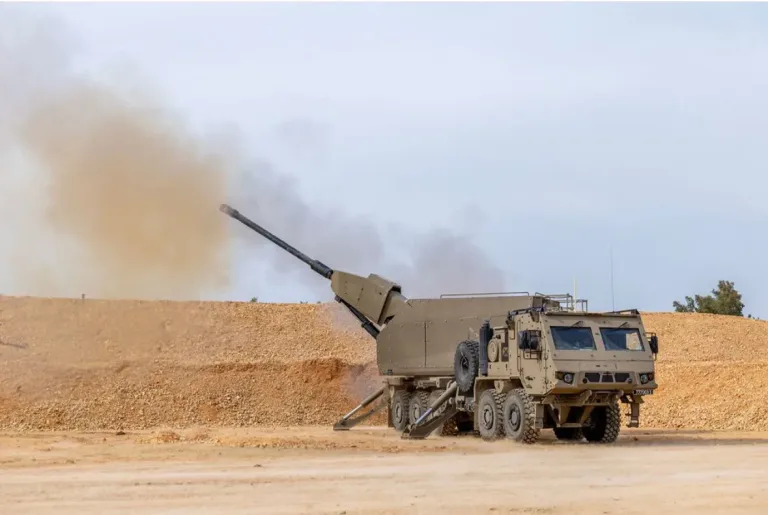
For the first time since joining the IDF and the Artillery Corps, the ‘Ro’em’ cannon has conducted operational fire: Forces of the 282nd Fire Brigade of the Artillery Corps recently operated the new system in support of maneuvering forces in the north, and used it to attack Hezbollah targets from which fire was directed at our forces.
This is a significant milestone for the corps – not only because of the first operational use, but also because of what it represents: the transition to the first automatic cannon of its kind in the IDF after decades, embodying a conceptual change in how artillery fire is employed on the battlefield.
“The ‘Ro’em’ brings with it many new capabilities compared to the existing cannon,” explains Lt. Col. B., Head of the ‘Ro’em’ Branch at the Artillery Corps School. “Both mobility, full automation, and the ability to operate as part of a maneuver deep in enemy territory. It fires further and more accurately, making it a real breakthrough.”
The firing, which was conducted for the first time against several Hamas and Anti-Tank missile targets of Hezbollah that posed a threat to the forces, was defined as an operational success, contributed to the removal of a threat to the forces, and even served as a basis for developing new responses in the field of artillery fire – during combat.
Behind the scenes, this is a weapon that also changes the appearance of the battery in the field. The cannon is mounted on a heavy truck capable of moving independently, without a tractor – allowing for faster transitions between positions and locations. “It’s a big truck, but a smarter one,” describes Lt. Col. B. “Much of the work that was previously manual is now done automatically.”
The operational significance is felt mainly in speed and accuracy: the ‘Ro’em’ is capable of firing at a significantly higher rate than existing systems, at longer ranges – and can even perform fire with multiple trajectories so that different shells hit the target simultaneously. In addition, the response time is reduced to less than a minute, and operating the weapon requires only three crew members – compared to eight in previous cannons.

“This is a historic event,” states the Artillery Officer. “Imagine this moment – after 50 years, we are replacing, or rather upgrading, a cannon in the corps. In reality, this translates to one thing – more fire in less time, less exposure and danger to forces in the field.”
And precisely in light of the impressive success of the new cannon, he emphasizes that the integration of the ‘Ro’em’ into combat is done through continuous learning from the battlefield, and that the firing conducted in the north is not just an operational achievement – but also another step in the assimilation of the system and its adaptation to the various operational methods in the changing combat environment.
Concurrently, with the clear objective for the future, the army is already looking ahead: the new cannon is expected to gradually enter wider use, through the conversion of the ‘Doher’ battalions in regular and reserve service. “Ultimately, we are working to integrate the new capabilities into all fire units in the corps, all to adapt them not only to today’s battlefield, but also to the future one.”

And alongside all the technology, one cannot fail to mention at such a moment those who are behind the tools – the fighters themselves. “We must not forget one thing: in the end, it is not the cannon that wins – but the person. There are fighters here who have been operating these tools for over two and a half years of continuous combat, and although the ‘Ro’em’ gives them additional capabilities, they are the ones who make the big difference.”