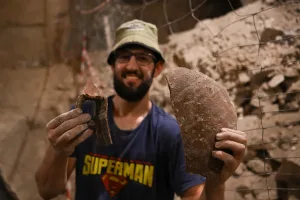

Israeli Archaeologists Launch Project to Trace Origins of Ancient Pottery
Israeli archaeologists launch a project with cutting-edge science to trace the origins of thousands of ancient pottery vessels across Israel, creating a.



Israeli archaeologists launch a project with cutting-edge science to trace the origins of thousands of ancient pottery vessels across Israel, creating a.
Discover how 160-million-year-old feathers are forcing a rethink of flight's origins. Israeli scientists at Tel Aviv University reveal dinosaurs may have flown.
By Pesach Benson • December 16, 2025
Jerusalem, 16 December, 2025 (TPS-IL) — A rare set of 160-million-year-old dinosaur fossils is reshaping scientists’ understanding of how flight evolved among dinosaurs and birds, offering the first direct behavioral evidence that some feathered dinosaurs may have developed early flight capabilities — and then lost them later in their evolutionary history.
The discovery comes from a new study led by Dr. Yosef Kiat of the School of Zoology and the Steinhardt Museum of Natural History at Tel Aviv University, in collaboration with researchers from China and the United States. Published in the peer-reviewed journal Communications Biology, the research introduces a novel approach to studying flight evolution by examining molting patterns preserved in fossilized feathers — something that had never before been documented in non-avian dinosaurs.
“This finding has broad significance, as it suggests that the development of flight throughout the evolution of dinosaurs and birds was far more complex than previously believed,” the research team said. “In fact, certain species may have developed basic flight abilities — and then lost them later in their evolution.”
Until now, scientists have largely inferred flight capability in feathered dinosaurs from skeletal features such as wing length, bone structure, and muscle attachment points. While informative, those clues provide only indirect evidence. The new study goes further, offering functional insight into how these animals actually lived.
The researchers examined nine fossils from eastern China belonging to Anchiornis, a small feathered dinosaur from the Pennaraptora group — the lineage that includes the distant ancestors of modern birds and the only group of dinosaurs known to have survived the mass extinction 66 million years ago. The fossils are exceptionally rare because they preserved feathers with their original coloration intact, including white wing feathers marked by a distinct black spot at the tip.
Dr. Kiat, an ornithologist specializing in feather research, said this preservation allowed the team to analyze molting — the process by which feathers are shed and replaced — and use it as a diagnostic tool for flight ability. “Feathers grow for two to three weeks,” he explained. “Reaching their final size, they detach from the blood vessels that fed them during growth and become dead material. Worn over time, they are shed and replaced by new feathers — in a process called molting.”
In modern birds, molting follows different patterns depending on whether the animal relies on flight.
“Birds that depend on flight molt in an orderly, gradual process that maintains symmetry between the wings and allows them to keep flying,” Kiat explained. “In birds without flight ability, on the other hand, molting is more random and irregular. Consequently, the molting pattern tells us whether a certain winged creature was capable of flight.”
The preserved feather coloration in the Anchiornis fossils enabled researchers to distinguish fully grown feathers from new ones still in development, identified by black spots that had not yet aligned with the continuous black edge of the wing. When the team analyzed these growth patterns across all nine fossils, they found that feather replacement occurred irregularly rather than in a coordinated, symmetrical sequence.
“Based on my familiarity with modern birds, I identified a molting pattern indicating that these dinosaurs were probably flightless,” Kiat said. “This is a rare and especially exciting finding. The preserved coloration of the feathers gave us a unique opportunity to identify a functional trait of these ancient creatures — not only the body structure preserved in fossils of skeletons and bones.”
The findings challenge a long-standing assumption that flight evolution followed a straightforward, linear path. “The dinosaur lineage split from other reptiles 240 million years ago,” Kiat noted. “Soon afterwards, many dinosaurs developed feathers — a unique lightweight and strong organic structure, used mainly for flight and for preserving body temperature.” However, he added, environmental pressures may have reversed that trajectory in some cases, much as they have in modern flightless birds such as ostriches and penguins.
“Feather molting seems like a small technical detail — but when examined in fossils, it can change everything we thought about the origins of flight,” Kiat said. “Anchiornis now joins the list of dinosaurs that were covered in feathers but not capable of flight, highlighting how complex and diverse wing evolution truly was.”
Iranian-linked attack group MuddyWater launches large-scale phishing campaign targeting Israeli organizations with a new attack tool, BlackBeard, compromising
In recent weeks, the Israel National Cyber Directorate (INCD) has identified a large-scale phishing campaign targeting organizations, employing a method that appears highly credible to recipients. The systematic attack attempts are attributed to the Iranian-linked attack group MuddyWater. A special report on the campaign was released today and will be presented during Cyber Week (CyberWeek) at Tel Aviv University.
As part of the attacks, threat actors breach legitimate organizational email accounts and use them to distribute phishing emails that appear authentic – featuring proper Hebrew, content tailored to the organization’s field of activity, and attachments with relevant filenames. The emails include a malicious Word document, and once the user clicks “Enable Content,” the malicious tool takes control of the workstation. The messages are customized to match the organization’s environment, including the use of official-looking logos, signatures, and documents.
Upon opening the file, a dedicated attack tool known as BlackBeard is installed on the endpoint. This relatively new malware enables the attacker to gain full control of the system, map the environment, bypass security products, and download additional attack components as needed. From the moment of infection, the compromised user’s email account is leveraged to further propagate the attack both inside and outside the organization, reaching thousands of recipients. The malware employs stealthy persistence techniques that allow it to remain active without appearing in locations commonly monitored by security tools. This operational pattern is highly consistent with MuddyWater’s known tactics and has been observed in previous attacks in Israel.
MuddyWater, which operates under Iran’s Ministry of Intelligence, focuses on intelligence collection and establishing long-term footholds within target networks. In recent years, the group has consistently attempted to attack Israeli entities, including government, healthcare, education, and small-to-medium-sized businesses. The group combines self-developed tools with distributed command-and-control infrastructures. Its attack attempts have also been identified in other countries, including Turkey, Afghanistan, Pakistan, the United Arab Emirates, Iraq, the United Kingdom, Azerbaijan, the United States, Egypt, and Nigeria.
The Israel National Cyber Directorate calls on organizations across Israel to exercise heightened vigilance, strictly implement several critical protective measures, and review the published indicators of compromise (IOCs) and recommended mitigation actions.
According to INCD cyber researchers, authors of the report: “The recent attacks once again demonstrate persistent attempts by Iranian actors to infiltrate Israeli networks and establish long-term presence within them. The impersonation, precise language, and legitimate-looking files are all designed to bypass human instinct and lure users into opening the malicious attachment. A single successful intrusion of this kind can rapidly escalate into a widespread attack across entire organizations. This is why the INCD continues to issue updates, warnings, and hands-on guidance to organizations in order to reduce risk and strengthen national cyber resilience.”
Click here for the full report
The global surge in antisemitic incidents triggered by the October 7 Hamas attack is showing signs of easing—but levels remain significantly higher than before the war, according to the *Antisemitism Worldwide Report 2024,” published by Tel Aviv University’s…
Jerusalem, 23 April, 2025 (TPS-IL) — The global surge in antisemitic incidents triggered by the October 7 Hamas attack is showing signs of easing—but levels remain significantly higher than before the war, according to the *Antisemitism Worldwide Report 2024,” published by Tel Aviv University’s Center for the Study of Contemporary European Jewry and the Irwin Cotler Institute for Democracy, Human Rights and Justice.
The comprehensive 160-page report, released ahead of Holocaust Remembrance Day — which begins on Wednesday night — presents data collected by 11 researchers and is widely regarded as the most authoritative annual analysis of antisemitic trends globally. Contrary to widespread belief, the report finds that antisemitic incidents peaked not as the war in Gaza wore on, but in the weeks immediately following October 7, 2023.
“Levels of antisemitism remain significantly higher compared to the period before October 7,” said Prof. Uriya Shavit, the report’s chief editor. “However, contrary to popular belief, the findings indicate that the wave did not steadily intensify with the humanitarian crisis in Gaza. The peak was in October to December 2023. The sad truth is that antisemitism reared its head at the moment when the Jewish state appeared weaker than ever and under existential threat.”
Australia experienced a particularly troubling rise in incidents, with the Executive Council of Australian Jewry reporting 1,713 incidents in 2024, up from 1,200 the previous year. In the immediate aftermath of October 7, Australia saw 827 incidents between October and December 2023—far higher than the 478 recorded during the same period in 2024.
Similar spikes and subsequent declines were recorded in the United States, where New York, the largest Jewish city in the world, logged 344 antisemitic complaints in 2024 compared to 325 in 2023. Between October and December 2023, 159 incidents occurred in New York, dropping to 68 during the same period in 2024.
Canada saw record-high numbers overall, with B’nai Brith documenting 6,219 antisemitic incidents in 2024, up from 5,791 in 2023. But even there, the pattern held: 601 incidents were reported in October 2023, falling to 427 in October 2024.
Italy experienced nearly a doubling in cases, with 877 incidents in 2024, compared to 454 the year before. And while some countries, like France, the UK, and Germany, recorded overall decreases in 2024 compared to 2023, their numbers remained well above pre-2022 levels.
France, for example, recorded 1,570 antisemitic incidents in 2024, down slightly from 1,676 in 2023—but still far higher than the 436 in 2022. Alarmingly, the number of physical assaults on Jews rose from 85 to 106.
A sobering section of the report highlights the lack of follow-through by law enforcement in countries like the United States, Canada, and the United Kingdom. A study by researcher Avi Teich found that in some cases, fewer than 10% of antisemitic hate crime complaints led to arrests.
“There are unique difficulties in identifying perpetrators of hate crimes,” said Dr. Carl Yonker, Senior Researcher and Academic Director of the Cotler Institute. “Nevertheless, much more can be done if the will exists. Education and legislation without enforcement are meaningless. The fight against antisemitism requires dedicated efforts from police forces and prosecutors, not pompous statements and grotesque award ceremonies with Hollywood stars.”
The report also includes first-person accounts of antisemitic attacks under a project titled “It Happened One Day,” showcasing the lasting emotional impact of incidents often dismissed as “minor.” Project editor Noah Abrahams said, “We wanted to show the heavy emotional toll of these experiences. Even throwing eggs can violate a person’s sense of security and dignity.”
One study in the report analyzes a novel written by Hamas leader Yahya Sinwar while in Israeli prison, “The Thorn and the Carnation,” describing it as steeped in religiously motivated antisemitism and a rejection of peace.
Irwin Cotler, the former Canadian Justice Minister and global leader in combating antisemitism, warned that authoritarian regimes are exploiting antisemitism as a tool of statecraft. “Russia, China, and particularly Iran are working collaboratively, incorporating the weaponization of antisemitism into their disinformation campaigns,” he wrote. “These powers contribute to the ‘antisemitic ecosystem,’ now anchored within the axis of authoritarianism.”
In March, controversy erupted after senior European Jewish leaders boycotted a Diaspora Affairs Ministry conference in Israel, protesting the inclusion of far-right politicians. Prof. Shavit criticized the ministry’s leadership and called for clear standards for engagement with parties with antisemitic histories. “We propose two criteria for legitimization,” he said. “Leaders must expel any member who has expressed antisemitic views without retraction and prove their commitment to fighting antisemitism over at least two election cycles.”
A groundbreaking discovery in central Israel is reshaping science's understanding of early human history. For the first time, researchers...
Jerusalem, 11 March, 2025 (TPS-IL) — A groundbreaking discovery in central Israel is reshaping science’s understanding of early human history. For the first time, researchers have uncovered evidence that two distinct human species, previously thought to have lived in isolation, actively interacted with each other. These interactions — spanning technology, daily life, and even burial practices — suggest a rich cultural exchange and social complexity that challenges long-held assumptions about the past.
The findings, published in the peer-reviewed Nature Human Behaviour, reveal the Levant as a crossroads where early human groups not only met but influenced each other’s development.
The research team, led by Prof. Yossi Zaidner of the Hebrew University of Jerusalem, Prof. Israel Hershkovitz of Tel Aviv University, and Dr. Marion Prévost of the Hebrew University, began excavating Tinshemet Cave in central Israel in 2017. Their ongoing work has unearthed several human burials, the first Middle Palaeolithic period burials discovered in over fifty years.
These burials, along with other key archaeological findings, shed light on the nature of Homo sapiens-Neanderthal interactions, which have long been a subject of debate. Were these early human groups rivals, peaceful neighbors, or perhaps even collaborators?
Neanderthals were a robust and stocky species that thrived in cold climates. They had prominent brow ridges, wide noses, and large ribcages, adaptations that helped them survive harsh conditions. Neanderthals were skilled toolmakers and evidence suggests they had complex social structures, cared for the elderly and injured, and possibly engaged in symbolic practices. However, their cognitive abilities were generally considered less advanced than those of Homo sapiens. Neanderthals went extinct around 40,000 years ago, likely due to a combination of climate change, competition with early humans, and interbreeding.
In contrast, homo sapiens, developed more advanced cognitive skills, including abstract thinking and complex language, and were taller and more slender than the Neanderthals. Homo sapiens created a broader range of specialized tools, including art, sculptures, and other symbolic objects, marking significant cultural and technological advancements. They organized in larger and more complex social groups, adapted to diverse environments, and spread across the globe.
According to Zaidner, the research suggests a much more nuanced view of the relationships between Neanderthals and homo sapiens.
“Our data show that human connections and population interactions have been fundamental in driving cultural and technological innovations throughout history,” said Zaidner. By examining four key aspects — stone tool production, hunting strategies, symbolic behavior, and social complexity — the study argued that the interactions between Neanderthals, Homo sapiens, and other human populations were rich and varied. This exchange of knowledge likely led to cultural homogenization across different groups, fostering greater social complexity and behavioral innovation.
One of the most striking findings at Tinshemet Cave is the appearance of formal burial practices, the researchers said. These customs, which first began to appear around 110,000 years ago in the Levant, are seen as one of the earliest signs of social complexity.
“The use of ochre for body decoration, likely to signify social identities, and the presence of burial practices point to shared cultural rituals,” Prévost explained. The extensive use of mineral pigments, especially ochre, may have been used for body painting or decoration, potentially to define group identities or signify social distinctions.
Additionally, the human burials at Tinshemet Cave are clustered in a way that suggests the site may have functioned as a burial ground or even a cemetery. The presence of stone tools, animal bones, and ochre within the burial pits hints at early beliefs in the afterlife, further indicating the cultural significance of these rituals. “This research highlights the role of human connections in shaping the trajectory of early societies,” Zaidner said.
The region’s geographic position at the crossroads of human dispersals played a key role in facilitating these interactions. Prévost noted that climatic improvements during the Middle Palaeolithic period led to a more hospitable environment, increasing the region’s carrying capacity. This, in turn, spurred demographic expansion and greater contact between Homo sapiens, Neanderthals, and other human groups.
“These findings paint a picture of dynamic interactions shaped by both cooperation and competition,” said Hershkovitz.