
By Pesach Benson • August 24, 2026
Jerusalem, 24 August, 2026 (TPS-IL) — The October Council, a group of relatives of victims of the October 7, 2023, Hamas-led attack, warned Monday that Israel risks repeating the conditions that preceded the assault by relying on a policy of containing Hamas rather than dismantling the terror group.
In a report based on testimony from active-duty and reserve soldiers, military lookouts, security officials and residents of communities near the Gaza border, the Council identified seven warning signs it said could return Israel to what it described as the “mindset of October 6,” referring to the assumptions about Hamas that prevailed before the attack.
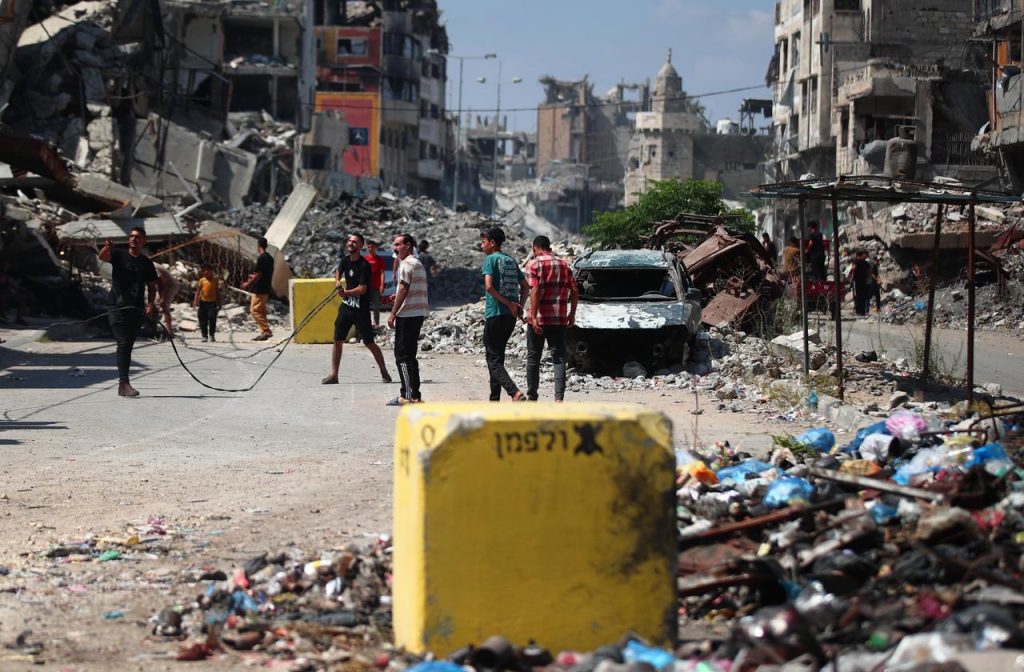
Palestinian walk past a concrete block marking Gaza’s Yellow Line along Salah al-Din Street near Gaza City on July 27, 2026. The Yellow Line imarks the boundary of Israeli Military withdrawal areas under ceasefire arrangements. Photo by TPS-IL
The report argues that while Hamas has been severely weakened by Israel’s military campaign in Gaza, it “has not been disarmed and continues to recruit, manufacture, rebuild and reestablish governing mechanisms.”
Around 1,200 people were killed, and 252 Israelis and foreign nationals were taken captive by Hamas during the October 7, 2023, attack on southern Israel. Most were freed in a series of exchanges with Hamas as part of a ceasefire.
According to the Council, Israel has replaced its prewar assumption that Hamas was deterred and focused on governance with a similar strategy of managing the threat. The report cites mechanisms such as the Yellow Line, which marks the current boundary of Israeli military withdrawal in Gaza, and international plans for the Strip’s future as examples of this approach.
Testimonies from military personnel cited in the report describe Hamas operatives repeatedly approaching or crossing the Yellow Line, gathering intelligence and testing Israeli responses.
One reserve officer serving in Gaza said operational restrictions were preventing troops from confronting the threat.
“We are just a few meters from the enemy, we see them with our own eyes — and the orders tie our hands,” he said. “Instead of defeating them, we ‘contain’ them. Instead of addressing the root of the problem, we continue to manage the failure.”
Concerns About Military Readiness
The report also raises concerns about manpower along the Gaza border, particularly reductions in reserve forces protecting communities. One soldier described units struggling to fill positions and warned that simultaneous incidents in multiple communities could leave some without adequate protection.
The Council also highlighted concerns among military lookouts, whose warnings about Hamas activity before October 7, the report says, were largely ignored. The report cites relatives of current and former lookouts who described delays in responding to warnings and a culture in which personnel fear speaking out.
“If, even today, those who identify a danger are afraid to speak up, that constitutes a security failure in and of itself,” the report states.
Former senior security officials cited in the report similarly described a reluctance to voice criticism in formal decision-making forums. “People speak much more freely in the corridors than they do in meeting rooms,” one former official said.
The report also questions Israel’s prewar policy toward Qatar, including the transfer of Qatari funds to Gaza and Doha’s hosting of Hamas leaders. It calls for an examination of whether the policy inadvertently helped Hamas strengthen its rule and whether ties between Qatar and figures in the prime minister’s circle influenced decision-making.
One senior security official, identified as N., said Israel’s focus on Iran diverted resources from Gaza. “The decision to concentrate on the Iranian arena wasted billions on projects that were fanciful, while Hamas grew stronger in Gaza,” he said.
The Council stressed that its report is not a substitute for a state commission of inquiry and does not determine criminal or professional responsibility. It renewed its call for an independent commission to examine the political leadership, security establishment and decision-making before and after October 7.