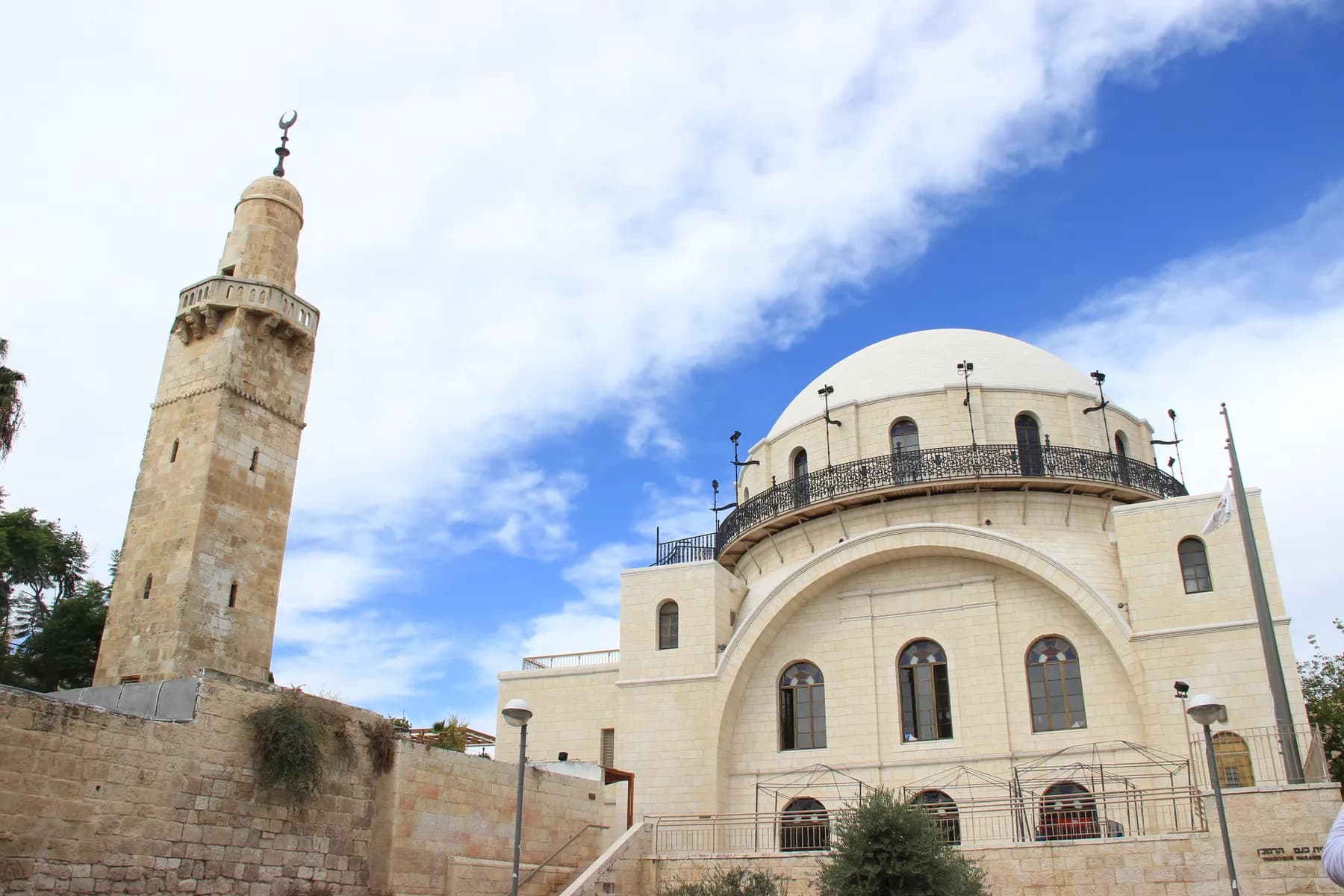
Religious site · The Old City of Jerusalem
Hurva Synagogue
The Jewish Quarter's landmark synagogue was blown up by the Jordanian Arab Legion on 27 May 1948 and rebuilt to its nineteenth-century design, reopening on 15 March 2010 with a walkway round the base of its dome.
Abruth / CC BY-SA 3.0 · Wikimedia Commons
Adult ticket
₪24
Jewish Quarter Development Company price list, read August 2026
Top of the dome
24 m
the height of the 1864 building, reproduced in the rebuild
Destroyed
27 May 1948
in the battle for the Jewish Quarter
Rededicated
15 March 2010
62 years later, after five years of building work
In short
- How long to give it
- about 40 minutes
- Sunday to Thursday
- 09:00-17:00
- Adult
- ₪24
בית הכנסת החורבה
The Hurva is the large white-domed synagogue in the middle of Jerusalem's Jewish Quarter, and the building standing there now was finished in 2010. It is a close copy of the synagogue of 1864 that the Jordanian Arab Legion brought down with explosives on 27 May 1948, put up on the same plot and to much the same dimensions. For most of the 62 years in between, the site held rubble, and from 1977 a single stone arch 16 metres high that stood in for the building nobody could agree how to replace.
The name means the Ruin, and it is older than the destruction most visitors have heard about. A group of about 500 Ashkenazi immigrants who followed Judah heHasid from Poland in the winter of 1700 began building here, ran out of money, borrowed from local lenders and could not repay. In late 1720 the creditors set the synagogue alight, the community's leaders were gaoled, and all Ashkenazim were banished from Jerusalem until the loans lapsed roughly a century later. The plot lay desolate for 116 years and kept the name through every building since.
What a ticket buys is not really the prayer hall, which is a working synagogue with its own rabbi and its own timetable. It is the vertical route: a basement of Second Temple ritual baths and a Byzantine street, a gallery looking down into the hall, and then two flights of iron spiral stairs onto a walkway round the base of the dome, from where the Dome of the Rock, the Holy Sepulchre and the Mount of Olives come round in one turn.
The name
Why a working synagogue is called the Ruin
Judah heHasid led roughly 500 followers from Poland to Jerusalem in the winter of 1700, intending to hasten the messianic age by living ascetically in the city. He died a few days after arriving. Those who stayed built about forty dwellings and a small synagogue in the Ashkenazic compound, then began a larger one, and the larger one ruined them: bribes, unforeseen building costs and taxes drained the funds, and the community borrowed from local Arab lenders.
In late 1720, with the debts still outstanding, the lenders lost patience and burned the synagogue and its contents. The consequences went well beyond the building. The community's leaders were imprisoned, and all Ashkenazim, not only heHasid's group, were banished from Jerusalem under an interdiction that held until the statute of limitations on the loans expired about a century later. Shops went up in the courtyard and the plot stayed desolate for 116 years, known simply as the Ruin of Rabbi Judah heHasid.
The Perushim, disciples of the Vilna Gaon, took the site back in stages. Avraham Shlomo Zalman Zoref obtained the long-sought firman on 23 June 1836, with backing from the Austrian and Russian consuls in Alexandria and by invoking the Rothschild name; the Perushim began clearing rubble that September and dedicated the modest Menachem Zion synagogue in the courtyard by January 1837. Zoref did not see the great synagogue built. He was struck on the head with a sword in 1851 and died of the wound three months later.
1864
The synagogue the sultan's architect designed
Permission finally came from Sultan Abdülmecid, and the design and the building work were supervised by Assad Effendi, the sultan's own architect. Baron Alphonse James de Rothschild laid the first stone, eight years before the dedication. Money came in slowly and from a long way off: the largest single gift was 100,000 of the million piasters needed, from Ezekiel Reuben, a Sephardi merchant in Baghdad, whose family eventually covered more than half the cost. Emissaries collected across the diaspora under the slogan "Merit Eternal Life with one stone".
The domed ceiling was closed in 1862, Rabbi Yeshaya Bardaki setting the final stone, and the synagogue was dedicated two years later. Its official name was Beis Yaakov, in memory of James Mayer de Rothschild. Nobody used it. The building was the Hurva then and it is the Hurva now.
It was built in a Byzantine revival manner, four massive pilasters at the corners carrying a large dome, and it was one of the tallest things in the Old City: 16 metres to the base of the dome, 24 metres to the top, with window arches 12.5 metres high in the facade. Twelve windows ringed the base of the dome and a veranda ran round the outside of it, which is where the view has always been. Only one of the four corner towers was ever finished; the other three lacked their upper level and its small capping dome, and photographs from before 1948 show the building that way.
Inside, the prayer hall measured about 15.5 by 14 metres, with the women's galleries carried along three sides and reached through the corner towers. The dome was painted sky blue and scattered with gold, and frescoes of the menorah, Mount Sinai and the Ten Commandments covered the walls.
- 16 m to the base of the dome, 24 m to the top
- Prayer hall about 15.5 m by 14 m
- Window arches 12.5 m high in the facade
- Twelve windows round the dome, with a veranda outside them
- Four corner pilasters, of which one tower was completed
27 May 1948
The demolition, and the accounts that do not agree
The Hurva was the tallest building in the Jewish Quarter, which made it a position as well as a synagogue. On 25 May 1948 Major Abdullah el-Tell, commanding the Arab Legion in the Old City, warned the Red Cross that unless the Haganah withdrew from the synagogue and its courtyard the Legion would attack it. Moshe Russnak, the Haganah commander, did not withdraw; he understood that if the Hurva fell the quarter would follow. An ultimatum on 26 May gave twelve hours.
On 27 May el-Tell told his men to take the Hurva by noon. Fawzi el-Kutub set a 200-litre barrel of explosives against the wall and blew a hole in it; the fighting inside lasted about forty-five minutes. Three Legionnaires were shot by snipers trying to reach the dome to plant a flag and the fourth got it up, which was the signal across the Old City that the quarter was going. The Jewish defenders surrendered the next day.
What happened after the building was taken is where the accounts part. Israeli sources say the Arab Legion then blew up what was left, destroying the 84-year-old synagogue along with the Etz Chaim yeshiva attached to it. Jordanian and Palestinian accounts hold that the synagogue had to be shelled because its high roofs were being used militarily. Both descriptions are of the same rubble, and the difference between them is not a detail: it is the whole argument about who destroyed the Hurva and why.
The gap
Thirty-three years of argument, and one arch
After 1967 the plot was Israel's to build on and nobody could agree what to build. Many religious and political figures wanted the synagogue back where it was and as it was. The Jewish Quarter Development Company, running the quarter's restoration, opposed that: its planners wanted a building that read as modern, and in any case the architects and masons doubted they had the traditional masonry skill to copy the original, most of whose carved stones and decorative work had been carried off.
So the commission went to Louis Kahn, on Ram Karmi's recommendation, and between 1968 and 1973 Kahn produced three schemes. He proposed a structure inside a structure: sixteen outer piers of golden Jerusalem stone, cut in blocks of the same proportions and finish as those of the Western Wall, enclosing four hollow concrete pillars, with alcoves in the corners for daily prayer. The 1864 ruins were to stay, kept as a memorial garden, with a promenade called the Route of the Prophets running down to the Western Wall. Moshe Safdie backed the approach in blunt terms: it was absurd, he said, to rebuild the Hurva as if nothing had happened.
Teddy Kollek, then mayor, killed it. Learning that Kahn meant to work at a scale comparable to the Dome of the Rock and the Western Wall, Kollek asked whether the Jewish Quarter should have a building that competes with the mosque and the Holy Sepulchre, or with the Western Wall. The model went into the Israel Museum and the plan was shelved when Kahn died in 1974. Kent Larson later called it the greatest of the unbuilt, and made a computer reconstruction of it at MIT; the animation work was done at the University of Maryland, Baltimore County.
Charles Clore then funded a second attempt, commissioning Denys Lasdun, whose plans of 1978 to 1981 stayed closer to the original and were still refused, with Menachem Begin and the interior minister declining to sign. In the meantime, in 1977, one of the four stone arches that had carried the old dome was rebuilt on the site as a temporary marker, 16 metres high, two thirds the height of the building it stood for. It lasted until 2006, long enough to become the emblem of the Jewish Quarter in its own right, painted and printed and put on a stamp, before it was taken down to make room for the synagogue.
What is new
What was rebuilt, and what is genuinely old
The Israeli government approved rebuilding in the nineteenth-century style in 2000 and gave the commission to the Jerusalem architect Nahum Meltzer, who had argued for restoring the building in its Ottoman form out of respect both for historical memory and for the built fabric around it. Work began in 2005. The keystone went into the dome on 15 April 2008 and the synagogue was rededicated on 15 March 2010, with a new Torah scroll carried in the day before.
The design is a reconstruction rather than a restoration, but it is not built on nothing. Meltzer's scheme kept the unplastered masonry walls left standing after the 1948 explosion and worked them into the new building, alongside adjustments for modern building code. The operator says the interior follows original architectural drawings found in archives in Istanbul, which is the kind of claim worth attributing rather than repeating flat.
The published cost figures do not agree. English Wikipedia gives a total of 7.3 million dollars, about 28 million shekels, and records that the government contributed 11 million shekels rather than the 85 per cent share the development corporation had sought, with the Ukrainian businessman Vadim Rabinovitch making up the rest. Gil Zohar, reporting for the Jewish Journal at the reopening, put the four-year project at 43 million shekels. Both are in print and this page prints both.
The reopening was political before it was liturgical. Several Palestinian leaders read the rededication as a signal of intent towards the Temple Mount, and the Fatah official Khatem Abd el-Khader called it a provocation. More than 3,000 police were deployed for the ceremony, clashes followed in East Jerusalem the next day, and the Jordanian government, the Organisation of the Islamic Conference and Iran's foreign ministry all issued condemnations. Israeli officials answered that the fears rested on rumour.
Below
The basement: ritual baths, a Byzantine street and an arch
Nothing could be built until the ground had been dug, and the digging is now part of the visit. Salvage excavation directed by Hillel Geva and Oren Gutfeld found evidence of four main periods of settlement: First Temple, roughly 800 to 600 BCE; Second Temple; Byzantine; and Ottoman. Three ritual baths cut into the bedrock, dated to the first century CE, came out of the work carried out in July and August 2003.
The find that shaped the basement was a Byzantine arch, still standing, 3.7 metres wide, 1.3 metres thick and 5 metres high, beside the remnant of a stone-paved street that branched off the Cardo. It is preserved in place under the synagogue, which is why the operator sells the visit as a lookout and an underground passage rather than as a synagogue tour. The mikveh beneath the paving is older than the street that covered it.
The route is easy to walk past, because the way down is near the toilets rather than off the main hall. It is short, and it is the only part of the building that was not built in this century.
What to look for
Things not to walk past at Hurva Synagogue
The details that repay knowing about before you are standing in front of them.
The walkway round the dome
Two flights of iron spiral stairs above the gallery lead onto a railed walkway that circles the outside of the dome, the highest point in the Jewish Quarter by the operator's account. The Dome of the Rock, the Mount of Olives, Mount Zion and the Christian Quarter come round in a single turn.
The Byzantine arch in the basement
Found intact during the salvage excavation and left where it stood: 3.7 metres wide, 1.3 metres thick and 5 metres high, beside a paved street that ran off the Cardo.
The rock-cut ritual baths
Three mikva'ot hewn into the bedrock and dated to the first century CE, from the wealthy houses that stood here before the Roman destruction. The Byzantine street was later laid over one of them.
The Sidna Omar minaret
The slender fourteenth-century minaret standing immediately beside the dome belongs to the Sidna Omar mosque, not to the synagogue. It is the reason almost every photograph of the Hurva has a minaret in it.
The gallery balcony
One level up from the hall, the women's gallery has its own outdoor balcony looking towards Mount Zion and across the Armenian and Christian quarters. It is reached by lift as well as by stairs, unlike the dome.
The old courses in the new wall
The unplastered masonry left standing after the 1948 explosion was kept and built into the reconstruction, so parts of the outer wall are Ottoman work and the rest is post-2005.
The long view
Hurva Synagogue, in order
Winter 1700
About 500 Ashkenazim led by Judah heHasid arrive from Poland; he dies within days of reaching Jerusalem
Late 1720
Arab creditors burn the unfinished synagogue over unpaid debts; the community's leaders are imprisoned and all Ashkenazim are banished from the city
23 June 1836
Avraham Shlomo Zalman Zoref obtains the firman; the Perushim begin clearing the courtyard that September
January 1837
The modest Menachem Zion synagogue is dedicated in the corner of the same courtyard
1856
Baron Alphonse James de Rothschild lays the first stone of the great synagogue, designed under the sultan's architect Assad Effendi
1862
The domed ceiling is completed, the last stone set by Rabbi Yeshaya Bardaki
1864
The synagogue is dedicated, officially named Beis Yaakov for James Mayer de Rothschild and universally called the Hurva
27 May 1948
The Jordanian Arab Legion takes and destroys the building; Israeli and Jordanian accounts of how and why differ
1968-1973
Louis Kahn presents three schemes for a new synagogue beside the preserved ruins; Mayor Teddy Kollek objects to the scale
1974
Kahn dies and the plan is shelved; his model had been shown at the Israel Museum
1977
One of the four arches that carried the old dome is rebuilt as a temporary marker, 16 metres high
1978-1981
Denys Lasdun, funded by Charles Clore, draws a closer copy of the original; Menachem Begin and the interior minister refuse to sign
2000
The Israeli government approves rebuilding in the nineteenth-century style; Nahum Meltzer takes the commission
July-August 2003
Salvage excavation under Hillel Geva and Oren Gutfeld finds First Temple to Ottoman remains, three first-century ritual baths and an intact Byzantine arch
2005
Construction begins
2006
The memorial arch is dismantled after 29 years
15 April 2008
The keystone is placed in the new dome
15 March 2010
The synagogue is rededicated, with over 3,000 police deployed and condemnations from Jordan, the OIC and Iran
Practical
Visiting Hurva Synagogue
Where
Hurva Square, the Jewish Quarter, Old City of Jerusalem
What ticket you need
The Hurva is one of six ticketed sites the Jewish Quarter Development Company runs inside the quarter, all on one timetable and one price list: the Davidson Centre archaeological garden and the Herodian Quarter at ₪40 for an adult, and the Hurva, the Burnt House, Plugat HaKotel and Hezekiah's Broad Wall at ₪24. There is no single ticket to the Old City itself, and the Western Wall plaza a few minutes downhill is free.
Opening hours
Admission
Access
The operator marks the site as accessible and there is a lift up to the women's gallery level, which has its own outdoor balcony. The dome walkway is a different matter: it is reached by two flights of narrow iron spiral stairs above the gallery and cannot be done in a wheelchair or with a pushchair. Getting to the door is its own obstacle, since the approach across the Jewish Quarter is stepped and cobbled throughout. The operator's accessibility statement page was still unfinished when this was written.
On site
- Toilets
- Lift to the gallery level
- Basement archaeological route
- Dome walkway
- Guided tours by prior arrangement
Booking
Independent visits are sold as timed tickets through the operator's online system, and guided tours for groups are arranged in advance through the booking centre on *4987 or 02-6265906. The operator asks visitors to arrive at least ten minutes before the time on the ticket.
Hours and prices are given as the operator publishes them and change without much notice, particularly around Shabbat and the festivals. Check the operator's own page before you travel for this.
Official page at travelrova.co.il →What people wish they had known
- Use the operator's Hebrew page for hours and prices. The English page for the Hurva currently carries the Broad Wall's history text under the Hurva's title, and gives a different visit length and a headline price of 12 shekels, which is the concession rate rather than the adult one.
- Do not turn up on a Friday expecting to get in. Sunday to Thursday the site keeps 09:00 to 17:00; Friday is by prior arrangement with the booking centre only, and last entry is about 40 minutes before closing, so a 16:30 arrival is a wasted walk.
- The point of the ticket is above the gallery, not at it. Plenty of visitors stop at the women's gallery, look at the hall and leave; the spiral stairs continuing up to the dome walkway are the reason to have paid.
- The prayer hall is a working synagogue and access to it is not guaranteed. Groups have been kept to the gallery on ordinary weekdays, which is the normal working of the building rather than a fault in the ticket.
- Find the way down before you go up. The stair to the basement, where the ritual baths and the Byzantine street are, is by the toilets rather than off the main hall, and it is the part people miss.
- The minaret beside the dome is not part of the synagogue. It belongs to the fourteenth-century Sidna Omar mosque next door, which predates every building the Hurva has had.
The figures
Hurva Synagogue by the numbers
Each figure carries the year it belongs to and links the source it came from.
| Measure | Figure | As of | Source |
|---|---|---|---|
| Adult admission | ₪24 | 2026 | travelrova.co.il |
| Concession admission (child 5-18, soldier, pensioner) | ₪12 | 2026 | travelrova.co.il |
| Visit length given by the operator | 40 minutes | 2026 | travelrova.co.il |
| Height to the top of the dome | 24 m | 1864 | en.wikipedia.org |
| Prayer hall | about 15.5 m by 14 m | 1864 | en.wikipedia.org |
| Memorial arch that stood here from 1977 to 2006 | 16 m high | 1977 | en.wikipedia.org |
| Byzantine arch in the basement | 3.7 m wide, 1.3 m thick, 5 m high | 2003 | jewishjournal.com |
| Published cost of the reconstruction | NIS 28m (USD 7.3m) in one account, NIS 43m in another | 2010 | en.wikipedia.org |
While you are here
The rest of The Old City of Jerusalem
Everything else in this destination with a page of its own.
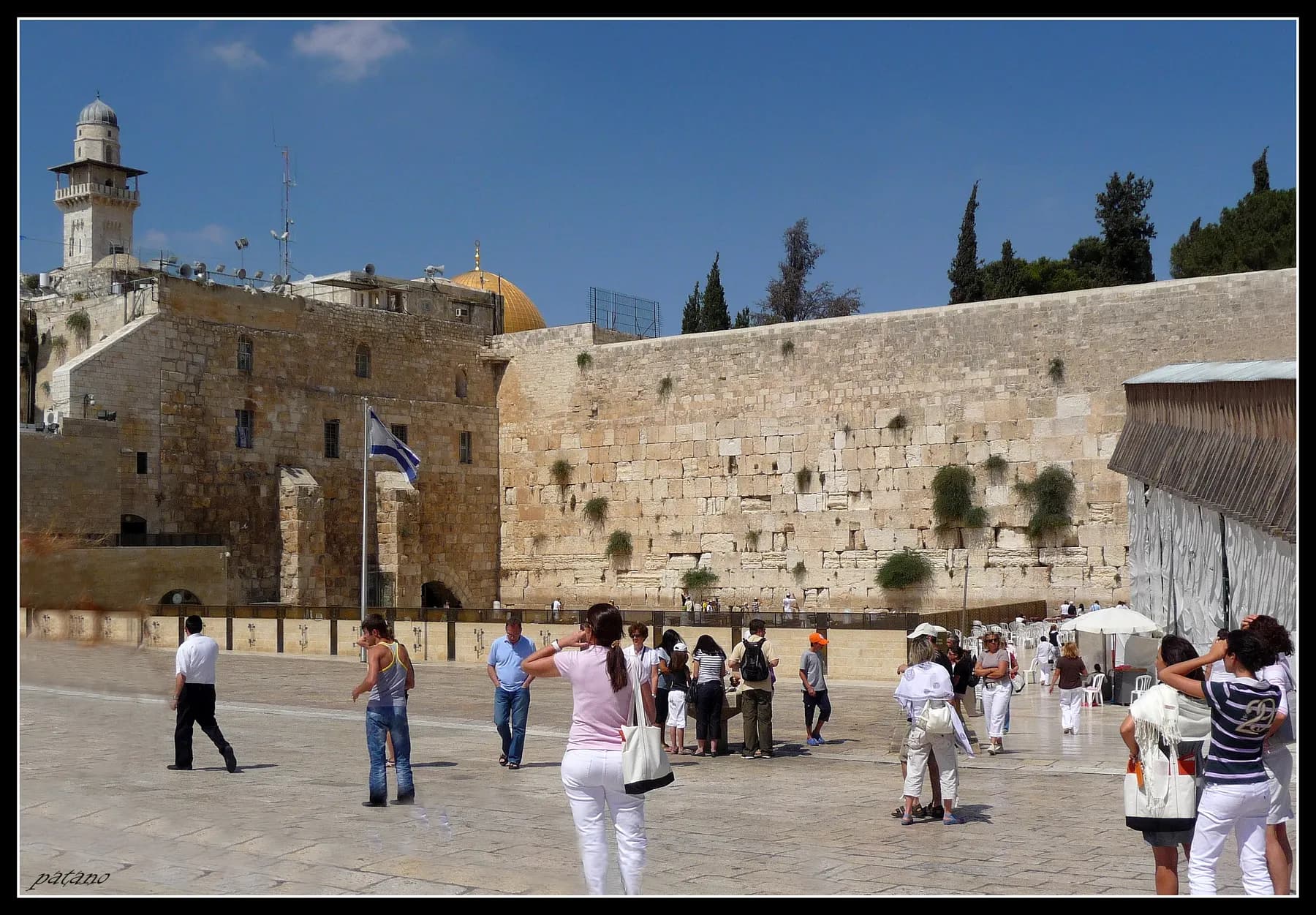
patano / CC BY-SA 3.0 · Wikimedia Commons
Religious site
The Western Wall
The prayer plaza shows about 50 metres of a retaining wall that runs 488 metres in total, and it is open free of charge at every hour of every day of the year.

שלמה רודד / CC BY 2.5 · Wikimedia Commons
Market
The Arab Souk and the Old City markets
The three parallel covered lanes at the centre of the souk were built as one market in 1152 by Melisende, Queen of Jerusalem, who hired Muslim labourers from Magna Mahomeria, the village now called al-Bireh, to build it.
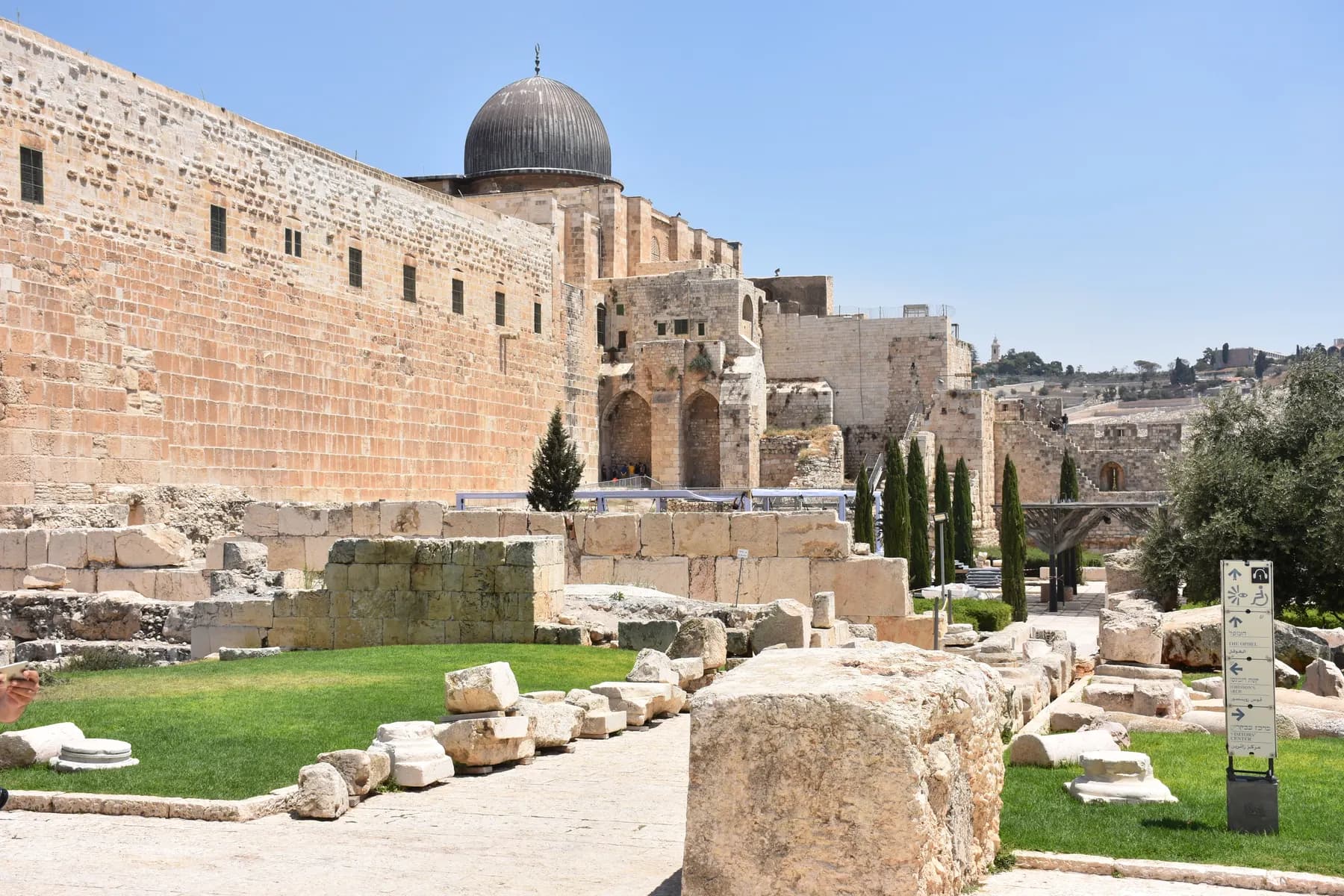
Mohammad Shad Siddiqui / CC BY-SA 4.0 · Wikimedia Commons
Archaeological site
Jerusalem Archaeological Park, Davidson Center
The excavated corner where the Temple Mount's southern and western walls meet, with the paving of the Herodian street still under the heap of masonry the Romans pushed off the top in 70 CE.
Sources and further reading
Every link below was opened and checked when this page was written. Official statements are marked as such: they are the subject's own account, not an independent one.
- OfficialJewish Quarter Development Companytravelrova.co.ilבית כנסת החורבה (the Hurva Synagogue)
the operator's current site page: 09:00-17:00 Sunday to Thursday, from ₪12, 40 minutes, and the description of the visit as basement, prayer hall and 360 degree dome balcony
- OfficialJewish Quarter Development Companytravelrova.co.ilמידע חיוני למבקר: מחירון ושעות פעילות (visitor information: price list and opening hours)
the published price table for all six of the operator's sites and the hours, including the Friday arrangement and the 40-minute last entry
- OfficialJewish Quarter Development Companytravelrova.co.ilThe Hurva Synagogue: 360 Degree Lookout and Underground Passageway
the English page, which quotes 30 minutes and a starting price of 12 NIS and, at the time of reading, carried the Broad Wall's history text
- ReportingJewish Actionjewishaction.comThe Hurva Synagogue 1700-2010
independent confirmation of the 24-metre height, the hall dimensions, Assad Effendi as architect, the Beis Yaakov name and the 1864 and 2010 dedications
- ReportingJewish Journaljewishjournal.comFrom ruin to reconstruction, the Hurva Synagogue is completed again
Gil Zohar on the Geva and Gutfeld excavation, the Byzantine arch dimensions, the reuse of the standing unplastered walls, and a project cost of NIS 43 million
- ReportingJewish Telegraphic Agencyjta.orgHurva Synagogue rededicated
the 15 March 2010 ceremony, the police deployment and the Palestinian reaction, reported on the day
- ReportingShmuel Browns, licensed Israeli tour guideisrael-tourguide.infoHurva Synagogue views
a first-hand account of the visitor route: the basement mikveh and Byzantine street reached by the washrooms, the women's balcony, and the 360 degree view from the walkway round the dome
- ReferenceWikipediaen.wikipedia.orgHurva Synagogue
the dated chronology from 1700 to 2010, the 1864 dimensions, the 1948 accounts on both sides, the Kahn and Lasdun schemes, the 1977 arch and the cost of the rebuild
- ReferenceM+, Hong Kongmplus.org.hkModel, Hurva Synagogue, Jerusalem, Israel (1968), Louis Kahn
the museum holding Kahn's model: three unbuilt schemes, the sixteen stone pylons and four hollowed columns, and the project's end at his death in 1974
- ReferenceImaging Research Center, University of Maryland Baltimore Countyirc.umbc.eduUnbuilt Hurva
the digital reconstruction of Kahn's scheme, directed by Kent Larson with animation by Dan Bailey
- ReferenceEncyclopaedia Britannicabritannica.comOld City of Jerusalem
the Jewish Quarter left in rubble in 1948 and rebuilt by the government after 1967, the context the Hurva's own gap sits in
Hurva Synagogue: common questions
What is the Hurva Synagogue?+
It is the main Ashkenazi synagogue of Jerusalem's Jewish Quarter, rebuilt in 2005 to 2010 as a close copy of the building of 1864 that was destroyed on 27 May 1948. The plot has held three attempts at a synagogue since 1700, two of which were destroyed, which is where the name comes from: hurva is Hebrew for ruin. The current building is a functioning Orthodox synagogue that also sells tickets to a visitor route through its basement, gallery and dome.
How much does it cost to visit?+
The Jewish Quarter Development Company's price list gives ₪24 for an adult, ₪12 for a child aged 5 to 18, a soldier or a pensioner, and ₪20 for a student. Groups of more than 25 are priced separately through the booking centre. The operator's English-language page quotes a starting price of 12 shekels, which is that concession rate rather than the adult ticket.
What are the opening hours?+
Sunday to Thursday, 09:00 to 17:00, with last entry about 40 minutes before closing. On Friday the operator opens only its Davidson Centre on a walk-up basis, from 09:00 to 14:00, and the Hurva and its other sites on Friday by prior arrangement with the booking centre. No Saturday opening is listed.
Can you go up to the dome, and how hard is the climb?+
Yes, and the walkway round the outside of the dome is the main reason to buy a ticket. From the gallery level it is two flights of narrow iron spiral stairs, short but steep, onto a railed walkway that goes right round the drum. There is no lift for that last stage.
Is it wheelchair accessible?+
Partly. A lift reaches the women's gallery level and its outdoor balcony, which has a genuine view over the quarter towards Mount Zion, but the dome walkway is up spiral stairs and is not reachable in a wheelchair. The approach through the Jewish Quarter is stepped and cobbled, so the journey to the door needs planning as much as the building does.
Is the building original, or a replica?+
Almost all of what stands is new work from 2005 to 2010, built to the nineteenth-century design and to the same height of 24 metres. The masonry walls that were still standing unplastered after the 1948 explosion were kept and built into the reconstruction, so parts of the outer wall are Ottoman. The genuinely ancient material is in the basement: first-century ritual baths, a sixth-century street and a Byzantine arch left where it was found.
Is it worth it if you have already seen the Western Wall?+
It answers a different question. The Western Wall is a place to stand at ground level in a crowd; the Hurva is the only ticketed way in the Jewish Quarter to get above the roofs and see how the four quarters, the two great compounds and the walls actually sit together. At 40 minutes and ₪24 it is also the cheapest and quickest big view inside the walls.
Can you pray there?+
Yes, it is an active Orthodox synagogue with its own rabbi and regular services, and that use comes first. Visitors on a ticket are not guaranteed the floor of the prayer hall on any given day: groups are sometimes kept to the gallery, from which the hall is fully visible.
What can you actually see from the top?+
The full circle: the Dome of the Rock and the Temple Mount compound to the east, the Mount of Olives behind it, the domes of the Holy Sepulchre over the Christian Quarter to the north-west, Mount Zion and the Armenian Quarter to the south, and the rooftops, water tanks and washing lines of the quarter immediately below. It is the highest point in the Jewish Quarter by the operator's own description.
Why did it take 62 years to rebuild?+
Because nobody could agree what to build. Louis Kahn produced three schemes between 1968 and 1973 for a modern synagogue beside the preserved ruins, and Mayor Teddy Kollek objected that it would compete with the Dome of the Rock and the Western Wall; Kahn died in 1974 and the plan was shelved. Denys Lasdun's closer copy of 1978 to 1981 was refused signature by Menachem Begin and the interior minister. A single rebuilt arch, 16 metres high, stood in for the building from 1977 until 2006, and the decision to reconstruct the 1864 design only came in 2000.