Archaeological site · Caesarea
Roman Theatre of Caesarea
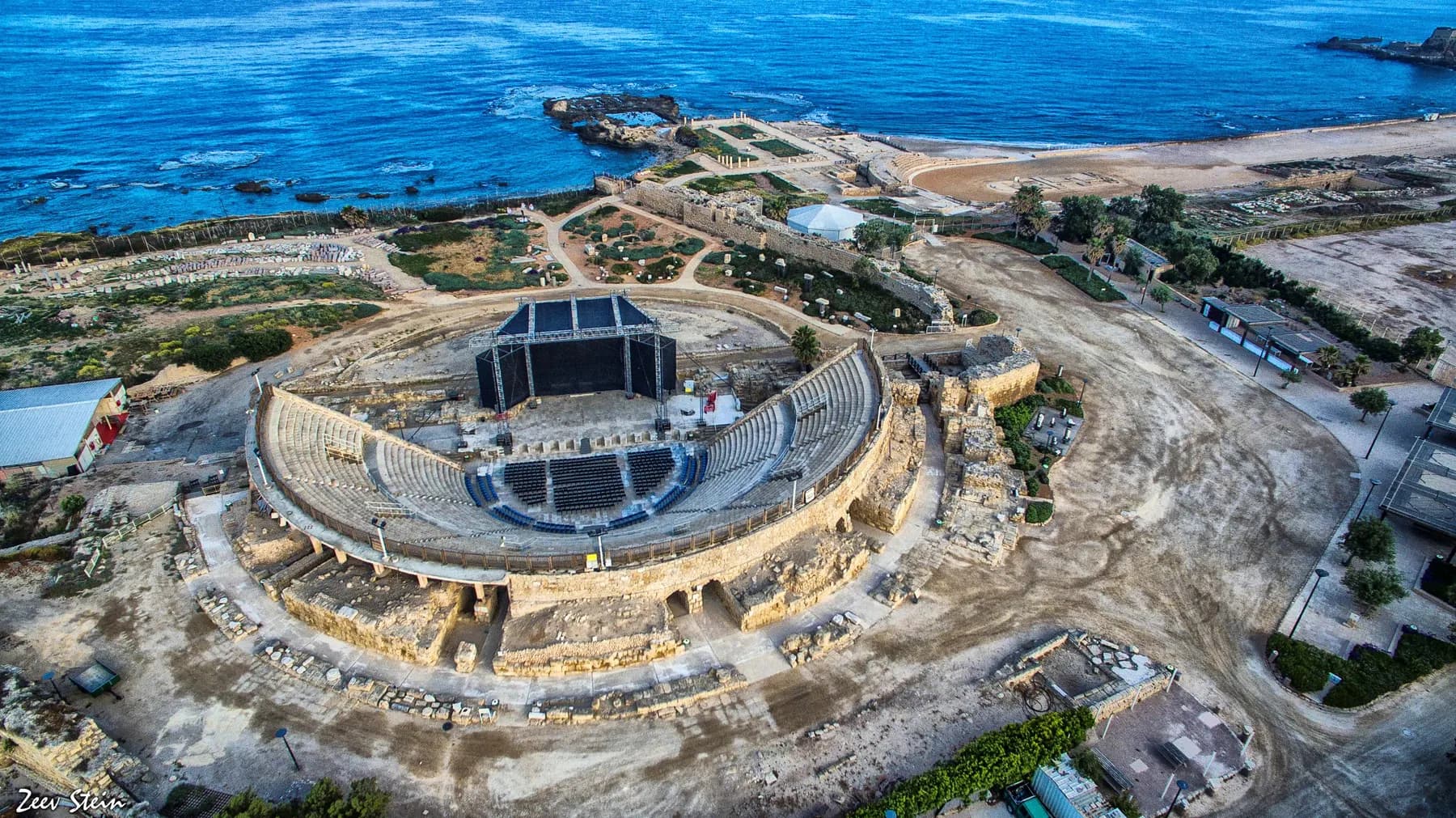
Herod's builders had no hillside to work with, so they stood the seating on a semicircle of vaults, and the building has been a working concert hall again since Pablo Casals played it in September 1961.
זאב שטיין / CC BY 2.5 · Wikimedia Commons
Built
c. 22–10/9 BCE
the years Herod rebuilt Caesarea, per Britannica
Cavea diameter
about 100 m
orchestra about 30 m across, in the Landesarchäologie Mainz theatre database
Seats
about 4,000
the figure the Caesarea Development Corporation gives for concerts
First modern concert
September 1961
Pablo Casals, three months after the Pilate stone came out of the dig
In short
- How long to give it
- about 45 minutes for the theatre and the finds garden, and about three hours for the whole national park
- Summer, Sunday to Thursday and Saturday
- 08:00 to 17:00
- Adult
- ₪46
התיאטרון הרומי בקיסריה
The Roman theatre of Caesarea is a semicircular auditorium at the southern tip of Caesarea National Park, built for Herod the Great and still in use: it holds concerts through the summer. The Israeli foreign ministry's account of the site calls it the earliest of the Roman entertainment buildings raised anywhere in Herod's kingdom. A Greek theatre would have been cut into a slope, and there is no slope here. The tiers sit instead on a semicircle of masonry substructures, and visitors walk in through them.
Almost everything above the lowest rows is modern. An Italian expedition from the University of Milan under Antonio Frova cleared the building between 1959 and 1964, and Israeli reporting on the dig records that only the first tier of stone seats was standing; a second tier was then rebuilt on the foundations of the one that had gone. Nothing at all is left of the scaenae frons, the high stage wall that once closed off the view. The sea behind the stage, which is the thing everyone photographs, is what a collapse left behind rather than what Herod's audience looked at.
The theatre also produced the smallest and most consequential object found at Caesarea. In June 1961, reused as a step in the theatre's stairs, Frova's team turned over a limestone block carrying a Latin dedication by Pontius Pilatus, prefect of Judaea.
Orientation
Where it is, and what you walk into
The theatre stands at the southern end of the national park and has its own gate. The parks authority describes the park as two entrances and three main complexes, and this is the theatre and palace complex: the theatre itself, the archaeological finds garden, the reef palace on its promontory, the prison and the seaside hippodrome. The harbour, the visitor centre and the Crusader walls sit at the other end, reached along the sea promenade. There is a car park outside the southern gate, which matters if the theatre is the point of the trip rather than an afterthought.
The plan is the standard Roman one and the parks authority sets it out in those terms: the semicircle of seating, the blocks of seats divided by passages, the flat arena at the foot of the tiers, the orchestra, the stage wall that has gone, and underground rooms that served as dressing rooms for the actors. Under the stage building was a hyposcaenium, a space for keeping props. The seating and the stage building were designed as a single architectural unit rather than as two structures facing each other.
Between the theatre and the sea, the finds garden holds columns, capitals, tombs and statuary gathered from across the park, most of it architectural. Beside it the parks authority has put up a map showing where the raw materials for building the theatre were brought in from. It takes two minutes and it makes the same point the harbour makes: this was a building assembled out of a shipping network, not out of the quarry over the road.
Herod
A theatre with no hill to sit on
Herod rebuilt Caesarea between roughly 22 and 10/9 BCE, and the theatre went up inside that programme. Building an auditorium on level sand meant raising the whole bowl on artificial substructures, and the parks authority credits the solution to Roman vaulting technology. It also says Herod came back to the building later and added several more blocks of seating, enlarging it.
The finishes were upgraded as the city got richer. The orchestra floor was originally coloured plaster, decorated in the Pompeian manner; excavation found it beneath a later floor of polychrome marble laid in opus sectile, which the theatre database of the Rhineland-Palatinate heritage directorate assigns to the middle imperial period. Marble decoration of the second century CE is among the ancient material still on show at the site.
What happened here was never only drama. Josephus has Herod founding games at Caesarea every fifth year in honour of Augustus, and putting up the largest prizes for them himself. A Greek inscription from the theatre records a comic actor and lead speaker, Quintus Caecillius of Antioch by Daphne, paying for a dedication. Late antique writers describe theatre days that ran from morning to dusk and took in boxers, wrestlers, acrobats and animal fights alongside the plays.
The record
Two men this building put into the historical record
In 44 CE, on Josephus's account, Agrippa I came into the theatre at Caesarea early in the morning in a garment woven wholly of silver. The sun caught it, his flatterers shouted that he was a god, he neither rebuked them nor rejected the flattery, and a violent pain took him in the belly; he was carried to the palace and died. The Acts of the Apostles tells the same episode at Caesarea without naming the building it happened in.
The second man arrived by accident, seventeen centuries late. In June 1961, in its third season, the Italian expedition turned over a limestone block reused as a step in the theatre's stairs and found a damaged Latin dedication of a Tiberieum by Pontius Pilatus, prefect of Judaea. It is the only surviving inscription naming a Roman governor of Judaea from before the Jewish revolts, and it gives Pilate's rank as prefect where later writers routinely call the governors of Judaea procurators.
The theatre database notes that the block was reused during the late alterations that fitted the orchestra out as a water basin, which is a dry way of saying that the only contemporary record of Pilate survived because somebody needed a step. What stands at the theatre now is a cast. The original is in the Israel Museum in Jerusalem.
Fabric
What is ancient here, and what is not
The honest answer is that the bottom of the building is old and most of what an audience sits on is not. Israeli reporting on the excavation is explicit: only the first tier of stone seats was there when the Italians finished, and the second tier was rebuilt on the foundation remains of the destroyed original. The parks authority says a visitor can still pick out several of the original seats, along with marble decoration of the second century CE, and that nothing whatever survives of the stage wall.
The later chronology is genuinely contested, and the contradiction runs between the two bodies that share the site. The parks authority's Hebrew page says flatly that the theatre was ruined in the third century. The Caesarea Development Corporation says the orchestra was converted into a pool for water games at the end of the Byzantine period. The architectural literature has the stage building pulled down in a late phase, the orchestra completed into a full circle so the space could take amphitheatre-style shows, and a water reservoir laid in during the fourth century for water displays. Hebrew Wikipedia has the building working until the sixth century, when it stopped under Justinian and was partly turned into a fortress.
Those accounts cannot all be right, and no visitor needs them to be. What is on the ground is a theatre that was remodelled repeatedly, converted to uses it was not designed for, fortified, buried, dug out in the middle of the twentieth century and then partly rebuilt so that people could sit in it again.
- Ancient: the vaulted substructures under the seating, some seats in the lowest tier, second-century marble decoration and the buried plaster and opus sectile orchestra floors
- Rebuilt: the upper tier of seating, raised on the ancient foundations after the excavation of 1959 to 1964
- Gone entirely: the scaenae frons, the high stage wall that once shut out the sea
- Modern: everything that makes it a working venue, from the stage platform to the audience seating installed on the tiers
Now
Amfi Kisarya, which is not an amphitheatre
Performances resumed in September 1961, when the Catalan cellist Pablo Casals played the restored theatre without amplification. Israeli reporting on the excavation adds a detail from before that: an amateur archaeologist from the neighbouring kibbutz, who had photographed the dig and joined the Italian team, tested the acoustics by putting a kibbutz child on the stage with a violin and listening from the far rows.
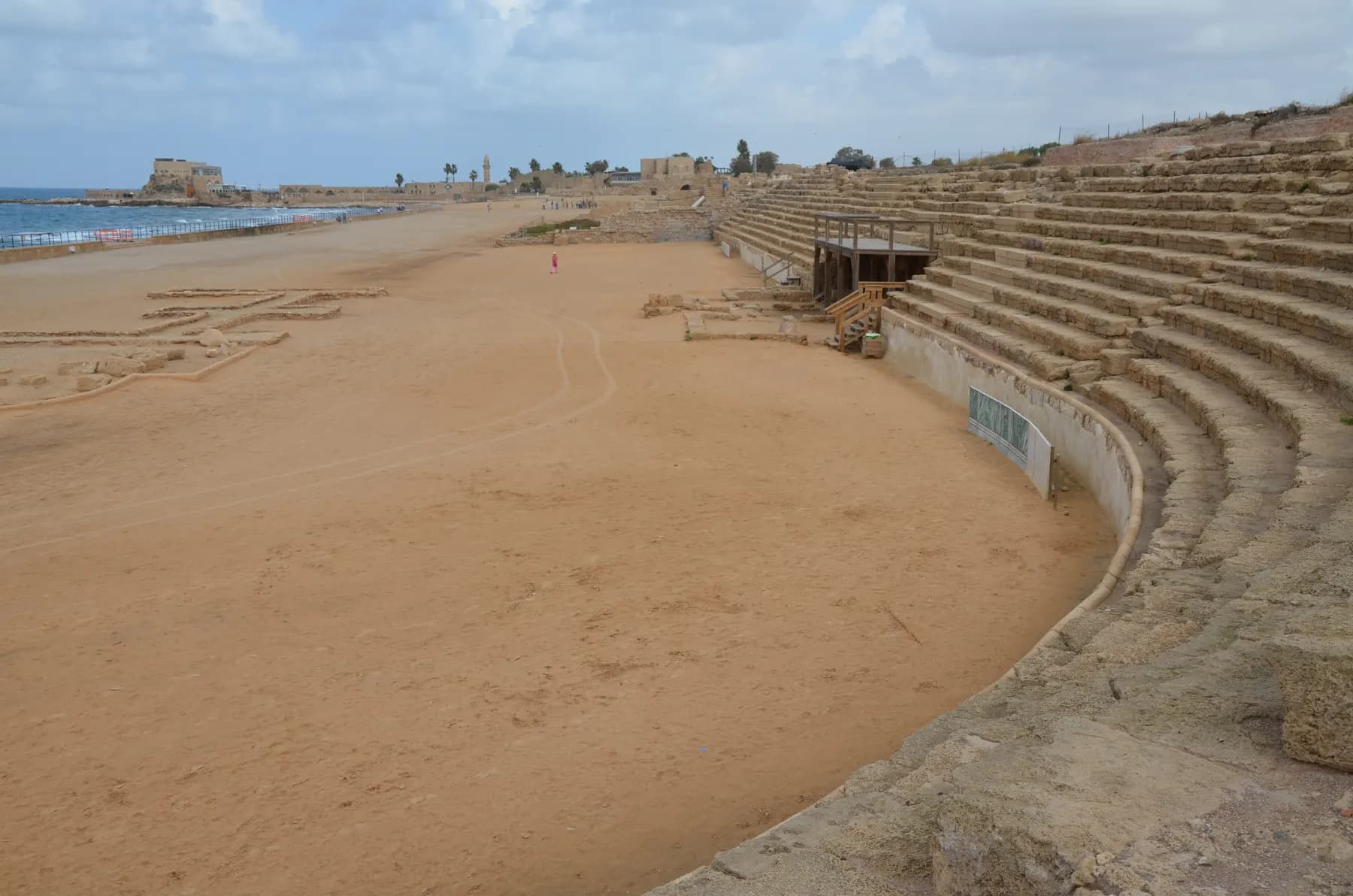
The venue trades as Caesarea Amphitheatre, and Hebrew Wikipedia points out the problem with the name. This is a theatre: a semicircle facing a stage. An amphitheatre is an oval enclosing an arena, seen from all round. The genuinely oval structure at Caesarea is the seaside hippodrome a short walk north, which the parks authority says was later adapted for gladiatorial contests, with the animals housed beneath the arena.
Capacity is the other figure to handle carefully, because the operator publishes two. The Caesarea Development Corporation's music page gives about 4,000 seats. Its own page on the theatre complex gives about 6,000. The Rhineland-Palatinate theatre database puts the ancient audience at 4,000 and the cavea at about 100 metres across, with an orchestra of about 30 metres; Hebrew Wikipedia gives the overall diameter as 90 metres. No reconciled number is published anywhere.
Concerts are ticketed separately from the national park, and the park entrance fee does not cover a performance. The Caesarea Development Corporation, which also runs the harbour front, publishes the schedule and describes the theatre as a milestone that artists count in their careers.
What to look for
Things not to walk past at Roman Theatre of Caesarea
The details that repay knowing about before you are standing in front of them.
The vaults you walk in through
The seating does not rest on a hill; it rests on a semicircle of masonry substructures, and the entrance passages run through them. That is the Roman engineering answer to a flat shore.
The lowest rows of seating
Some of the original stone seats survive in the bottom tier. Everything above them was rebuilt on ancient foundations after the excavation of 1959 to 1964.
The cast of the Pilate inscription
A copy of the limestone block naming Pontius Pilatus, prefect of Judaea, stands at the theatre where it was found reused as a step. The original went to the Israel Museum in Jerusalem.
The missing stage wall
Nothing is left of the scaenae frons. The sea view behind the stage that sells the place is the consequence of a wall falling down, not part of the ancient design.
The finds garden and the materials map
On the way from the theatre down to the water, a display of columns, capitals, tombs and statuary from across the park, beside a map of where the theatre's building materials were shipped in from.
The long view
Roman Theatre of Caesarea, in order
c. 22–10/9 BCE
Herod rebuilds Caesarea. The theatre is raised on artificial vaulted substructures, the earliest of the Roman entertainment buildings in his kingdom.
44 CE
Josephus places Agrippa I's fatal appearance in a silver robe in this theatre. Acts tells the same story at Caesarea without naming the building.
2nd century CE
Marble decoration is added, and the plastered orchestra floor is replaced by polychrome marble laid in opus sectile.
3rd century CE
The parks authority dates the ruin of the theatre to this century.
4th century CE
In a late phase the stage building comes down and the orchestra is completed into a full circle; a water reservoir is installed for water displays. The Pilate block is reused as building stone during the works.
6th century CE
The theatre goes out of use and part of the structure is fortified. Published accounts of when it stopped working differ by three centuries.
1959–1964
An Italian expedition from the University of Milan under Antonio Frova excavates the theatre, while Avraham Negev works on the Crusader city alongside.
June 1961
The expedition's third season turns up the Pontius Pilate inscription, reused as a step in the theatre's stairs.
September 1961
Pablo Casals gives the first modern concert in the restored theatre.
Practical
Visiting Roman Theatre of Caesarea
Where
Caesarea National Park, southern (theatre) entrance, Caesarea
What ticket you need
The theatre sits inside Caesarea National Park and is not separately ticketed. One park ticket covers it along with the reef palace, the hippodrome, the harbour and the Crusader city, and the southern gate beside the theatre is one of the park's two entrances.
Opening hours
- Summer, Sunday to Thursday and Saturday
- 08:00 to 17:00source
- Summer, Friday and holiday eves
- 08:00 to 16:00source
- Winter, Sunday to Thursday and Saturday
- 08:00 to 16:00source
- Winter, Friday and holiday eves
- 08:00 to 15:00source
- Holiday eves and Yom Kippur eve
- 08:00 to 13:00source
- Last entry
- one hour before the closing time listedsource
Admission
Access
Good by the standards of an excavated Roman building, and incomplete by any other. The parks authority lists accessible parking at the theatre entrance, an accessible ticket office with a hearing aid device, concrete paths and paved plazas from the gate to the points of interest, handrails on the steps, shade shelters, three accessible drinking fountains, a scale model and an accessible toilet in the theatre area. It also says entry into the antiquities themselves is adapted only as far as the fragility of the remains allows. The seating tiers are stone steps, so there is no step-free route to the upper rows.
On site
- Ticket office at the southern gate
- Car park outside the southern gate
- Accessible parking
- Toilets, including an accessible toilet
- Drinking fountains
- Shaded seating
- Archaeological finds garden
- Scale model of the site
- Dogs allowed on a lead and muzzled
Booking
The parks authority runs an online visit reservation system for the national park and says a booking guarantees a place at the site and time chosen. Concert tickets are a separate transaction, sold through the Caesarea Development Corporation rather than the parks authority.
Hours and prices are given as the operator publishes them and change without much notice, particularly around Shabbat and the festivals. Check the operator's own page before you travel for this.
Official page at en.parks.org.il →What people wish they had known
- Entry to the national park closes an hour before the closing time the parks authority prints, so arriving at 16:15 on a summer afternoon means not getting in at all.
- Park at the southern gate if the theatre is the reason for the visit. The park has two entrances and the other one is at the harbour, a walk away along the shore.
- The block naming Pontius Pilate at the theatre is a cast. People hunt for the original here; it is in the Israel Museum in Jerusalem.
- The parks authority's English page currently states that the Caesarea Experience display next to the Roman theatre has not yet opened to visitors, while its Hebrew page describes the film running every quarter of an hour. Do not plan the visit around it.
- A park ticket and a concert ticket are different purchases. The ₪46 entrance fee does not admit anyone to a performance, and performances are sold by the Caesarea Development Corporation.
- The parks authority's discounted senior rate is listed as 'Israeli senior citizen'. Visitors arriving from abroad should expect to pay the adult rate.
The figures
Roman Theatre of Caesarea by the numbers
Each figure carries the year it belongs to and links the source it came from.
| Measure | Figure | As of | Source |
|---|---|---|---|
| Adult admission to Caesarea National Park | ₪46 (child ₪27, student ₪39, Israeli senior ₪23) | 2026 | en.parks.org.il |
| Diameter of the cavea | about 100 m | 2026 | theatrum.de |
| Diameter of the orchestra | about 30 m | 2026 | theatrum.de |
| Ancient audience | 4,000 | 2026 | theatrum.de |
| Seats, as the operator's music page gives them | about 4,000 | 2026 | caesarea.com |
| Seats, as the same operator's theatre page gives them | about 6,000 | 2026 | caesarea.com |
| Italian excavation of the theatre | 1959 to 1964, under Antonio Frova of the University of Milan | 1964 | ynet.co.il |
| Pilate inscription found | June 1961, reused as a step in the theatre stairs | 1961 | en.wikipedia.org |
While you are here
The rest of Caesarea
Everything else in this destination with a page of its own.
Carole Raddato from FRANKFURT, Germany / CC BY-SA 2.0 · Wikimedia Commons
Archaeological site
Herod's Hippodrome and Amphitheatre
A racing floor 301 metres long by 50.3 metres wide, laid on sand between Herod's palace and the sea, with eight starting gates at its northern end.
זאב שטיין / CC BY 2.5 · Wikimedia Commons
Archaeological site
Herod's Harbour (Sebastos)
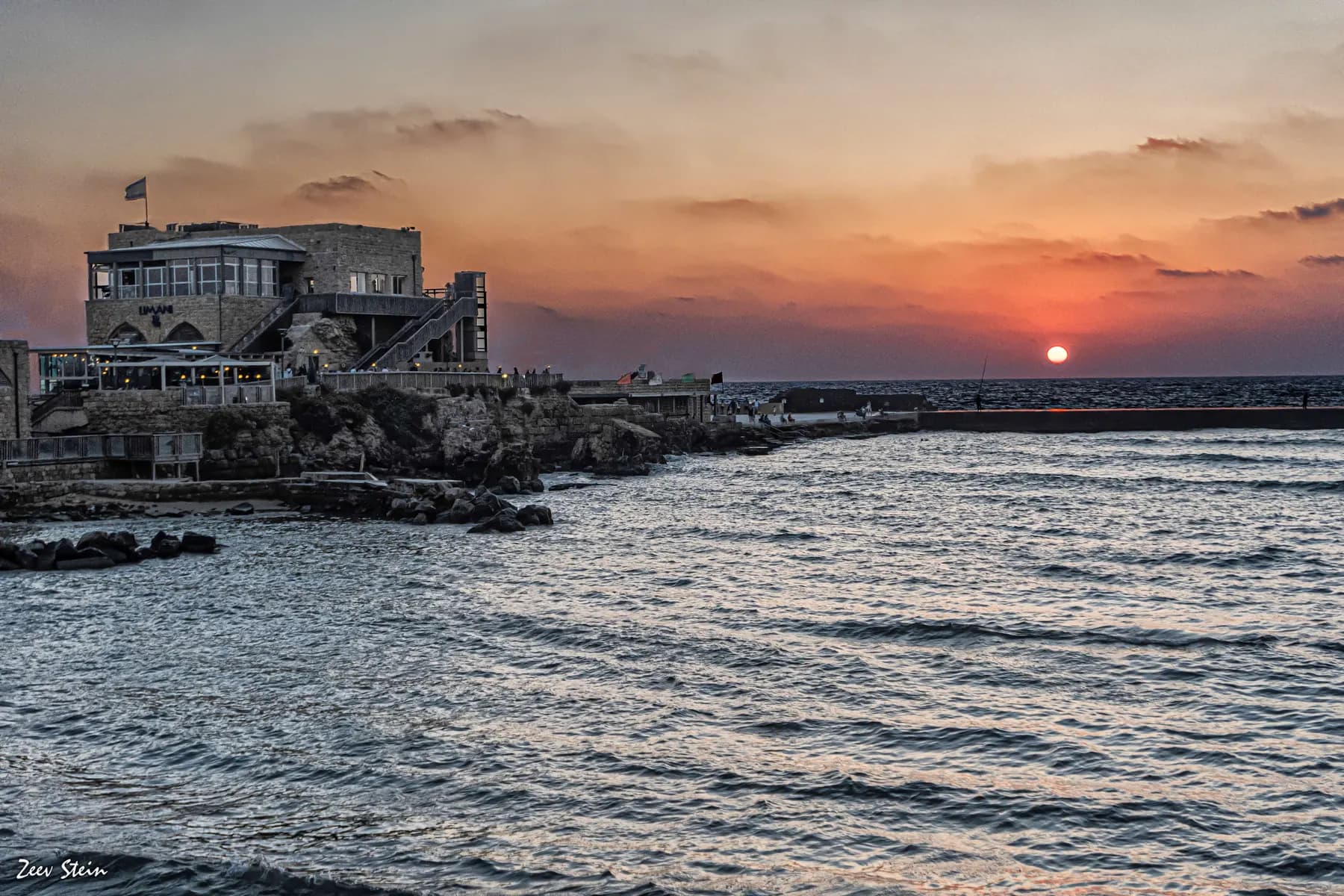
The breakwaters that made Caesarea possible are still there, five to seven metres down, and the harbour began settling into the seabed almost as soon as it was finished.
Museum
Caesarea Harbour Visitors' Centre
Four of the fourteen Herodian vaults that carried the temple platform above the harbour were dug out, stabilised and opened to the public in June 2019, after about five years of work.
Sources and further reading
Every link below was opened and checked when this page was written. Official statements are marked as such: they are the subject's own account, not an independent one.
- OfficialIsrael Nature and Parks Authorityen.parks.org.ilCaesarea National Park
Summer and winter opening hours, the one-hour entry cutoff, the full entrance fee table (₪46/₪27/₪39/₪23), the accessible areas including the Roman Theater area with an accessible restroom, and the note that the Caesarea Experience display beside the theatre has not yet opened
- OfficialIsrael Nature and Parks Authorityparks.org.ilגן לאומי קיסריה (Caesarea National Park, Hebrew site)
The theatre described in full: Herod's vaulting technology, the later enlargement with extra seating blocks, the surviving original seats and second-century marble, the total loss of the stage wall, the ruin dated to the third century, the materials map by the finds garden, the two entrances and three complexes, and the accessibility provision at the theatre gate
- OfficialCaesarea Development Corporationcaesarea.comMusic and Performances (Caesarea Amphitheater)
About 4,000 seats, the Herodian origin, the Byzantine conversion of the orchestra into a pool, and the theatre as a career milestone for performers
- OfficialCaesarea Development Corporationcaesarea.comThe Roman Theater Complex
The same operator's other capacity figure, about 6,000 seats, and the pairing of the theatre with the reef palace in one visitor complex
- ReportingYnetynet.co.ilלידיעת שלמה ארצי: כך נחשף תיאטרון קיסריה
The 1959 to 1964 excavations, Frova's Italian expedition from the University of Milan alongside Avraham Negev on the Crusader city, the kibbutz photographer who tested the acoustics with a child and a violin, the September 1961 Casals concert, and the rebuilding of the second tier of seating on the foundations of the destroyed original
- ReferenceGeneraldirektion Kulturelles Erbe Rheinland-Pfalz, Direktion Landesarchäologie Mainz (theatrum.de)theatrum.deCAESAREA MARITIMA, Theater
Cavea diameter 100 m, orchestra 30 m, audience 4,000; construction under Herod on substructions with access through them; the hyposcaenium; the painted orchestra floor replaced by opus sectile marble; the late demolition of the stage building and the full-circle orchestra; the fourth-century water reservoir in which the Pilate inscription was reused; and the actor's inscription of Quintus Caecillius. Bibliography from Frova 1966 to Weiss 2014
- ReferenceFlavius Josephus, Whiston translation, University of Chicago (Penelope)penelope.uchicago.eduAntiquities of the Jews, Book XIX, chapter 8
The primary account of Agrippa I entering the theatre at Caesarea in a garment made wholly of silver, the acclamation as a god, and his collapse
- ReferenceFlavius Josephus, Whiston translation, University of Chicago (Penelope)penelope.uchicago.eduThe Wars of the Jews, Book I, chapter 21
Herod's theatre and amphitheatre at Caesarea, and the games founded every fifth year in Augustus's honour with the largest prizes offered at the 192nd Olympiad
- ReferenceIsrael Ministry of Foreign Affairs, republished by the Jewish Virtual Libraryjewishvirtuallibrary.orgArchaeology in Israel: Caesarea
The theatre in the south of the city, commissioned by Herod and described as the earliest of the Roman entertainment facilities built in his kingdom; the seats resting on a semicircular structure of vaults; the orchestra first paved in painted plaster and later in marble; and the Pilate stone found in the excavated theatre
- ReferenceHebrew Wikipediahe.wikipedia.orgתיאטרון קיסריה (Caesarea Theatre)
Diameter given as 90 m with about 4,000 seats, the Pompeian-style painted plaster under the marble orchestra floor, use continuing to the sixth century and the conversion into a fortress under Justinian, the September 1961 Casals concert, and the point that the venue is not architecturally an amphitheatre despite its name
- ReferenceWikipediaen.wikipedia.orgPilate stone
The June 1961 discovery during the expedition's third season, the block's reuse in the theatre stairs, the text and its restoration, and the original's transfer to the Israel Museum in Jerusalem
- ReferenceEncyclopaedia Britannicabritannica.comCaesarea
Herod's rebuilding of the city between 22 and 10 BCE, the frame the theatre's construction date sits inside
Roman Theatre of Caesarea: common questions
How long does the Roman theatre take?+
About 45 minutes covers the theatre and the finds garden beside it without rushing. The theatre is a single structure and there is not a great deal of interpretation on the ground, so the time goes on walking the tiers and reading the materials map. Allow about three hours if the plan is the whole national park, which runs from here north to the harbour and the Crusader walls.
Do I need a separate ticket for the theatre?+
No. The theatre is inside Caesarea National Park and one park ticket covers it. The parks authority lists ₪46 for an adult, ₪27 for a child, ₪39 for a student or an adult in a group, and ₪23 for a child in a group or an Israeli senior citizen. The southern gate next to the theatre is one of the park's two entrances and sells tickets.
Is the theatre original or a reconstruction?+
Both, and the split is easy to see once it is pointed out. The vaulted substructures, some seats in the lowest tier and second-century marble decoration are ancient; the upper tier was rebuilt on the ancient foundations after the Italian excavation of 1959 to 1964, because Israeli reporting on the dig says only the first tier was still standing. The stage wall is gone completely.
Can you see the Pontius Pilate stone at the theatre?+
You can see a cast of it at the theatre, which is where the original was found in June 1961, reused as a step in the stairs. The original limestone block is in the Israel Museum in Jerusalem. It carries a damaged Latin dedication of a Tiberieum by Pontius Pilatus, prefect of Judaea, and it is the only surviving inscription naming a Roman governor of Judaea from before the Jewish revolts.
Is the Roman theatre wheelchair accessible?+
The approach is, the seating is not. The parks authority lists accessible parking at the theatre entrance, an accessible ticket office, concrete paths and paved plazas from the gate to the points of interest, handrails on steps, shade shelters, drinking fountains and an accessible toilet in the theatre area. It also says access into the antiquities themselves goes as far as the fragility of the remains allows, and the tiers are stone steps, so the upper rows are not reachable on wheels.
How many seats does it have?+
Published figures disagree, including on the operator's own website. The Caesarea Development Corporation's music page says about 4,000 seats and its page on the theatre complex says about 6,000. The Rhineland-Palatinate heritage directorate's theatre database puts the ancient audience at 4,000. Treat 4,000 as the working number and note that nobody has published a reconciliation.
Is this really the oldest theatre in Israel?+
The Israeli foreign ministry's account of Caesarea calls it the earliest of the Roman entertainment buildings put up in Herod's kingdom, which is the strongest claim with a named body behind it. Herod's building programme at Caesarea ran from about 22 to 10/9 BCE, earlier than the surviving theatres at Beit She'an or Sepphoris. It is a claim about Herod's own works rather than a survey of every ancient theatre in the country.
Why is it called an amphitheatre if it is a theatre?+
Because the concert venue markets itself as Caesarea Amphitheatre, and the name stuck in Hebrew as Amfi Kisarya. Architecturally it is wrong: a theatre is a semicircle facing a stage, while an amphitheatre is an oval enclosing an arena. Hebrew Wikipedia makes the same point. The oval structure at Caesarea is the seaside hippodrome to the north, later adapted for gladiatorial shows.
Is there any shade at the theatre?+
Not in the seating bowl, which is open stone facing west with nothing over it. The parks authority lists shade shelters and three accessible drinking fountains in the theatre and hippodrome complex, so there is somewhere to sit out of the sun nearby, but the theatre itself is exposed. In summer the first two hours after the 08:00 opening are the comfortable ones.
Can I go to a concert here, and does that replace visiting the ruins?+
You can, and it does not. Concerts run mainly in summer, are sold by the Caesarea Development Corporation rather than the parks authority, and are not covered by the park entrance fee. A performance also puts a modern stage, a lighting rig and several thousand people between the audience and the building, so anyone who wants to look at Herod's masonry should come in daylight as well.