Home Front Command's Chief Joins Rescue Crews at Arad Impact Site
The IDF Home Front Command said its commander and rescue units had spent hours at impact sites in southern Israel and urged the public to keep obeying alert instructions.
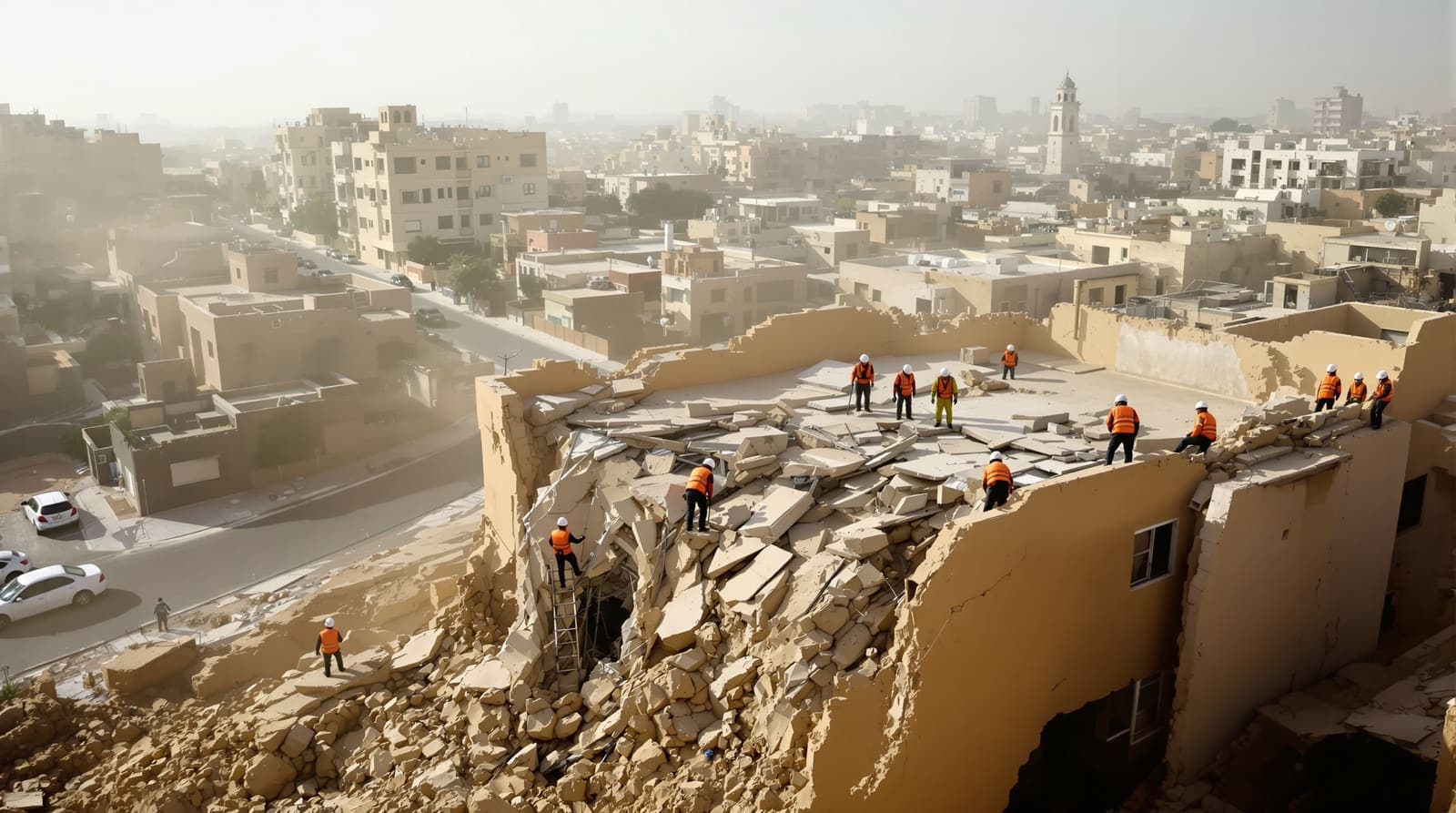
Illustration
The Israel Defence Forces' Home Front Command said that its commander, Major General Ori Gordin, along with rescue and relief forces, had been operating for several hours at impact sites in the south of the country. The statement, issued in the small hours of 23 March 2026, gave no further operational detail. It closed by calling on the public to continue obeying life-saving instructions and to act as required on receiving an alert.
Arad, named in the statement's headline, is a town of the northeastern Negev, set on high ground west of the Dead Sea between Be'er Sheba and the Dead Sea shore. The Home Front Command is the IDF command responsible for civil defence: it runs the national alert system, sets the rules civilians must follow during an emergency, and fields the search-and-rescue battalions that dig through collapsed buildings after a strike.
What had hit the south
The release did not say what caused the impacts. Two days earlier, on 21 March 2026, Iranian ballistic missiles struck the southern cities of Arad and Dimona, injuring nearly 200 people, 11 of them seriously, The Times of Israel reported. Iran said it had aimed at the nuclear research facility near Dimona, in retaliation for an American strike on its enrichment site at Natanz. Soroka Medical Center in Be'er Sheba treated 175 of the wounded.
The war behind the sirens
The strikes came during a war that had begun three weeks earlier. On 28 February 2026 the United States and Israel launched a large combined air campaign against Iran; American officials described roughly 900 strikes in the first twelve hours, and Iran responded with about 170 ballistic missiles and drones fired at American bases in the region and at Israel, according to the Institute for the Study of War. From the opening day the Home Front Command placed the civilian population under restrictions, banning public gatherings outright, a ban still in force at Purim in early March, when even public readings of the Book of Esther were prohibited, The Times of Israel reported.
The command that decides what civilians may do
The Home Front Command's reach goes well beyond the rubble. In an emergency its instructions set the terms of ordinary life (whether people travel to work, whether children go to school, whether crowds may gather), which is why a statement about rescue teams is also, in effect, a statement from the body regulating the country. After the strikes on Arad and Dimona the education minister cancelled in-person schooling nationwide for the following two days, and the command was examining the circumstances of the impacts, including why the incoming missile was not intercepted, The Times of Israel reported.
What is still unclear
The Home Front Command's statement named no casualties, no number of buildings damaged and no specific location beyond the south of the country. It did not say how many rescue teams were deployed, whether anyone was still unaccounted for, or when the work at the sites was expected to finish. It also did not say what caused the impacts; that came from separate reporting.
Sources and further reading
Every link below was opened and checked when this page was written. Official statements are marked as such: they are the subject's own account, not an independent one.
- ReportingTimes of Israeltimesofisrael.comAlmost 200 injured, 11 seriously, in Iranian missile strikes on southern cities of Arad, Dimona
What struck Arad and Dimona on 21 March 2026 and the casualty toll
- ReportingInstitute for the Study of Warunderstandingwar.orgIran Update Evening Special Report, February 28, 2026
Opening of the war on 28 February 2026 and the scale of the exchange
- ReportingTimes of Israeltimesofisrael.comFrom Zoom megillahs to sirens during reading, all you need to know about Purim at war
The Home Front Command's ban on gatherings during the same period
How we checked this
The account of the deployment is the IDF Home Front Command statement of 23 March 2026, which is two sentences long and carries no casualty or damage figures. The description of the strikes on Arad and Dimona is Times of Israel reporting of 22 March 2026, and the war's start date is dated to the Institute for the Study of War's 28 February 2026 assessment.
Our sourcing and corrections policy →The week from Israel, in one email
The stories that mattered, sourced and checked by the Israel.com newsroom. Free, weekly, one-click unsubscribe.
One list, unsubscribe in a click. See our privacy policy.
More in Security
All security →


Latest
- Houthi forces reported streaming into Yemen's port city of Mocha
- Israel says three Hamas weapons depots destroyed in strikes across Gaza
- Advisers warned Trump the Iran war could outlast his presidency
- Iranian agency reports explosions near Jask and the port of Sirik
- Drone sirens sound in Galilee Panhandle, then declared a false identification
- Netanyahu visits Mount Hermon inside Syria; Damascus calls it illegal