Jordanian Desert Dust Fouls Israel's Air Until Wednesday
Health and environment ministries warned of high to very high pollution nationwide as south-easterly winds carried dust from Jordan, with no relief before Wednesday.
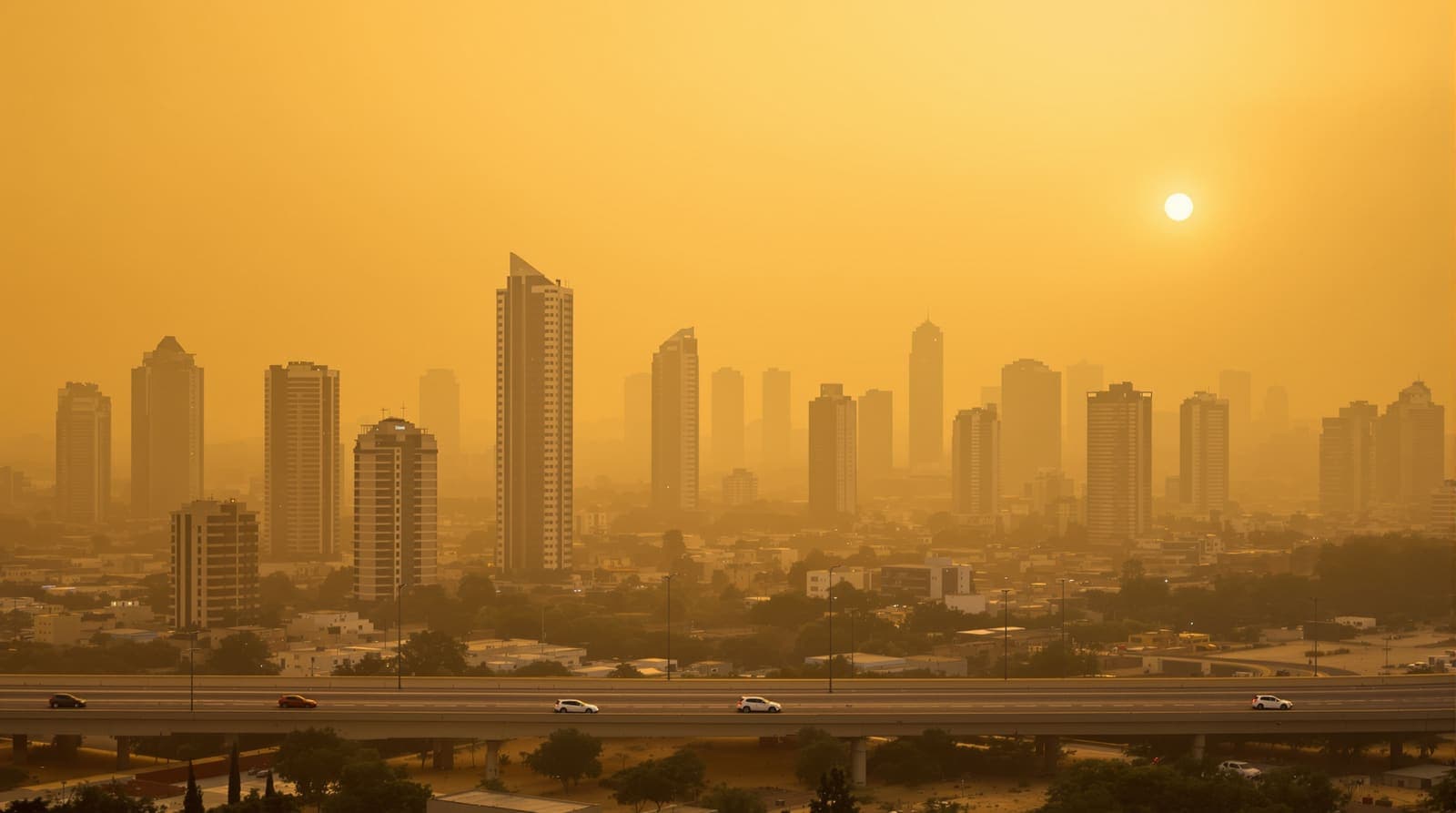
Illustration
Israel's Ministry of Health and Ministry of Environmental Protection warned that high to very high air pollution was persisting across the country, caused by dust carried in on south-easterly winds from Jordan. The ministries said the poor air quality was expected to continue through Wednesday.
Their advice followed the standard Israeli template for dust events. Sensitive groups (the elderly, children, pregnant women and people with heart or lung conditions) were told to avoid strenuous outdoor activity, while the general public was advised to limit intense outdoor exercise.
A season of dust, not a single storm
The warning came in a winter in which Israeli air-quality alerts had become close to routine. Days earlier, a severe dust event pushed Jerusalem and Tel Aviv to the top of the global pollution rankings: the Times of Israel reported on 14 February 2026 that monitoring stations recorded a severe drop in air quality from around 3am as strong winds carried dust in from North Africa and the Sahara, and that the monitoring site IQAir listed the two Israeli cities above Almaty, Lahore and Kolkata. That episode was accompanied by sustained winds of at least 34mph and rough seas along the central coast.
Two weeks before that, the same two ministries had issued a similar nationwide advisory. The Jerusalem Post reported on 30 January 2026 that high pollution was expected from the weekend through Monday, attributed to south-westerly winds transporting dust from North Africa, and pointed the public to the Environmental Protection Ministry's air monitoring site and its air-quality app for live readings.
Why the wind direction is the story
The direction the dust arrives from is not a meteorological footnote: it identifies the source region. South-westerly flow draws dust off the Sahara and North Africa; south-easterly flow, as in this event, pulls it from the deserts of Jordan and the Arabian interior to Israel's east. The two patterns can produce similar readings on the ground but arrive on different weather systems and clear on different timetables, which is why the ministries issue a fresh forecast for each episode rather than a standing warning.
Israeli dust events are also capable of doing physical damage rather than merely degrading air. Ynetnews has reported on a storm in which gusts reached about 100km/h, haze spread from the western Negev and the Gaza-border communities northwards through Tel Aviv, Netanya and Rishon LeZion, and power supplies were disrupted in a string of southern communities.
What the dust actually does to people
The health advice is narrower than it sounds. The pollutant of concern in a dust event is particulate matter; mineral dust is one of the main components of the particle load that air-quality indices measure. In its fact sheet of 24 October 2024, the World Health Organization describes particulate matter as the standard proxy indicator for air pollution, and attributes the great majority of deaths from outdoor air pollution to cardiovascular and respiratory disease: about 68 per cent to ischaemic heart disease and stroke, 14 per cent to chronic obstructive pulmonary disease and 14 per cent to acute lower respiratory infections. The WHO singles out air pollution as one of the largest environmental risks to children's health.
That is the logic behind naming the elderly, children, pregnant women and heart and lung patients specifically: for most healthy adults a two-day dust episode is unpleasant, while for those groups the same exposure carries measurable risk.
What the warning did not say
The ministries' notice did not give particulate readings for any city, did not specify which regions were worst affected, and did not say whether schools, sports fixtures or outdoor workplaces were subject to any restriction. It also did not indicate how the episode compared with the dust events earlier in the same month.
Sources and further reading
Every link below was opened and checked when this page was written. Official statements are marked as such: they are the subject's own account, not an independent one.
- OfficialWorld Health Organizationwho.intAmbient (outdoor) air quality and health
Health effects of particulate matter and the groups most at risk, fact sheet of 24 October 2024
- ReportingTimes of Israeltimesofisrael.comSevere dust storm pushes Jerusalem, Tel Aviv to top of global pollution index
The 14 February 2026 dust event and the global pollution rankings
- ReportingJerusalem Postjpost.comIsrael braces for high air pollution as dust from North Africa impacts air quality
An earlier ministry advisory of 30 January 2026 and where the public can check readings
- ReportingYnetnewsynetnews.comSevere dust storm sweeps Israel with winds up to 62 mph
Wind speeds, affected regions and power disruption during an Israeli dust storm
How we checked this
The warning, its wording and the forecast duration come from the ministries' advisory as carried in the original release of 16 February 2026. The surrounding dust events, wind patterns and health effects of particulate matter were researched separately and are cited to the Times of Israel, the Jerusalem Post, Ynetnews and the World Health Organization.
Our sourcing and corrections policy →The week from Israel, in one email
The stories that mattered, sourced and checked by the Israel.com newsroom. Free, weekly, one-click unsubscribe.
One list, unsubscribe in a click. See our privacy policy.
More in Security
All security →
Latest
- Houthi forces reported streaming into Yemen's port city of Mocha
- Israel says three Hamas weapons depots destroyed in strikes across Gaza
- Advisers warned Trump the Iran war could outlast his presidency
- Iranian agency reports explosions near Jask and the port of Sirik
- Drone sirens sound in Galilee Panhandle, then declared a false identification
- Netanyahu visits Mount Hermon inside Syria; Damascus calls it illegal